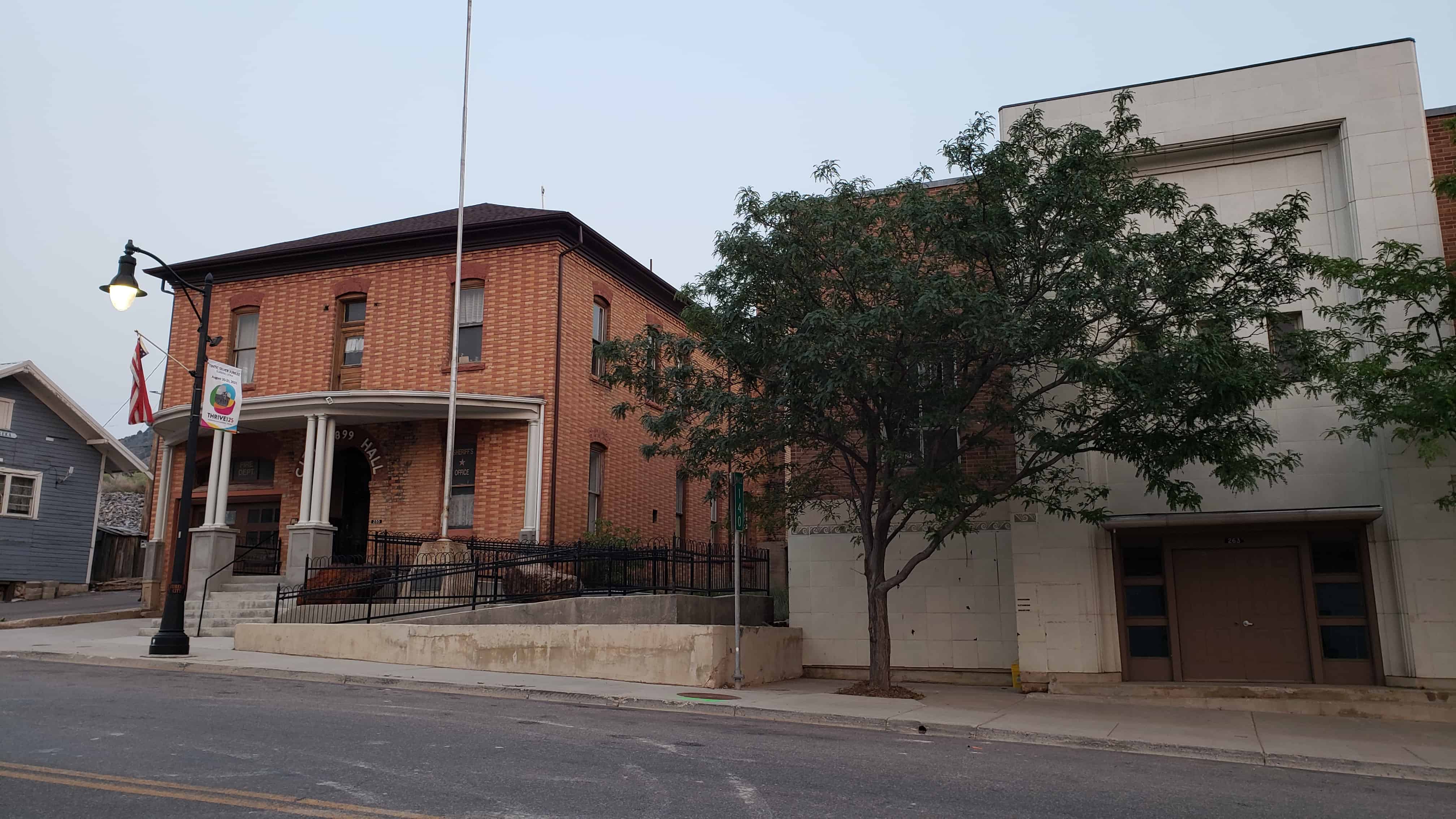
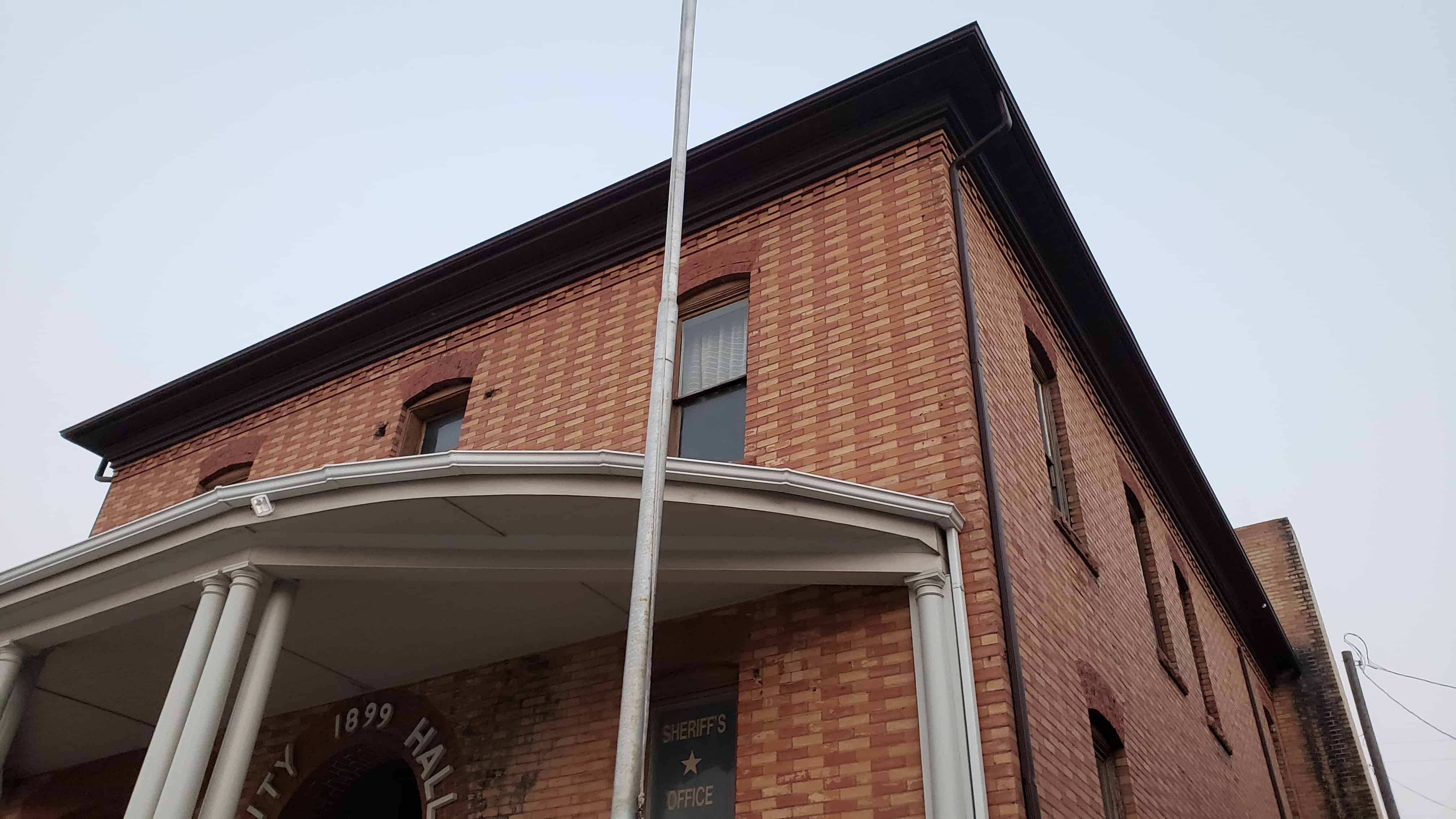
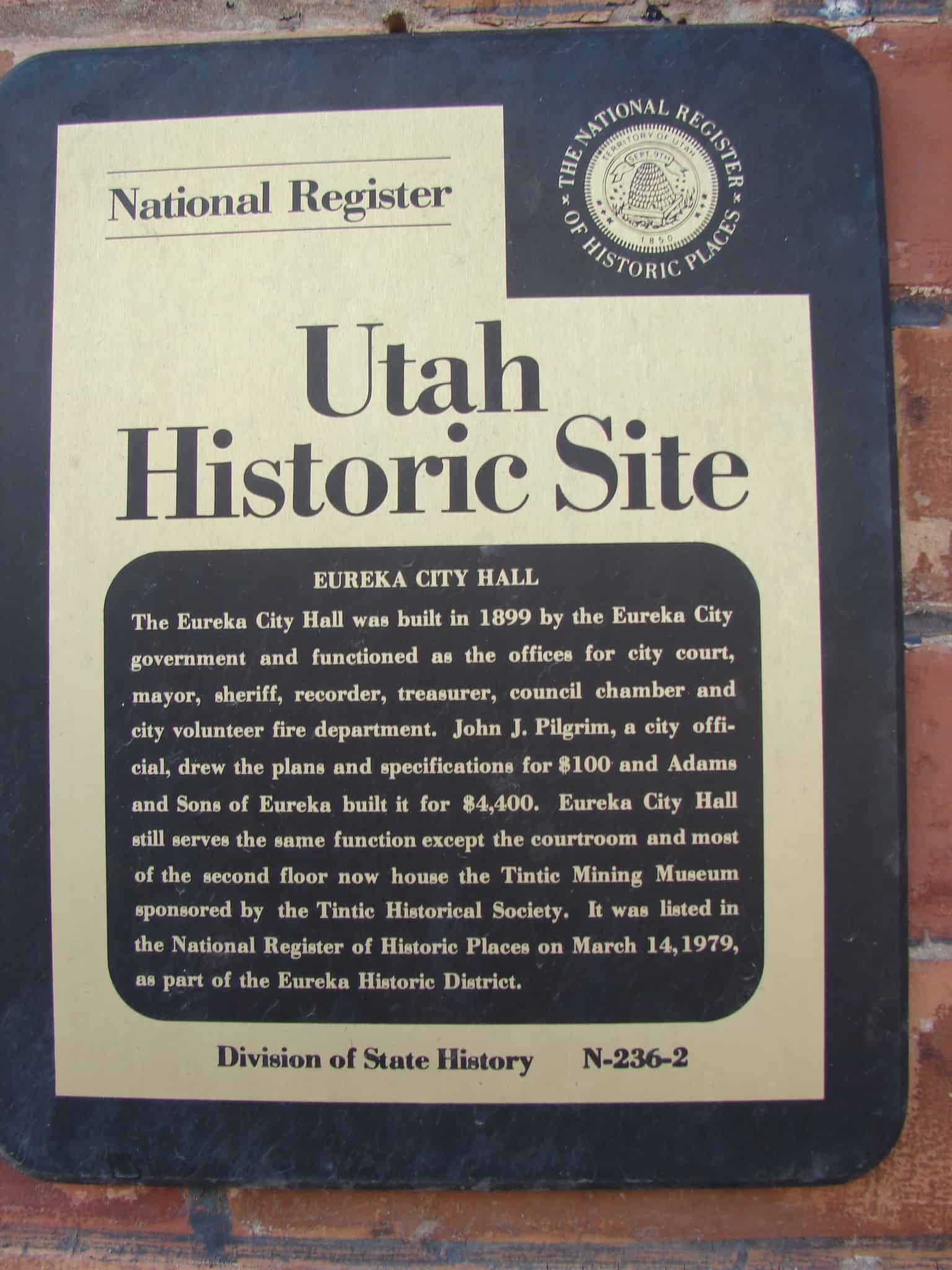
The Eureka City Hall was built in 1899 by the Eureka City government and functioned as the offices for city court, mayor, sheriff, recorder, treasurer, council chamber and city volunteer fire department. John J. Pilgrim, a city official, drew the plans and specifications for $100 and Adams and Sons of Eureka built it for $4,400. Eureka City Hall still serves the same function except the courtroom and most of the second floor now house the Tintic Mining Museum sponsored by the Tintic Historical Society. It was listed in the National Register of Historic Places in March 14, 1979, as part of the Eureka Historic District.
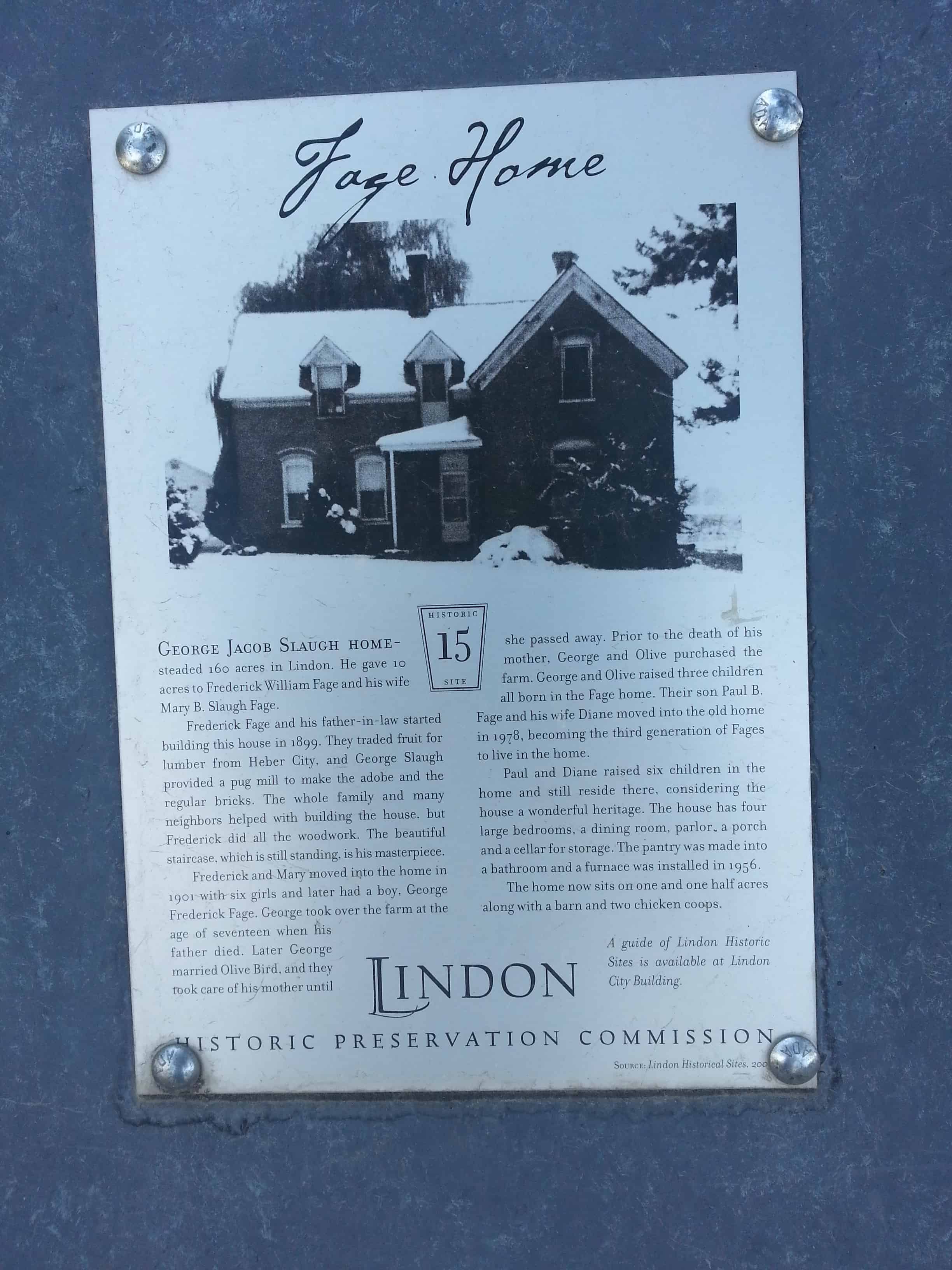
George Jacob Slaugh homesteaded 160 acres in Lindon. He gave 10 acres to Frederick William Fage and his wife Mary B. Slaugh Fage.
Frederick Fage and his father-in-law started building this house in 1899. They traded fruit for lumber from Heber City, and George Slaugh provided a pug mill to make the adobe and the regular bricks. The whole family and many neighbors helped with building the house, but Frederick did all the woodwork. The beautiful staircase, which is still standing, is his masterpiece.
Frederick and Mary moved into the home in 1901 with six girls and later had a boy, George Frederick Fage. George took over the farm at the age of seventeen when his father died. Later George married Olive Bird, and they took care of his mother until she passed away. Prior to the death of his mother, George and Olive purchased the farm. George and Olive raised three children all born in the Fage home. Their son Paul B. Fage and his wife Diane moved into the old home in 1978, becoming the third generation of Fages to live in the home.
Paul and Diane raised six children in the home and still reside there, considering the house a wonderful heritage.
The house has four large bedrooms, a dining room, parlor, a porch and a cellar for storage. The pantry was made into a bathroom and a furnace was installed in 1956.
The home now sits on one and one half acres along with a barn and two chicken coops.
Circleville was settled in 1864 by a group of pioneers from Sanpete County, the Church of Jesus Christ of Latter-day Saints organized a branch, William J. Allred, Presiding Elder. Land was cultivated and homes erected. In 1865 the Black Hawk War forced evacuation. Non-Mormons began homesteading the valley in 1873 and Mormons from the Beaver area arrived a year later, Thomas Day, Presiding Elder. In 1876 Thomas King and sons established a United Order 2 miles east of the original settlement.
Just wanted to share some information I was reading online:
The word “Deseret” appears twice on the Utah stone at the Washington Monument (1978; replica of the cornerstone of the Salt Lake Temple, 1853). The interior of the monument contains 190 stones representing individuals, cities, states, and nations. “Deseret” was a name often used in the territory colonized by the Mormon pioneers. Photographer: Robert L. Palmer.
by Jeffrey Ogden Johnson
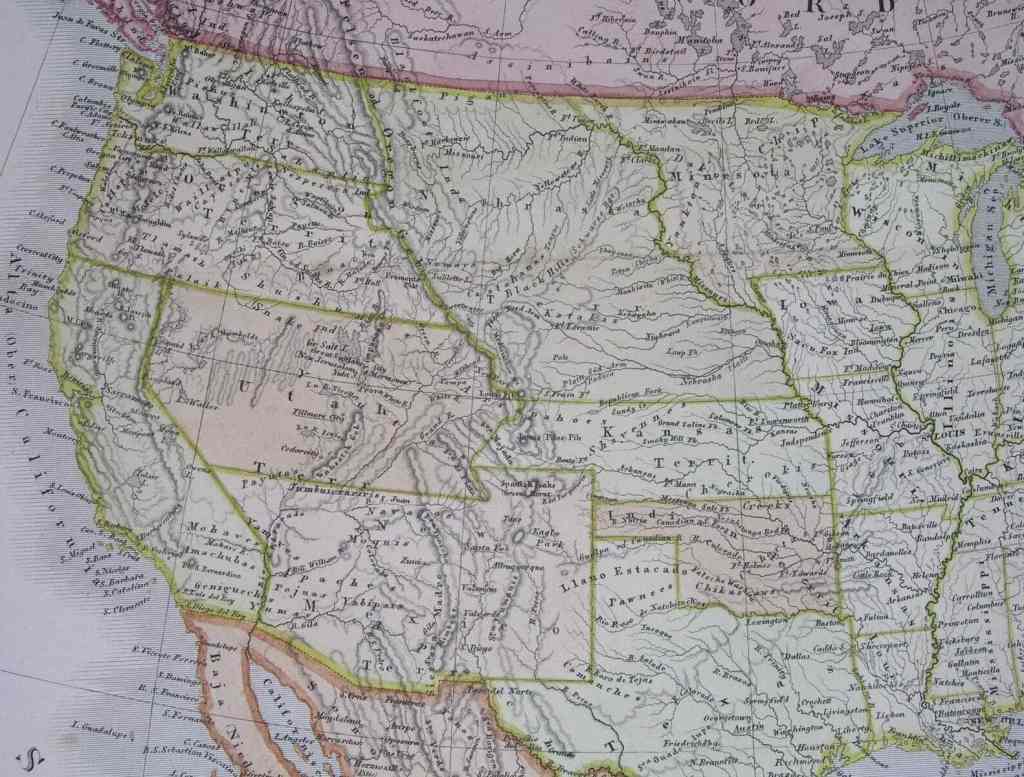
On February 2, 1848, by the Treaty of Guadalupe Hidalgo, Mexico ceded to the United States an extensive area that included the Great Basin, where Mormon pioneers had begun settlement six months earlier. Even before the treaty was signed, Church leaders began discussing petitioning the U.S. government for recognition as a state or asking for territorial privileges. In July 1849 a committee wrote a Constitution. It used as models the U.S. Constitution and the Iowa Constitution of 1846, from which the committee took fifty-seven of the sixty-seven sections of the new Constitution. The committee requested that the state be named Deseret and that the boundaries be Oregon on the north, the Green River on the east, Mexico on the south, and the Sierra Nevada on the west, including a portion of the Southern California seacoast. “Deseret,” a word from the Book of Mormon, means “honeybee” (Ether 2:3) and is symbolic of work and industry. A slate of officers was approved, with Brigham Young as governor. Almon W. Babbitt, appointed representative to Congress, was instructed to carry the plea for statehood to Washington, D.C.
This effort by Latter-day Saint settlers to organize themselves into a provisional government was much like the attempt made in the 1780s by settlers in Tennessee, who organized the state of Franklin when they felt neglected by North Carolina, and the settlers of Oregon, who established a local government that functioned without recognition from the U.S. government until they were given territorial status in 1848.
The State of Deseret General Assembly met in regular session from December 1849 to March 1850. After special sessions during the summer, the members assembled for their second regular session in December 1850. Earlier, on September 9, U.S. President Millard Fillmore had signed an act to create a much smaller Utah Territory and appointed Brigham Young the first territorial governor. After word of the creation of the territory reached Utah, the tentative state of Deseret was dissolved on March 28, 1851. The provisional government had lasted only about a year and a half.
The territorial status did not provide the self-government Latter-day Saints desired, and even though Brigham Young was appointed first governor, Church leaders and the territorial legislature continued efforts to obtain statehood. In 1856, delegates met to again write a Constitution and propose the state of Deseret, an effort rejected by Congress. As a part of a third effort in 1862, Brigham Young called the State of Deseret General Assembly into session for the first time since 1851. Thereafter it met each year until 1870, each session lasting only a few days and focusing on winning statehood on the basis of the proposed Constitution of 1849 with only minor changes.
In the meantime, Brigham Young had been replaced as territorial governor by a series of outside appointees, who became progressively more hostile to the meetings of the General Assembly and complained about this “ghost government,” as they called it. In 1872 a constitutional convention drew up a new Constitution and dropped the name Deseret from the petition. This petition also failed, and hope for the state of Deseret came to an end.
[See also History of the Church, 1844-1877; Utah Statehood; Daily Living home page; Church History home page]
SALT LAKE CITY — The Bear Lake Monster. Whales living in the Great Salt Lake. A neighborhood of hobbits in Sugar House.
Only a short drive within the state can take you to any one of Utah’s legendary locations. While Utah’s places of legend and folklore make for good stories, are they actually true?
Whales in the Great Salt Lake
Folklore claims that sometime around 1873, an Englishman named James Wickham brought two 35-foot Australian whales from San Francisco to the Great Salt Lake in tanks made especially for them. He hoped the whales would live and reproduce, and he would have whales on-hand for their precious oil.
The whales adapted to the lake, the story claims, as if it were the ocean, reproducing young. Though nobody has been able to confirm it, people have claimed whale sightings in the lake.
According to a 1995 Deseret News article, however, only one newspaper — the now-defunct newspaper Utah Enquirer, of Provo — wrote about such a momentous event as two whales being transplanted to Utah.
“If there actually were whales in the Great Salt Lake, just waiting to supply the oil lamps of pioneering Deseret Territory residents, no mention is made of them in any source the Deseret News could find,” the Deseret News wrote.
Even if the whales did come to Utah, the University of Utah’s Department of Biology says the mammals could not have survived the lake’s high salt content.
Though you might not see a whale, you can check out the lake’s salt content yourself by taking a boat ride or walk the Spiral Jetty.
Allen Park, “Hobbitville”
Legend has it that a small, secret neighborhood in Salt Lake was built exclusively for little people, probably hobbits.
Once inside this secret suburb, you would see tiny houses, posts with strange sayings painted on them, and you might be chased away by small people throwing vegetables and wielding pitchforks.
The story misses the mark.
Dr. George Allen and Ruth Larsen Allen built the 8-acre neighborhood, Allen Park, in the 1930s and 1940s as a bird sanctuary. The small houses and log cabins were not built for hobbits or little people.
Allen was the town’s doctor, and bought the houses when a town owned by Kennecott was turned into the slag dump by the company.
“I guess they’re little houses, but they’re one- and two-bedroom apartments,” said Amy Allen Price, the daughter of the Allens.
The wooded neighborhood does boast hand-painted and carved adages on its handcrafted stone lightposts, saying things like “The night has a thousand eyes,” “List to nature’s teachings,” and “Earth fills her lap with pleasures of her own.”
“I don’t think secretive is the word, just very private,” said Chad Farnes of the blog “Utah’s Present History,” who met with Price and photographed the neighborhood.
The neighborhood is private, and they ask that visitors not disturb the tenants, though you can get a view from a distance.
Suicide Rock
In the mouth of Parley’s Canyon, a towering rock — said to be used as a watchtower for Native Americans — rests almost level with the highway cut into the hills.
According to the oral tradition, hundreds of years ago, a young Native American woman threw herself from the rock’s edge after learning of her love’s death.
Though oral tradition is hard to prove, the sandstone rock did welcome early travelers into the Salt Lake Valley from Parley’s Canyon.
Now, the rock continues to welcome people into Salt Lake, but it has taken a much more colorful form. The rock’s surface changes with every mark of paint added by those brave enough to scale Suicide Rock.
The Suicide Rock trail, dotted with historical markers, leads into the canyon and to the reservoir, about 3 miles away.
Bear Lake Monster
Lurking beyond Bear Lake’s resorts, scenic shores and blue waters is the lake’s monster. Folklore claims the monster hides in the parts of the lake too deep to be measured. The creature is said to be anywhere from 40 to 200 feet long, brown, with a head like an alligator (though some said it was a walrus-like head) and big eyes set a foot apart.
More than a century later, people still claim to see the beast of such a vague description from time-to-time.
The monster’s origins stem from Native Americans in the area, who claimed that their ancestors had seen the monster, according to the Bear Lake Chamber.
The story became popular, however, after Joseph C. Rich, wrote the monster’s story down and sent it to the Deseret News. It was published on July 31, 1868.
Though the story has little evidence to back it up, it certainly gives tourists an extra thrill as they’re out on the lake. In case of snow, fill your time with winter skiing and hiking.
Places like these become cherished not just for their beauty, but for their story when you take some time to explore the legends of Utah.
Salt Lake City, Utah has its own folklore filled with myths, scary urban legends, divine intervention, and ghost stories. But are they true? Test your knowledge on some of the most well-known urban myths of Salt Lake City.
Mythbuster #1: Emo’s Grave
The Legend: Emo’s Grave, a stone tomb located in the Salt Lake City Cemetery, stands about six feet tall and features an iron gate with a barred window, and a shattered urn can be seen inside. The grave has been haunted for years, according to many residents of Salt Lake City. Urban legend claims if you walk around the tomb three times chanting Emo’s name that either Emo’s ghostly face or his red eyes will appear inside the crypt’s window. Some say that Emo was Salt Lake City’s first devil worshiper. After he was burned at the stake by local residents, his ashes were placed in the urn inside the monument. Others say that Emo was a serial killer.
Verdict: This urban legend is false.
Explanation: Emo’s Grave is simply a monument erected in memory of Jacob Moritz (1849-1909), a prominent businessman and politician. Moritz was born in Germany and immigrated to Utah, where he grew the Salt Lake Brewing Company into the largest beer brewery in Salt Lake City. In 1908, Moritz began experiencing health problems and hoped a change of air would help him recover. He and his wife traveled back to Germany, where Moritz died from stomach cancer. Moritz was cremated in Germany, and his wife returned to Utah with his ashes and constructed the monument in his memory. However, the ashes were not placed inside the monument. The urn that can be seen through the window is simply a vase for flowers that was broken by vandals.
Although locals have been calling the monument Emo’s Grave for at least 40 years, it is not clear where the nickname originated. Jacob Moritz’s name is engraved on the monument, and he was never known by the name Emo.
Mythbuster #2: Hobbitville
The Legend: According to Salt Lake City urban legend, there is a small, secret neighborhood in the city built exclusively to house little people. Hobbit Town or Hobbitville, as locals call it, is full of tiny houses and stonework with mysterious sayings carved on them. If you snoop around looking for hobbits, the little people will chase you away by throwing vegetables and running after you with pitchforks and rakes.
Verdict: This urban myth is false.
Explanation: The area known as Hobbitville is actually Allen Park, an eclectic bird sanctuary built in the 1920s. The park contains private residences and small cabin structures that serve as shelters for the birds, and its remote location and no trespassing policy contribute to its lure. The park’s elaborate stone walls, pillars and gates feature mosaics and inscriptions created by the people who built the park. Although this urban myth sounds more like the setting for a good book than reality, many curious locals often attempt to trespass looking for hobbits inside this intriguing and quirky neighborhood in Salt Lake City.
Mythbuster #3: The Mystery of Lilly E. Gray
The Legend: In the Salt Lake City cemetery stands a small tombstone which reads, “Lilly E. Gray (June 6, 1881 – November 14, 1958) Victim of the Beast 666.” This mysterious and ominous phrase inscribed on Gray’s tombstone has triggered rumors about the fate of the woman for decades. Some versions of the urban myth speculate that she was mentally ill or demonically possessed. Others believe she was the victim of spousal abuse, satanic ritual abuse, religious persecution by Mormons, or a car accident on Highway 666 (nicknamed the Devil’s Highway). Discrepancies between her gravestone and her obituary (her birth date and the spelling of her name are different) have led to numerology speculations. But those who have researched Lilly E. Gray have found no more information than her obituary, which simply states she died of natural causes.
Verdict: This urban legend is true.
Explanation: The gravestone for Lilly E. Gray, including the eerie inscription, are real and can be seen in the Salt Lake City Cemetery. Little information is available about who she was or how she died. Lilly Gray’s obituary and that of her husband, Elmer L. Gray, are both available on microfilm in the archives of the local newspaper agency. The discrepancies in the spelling of Gray’s name (spelled Lily on her obituary) and her birth date exist, and the obituary does state that Gray died of natural causes. Many who have tried to dig deeper, including the Utah State Historical Society, have been unable to find any further information.
One writer, Richelle Hawks, has uncovered an application for parole filed by Lilly’s husband. In the application, dated several years before Elmer and Lilly were married, Elmer Gray claims that he was kidnapped by five officials from the Democratic Party. He also claims that his previous wife (before Lilly) was murdered by his kidnappers and that his parents died of grief after her death.
This document reveals, at the least, a cantankerous and colorful man with a hatred for the government, possibly suffering from paranoid delusions of political persecution. It appears that Elmer Gray was Lilly Gray’s only survivor, and his wild and outlandish beliefs may provide the most reasonable explanation for the inscription on her gravestone.
Mythbuster #4: The Miracle of the Seagulls and the Crickets
The Legend: The Mormon pioneers first entered the Salt Lake Valley in July 1847, and the following spring they found themselves starving and desperate for their crops to grow. The crops were swarmed by crickets that were devouring the entire harvest, already damaged by a late frost and drought. Unable to stop the crickets on their own, the pioneers prayed that they would be saved from starvation. A large flock of seagulls – so many that they darkened the sky – flew in from the west and feasted on the crickets. According to the legend, many seagulls were seen eating their fill then regurgitating in order to kill more insects. The birds returned day after day until no crickets remained, thus preserving the harvest and saving the pioneers from starvation.
This urban legend of Salt Lake City’s past has been told by both Mormons and Utahans as an example of divine intervention and as a part of Utah’s early history.
Verdict: This urban myth is partly true.
Explanation: The story of the seagulls and the crickets is so deeply ingrained in the culture of Salt Lake City and the Mormon Church that the California Gull (the seagulls in the story) was made the state bird. A monument to the seagulls stands on the Mormon Temple Square in the heart of Salt Lake City, and the variety of cricket that swarmed the crops is commonly named the Mormon cricket because of this legend.
William G. Hartley, a Utah historian, has researched the story based on pioneer journal entries from 1848. Hartley’s investigation determined that there was a swarm of Mormon crickets that attacked the crops of the pioneers for about three weeks in May and June that year. The journals also account for crop damage due to frost and drought. He discovered that the pioneers had used many methods to drive out the insects, including forming lines to beat the insects out of the fields. While some journals recounted seagulls eating crickets at the edges of fields, others did not mention them.
Hartley concluded that the seagulls eating the crickets was a natural event that was isolated to some small flocks, and the birds did not devour all of the crickets. Over time, the role of the seagulls was exaggerated and credited as divine intervention.
Mythbuster #5: The Devil’s Highway
The Legend: Utah’s Route 666, nicknamed the Devil’s Highway, is considered to be haunted and one of the most dangerous highways in the world (due to its sinister name). Urban myth claims that ghosts appear to drivers on the road, in front of their cars, or in their backseats. Skin-walkers, shape-shifters and demon dogs haunt the road, and if you dare stop at night your tires will be shredded by the dogs. An apparition of a flaming semi-truck has been seen speeding down the highway directly toward oncoming cars. The hauntings and apparitions have caused an unusually high number of traffic fatalities.
Verdict: This urban legend is partly true.
Explanation: US Route 666 does exist and runs from New Mexico to Interstate 15 in American Fork, Utah. Due to the nickname of the Devil’s Highway, rumors about curses and supernatural occurrences, and an unusual number of sign thefts, the highway has been renamed. US Route 666 was given its original name because it was the sixth route of Route 66, which is now defunct.
Now known as Route 491, the stretch of the highway that runs from Price, Utah to American Fork, Utah has been named one of the deadliest in the United States. However, the accident rate is blamed on high traffic volume through the narrow and winding American Fork Canyon instead of the supernatural. The road also has tight, blind curves that are hard to navigate if drivers exceed the speed limit of 65 mph. Many accidents are blamed on drivers attempting to pass traffic on these stretches without being able to see oncoming cars. This route is also heavily used because it is the quickest route from Denver to Salt Lake City; it connects rural Utah to urban areas, and it leads to Utah’s National Parks.
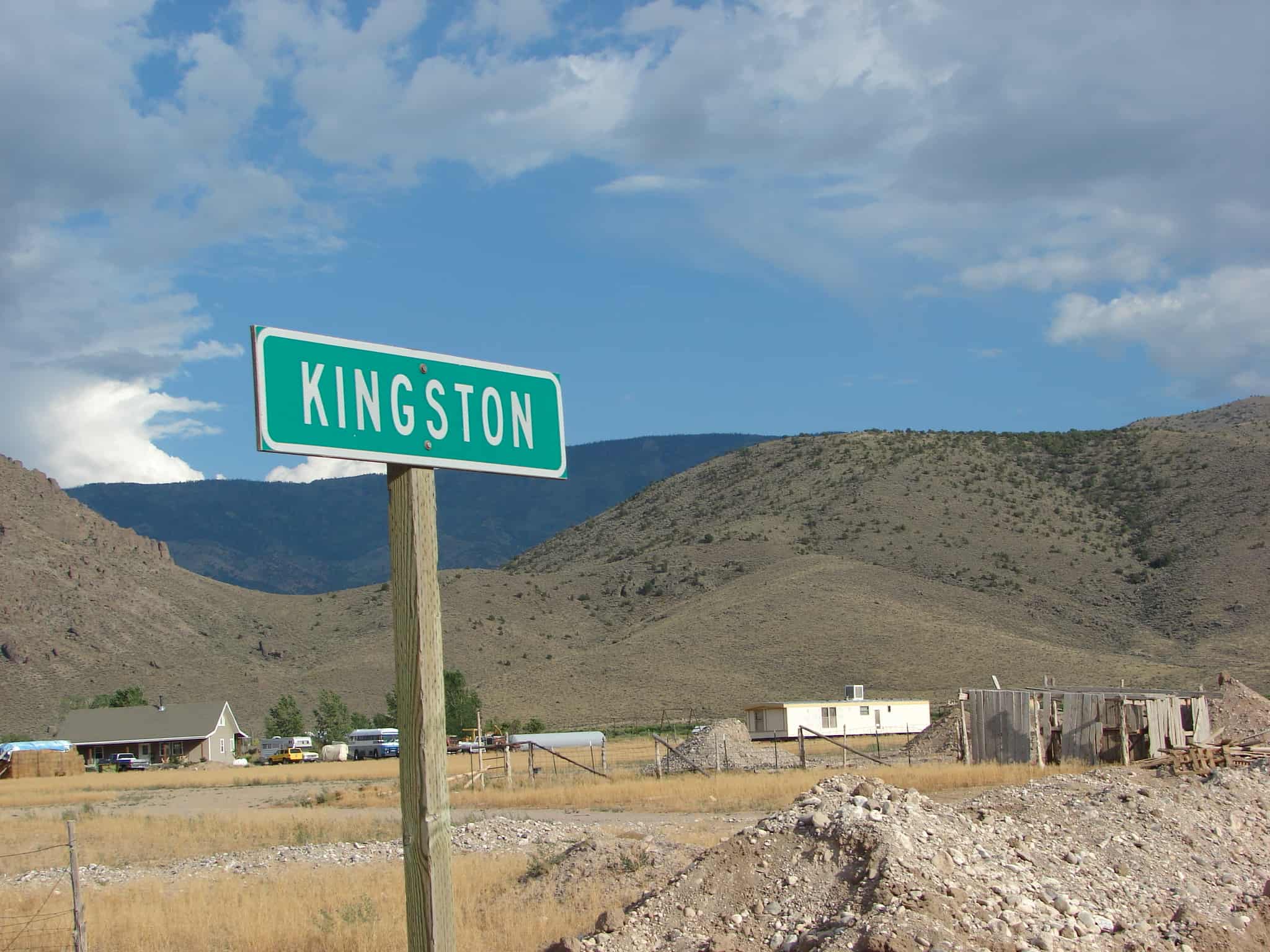
Kingston is named for Thomas Rice King, who moved from Fillmore to Piute County with his five sons and their families specifically to find a place where they could establish a United Order. In the 1870s Brigham Young was encouraging communal living in United Order communities. The King families’ United Order functioned from 1876 to 1883. Kingston became an incorporated town in 1935.
The Joseph Wadley Farm
67 East 400 North in Lindon
In 1869, Joseph Wadley, a Mormon convert from England, was granted legal title to farm 32 acres on this Lindon hill. A horticulturist by trade, Joseph cleared this land of sagebrush and rock, developed the irrigation system, and planted a large variety of shade and fruit trees that he had brought from his home in England.
In 1881 he began quarrying and hauling Tulfa rock from Pleasant Grove for construction of this home. It was designed after the traditional English country manor, with formal English gardens in the front. The home was completed in 1882.
Joseph and his family resided here until his death in 1904. His son, Joseph Daniel Wadley, purchased this farm in 1907. He in turn sold the property to his son, Joseph Daniel Wadley, Jr., in 1925. In 1988, a grandson purchased the home and restored it to its original state. He also added several more rooms at the back of the home.
Chester was founded by David Candland. In the beginning the town was named Canal Creek after the waterway from which the community received its water. Candland then changed the name to Chesterfield after his hometown in England; it was later reduced to Chester.
This community (like several others) claims to be the closest to the geographic center of Utah.
Lindon Ward Chapel 400 North and Main Street in Lindon
The Lindon Ward Chapel, originally built for the Pleasant Grove 2nd Ward of The Church of Jesus Christ of Latter-day Saints, was dedicated by Reed Smoot of the Council of the Twelve Apostles in 1891.
Construction of the chapel was a community effort. The property was donated by Joseph Wm. Ash. Every able-bodied man and boy contributed labor to the construction. Horses hauled clay from the foothills and pulled the mill to make adobes for the walls of the chapel.
In December 1890, construction was far enough along for a dance to be held. Proceeds from the dance were turned over to the building fund. Alfred E. Culmer, architect and project director, passed away before the final completion of the building. His funeral was the first to be held in the chapel.
The main hall contained two potbellied stoves— one in each corner. The benches ran the full width of the chapel with isles on each side. An upper gallery above the front door could be converted into a classroom by closing a set of curtains.
The chapel was torn down in 1941 with plans to build a new one. The iron fence on the north side of the property and several large pine trees remain.