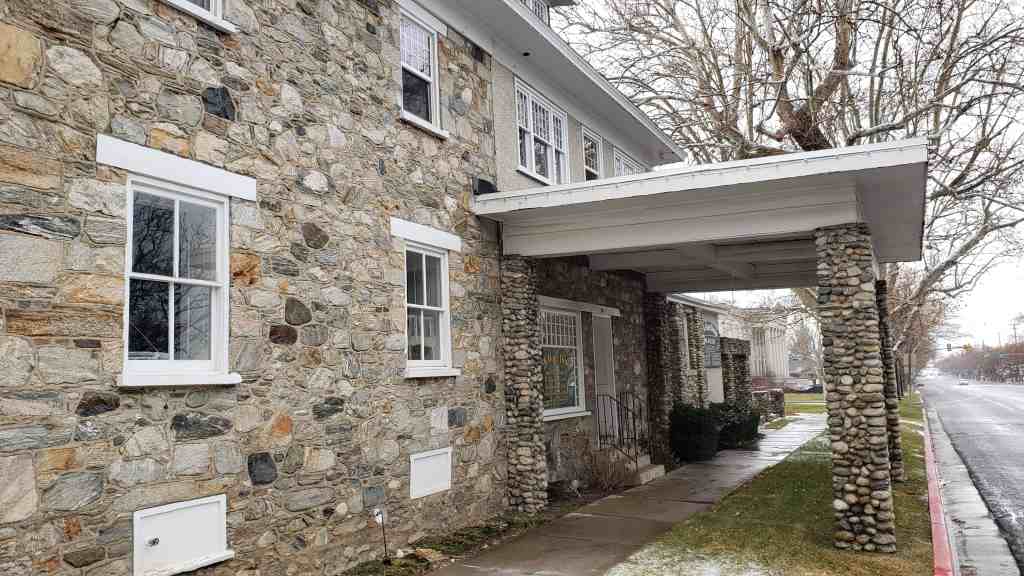
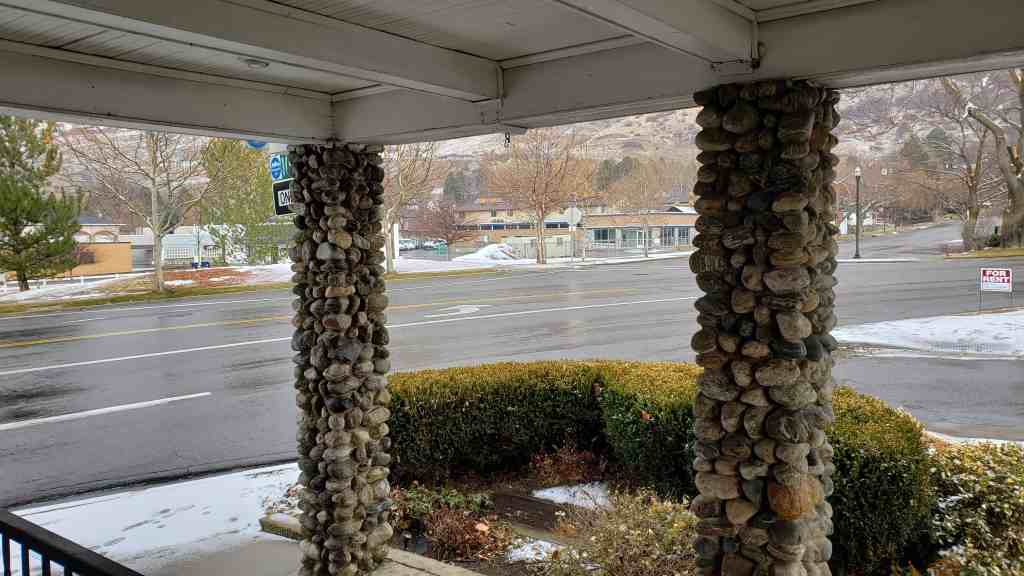
On February 3, 1916, the Daughters of the Utah Pioneers, along with several other civic groups, presented the idea of establishing a public library to Mayor Joseph J. Richardson and the Smithfield City Council. Constructed in 1921 at a cost of $20,000, the Smithfield Carnegie Public Library is significant as the first public library in Smithfield and is a fine example of the work of Fred. W. Hodgson, a prominent local architect who designed many other buildings in Cache Valley. The Smithfield Public Library was one of more than 1,400 public libraries established throughout the U.S. between 1898 and 1920, primarily through grants from Andrew Carnegie, a multi-millionaire and steel magnate who felt that the rich had an obligation to use their excess wealth for the benefit of mankind. Carnegie hoped to stimulate a community’s commitment to establishing a free library program by giving it much, but not all, of the money required to build the library, with the understanding that the community would be responsible for furnishing and maintaining it; this was the case in Smithfield. Continually used as a public library, the building is a key historic resource within the community of Smithfield. A new addition to the building was completed in 2014.
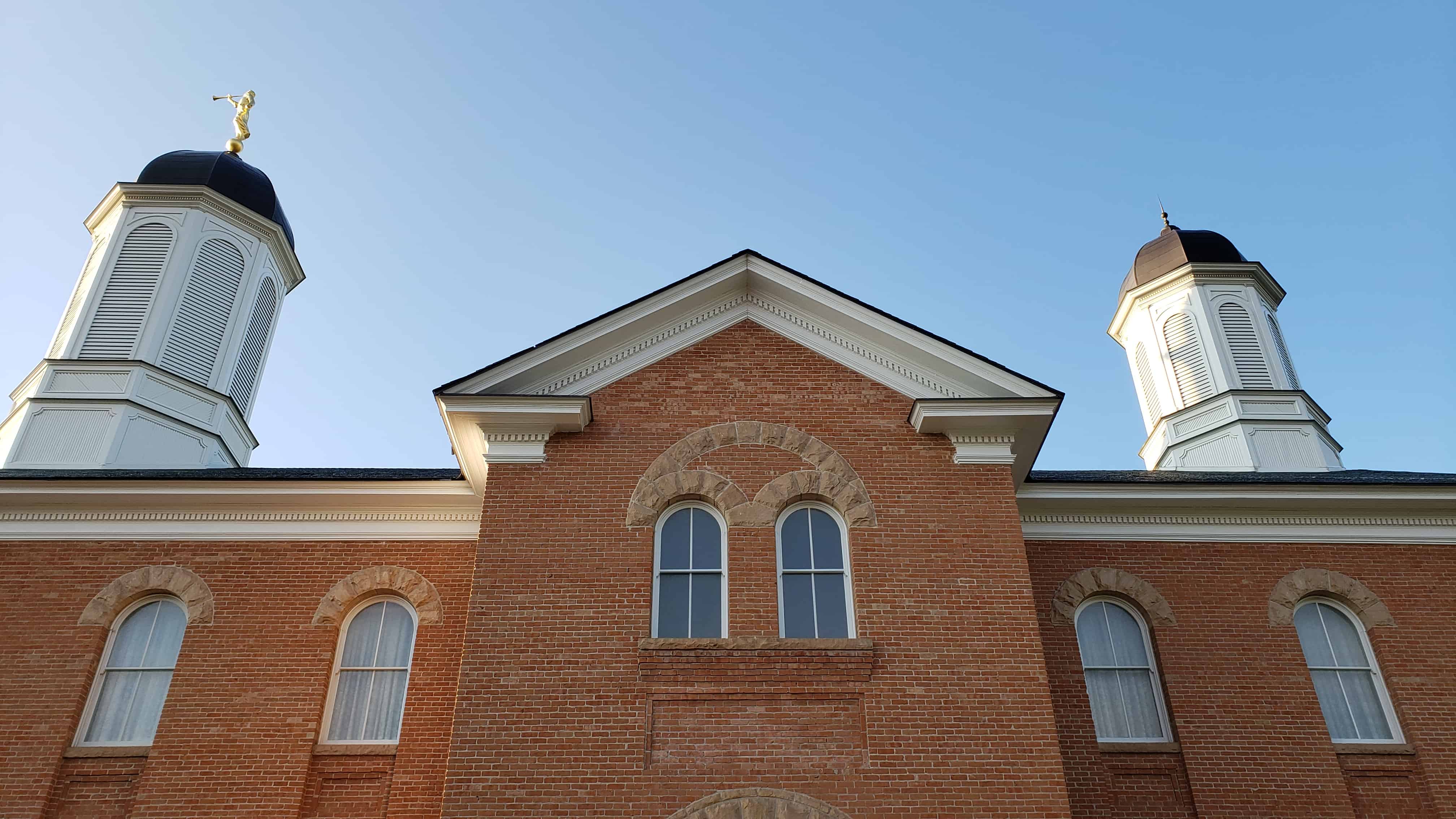
The Vernal Utah Temple of The Church of Jesus Christ of Latter-day Saints, formerly the Uintah Stake Tabernacle.
On February 13, 1994 it was annouced that the vacant tabernacle would be converted into a temple for the LDS Church.
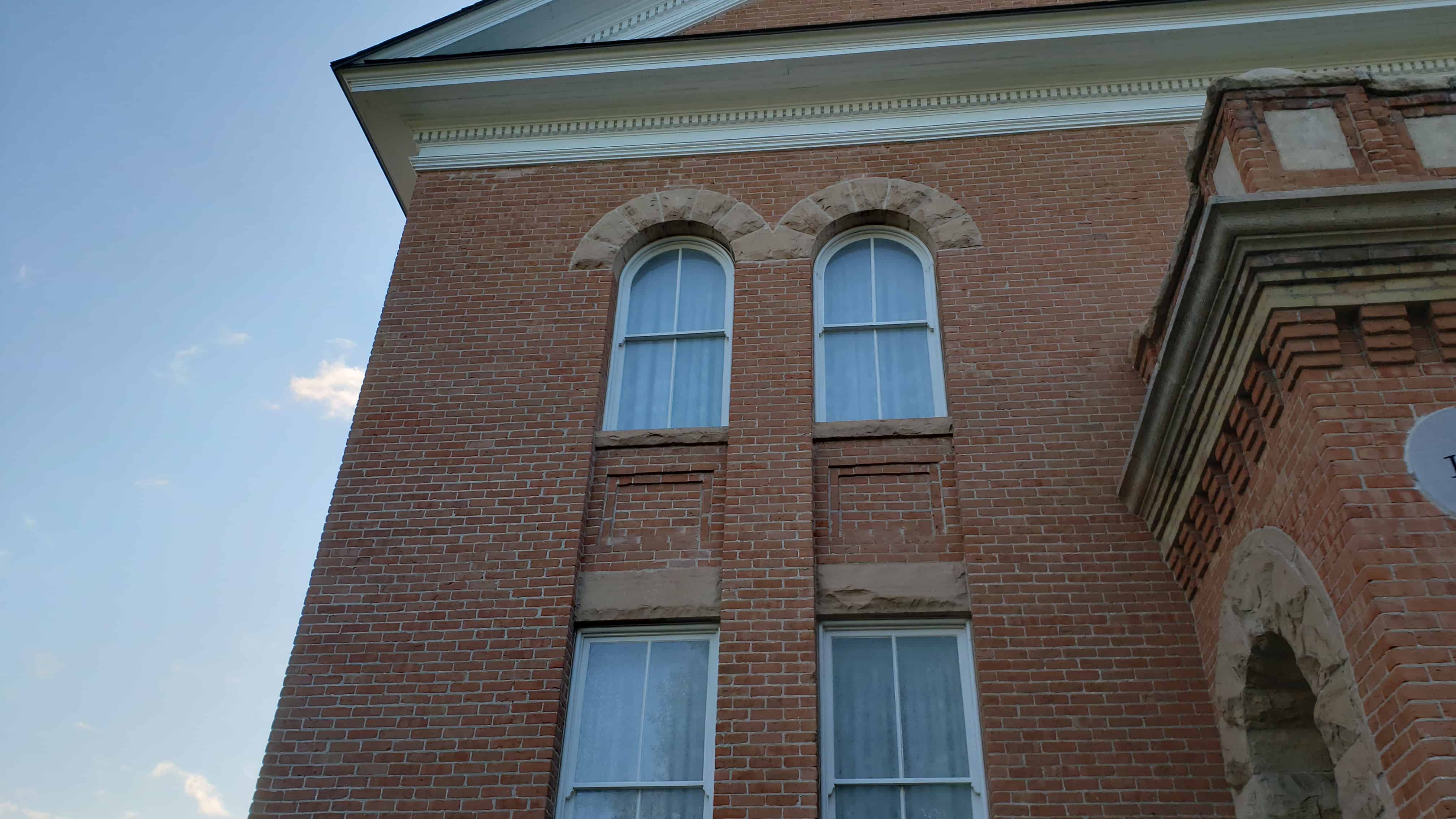
The Uintah Stake Tabernacle is devoid of Gothic detail common in church architecture and is a more simplified and almost civic variant of the Georgian New England Church form. Of over forty tabernacles built in Utah, it is the only one existing in the eastern part of the state. Built during the years between 1900-1907, it is the most significant symbol of the Mormon culture in the Uintah Basin, one of Utah’s last frontiers to be settled by members of the Church of Jesus Christ of Latter-day Saints. The Uintah Stake Tabernacle is also on the Utah Register of Historic Places.
Built in 1887, the Vernal Tithing Office is historically significant as one of 32 well preserved tithing buildings in Utah that were part of the successful “in kind” tithing system of The Church of Jesus Christ of Latter-day Saints (Mormons) between the 1850s and about 1910. Tithing lots, which usually included an office and several auxiliary structures, were facilities for collecting, storing, and distributing the farm products that were donated as tithing by church members in the cash-poor agricultural communities throughout the state. Harley Mowery, a local stone mason of English descent, was contracted to construct the stone tithing office. The building was saved from demolition in 1958 when it was moved from its original site to its current location by the Daughters of Utah Pioneers.
This historic tithing office is located at 186 South 500 West in Vernal, Utah and is now the DUP Museum. It was added to the National Register of Historic Places (#85000286) on January 25, 1985.
Built in 1887, the Vernal Tithing Office is historically significant as one of o 30 well preserved tithing buildings in Utah that were part of the successful w “in kind” tithing system of The Church of Jesus Christ of Latter-day Saints (LDS or Mormon church) between the 1850s and about 1910. Tithing lots, which usually included an office and several auxiliary structures, were facilities for collecting, storing, and distributing the farm products that were donated as tithing by church members in the cash-poor agricultural communities throughout the state. Tithing offices were a vital part of almost every Mormon community, serving as local centers of trade, welfare assistance, and economic activity. They were also important as the basic units of the church-wide tithing network that was centered in Salt Lake City.
The Vernal Tithing Office was built in 1887 at the request of Samuel R. Bennion, stake president of the Uintah Stake of The Church of Jesus Christ of Latter-day Saints. Harley Mowery, a local store mason of English descent, was contracted to construct the stone building.
The Vernal area, like most of Utah in the nineteenth century, was a cash-poor agricultural area, so tithing donations by church members were necessarily farm products. These were stored in the tithing office and its auxiliary buildings and structures, such as granaries, barns, and corrals. Produce was stored in the half basement under the tithing office to keep it cool and prolong its usefulness.
It is uncertain how long the Vernal Tithing Office functioned under its original use, but its importance as a storage and collection facility probably decreased dramatically during the first two decades of the twentieth century as “in kind” tithing contributions were replaced by cash donations. The building was saved from demolition in 1958 when it was moved from its original site to its current location by the Daughters of Utah Pioneers. The LDS church had offered to give the building to the DUP if they would move it from the property, which was to be sold to Mountain States Telephone and Telegraph Company. After purchasing land across the street from the Old Tabernacle, and with the help of the telephone company which donated $500 to the cause, the DUP moved the tithing office to its current location.
The Vernal Tithing Office is a one story stone single cell temple-form building with a gable roof. The stone is cut and coursed. Typical of the Greek Revival temple-form building, it is oriented gable end to the street and has a boxed cornice with a wide fascia. The gable end orientation is meant to imitate monumental classical buildings. 1 The temple-form building was the preferred building type for religious buildings in Utah in the late nineteenth century. A door is centered on the facade and there is a single six over six double hung sash window on each side of the building. A frame hood which dates out of the historic period is attached over the door. It has a boxed cornice and a gable roof which repeats the pitch of the main roof. The hood is unobtrusive and could easily be removed. A low one story modern addition is attached to the rear of the tithing office. Its style does not complement the building, but because it is built of similar materials, having a stone veneer, and because it is a low building with a flat roof, it does not affect the original character of the tithing office. The attachment of the modern addition affects only the rear of the tithing office, and its penetration into the original fabric appears to be minimal.
The Vernal Tithing Office is an excellent example of an early tithing office form. Like the tithing offices in Kanosh, Escalante, Parowan, Leeds and Pine Valley, it is a simple traditional form with a minimal amount of exterior decoration.
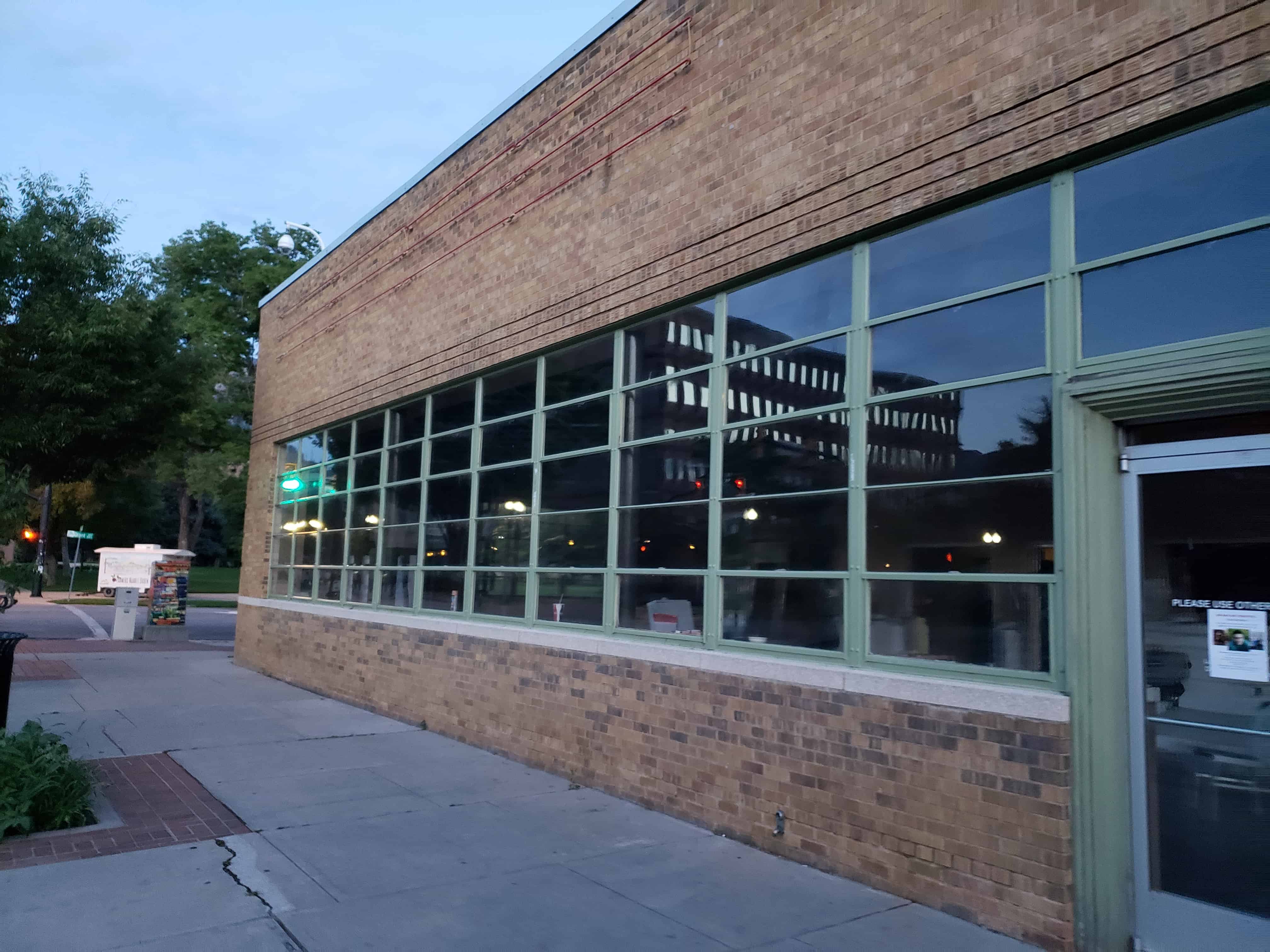
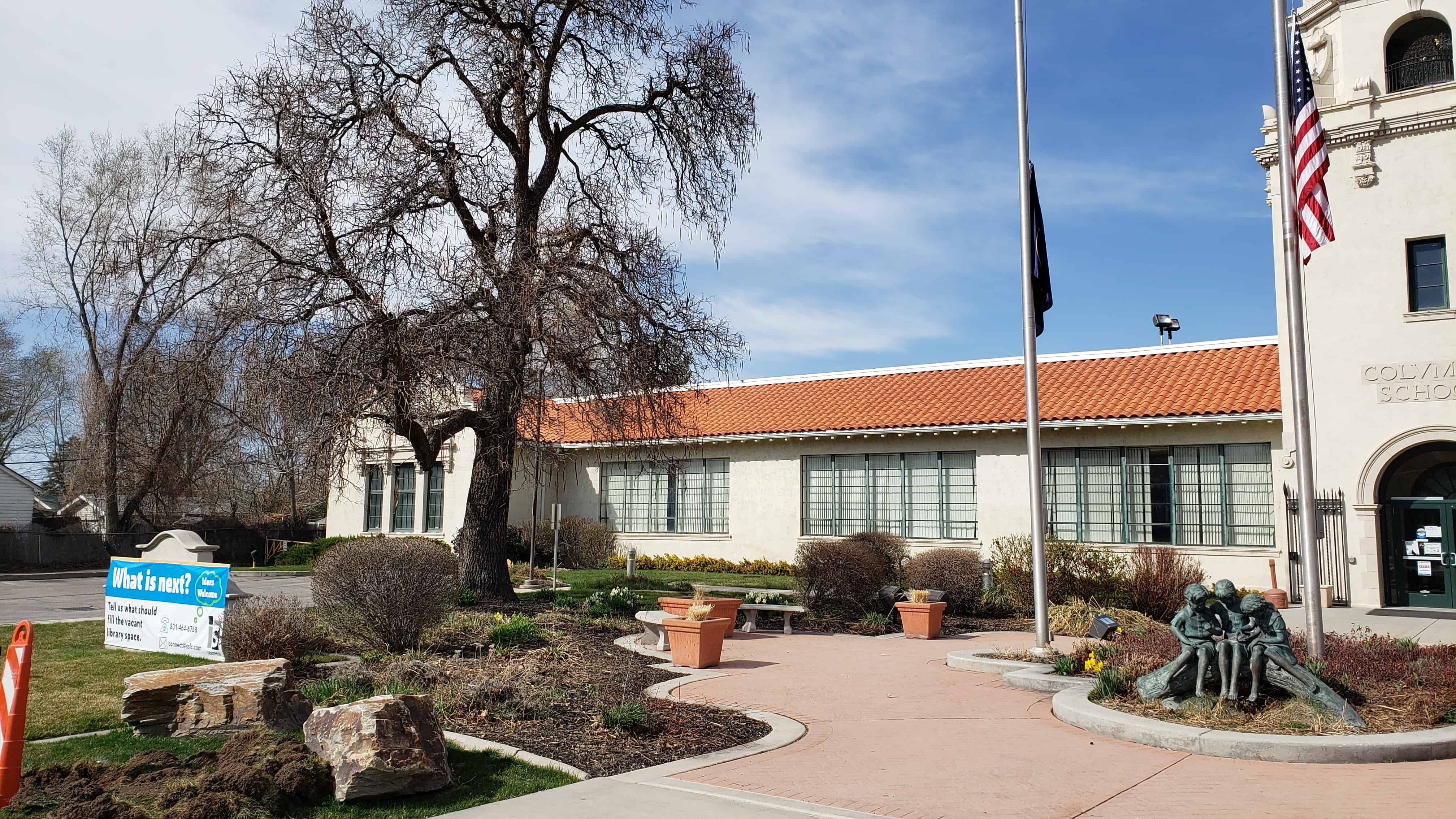
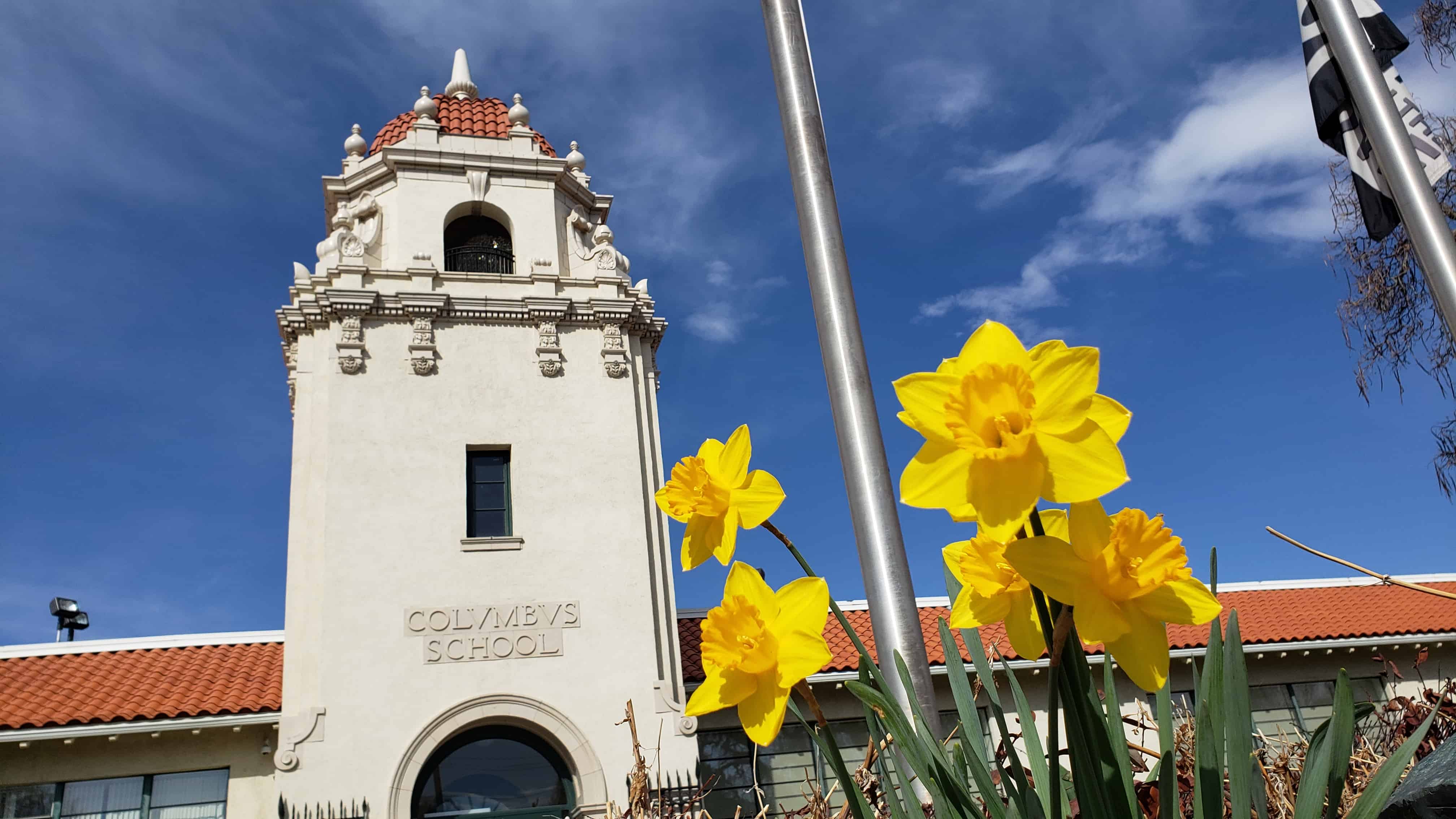
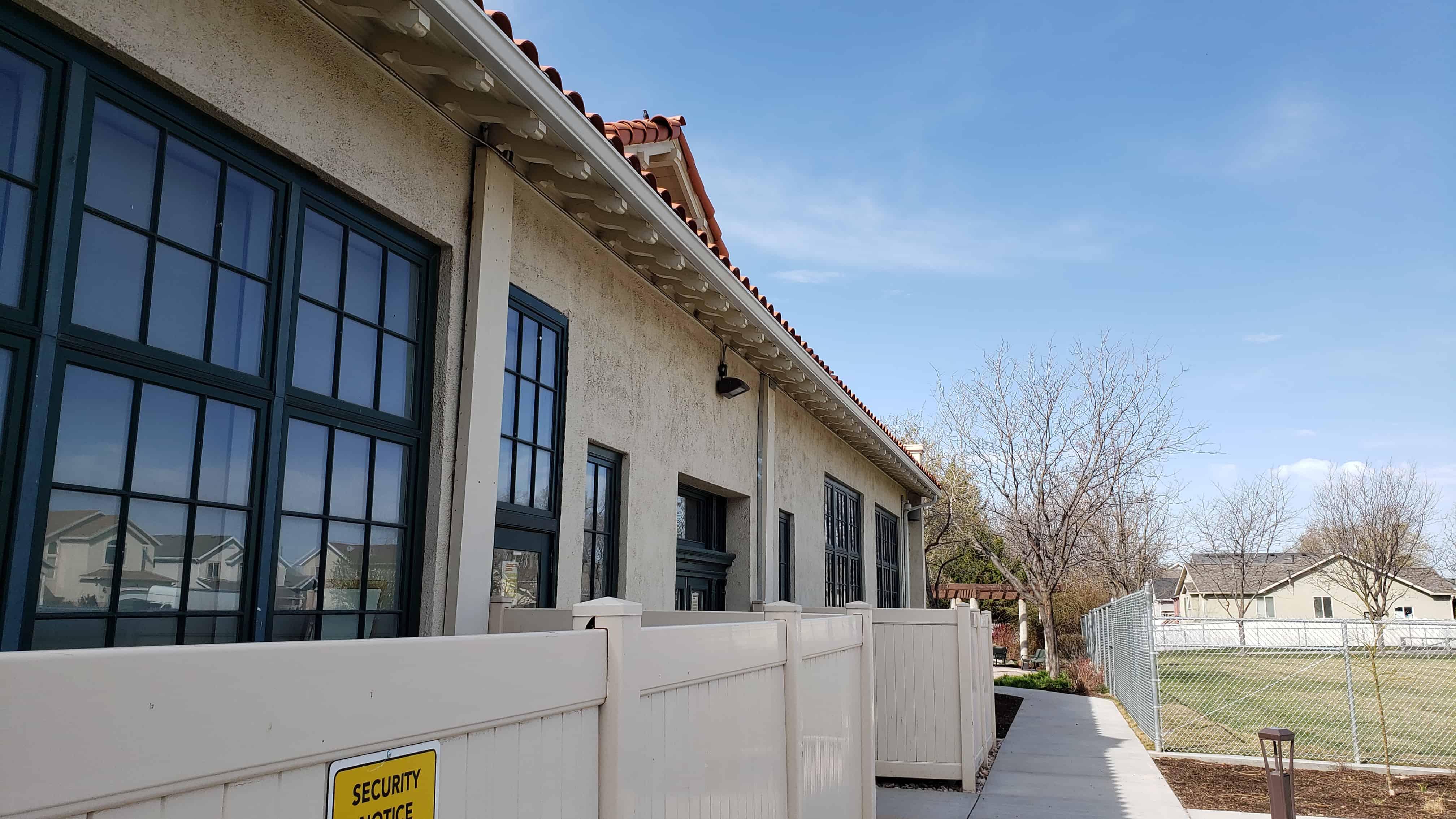
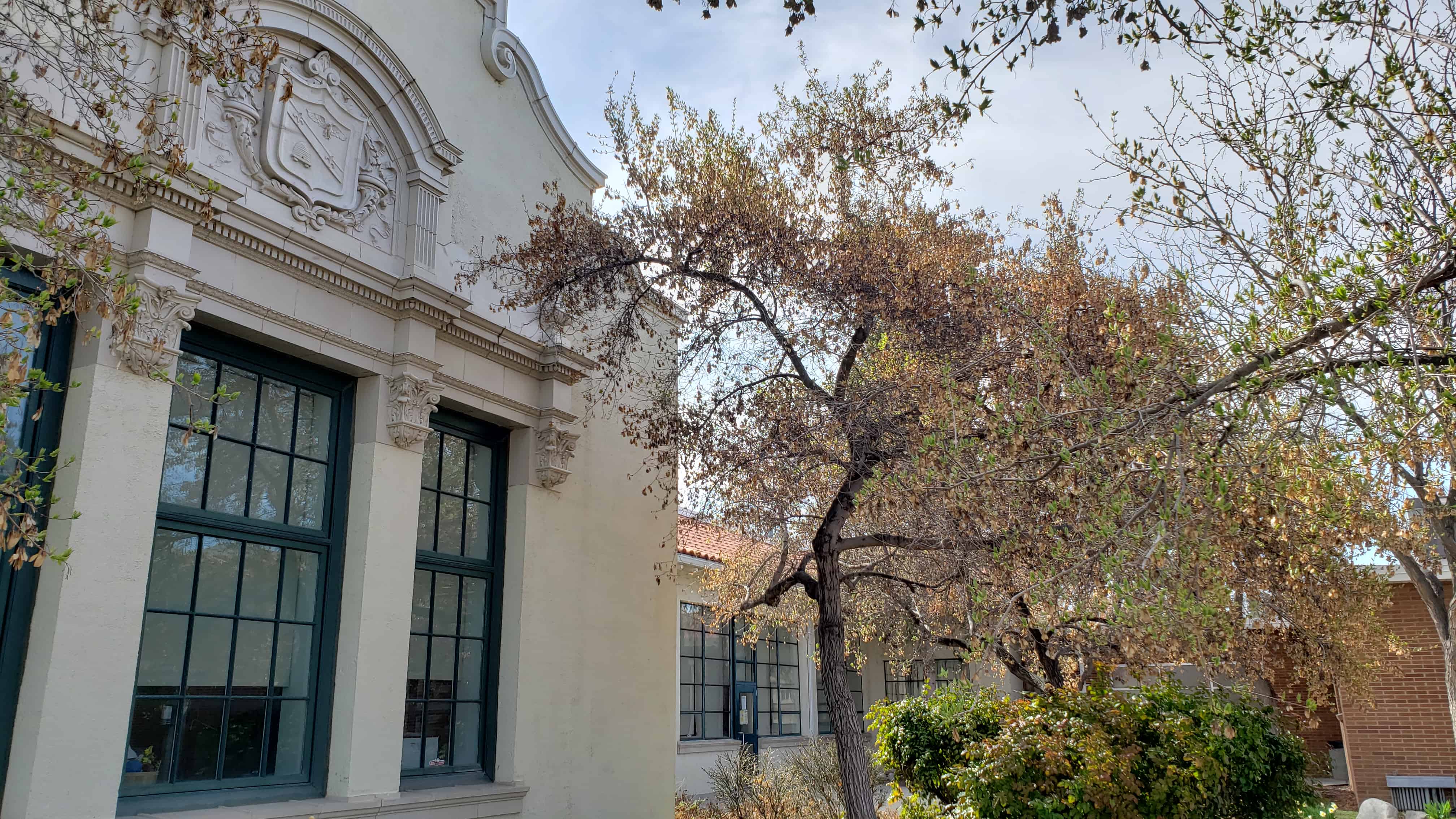
The Columbus School, later the Columbus Center, located at 2531 S 500 East in South Salt Lake City, Utah was a school from 1917 to 1968 and a community center after that, then a warehouse and then a library.
The Park Hotel is significant for its association with the early 20th century development of Salt Lake City’s transportation and industrial district. Built immediately after completion of the nearby Rio Grande and Union Pacific railroad stations (both built in 1909-10), the Park Hotel provided housing and services for blue collar workers, many of them ethnic immigrants, employed in local transportation, manufacturing, commercial, and construction enterprises. Designed by Ware and Treganza, one of Utah’s most prominent architectural firms, and constructed in 1911, the Park Hotel was the first hotel erected near the Rio Grande Depot.
With shops and café on the first level and residential rooms on the second level, the Park Hotel was modest in size and design, yet it was one of the first one a soon-popular building type. Over the next few years, several other hotels were constructed to the east along 300 South, producing something of a “hotel row.” Following World War II the name was changed to the Rio Grande Hotel. It continues it s historic function as a single room occupancy hotel.
Originally built by Thomas and Electa Hunt in the 1860s, the VanFleet Hotel was probably first used as a residence. Located next to a Wells Fargo stagecoach stop and county courthouse on what was once the highway connecting Salt Lake City and Ogden, it was at the center of commerce and government in the city and county. This location made the building well suited for a public function and it was apparently used as a hotel after the 1870s.
Hyrum VanFleet purchased the hotel in 1908 during an era when the city was enjoying a period of wealth and expansion fostered by the Farmington Commercial Club. After a fire in January 1913 nearly destroyed the structure, VanFleet undertook a major renovation which resulted in the doubling of its size. The hotel became known as the “Honeymoon Hotel” because many couples who married in the courthouse would spend their honeymoon here. The VanFleet family lived in and operated the hotel for more than four decades until 1953 when they converted the building into apartment space. In 1995, after years of vacancy, the building was rehabilitated by Drs. P. Berrett Packer and Scott W. Corry for dental offices.
This building was constructed in 1938-40 as a Works Progress Administration (WPA) project. The WPA was one of several New Deal programs designed to stimulate economic recovery during the Great Depression while providing needed public services and facilities. Over 230 public works buildings were constructed in Utah; approximately half of them retain their architectural integrity.
This building housed the city offices, library, police, and Hurricane Canal Company until the mid-1980s. The city then made it available to the Hurricane Valley Pioneer Heritage Foundation to develop as a museum.
The structure is built chiefly of hand-hewn sandstone that was quarried by construction workers from the banks of Berry Springs, about six miles west of Hurricane. The original estimated cost of construction was $22,300, but as the material cost was greatly reduced, the city was obligated to pay only $7,000.
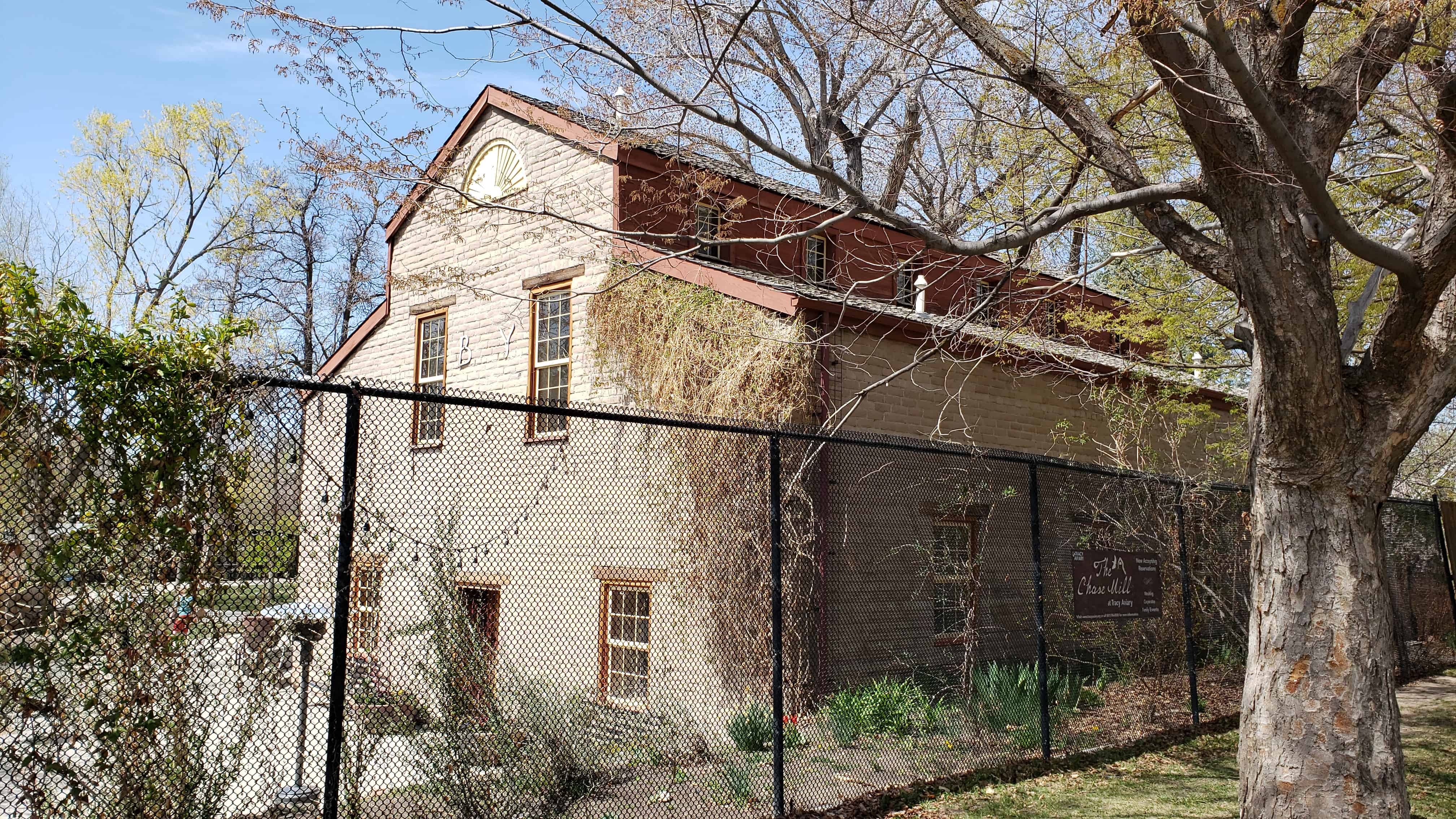
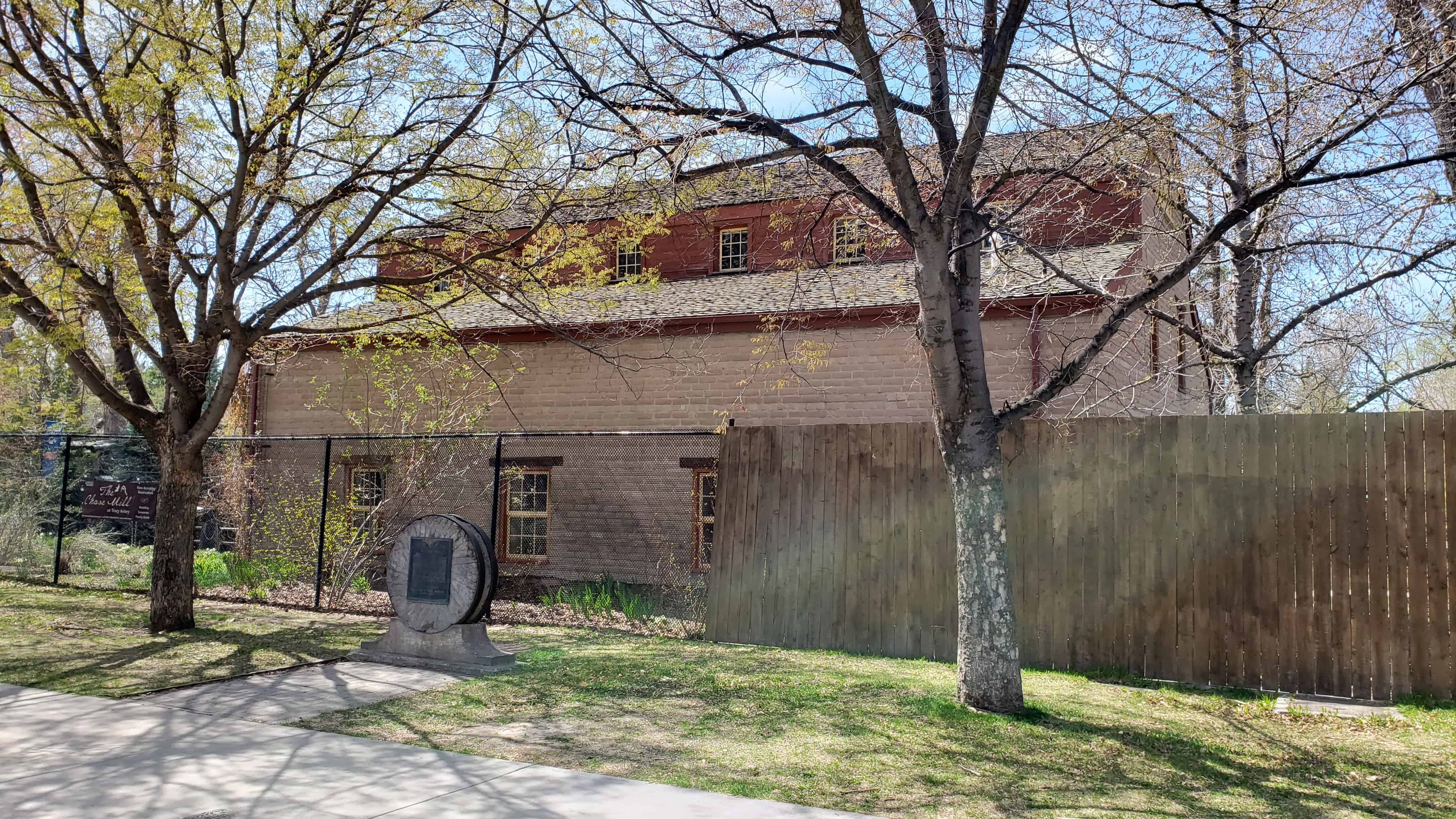
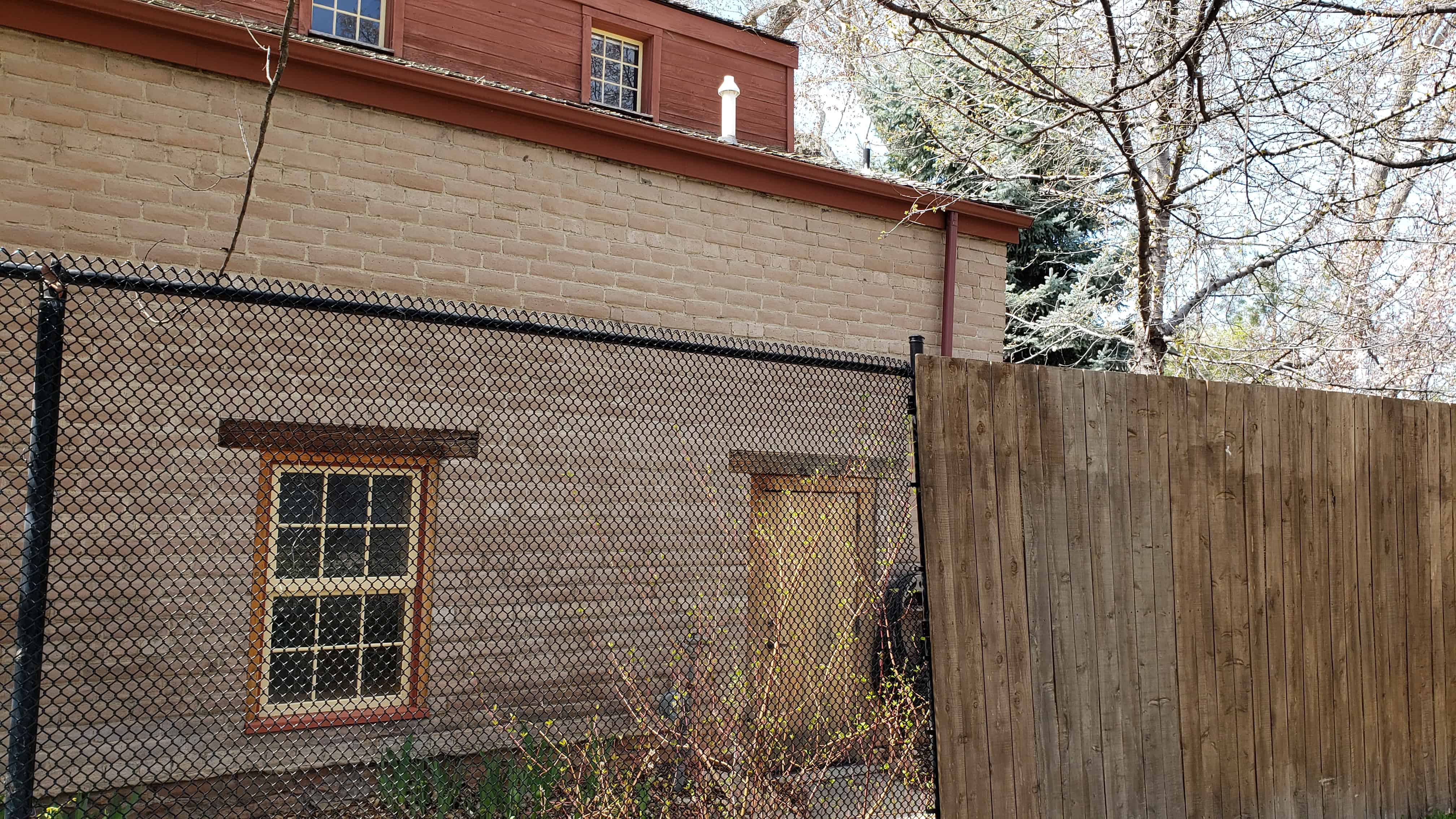
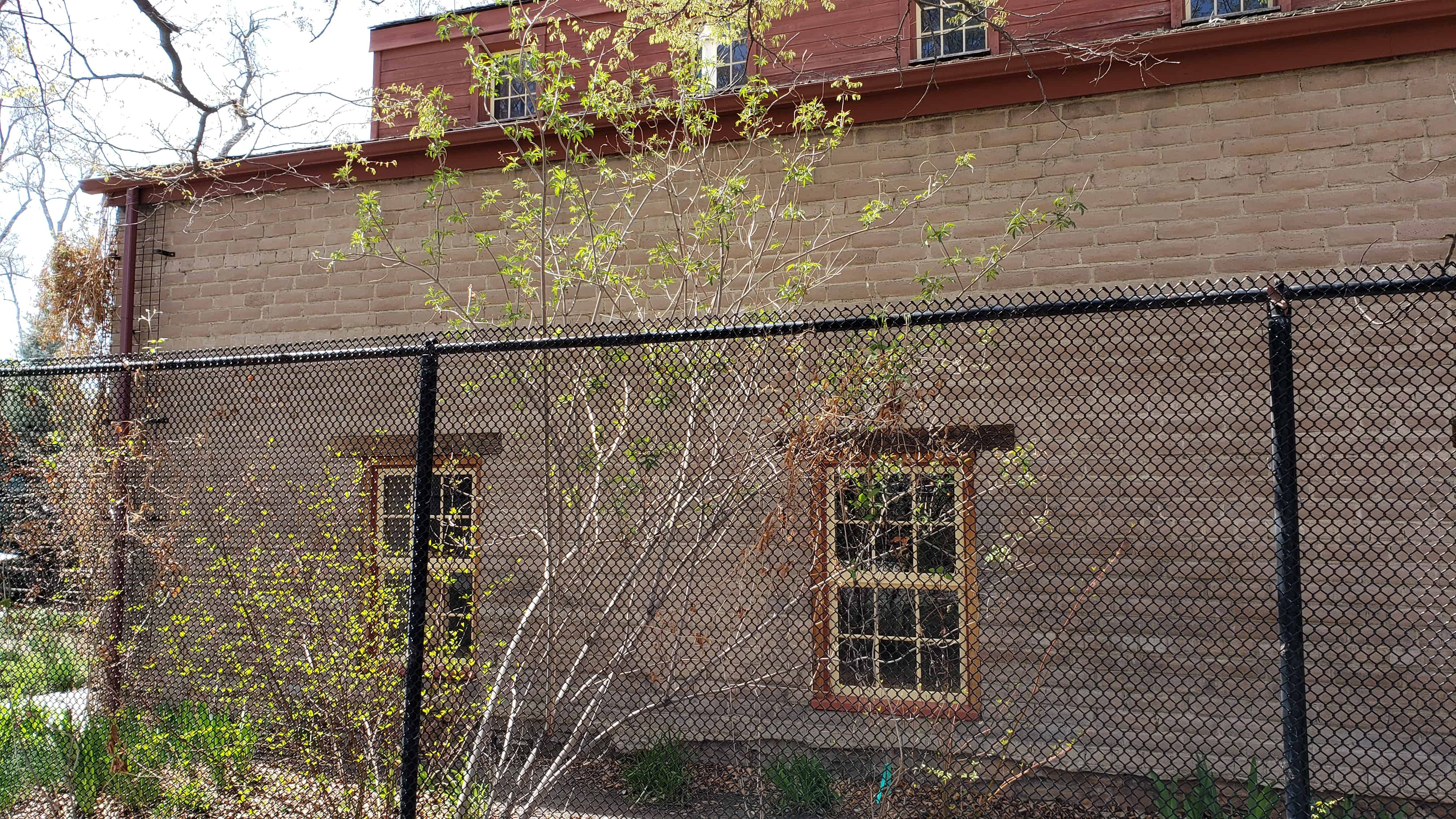
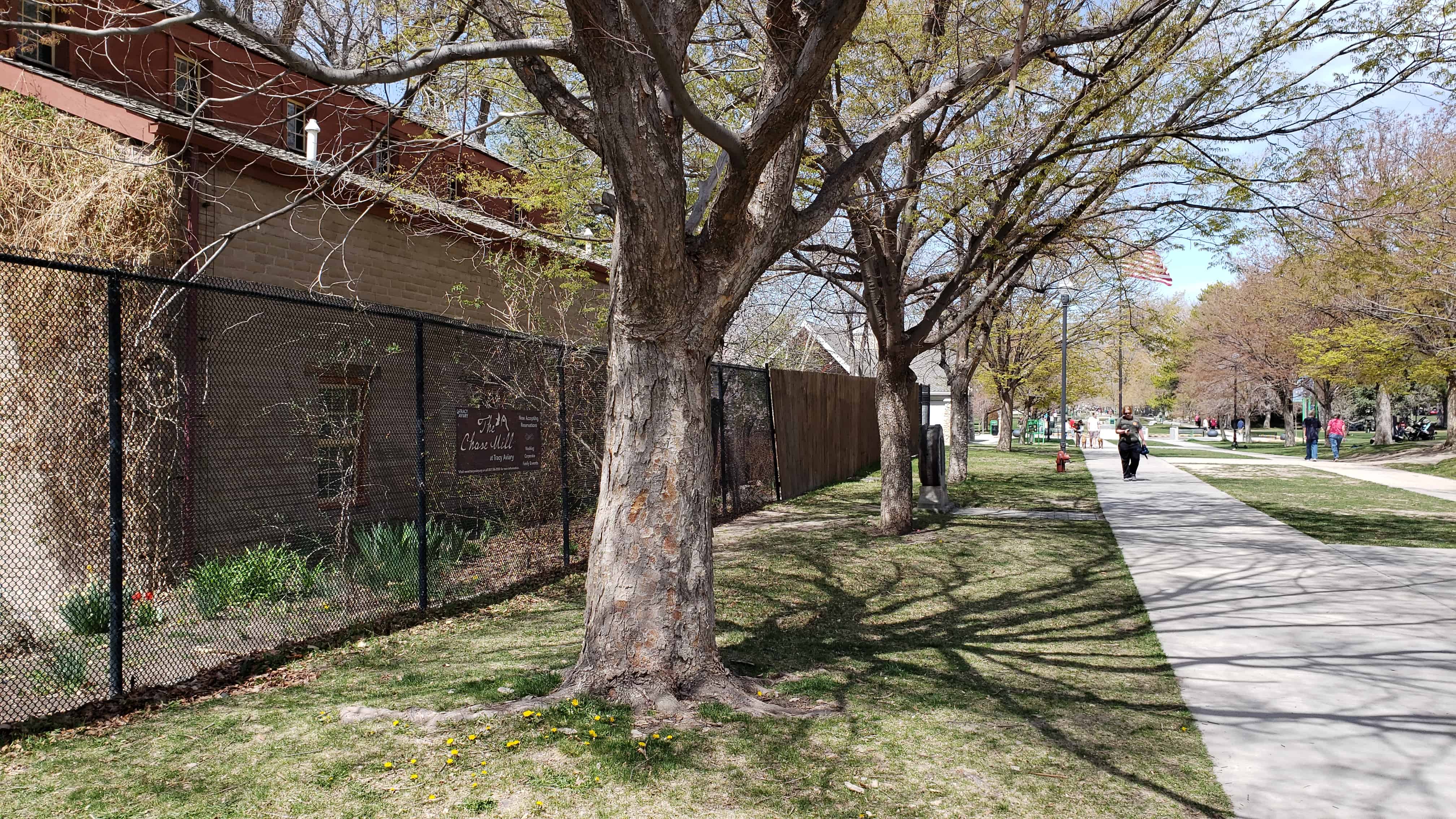
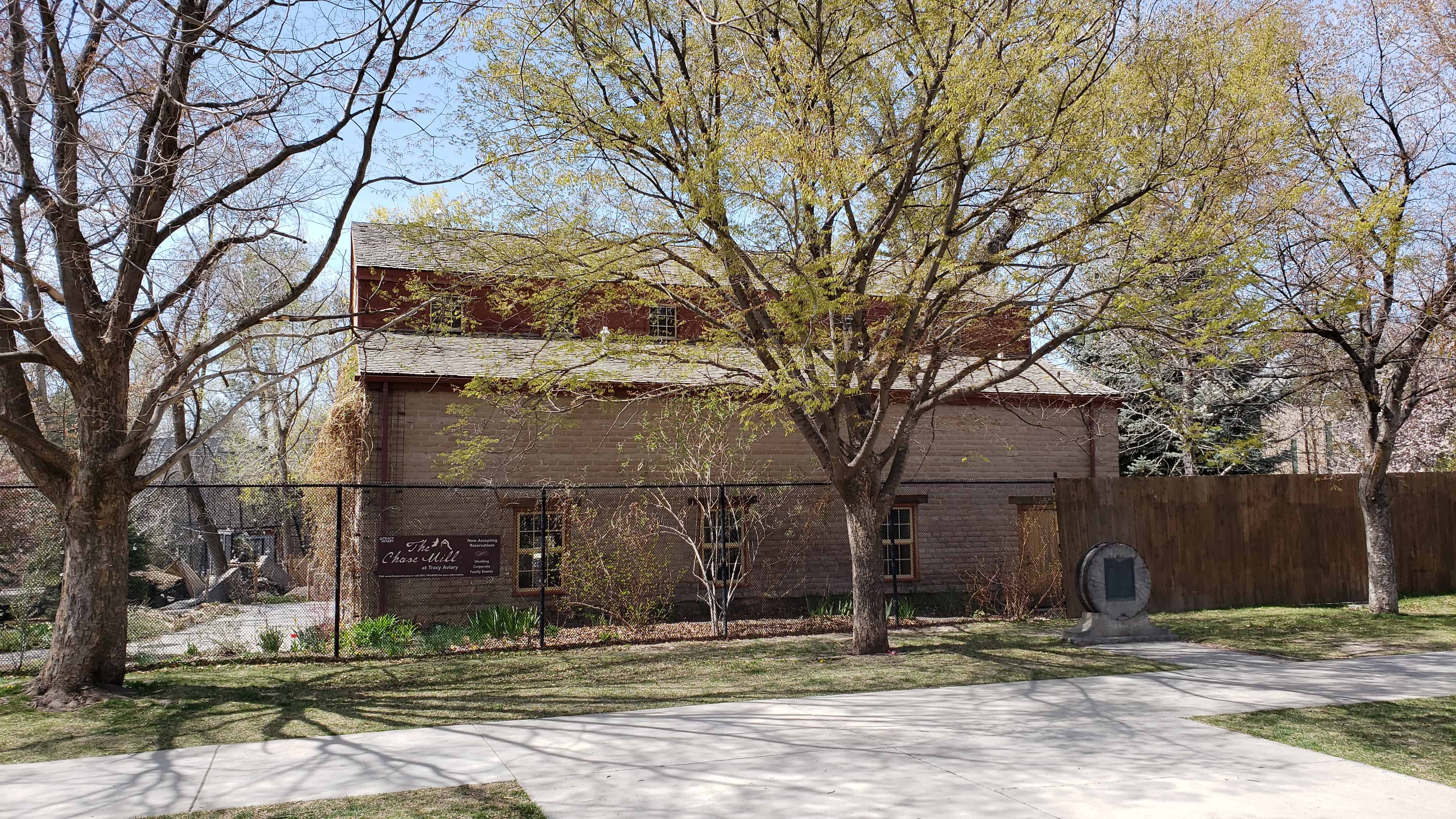
The Isaac Chase Mill, located In Liberty Park, remains as the only grist mill on its original site built by the early pioneers in Salt Lake City. It was also the first mill in the valley to separate the flour from the shorts and bran.
The property, with springs of water, was deeded to Isaac Chase in 1847. He soon purchased another fifteen acres and eventually owned more than one hundred acres in the area. In late 1847, he built an upright sawmill to cut lumber for his home and mill. In 1848, a small crackling mill was built. hen, in 1852, Isaac Chase supervised the building of the “Chase Mill” and installed the irons and millstones his daughter had “freighted” to Utah when the family emigrated to the valley in September 1847. William Weeks was the architect. Chase later built a home nearby, which is still standing.
In 1854 Brigham Young, who had married Mrs. Chase’s daughter by a previous marriage, bought into the mill. The mill’s flour became extremely important during the famine period of 1856-1857. In 1859 Brigham Young Jr. was assigned to manage the mill. By 1860 Brigham Young purchased Chase’s stock and assumed complete control. Chase moved to his adobe cabin on State Street where he died a year later.
The mill continued to be used into the 1880’s. About 1882 the location was purchased from the Brigham Young estate by Salt Lake City for “Liberty Park.” The mill was used as a supply shed for a number of years. Then, in 1896, a drive was made to tear it down; however, through the effective efforts of Kate Chase, a grand-daughter, support was marshalled to save it.
In 1927, the Daughters of Utah Pioneers, began negotiations with the city for its use and preservation, which they obtained under lease in 1933. They have used it as a relic hall and now open it to the public during the summer months.
Interest has been expressed at various times to restore it to operating condition, which now may become a possibility.
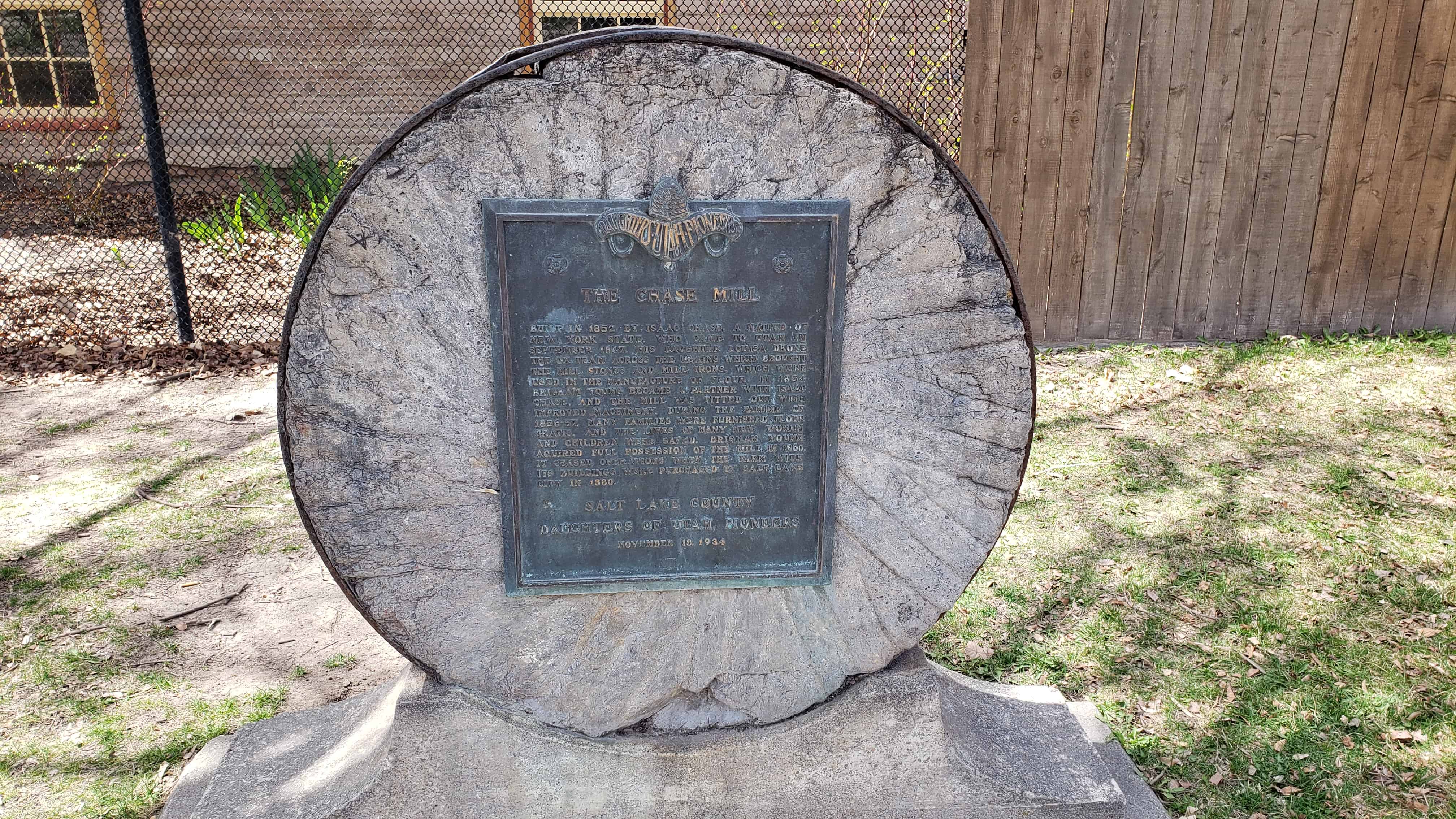
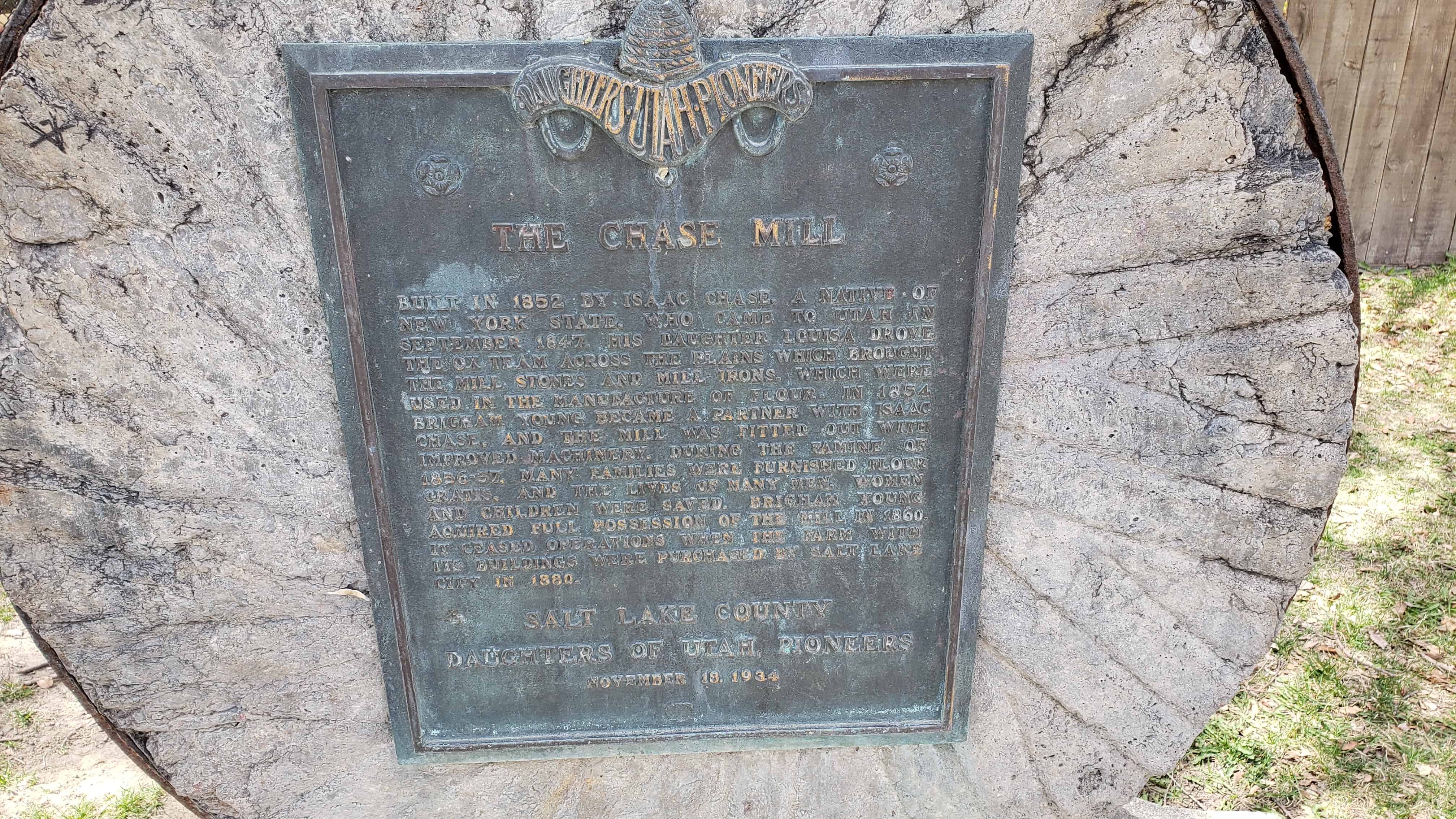
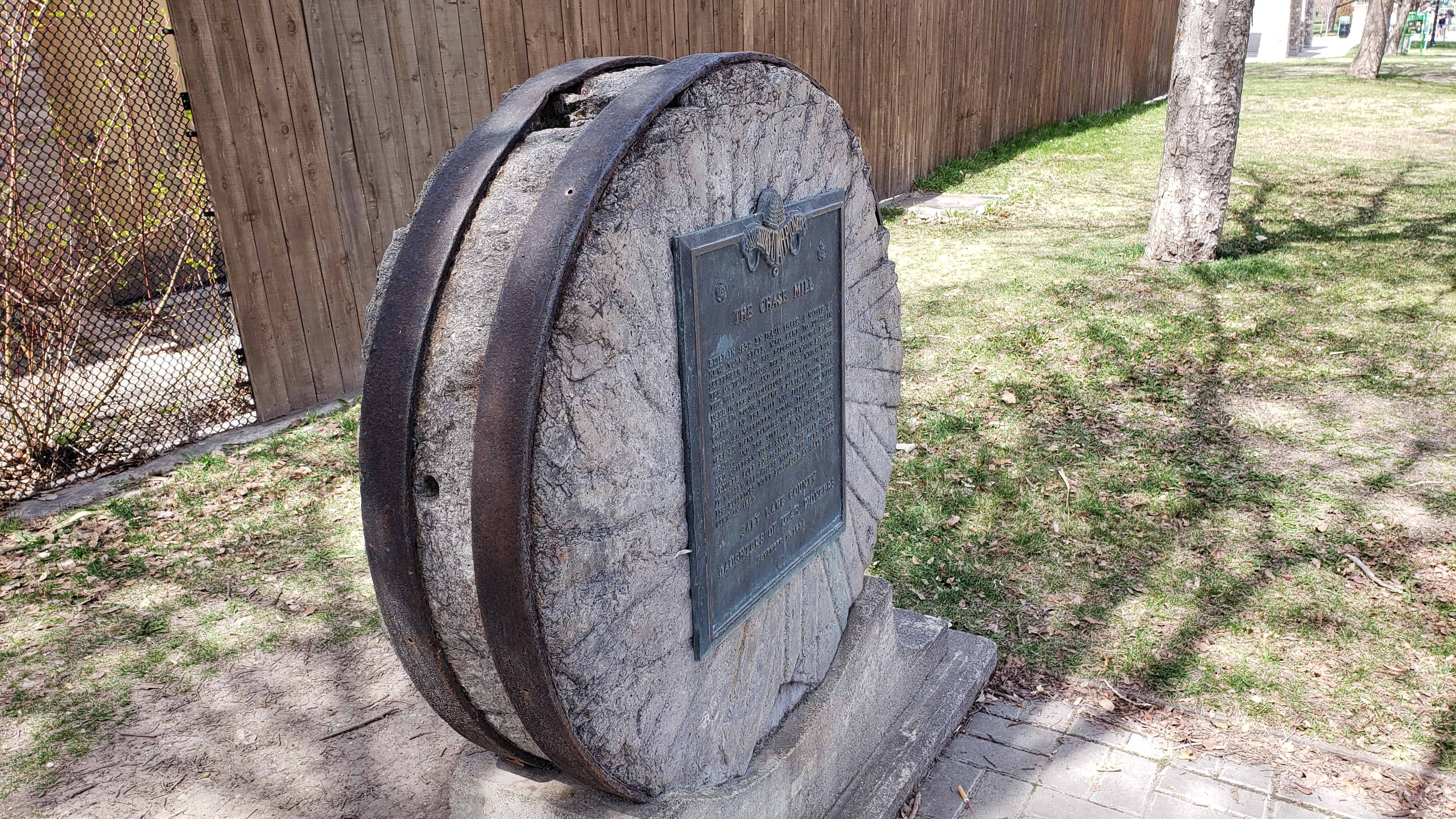
The Daughters of Utah Pioneers historic marker at the site reads:
The Chase Mill Built in 1852 by Isaac Chase, a native of New York State, who came to Utah in September 1847. His daughter Louisa drove the ox team across the plains which brought the mill stones and mill irons, which were used in the manufacture of flour. In 1854 Brigham Young became a partner with Isaac Chase, ad the mill was fitted out with improved machinery. During the famine of 1856-57 many families were furnished flour gratis, and the lives of many men, women and children were saved. Brigham Young acquired full possession of the mill in 1860, it ceased operations when the farm with its buildings were purchased by Salt Lake City in 1880.