• About JacobBarlow.com
  • Cemeteries in Utah
  • D.U.P. Markers
  • Doors
  • Exploring Utah Email List
  • Geocaching
  • Historic Marker Map
  • Links
  • Movie/TV Show Filming Locations
  • Oldest in Utah
  • Other Travels
  • Photos Then and Now
  • S.U.P. Markers
  • U.P.T.L.A. Markers
  • Utah Cities and Places.
  • Utah Homes for Sale
  • Utah Treasure Hunt

JacobBarlow.com

~ Exploring with Jacob Barlow

JacobBarlow.com

Tag Archives: Historic Buildings

Princess Recreation Hall / Lynndyl LDS Meetinghouse

20 Thursday Jan 2022

Posted by Jacob Barlow in Uncategorized

≈ Leave a comment

Tags

Chapels, City Hall Buildings, Dance Halls, Historic Buildings, Hospitals, Juab County, Lynndyl, NRHP, Schools, Theaters

The Princess Recreation Hall/Lynndyl LDS Meetinghouse is locally significant in the areas of entertainment/recreation and religion. Lynndyl Town was established during the railroad expansion era and the Princess Recreation Hall was built to meet the needs of the citizens for a social gathering center. Originally constructed in 1914 as a social and recreation place for the community, is was used for sporting events, dances, public meetings, a school house, a movie theater, and even a hospital during the influenza epidemic of 1917-1918. During its time as a recreation hall, the building also concurrently served as the meetinghouse for the LDS Lynndyl Ward from 1915-1985. It its 100 year history the Princess has never been empty and has remained a community center for social gathering from the beginning. It has been used as the Lynndyl Town Hall since 1982.

Located at 98 East Center Street in Lynndyl, Utah

From the National Register nomination form:
Located within the town of Lynndyl, the Princess Recreation Hall/Lynndyl LDS Meetinghouse is a one-story wood frame and stucco building with minimal detail, located at 98 East Center Street. It is situated in the north-east corner of the community park, with a sports court to the west and a grass sports field to the south and west. The original 1914 building was a recreation hall constructed of wood frame and wood siding, with a basketball court and stage. In 1936-38, an addition was constructed to the west of the building for classrooms and other meeting space to accommodate the needs of The Church of Jesus Christ of Latter- day Saints’ membership in the town. The structure now took on an “L” shape, with projecting entryways. The original building and the new addition were finished with a more modern stucco appearance, although it maintained a vernacular classical appearance. In 1983, a fire station was added to the south of the building, creating a “T” shape. And, although the outside was finished to match the 1936 stucco exterior, the inside of the new section was modern. However, the interior of the 1914/1936 church remodel was not altered. As of 2014, the interior still retains this layout and architectural detail, such as stained wood molding and interior wood doors. The structure has very simplistic features such as the wood decorative eaves and the original wood frame six over six double hung windows, which helps the structure to retain its historic integrity.

Located within Millard County, in the small town of Lynndyl, Utah, The Princess Recreation Hall/Lynndyl LDS Meetinghouse is currently being used for the town hall. In spite of a 1983 addition, the structure has kept its historic integrity by retaining much of the original work from 1914 and the 1936-38 addition. The building was constructed on the corner of Center Street and 100 East, in the north east corner of the public community park. Ball fields can be found south of the building and a sports court is found to the west, divided by a row of several large deciduous trees separating the building from the sports court. Other vegetation around the building includes shrubs and grass. A concrete sidewalk is found along the road on the north and east sides of the building, with unmarked gravel parking adjacent to the concrete sidewalk.

The building was originally constructed in 1914 as a rectangular plan recreation hall with gymnasium and auditorium. The original structure was built on a concrete slab with wood framing and covered with wood siding. The vernacular building was constructed with simplistic detail that was functional rather than decorative. In 1936, the Church of Jesus Christ of Latter-day Saints responded to the demand for a larger place of worship by constructing an addition to the west portion of the building. The new structure used a concrete block foundation which raised the main level of the addition up one-half story and allowed for a full basement. This basement had a coal furnace and coal storage room along with classrooms. The new addition was built using wood framing. It did not keep to the original exposed wood siding of the original, but was finished with stucco. The exterior of the original recreation hall was also finished with stucco to match the new exterior. Other simple details were added to the wide eaves to give the building a slightly more formal appearance, with an understated Classical feeling. When completed in 1938, the new Lynndyl LDS church building had an L-shape plan and increased space for meetings and classes, yet the social hall remained open as a community gathering area with wood floors and plaster covered walls. When completed the finished space was approximately 3,620 square feet.

From the primary entrance on the north side of the 1936-38 wing, one enters a vestibule then proceeds to the interior of this section. The interior of the addition was designed in a split level format with a full set of stairs to the basement and a half flight to the upper level. The basement below this section has rooms for storage, classrooms a coal furnace and a coal room.

The upper level of the addition has a large room on the west side that was originally used as chapel for church services. Another room to the east of this is divided off by an accordion wall and served as a classroom. There is a small window on the south elevation that provided light to this room. However, this was covered on the exterior when the fire station was added. To the east of this room, and separated by another accordion wall is the back stage area from the gymnasium. The east wall of this area has large built-in cupboards and a single window. A doorway at the northeast corner, next to the stage curtains, provides access to a small stairway leading down north to the gymnasium floor. The gymnasium is to the north of this area and is a large open hall with maple flooring. A basketball hoop is on the north end. The ceiling is coved and has fairly old acoustic tile. The gym has a separate exterior entrance through the projecting vestibule on the west side described above. Another doorway at the southwest corner of the gymnasium provides access to an interior stairway leading up to the hall/landing area and a small kitchen. All of the original plaster walls, doors, wood trim and finishes are retained in the 1914-1938 part of the building and very little has been changed or updated except for carpeting on the floors, accordion doors, and light fixtures.

The building remained in this plan until 1983 when Lynndyl Town moved into the building creating a new use as the town hall. Although no structural changes took place within the existing building, a fire station was constructed at the south end as an extension of the gymnasium/auditorium section and was built using wood frame construction and covered with stucco to match the rest of the structure.

The 1983 fire station addition is accessed from the interior by a doorway from the classroom section of the 1936-38 addition. The door leads to a landing with stairs (behind a door) that go up to the second story of the addition, and a half-flight of stairs that leads to the ground-level hall and rooms of the addition. Two restrooms at the north end of the addition are separated from the garage/vehicle storage area of the fire station by an east/west running hallway. At either end of the hall are exterior exits. At the west end of the hall are located the stairs to the second floor and a second stairwell to the basement rooms. The fire station garage area is a single large, open area with room for two vehicles and equipment.

The building has undergone two building campaigns since the original construction that have seen two major sections added to the building. The first one, 1936-38, made major alterations to the original structure in both form and use. The second, in 1983, added a new use and major addition while making little alteration to the overall appearance. In spite of the non-historic addition, the building still retains historical integrity of the 1930s appearance and is a contributing historic building in the small town of Lynndyl.

The Princess Recreation Hall/Lynndyl LDS Meetinghouse is locally significant under Criterion A in the areas of Entertainment/Recreation and Religion, as well as Criteria Consideration A for its historical use as a religious meeting place. Lynndyl Town was established during the railroad expansion era and the Princess Recreation Hall was built to meet the needs of the citizens for a social gathering center. Originally constructed in 1914 as a social and recreation place for the community, it was used for sporting events, dances, public meetings, a school house, a movie theater, and even a hospital during the influenza of 1917-18. During its time as a recreation hall it also concurrently served as the meetinghouse for The Church of Jesus Christ of Latter-day Saints’ Lynndyl Ward from 1915-1982. Therefore, it is significant in relation to its contribution to the social and religious aspects of Lynndyl. Within the 1914-1964 period of significance, the building had two distinct construction periods: 1914, when the original wood framed building housing the gymnasium and stage was built, and 1936-38, when the meetinghouse expansion was completed. In its one hundred-year history the Princess has never been empty and has remained a community center for social gathering from the beginning. It is currently being used as the Lynndyl Town Hall, and has been since 1982 when the Lynndyl LDS Ward was disbanded. In 1983 a section was added to the rear of the building to house the town fire station. In spite of the new construction, the historic portion of the building retains its historical integrity and remains a contributing historic building in the small town of Lynndyl.

The Princess Recreation Hall is significant in the area of Entertainment/Recreation as it was the center of all social life for the community. In 1914 the town’s people desired a social hall to be constructed for their gatherings and events. F.L. Copenham, Walter Johnson and other community members helped construct the hall. Prior to completion, the first ball was held and was recorded as being a “grand affair”. The hall was used for a variety of social and sporting purposes and events. These included a movie theater, a dance hall, and a sporting events center which included a basketball court and collapsible boxing and wrestling ring. According to the Polk and Co.’s Utah Gazetteer, the Princess had several recorded managers, Elmer A. Jacob (1918-1919), GW Sudbury (1924-1925) and Elmer Banks (1927-1928).

The Princess truly served as multi-functional building in this small town. During the day it was used as the school house and at night a dance hall with music provided by a piano, fiddle and banjo, and later, the Lynndyl Town Band. The building was mostly used as a gymnasium where a collapsible platform could be set up for boxing and wrestling. According to a poem written by Lynndyl resident, Roberta Dutson, boxer Jack Dempsey and wrestler Ira Dern, visited the Princess for an exhibition.

Along with the role as a dance hall and gymnasium, the building also served as the local movie theater. According to local historian, Mary Greathouse:
“The first picture show was run by Elmer Jacobs. Sometimes the film would break and the audience sat in the dark until Elmer climbed down [to] find a woman who would loan him a hairpin to make repairs. At other times, the film would catch fire and Mr. Jacobs would toss it down from the projecting booth for someone to stamp out. The film would be sliced and the show would go on.”

The building was heated by two large stoves, located in opposite corners of the gym. Prior to 1928, when electric power infrastructure was brought to Lynndyl, the power for lights and the projector was provided by a generator powered by an “old Ford motor”

During the influenza pandemic of 1918, the population of Lynndyl was devastated. Because of the population size and isolation of the town, there was no hospital to serve the health needs of the community. In order to deal with the many sick who required increased observation the Princess was put into use as a makeshift hospital. The building’s use as a hospital was short-lived, as was its former use as a place of education. When the flu threat was over a new school was constructed adjacent to the hall and opened for students in 1919.

The Princess Recreation Hall/Lynndyl LDS Ward Building is significant in the area of Religion under Criteria Consideration A because of the dual role of the building as the primary social and religious-use space in the community. Although there were some informal Sunday schools being held in different homes, there were no other formally established religious organizations in Lynndyl other than the Church of Jesus Christ of Latter-day Saints (which was typical of most communities in Utah). The Lynndyl LDS Ward, which met in The Princess, was the only ward (parish) found in the area.

In 1915, not long after the recreation hall was completed and put into use, the LDS Church purchased the building to use as a meetinghouse. This did not end its use as a recreation hall, however. Even though the ward used the space as a meetinghouse, the structure remained significant in regard to the social aspect of the community as a whole. From its inception, the LDS Church championed recreational activity in all the communities it settled in Utah and the surrounding region. Particularly after the turn of the twentieth century, when the Church’s building program became more formalized, it was common to construct “cultural halls” near its meetinghouses which had functions similar to the Princess Recreation Hall, with a basketball court and stage area. Perhaps because of the small population of Lynndyl, the LDS Church deemed it more feasible to purchase the existing hall and make it a multiple-use building.

For many years the simple gymnasium and stage was used as the chapel and classrooms, with curtains hung on wires to divide up the space. As the population of the community increased, more space was needed for the expanding Lynndyl Ward. In 1936, approval was granted by the school board for the ward to meet in the school building while Princess Hall was enlarged to include a formal chapel and classrooms. In 1938, construction was completed and on Saturday, September 10, a celebration was held that included sporting events followed by a banquet and program. Some 700 people were in attendance for the events which ended with a dance in the hall. On Sunday, the building was dedicated by LDS Church President Heber J. Grant. At this time the membership for the Lynndyl Ward was 248 people.
The town continued with stable population for a few years longer, but as steam locomotives switched to diesel, the railroad no longer found it necessary to stop in Lynndyl. As a result jobs decreased and with it, the population. Although population declined over the decades, the building continued in shared public and religious use for several decades.

On Sunday, November 22, 1981, the LDS Stake President announced the Lynndyl Ward would most likely be abandoned at the beginning of 1982. This was a shock to many of the members and devastating to think of their community without a place to worship and meet with friends and neighbors. The ward continued on for another eleven months and on October 20, 1982, the last meetings were held in the Lynndyl Ward Meetinghouse. Alpha Nielson, who wrote the history of the Relief Society2 in Lyndyll, stated the following: “No more Lynndyl. No more meeting place. No more cultural hall or public building. A little town with no identity. No heart or soul”.

Although the Lynndyl Ward no longer met in the building, it did not remain empty for long. Soon after the ward moved out, Lynndyl Town set up offices in the building. Along with the new use, the town established a local fire department and constructed permanent quarters for their emergency vehicles in 1983. Along with Town functions, the building continues to be used as a public meeting space for the community, with the gymnasium and stage put in use at various times of the year.

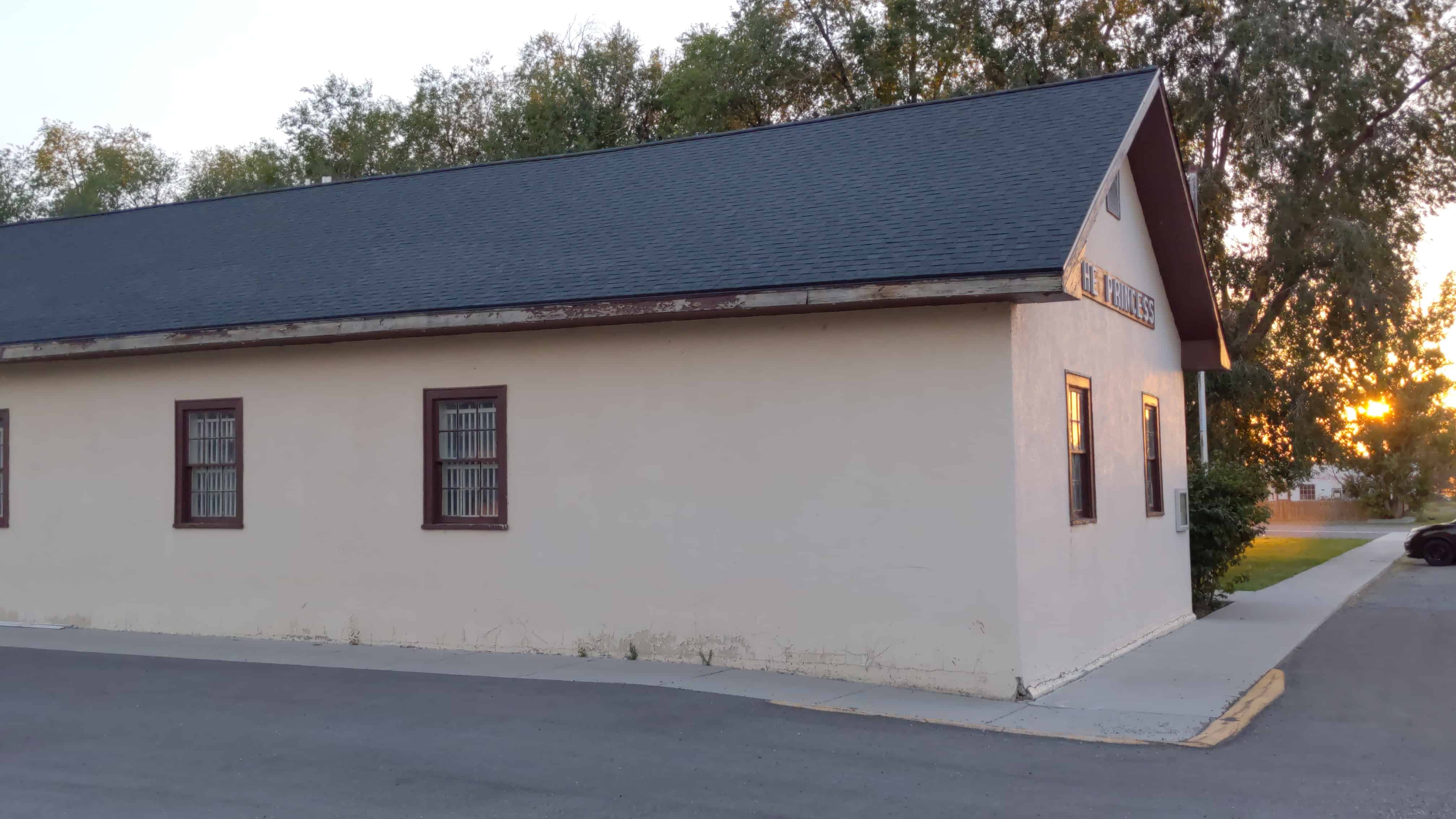
When the nearby IPP power plant finally opened, the population saw a small increase; however it has always remained below 150 residents. In 1990 C.B. Tolbert became mayor and pushed for a beautification of the community. He had the town hall repainted and placed letters on the outside that stated once again “The Princess” (Greathouse 207). Being the town hall, it has remained a community gather place. Public meetings continue to be held at the building along with recreational activities, dances, pancake breakfasts, holiday turkey dinners, bingo games, basketball and other recreational activities. The Princess Hall has remained throughout Lynndyl’s history the most significant and prominent structure within the community, and remains a contributing historic resource.

Low Hotel

18 Tuesday Jan 2022

Posted by Jacob Barlow in Uncategorized

≈ Leave a comment

Tags

Historic Buildings, Hotels, Murals

The old Low Hotel in Beaver, Utah
95 North Main Street in Beaver, Utah

Kaysville Tabernacle

01 Saturday Jan 2022

Posted by Jacob Barlow in Uncategorized

≈ 1 Comment

Tags

Davis County, Historic Buildings, Tabernacles, utah

Construction of the Kaysville Tabernacle began in 1912 and the building was dedicated May 24, 1914. When the old adobe meetinghouse, built between 1855 and 1863, became too small, Kaysville architect William Allen was commissioned to design a new church across the street. A groundbreaking ceremony was held July 24, 1912 under the direction of Bishop Henry H. Blood, who later served as Utah’s governor from 1933 to 1941. The Tabernacle combines “modern” and Greek Revival styling and is noted for its beautiful stained glass windows.

198 W Center Street in Kaysville, Utah.

East Canyon Campsites

31 Friday Dec 2021

Posted by Jacob Barlow in Uncategorized

≈ Leave a comment

Tags

DUP, Historic Buildings, Mormon Pioneer National Historic Trail, SUP, utah

East Canyon Campsites
Mormon Pioneer Trail

The main group of Mormon pioneers camped one mile above the mouth of Echo Canyon on July 16, 1847. They were following the 1846 tracks of the Donner-Reed Party who had taken a “new” route to California proposed by Lansford W. Hastings. The next day, the pioneers entered the Henefer Valley and traveled downstream along the Weber River where they camped July 17 and 18. In the hills north of their camp, they offered a special prayer for Brigham Young who was ill.

Leaving Brigham Young and a few wagons in the Henefer Valley on July 19, the main group crossed the Weber River at present Henefer and turned up Main Canyon to Hogsback Summit. From this point, they stood in awe of the distant Wasatch Mountains, yet to be traversed. The Pioneers proceeded down Dixie Hollow, up Broad Hollow, and through present East Canyon State Park to East Canyon Creek. They camped at a spot now underwater, about ¼ mile upstream from the dam.

On July 20, the pioneers went 7¼ miles south up East Canyon. They forded the creek eleven times in one day. The pioneers camped at Large Spring, ½ mile north of present Mormon Flat. William Clayton said, “The last three miles has been the worst road… it being through willow bushes over twenty feet high… it is yet scarcely possible to travel without tearing wagon covers… The road is one of the crookedest I ever saw…” The next day, the pioneers traveled up Little Emigration Canyon to the summit of Big Mountain, the longest sustained climb of the entire trip. The pioneers paused here with heartfelt gratitude, for looking southwest they saw their destination, the Valley of the Great Salt Lake.

The pioneers proceeded down the extremely steep trail off Big Mountain to Mountain Dell, over Little Mountain, then down into Emigration Canyon. The main group camped 2½ miles from the mouth of Emigration Canyon on July 21. The next day they traveled to a campsite near 17th South and 5th East in what is now Salt Lake City. They had arrived! Brigham Young entered the valley on July 24.

This historic marker is part of the series by the D.U.P. (#497) and also part of the series by the S.U.P. (#83) and also part of the series Mormon Pioneer National Historic Trail, it is located at East Canyon Resort.

Odd Fellows Hall/Beaver Drugstore

13 Monday Dec 2021

Posted by Jacob Barlow in Uncategorized

≈ Leave a comment

Tags

Beaver, Beaver County, Historic Buildings, I.O.O.F, NRHP, utah

The Odd Fellows Hall, built in 1903, is significant as one of only four commercial w structures on Main Street that retain historic integrity, and as the only building in Beaver documenting the importance of secular fraternal lodges and societies in the development of the town. The Independent Order of Odd Fellows ranked as an important nineteenth and twentieth century fraternal organization, who served a vital social function in many towns throughout the country. The eventual acquisition of this building by the Beaver Grand Lodge symbolized the adherence of this social order to the town of Beaver.

This commercial structure was built in about 1903, probably by Charles C. Woodhouse. Scant records indicate that the structure served as a commercial property on the first floor and housed meeting rooms and social space on the second. In 1926 the IOOF Beaver Lodge, who had apparently been utilizing the second floor of the facility, decided to purchase the property as their own. The building was mortgaged and finally paid off in November, 1940. It continues to be owned by the IOOF Lodge.

An original 1917 Sanborn map and an updated map of 1931 indicate that the structure housed a drug store on the first floor. It continues in that function as the home of Beaver Drug.

Located at 35 North Main Street in Beaver, Utah and added to the National Historic Register (#83003885)

Related:

  • Odd Fellows Buildings

Daniel Carter Barn

12 Sunday Dec 2021

Posted by Jacob Barlow in Uncategorized

≈ Leave a comment

Tags

Barns, Bountiful, Davis County, historic, Historic Buildings, utah

Daniel Carter Barn
1803-1887

The Daniel Carter Barn was built in 1850. It is the oldest structure standing in its original location in Bountiful.

Daniel Carter was born 28 August 1803, in Benson, Rutland, Vermont, the son of Jabez Carter and Rebecca Dowd. He was a farmer by profession. After joining the Church of Jesus Christ of Latter-day Saints, he moved first to Kirtland, Ohio, then Far West, Missouri, then Nauvoo, Illinois, and finally traveled by wagon train to the Salt Lake Valley in 1850 with his daughter, Ruth Clarissa.

He settled in what is now known as Bountiful. He built the rock barn to shelter not only his animals, but his family. Carter is listed among the area’s first nurserymen.

A description in the book, “east of Antelope Island,” said “Many a tree was budded by him.” He had the best fruit orchard in Bountiful and the produce from his vegetable garden was so plentiful, that he always had much to give away. Flowers, too, grew abundantly around his home. He died 10 April 1887, and is buried in the Bountiful City Cemetery.

This plaque has been donated by the posterity of Peter Carlos Cornia, a great grandson of Daniel Carter. Carlos was born 8 March 1886 in Woodruff, Rich County, Utah, the son of Peter Carlos Cornia and Lucy Helen Dickson. He died 11 March 1979 and is buried in the Woodruff City Cemetery.

Located at 299 North 200 West in Bountiful, Utah.

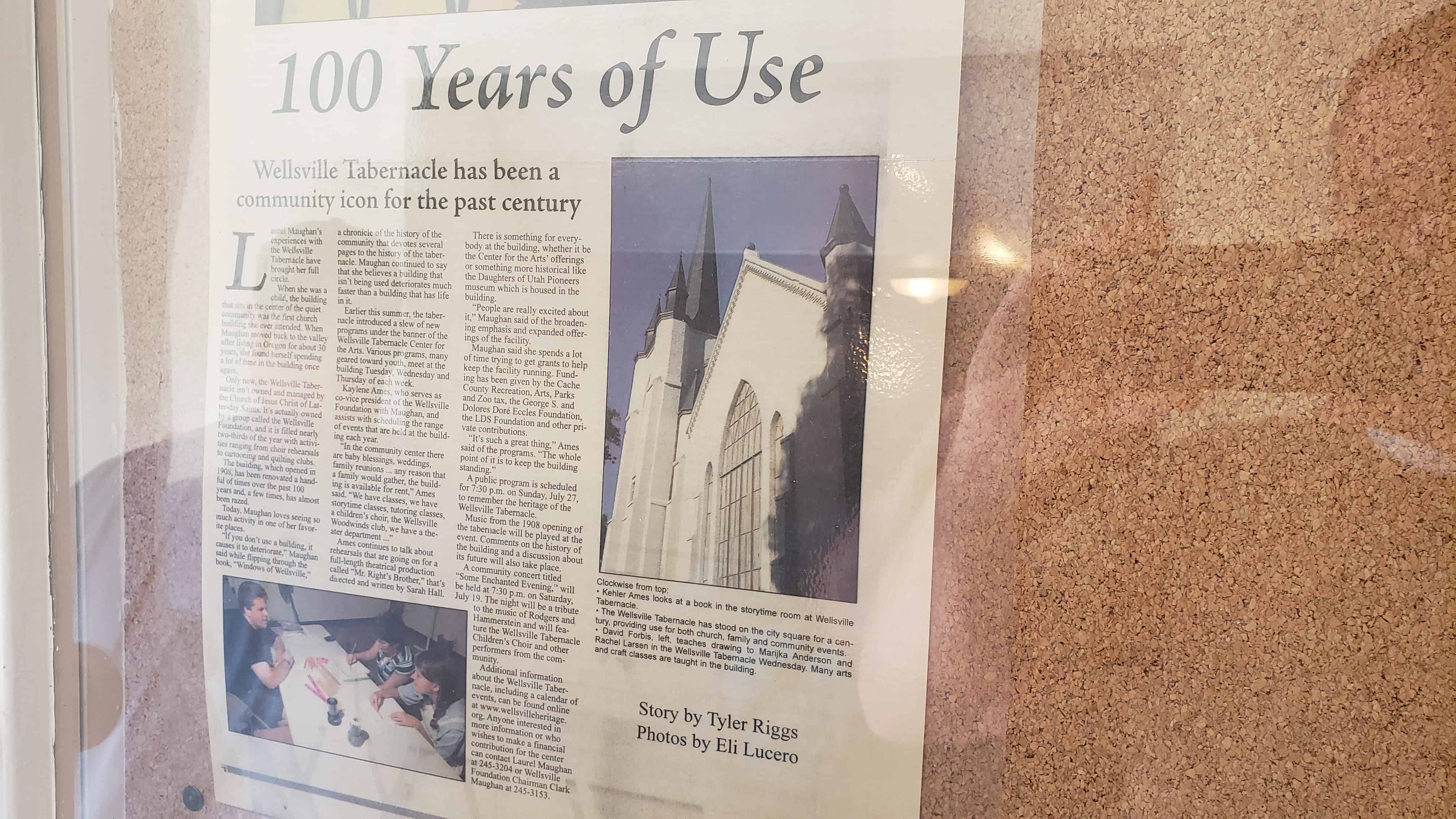
Wellsville Tabernacle

09 Thursday Dec 2021

Posted by Jacob Barlow in Uncategorized

≈ Leave a comment

Tags

Cache County, Historic Buildings, NRHP, Tabernacles, utah, Wellsville

The Wellsville Tabernacle is one of two tabernacles in Cache Valley, and dominates the south end of the valley. Built during the years 1902 to 1908, it demonstrates the persistence of the Mormon village form, based on cooperative idealism. In spite of alterations, primarily to the tower, the architectural form and imposing scale make the tabernacle one of the four major landmarks in the Mormon settlements of northern Utah.

Plans for the Wellsville Tabernacle were prepared by the architect C.T. Barrett under the direction of Bishop Evan R. Owen. Ground was broken in 1902 by former Bishop William H. Maughn who had served as bishop for forty years.

The cornerstones were laid by Apostle Owen Woodruff and President Seymour B. Young in 1903. It was dedicated June 28, 1908 by Anton H. Lund of the Mormon Church’s First Presidency.

All the materials came from local sources. A rock quarry, a lime kiln and a brickyard were operated by local men. William S. Poppleton supervised the stone work, quarried in nearby Sardine Canyon. Job Miller Sr. made the red brick, which was laid by Fred Douglas and Co. Alex Hill provided the rough lumber from his sawmill in Blacksmith Fork Canyon. Thomas Thorpe Sr. directed the plaster work and the Brenchley Brothers did the iron work. Daniel and William Walters and Francis O. Gunnell were responsible for the carpentrywork. Professor Emil Hansed, a landscape gardener, supervised the planting of the lawn, shrubs, and trees. The total cost of the building was $65,000.

Located at 75 South 100 East in Wellsville, Utah and added to the National Register of Historic Places (#80003893) November 26, 1980.

Related:

  • LDS Tabernacles

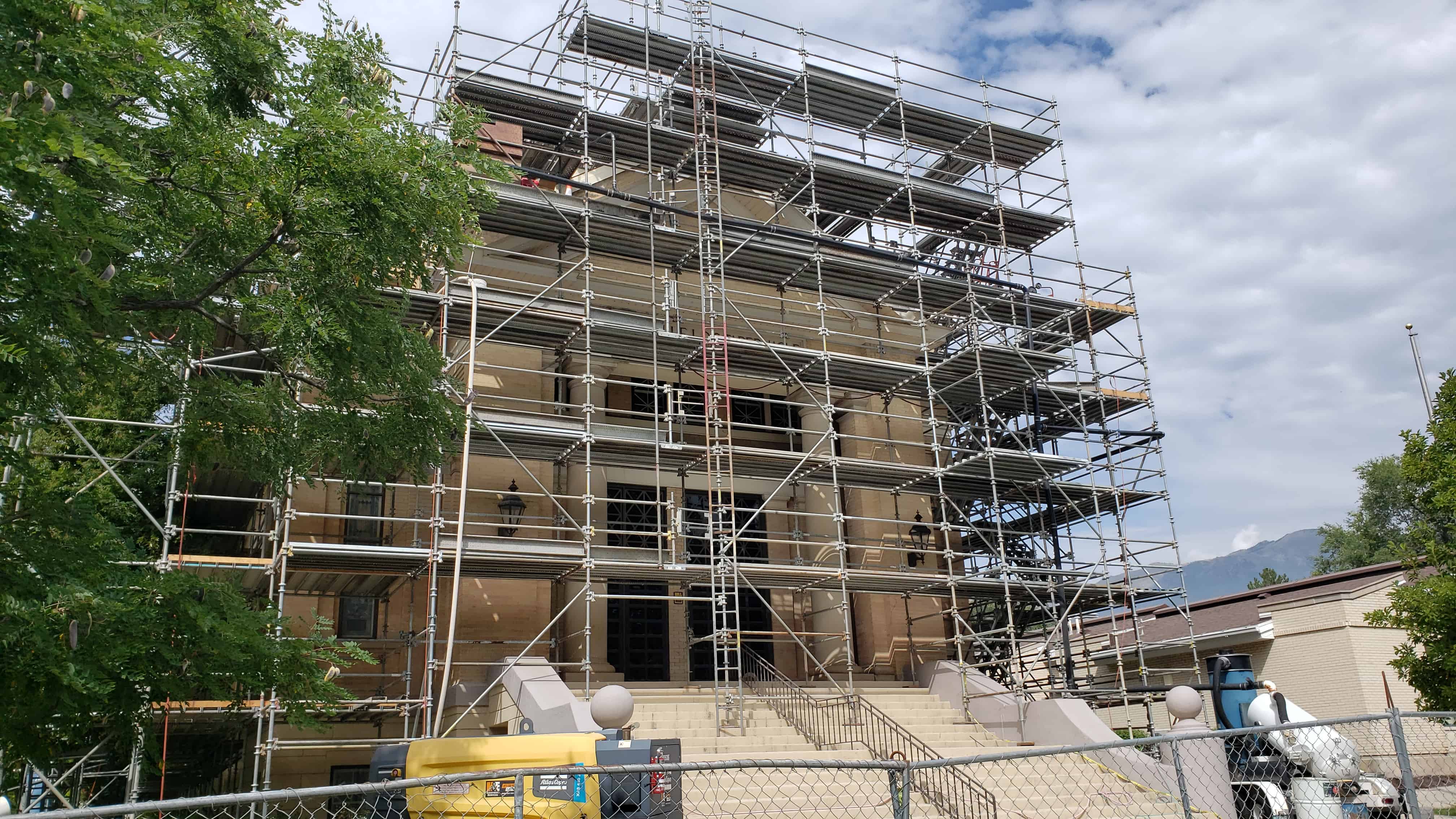
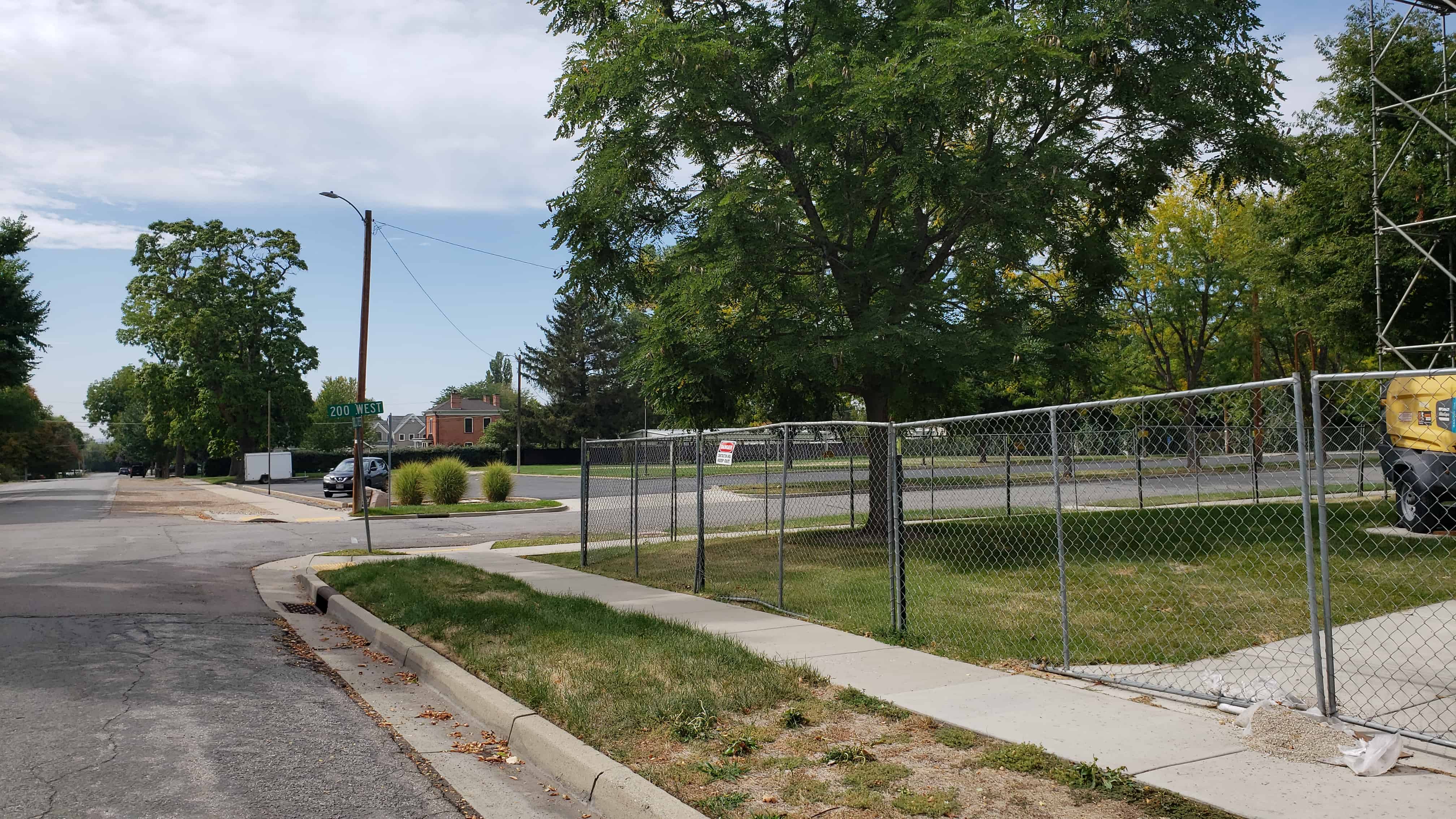
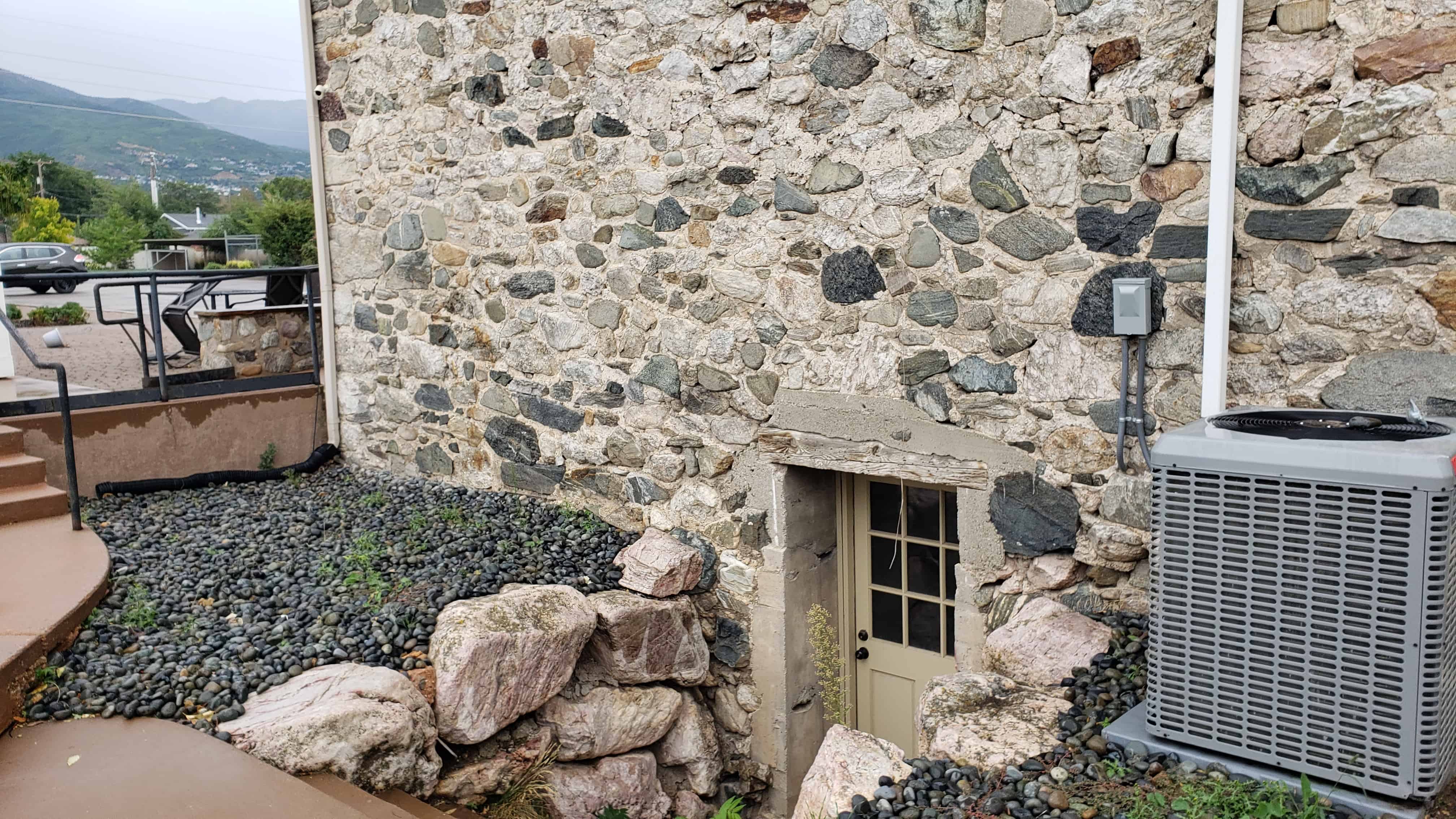
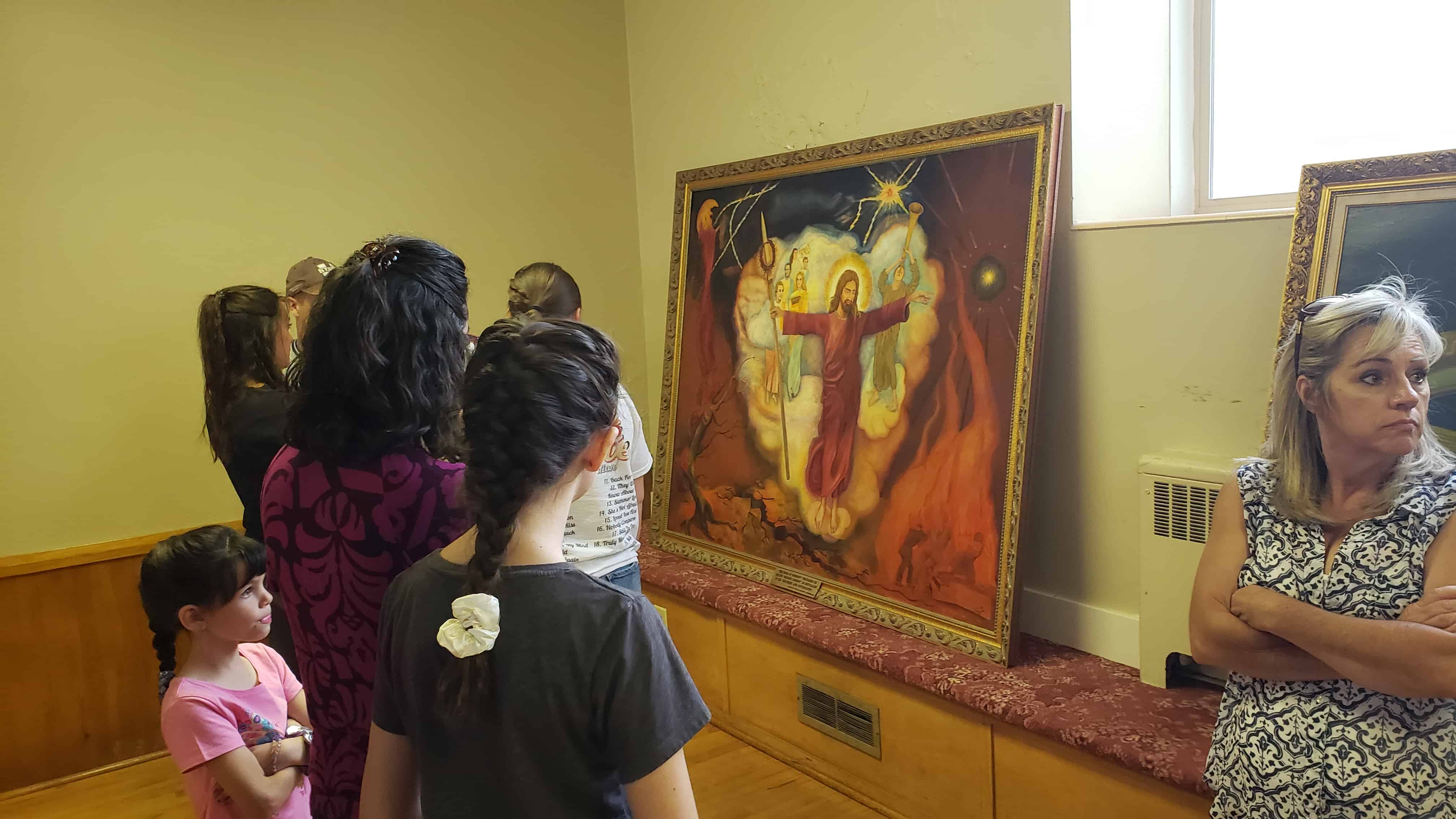
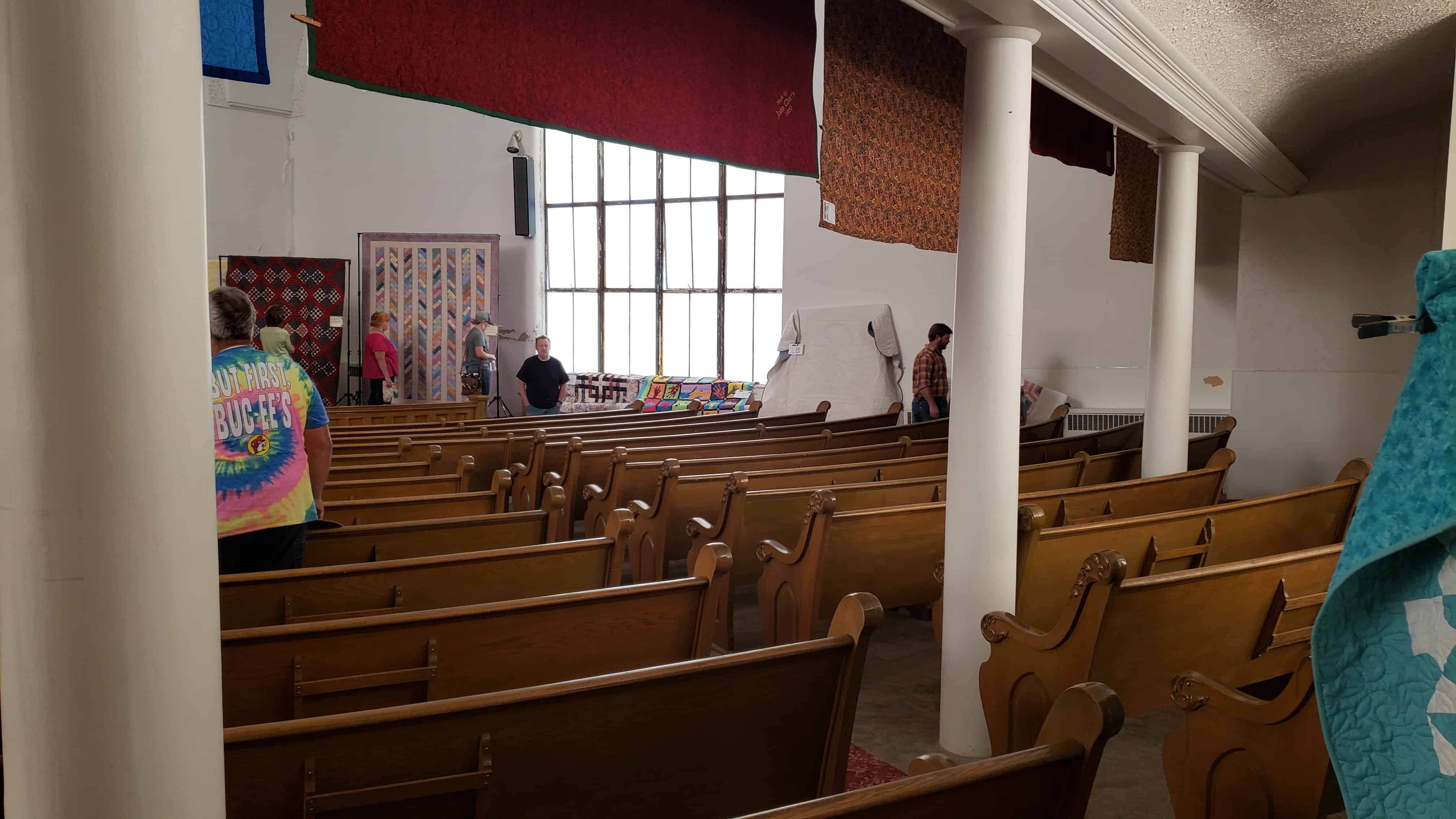
I stopped by the town celebration on September 6th, 2021 and they were letting people inside – they said nobody had been let inside for ten years. Here are some interior photos:

The Wellsville Tabernacle is one of two tabernacles in Cache Valley, and dominates the south end of the valley. Built during the years 1902 to 1908, it demonstrates the persistence of the Mormon village form, based on cooperative idealism. In spite of alterations, primarily to the tower, the architectural form and imposing scale make the tabernacle one of the four major landmarks in the Mormon settlements of northern Utah.

Plans for the Wellsville Tabernacle were prepared by the architect C.T. Barrett under the direction of Bishop Evan R. Owen. Ground was broken in 1902 by former Bishop William H. Maughn who had served as bishop for forty years. The cornerstones were laid by Apostle Owen Woodruff and President Seymour B. Young in 1903. It was dedicated June 28, 1908 by Anton H. Lund of the Mormon Church’s First Presidency.

All the materials came from local sources. A rock quarry, a lime kiln and a brickyard were operated by local men. William S. Poppleton supervised the stone work, quarried in nearby Sardine Canyon. Job Miller Sr. made the red brick, which was laid by Fred Douglas and Co. Alex Hill provided the rough lumber from his sawmill in Blacksmith Fork Canyon. Thomas Thorpe Sr. directed the plaster work and the Brenchley Brothers did the iron work. Daniel and William Walters and Francis 0. Gunnell were responsible for the carpentrywork. Professor Emil Hansed, a landscape gardener, supervised the planting of the lawn, shrubs, and trees. The total cost of the building was $65,000.

Virgin Valley Heritage Museum

10 Wednesday Nov 2021

Posted by Jacob Barlow in Uncategorized

≈ Leave a comment

Tags

Historic Buildings, Nevada, NRHP

The Virgin Valley Heritage Museum (originally the Desert Valley Museum) in Mesquite, Nevada.

Constructed by the National Youth Administration of Nevada in 1941-1942 and co-sponsored by the City of Mesquite.

More history of the building can be seen on this page.

Related:

  • Abbott Way Station (Mesquite Marker #3)
  • Museum and Fire House (Mesquite Marker #1)
  • The Old Spanish Trail (Nevada Marker #31 )
  • Restored Wagon
  • Virgin Valley (Nevada Marker #56)

The museum was added to the National Register of Historic Places (#91001527) on October 24, 1991.

From the national register’s nomination form:
The Museum/Library Building of Mesquite, Nevada is significant as one of two of the only known surviving examples of National Youth Administration (NYA) activity in Nevada. It is eligible under criteria A arid C for association with this New Deal program and for the method of construction and design. Built in 1941 at the end of the program’s duration, the Museum/Library building is a vernacular adaptation of Pueblo Revival architecture, a style rarely seen in Nevada,

Setting:

Mesquite is situated on the Nevada/Arizona border not far from Utah. The nineteenth-century Spanish Trail cut through the vicinity, and Mesquite was serviced by the twentieth-century Arrowhead-Trail portion of the transcontinental highway. Mesquite was founded in 1880 when ten families, members of the Church of Latter Day Saints of Jesus Christ, moved from St. George, Utah to the north side of the Virgin River of southern Nevada. The Post Office called the community Mesquite from 1880 to 1887 when service was terminated. Unfortunately, the Virgin River was prone to flooding, endangering structures, canals and fields, A severe flood in 1882 caused many of the original settlers to leave the area which was abandoned entirely by 1891. It was, however, reestablished in 1895 by another, smaller group of Mormons who reinstituted cultivation of the fields. Postal service was resumed in 1897 to the community, there after called Mesquite. 1 The population has remained limited throughout most of the community’s history: In 1900 there were only 102 residents there; by 1940 it had grown to 515; and by 1980 it was home to 922 people, many of whom were descendants from the 1895 settlement.

Initially, settlers were attracted to area because of its temperate climate and available source of water from the Virgin River. This made the cultivation of cotton and grapes possible. Eventually, cotton was replaced by alfalfa.

Structures in the valley were originally adobe since the closest lumber supply was 85 miles away and the nearest railroad station was in Milford, Utah, 150 miles away. In 1900 telephone service reached the valley. In 1909 a Mormon temple was erected. About the same time the community constructed a lumber school building. This was replaced in 1923 by “A beautiful cement block building.” By 1923 there were four small stores in town. The community changed dramatically in 1981 with the construction of a major hotel/casino resort.

National Youth Administration – Criterion A:

The NYA was inspired largely by Eleanor Roosevelt who once said that “I have moments of real terror when I think we might be losing this generation.” While the Civilian Conservation Corps was created to care for the most desperate cases, those young people who no longer attended school and were dropping out of society, the NYA was organized specifically to assist young people who were in school and yet were threatened with the need to drop out because of lack of funds. Created on June 26, 1935 by executive order, it was initially attached to the Works Progress Administration.

There were two divisions of the NYA, one of which dealt with student work. This program provided funding for students, chiefly belonging to relief families, who needed support, to stay in school. The second program was designed to assist young people who had dropped out of school. This program provided training to these young people so that they could assume their place in the labor market as qualified workers.

Audrey Williams, who became the head of the new agency, decided that the national office would impose only the most general guidelines on the program to enable state and local officials to tailor the program to fit local needs. John Salmond points out that “By early 1937, more than 400,000 young people were receiving assistance, and the monthly number rarely dropped below 300,000 thereafter. By the time the program was terminated in 1943, more than 2 million young people had received assistance.

Initially the NYA worked on parks projects and community efforts which required little capital but a great deal of labor. This approach was largely abandoned by 1937, replaced by one which called for more technical training, since this was more in keeping with the spirit of the NYA. In 1939 the NYA began yet another transition as it postured itself in the federal effort to prepare for war. Increasingly the youth were trained in the defense industry and as Salmond points out, “From mid-1940, its nondefense function were progressively shed until by 1942 it was involved solely in the war effort.”

Nevada’s participation in the NYA was minimal. Although the New Deal was generally effective in Nevada, minimal participation was generally the rule due to limited population and to the fact that the state suffered less from the Great Depression than others. It consistently ranked at the bottom in the nation for the number of schools and students participating and for the amount of funds expended. The Final Report of the National Youth Administration; Fiscal Years 1936-1943 points out that between 1939 and 1940 only 38 Nevada schools and colleges participated in the NYA Student Work Program. At the same time, Nevada had only 301 students participating 213 in the School Work Program and 88 in the College Work Program. In comparison, Delaware, the next highest state, had fifty schools and 507 students involved. In 1940-41, for further contrast, Illinois had 25,466 students participating and Pennsylvania had almost 30,000. During the fiscal year 1941-42, Nevada’s enrollment dropped to 218 and by the following it diminished to 31, reflecting the national process of phasing out the NYA. Similarly, the Nevada Out of School pi-ogram employed 227 young people in 1940, 268 in 1941 and 187 in 1942. Between 1936 and 1943, $373,742 was distributed in Nevada through the NYA for both programs. This represents the smallest amount given to any state. Delaware, recipient of the next largest amount, received $794,928, while Pennsylvania, which received the most, was awarded $47,998,272.
The NYA in Nevada supported college students at the University of Nevada campus (located in Reno) who were employed to grade papers and to help professors. It appears that the program designed to employ young people not enrolled at the University took a variety of forms, but the specifics of the program are not documented in the state.

The building constructed by the NYA in Mesquite provides an excellent opportunity to understand how the program was implemented in Nevada for non-University students. Although construction of buildings was not a commonly funded goal of the NYA, the program occasionally supported such tasks as a means of employing and training NYA youth. Such buildings were constructed by boys working under qualified supervisors. In this case, Walter Warren Hughes, a local resident, acted as supervisor and builder. There is only one other known example of the NYA building program in Nevada: in Lovelock, Nevada, the NYA funded the construction of a Vocational Agriculture building also in 1941.

The building in Mesquite, Nevada was constructed in 1941. This structure was originally intended to serve the community as a museum and library. It housed the Mesquite Branch of the Clark County Library for about a year after which it was used as a clinic and hospital. The building served in this capacity until 1977 when it was vacated. Following a hiatus of several years, the Boy Scouts assumed control of the building, which in 1985 became a community museum.

The modest size of the Mesquite Museum/Library corresponds to the limited population of Mesquite in 1940 (510 people) and to a sluggish agricultural community. Indeed, no architect was hired for the project and funds for the construction of the building ran out by the time the walls had reached the top of the windows. Volunteers finished the project and lumber was donated for the roof: five students traded their labor at Johnny Bower’s lumber mill, located in the Pine Valley Mountains, for the material. A shift in the size of rocks provides evidence of this break in construction: smaller stones are used to the top of the windows above which larger rocks, which took less time to set in place, are used.

Initially the NYA project employed between fifteen and twenty-five high school students who earned fifty cents a day fqr work. About five worked at a time. The students hauled rock from the nearby Virgin River.

A newspaper article in the Las Vegas Review Journal at the time of the ground breaking in January, 1941 pointed out that “When completed, the building will house old pioneer and Indian relics as well as mounted specimens of insects and birds prevalent in the Virgin Valley. In connection there will be a school library which will be open to the public.” The article also pointed out that the students received training in “rock masonry, carpentry, plumbing, blacksmithing, and landscaping of the grounds.” The fact that the building, which continues to serve the community, was completed stands as testimony to the New Deal program and to the voluntary efforts of Mesquite’s youth who donated their time when funds ran out to make the project a success.

Vernacular Adaptation to Pueblo Revival Architecture – Criterion C

The Mesquite Museum/ Library building is constructed in a vernacular adaptation of Pueblo Revival style architecture. This style is rarely found in Nevada. The only other known example is in the Lost City Museum, constructed by Civilian Conservation Corps (CCC) workers in 1935 in Overton, Nevada, about 25 miles to the southwest. The Lost City Museum was erected to house artifacts gathered from the Anasazi ruins at Lost City overlooking the Colorado River. The site was in danger of flooding caused by the rising waters of Lake Mead, produced by the Hoover/Boulder Dam project. CCC workers were employed to build the museum and to create replicas of the ruins for museum use. The Pueblo-Revival style architecture was considered appropriate for a museum facility designed to house Anasazi ruins since those prehistoric Native Americans, although inhabiting only a small portion of the state, traditionally employed pueblo architecture. Since the Lost City facility was constructed only a few years before the construction of the Mesquite NYA project, and since the Mesquite building was also intended as a Museum to “house [in part] Indian relics,” it seems clear that Hughes, the project supervisor, selected this style of architecture as appropriate. As one of the few historic uses of Pueblo Revival architecture in Nevada, the Mesquite Museum/Library is of considerable significance. That it represents a vernacular adaptation influenced by yet another New Deal project makes it all the more impressive.

Beaver Carnegie Library

08 Monday Nov 2021

Posted by Jacob Barlow in Uncategorized

≈ 1 Comment

Tags

Beaver, Beaver County, Carnegie Libraries, Historic Buildings, Libraries, NRHP, utah

Beaver Carnegie Library

This Carnegie Library in Beaver is built in a Federalist Revival Style. Its plan is rectangular, with the broad side to the street. It has a flat roof and the front façade has a central door and two windows on either side, all of which are arranged with bilateral symmetry. The window detiling and the cornice are the most interesting architectural features on the exterior. The main windows are quite large and are filled with small panes of glass and wooden mullions. The windows are all arched and above them are arched transom windows with swag-like mullions. There are side lights as well and all the glass is outlined and emphasized with broad bands of decorative brickwork. The cornice is approximately 3 feet wide and is overhanging and banded with molding. Besides this, there are several decorative brick patterns and 2 brick string courses on the exterior. This brick is yellow color and was imported to Beaver. On the interior, the building still retains its original high ceilings, book cases, and furnishings. Only a month ago were the original hardwood floors covered with indoor/outdoor carpet.

Built in 1917 at 55 West Center Street in Beaver, Utah

Related:

  • Carnegie Libraries in Utah
  • National Register Nomination Form

The library is an excellent example of the Federalist Revival Style and is the only building designed so clearly in this style in Beaver. The building is one of a series of small town libraries built to enhance the cultural and educational life of rural areas by the Carnigie family. That it has remained totally unaltered until 1979 is a tribute to its excellent design and workmanship.

Green River Presbyterian Church

20 Wednesday Oct 2021

Posted by Jacob Barlow in Uncategorized

≈ Leave a comment

Tags

Chapels, Churches, Emery County, Historic Buildings, Historic Churches, Late Gothic Revival, NRHP, Presbyterian, Presbyterian Churches, utah, Victorian, Victorian Gothic

The Green River Presbyterian Church / Green River Bible Church

Built in 1907, this small wooden church is a good example of the Victorian Gothic architectural style. It is composed of intersecting wings with a tower set into the entrance angle. The principal wing is nearly two stories high and has a broad, steeply pitched gable roof. The front projecting wing is smaller, perhaps a story-and-a-half, but has the same pointed roof shape as the larger section to the rear. The tower is a full two stories and the roof a unique mixture of hip and tower element. The tower roof itself is hipped, but it is clipped at each corner by square battlements that protrude upward to a point just below the apex of the hip. Each wing contains large Gothic arched, stained-glass windows with
pointed-arch wooden tracery. The two visible sides of the tower have round-arched paired windows on the second story. Above each of these windows is another small round window which is framed beneath a decorative pointed arch of applied wood. Over the tower’s front door is a slightly flared hipped roof canopy. The wooden frame sits on a rusticated stone foundation and is covered with clapboard siding. Originally, the building was white with brown trim.

In 1963 a four room addition was put on the west end for Sunday School rooms, and storage. In 1986 the old paint was removed and the church repainted white with gold trim. The interior walls were originally painted plaster and moveable chairs were used for seating. In the 1970’s, carpet was placed over the wooden floors, and pine pews replaced moveable chairs. In 1985, the interior plaster walls were replaced with insulation and sheetrock and all woodwork was restored and refinished. In 1986, the church received a new asphalt roof. Despite these changes and perhaps because of them the building retains much of its historic integrity.

Located at 320 West Main Street in Green River, Utah and added to the National Historic Register (#88002998) on January 5, 1989.

Constructed in 1906-07, the Green River Presbyterian Church is architecturally significant at the local level as an excellent example of the Victorian Gothic style. It is also historically significant as the first church built in the town and as an important early example of the “community church” phase of Protestant church activity in predominantly Mormon Utah. Unlike nineteenth-century Protestant church buildings in Utah, which were erected as part of the missionary effort among the Mormons, twentieth-century churches were constructed with the sole purpose of serving local congregations. The relatively small number of non-Mormons in Utah communities often prompted members of various Protestant backgrounds to band together in a community church arrangement, even though one faith may have sponsored the congregation and the construction of the building. Such was the case with the Green River church, which was loosely affiliated with the Presbyterian Church but had several different denominations represented among its original members. Although the church acted solely as a religious structure, its significance is derived from its unique architecture and early representation of the historical theme of Protestant community churches.

The first Protestant congregation in Green River was established in March 1906 under the direction of Rev. J.K. McGillivray, a Presbyterian pastor. There were 29 members of the original congregation, representing eight different denominations. Immediately after Rev. McLain W. Davis took over the pastorate in December 1906, he proposed the project to construct a building for the congregation. Land for the new church (five lots valued at $1000) was donated by the Green River Land and Townsite Company, and over $2200 were raised locally through donations, labor subscriptions and a variety of fund-raising activities, such as chicken pie suppers. There was also a $1000 grant from the “Board of Church Erection” of the Utah Presbytery to assist with construction costs. Ware & Treganza, a prominent architectural firm from Salt Lake City, was hired at a cost of $125 to design the new structure. Work on the project probably started in the spring or summer of 1907. The building was dedicated on October 20, 1907, though it had been used for some time before its completion. Total cost of the facility, which included an organ and chairs, was almost $4500. The building functioned as a Presbyterian church until 1958, when the Presbytery of Utah was no longer able to provide a full-time minister. Since 1959 the church has been a nondenominational community church, though its historical role has always been that of a community church.

The Green River Presbyterian Church was constructed at a time when the community of Green River was emerging as an official town. A makeshift settlement known as Blake City had been located at this site as early as 1879 along the newly established mail route connecting Salina, Utah, and Ouray, Colorado. The site of the settlement was at a favorable crossing of the Green River. In 1883 the Denver and Rio Grande Western Railroad established an east/west line along that route, helping ensure the existence of the settlement. The town took on the name Green River in 1895, but it was not until 1906 that the first town council was elected and a new townsite laid out. Green River was officially incorporated in 1910. This period of municipal growth corresponded with the local “Peach Boom,” during which the peach industry was introduced and thrived. Other community advances at that time were the construction of a two-story brick school in 1910, the erection of a metal-truss wagon bridge across the Green River in 1910, the establishment of a Mormon ward (congregation) in 1904, and the formation of a Presbyterian congregation in 1906 and the construction of their building in 1907.

The Green River Presbyterian Church represents a new phase of Protestant activity in Utah cities, a “community church” phase. The evangelical zeal that had sustained Protestant missionary efforts in Utah during the 1870s-90s was extinguished by the turn of the century. Nationwide economic depressions during the 1890s greatly reduced donations from church contributors in the eastern U.S., and the perceived need for missionary work among the Mormons was significantly lessened with the 1890 Manifesto denouncing polygamy by Mormon church president Wilford Woodruff. The establishment of a viable Utah public school system in the 1890s also had a negative effect on Protestant missionary efforts in Utah. These efforts focused on providing Mormon children with schooling as a first step toward conversion. The combination of these factors in the 1890s brought an end to the Protestant evangelical missionary period in Utah.

The community church phase of Protestantism in Utah represents a local desire for Protestant religious services and the willingness of the various churches to support congregations of mixed denominational background. Most Utah towns were at overwhelmingly Mormon, so there were relatively few Protestant churches, usually only one per community (except in the larger cities). No single denomination had enough congregants to justify the expense of a building and minister, so ecumenical community churches were the practical solution. Affiliations with the sponsoring institutions were maintained for a number of years (e.g. Green River Presbyterian Church, Magna Community Baptist Church), but they usually became weaker with time. Most of the congregations eventually became nondenominational community churches.

← Older posts
Newer posts →

Follow Jacob

Follow Jacob

Come wander with me on Youtube.

Blog Stats

  • 2,099,551 hits

Social and Other Links

BarlowLinks.com

Recent Posts

  • Scout Monument
  • Provo High School Seminary Building
  • 821 E 100 S
  • 820 E 100 S
  • 817-819 E 100 S

Archives

Loading Comments...