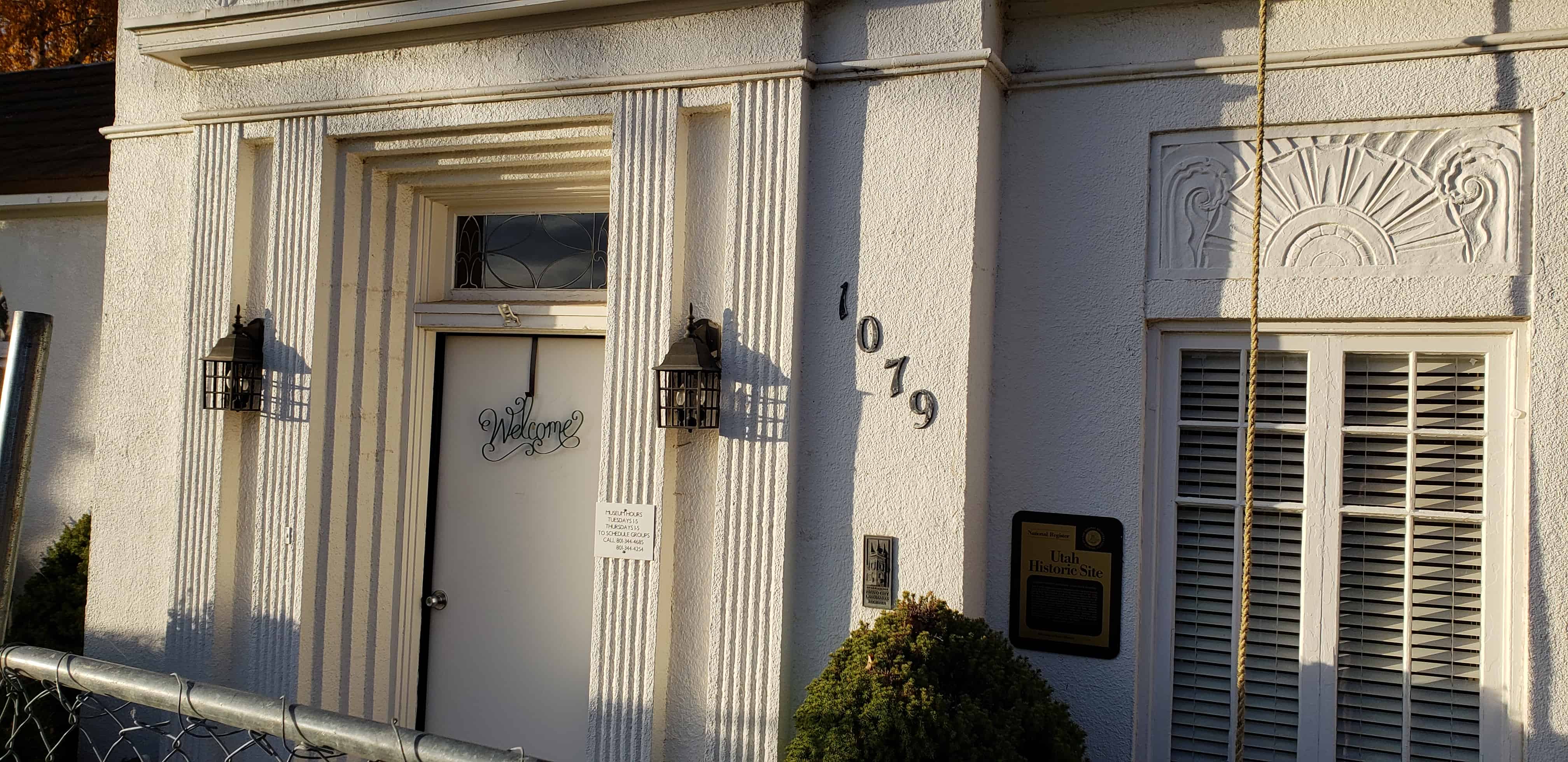
This house is a good example of a Victorian Eclectic Cottage with the Crosswing plan. The projecting front wing has Greek Revival style cornice returns. A period carriage house lends to the architectural integrity of the site. Notable owners of this property include C. W. Reid, (1906–1910) who was a member of the BYU Music Department faculty, then joined the Mccune School of Music in Salt Lake City and continued private instruction in San Francisco. Robert D. Snow acquired the property in 1940 and the property has remained in the Snow family ever since then. Mr. Snow worked at Columbia-Geneva Steel Works for 31 years before passing away in 1961.
The Lakeview Tithing Office was originally constructed as a creamery by Leslie L. Bunnell in 1899. Leslie and his father, Stephen I. Bunnell, operated a successful dairy operation for a number of years, and this creamery served as the headquarters of their business, which involved making and selling cheese and butter, as well as selling milk. It was the first creamery in Lakeview, a small, unincorporated farming community located between Provo and Utah Lake. The 16’x 16′ room on the west side of the creamery served as the home for the family, which included five children, until 1904, when the adjacent house was built. Soon after that, the Bunnells sold the creamery to the Lakeview Ward of the LDS church for use as a tithing office. The west room was used as an office and the east room served as a storage area for grain and other tithing commodities. The Bunnell family bought the tithing office/creamery back around 1920 and used it for a granary. Occasionally, the west room was used as a residence the last time was during World War II, when a single man lived there for several months. Currently the building is used for storage by the Bunnells.
The Lakeview Tithing Office, built in 1899, is historically significant as one of 28 well preserved tithing buildings in Utah that were part of the successful tithing system of The Church of Jesus Christ of Latter-day Saints (LDS or Mormon church) between the 1850s and about 1910. Tithing lots, which usually included an office and several auxiliary structures, were facilities for collecting, storing, and distributing the farm products that were donated as tithing by church members in the cash-poor agricultural communities throughout the state. Tithing offices were a vital part of almost every Mormon community, serving as local centers of trade, welfare assistance, and economic activity. They were also important as the basic units of the church-wide tithing network that was centered in Salt Lake City.
The Lakeview Tithing Office is a one story brick building with a combination gable and hip roof, a stone foundation, and a false front. There is a chimney three quarters of the way down the ridge line. The false front is typical of small town commercial buildings at the turn of the century, as is the corbelling of its upper edge, the jigsaw cut decorative elements in the wooden arches over the facade openings, and the rock-faced shoulder arches over the same openings. The false front is stepped. The facade openings consist of a door centered between two windows. Behind the lower step of the false front on the east side of the building is an extension off the main block of the building. It is a rectangular room with a shed roof and rear entrance, and is situated under the eaves of the main roof. It was probably part of the original construction. According to information in a 1975 Utah Historic Sites Inventory form, it is likely that the room was used to house a boiler that powered the machinery of the creamery. The building has received no major alterations, is in fair condition and maintains its original integrity.
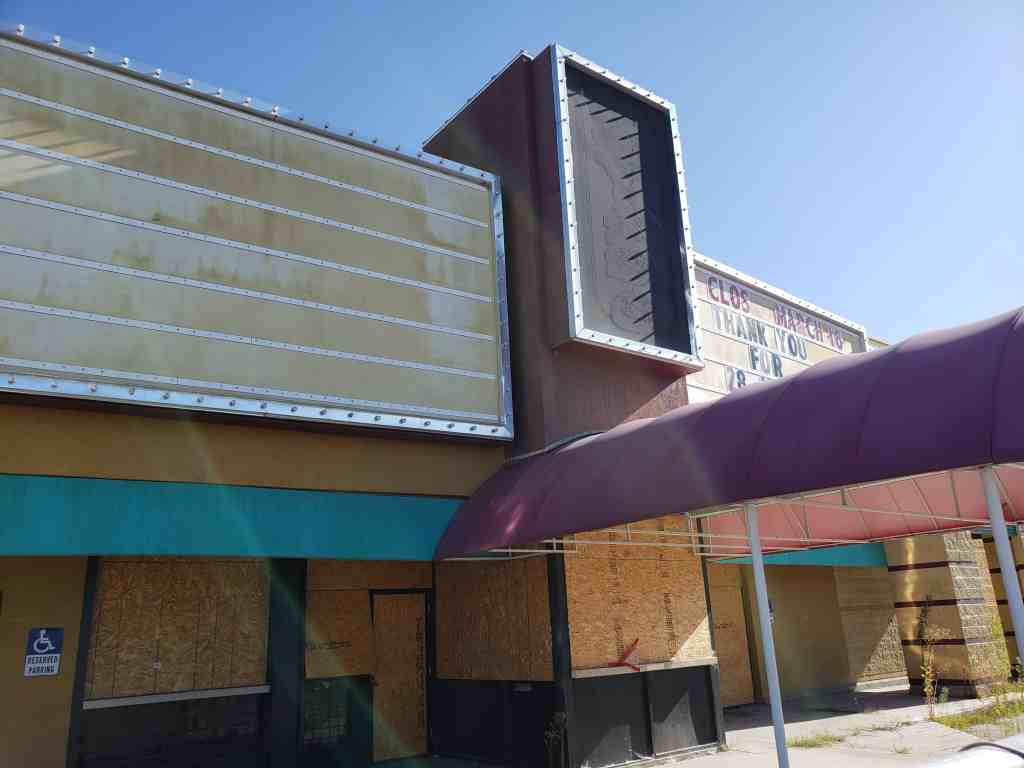
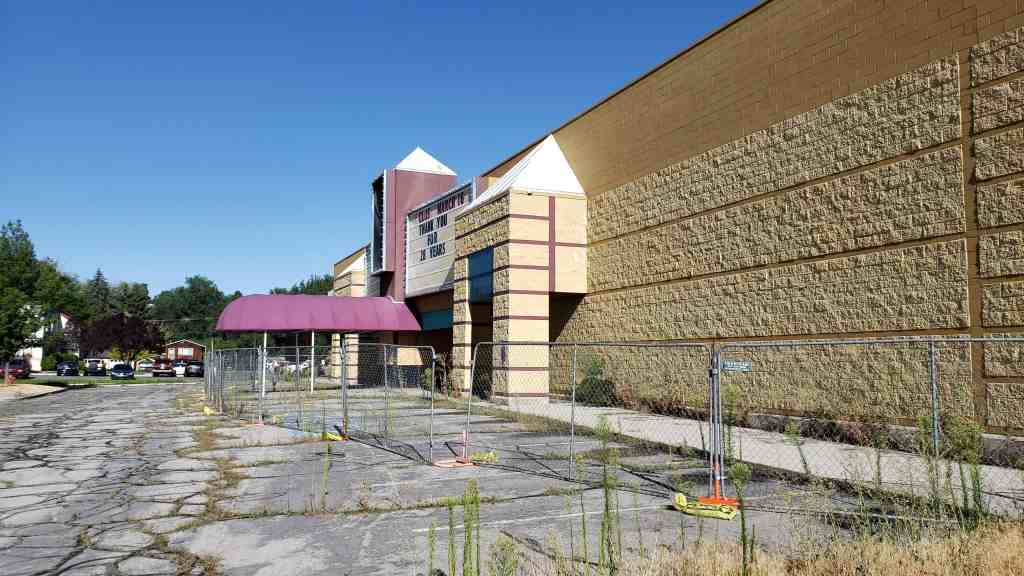
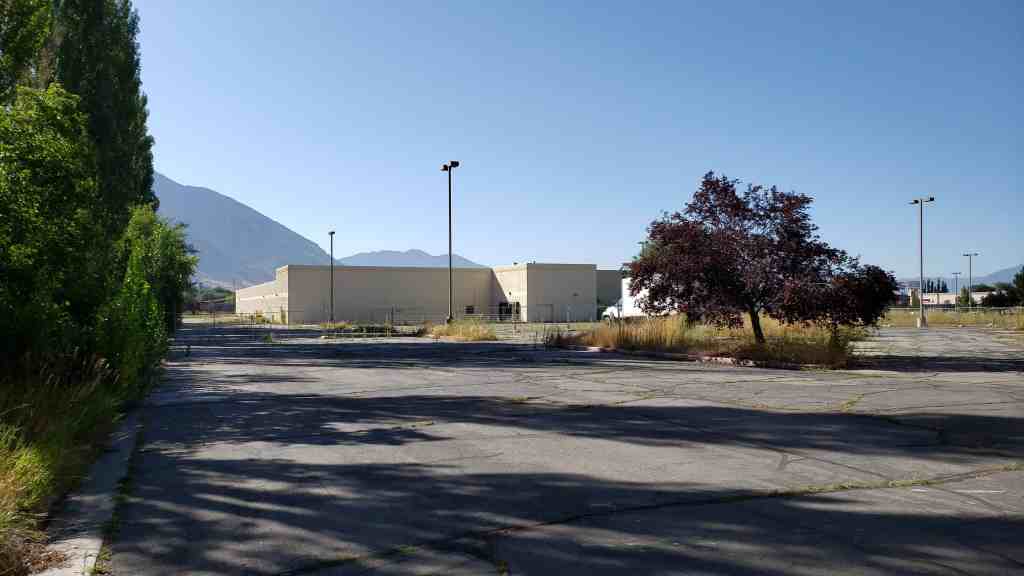
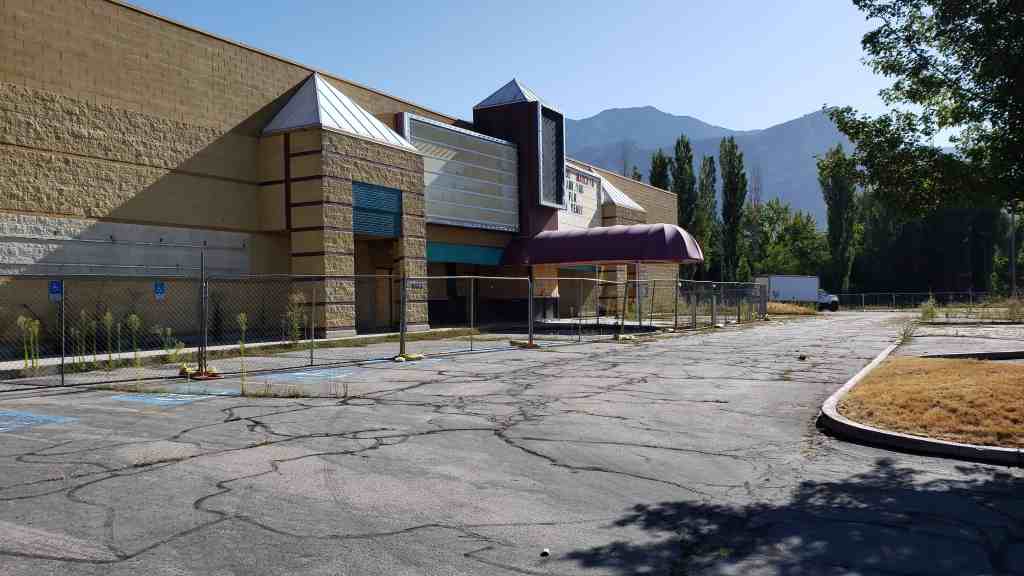
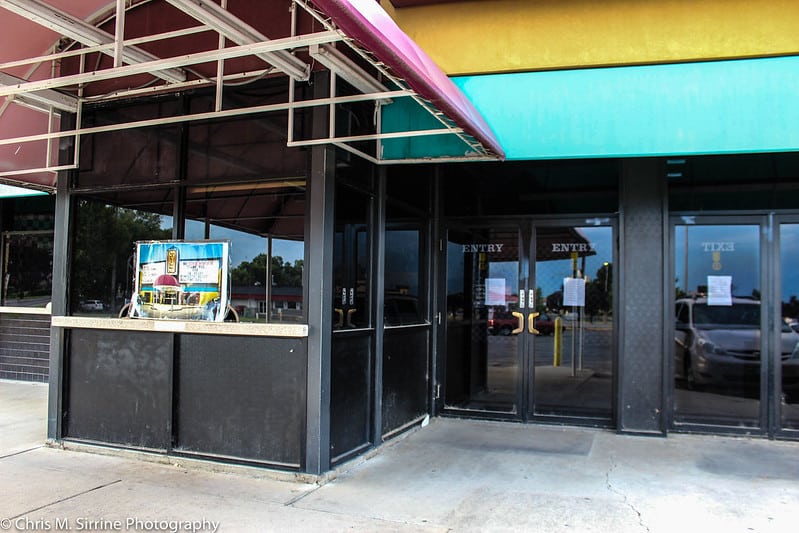
Movies 8, located at 2424 North University Parkway, Provo, Utah opened in October 1988 and was a very popular spot for local families and students for over two decades and after slowing down for a few years finally closed after 29 years in March of 2017.
It was Cinemark’s test location for “dollar theaters” and at one point in 1992 was bringing in more revenue than any of the other 150+ Cinemark locations in the US.
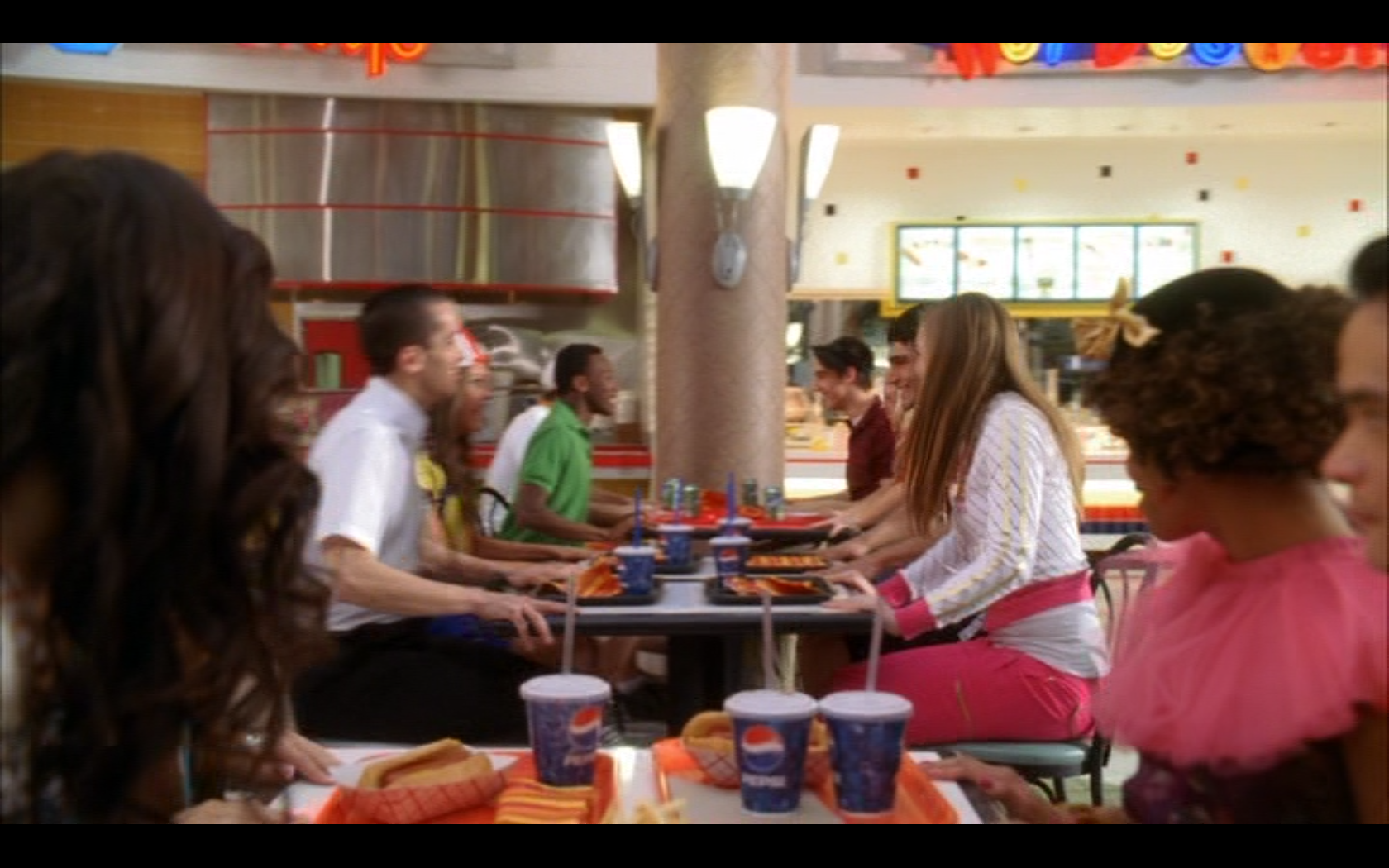
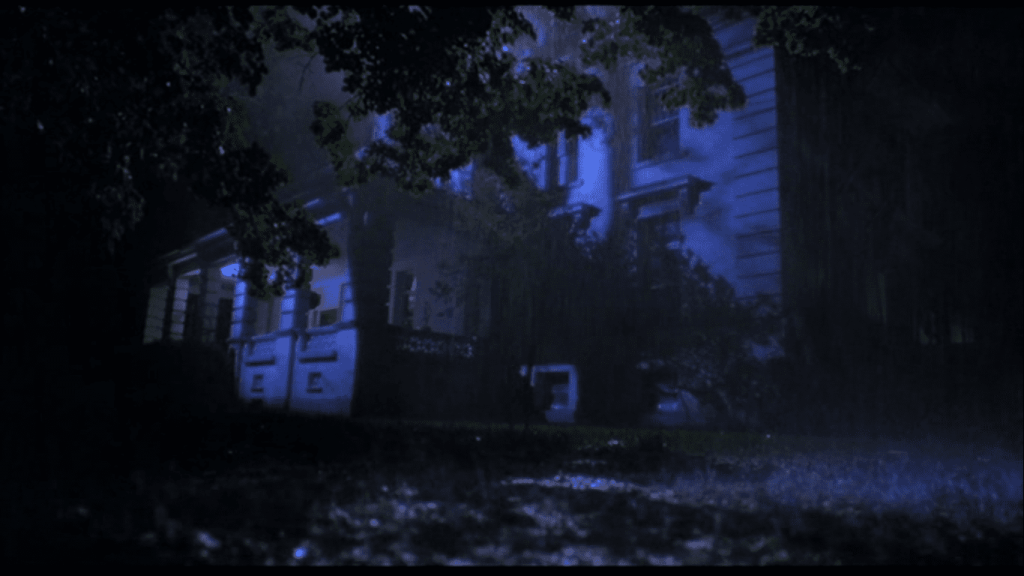
The location where they filmed the scenes for Halloween 5: The Revenge of Michael Myers (1989) that took place at the Haddonfield Children’s Clinic.
It is gated off private property owned by the power company at the Olmsted Power Plant so I didn’t get a lot of my own photos to match up with the screenshots like I usually do.
Amanda Knight Hall, named in honor of Amanda McEwan Knight, wife of Jesse Knight, was the first dormitory for women built by Brigham Young University. Completed in 1939, this three-story, red brick building was designed by architect, Joseph Nelson. ‘The blend of Tudor Revival and Collegiate Gothic architectural styles is rarely seen in Provo and contributes to the turn-of-the-century architecture found on North University Avenue. The building was dedicated by LDS Church President David O. McKay on May 26, 1954.
The Amanda Knight Hall, completed in 1939, is locally significant under Criterion C in the area of Architecture as the only, largest, and most ornate hybrid example of the English Tudor Revival and Jacobethan Revival styles in the city of Provo. The building is the embodiment of the distinctive characteristics of its period and styles of construction. It is a product related to the peak of English styles of architecture on college campuses in the early twentieth century, particularly for private universities, sometimes known as the Collegiate Gothic style. In Utah, the Jacobethan Revival style was particularly popular for educational buildings in the first half of the twentieth century. The English Tudor Revival elements provide a more domestic feel to the dormitory. The Amanda Knight Hall is also a local landmark significant under Criterion A in the area of Education for its association with the development of Brigham Young University (BYU). The women’s dormitory was built in the late 1930s during a time of growing enrollment at Brigham Young University, a private college owned by the Church of Jesus Christ of Latter-day Saints (LDS Church). It was the first and only institutional housing built for female students at BYU prior to World War II. The Amanda Knight Hall and its contemporaneous companion, the Allen Hall built for male students, were built in the residential neighborhood between BYU original lower campus and the current upper campus. Since the demolition of Allen Hall in 2018, the Amanda Knight Hall is now the only landmark building that links the lower (former) and upper (current) BYU campuses. The period of significance begins with the construction of Amanda Knight Hall in 1938-1939 and ends with the last women’s dormitory use in 1964.
Located at 42 East 800 North in Provo, Utah the hall was added to the National Historic Register (#100006910) on September 15th, 2021.
Construction on the Amanda Knight Hall began in 1938 and was completed in 1939. The property is locally significant under Criterion C in the area of Architecture as the only example of a hybrid of the Jacobethan and English Tudor Revival styles in Provo. The building was designed by local architect, Joseph Nelson, of Provo. Joseph Nelson also designed the first men’s dormitory associated with the campus: Allen Hall at 100 E. 700 North, completed in 1938. Allen Hall was a smaller complex, housing 70 male students, less than the 90 female students housed in the Amanda Knight Hall. The Jacobethan Revival architecture of Allen Hall was similar with gabled parapets, striated brick, and cast concrete; however, Allen Hall had only a small amount of decoration and no English Tudor Revival elements. The demolition of Allen Hall in 2018 helped spark public interest in the preservation of the Amanda Knight Hall. The Amanda Knight Hall was the first women’s dormitory built at Brigham Young University. It remained the only women’s institution housing for the university until the 1950s when BYU initiated an ambitious plan of constructing dormitories and apartments on the upper campus.
Brigham Young University was founded in Provo in 1875 as the Brigham Young Academy. The Academy used various commercial buildings in downtown Provo until 1892 when the Academy building was dedicated. The Academy building is a large Victorian Eclectic style building that was used by the university until 1968. The building was listed on the NRHP in 1976 (NRIS #76001839). It was restored between 1999-2001 and is now the Provo City Library at Academy Square (520 N. University Avenue). The Brigham Young Academy became Brigham Young University (BYU) in 1903. A group of buildings associated with the Academy (later BYU) were built in this location, known as the lower campus. Most have been demolished, but the Women’s Gymnasium, a NeoClassical building, (built in 1912) and a utilitarian Blacksmith Shop (1904) still exist across the street from the Academy Square. Like most public and private universities of the nineteenth century, BYU’s lower campus was a mix of architectural styles as buildings were added according to a particular donor’s fancy.
Beginning in 1894 with the construction of Pembroke Hall at Bryn Mawr College on the east coast, campus architects in the United States began emulating the venerated architecture of Cambridge and Oxford in England. A more focused version of the Victorian Eclectic, this style of architecture became known as the Collegiate Gothic style, also known as Educational Gothic. Whole campus were either designed or remade with Collegiate Gothic buildings around a central quad. Utah’s best example is Converse Hall on the campus of Westminster College in Salt Lake City built in 1906 (NRIS #78002685). Converse Hall has many elements of the Jacobethan Revival style (steeply pitched roof, window and door surrounds, bay windows), but the tall towers are a mark of the Collegiate Gothic style.
Because of the gradual transition of campus facilities from the lower campus on University Avenue to the upper campus on Temple Hill after land was acquired in 1907, BYU did not adapt the English quad model of campus planning. The Maeser Building was Neo-Classical (1909-1911), the one-story Brimhall Building (1918) was updated with Art Deco upper floors in the 1930s, and the Heber J. Grant Building was a muted example of the Second Renaissance Revival (1925). The same year Provo architect Joseph Nelson designed the Grant Building, he also designed the first President’s House at BYU, a two-story English Tudor cottage. Joseph Nelson would later design Allen Hall and the Amanda Knight Hall in 1937 and 1938 respectively.
Joseph Nelson was born in Mantua, Utah, in 1876 and graduated from the Brigham Young College in Logan, Utah.3 He later studied at the University of Pennsylvania under noted architect Paul P. Cret. Nelson won first prize in a 1908 design competition while at the university. He traveled and studied architecture throughout Europe as a young man. After establishing his offices in Provo, Nelson designed a number of institutional buildings in central and southern Utah. A biographical sketch of Nelson described his experience: “Having spent a large portion of this time in studying the architecture of the large eastern cities, specializing to a great extent on schools, churches, gymnasiums and libraries, he is especially qualified for work along these lines.”4 After a long career designing mostly institutional and commercial buildings, Joseph Nelson died at the age of 76.
The contractor for both the Allen Hall and the Amanda Knight Hall was Louis De Young.5 De Young was born in the Netherlands in 1890. He started working in the building trades at the young age of eight years old. He immigrated to Utah in 1908 and was a concrete worker before starting his own contracting business in Salt Lake City. De Young worked in a variety of building types and styles. His notable works include the dairy building at the Branch Agricultural College in Cedar City (now Southern Utah University), the remodeling of the LDS Hospital and the construction of the Yalecrest LDS Ward Meetinghouse (both in Salt Lake City). Louis De Young died in 1966.
The use of the Jacobethan Revival style for Allen Hall and Amanda Knight Hall is not surprising since the style was popular for institutional buildings in Utah from 1900s to the late 1930s. Allen Hall showed all the characteristics of the style: steeply pitched gable roofs, bay windows, and ogee arched entrances. The style was particularly distinctive for its use of stone, terra-cotta, or cast concrete for surrounds, copings, and stringcourses. What makes the Amanda Knight Hall stand out in terms of design is the seamless integration of the Jacobethan Revival with the English Tudor Revival style of architecture. The English Tudor Revival was the most popular of the European influenced styles that doughboys returning from World War I brought back to the United States. The style was popular in Utah between 1915 and 1930 and was mainly adapted to residential architecture, but also a few churches. The characteristics of the style include an asymmetrical façade, steeply pitched roofs, casement windows, and exposed framing members with infill panels of stucco. The alternating pattern of Jacobethan and English Tudor Revival ornamentation across the façade of the Amanda Knight Hall produced a surprisingly unified design.
The Amanda Knight Hall is particularly well-preserved, especially on the exterior. Contextually, the Amanda Knight Hall (and its demolished companion, the Allen Hall) represent the only phase of construction at Brigham Young University that was influenced by rise of English Revival styles (Jacobethan, English Tudor and the Collegiate Gothic) on campuses throughout the United States in the first half of the twentieth century. The two dormitories were built as BYU was transitioning to the upper campus, which would eventually be dominated by Modern-style buildings by 1968 when the university closed the Academy building within the lower campus.
The Amanda Knight Hall is locally significant under Criterion A in the area of Education as the only surviving institutional housing associated with Brigham Young University that was built prior to World War II. The property is also an important architectural representative of the history and influence of the Church of Jesus Christ of Latter-day Saints in the day-to-day operations of its flagship school: Brigham Young University. Enrollment in 1904, the campus’ first full year as a university was 899 students, with 74 in collegiate programs and 825 in the high school level academy. When Franklin S. Harris became university president in 1921, the high school programs had been phased out with the exception of teacher training, and the university enrollment was nearly 300. By the time the Amanda Knight Hall was completed in 1939, BYU was an accredited university with 2,375 students.
Aware of the need to expand the campus, the university’s most generous benefactors, Jesse and his wife, Amanda Knight, donated 7.18 acres of land on Temple Hill (now called University Hill), which Amada had originally obtained for use a public park named for her son, Raymond. The Knights owned most of the upper campus where nearly all the university’s subsequent land acquisitions were located. Jesse and Amanda Knight would eventually donate or sell nearly 500 acres to the university. Even with rapid enrollment growth in the first quarter of the twentieth century, no institutional housing was built by the university. Students lived with relatives or rented rooms in private homes throughout the city.
At a meeting in 1937, BYU President Harris reminded the Church Board of Education that the university’s only endowment fund for many years contained $200,000 and was producing an extremely low rate of interest. President Harris recommended that part of the Jesse Knight Endowment fund be used to build a dormitory for 70 to 75 male students to accommodate burgeoning enrollment. Following up on President Harris’ recommendation, Allen Hall was completed at a cost of $75,000 with a large amount of labor donated by the students. The 35-bedroom hall was designed as a cooperative housing unit where residents would donate their time to meal preparation and building maintenance. This was designed to help students with limited means. Allen Hall was the first dormitory built for BYU. The Provo Daily Herald noted that “With the erection of a new dormitory for men at Brigham Young University, Provo will take on more and more the aspect of a university city.” Allen Hall at the corner of 700 North and 100 East opened on February 1, 1938 at full capacity. The residence hall was named for Robert Eugene and Inez Knight Allen, who was Amanda Knight’s daughter. Mr. and Mrs. Allen were also generous benefactors to the university.
Allen Hall proved so successful that steps were taken to construct a similar cooperative residence hall for women, also financed partially through the Knight Endowment fund. President of the LDS Church, Heber J. Grant had to personally approve the financing. Construction on the 46-bedroom Amanda Knight Hall began in the fall of 1938 and continued through the spring of 1939. As with Allen Hall some of the labor was donated by students. The housing costs for the 90 to 100 coeds was estimated to be $20 to $25 per month, with opportunities for cooperative meal preparation and building maintenance. Several descriptions of the nearly completed building complimented the Tudor design, especially the “long Tudor dining room.” One article described the building enthusiastically in this way: “It is of authentic sixteenth century Tudor and Elizabethan architecture with ultra-modern facilities and furnishing.” The building cost was $100,000.
Allen Hall and Amanda Knight Hall remained the only dormitories until World War II when an influx of defense workers caused a housing shortage for students throughout Utah County. For a short time during World War II, Allen Hall housed young women as the number of male enrollees dropped considerably, while female enrollment increased. Portions of buildings on the lower campus were converted to temporary dormitories. These buildings were part of the Brigham Young Academy Historic District in 1976 but were later demolished.
To alleviate the shortage for female students, BYU purchased a number of private houses to serve as cooperative housing. One known example, the Iona House, named for Iona Knight Jordan, was located at approximately 710 N. 300 East. About 30 female students occupied Iona House during the war years and during a dramatic increase in enrollment in the decade after World War II. Iona House was demolished in the early 1990s. Warnick House, located kitty-corner from Allen Hall, at 694 N. 100 East, housed a similar number of female students in the same time period. Warnick House was probably named for Effie Warnick, the dean of the Home Economics department. The house, built in 1916, is extant, but it has been a single-family dwelling since 1992. There were at least two other cooperative houses, but their addresses are unknown.
In the years after World War II, enrollment at BYU doubled to over 5,000 by 1951, the year Ernest W. Wilkinson became university president. Only about a quarter of students lived in universityowned housing. Most of the students still lived in privately-owned houses and apartments in Provo and the neighboring communities. By 1951, the occupancy of Amanda Knight Hall had risen to 140 to female students, Allen Hall housed 110 male students, and there were 111 student living in various cooperative houses. On the upper campus, BYU had acquired 26 barracks from the Ogden Arsenal at the close of World War II, which housed 350 single students and 200 married families in 1951. The barracks were eventually replaced by mobile homes in 1956 (Wyview Village, demolished circa 1970) and student family apartments in 1962 (Wymount Terrace, partially intact). In 1948, BYU remodeled a 1930s youth training school into the Knight Mangum Hall on the upper campus for 340 female students in 1951 (used as housing for a few years only, demolished in 2008).
With a goal of housing approximately half the students on campus, BYU built several large-scale Modern-style student housing projects in the 1950s and 1960s. Between 1953 and 1956, a complex of 24 residential buildings known as Heritage Halls were built on the upper campus. Each building was named for a notable LDS woman. The living arrangement in these halls was more apartmentlike with six unmarried female students sharing a kitchen and bathroom, which became a model for approved off-campus housing. Heritage Halls was replaced by a new set of apartment buildings constructed between 2011 and 2015. Several new Heritage Halls (2015-2020) replaced the dormitory-style Deseret Towers (built in 1965 and demolished in 2006-2008). Helaman Halls, built in 1958, and renovated in the 1990s, is the only remaining twentieth-century dormitory-style complex on campus.
Even before construction began, the name Amanda Knight Hall was chosen for the first women’s dormitory at BYU. The Amanda Knight Hall was the first building to be named in honor of a woman at BYU. The building was dedicated, along with 22 other campus buildings, by LDS Church President David O. McKay on May 26, 1954.10 Since the demolition of Allen Hall in 2018, the Amanda Knight Hall remains the only extant dormitory building, which was built prior to World War II and linked to BYU’s historic lower campus.
Amanda Knight was born Amanda Melvina McEwan in Salt Lake City on November 13, 1851. She married Jesse Knight on January 18, 1868. Jesse Knight (1845-1921) was one of the very few Mormon mining magnates in Utah. Poor throughout his youth, Knight struck it rich with the Humbug Mine in the Tintic Mining District in 1886. Knight was known for his benevolence toward his mine workers and their families, earning him the nickname “Uncle Jesse” for most of his life. The couple lived in Payson, Utah, for several years before building a large mansion on Provo’s Center Street. Their mansion was listed on the National Register in 1982 and is a contributing building in the Provo East Central Historic District (NRIS #82004174 and #98000281). Among their many philanthropic endeavors, Jesse and Amanda Knight shared an interest in supporting Brigham Young University. The financial support earned Jesse Knight, a second nickname: the “patron saint” of BYU. The campus has the Jesse Knight Building and several monuments to him, but only the Amanda Knight Hall honors her contributions.
As a mother, Amanda sought to further the education of her six children. For that reason, the family moved from Payson to Provo. One tribute noted “She was particularly interested in assisting young people to gain an education and awarded scholarships for that purpose.” Amanda Knight continued her philanthropic work for the university after the death of her husband in 1921, until her own death at the age of 81 on December 15, 1932. Although the name of the building honors her, Criterion B was not selected for this nomination, since Amanda Knight died before it was constructed, making it a commemorative rather than an associated property.
Professor Effie Warnick was chosen to be the first supervisor of the Amanda Knight Hall. Effie Warnick (1883-1965) joined the BYU faculty in 1922. By 1935, Warnick was a full professor and the chair of the Home Economics department. According to one source, Effie Warnick contributed to the design of the dormitory. The 1940 census enumeration lists Effie Warnick as the head of household at Amanda Knight Hall, presumably living in the supervisor’s apartment on the second floor. The census listed another faculty member in residence, Ileen Ann Waspe (1903-1943). Ileen Waspe was the assistant dean of women at BYU when she retired to marry Wilford LeCheminant in 1942. The census lists only nine students living at the hall in April 1940. Three were from Mexico, two were from Hawaii, two from Utah, and one from Canada.
In 1964, Amanda Knight Hall was no longer used as a female dormitory. Teacher training workshops were held in the building in the 1960s. For a time both Allen Hall and Amanda Knight Hall housed church missionaries to accommodate overflow from the Language Training Mission in Salt Lake City. This use presumably was continued until the Missionary Training Center was built above BYU’s upper campus and all missionary training transferred there in 1978. Among its many subsequent uses, the Amanda Knight Hall has been home to the BYU Arts Department and most recently, the English as a Second Language program. In 2019, BYU sold the building to the current owner. The rehabilitation was completed and approved as a state and federal tax credit project in 2021.
This page is to condense and link to other posts on this website that relate to the Provo Tabernacle which later became the Provo City Center Temple.
There was some debate about where to put the first tabernacle, it was finally dedicated in 1867 and then demolished in 1918. (read about that here.)
I don’t have a lot of photos of the original tabernacle but here is one.
The new tabernacle was built in 1898, for 20 years after that and before the original was demolished the original was used as a meetinghouse. The lintel stone from the original can be seen here.
Here you can see a photo taken after the new tabernacle was built but before the original was demolished.
Some photos I took of the rebuilding process after the fire, spanning 2013 to 2017 can be seen here.
Some pictures of the property around the temple are here.
The tabernacle is located at 50 South University Avenue in Provo, Utah and was added to the National Register of Historic Places (#75001830) on September 9, 1975. The text below is from the nomination form from when it was submited:
The Provo Tabernacle is significant for both religious and architectural reasons. It is still the place where great nesses of Mormons come to hold their conferences. It is also the major symbol of pioneer accomplishment in Utah Valley. The Tabernacle is used by the Utah Valley Symphony and other groups promoting cultural, political and religious betterment,, causes which were greatly espoused by the pioneers in Utah Valley.
Since the destruction of the old tabernacle in 1919 and the later razing of the old court house and others of Provo’s historic buildings, the Tabernacle stands out as the roost important architectural landmark in the valley, Both its monumentality and its architectural refinement continue to told the observer somewhat awestruck. The building is useful, beautiful and it should continue to serve the community for countless years.
Description –
The present Provo Tabernacle was built clue south of the older tabernacle constructed 1856 to 1867, which continued to stand until 1919* The old tabernacle could seat 1100 to 1300 people, but in 1882 was deemed too small and a decision was made to build a tabernacle that would house three times the number of people as did the older edifice. At a quarterly conference held, in September, 1882, a building committee was chosen and soon after,, work on the tabernacle began. The following description of the building was made in 1914, four years before its renovation: “Located in Provo, Utah and erected between 1883 and 1896, it is made of brick and stone, the superstructure being of brick, The building measures 128 by 75 feet and 40 feet to the square. The seating capacity is three thousand. It cost between eighty and ninety thousand dollars, There is one auditorium and a vestry. William H. Folsum was the architect. Building supervisors were Elder H. H. Cluff, and later. Elder Reed Snoot. The building was so far completed that the general conference of the Church of Jesus Christ of Latter-day Saints was held in it in April, 1887.
Another description, made in 1947, also tells of the building’s interior: “The Provo Tabernacle, located on University Avenue between Center Street and First South Street, was erected at a cost of $100,000, It is built of red brick and set in wide lawns covering most of the city block. The building has octagon towers at each of its four corners. A central tower that arose above the lintel to the height of 140 feet was later removed, being too heavy for the roof. Cathedral windows are used throughout the building, and beautiful ivy vines cover the walls. The interior is finished with painted- stained and varnished sugar pine wood. The stand was designed by Thomas Alltman, When first finished the benches were made with straight backs and the seats were covered with red velvet later these were replaced by curved back, spring-filled. leather upholstered benches. A green plush curtain separated the choir from top pulpit and speakers. When the green curtain was removed, the space was filled with a strip of fir lumber, beautifully designed, carved and engraved by Thomas M. Allman, which has been admired by many church leaders, diplomats, and thousands of Saints and friends. The balcony extends around the entire assembly hall and the building is well lighted, heated and ventilated. The pipe organ was imported by D. O. Calder and was one of the finest to be bought at that tine. The Tabernacle has been in service for sixty years, being used for church gatherings and other special occasions. It has a seating capacity of 3000 people.
At the time it was completed, Utah Stake boundary lines included all of Utah County. All joint meetings and special church assemblies, including the semi-annual conference in October, 1886, were held in the Tabernacle, At the present time Provo and Utah Stakes use the Tabernacle jointly, arranging quarterly conferences at different tines.
Another report states that the indebtedness upon the building was liquidated by the “50¢ Fund” which called upon men in the stake to contribute 50¢ a month toward the building, and women 25¢.
The building was partly condemned in 1918 because the roof was under great stress from the large tower which sat at the crossing of the ridges, The building was renovated at this time, but the tower was permitted to stay until 1949 when the building was again condemned. At that time the building was about to be destroyed when Provo architect Fred Markham stepped in just in time to save the structure. He designed a method for removing the central tower and rebuilding the roof and in this manner the tabernacle was saved. This work was done in 1950. Stake meetings continue to be held frequently in the edifice.
The Provo tabernacle is a stately structure. It is slightly cruciform in plan and is a split-level with two full stories altogether. At each of the four major corners is a large, octagonal tower. At the east end they also serve as vestries. The towers have a combination of Gothic and segmented bays, each having corbeled arches and keystones. The towers have molded cornices and segmented, conical steeples. The four major gabled ends are extensively detailed. Features include a corbeled dentil run with, tiny Gothic arches, a curious terminal piece at the top of the gable, a swooping., steep roof pitch, indented Gothic arches, large Gothic windows with central mullions and several other decorative elements which harmoniously combine to give an overall effect of dignity and grandeur. In the English tradition ivy grows on the walls. The city fathers themselves once admitted that s the design was adapted with the view of preserving among us a reminiscence of a Presbyterian meetinghouse, that the children of the saints might see in what kind of edifice their fathers worshipped before they heard the gospel.” With this in mind we can better appreciate some of the unusual decorative elements of the building. The central tower which was taken away was wider and had a taller steeple than the existing towers. It sat on a square pedestal. From the ground level to the top of the tower the height was 140 feet.
The interior assembly hall is a spectacular space. The original pews, horseshoe gallery, decorative woodworking and beautiful organ loft with exposed pipes remain as a tribute to the craftsmanship of our pioneer ancestors. Below the chapel are four rooms for the accommodation of the Stake Presidency, High Council and auxiliary Stake boards. On the top floor is a circular prayer room with dressing rooms attached. There is also a baptismal font with dressing rooms in the basement. The treatment of the interior is tastefully lavish and. inspiring. There is an especially impressive mood in the morning when the sunlight floods into the huge chapel through the many stained glass windows.
The house is a good example of an English Tudor period cottage. The steep roof pitches, large front chimney, round arched entry and multicolored brick are elements of this style. The property has been owned by members of the Pierpont family since 1962. The Pierpont name is well known due to Thomas Pierpont, who was prominent in the steel and foundry business. Other owners of this home include Albert and Pauline Taylor (1937 to 1953) and Ralph and Elaine Bringhurst (1953 to 1962).
Built in 1934, this residence is a one-and-a-half story, brick Colonial Revival style house. The Superintendent’s Residence is historically significant because it helps document the impact of New Deal programs in Utah. The Superintendent’s House is one of 232 buildings constructed in Utah during the 1930s and early 1940s under the Works Progress Administration (WPA) and other New Deal programs. In 1933 Utah had an unemployment rate of 36 percent, the fourth highest in the country. For the period between 1932-40, Utah’s unemployment rate averaged 25 percent. Because the depression hit Utah so hard, federal spending in Utah during the 1930s was ninth among the 48 states, and the percentage of workers on federal works projects was far above the national average. During the 1930s virtually every public building constructed in Utah, including courthouses, city halls, fire stations, and a variety of others, were built under the direction of federal programs.