Tags
Westridge Elementary School
02 Friday Jun 2023
Posted in Uncategorized

02 Friday Jun 2023
Posted in Uncategorized
01 Thursday Jun 2023
Posted in Uncategorized
07 Sunday May 2023
Posted in Uncategorized
Fruita Schoolhouse
The Fruita School house is one of the few remaining early structures in this region of Utah. Because of the geographical isolation of the valleys of Sulphur Creek and Fremont River, this section of the state was the last to be explored and settled. The first permanent settler, Niels Johnson, located a homestead near the junction of the streams in 1880. The tillable land in the narrow valleys could support only 8 to 10 families, and the almost impassable roads isolated the community from the outside world.
As the earliest school house of the area and typical of certain log structures built. at the time, it is a significant building. It is a well constructed building of squared logs; the sturdy structure, and fine detailing of window and door trim is a tribute to the local builders who probably had little professional assistance.
The one-room school building was built by the pioneers of the community who were largely members of the L.D.S. Church. It was constructed on the site where it now stands in the early 1890s. Elijah Cutler Behunin donated the ground before 1892, and inquiries indicate that Behunin and others of the community built the structure in 1892, or possibly as late as 1894. Nettie Behunin, daughter of the above, was the first teacher, and eleven children of Behunin, Pierce and Pendleton families were enrolled early. In 1895 the district was organized and known as the Junction School Precinct. It continued to be used as the grade school of the community until 1941. Since that date it has remained unoccupied.
The Schoolhouse is located in Capitol Reef National Park and was added to the National Historic Register (#72000098) on February 23, 1972.
04 Saturday Mar 2023
Posted in Uncategorized

Ogden High School, completed in 1937, together with the U.S. Forest Service Building (1933) and the Ogden/Weber Municipal Building (1939), are exceptionally important as the most significant Art Deco structures in Ogden and the state of Utah. These structures gain added importance as works of the architectural firm of Hodgson and McClenahan, and are excellent examples of federal, work projects initiated during the Great Depression of the 1930s. Leslie S. Hodgson, who designed the school, has been labeled as the most important architect of the Ogden-Weber County area from the late 19th to mid 20th century. The Ogden High School was regarded as his “masterpiece, the culmination of almost four decade’s work.”
Located at 2828 Harrison Boulevard in Ogden, Utah and added to the National Historic Register (#83003201) on June 7, 1983.
Related:

Public works projects formed an important part of the federal government’s response to the depression of the 1930s. The Public Works Administration was established under the National Industrial Recovery Act, and was continued by the Emergency Relief Appropriation Act of 1935. This agency was authorized to make loans and grants available for “non-federal construction projects of states, counties, cities, territories, and possessions, and to conduct federal demonstrations of slum clearance and low-rent housing.” Such projects were financed by PWA grants from Federal Emergency Relief Administration funds for a portion of the total cost. The remaining cost was usually paid by the local bodies sponsoring the projects.

As early as June 1933, Ogden City, Utah was seeking some $1,745,000 from the state PWA director, R. A. Hart, with the Ogden City Board of Education applying for $600,000 for a new high school. Sources indicate that after delays in funding, plans were executed by the architectural firm of Hodgson and McClenahan for the structure. The contractor for the building was the company of George A. Whitmeyer & Sons. Leslie S. Hodgson, who produced most of the design concepts for the firm became noted for his ability to work with a wide range of architectural styles, from Prairie School and Egyptian Revival to the Art Deco, for example. The high school was considered his “masterpiece,” as he designed it and supervised its construction.

Completed in 1937, Ogden High School cost about $1,150,000. Ogden’s “Million Dollar School” was lauded locally as “truly a magnificent structure, modernly equipped,” with credit going to the Board of Education, PWA, and local voters who provided needed funding for the project. At dedicatory festivities,
state PWA director, R. A. Hart, listed his agency’s objectives as putting men to work, and constructing worthwhile buildings. He stated further that Ogden City and Weber County had done more for recovery through construction projects than any other unit in the state. The high school became a source
of community pride, with a Kiwanis arboretum and lane dedicated at the site in April 1938.

The building remains as the Ogden High School. Remodeling was completed at the school in the late 1970s, by the architectural firm of Sterling R. Lyon, with Barbara G. Cowley, project designer. This was accomplished tastefully, and reflects the continued pride held for the building.

Architecture:
The corner stone of Ogden High notes that it was Public Works Project #1423. Like the U. S. Forestry Service Building and the Ogden/Weber Municipal Building, it was designed by the firm of Hodgson and McClenahan during the 1930s when both public works projects and the Art Deco Style were predominant
on the American architectural scene.
Ogden High School, completed in 1937, was built of tan brick with glazed terra cotta trim. The horizontal massing almost negates the vertical implications which are so characteristic of the Art Deco Style. The asymmetry of massing also varies from most Art Deco prototypes. Flat roofed, similarly detailed rectangular units of varying height are collected into an overall grouping. Interior space use administrative offices, classrooms, gymnasium and auditorium) is implied by the exterior massing.
As in the other Art Deco buildings, vertical bands of metal frame windows are separated by brick pilasters. Spandrels reveal decorative masonry with the geometric Art Deco character, stressing verticals and diagonals in the corbelling patterns. Top spandrels and pilasters are terminated by terra cotta trim reflecting the undulation of the wall plane below.
The main entrance is determined by a tall rectangular mass. Cast terra cotta spandrels here have geo-floral motifs. There is greater spatial undulation here than in other parts of the building and a more vertical feeling. Each of the four entrance doors has a geometric patterned metal grill transom. The original exterior lamps at the entrance are extant, reflecting Art Deco design considerations.
The school interior remains largely unchanged and well preserved. Polychromatic wall stencils, patterned floors, marble dados, metal trim and plaster work are extant. The library was recently renovated (late 1970s) in a way most sensitive to the original design. Subsidiary buildings on campus and all exterior modifications also sensitively reproduce the character of the main building in scale, massing, materials, and trim. The nomination includes the school and gymnasium building.
02 Thursday Mar 2023
Posted in Uncategorized
Tags
Chapels, Grand County, Historic Buildings, Historic Churches, Historic Markers, Moab, museums, NRHP, Schools, utah

Moab L.D.S. Church
Constructed of adobe in 1889, the Moab L.D.S. Church was built nine years after the establishment of Moab in 1880. Angus Stocks supervised the laying of the foundation and adobes. Within a few years of the original construction, an addition was made to the rear of the building. The church was used by the Moab Ward until 1925 when a new church was built and this church deeded to the Grand County School District. In 1937 the Grand County Camp of the Daughters of the Utah Pioneers began holding meetings in the building and have continued to use the building, with the exception of a ten year period between 1954-1964 when it was used for classrooms.
The Moab L.D.S. Church is located at 45 North 200 East in Moab, Utah and was added to the National Historic Register (#80003907) on November 28, 1980.
Related:

This 1889 stuccoed adobe structure is emblimatic of the LDS origins of Moab and the continuing importance of religion in the life of that community and is significant as a late example in Utah of a church building which exhibits the Greek Revival influence. It is of typical pioneer architecture, constructed of locally-available materials through the efforts of many local citizens, and its T-shape plan reveals the rapid growth of LDS Church membership during Moab’s early years of settlement. This structure was also the only religious building in Moab until 1910, when the Baptist chapel was formally dedicated.

The Moab area was long of interest to many groups because the Colorado River could be easily crossed at that point. Moab (then unnamed) was on the Old Spanish Trail, it became the site of the Mormon Elk Mountain Mission in 1854-55 and was sporadically used as grazing lands for cattlemen from both Utah
and Colorado in the 1860s and 1870s. Both Utes and Piutes claimed the land, and were partially responsible for the quick demise of the Elk Mountain Mission.
The present town of Moab dates its official founding from the establishment of the post office on March 23, 1880. The town served as a regular stop on the mail route from Salina, Utah to Ouray, Colorado, the first and only route in southeastern Utah and much of western Colorado. As a fragile link to the outside world, it was of tremendous importance to settlers in the area who tended to congregate at mail stops, hence increasing the population of towns like Moab. Most of those early settlers of Moab were Mormons, and on February 15, 1881, visiting church officials organized the Moab Ward with Randolph H. Stewart, bishop, Alfred G. Wilson, first counselor, and Orlando W. Warner, second counselor.
At the time of the Ward’s founding, Moab was part of the Emery Stake. However, in 1884 the Moab ward became part of the San Juan stake and began acquiring property. The Church lot was sold for $100 by the patentee, Leonidas L. Crapo, to Bishop Stewart and Counselor Warner in 1884. The bishop, a polygamist with three wives, was sorely pressed by the “raids” of the time and in 1885 transferred the land solely to Warner for $500. The following year Warner deeded all of Lot 1 to the Moab LDS Church Trustees-in-Trust: Henry Holyoak, Jefferson A. Huff and David A. Johnson.
In 1888 the building program began. “For the first part of the building, O.W. Warner, Henry Holyoak, and O.D. Allan were appointed as the building committee. Labor, money, and building materials were donated by the Church members. Angus Stocks supervised the laying of the foundation and the adobes (which) were made in the Jonathan Huff place.. .Hyrum Alien supervised the hauling of rock…from the canyon east of Moab. J.H. Staniford supervised the carpenter work. Lumber, shingles, windows and doors were ordered from Salt Lake City. Everyone with a team and wagon helped with the hauling.. .Bill Bliss cut the stones for the foundation and Angus Stocks laid them. Mr. Bliss helped make adobes on the Huff place. John Holyoak, Mrs. Mary Murphy, and their two oldest boys hauled the adobes to the Church site.” “Grandpa” Henry Holyoak cut logs from Pack Creek to make lumber at his sawmill. Many other community members aided in construction.
However, even as the church building rose, the town population also increased. When church members congregated for the first service in 1889 the building proved too small to hold them. Builders added another room sometime prior to 1900, giving the building its present “T” plan. For many years children attended Sunday school in the basement.
In 1902 the Moab LDS Church incorporated, and the Trustees-in-Trust deeded the land to the bishop, David A. Johnson, who immediately deeded the land to the Moab Corporation of the LDS Chruch, all in that year. Until 1925 this building continued serving as a church, until the population of the faithful
increased beyond the capacity of this structure. A new church was built at a cost of $30,000, and a newer one for $200,000. In 1925 the first church was deeded to the Grand County School District, who still retains ownership.
From 1925 to 1937 this building remained vacant. On November 3, 1934 the Grand County Camp of the Daughters of Utah Pioneers was organized and began meeting in private houses and in the Relief Society rooms of the newer LDS Church. As their membership expanded, they needed more space, and in 1937 the School Board allowed them to begin meeting in the original IDS Church. At their first meeting there, on May 26, 1937, “Daughter Mary presented the Daughters with an Organ” which still remains at the Hall. On October 28, 1937, “Daughter Mabel Johnson donated a stove for the rooms of the DUP. It was decided that members would take turns in furnishing coal and kindling for the fires and should also take turns in starting the fires, on meeting nights.” Finally, the Daughters installed linoleum removed from the local hospital, for which they had made curtains. At the April 28, 1938 meeting the Daughters organized a committee for gathering relics.
Since that time the original church has served as the DUP meeting rooms and Relic Hall with the exception of a ten-year period from 1954-64. During this period of Moab’s uranium boom, the school district reclaimed the building for use as classrooms and added the door at the left rear of the building to
permit easy access. They also installed a new, lower ceiling in the front part of the structure in a room then used for band class.
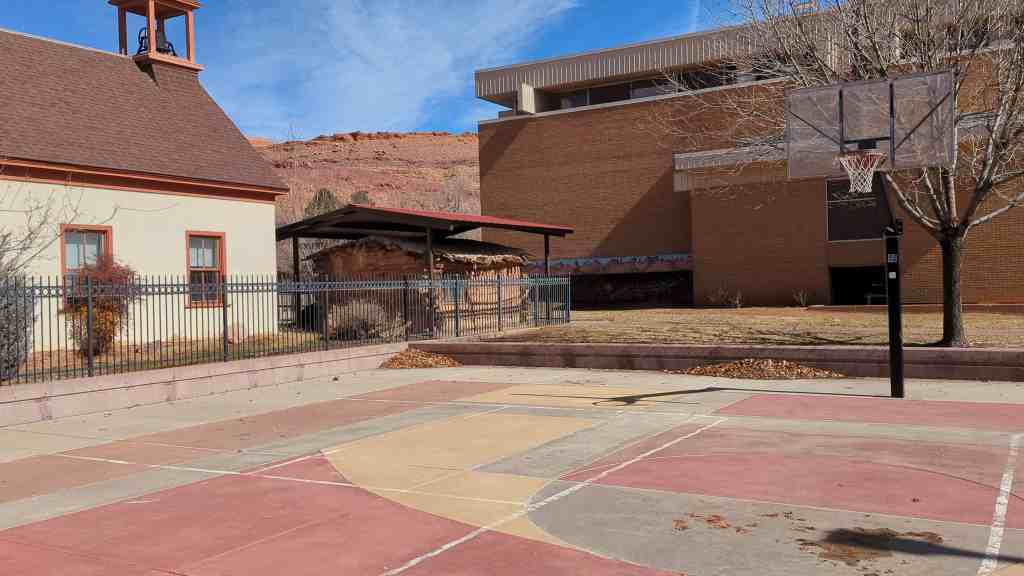


The Moab L.D.S. Church is a one story, gable roof building, originally built with an I plan, but later extended to a T plan. It was built of adobe with a rock foundation and later stuccoed over. A belfry is mounted on the ridge of the roof over the main entrance. Slender chimneys with decorative brick coursing occur at each end of the extension. Greek Revival influence is evident in the orientation of the church with the gable end to the road, and in the boxed cornice which returns on the gable ends. The single door on the façade has a Greek Revival-type of pediment. According to an old photograph, a small circular window was centered over the door which no longer exists. There are three two over two double hung sash type windows on each side of the original building. With two exceptions the same type of window was used on the extension. A six over six double hung window with a transom has been used on the rear and on the north wall of the extension. Alterations to the original structure include the major rear addition, the elimination of the circular window, and the lowering of an interior ceiling. A rear door with a
frame extension over it was added to the rear extension and the larger windows also may not be original. The stuccoing of the entire building dates later than the construction of the original building and its extension.
26 Sunday Feb 2023
Posted in Uncategorized
Tags
08 Sunday Jan 2023
Posted in Uncategorized
Tags
Clark County, Gymnasiums, Historic Markers, Mesquite, Nevada, New Deal Funded, NRHP, PWA, PWA Projects, Schools

School and Gymnasium Block
Public Square, Circa 1894
Tent Chapel and School, circa 1899. When Mormon settlers came to Mesquite Flats in 1894, they designed the southeast corner of this block as the Public Square. It was a place where the community gathered for many events. At this site a tent was set up circa 1899 for use as a chapel and a school. It was 16′ x 16′ with no windows, no heat, a dirt floor, and only logs to sit on.
Block School, circa 1922.
The Block School, so-named because it was made of cement block, had four classrooms and an auditorium. It stood on the southeast corner of the block until it was replaced with a new campus in the 1960’s. The Church of Jesus Christ of Latter-Day Saints rented the schoolhouse for meetings and gatherings for several years.
Gymnasium, circa 1938.
This red brick gymnasium was built adjacent to the Block School and became the center of recreation for the community. The gymnasium was placed on the National Register of Historic Places in 1992. It represents Italian Renaissance REvival style architecture. Construction of the gymnasium was funded through the federal Public Works Administration (WPA) program.

This is Mesquite Historic Marker #9 (see others on this page) located at 51 East 100 North in Mesquite, Nevada.
The Mesquite High School Gymnasium was added to the National Register of Historic Places (#92000119) on March 10, 1992.


From the national register’s nomination form:
The Mesquite High School Gymnasium is significant under Criteria C in the area of significance of Architecture. Built in the Italian Renaissance Revival Style, it is representative of the historic context “Schoolhouse Architecture in Southern Nevada’s Fifth Supervision District, 1870 to 1942.” It is significant as an example of its style as well as its rare use of terra cotta and tinted concrete brick. The Mesquite Gymnasium is illustrative of the School Support Building property type, and possesses the characteristics of that type in terms of its historic use, which reflected the expanding educational curriculums of the 1930s, and its functional design, which incorporated a central gymnasium with classrooms on the perimeter. The building is representative of the Custom Architecturally Designed Schoolhouse property type as well. It embodies the characteristics of that type in terms of the formality of its style, and the special attention paid to the spatial organization of the building’s uses.
School support buildings were important components of the expanding role of education that occurred beginning in the early 20th Century. Their function and necessary large size often required designs and methods of construction quite different from traditional school buildings. Almost always designed by architects, and usually in the formal styles, the school support building became symbolic, not only of educational reform, but also of community stature.
Funded by the federal Public Works Administration (PWA), the Mesquite Gymnasium was designed by Salt Lake City architect Miles E. Miller, and built by Salzner-Thompson, contractors. Miller also designed gymnasiums in the nearby towns of Bunkerville (1939) and Overton (1938) under the PWA program. The Mesquite Gymnasium exemplifies the public architecture sponsored by the federal relief programs of the Depression era. The federal government promoted subdued or minimal versions of the traditional styles associated with public buildings. Those styles were mostly drawn from Italian Renaissance or classical examples. They also promoted the use of modern, fireproof materials, particularly concrete and steel.
The design of the Mesquite Gymnasium illustrates that preference through its incorporation of elements of the Italian Renaissance Revival Style in a simple, straightforward manner. Stylistic features of the Mesquite Gymnasium that typify the Italian Renaissance Revival model are strict attention to symmetry at the principal façade, a division of the façade into three primary bays, and classical detailing of the cornice, entry frontispiece, pilasters, and doorways. The gymnasium entrance bay is designed with a pair of fluted classical pilasters flanking each side of the recessed, round arch doorway. The pilasters terminate at an ornate entablature and cornice that extends the length of the facade. Those elements are built of tan terra cotta. Although a common architectural product, its application on Southern Nevada school buildings is rare. The stylized frieze at the gymnasium eave is also decorated with terra cotta, in the form of medallions.
Aside from the application of terra cotta ornamentation and symmetry of the building, the design makes little additional reference to classical architecture. The balance of the gymnasium’s design is, however, in keeping with the concepts of minimalism, simplicity, and use of modern materials, as promoted by the federal government. Windows along the front of the building, which shed light into classrooms, are organized in groups of five and are tall, steel sash awning windows. Other windows are symmetrically located and also constructed of steel. Tall, arched windows along the rear wall of the gymnasium, now infilled, were also constructed of steel sash.
The use of brick-size, red-tinted concrete masonry units is regionally rare, but reflects the desire to use modern fireproof materials that simulated traditional clay brick. Although briefly popular during the 1920s and 1930s, the use of concrete brick was not economical and was soon replaced with larger concrete block, which required less material to manufacture and less labor to erect. The masonry work at the gymnasium is well detailed, with stepped back reveals at the building corners, and soldier courses at the water table and as a decorative band along the upper walls of the lesser facades.
30 Sunday Oct 2022
Posted in Uncategorized

Goldfield High School
Built in 1907 by architect-builder Joseph F. Rannells, it is one of four stone schools built from 1906 through 1908, and one of only two still surviving. The high school originally housed four hundred students, and features a large skylight window in the main hall.
Located at 321 Euclid Avenue in the Goldfield National Historic District in Goldfield, Nevada


08 Saturday Oct 2022
Posted in Uncategorized
Tags

Dutch Flat was first settled by German brothers, Charles and Joseph Dornbach, and their wives, who built a log cabin on this site in the Spring of 1851.
In 1859, the Dornbachs donated land for a schoolhouse to be built. The school operated continuously until 1962. Residents built three schoolhouses on this site. It now serves as the Dutch Flat Community Center.
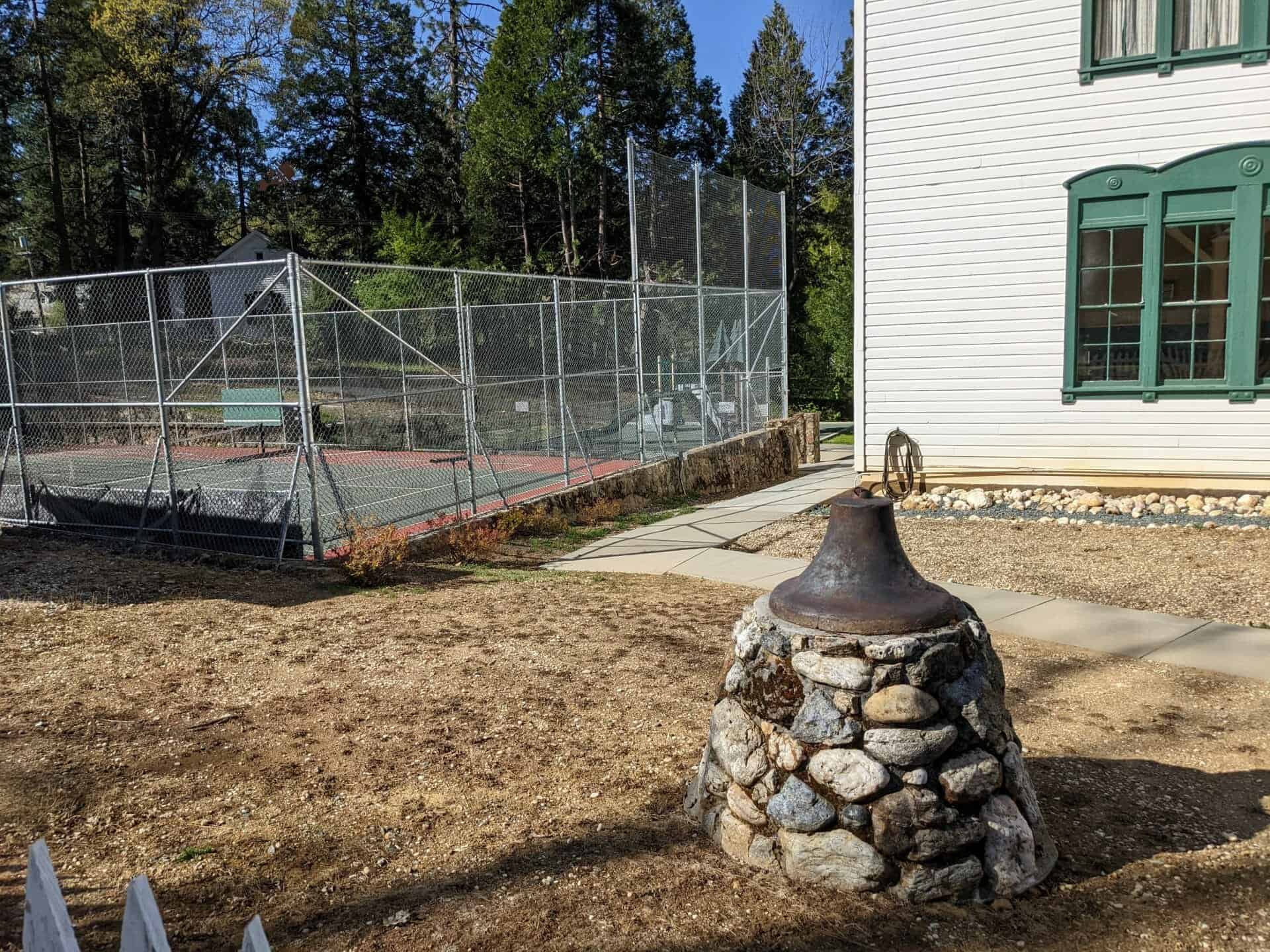
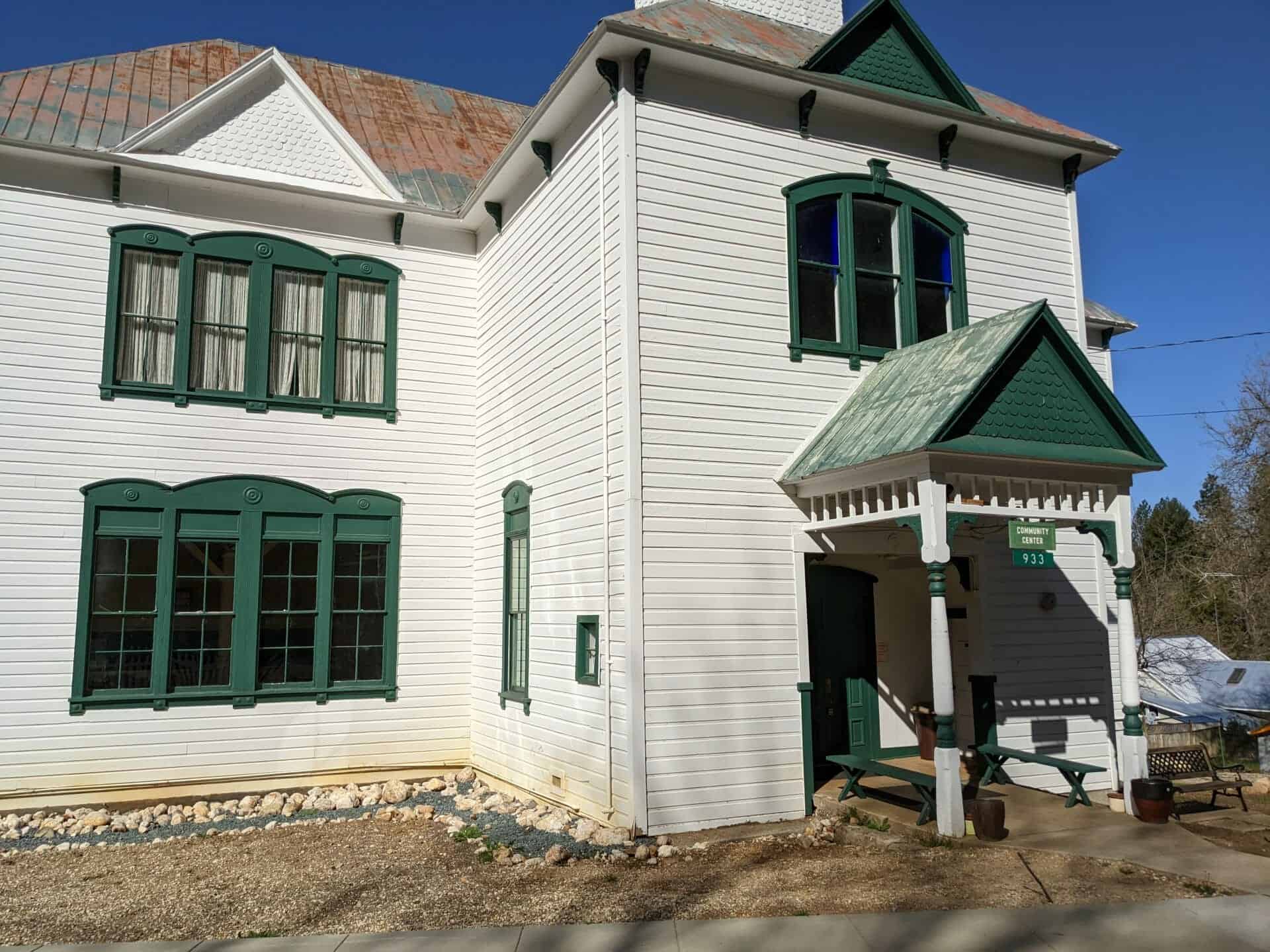


Located in Dutch Flat, California.

Hydraulic Mining Monitor
Used at Polar Star Mine, Dutch Flat, California 1890s to early 1900s


17 Wednesday Aug 2022
Posted in Uncategorized
Tags

884 East Aultman Street in Ely, Nevada.