Mormon pioneer, polygamist, poet, farmer, miner, and militia member.
His families were raised near this site, now designated as Wasatch State Park.
He had an esthetic nature, and spent many hours writing poetry in this picturesque setting overlooking the beautiful Heber Valley and surrounded by the mountains he loved.
He was buried under these oaks, where he enjoyed much of his leisure time. Legend has it that he requested burial here in a sitting position in order “to see the sun rise over the majestic mountains, lighting the beautiful valley below.”
A reference to this on the billiongraves page for Moroni Blood:
A granddaughter of Moroni and Louisa Blood, Thelma Blood Carlile, daughter of Roswell Jr and Hazel McNaughton Blood was only eight years old when Moroni Blood died but said he was definitely the carpenter who made most of the decorative cornices on the old pioneer homes in Midway. She also remembered that he made coffins — one at the request of a man who wanted to be buried sitting up! The coffin had to be specially shaped. He also wanted to be buried on his own property at the bottom of Snake Creek Canyon.
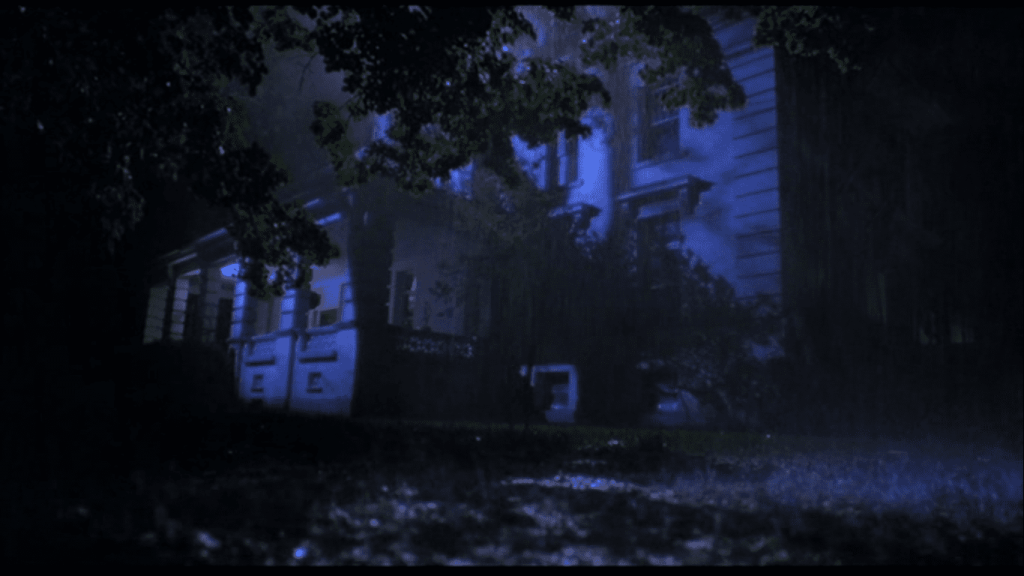
The location where they filmed the scenes for Halloween 5: The Revenge of Michael Myers (1989) that took place at the Haddonfield Children’s Clinic.
It is gated off private property owned by the power company at the Olmsted Power Plant so I didn’t get a lot of my own photos to match up with the screenshots like I usually do.
The Stairs Project was built in 1894-96 as the first hydroelectric power plant to provide electricity to Salt Lake City. It was also one of the first plants in Utah to transmit power long distance, using alternating current rather than direct current. In addition to the powerhouse, other elements of the historic complex include the dam, conduit, and penstock—all critical components of a hydroelectric plant. The power plant is ideally located to take advantage of the Stairs cascade on Big Cottonwood Creek.
During the late nineteenth century, a combination of technological developments, capitalist enterprise, and economic demands led to the creation of Utah’s hydroelectric power industry. Small utility companies around the state built water power plants to generate electricity, mostly for streetcar systems, mines, and other industries. Cities and small towns also consumed power for municipal, commercial, and domestic use. By the early twentieth century, a merger and consolidation movement among Utah’s utilities culminated in the formation of the Utah Power & Light Company (UP&L). In 1989, UP&L merged with PacifiCorp, an Oregon corporation, which continues to operate the Stairs Project.
Constructed In 1894-1695, Stairs Hydroelectric Power Plant, is located in Big Cottonwood Canyon near Salt Lake City. The plant consists of a powerhouse, switchyard, darn, pipeline, standpipe, and penstock, as well as a few ancillary structures. Five of these features are contributing and three are non-contributing. Since its construction, Stairs has sustained alterations, such as the reconstruction of its original dam, changes to the standpipe, removal of the operator’s camp, and replacement of the brick parapet around the top of the powerhouse. These alterations, however, do not compromise the plant’s overall integrity of location, setting, design, materials, workmanship, feeling, and association. Stairs Station is still an outstanding example of a high-head hydroelectric plant dating from the late nineteenth and early twentieth centuries.
General Setting
Stairs Station is located approximately eight miles southeast of Salt Lake City, Utah in Big Cottonwood Canyon along state highway number 152. Stairs Station is about two and one-half miles upstream from the Granite Power Plant, and is surrounded by the Wasatch National Forest. Lying in a narrow part of the the Stairs powerhouse is squeezed between the highway, about 15 feet to the north, and Big Cottonwood Creek to the south. Moving in a westerly fashion, the creek flows past the powerhouse and pools behind a dam just below the plant which diverts water for the Granite Hydroelectric Power Plant. An asphalt driveway provides access to the highway on the west side of the station, crosses a wooden bridge over Big Cottonwood Creek and enters a flat area used as a recreation and picnic site. This open space is lined with shade trees as is the driveway into the plant. Originally a shop/garage stood where now picnic tables are circled around a fire pit. The recreation area was almost totally rebuilt after a major flood destroyed the previous facility in the early 1980s. To the east of the picnic area and sand volleyball pit are the foundations of two operators’ houses, today almost covered with vegetation. These homes have been removed. Steep canyon walls rise behind the recreation area, to the south.
Powerhouse
The only original remaining building at the Stairs Station is, powerhouse. Constructed in 1895, this structure reflects the Second Renaissance Revival architectural style. A two-story, rectangular-shaped brick structure, the powerhouse has a concrete foundation and an asphalt, slightly gabled roof with a concrete capped parapet wall rising above it. Corbelled brick belt courses extend around the structure at top of the first story and below the parapet wall. The building’s facades are divided into bays by pilaster strips which on the north and south facades contain starshaped tire rod anchors. The north and south facades are divided into 7 bays, each containing a single window or pair of 2/2 double hung windows with a brick -corbelled semi-circular arched lintel in the first and second stories. The lower portion of windows on the first story have heavy metal screens.
On the north side of the building is a substation/switchyard enclosed in a cyclone fence. This facade has an entrance to the substation yard that has a 2-light transom over a wooden door and screen door in the westernmost bay. The central bay has a sign reading “The Big Cottonwood Power Co./Stairs Station 1895” which is lit with globed lights on metal brackets fastened on either side of the sign. Both the east and west facades are divided by pilasters into 3 bays. she side bays contain single windows. The central bay has a pair of windows over an entrance with a brick corbelled semi-circular arched lintel, an arched wooden transom and a pair of wooden doors. The eastern entrance retains the original transom window of 6-lights radiating around central semi-circular shaped light.
Water both enters and leaves the power plant on the building’s south side. A metal receiver pipe for the penstock runs the length of the facade, bringing water to the turbines. Segmental arched openings in the foundation wall allow the waste water to enter the tail race, which the receiver pipe and into Big Cottonwood Creek.
Since construction, the Stairs powerhouse exterior alterations. A new parapet wall has sustained only minor and concrete cap similar to the original has been added and new bricks have replaced deteriorating bricks. As the new brick is harder and darker in color, it is noticeable, especially in the southeast corner. These alterations, however, do not overwhelm the building’s original architectural style.
The interior of the Stairs powerhouse retains a level of integrity roughly compatible with its exterior, although some changes have been made over the years. The ground floor of Stairs powerhouse is the location of all generating equipment. Originally, the plant included four Pelton wheels attached to generators. These now have been replaced by one turbine-generator unit made up of a Francis reaction-type turbine (built by S. Morgan Smith) attached to a Westinghouse 2,300 volt a.c. generator, with field supplied by a General Electric 125 volt d.c. exciter. The unit has a capacity of about of about 1.2 megawatts. The turbine operates on a head of about 357 feet. Transmission equipment at Stairs is now mostly outside the powerhouse. The ground floor of the building, however, still includes a massive, air-cooled Westinghouse step-up transformer. The air cooling equipment, including a fan, is still in place. Other equipment at the ground-floor level Station includes a modern switchboard, a sound-proof batteries, and an original 10-ton overhead traveling probably built by the Silver Brothers of Salt Lake City.
The second floor of the Stairs powerhouse is largely empty. This space originally housed transformers, bus bars, and switching equipment. The second floor is now used for storage of odd materials and tools. A few small machines, such as a drill press, are also still in place. Toward the west end of the second floor there is a wood balustrade with a small opening to allow passage. The purpose of this balustrade is unknown. Between the balustrade and the west wall there is a rectangular opening in the floor which allows ventilation for the ground floor and which is used to hoist materials between floors. Other than the features mentioned here the second floor is empty.
The ceilings over the first and second floors of the Stairs powerhouse feature a design similar to the ceiling of the Granite powerhouse. The Stairs powerhouse ceilings first consist of steel beams laid crosswise between the north and south powerhouse walls. The areas between the beams are filled with arched brick vaults, covered with plaster, which extend over the length of the building.
Stairs powerhouse has sustained a number of alterations since its construction. A new parapet wall has been installed. The original turbine-generator units have been replaced. Transformers have been moved outside, leaving the second floor empty. Overall, however, the powerhouse still appears much as it did about ninety years ago. Moreover, the powerhouse is still a key part of a basically intact, functioning, high-head hydroelectric plant. Stairs, despite its alterations, still retains integrity of location, design, setting, materials, workmanship, feeling, and association. The powerhouse is a contributing feature of the historic district.
Switchyard
The Stairs transmission equipment, consisting of modern switchrack and transformers, is now located outside the building, on its north side, between the building and Utah Highway 152. The switchrack does not contribute to the historic district.
Storm Mountain Dam
Big Cottonwood Creek water for Stairs Station is impounded behind Storm Mountain Dam, located about one half mile above the powerhouse in Big Cottonwood Canyon. The dam is situated in a natural basin at the head of a cascade called “the Stairs,” which over a quarter mile section drops 200 ft. Storm Mountain Dam is an earth-fill structure faced on its upstream side with concrete. The dam is approximately 500 ft. in length and is approximately 10-20 ft. tall. About the northern two-thirds of the dam is straight, lying on a north-south axis. However, the rest of the dam angles toward the southeast. This portion of the dam has a reinforced concrete spillway about 35 ft. wide and 20 ft. tall on the downstream side. The spillway includes a flashboard gate system. Flashboards are set horizontally between steel I-beams supported by steel stanchions. A walkway made of wood planks, with steel posts and cables for a handrail, is perched on top of the flashboard structure. The southerly end of the dam abuts a rock outcropping. The north end of the dam abuts the north side of Big Cottonwood Canyon. The intake at Storm Mountain Dam is located at about the middle of the dam, adjacent to its straight section, about 10 feet from its upstream face. The intake is a reinforced concrete structure with a valve and trashrack. The intake is enclosed by a small wood-frame shed covered with corrugated metal.
Storm Mountain Dam in its present configuration was built in 1921. The dam actually no longer functions. A small amount of water pools behind the dam, but Utah Power and Light no longer maintains a reservoir. The dam was officially retired in ca. 1955-1958, apparently because water impounded behind it somehow became unsuitable for Salt Lake City’s Big Cottonwood Treatment Plant located near the mouth of the canyon, just below the Granite hydroelectric plant.
Other features at Storm Mountain Dam include portions of low retaining wall adjacent to the former reservoir area. These low walls, 1-3 ft. tall, consist of rubble and concrete. The walls are most visible on either side of Big Cottonwood Creek where Utah Highway 152 crosses the stream just eas-t of Storm Mountain Dam.
As originally constructed in the 1890s, Storm Mountain Dam consisted of a curved, earth fill-structure, roughly situated on an east-west axis adjacent to the position of the current dam. A spillway, cut into bedrock, was located at the east end of this dam. A drain tunnel was bored through rock just east of the dam. The original dam created a much larger reservoir than the dam. The low retaining walls described above may have been associated with the original dam. Otherwise, the principal features of the original dam are no longer visible.
Storm Mountain Dam, as built in 1921, has sustained little alteration. Some weathering of the dam has occurred, such as the cracking and flaking of the upstream concrete face. Otherwise, storm mountain dam retains integrity of setting, location, feeling, association, design, materials, and workmanship. Storm Mountain Darn is a contributing feature in the Stairs Station Historic District.
Conduit
Water entering the Storm Mountain Dam intake is first carried west through a welded steel pipe about 1,200 ft. long. Roughly the western half of the steel pipeline lies in a tunnel that was bored through a rock formation that extends from the north side of Big Cottonwood Canyon. Both ends of this tunnel have been closed with concrete, so the interior of the tunnel is not visible. Between the dam and the tunnel, the pipeline lies underground except for a short section just before it enters the tunnel. However, the course of the pipeline is apparent because earth was merely deposited over the pipeline so that it now appears as a long, low mound lying between the dam and the tunnel. After exiting the west end of the tunnel, the pipeline is now visible because Utah Power and Light has recently replaced a section of it between the tunnel and the top of the penstock. The original conduit, erected in the mid-1890s, was probably either replaced or renovated in 1921, at the time Storm Mountain Dam was built. Therefore, the conduit component of Stairs Station best represents the historic associations of a 1921 date.
Except for miner alteration, the steel pipeline conduit retains integrity of setting, location, feeling, materials, association, design, and workmanship. The conduit contributes to the historic district.
Penstock
The penstock is original, and was fabricated by Fraser and Chalmers of Chicago. It consists of a riveted steel pipe approximately 1,750 ft. in length. At its top, the penstock has a 50 in. diameter and is made of steel 1/4 in. thick. The penstock gradually decreases in diameter and increases in thickness as it descends toward the powerhouse. At the bottom, the penstock has a 49 in. diameter and is made of steel 1/2 in. thick. The penstock above ground except for about the last 150 ft., which now lies underneath Utah Highway 152. The Stairs penstock is a particularly well-preserved and visible (except for about the last 150 ft.) example of a late-1890s penstock.
The Stairs Station penstock maintains integrity of design, setting, workmanship, location, feeling, materials, and association. The penstock is a contributing feature of the historic district.
Standpipe
At the top of the penstock is a steel standpipe, built in 1939. The standpipe structure rests on a concrete block which is located at the point where the steel pipeline meets the top of the penstock. The top half of the standpipe was recently added by Utah Power and Light. Because of this recent addition, the standpipe no longer retains integrity of materials and design. It does not contribute to the Stairs Station Historic District.
Ancillary Structures
Other structures at the Stairs Station include a small, concrete block outhouse with a flat metal-covered roof and a wooden door which sits just north of the powerhouse. East of the powerhouse. is a rock-terraced opening which extends into the hillside. This wass the original oil shed (no. 7), but is currently unused because it has partially collapsed. Despite the collapse the oil shed from the outside appears Intact. The oil shed still retains overall integrity of location, design, materials, workmanship, setting, feeling, and association. It is a contributing element of the historic district. Similar rock terracing as was used for the oil shed acts as riprap along the highway embankment just north of the powerhouse. Adjacent to the powerhouse and crossing Big Cottonwood Creek is a modern bridge (no. 8) which provides access to the UP&L picnic grounds. This is a modern structure made of steel with a wood deck and concrete abutments. It is a non-contributing feature of the historic district.
Stairs Station is historically significant under Criteria A and Under Criterion A, Stairs Station is historically significant within a statewide context because of its association with the first long-distance transmission of alternating current in Utah Built in 1894-1896, in 1896 Stairs Station generated a.c. power and transmitted it over a 14-mile line to a substation in Salt Lake City. This inaugurated the widespread use in Utah of a.c. power generated from hydroelectric stations. Within a local context, Stairs Station is significant under Criterion A as the first hydroelectric power plant to supply electricity to Salt Li City. Utah’s largest urban/industrial center. Under Criterion <: Stains Station is significant within a local context because it embodies the distinctive characteristics of a late nineteenth century hydroelectric power plant (with later modifications). Situated in Big Cottonwood Canyon of the Wasatch range, Stairs Station’s engineering features were ideally suited to its mountainous setting. Power companies built numerous high-head plants in Utah during the late nineteenth and early twentieth centuries. They were the most efficient type of hydroelectric technology for generating power on Utah’s relatively small mountain streams.
Engineer Robert M. Jones originated the idea for Stairs Station, designed the facility, supervised its construction, and formed a company to oversee its operation. Jones was an experienced technician who had worked as a surveyor and mining engineer throughout the West, including New Mexico, Arizona, Colorado, Wyoming, and Utah. He also had assisted in the organization of the Laramie (Wyoming) Electric Light Company and had supervised the construction of its generating station. In 1889, Jones worked on the installation of electrical equipment for the Salt Lake City Railway. His acquaintance with the Salt Lake City area led him to consider the feasibility of establishing a hydroelectric plant on one of the numerous streams that emerged from the Wasatch Mountains just east of Salt Lake City. Certainly the Salt Lake area offered a prime market for electricity generated from such a station. Jones scouted the canyons along the Wasatch range, and in September 1891 he located appropriation for water from Big Cottonwood Creek, known as the Stairs.
Jones then set about developing the site. In 1893, he applied for a franchise from Salt Lake to furnish electricity to the city. He also led a group of citizens to the proposed power site and told them of his plan. But Jones met with failure as the mayor vetoed the council’s approval of his franchise. Undaunted, Jones tried again. In support of his cause, he submitted a petition bearing the signatures of 126 Salt Lake City businessmen. The council then passed the franchise over the mayor’s veto. Several months later, in December 1893, Jones organized the Big Cottonwood Power Company. Officers included president John W. Donnellan, vice president W.H. Rowe, secretary George M. Cannon, and treasurer George M. Downey. In 1894, workers employed by the Big Cottonwood Power Company began erecting the plant, but work was frequently halted because of construction difficulties and quarrels over water rights. In June 1895, the Big Cottonwood Power Company found some investors in the East and construction work continued. Stairs Station was finally completed in May 1896 it a cost of $325,000.
Stairs Station was an outstanding example of a small, late nineteenth-century high-head plant. Jones had chosen an ideal site for the facility. The location of the dam at the top of the Stairs and the sharp drop in elevation (350 ft. in about 1/4 mile at the site provided a high head for the turbines. Of equal importance, the short distance of the Stairs cascade necessitated only a minimum expenditure of materials and energy for the construction of a pipeline and penstock. In contrast, many highhead facilities had lengthy water delivery systems that were expensive to build and maintain (the wood flume and steel penstock for Granite Station, for instance, totaled about 1.75 miles in length.)
While construction of Stairs Station was underway, the Big Cottonwood Power Company looked for customers to purchase electricity from the plant. In January 1895, the company signed an agreement with the Salt Lake and Ogden Gas and Electric Light Company to supply the latter with power, purchased wholesale. Apparently the Salt Lake and Ogden Company’s steam plant, located In the business section of downtown Salt Lake City, had drawn the Ire of the local citizenry because It polluted the air. By drawing power from Stairs Station, the Salt Lake and Ogden Company hoped to abate the smoke problem caused by Its coal-fired facility. But before Big Cottonwood Power could begin generating electricity, competition between the two companies arose. Big Cottonwood Power entered a bid for the Salt Lake City municipal street lighting contract, which the Salt Lake and Ogden Company wanted to keep. Apparently the ensuing squabble between the firms led to the nullification of their earlier contract.
Potential competition from power companies outside the Salt Lake area soon brought Big Cottonwood Power and the Salt Lake and Ogden Company back together. 3y 1895, L.L. Nunn of Provo and the Pioneer Electric Power Company of Ogden threatened to build lines to Salt Lake. Out of self-defense, the Big Cottonwood Power Company and the Salt Lake and Ogden Company entered Into another agreement. A contract, dating from about June 188£, stipulated that Big Cottonwood Power would supply the Salt Lake and Ogden Company with electricity for ten years. R.F. Hayward, general manager of the Salt Lake and Ogden Company, supervised the construction of a transmission line, made of wood poles, from Stairs to a substation in Salt Lake City. Stairs Station began sending power over the 10,000 volt line on 2 June 1896. Stairs was the first hydroelectric power station to supply electricity to Salt Lake City. The transmission was the first in Utah to use alternating current over a long distance.
Big Cottonwood Power Company remained an independent business for only a short while. By 1897, owners of recently built hydroelectric power plants, including Stairs and Pioneer, instead of competing against each other merged their companies into one firm, the Union Light and Power Company. In 1899, Union Light and Power underwent reorganization and was renamed Utah Light and Power. Shortly thereafter, Utah Light and Power began operating the Pioneer, Stairs, and Granite plants in conjunction with each other. As part of an integrated system, these plants served Salt Lake City and Ogden as well as a number of smelters south of Salt Lake. In 1904, Utah Light and Power merged with Consolidated Railway and Power to form Utah Light and Railway. Ten years later, in 1914, Utah Light and Railway and the Salt Lake Light and Traction Company merged to form Utah Light and Traction. In 1915, Utah Light and Traction came under the management of Utah Power and and Light Company.
Since UP&L acquired Stairs Station, a number of changes have been made to the facility. Most importantly, in 1921 UP&L built Storm Mountain Dam, replacing the original structure which had rendered poor service because cf its porosity. The construction of Storm Mountain Dam reflected UP&L’s overall goal during the 1910s and 1920s of improving existing hydroelectric power plants so that each could function as a more reliable, efficient component in a huge network of electrical generating facilities. Another major alteration made to Stairs Station involved the replacement (date unknown) of the original generators and Pelton wheels with another unit featuring a Francis reaction turbine. Finally, at an undetermined date the company demolished the operator’s quarters the stat Despite these changes, the major technological components of Stairs Station the dam, conduit, penstock, powerhouse, remain essentially intact. Thus they still represent the historic associations of the period of significance and they still exhibit the important characteristics of an early high-head hydroelectric plant.
This three story (basement and full attic) home is done in Eastlake/Queen Anne style with all the ornamentation, shingles, finials, moldings, lattices, carved panels, friezes, balusters, that characterize the style. The building replaced an older adobe building and intruded upon the commercial district.
The home was built on a foundation made of red sandstone quarried from nearby Andrews Canyon. This sandstone was also used around some windows and door frames. The tanned colored brick was shipped in from the east. The mortar is red to match the sandstone.
The home is asymmetrical in composition. There is a domed turret topped by a tin finial. Tin finials also top a gabled end and the side porch.
This side porch is rounded and articulated with round posts and a bracketed cornice.
The front porch also has rounded posts and a projecting pediment which has carved wood ornamentation. The front steps are flanked with two sandstone projecting sear walls on which the words “Colonial” “Villa” are chiseled.
The north side porch also has a projecting, carved pediment. On the second floor above the front porch is a spindle and spool-like baluster in front of double doors.
Both the front and the north side doors have glass ovals. The north side door also has a carved wood ornamentation.
The first floor windows are done with leaded glass in the upper sashes. Several of the windows on the first and second floors have curved glass panels.
The interior of the home is dominated on the first floor by the central staircase of carved, massive oak. The floors are also of oak. Oak is used in the four matching sets of sliding doors. The oak mantels are intact on the fireplaces in the reception room and the parlor. The parlor also has a rounded chamber decorated with oak filigree work.
The text on this page is from the nomination form (#78002663) for the National Register of Historic Places. The mansion was added to the register December 12, 1978 and it is located at 106 South Main Street in Nephi, Utah.
The Sanpete Valley Railroad was built in 1880; it ran from Wales, Sanpete County to Nephi for the purpose of hauling coal. The railroad completion initiated a business and building boom in Nephi Nephi became the center of four highways and the terminus of two railroads. It became known as “Little Chicago.”
George Carter Whitmore was one of the merchants (Hyde and Whitmore Mercantile Establishment ) in Nephi who prospered during the boom.
George C. Whitmore, the son of James M. (physician) and Elizabeth Carter Whitmore, had come to Utah with his parents from Texas in 1857 with the Homer Duncan Company. The family settled in St. George where James M. was killed by Navaho Indians in 1861.
George C. moved to Nephi in 1872 and began to establish himself as one of Nephi’s leading entrepreneurs and, later, philanthropists. In 1885 he organized the First National Bank of Nephi which eventually had three other branches the State Bank of Payson, the Fillmore Commercial and Savings Bank and the Fountain Green State Bank. (His brother James M. was a successful businessman in Castle Valley and established in 1901 the First National Bank at Price.)
George C. also speculated in land and had large land holdings in Nevada and Utah, particularly in Carbon County. His speculating was not always appreciated by others, as is indicated in a rather notorious water rights case in which Whitmore was eventually found guilty of usurping water on the Grassy Trail Creek. (L.A. Scott-Elliott vs. Whitmore, 1893)
Using his financial and social position, Whitmore also became involved in politics. From 1900 to 1908 he was a member of the Utah State Senate. He was a delegate to the Democratic National Convention in 1904 and 1912. He was even considered for nomination as a candidate for governor but declined because of poor health. Prominent Utah politicians such as Simon Bamberger were frequent guests in Whitmore’s home.
This pretentious home representing the economic security and social prominence which Whitmore possessed, was designed and built by Oscar Booth, a local architect, using local labor 1898-1900. Whitmore, his wife Mary Elizabeth Hague and their eight children lived in the home only a few years before George C. died in Pasadena, California in 1917. His funeral was reported to have been one of the largest ever held in Nephi.
His son George M. who had taken over as president of the Nephi Bank also took over the home, (George C. had four sons who lived to maturity: George M. and L.L.A. took over the directorship of the Nephi Bank; Harvey E. was president of the National Copper Bank of S.L.C. and John W. owned the successful Toggery Clothing Store in Nephi and became mayor there 1911-1913.)
In 1938 the Whitmore family requested Frank Brough, who was then cashier in the Nephi Bank, to move into the mansion and care for it and other Whitmore holdings, including the cattle ranches in Carbon County. Brough used the reception room on the first floor of the mansion as his office. The Broughs lived in the home 21 years.
In 1962 Fred C. Painter purchased the home. (and sold it in 1978) Concreting over the front lawn and neglecting the house, the Painters used the property as part of their Painter Motor Company.
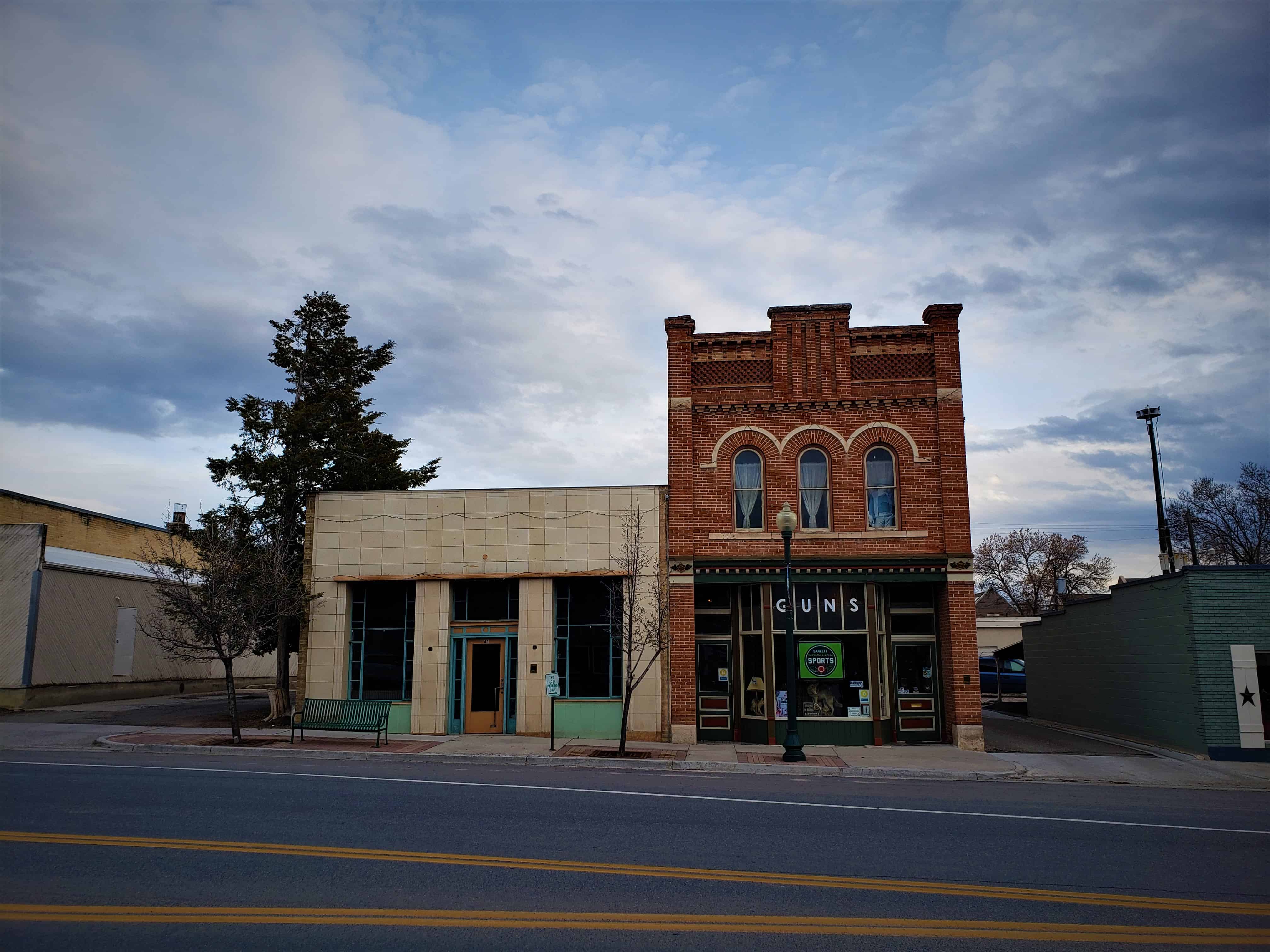
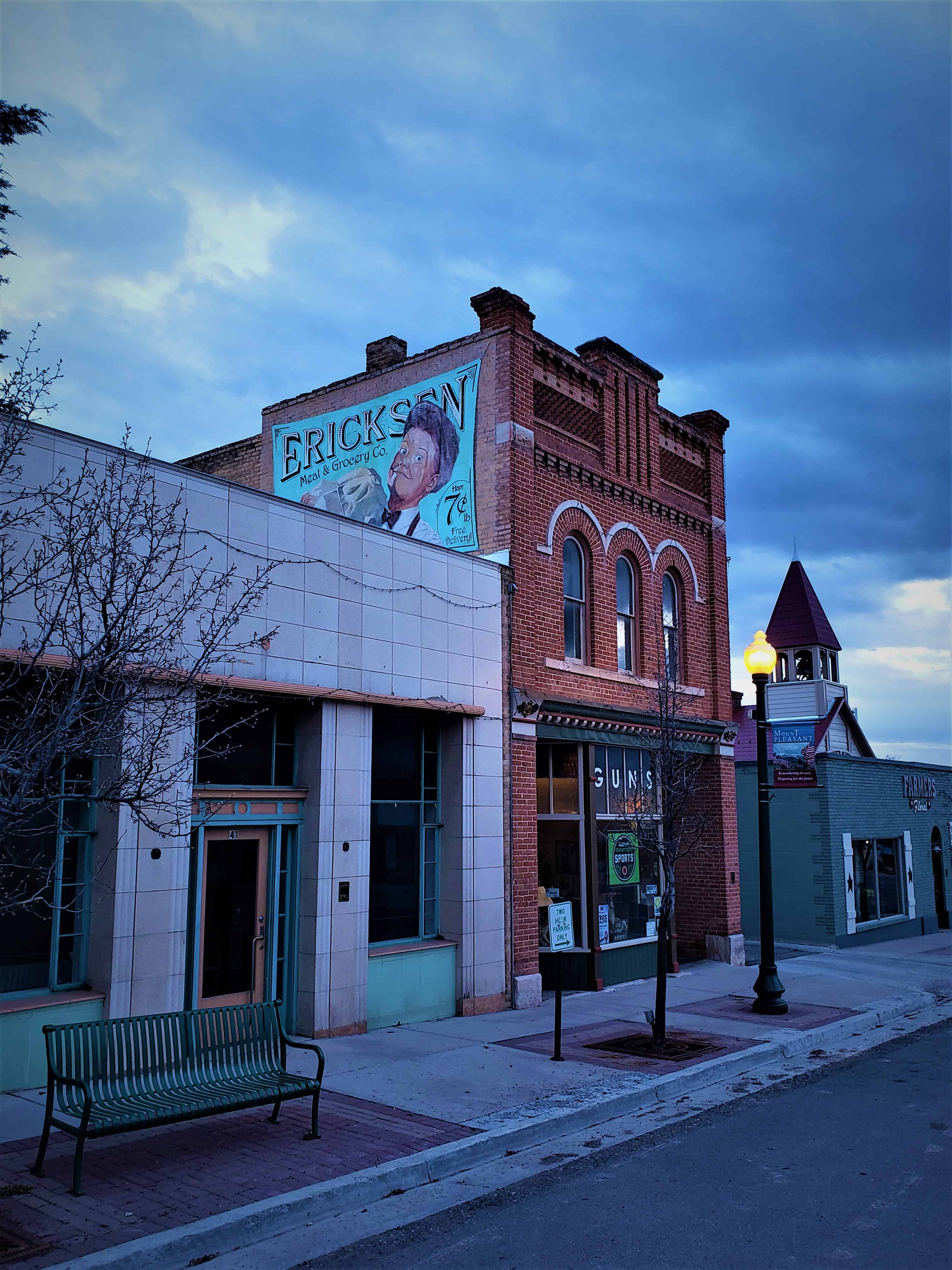
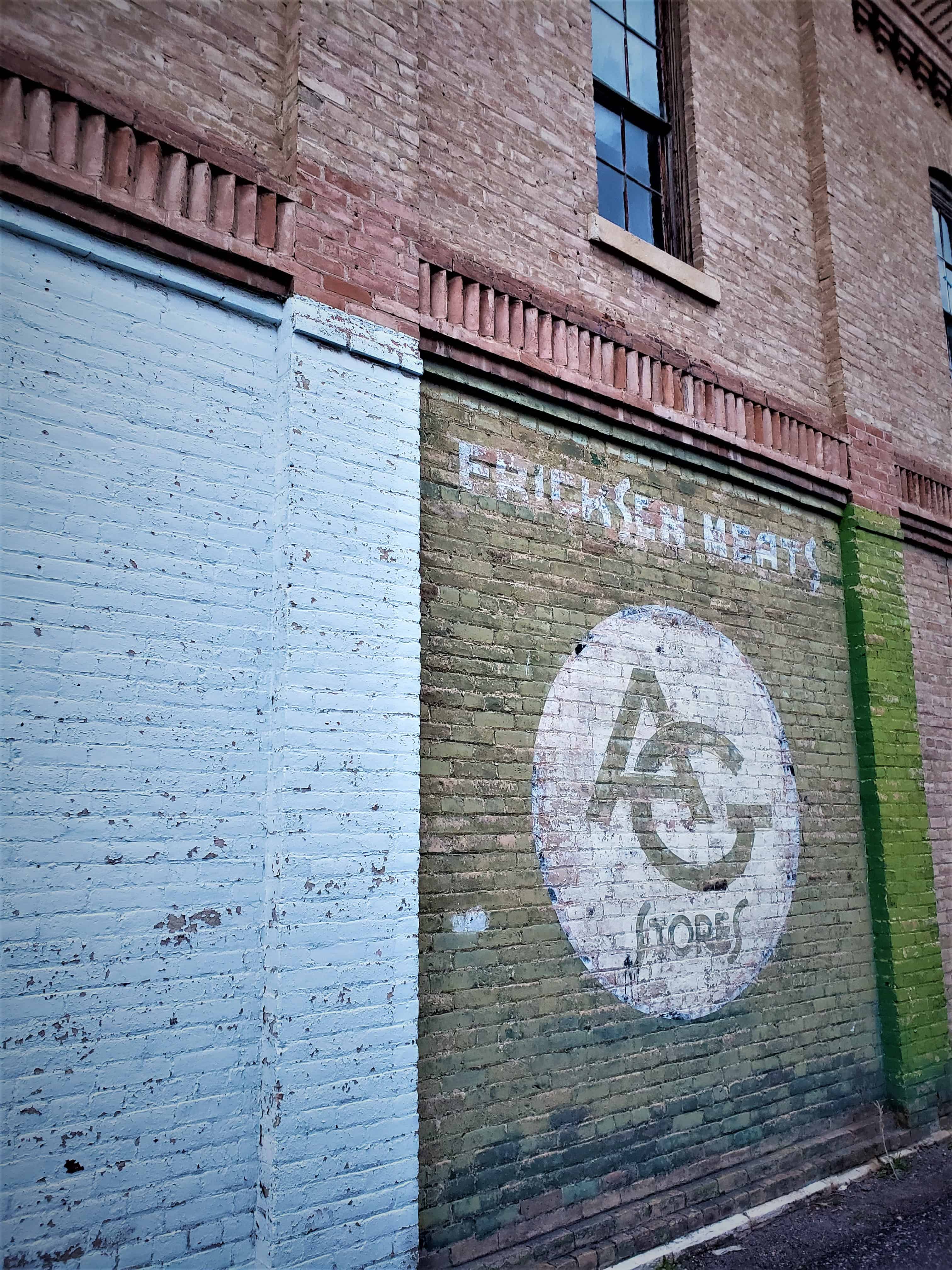
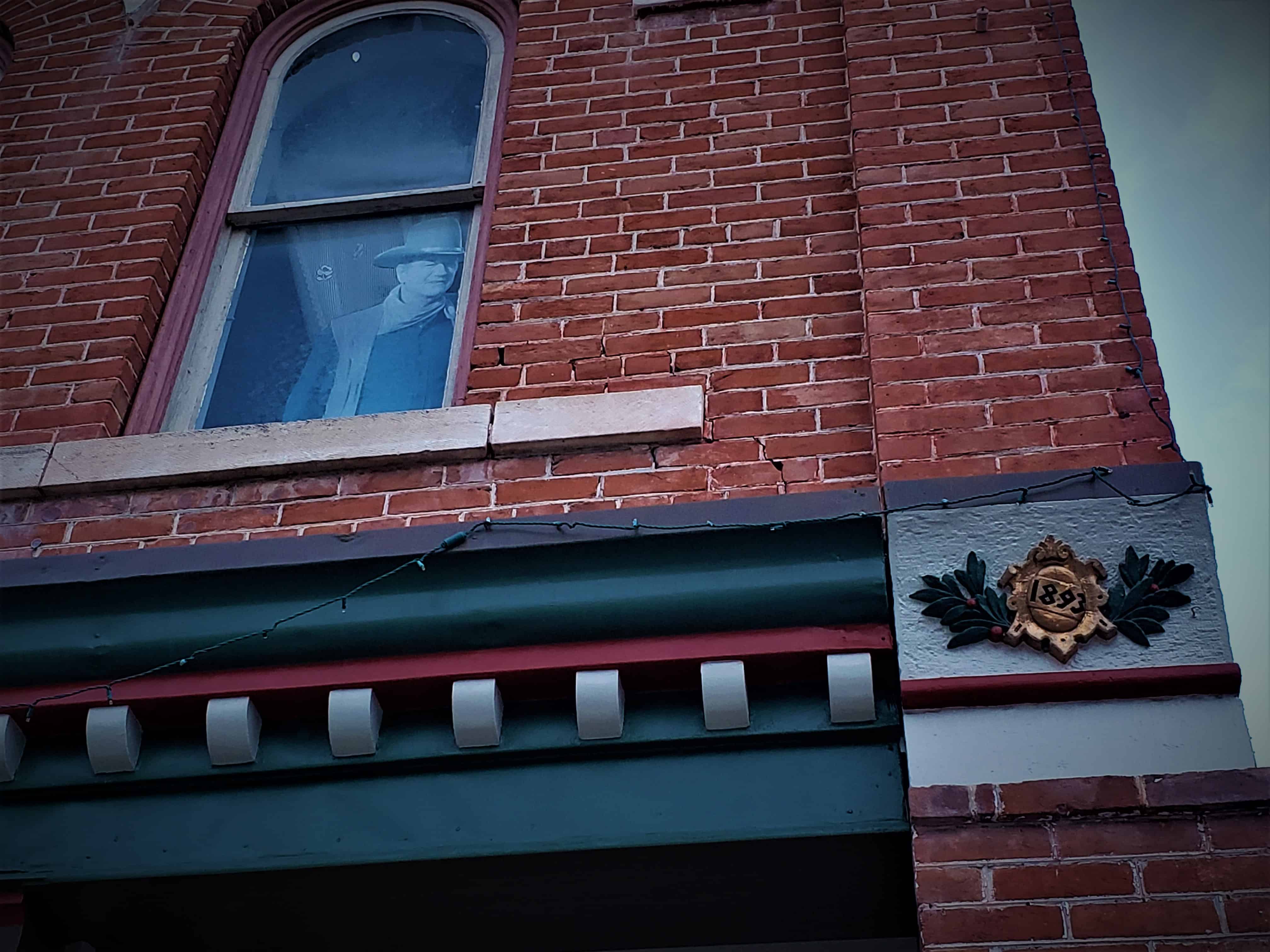
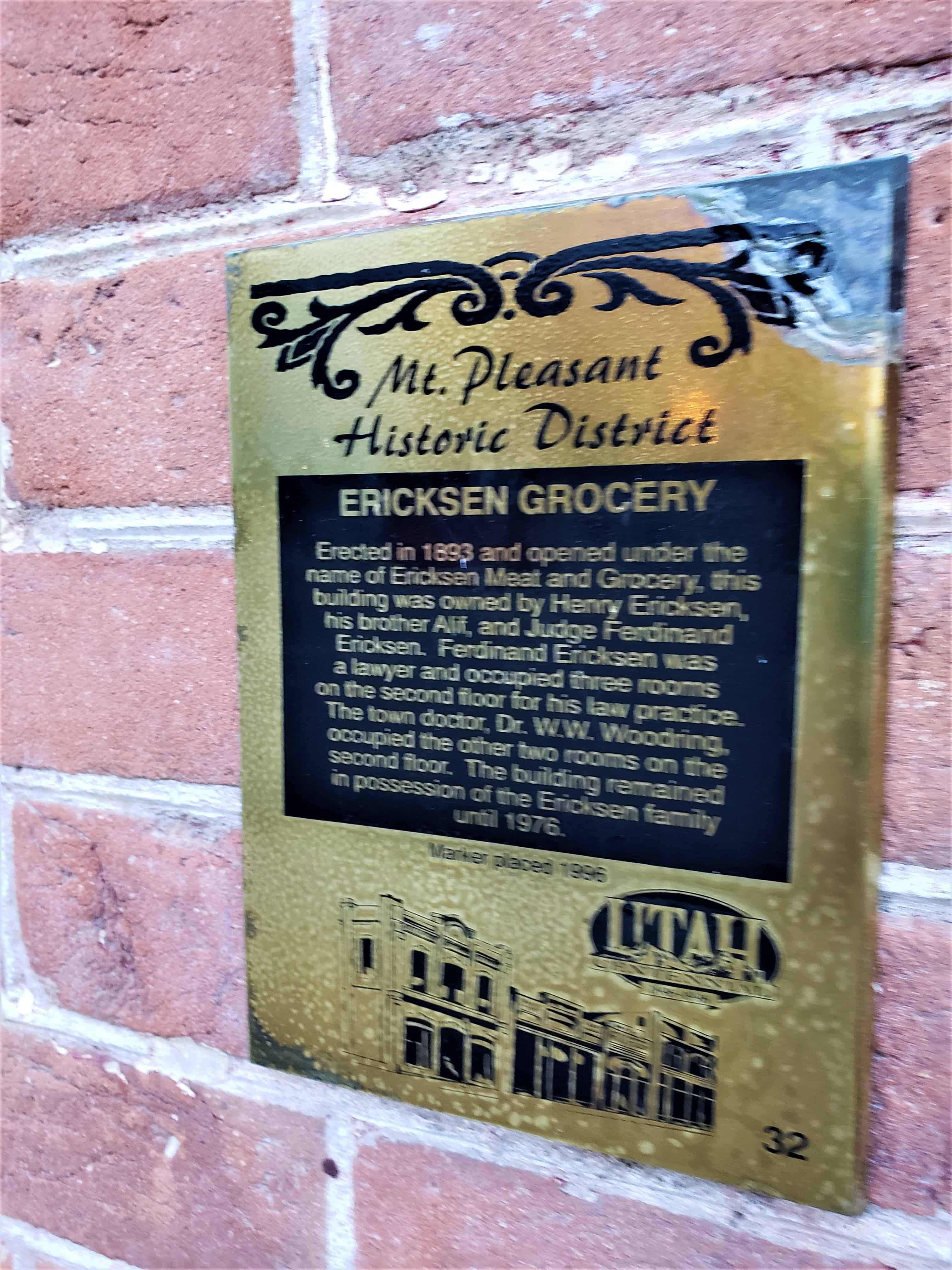
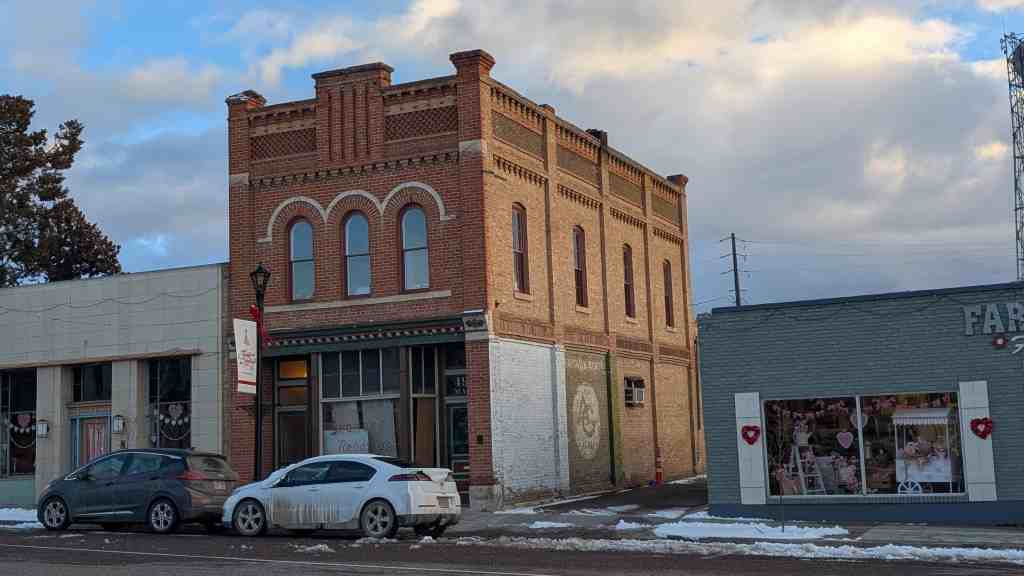
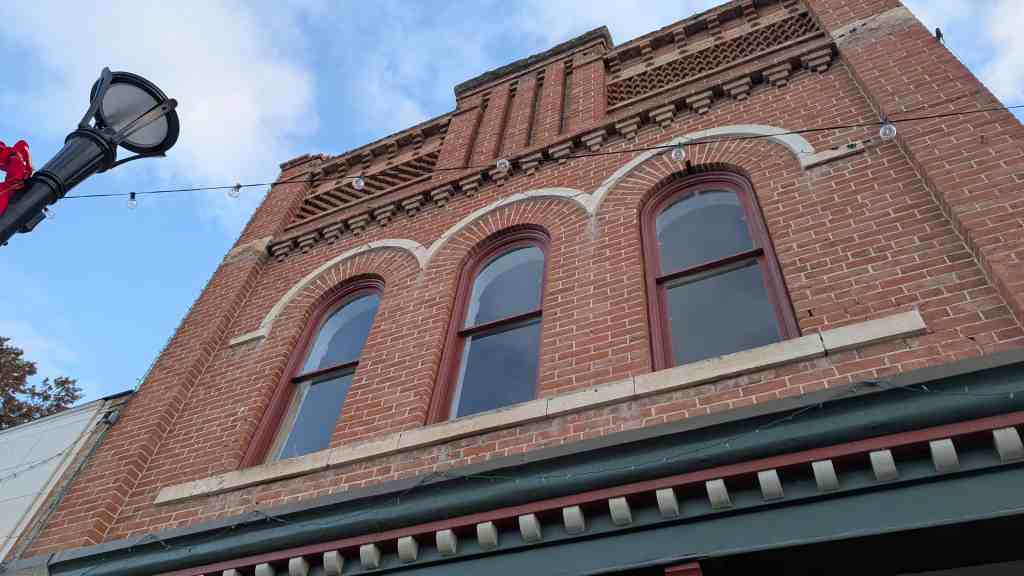
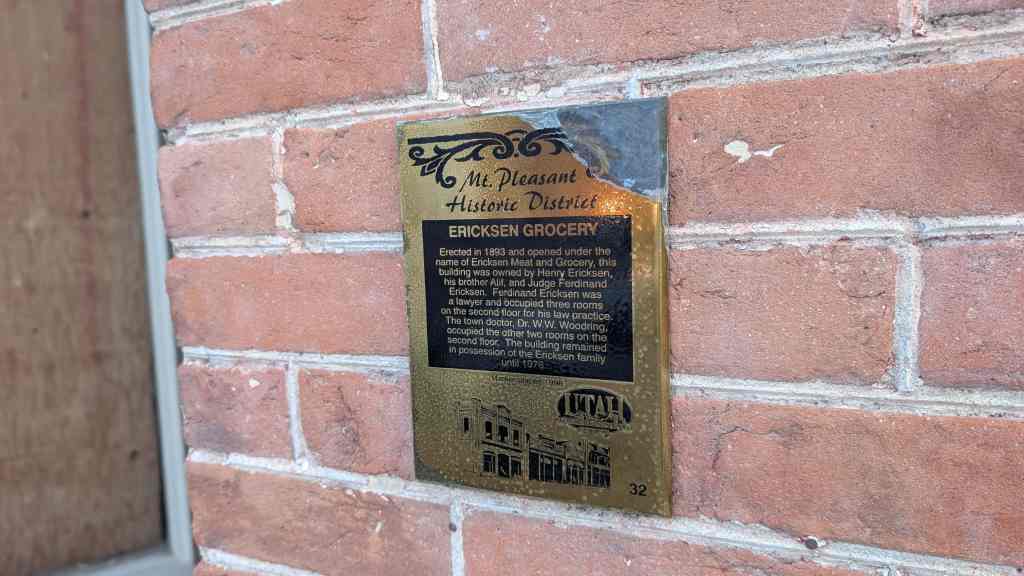
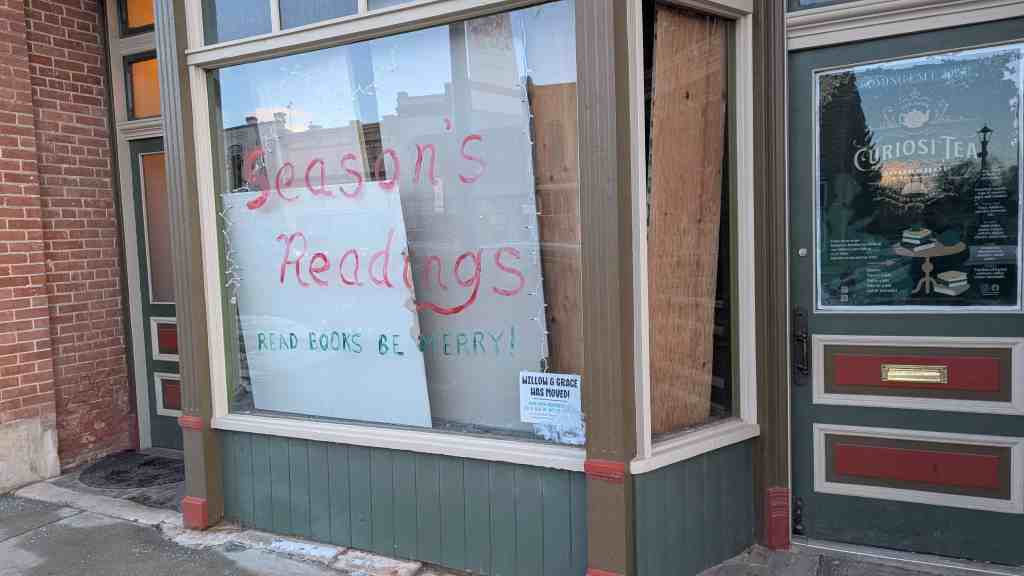
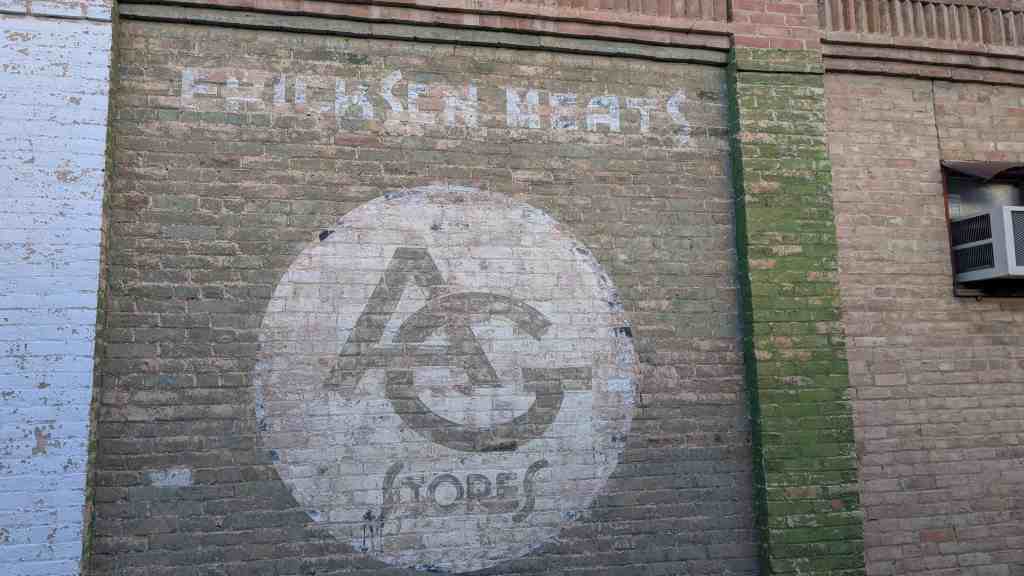
Erected in 1893 and opened under the name of Ericksen Meat and Grocery, this building was owned by Henry Ericksen, his brother Alif, and Judge Ferdinand Ericksen. Ferdinand Ericksen was a lawyer and occupied three rooms on the second floor for his law practice. The town doctor, Dr. W.W. Woodring, occupied the other two rooms on the second floor. The building remained in possession of the Ericksen family until 1976.
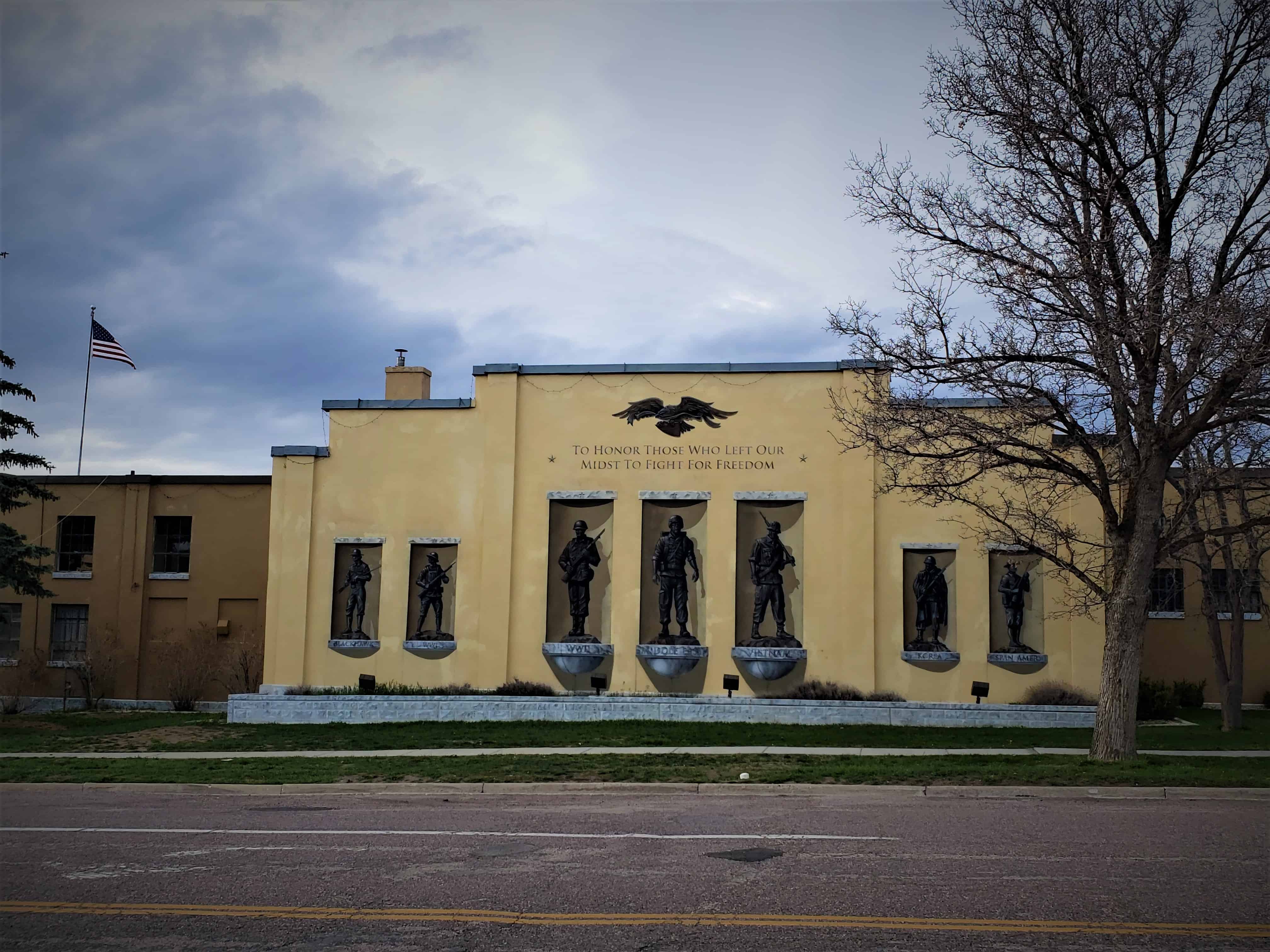
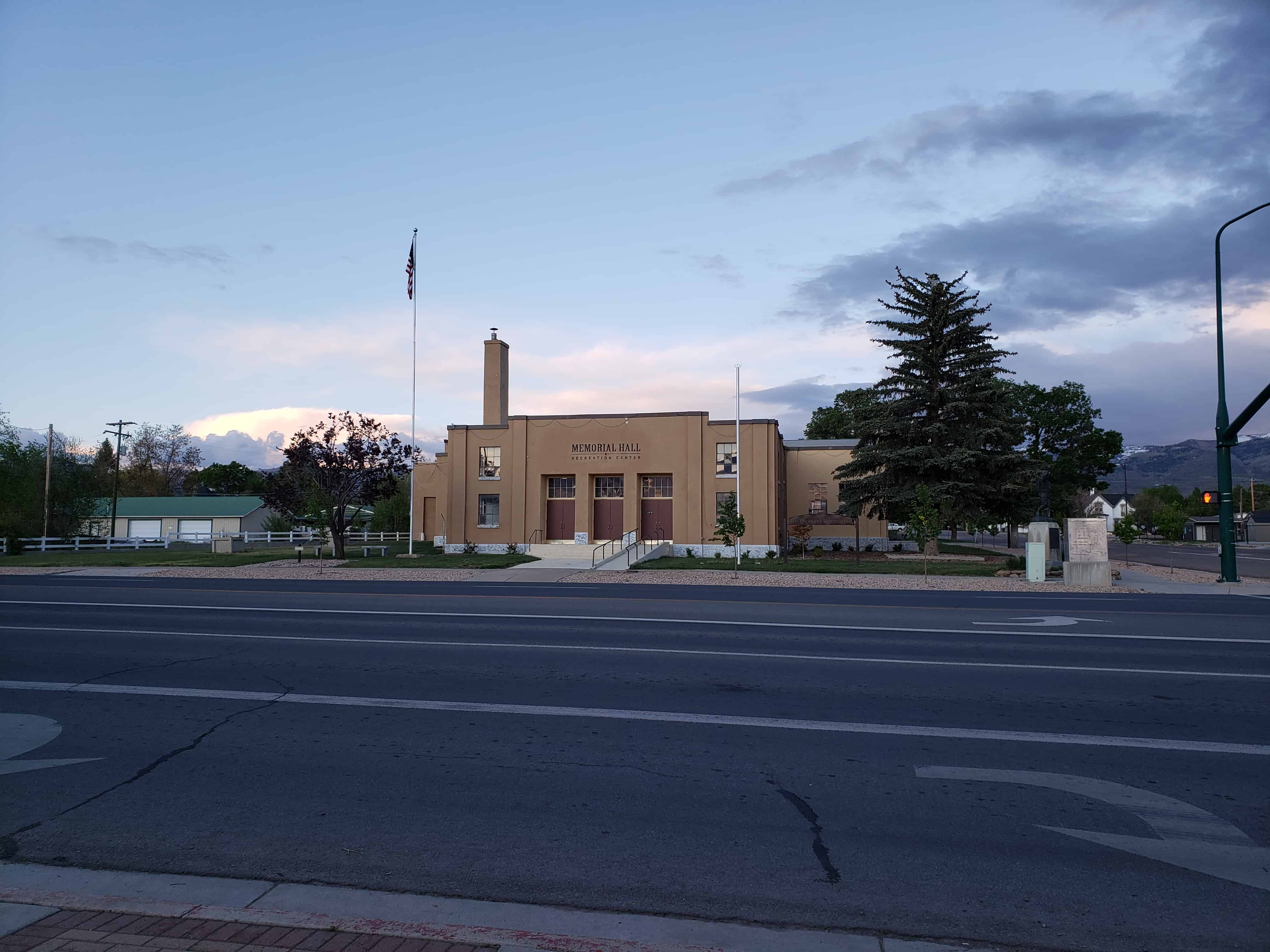
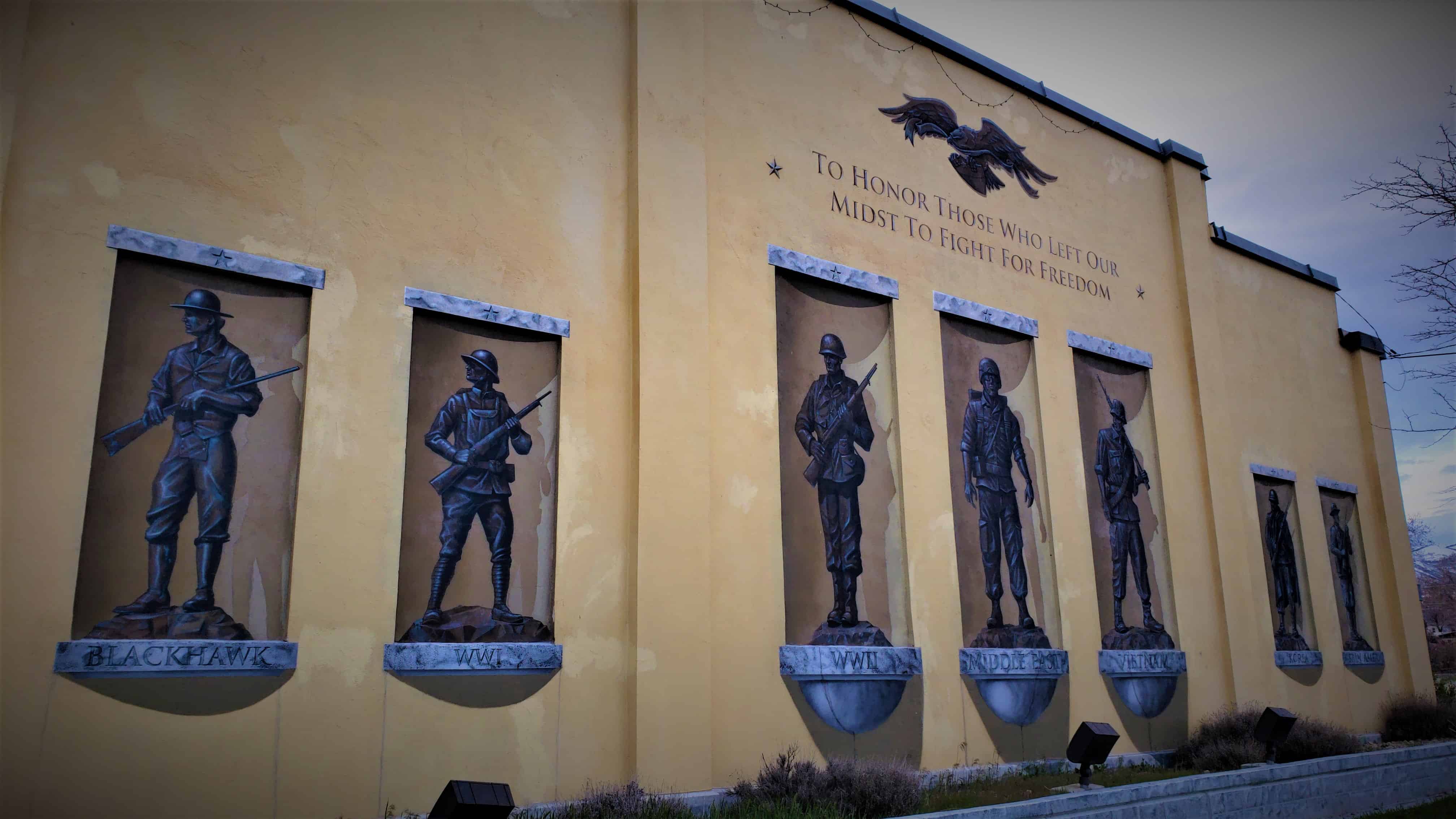
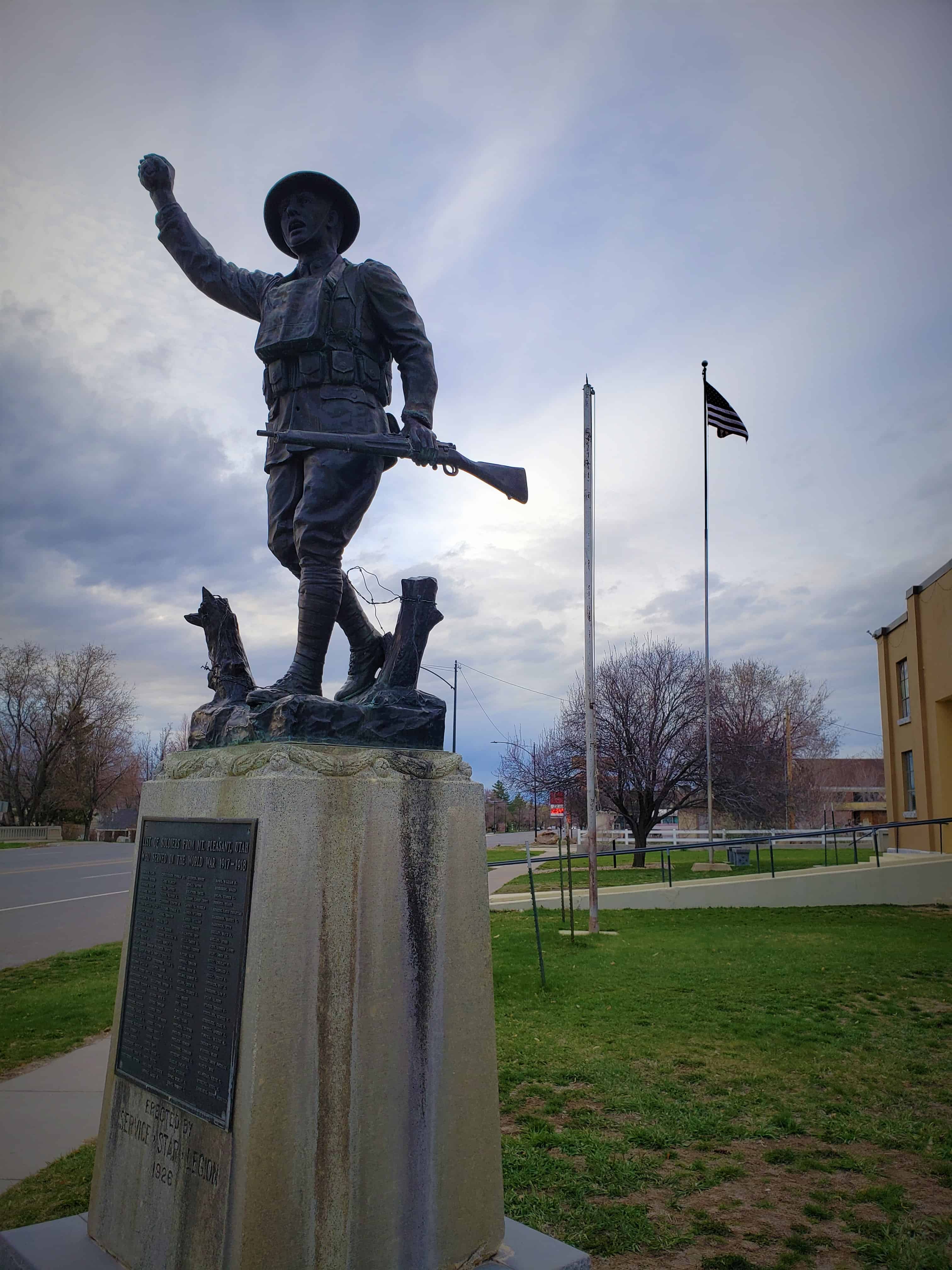
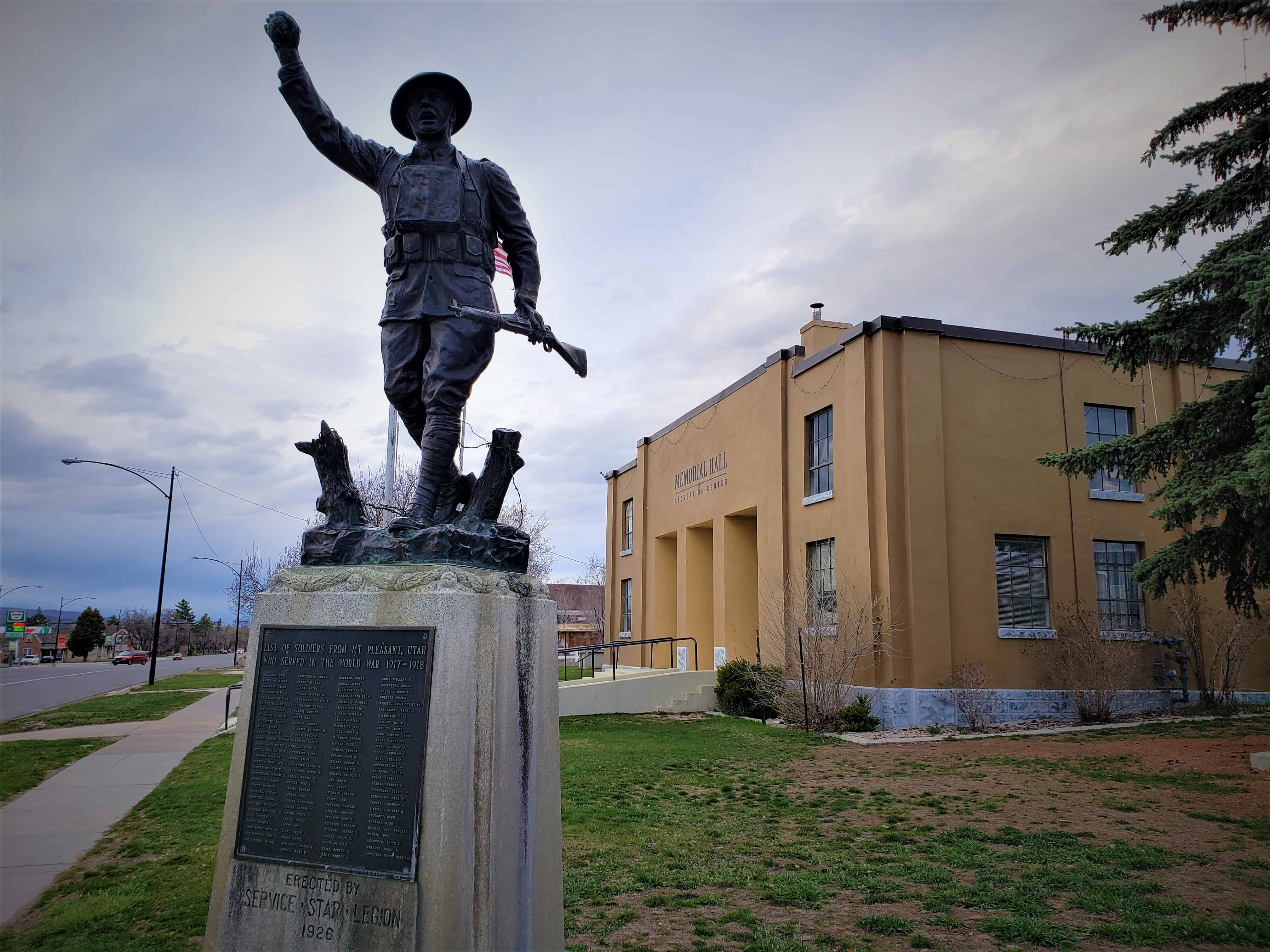
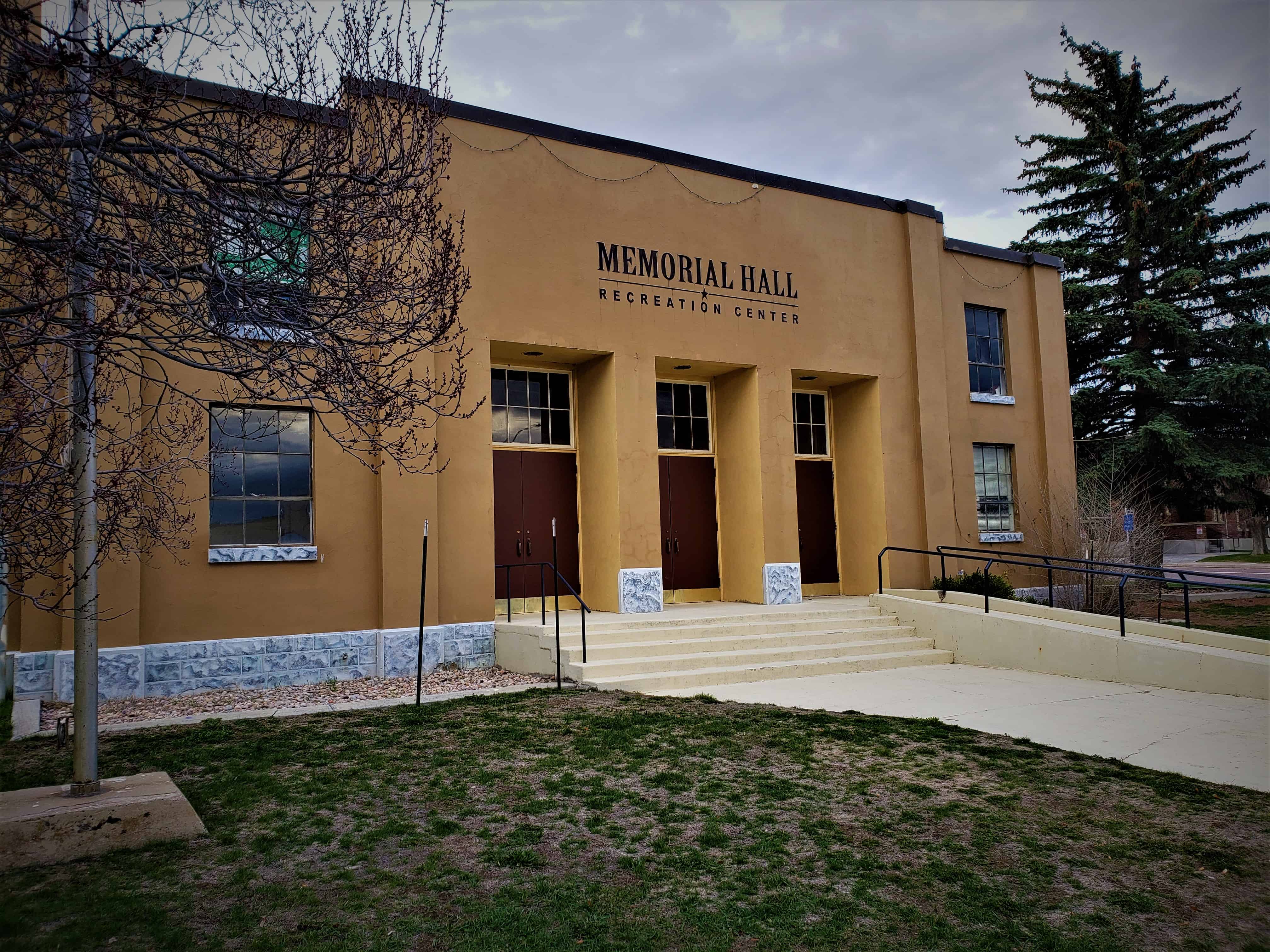
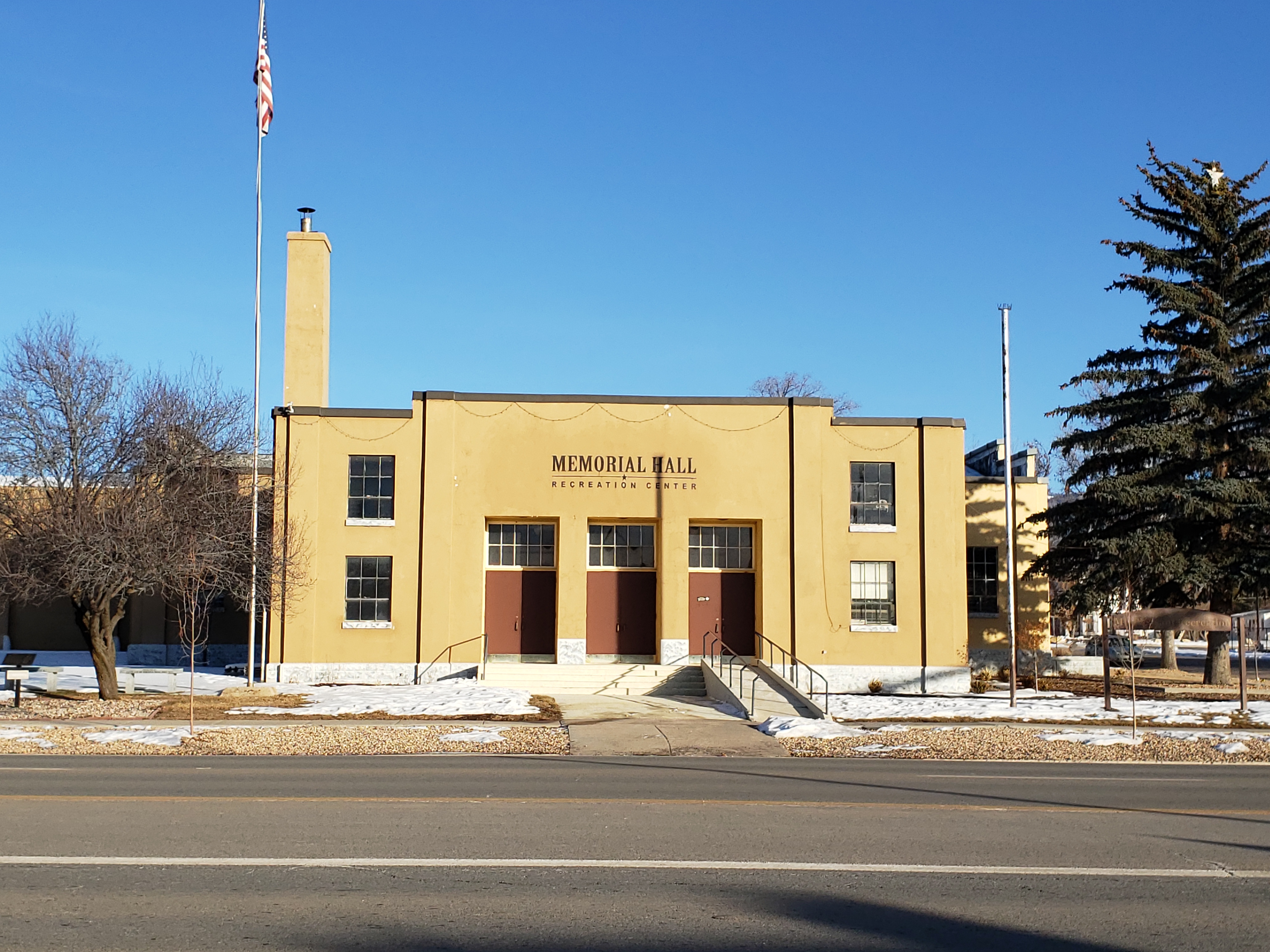
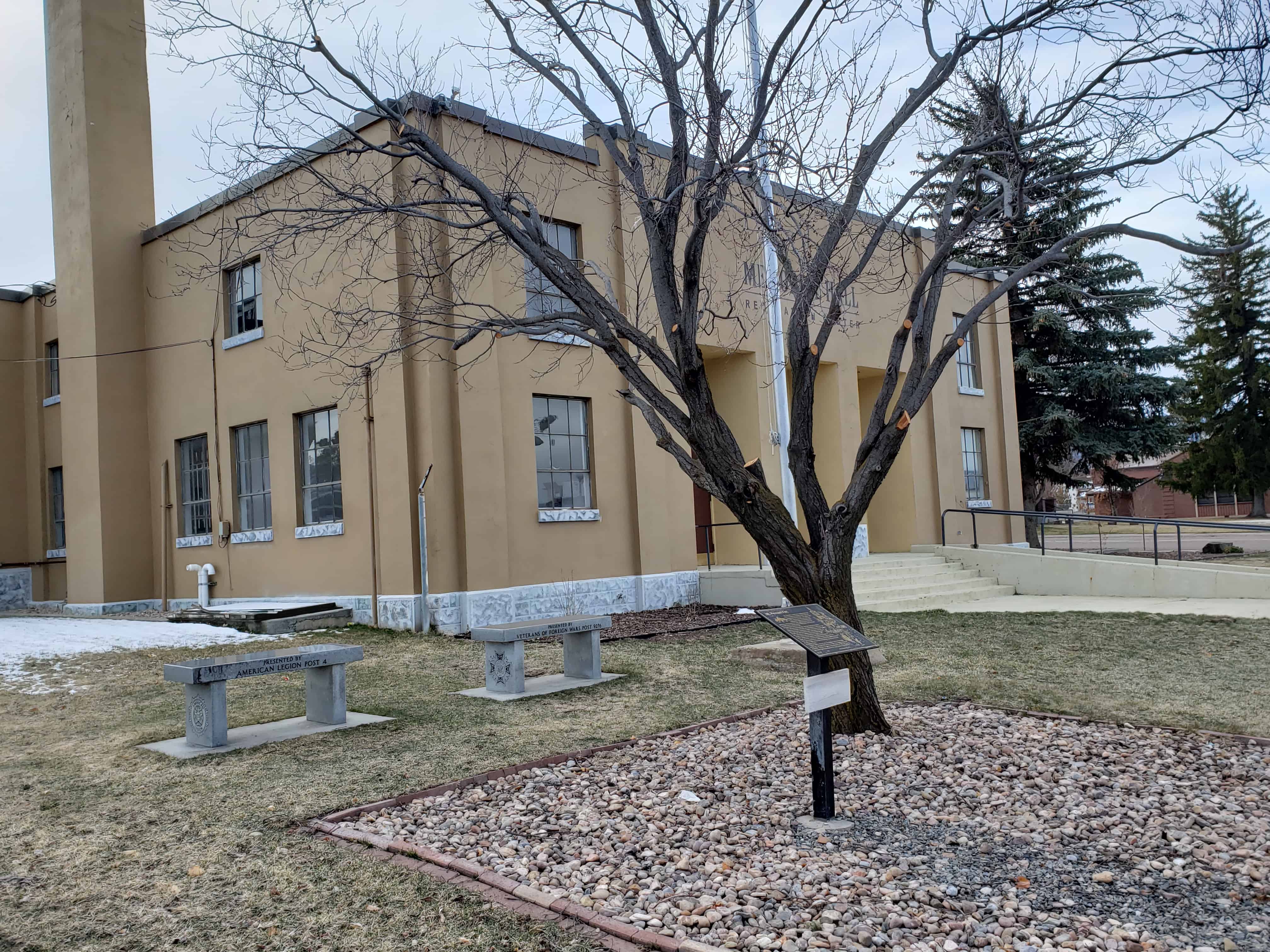
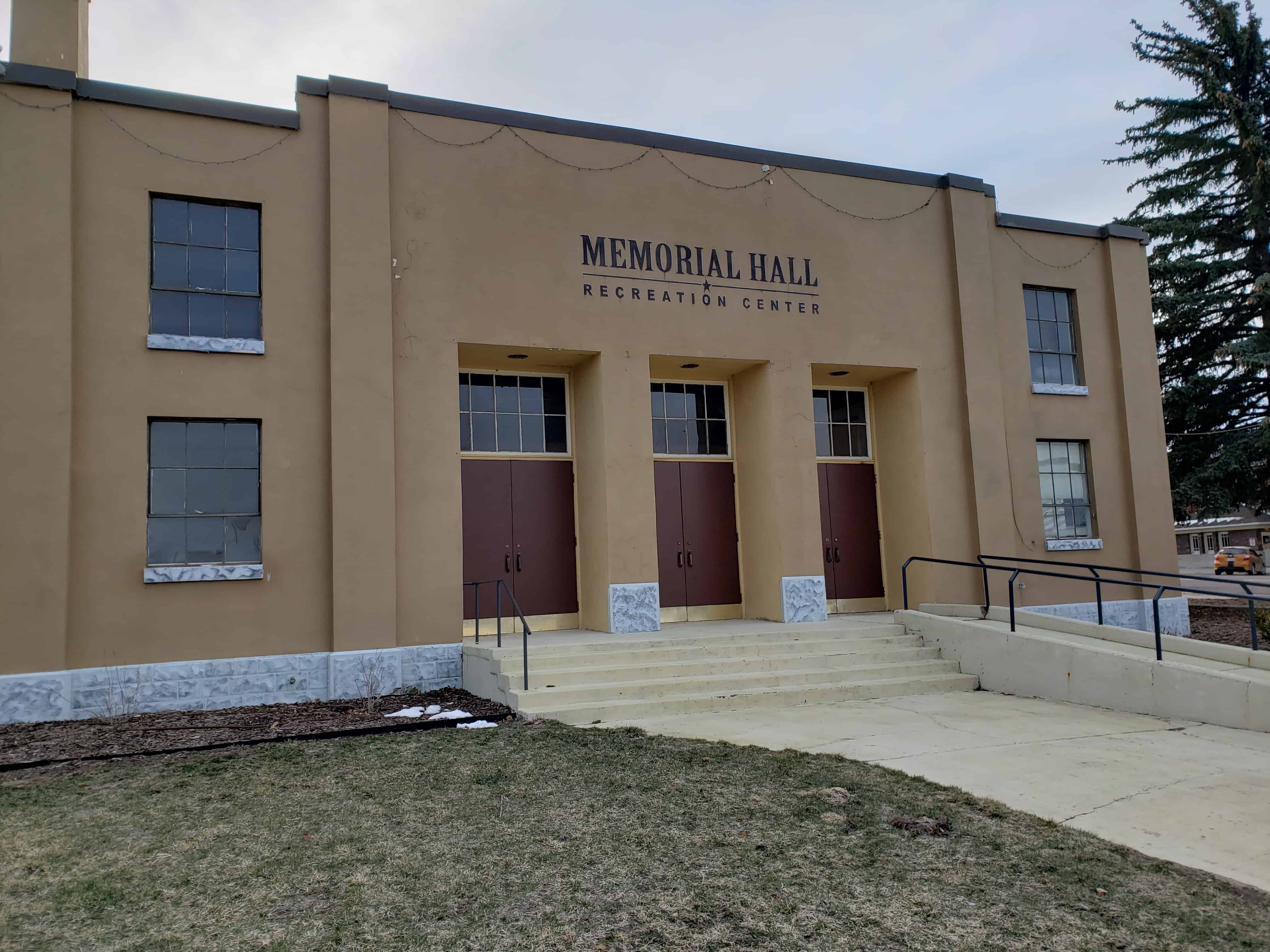
Built by Architects Niels P. Larsen and G.W. Brand. This building was in bad need of repair and has now had a significant face lift and is a Military memorial. The building was being used as a community recreation center, but the property was in terrible shape.
With the help of a federal grant and professional artists Bryan Spencer, Dean Kleven, and Jason Quinn, the armory now displays a larger-than-life mural of seven U.S. soldiers.(*)
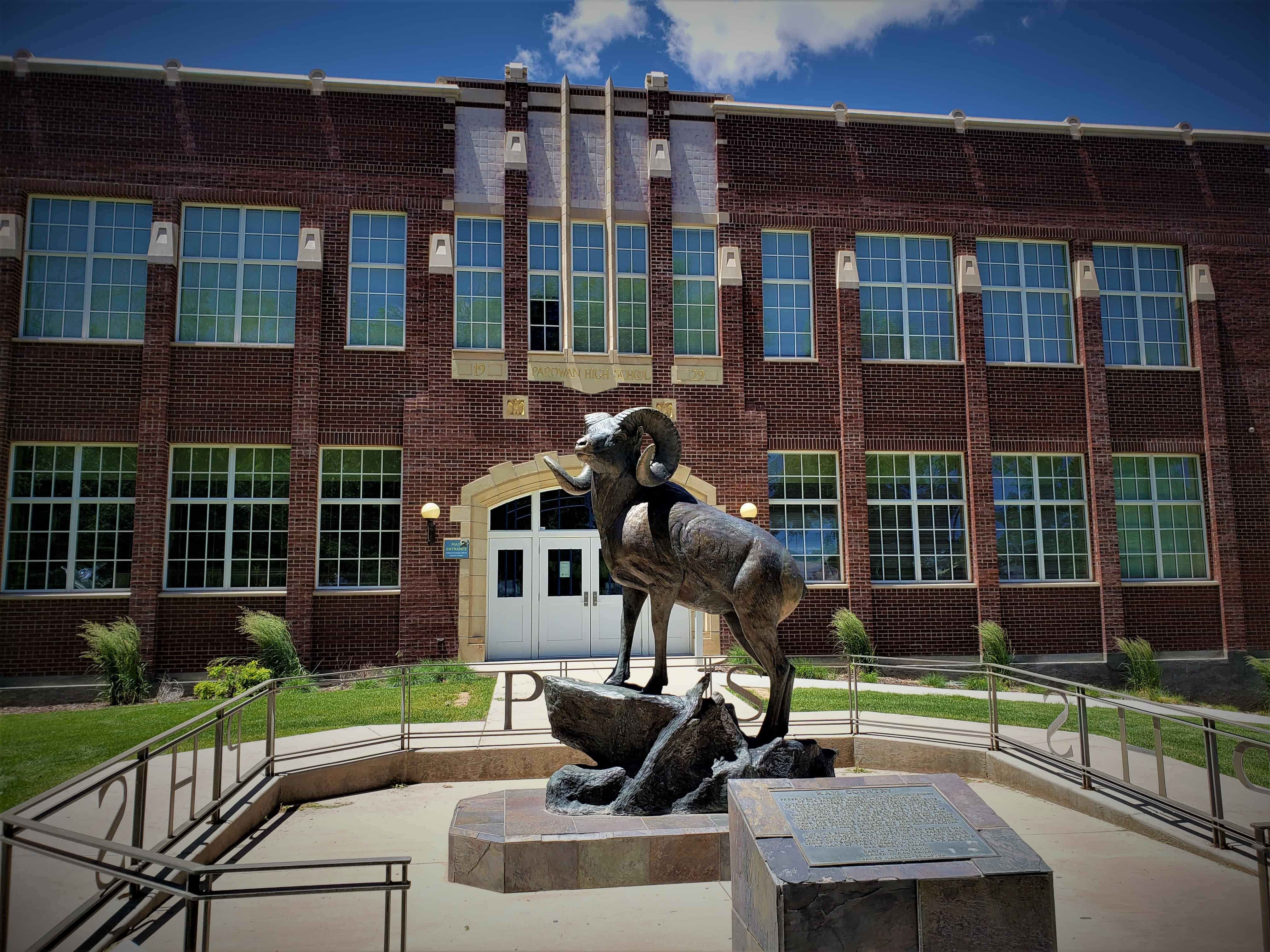
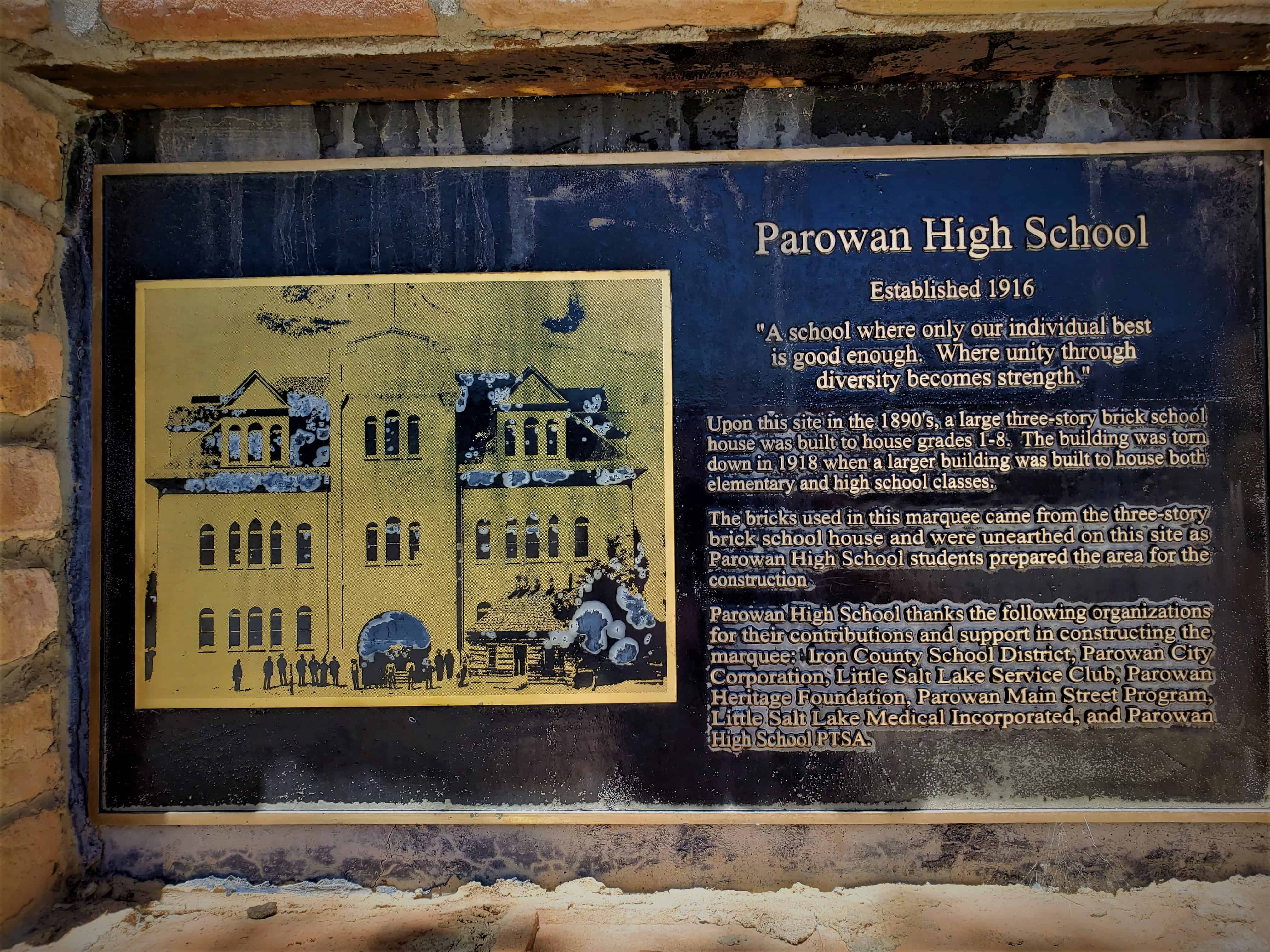
“A school where only our individual best is good enough. Where unity through diversity becomes strength.”
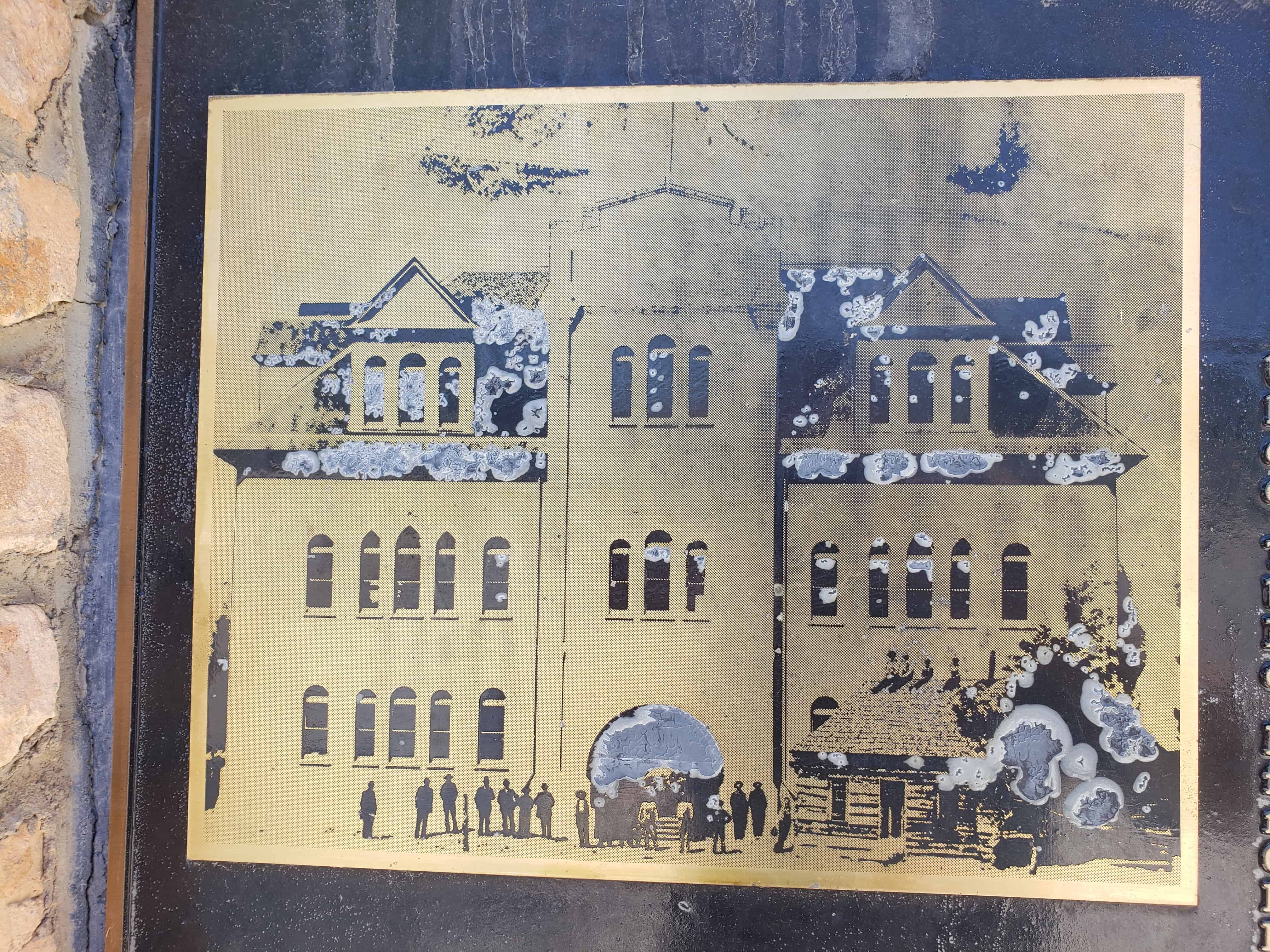
Upon this site in the 1890’s, a large three-story brick school house was built to house grades 1-8. The building was torn down in 1918 when a larger building was built to house both elementary and high school classes.
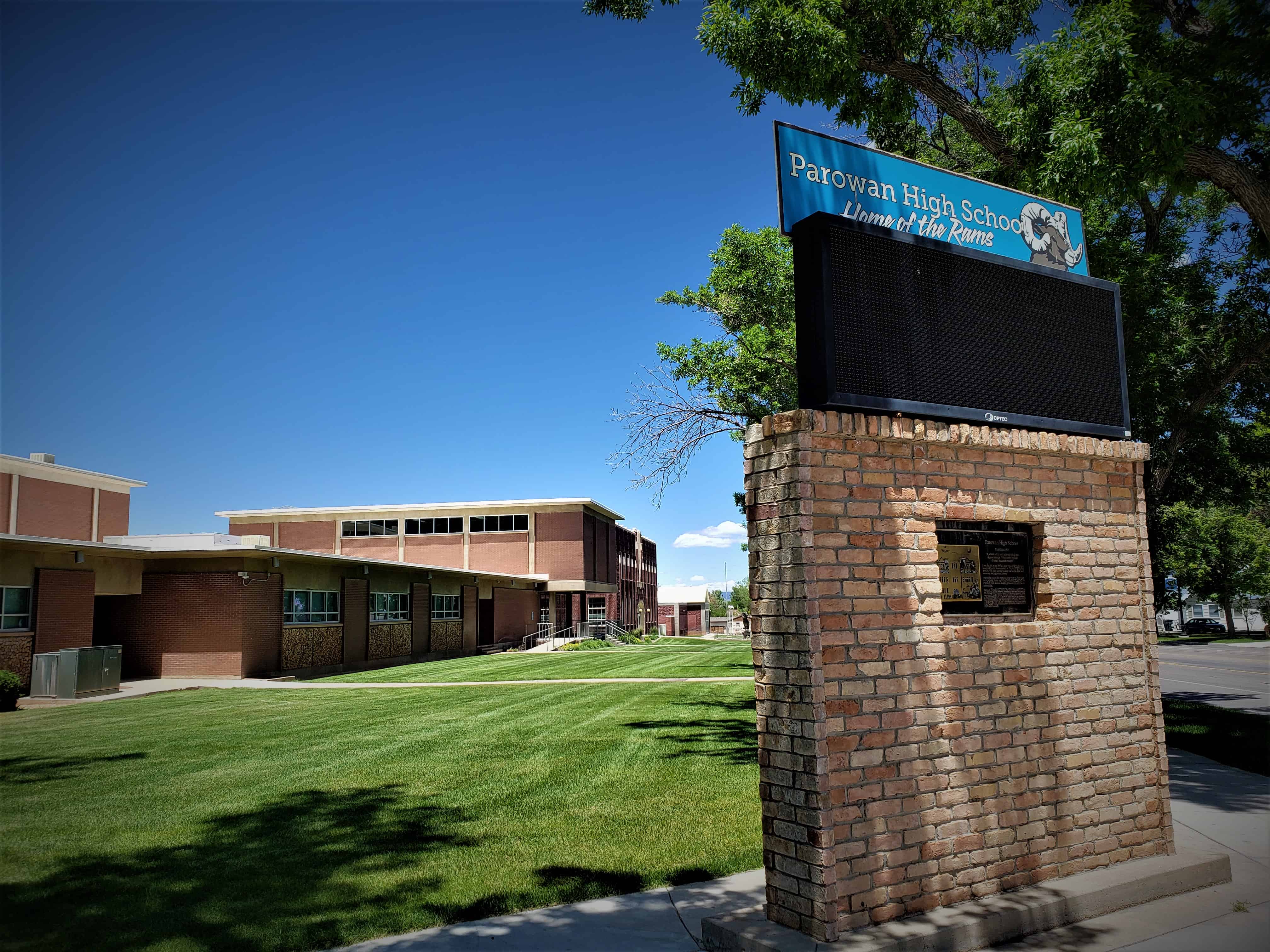
The bricks used in this marquee came from the three-story brick school house and were unearthed on this site as Parowan High School students prepared the area for the construction.
Parowan High School thanks the following organizations for their contributions and support in constructing the marquee: Iron County School District, Parowan City Corporation, Little Salt Lake Service Club, Parowan Heritage Foundation, Parowan Main Street Program, Little Salt Lake Medical Incorporated, and Parowan High School PTSA.
This fine Queen Anne style house was constructed in 1897 for John Dorius, Jr., a prominent local businessman. The son of a Danish immigrant farmer, John Dorius pieced together a successful career in farming, freighting, and merchandising in Ephraim during the 1880s and 1890s before moving his business to Salt Lake City in 1905. In scale, massing, and decorative detail, the Dorius House is a noteworthy expression of the Queen Anne design principals and remains one of the most outstanding examples of this important architectural style outside the major urban areas of Salt Lake City and Ogden. The barn in back of the house, built about the same time as the house, represents an excellent example of European craftsmanship which came to Sanpete Valley as part of the Mormon colonization.