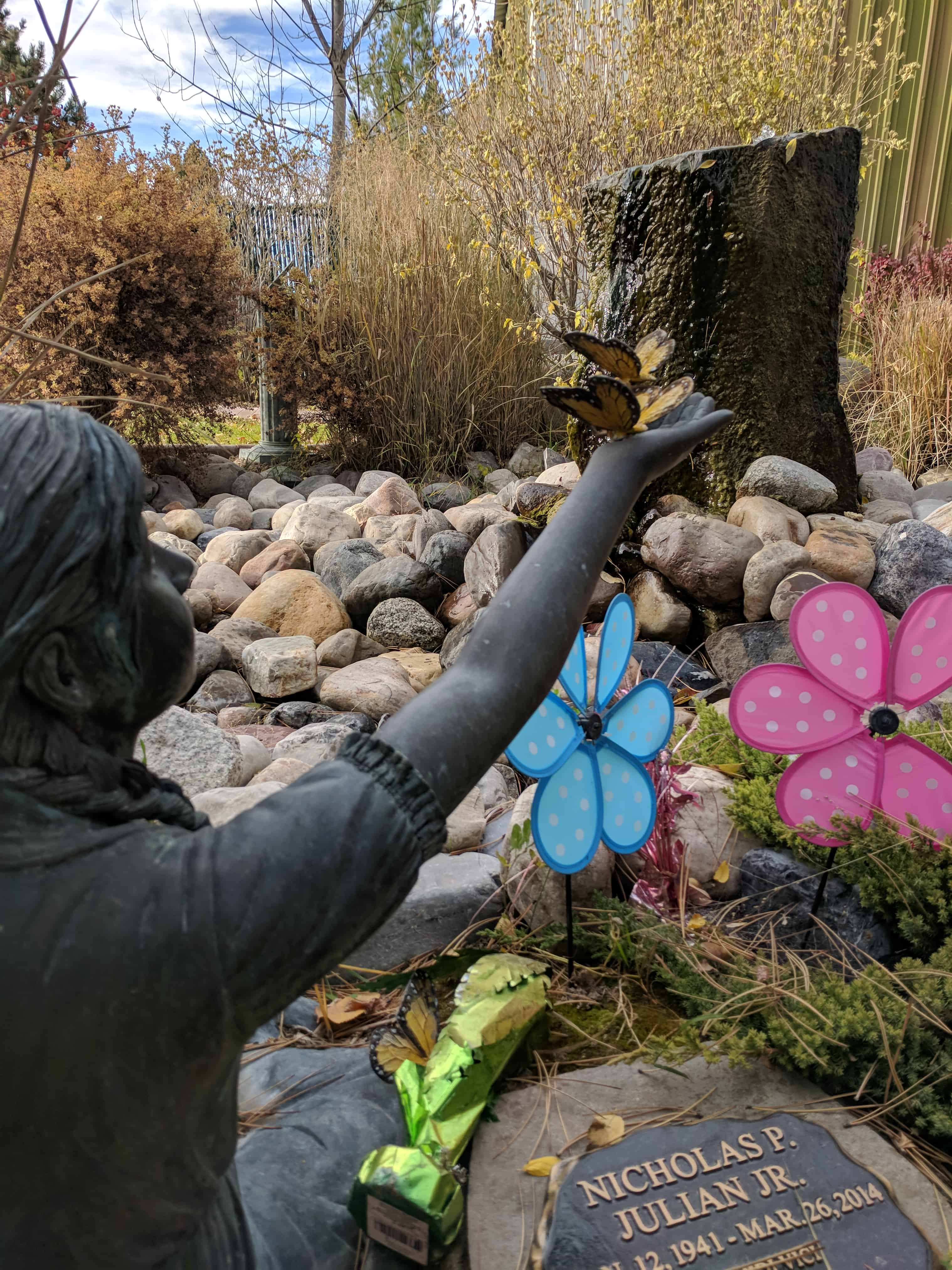
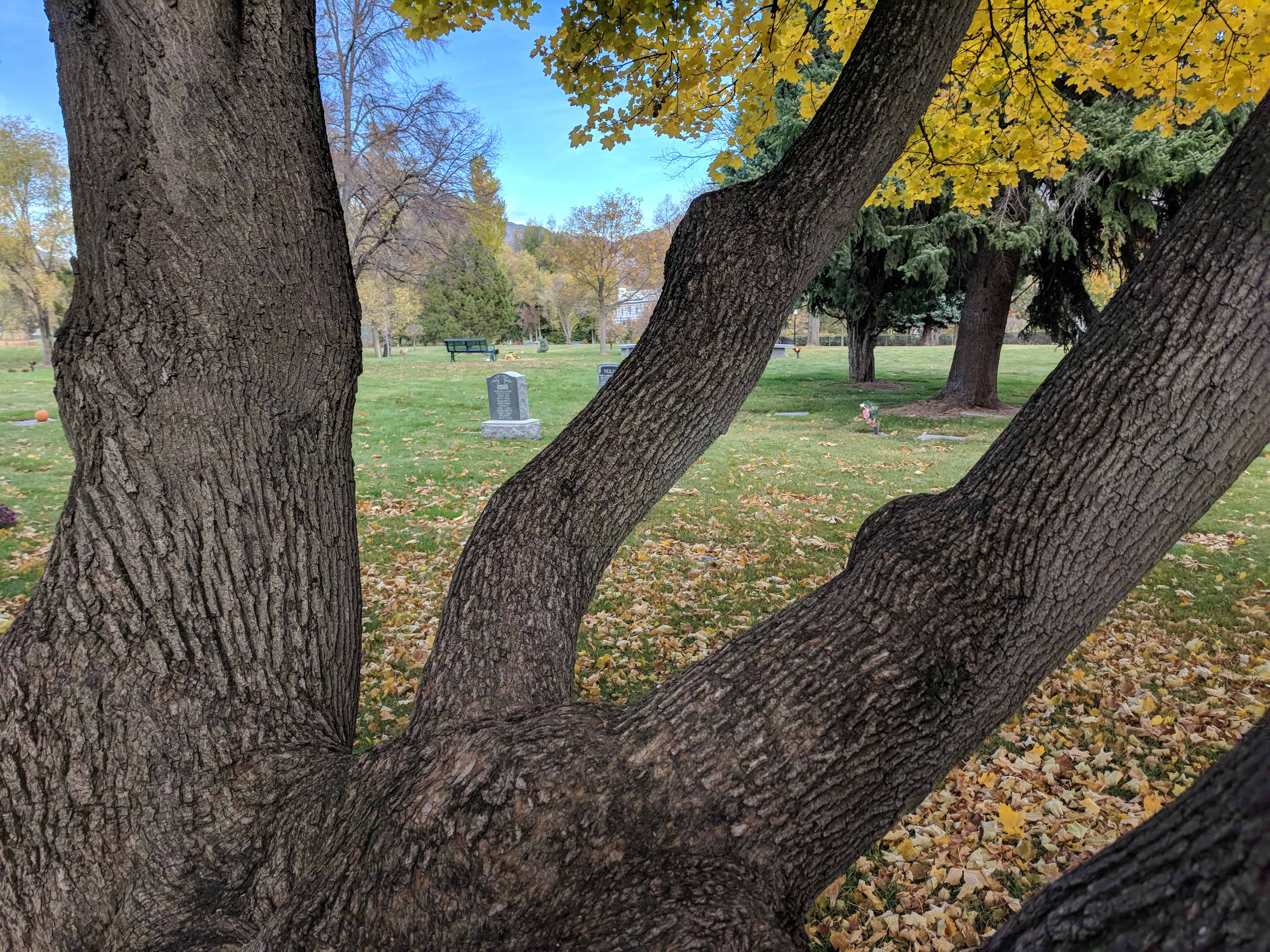
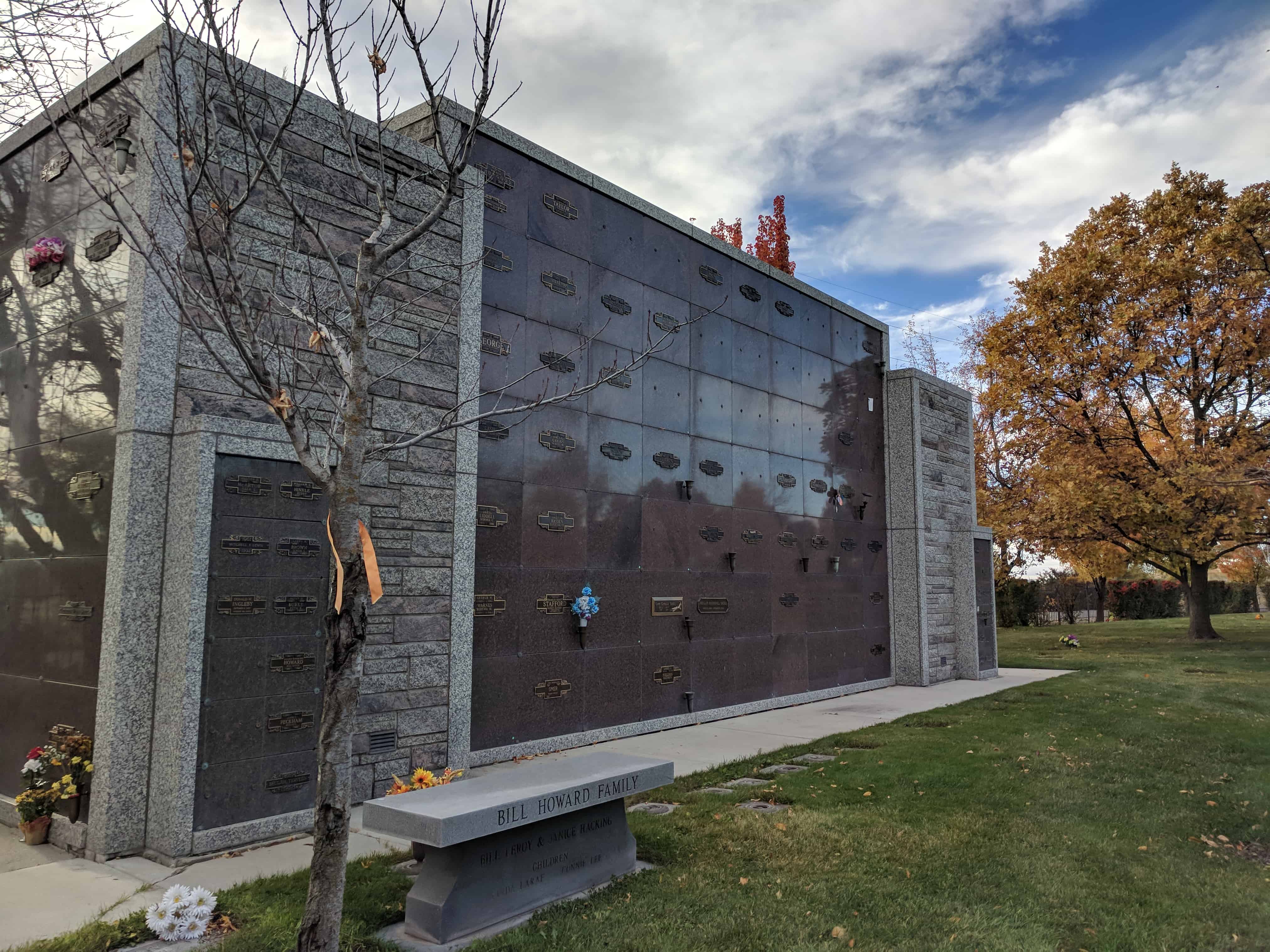
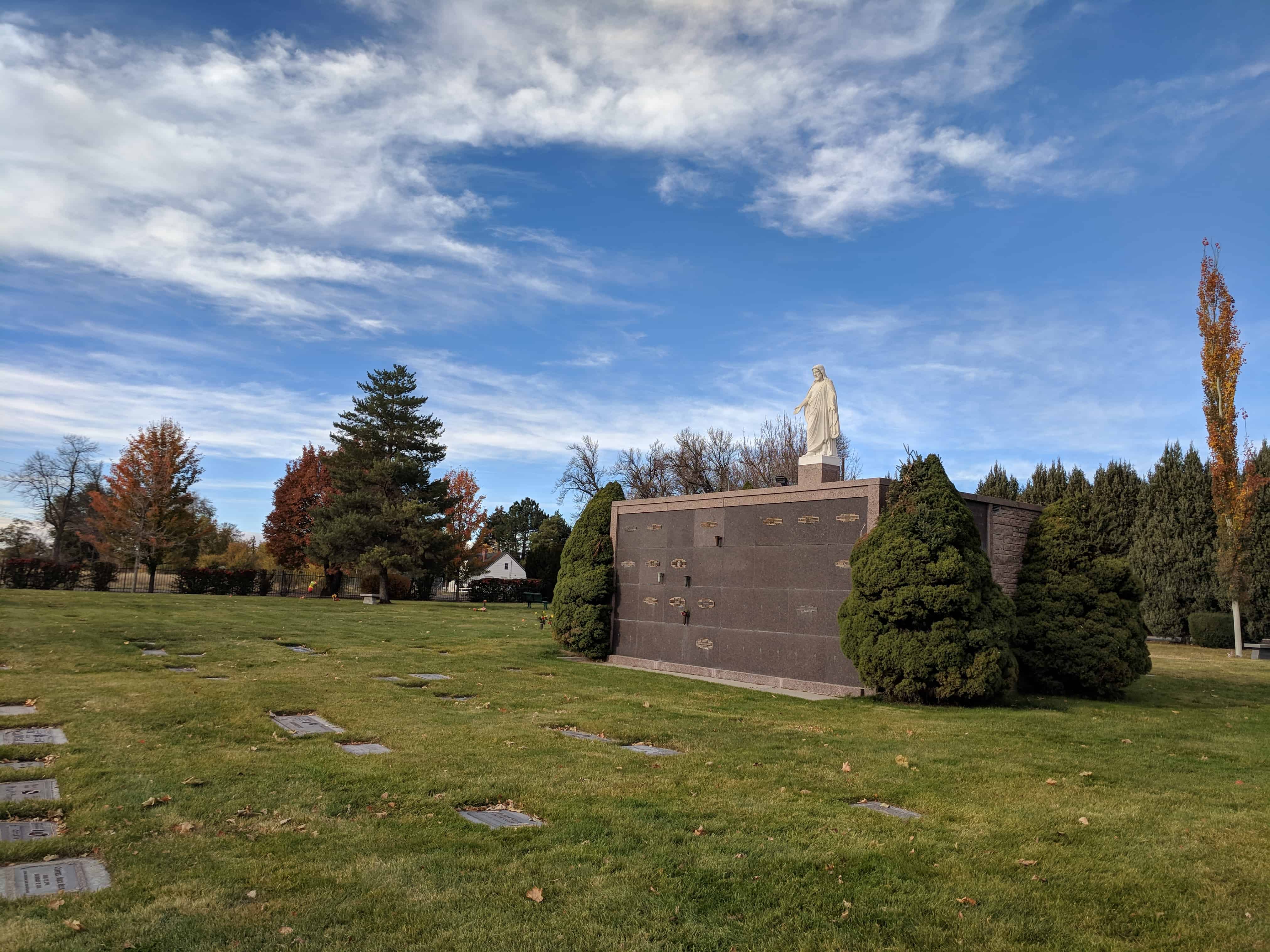
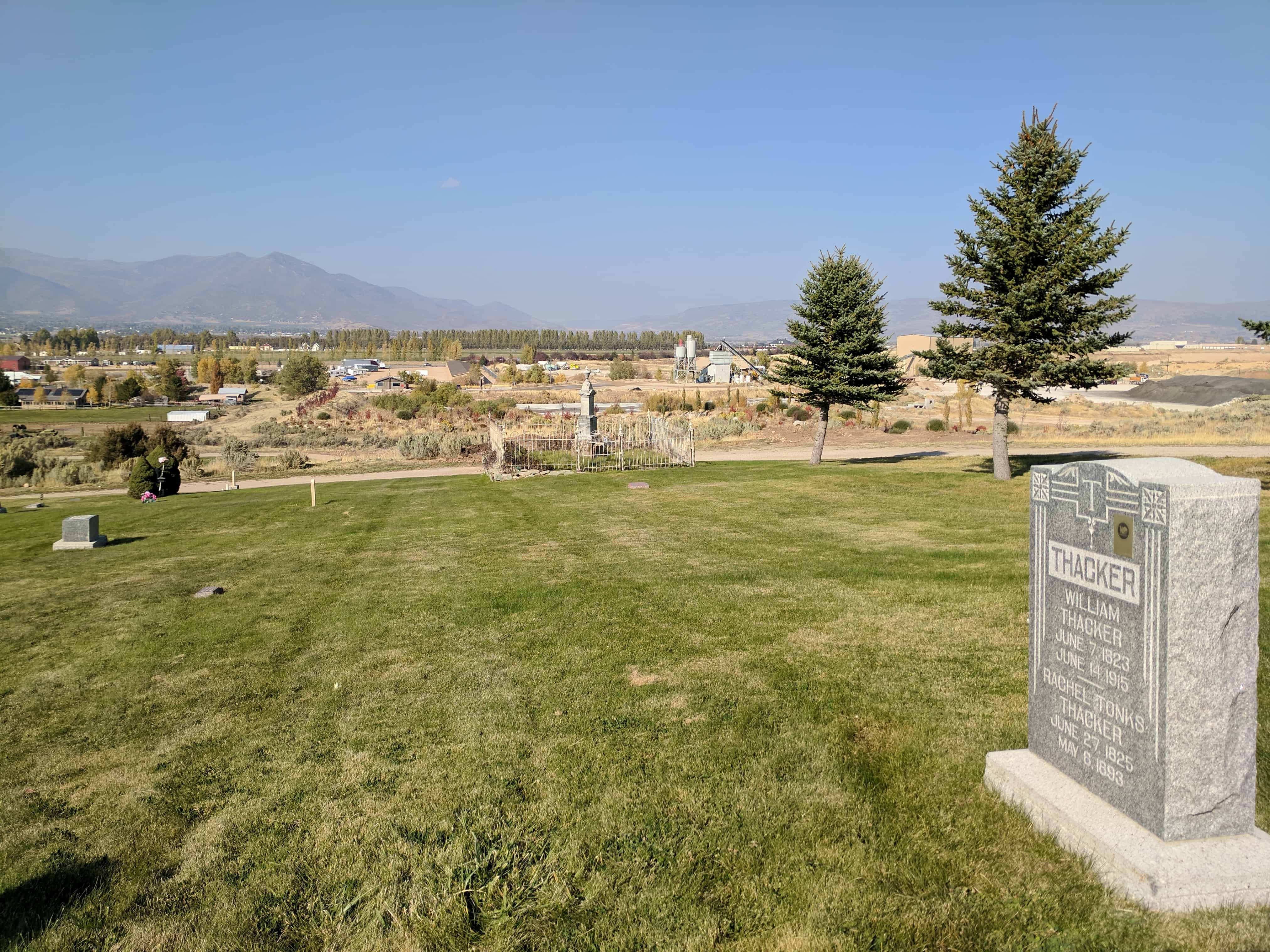
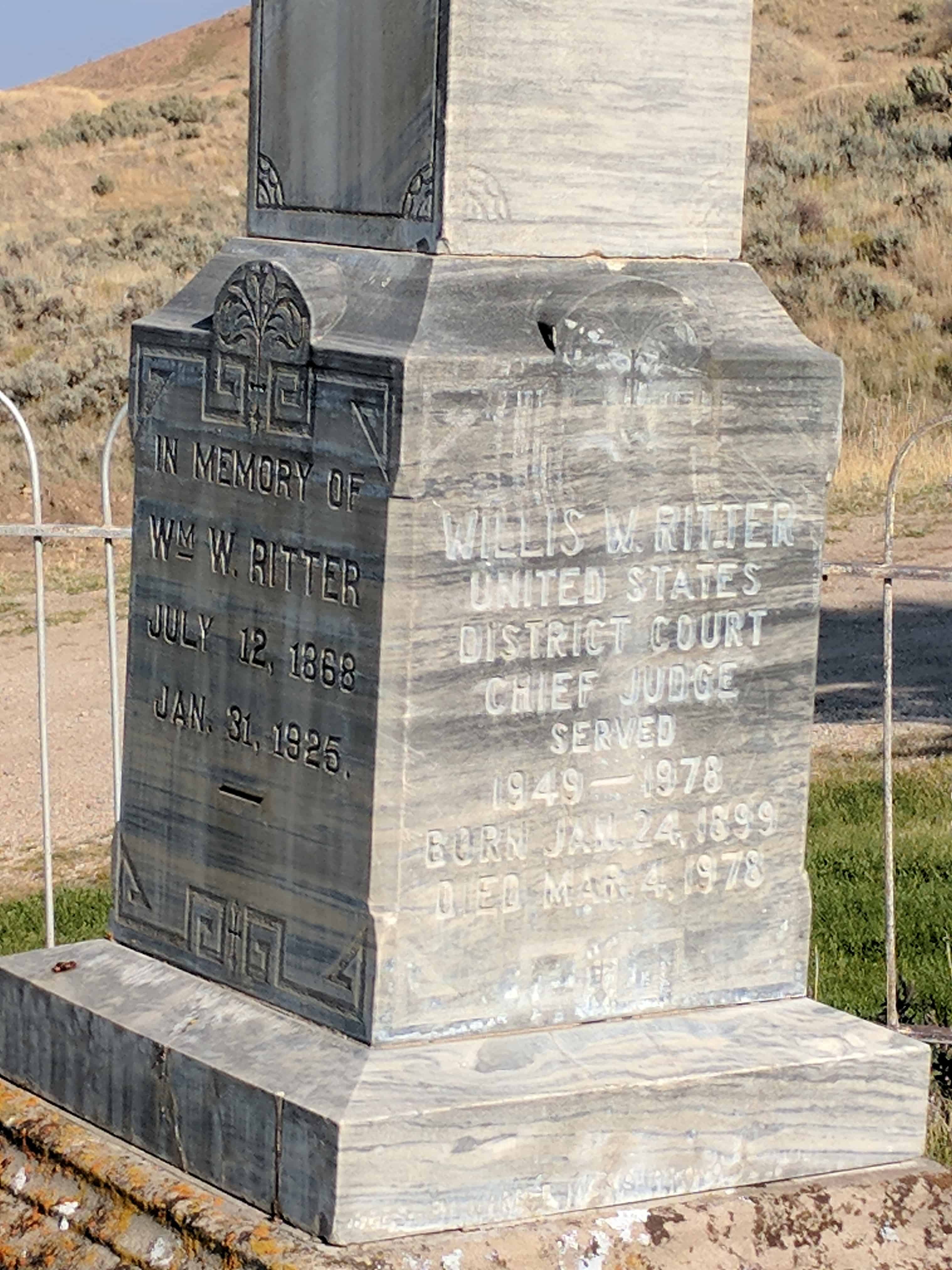
Located in Holladay, the Memorial Holladay Cemetery, also called Holladay Memorial Park is a beautiful cemetery with monuments, memorials and graves from pioneers to the area and recent.
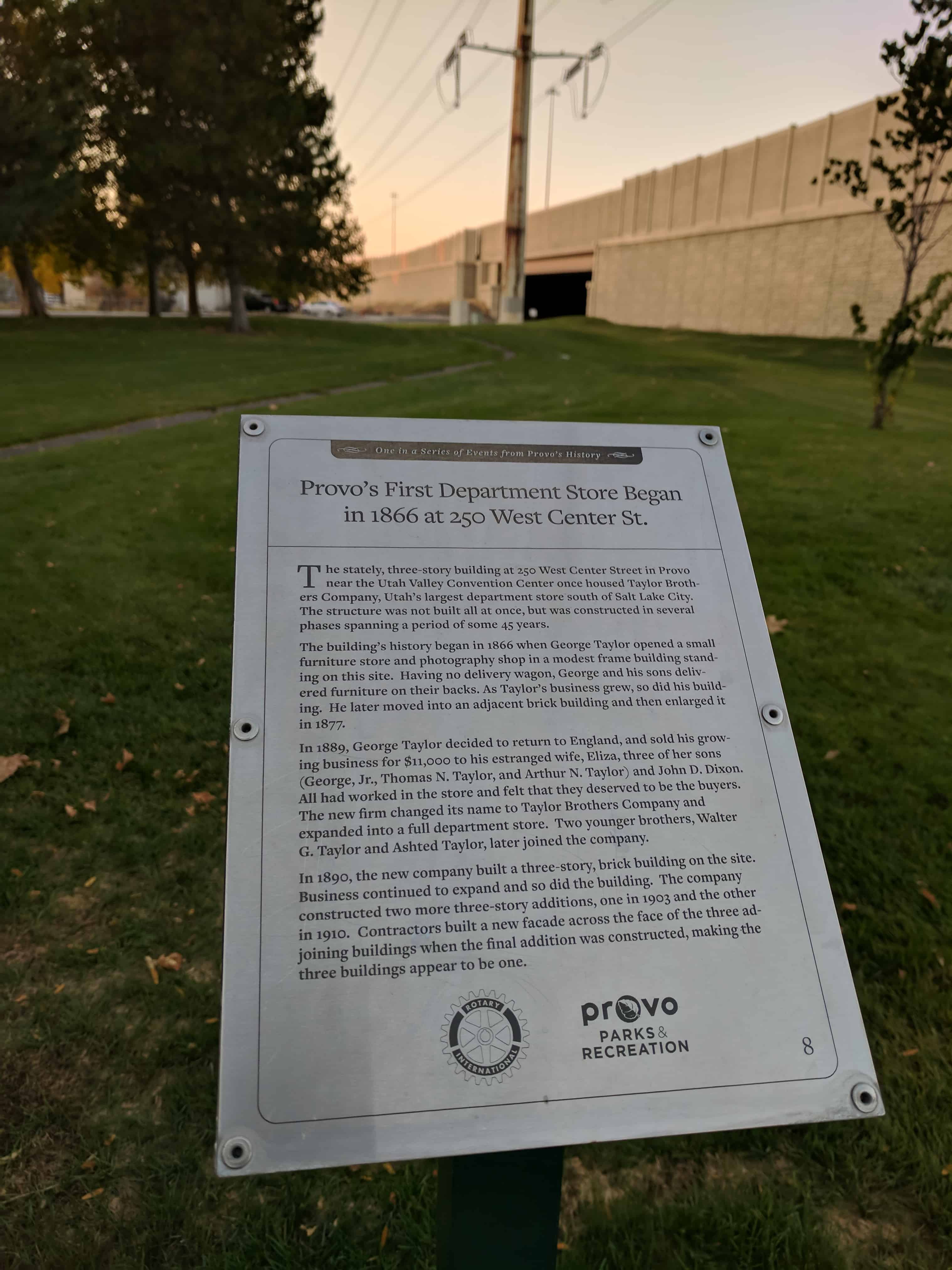
Provo’s First Department Store Began in 1866 at 250 West Center St.
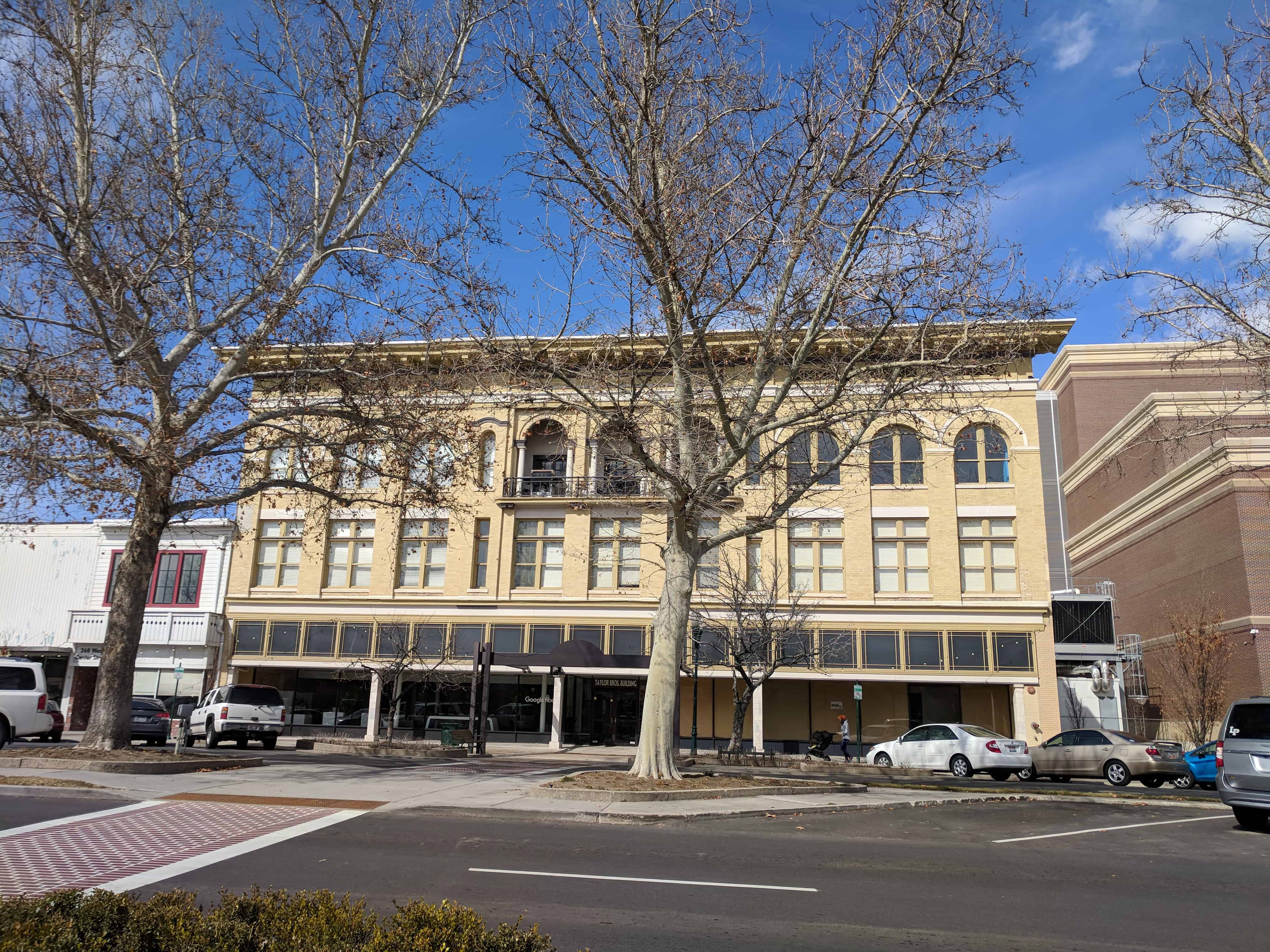
The stately, three-story building at 250 West Center Street in Provo near the Utah Valley Convention Center once housed Taylor Brothers Company, Utah’s largest department store south of Salt Lake City. The structure was not built all at once, but was constructed in several phases spanning a period of some 45 years.
The building’s history began in 1866 when George Taylor opened a small furniture store and photography shop in a modest frame building standing on this site. Having no delivery wagon, George and his sons delivered furniture on this backs. As Taylor’s business grew, so did his building. He later moved into an adjacent brick building and then enlarged it in 1877.
In 1889, George Taylor decided to return to England, and sold his growing business for $11,000 to his estranged wife, Eliza, three of her sons (George, Jr., Thomas N. Taylor, and Arthur N. Taylor) and John D. Dixon. All had worked in the store and felt that they deserved to be the buyers. The new firm changed its name to Taylor Brothers Company and expanded into a full department store. Two younger brothers, Walker G Taylor and Ashted Taylor, later joined the company.
In 1890, the new company built a three-story, brick building on the site. Business continued to expand and so did the building. The company constructed two more three-story additions, one in 1903 and the other in 1910. Contractors built a new facade across the face of the three adjoining buildings when the final addition was constructed, making the three buildings appear to be one.
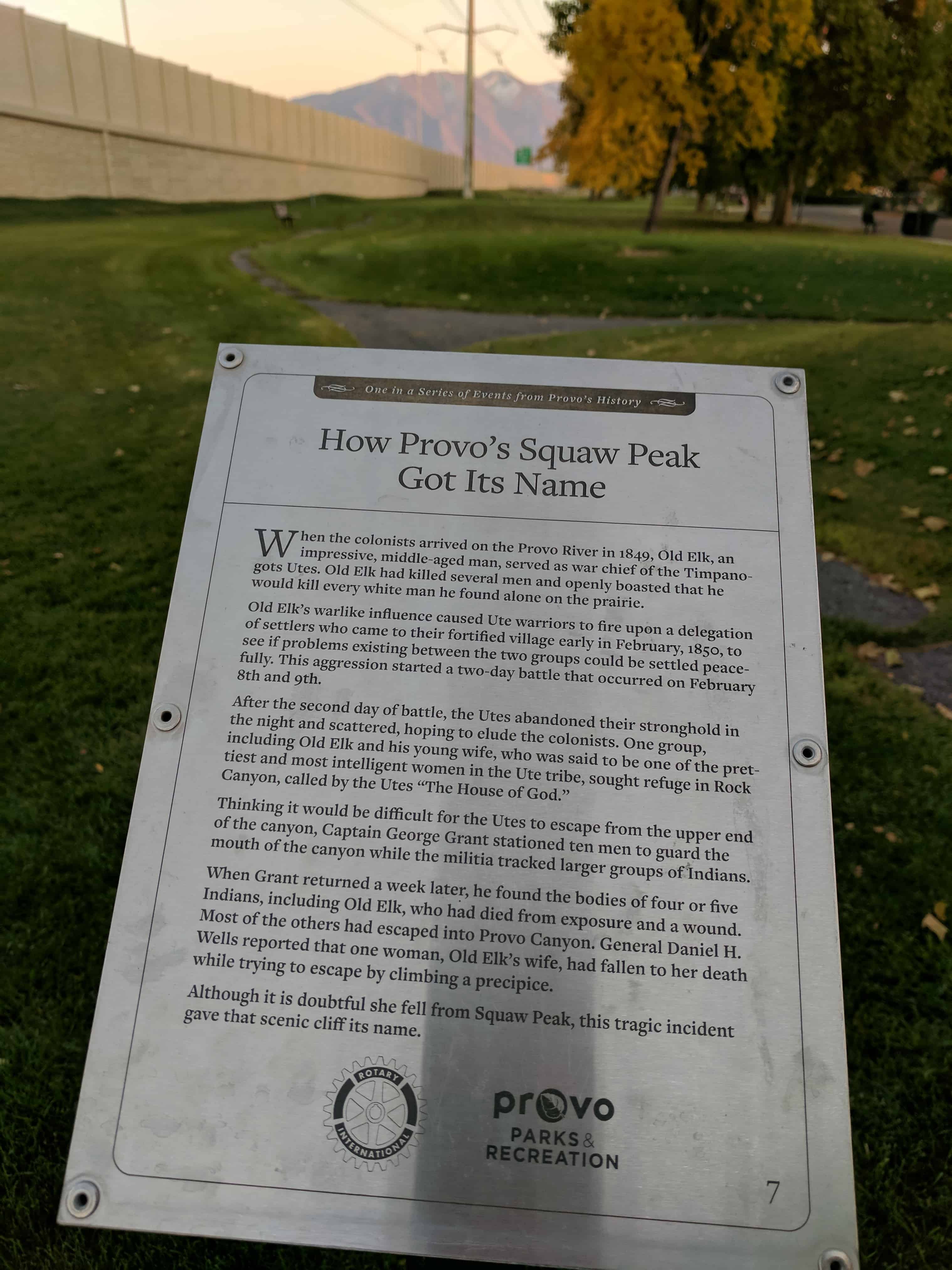
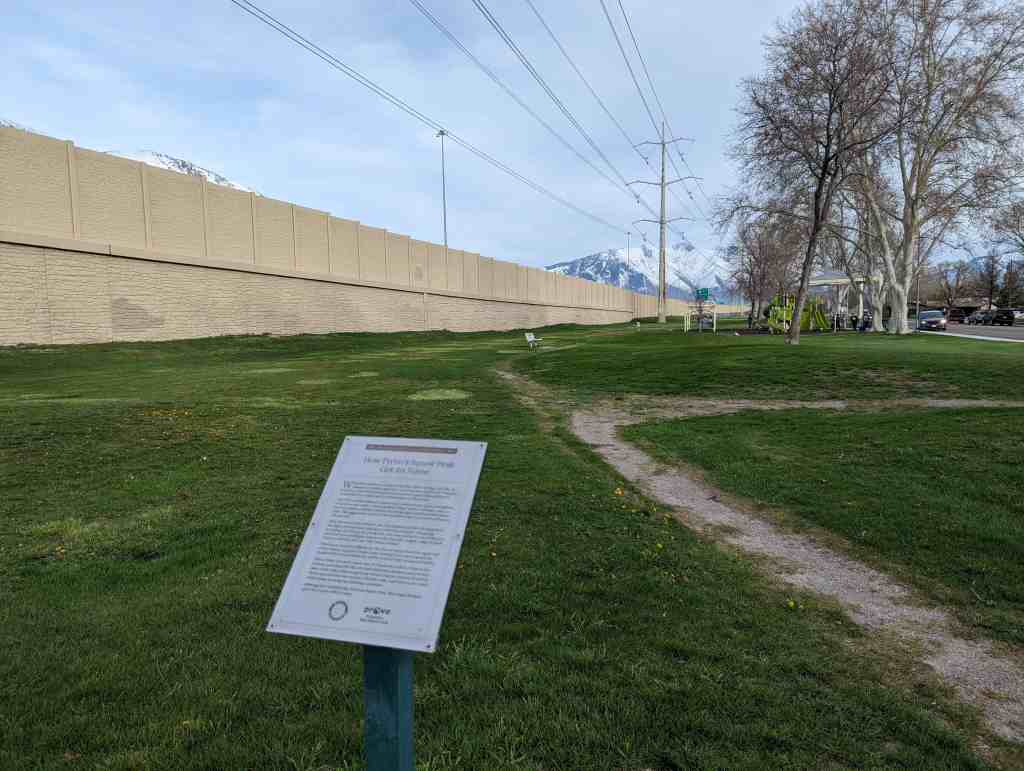
When the colonists arrived on the Provo River in 1849, Old Elk, an impressive, middle-aged man, served as war chief of the Timpanogots Utes. Old Elk had killed several men and openly boasted that he would kill every white man he found alone on the prairie.
Old Elk’s warlike influence caused Ute warriors to fire upon a delegation of settlers who came to their fortified village early in February, 1850, to see if problems existing between the two groups could be settled peacefully. This aggression started a two-day battle that occurred on February 8th and 9th.
After the second day of battle, the Utes abandoned their stronghold in the night and scattered hoping to elude the colonists. One group, including Old Elk and his young wife, who was said to be one of the prettiest and most intelligent women in the Ute tribe, sought refuge in Rock Canyon, called by the Utes “The House of God.”
Thinking it would be difficult for the Utes to escape from the upper end of the canyon, Captain George Grant stationed ten men to guard the mouth of the canyon while the militia tracked larger groups of Indians.
When Grant returned a week later, he found the bodies of four or five Indians, including Old Elk, who had died from exposure and a wound. Most of the others had escaped into Provo Canyon. General Daniel H. Wells reported that one woman, Old Elk’s wife, had fallen to her death while trying to escape by climbing a precipice.
Although it is doubtful she fell from Squaw Peak, this tragic incident gave that scenic cliff its name.
Erected about 1852 by President Brigham Young as the Official Residence of the President of the Church of Jesus Christ of Latter-day Saints and occupied by him from the time it was completed until his death in 1877.
From 1852 to 1855 it also served as the Executive Mansion of Governor Brigham Young of the Territory of Utah.
It was also the home of presidents Lorenzo Snow (1898 – 1901) and Joseph F. Smith (1901 – 1918), both of whom died here.
The Beehive is the State Emblem signifying industry.
The Utah Historic Site plaque says the Beehive House was built in 1854 of adobe brick, the architect was Truman O. Angell and it was the home of Brigham Young, the 2nd President of the Church of Jesus Christ of Latter-day Saints and 1st Governor of the Territory of Utah.
Tourstop 5 in the Salt Lake City Tour says: The Beehive House served as Brigham Young’s residence, office, and reception area for official visitors. At the time the house was built, Young was both president of the LDS Church and Utah’s territorial governor. The Beehive House was designed by Young’s brother-in-law, Truman O. Angell. Angell was also the architect for the Lion House and the Salt Lake LDS Temple. Built of stuccoed adobe, the Beehive House features a two-story veranda, an observatory, and a cupola topped with a beehive. Young’s son added a three-story wing to the north when he remodeled the house in 1888. In the early 1960s, the LDS Church restored the Beehive House to resemble its 1888 appearance.
(from Preservation Utah’s walking tour) The Beehive House 67 East South Temple 1853-1855, Truman O. Angell, SLC 30-minute guided tours available every 15 minutes Monday-Saturday, 9:30 am-4:30 pm, and Sunday, 10:00 am-1:00 pm.
The Beehive House served as Brigham Young’s residence, office, and reception area for official visitors. It was designed by Young’s brother-in-law, Truman O. Angell. Angell, one of Utah’s prominent early architects, also designed the Lion House and the Salt Lake City LDS Temple. The Greek Revival style Beehive House features a two-story veranda, an observatory, and a cupola topped with a beehive. Young’s son added a three-story wing to the north after he purchased the house in 1888.
In addition to the Beehive House and the Lion House, Young’s walled estate fronting South Temple also included the White House, a family schoolhouse, carpenter shop, barns, orchards, and gardens. The Eagle Gate at the intersection of South Temple and State streets marks the original entrance to Young’s multipurpose compound. The Eagle Gate also provided access to City Creek Canyon to the northeast. See the marker on the northeast corner of the intersection for a history of the Eagle Gate.
In the early 1960s, the LDS Church restored the Beehive House and opened it as a house museum. Guided tours of the building are available daily.
From the nomination form for the National Historic Register:
The beautiful old mansion Is the pioneer home of Brigham Young, but It in 1851. Today’s workmen, under the direction of architects (all grandsons of Brigham Young) have done a remarkable job of restoration. The outside adobe brick walls have been painted in the original straw-colored yellow, which gives the manor a gay, but antique appearance of the original.
The Beehive House was built to meet the dual needs of Brigham Young, second president of the Church of Jesus Christ of Latter-day Saints and first governor of the state of Deseret, later Utah Territory. Above all, however, the Beehive House was a home for his family. It was also used as an official mansion where the Mormon leader received and conferred with other Church leaders, state and federal dignitaries, and entertained prominent traveling officials. During the life of Brigham Young, many famous people were entertained in the Beehive House, including President Ulysses S. Grant, Emperor Dom Pedro of Brazil, General William T. Sherman, Ralph Waldo Emerson, Mark Twain, Jay Gould, Horace Greeley, and even the midget Tom Thumb and his tiny wife.
In 1893, the Church purchased the historic building to make it the official residence of its presidents. Lorenzo Snow and Joseph F. Smith were the only two succeeding presidents to live in it. After the death of President Smith, the house stood vacant for a number of years, and was again remodeled and maintained as an away-from-home residence for young women who came to the city to work or attend school.
In 1959, when the Church decided to restore the Beehive House, a committee made up primarily of descendants of Brigham Young was chosen to carry out the task. Research and detective work on the part of this committee took 18 months to complete, and included the use of old manuscripts describing the house, the search for Brigham Young’s furnishings, and the discovery of “clues” beneath old plaster to find tell-tale evidences of still earlier construction. The “Manuscript” had been written by Clarissa Young Spencer who lived in the Beehive House from childhood until after her marriage.
Heavy coats of paint and wallpaper were peeled away, revealing the original colors and patterns. False ceilings were torn down, exposing ornate medallions which pioneer craftsmen installed in 1854.
With restoration and furnishing complete, the lovely mansion is now open for tours to the public. In its location, it is near Temple Square, a National Landmark, and the Lion House, which adjoins it on the west, and which is also a National Landmark.
The design of the Beehive House follows the 19th century Greek revival in architecture. The architect was Truman O. Angel, who also designed the many-spired Salt Lake Temple, Some of the original drawings for the Beehive house, fortunately, were found in the archives of the Church Historian’s Office shortly after work on the restoration had begun in 1959, and proved invaluable in the complete restoration of the home.
As originally built, the main part of the house consisted of two stories and an attic, surmounted by a beehive-shaped cupola, the traditional Mormon symbol of industry which was to give the home its name. Surrounding this tower is a a steel-railed (originally was wood) “widow’s watch,” reminiscent of the colonial coast.
Since the death of Brigham Young, the Beehive House has undergone two major alterations. The first was made by a son who purchased the home in 1888. Under this remodeling, the rear section was rebuilt into a three-storied wing. The formal dining room downstairs also was extensively remodeled, and an upstairs sitting room and parlor added.
The “adobe” walls were found to be in remarkably good condition. When later additions were torn out (during restoration), the walls revealed the exact location of stairs, halls, doorways, partitions and roof lines as described in the old manuscripts and original plans. With restoration, wide pine board floors, laid with square nails replaced the hardwood (not original.)
In the 1850’s, Brigham Young had a nine-foot high cobblerock wall erected around the Beehive House as protection from unfriendly intruders and as a make-work project for men who needed employment. Portions of this same wall (recently pushed back 23 feet to widen State Street north of Eagle Gate now border the home on the north and east sides. A low wrought-iron fence stands in front of the house where the big wa11 once stood.
The oak-finished door, now painted white, with its silver doorknob opens onto the main hallway. The doorbell system installed by Brigham Young was discovered and restored. Downstairs were Brigham Young’s bedroom, the Parlor and kitchen; on the second floor the “long hall” for entertaining guests, and Brigham Young:1 s offices.
The lovely home is now authentically restored and furnished with furniture from Brigham Young and his family, and from other period furniture at a cost to the Church of Jesus Christ of Latter-day Saints approximating one-half million dollars.
Built by President Brigham Young and used by him as a residence from about 1855 until his death in 1877. On the lower floor were the dining room and kitchens. On the next floor were the living rooms and large parlor; and on the top floor were the bedrooms.
It was in this house that President Young died. Later the building was used for school purposes and as a social center for women and girls. The lion is a replica of one that occupied a similar position on a prominent home in Vermont, the State where President Young was born and spent his youth.
In 1869, Brigham Young founded the Young Women organization in the Lion House.
The Utah Historic Site plaque says the Lion House was constructed 1855-56 as a residence for Brigham Young and his family. The Lion House takes its name from the recumbent lion set on top of the front portico. The House was designed by Truman O. Angell and built of stuccoed adobe. Brigham Young, second president of the Church of Jesus Christ of Latter-day Saints and first territorial governor of Utah, died in this house on August 29, 1877. Since its construction, the Lion House has functioned as a community social center.
Tourstop 4 in the Salt Lake City Tour says: The Lion House takes its name from the carved lion on top of the front portico. The House was constructed with adobe blocks, a common building material during Utah’s settlement period. Brigham Young, second president of the Church of Jesus Christ of Latter-day Saints built the Lion House for his wives and children. He and some early Church members practiced the Old Testament principle of polygamy which was officially ended in 1890. The basement contained a dining room which could accommodate 70 people. On the main floor were sitting rooms and bedrooms for wives with children. The second floor had bedrooms for children and childless wives – one under each of the 20 steeply-pitched gables.
(from Preservation Utah’s walking tour) The Lion House 63 East South Temple 1854-1856, Truman O. Angell, SLC Restaurant open to the public Monday-Saturday, 11:00 am-2:00 pm, and Thursday-Saturday, 5:00-8:30 pm. No tours available. The Lion House is one of several houses built on South Temple by Brigham Young, the second president of the LDS Church and Utah’s territorial governor.Young’s presence on South Temple made it Salt Lake City’s most prestigious residential street. For many years, South Temple was informally known as “Brigham Street.” Brigham Young intended the Lion House to be a model for polygamous living arrangements. As many as 20 of his wives and dozens of his children lived here at one time. The basement contained a dining room which could accommodate 70 people. On the main floor were sitting rooms, a “prayer room,” and bedrooms for wives with children. The second floor had 20 bedrooms for childless wives and older children, one under each of the 20 gabled dormer windows. Brigham Young died in the Lion House in 1877. Some of his wives and children continued to live in the house until the 1900s. Today the building contains a reception center and restaurant.
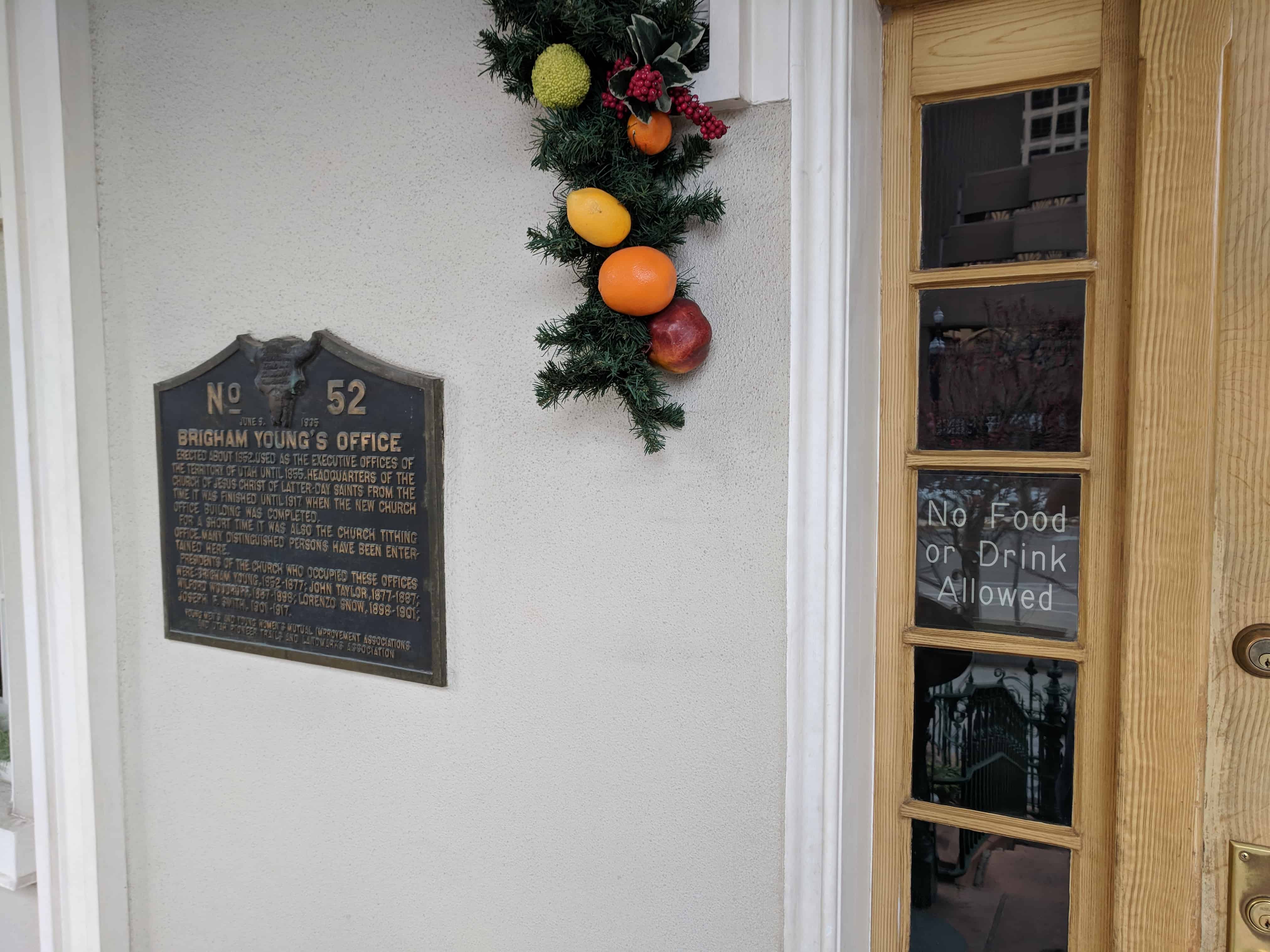
Erected about 1852, used as the executive offices of the Territory of Utah until 1855, headquarters of the Church of Jesus Christ of Latter-day Saints from the time it was finished until 1917, when the new Church Office Building was completed.
For a short time it was also the Church Tithing Office. Many distinguished persons have been entertained here.
Presidents of the Church who occupied these offices were Brigham Young, 1852 – 1877; John Taylor, 1877 – 1887; Wilford Woodruff, 1887 – 1898; Lorenzo Snow, 1898 – 1901; Joseph F. Smith, 1901 – 1917.