• About JacobBarlow.com
  • Cemeteries in Utah
  • D.U.P. Markers
  • Doors
  • Exploring Utah Email List
  • Geocaching
  • Historic Marker Map
  • Links
  • Movie/TV Show Filming Locations
  • Oldest in Utah
  • Other Travels
  • Photos Then and Now
  • S.U.P. Markers
  • U.P.T.L.A. Markers
  • Utah Cities and Places.
  • Utah Homes for Sale
  • Utah Treasure Hunt

JacobBarlow.com

~ Exploring with Jacob Barlow

JacobBarlow.com

Tag Archives: LDS Church

Site of First Chapel in Lehi

15 Monday Jan 2018

Posted by Jacob Barlow in Uncategorized

≈ 1 Comment

Tags

Historic Churches, LDS Church, Lehi, utah, utah county

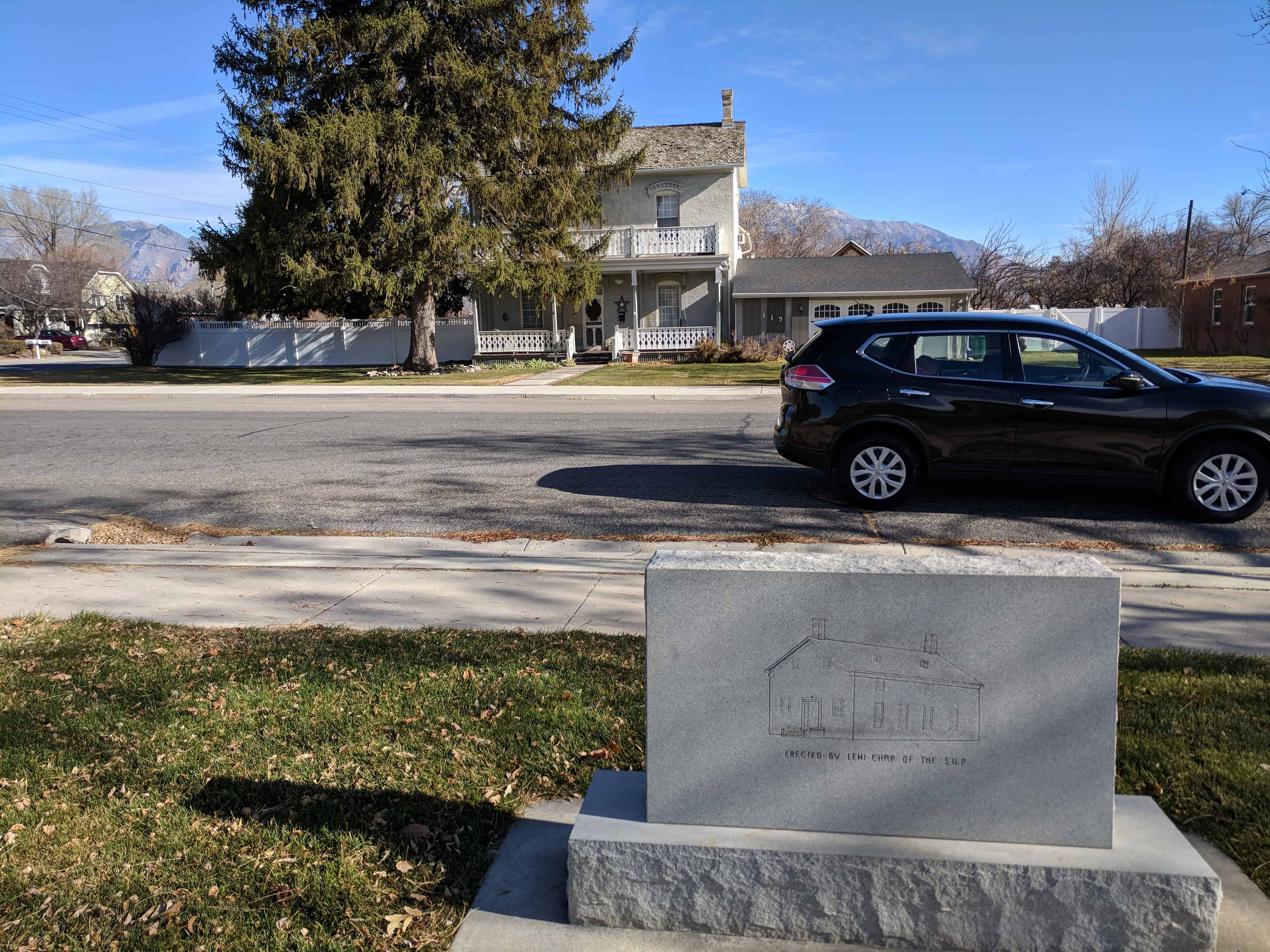
2017-11-25 12.38.50

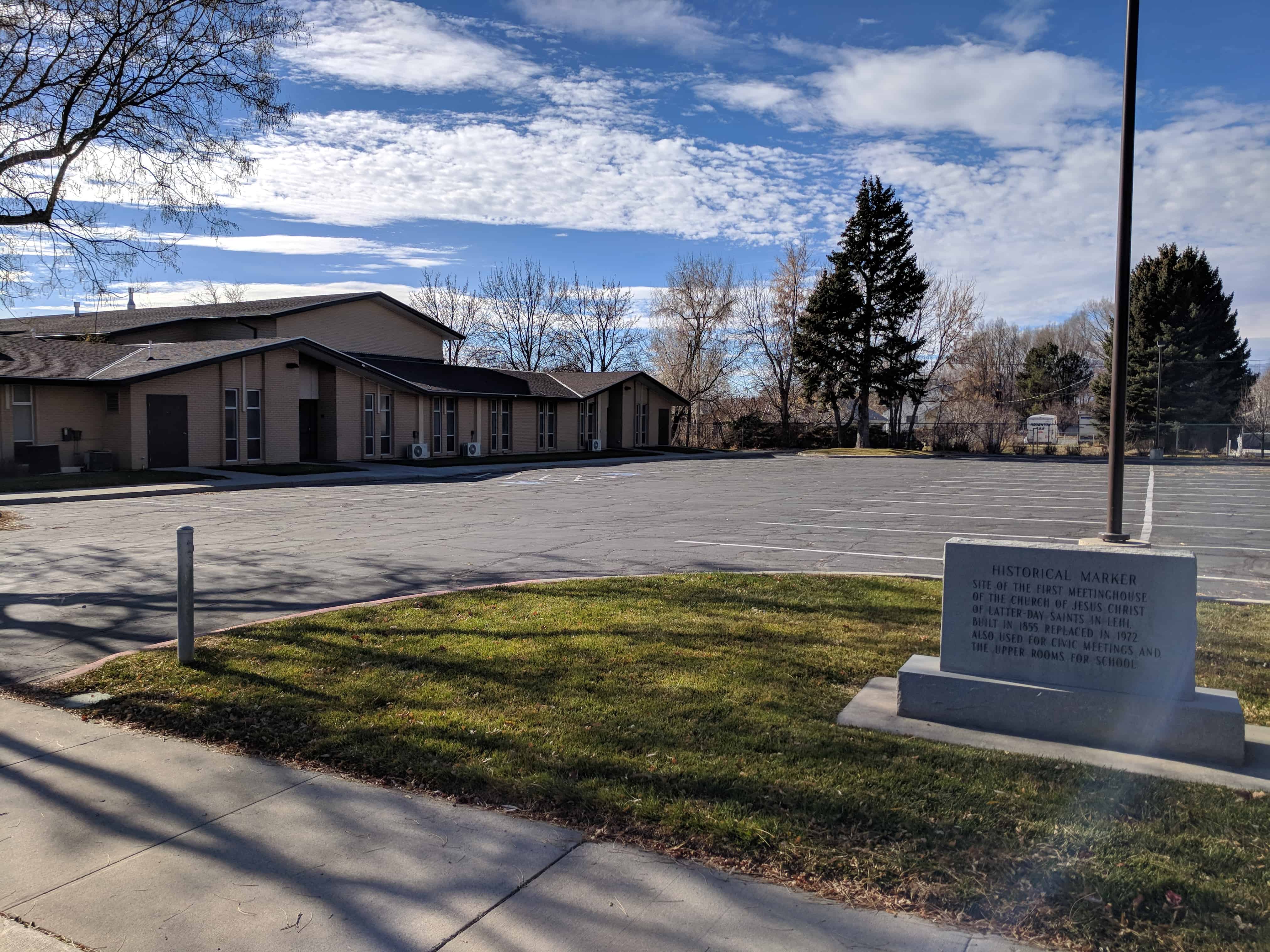
The site of the first Chapel in Lehi, Utah.

Site of the first meetinghouse of the Church of Jesus Christ of Latter-day Saints in Lehi, Built in 1855. Replaced in 1972. Also used for civic meetings and upper rooms for school.

This marker commemorates the ancient, beloved old “Lehi Meeting House” built in 1855 that served the community and church for 96 years.
2017-11-25 12.38.35

2017-11-25 12.38.56

2017-11-25 12.39.01

2017-11-25 12.38.42

In 1855 Lehi Ward Bishop Evans announced plans to erect a new meeting
house to replace the old log one. The site for the new structure was the southwest
corner of present First South and Second West, then the center of Lehi’s fort. A
committee, including James Harwood as assessor and collector, was appointed
under the chairmanship of Daniel S. Thomas. A community­wide tax of $1.50
per $100 valuation was assessed. One dollar was to be paid in labor and 50c in
grain.

Some men worked off their labor assessment felling trees in West Canyon.
The saw timber was then taken to mills in alpine and processed into planks,
shingles, joists, pillars, and other needed lumber. Additional workers labored in
the limestone quarry at Zion’s Hill on the Lake Mountains. Hundreds of tons of
rock were required for the building’s massive sixty­by­forty­foot foundation.
Most men, however, worked in the adobe pits south of the present Lehi Roller
Mills where thousands of the sun­baked bricks were required for the
eighteen­inch thick walls.

The construction of the Meeting House required five years. Everything
was made locally except the glass and hardware items, which were freighted from
the East. By the fall of 1855 the building was beginning to take form.
Although all men in the ward were required to work on the building, the
craftsmen who actually supervised the project included adobe makers William W.
Taylor, William B. Rigby, and Abel Evans; masons J. Wiley Norton and a Mr.
Howe; carpenters Thomas Ashton, Lorenzo Hatch, and Hyland D. Wilcox; and
plasterer William Clark.

The building was finally finished in the fall of 1860, though it was never
formally dedicated. The main entrance to the Meeting House fronted to the east
on Second West. Double doors opened into a twelve­by­forty­foot anteroom. A
stairwell to the gallery and the second­story school and prayer room was in the
south end of the anteroom.

The auditorium was forty-­eight by thirty-­six feet. The ceiling and second
floor were supported by eight twenty­foot pillars which were arranged so that the
first two on the east supported the gallery and the last two on the west defined the
speakers stand and the pulpit.

A large potbellied stove provided the auditorium’s heat though,
unfortunately, only the immediate area surrounding the stove offered real warmth
in the dead of winter. This spot was reserved for the ward’s elderly women, their
personal rocking chairs arranged around the stove.

The building’s seating capacity was five hundred, including the gallery.
This “balcony,” as many church members called it, was primarily for the choir’s
use. Above the gallery and auditorium was a second­story attic area which
contained two rooms. The largest was used for school until the 1863 completion
of the Southwest School (Thurman). It also served for a time as the city council
chamber. The smaller room was called the Quorum or Prayer Circle Room
because of the special Priesthood functions held there.

In 1903 when Lehi was divided into four ecclesiastical wards, the Meeting
House became the chapel of the new Lehi First Ward. In 1915 the old thurman
School, which stood just a few feet west of the Meeting House, was remodeled
into a ward amusement hall. The partition dividing the building into two rooms
was removed and a maple floor laid. A musician’s stand was erected in one end,
and the $600 project became a dance hall. From 1936 until 1949, major
renovations were made in the building. The old Meeting House was converted
into an amusement hall. The pillars, balcony, and partition wall near the front
entrance were removed and a stage was built on the west end. This remodeling
project combined the Meeting House and the historic Thurman School into a
single building. A new chapel was built to the south.

In 1972 the entire building, including the Meeting House was demolished.
A new $361,000 chapel was completed on this site. The following year the local
Sons of the Utah Pioneers, under the direction of Virgil Peterson, dedicated a
historical marker on the site of the original Meeting House.

Historic Churches in Salt Lake City

15 Monday Jan 2018

Posted by Jacob Barlow in Uncategorized

≈ 11 Comments

Tags

Churches, Historic Buildings, LDS Church, Salt Lake City, Salt Lake County, utah

2018-03-11 17.54.24

A list of the historic church buildings in Salt Lake City that I’ve come across.

  • The 2nd Ward Chapel
  • The 5th Ward Chapel
  • The 8th Ward Chapel
  • The 10th Ward Chapel
  • The 12th Ward Chapel
  • The 15th Ward Chapel
  • The 18th Ward Chapel
  • The 19th Ward Chapel
  • The 20th Ward Chapel
  • The 23rd Ward Chapel
  • The 24th Ward Chapel
  • The 28th Ward Chapel
  • The 31st Ward Chapel
  • The 34th Ward Chapel
  • Belvedere Ward Chapel
  • B’nai Israel Temple
  • Capitol Hill Ward Chapel
  • Cathedral of the Madeleine
  • First Baptist Church
  • First Church of Christ, Scientist
  • First Presbyterian Church of Salt Lake City
  • First United Methodist Church
  • Forest Dale Chapel
  • Historic Garden Park Ward
  • Holy Cross Chapel
  • Holy Trinity Greek Orthodox Church
  • Immanuel Baptist Church
  • Liberty Ward Chapel
  • Mount Tabor Lutheran Church
  • Nibley Park Ward
  • Saints Peter and Paul Orthodox Church – Congregation Montefiore Synagogue
  • St. Mark’s Episcopal Cathedral
  • Trinity African Methodist Episcopal Church
  • The Winder Ward Chapel (The Old Meeting House)
  • Zion Evangelical Lutheran Church

Joseph Smith Memorial Building

12 Friday Jan 2018

Posted by Jacob Barlow in Uncategorized

≈ 3 Comments

Tags

Historic Buildings, LDS Church, NRHP, Salt Lake City, Salt Lake County, Temple Square, utah

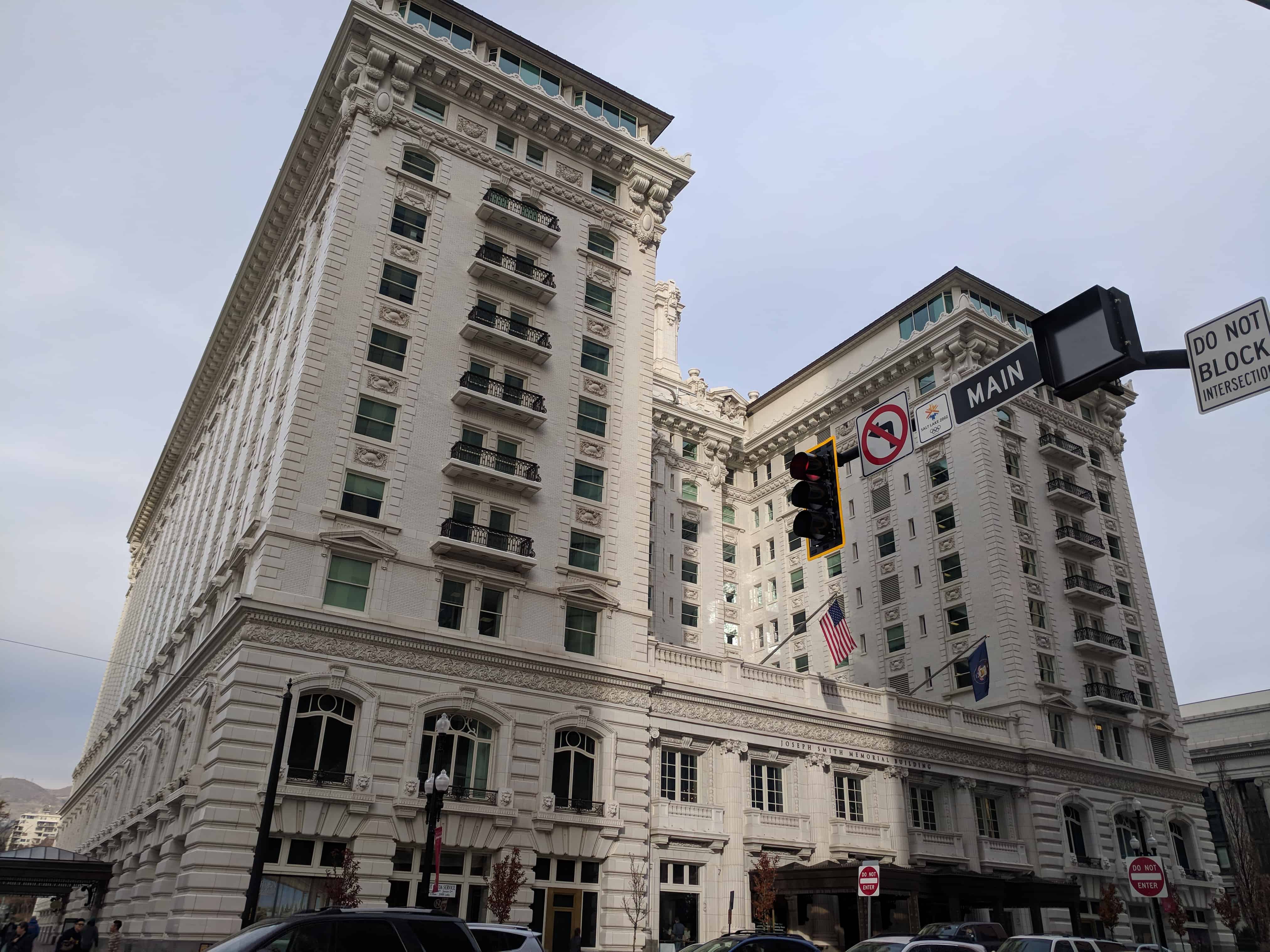
2017-12-02 15.09.49

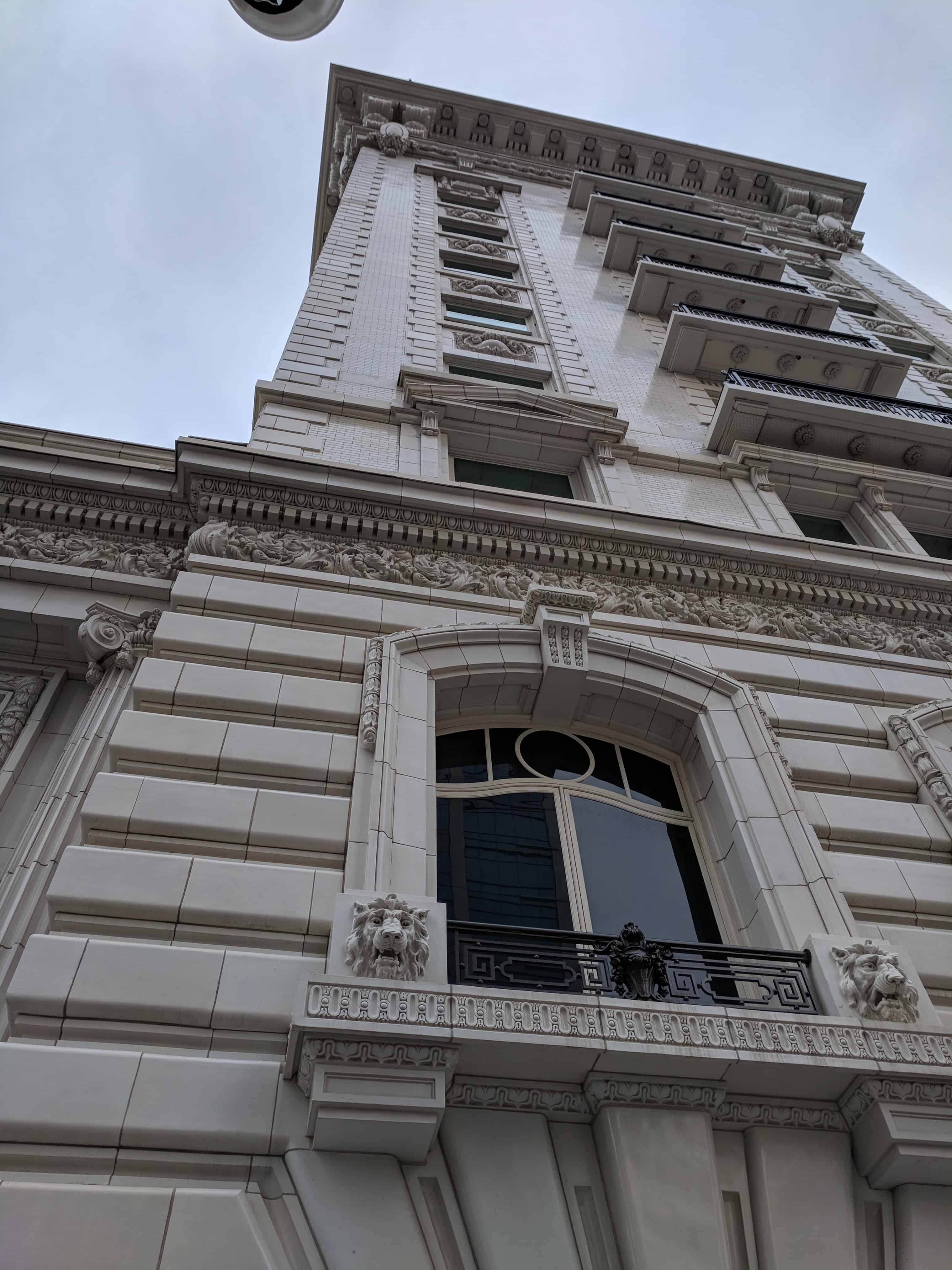
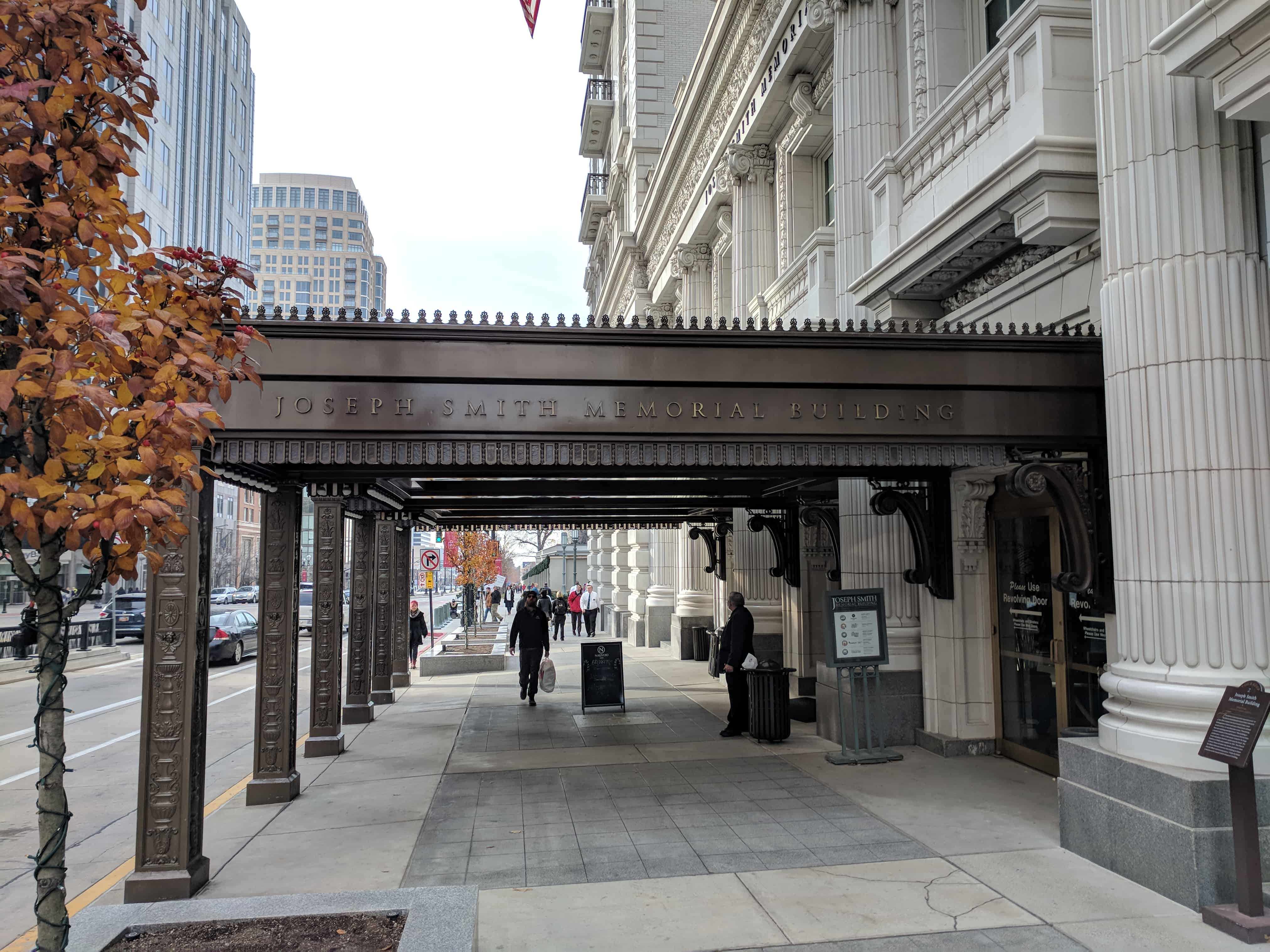
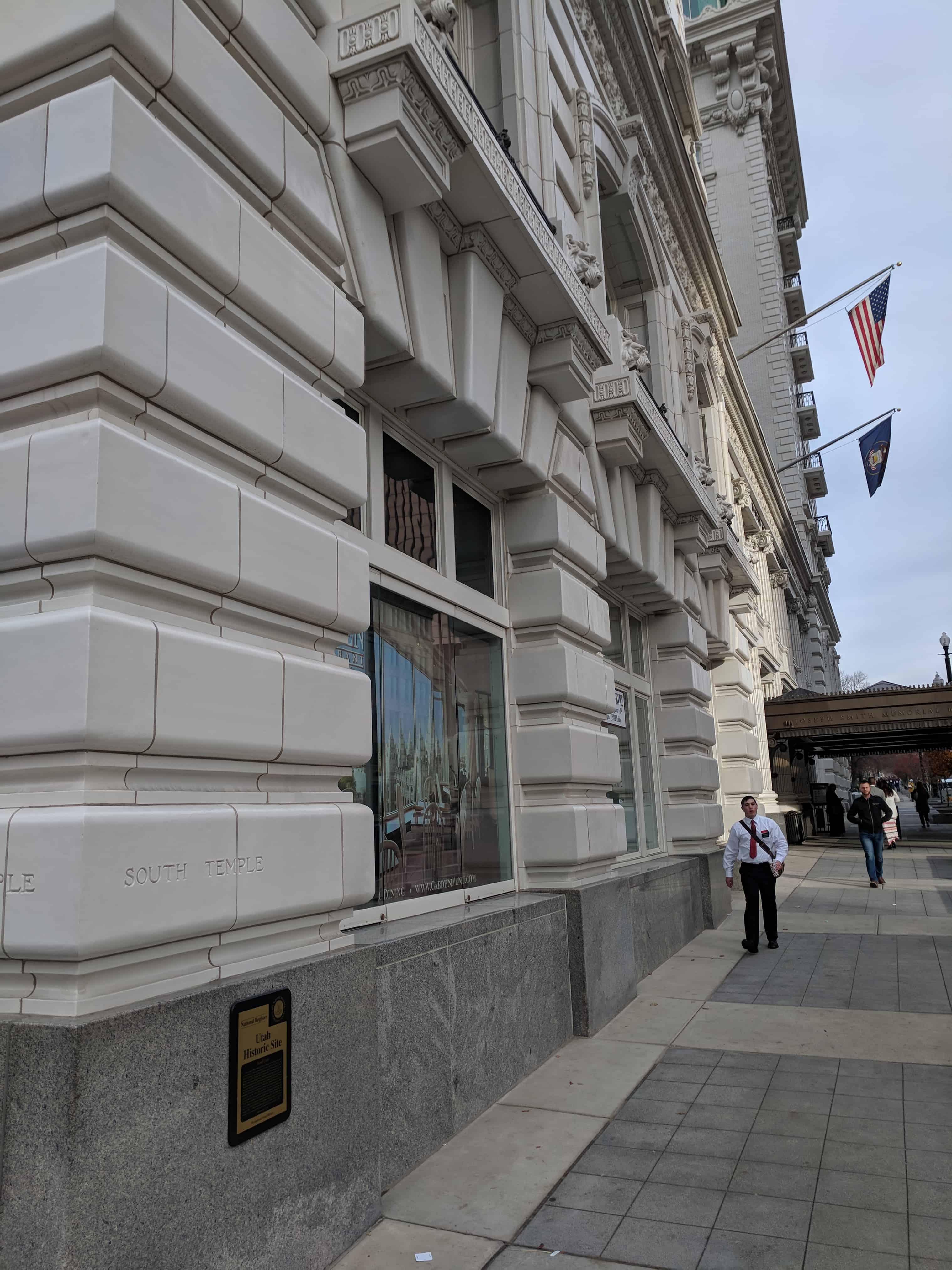
The Joseph Smith Memorial Building, originally called the Hotel Utah, is named in honor of Joseph Smith, the founder of the Latter Day Saint movement. It is located on the corner of Main Street and South Temple, on Temple Square in Salt Lake City. It is now a social center with three restaurants: The Roof Restaurant, The Garden Restaurant and The Nauvoo Cafe. It is also a venue for events complete with 13 banquet rooms, catering services, event coordinators and a full-service floral department – Flowers Squared. Several levels of the building also serve as administrative offices for The Church of Jesus Christ of Latter-day Saints (LDS Church) departments such as FamilySearch. On January 3, 1978, it was added to the National Register of Historic Places as the Hotel Utah.(*)

2017-12-02 14.59.05
2017-12-02 14.47.05
2017-12-02 14.47.07
2017-12-02 14.47.51
2017-12-02 14.47.55
2017-12-02 14.48.14
2017-12-02 14.48.46
2017-12-02 14.48.56
2017-12-02 14.55.42
2017-12-02 14.47.14

Tourstop 2 in the Salt Lake City Tour says:

Joseph Smith Memorial Building – Hotel Utah – 1909-1911, Parkinson & Bergstrom

The Hotel Utah was the “Grand Dame” of hotels in the intermountain west.  For most of the 20th century the hotel hosted Utah’s most distinguished visitors and was a focal point of local social activity.  As one historian wrote, “Everything that was anything was held there.”  The building is a lavish example of Second Renaissance Revival Style architecture – with a Utah touch.  Look for the huge brick and plaster beehive cupola atop the hotel.  The Beehive is Utah’s state symbol.  In 1987, The Church of Jesus Christ of Latter-day Saints decided to close the Hotel Utah and renovate the building to house church offices and meeting spaces.  Today the hotel is known as the Joseph Smith Memorial Building.

2017-12-02 14.47.21
2017-12-02 14.58.25

The Utah Historic Site plaque says:

Hotel Utah

The corner of Main Street and South Temple has long been important in Utah history.  Prior to construction of the Hotel Utah from 1909 to 1911, the general tithing office of the LDS Church, a bishop’s storehouse, and the Deseret News printing plant all were located on the site.

Work on the Second Renaissance Revival style hotel, designed by the Los Angeles architectural firm of Parkinson and Bergstrom, began in June 1909. Two years later, on June 9, 1911, the Hotel Utah opened for business. While the LDS Church was the primary stockholder, many Mormon and non-Mormon community and business leaders also purchased stock in the effort to provide the city with a first-class hotel.

The ten-story building has a concrete and steel structure and is covered with white glazed terra cotta and brick. Various additions and remodelings have occurred throughout the years, including a substantial expansion to the north and modifications to the roof-top dining facilities.

The building ceased operations as a hotel in August 1987. A major remodeling and adaptive reuse project to accommodate both community and church functions was completed in 1993.

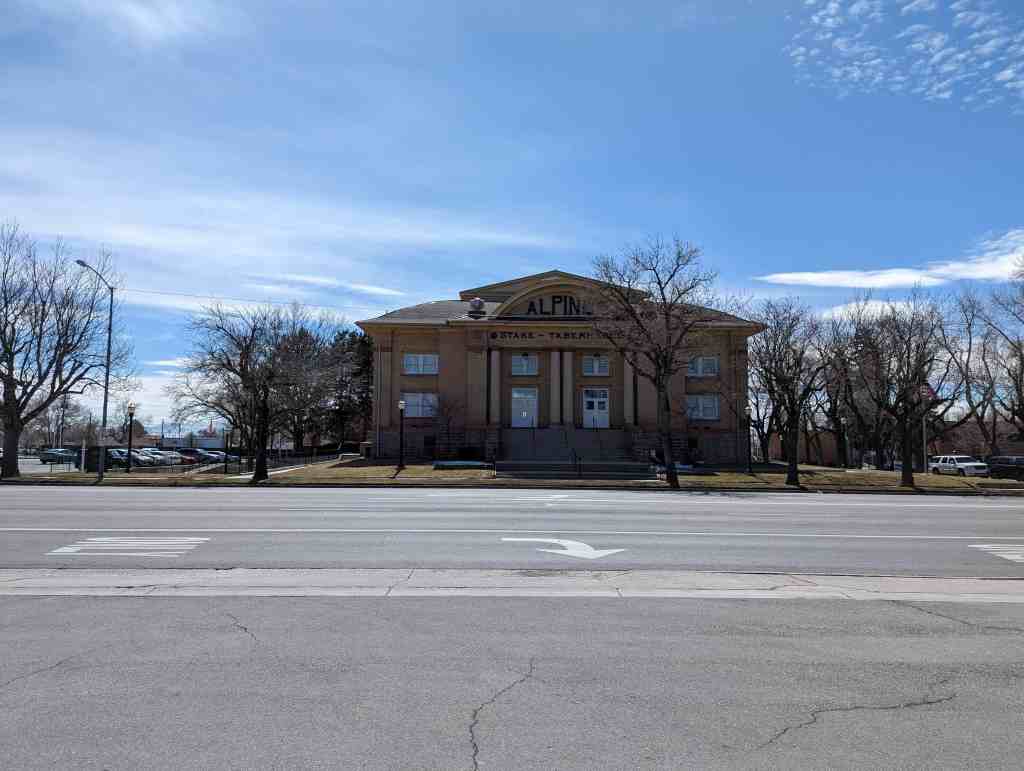
Alpine Stake Tabernacle

12 Friday Jan 2018

Posted by Jacob Barlow in Uncategorized

≈ 2 Comments

Tags

American Fork, Historic Buildings, Historic Churches, LDS Church, NRHP, utah, utah county

2015-03-28 18.43.21

Built in 1911, the Alpine Stake Tabernacle is located in the American Fork Historic District at 110 E. Main Street in American Fork, Utah. It was added to the National Historic Register on December 10, 1988.

Related:

  • LDS Tabernacles
2015-03-28 18.43.47
2015-03-28 18.43.25

LDS Church Administration Building

31 Sunday Dec 2017

Posted by Jacob Barlow in Uncategorized

≈ 1 Comment

Tags

LDS Church, Salt Lake City, Salt Lake County, Temple Square, utah

2017-12-02 15.11.38

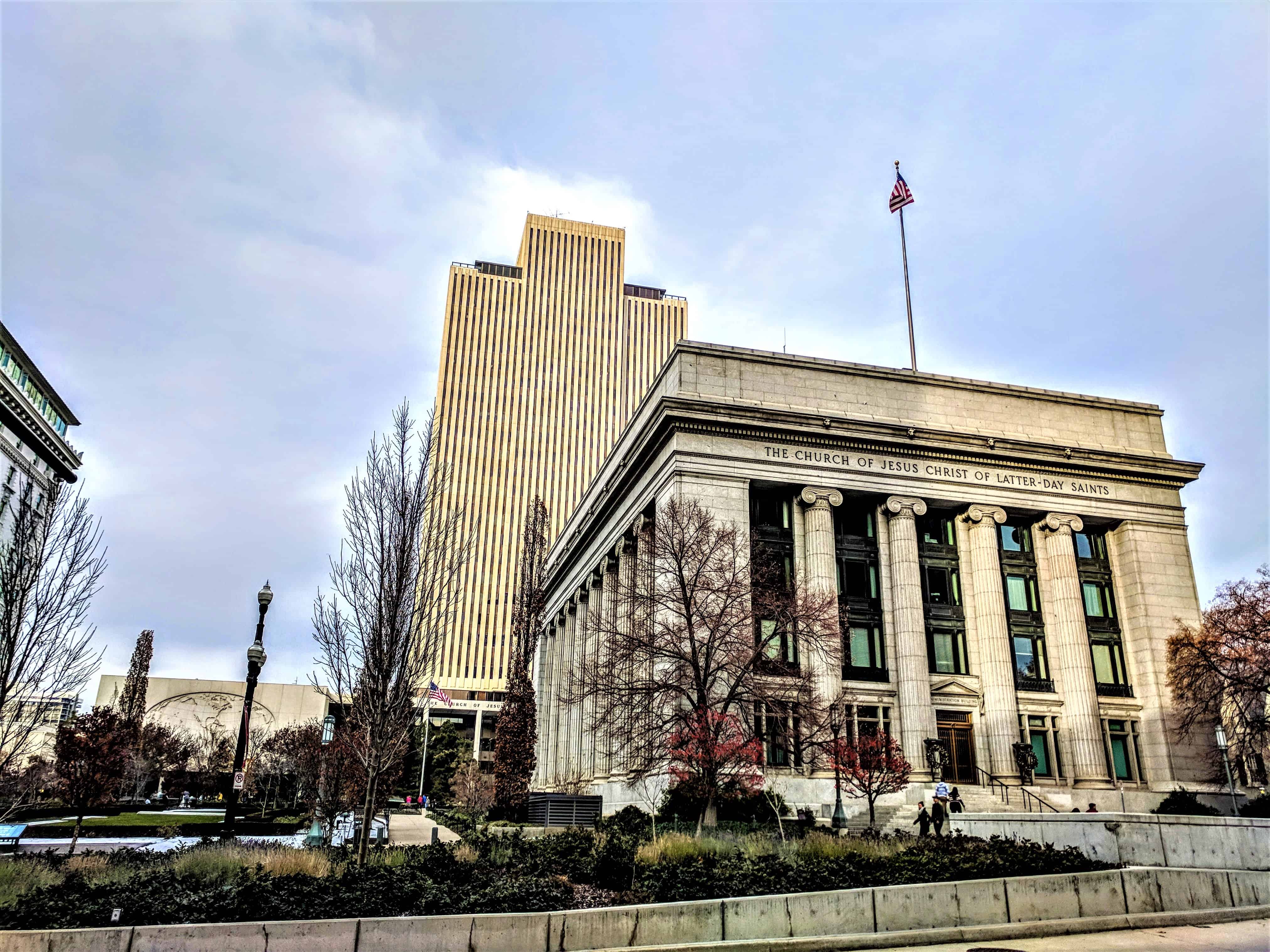
LDS Church Administration Building.

The Church of Jesus Christ of Latter-day Saints constructed this building between 1914 and 1917 to serve as its headquarters.  Prior to its completion, the office of the Church President was located just to the east between Brigham Young’s Lion House and Beehive House.  Today the Administration Building houses the offices of the Church’s First Presidency and other church leaders.  This building is an excellent example of Neoclassical Style architecture.  The 24 iconic pilasters which surround the exterior are made of solid granite.  This granite, as well as that which covers the rest of the steel and concrete structure, was taken from the same quarry as the stone used to build the Salt Lake Temple.

Located at 47 East South Temple in Salt Lake City, Utah

Related:

  • A. E. Tourssen Motor Company Photo Shoot (100 Year Car Tour)
2017-12-02 14.45.50
2017-12-02 14.46.08

First Utah Pioneer Cemetery Outside Salt Lake City

26 Tuesday Dec 2017

Posted by Jacob Barlow in Uncategorized

≈ 1 Comment

Tags

Cemeteries, Firsts, Historic Markers, LDS Church, Salt Lake City, Salt Lake County, utah

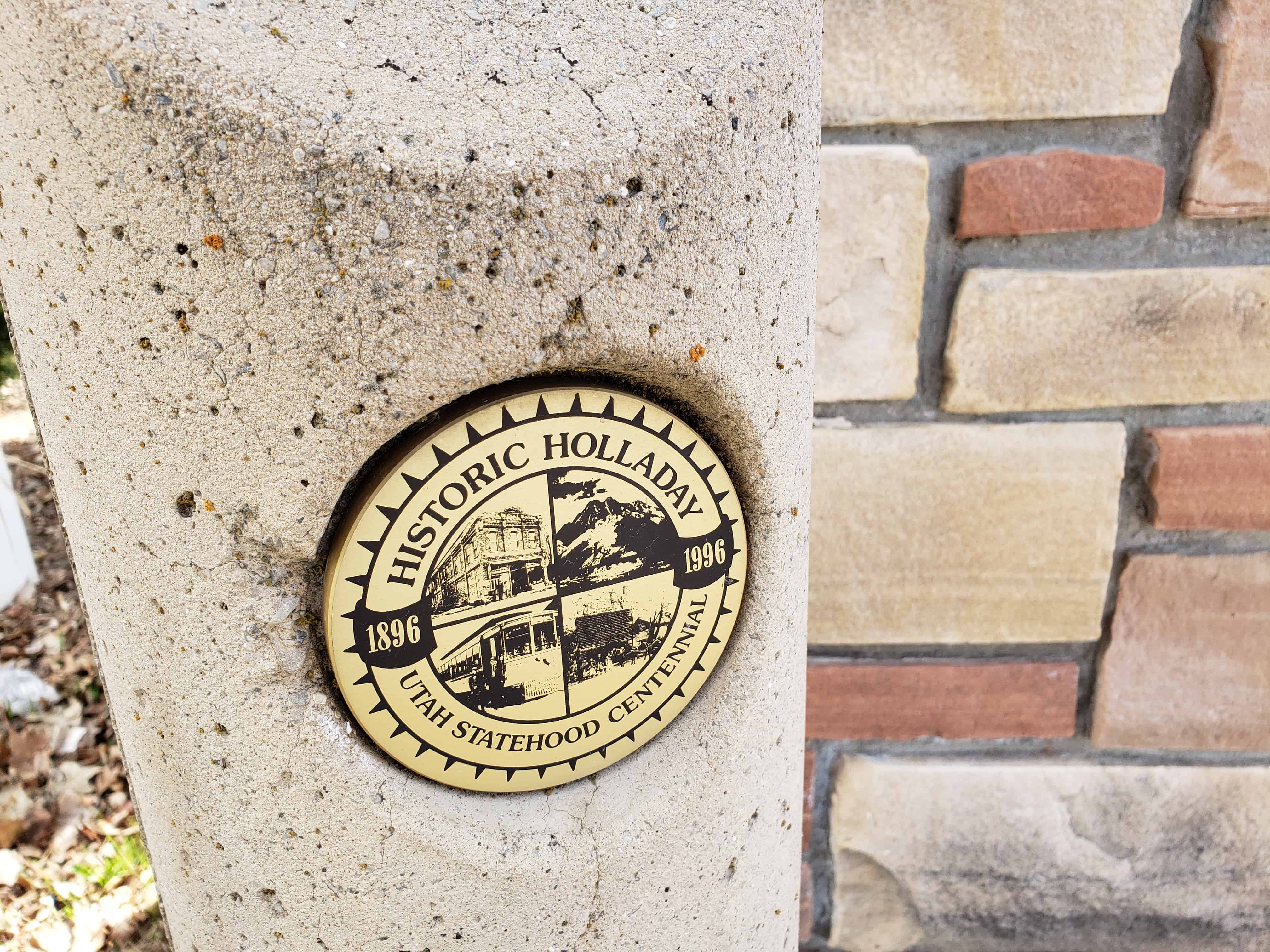
  • 2017-10-22 16.26.04

First Utah Pioneer Cemetery Outside Salt Lake City

In 1848, when the first pioneer death occurred in Holladay, the cemetery knoll southeast of here, overlooking lowland watery meadows of a then meandering Big Cottonwood Creek, was selected as a community cemetery.  Tradition has it that the first burial was a baby.

For 127 years, local LDS Church leadership oversaw this 13-acre cemetery in behalf of the entire community.  In 1975 the cemetery was sold.

In early pioneer Utah times, burial was generally 1 to 2 days after death.  Families themselves often dug the grave 5 to 6 feet deep.  The deceased person was dressed in regular clothing or in a burial shroud (a long nightgown-type of burial dress) and placed in a snug fitting wooden box or in blankets and cloth material.  Funerals were a community affair, most persons participating one way or another – attended the funeral at church, providing food for participants after the service, or helping the bereaved family do their chores.

Related posts:

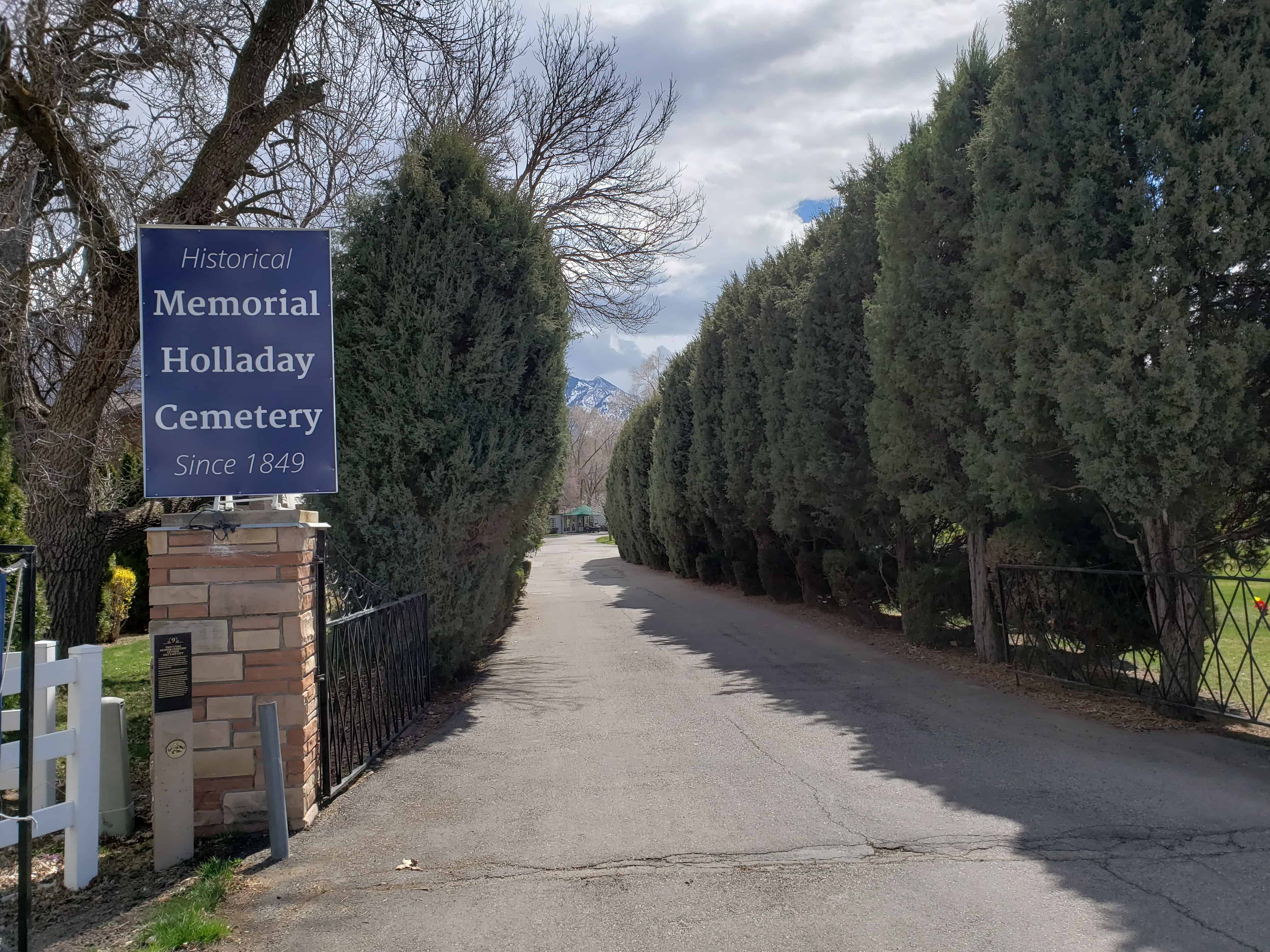
  • Memorial Holladay Cemetery

This historic marker is #9 of the Historical Walking Tour of Holladay on this page.

  • 2017-10-22 16.26.10

The Bee-Hive House

22 Friday Dec 2017

Posted by Jacob Barlow in Uncategorized

≈ 4 Comments

Tags

Historic Buildings, Historic Homes, Historic Markers, LDS Church, NRHP, Salt Lake City, Salt Lake County, SUP, utah

2017-12-02 14.42.23

The Bee-Hive House

Erected about 1852 by President Brigham Young as the Official Residence of the President of the Church of Jesus Christ of Latter-day Saints and occupied by him from the time it was completed until his death in 1877.

From 1852 to 1855 it also served as the Executive Mansion of Governor Brigham Young of the Territory of Utah.

It was also the home of presidents Lorenzo Snow (1898 – 1901) and Joseph F. Smith (1901 – 1918), both of whom died here.

The Beehive is the State Emblem signifying industry.

The Bee-Hive House is part of the Brigham Young Complex and is located at 67 East South Temple in the downtown neighborhood of Salt Lake City, Utah and was listed on the National Register of Historic Places February 26, 1970 (#70000626) and #70000631).

Related:

  • A. E. Tourssen Motor Company Photo Shoot (100 Year Car Tour)
2017-12-02 14.42.42
2017-12-02 14.42.29
2017-12-02 14.41.50
2017-12-02 14.42.50

Several SUP/UPTLA Markers are located near each other here.

  • #34 – Eagle Gate
  • #35 – A Private School House
  • #50 – The Bee-Hive House
  • #51 – The Lion House
  • #52 – Brigham Young’s Office

The Utah Historic Site plaque says the Beehive House was built in 1854 of adobe brick, the architect was Truman O. Angell and it was the home of Brigham Young, the 2nd President of the Church of Jesus Christ of Latter-day Saints and 1st Governor of the Territory of Utah.

2017-12-02 14.43.03

Tourstop 5 in the Salt Lake City Tour says:
The Beehive House served as Brigham Young’s residence, office, and reception area for official visitors.  At the time the house was built, Young was both president of the LDS Church and Utah’s territorial governor.  The Beehive House was designed by Young’s brother-in-law, Truman O. Angell.  Angell was also the architect for the Lion House and the Salt Lake LDS Temple.  Built of stuccoed adobe, the Beehive House features a two-story veranda, an observatory, and a cupola topped with a beehive.  Young’s son added a three-story wing to the north when he remodeled the house in 1888.  In the early 1960s, the LDS Church restored the Beehive House to resemble its 1888 appearance.

(from Preservation Utah’s walking tour)
The Beehive House
67 East South Temple
1853-1855, Truman O. Angell, SLC 30-minute guided tours available every 15 minutes Monday-Saturday, 9:30 am-4:30 pm, and Sunday, 10:00 am-1:00 pm.

The Beehive House served as Brigham Young’s residence, office, and reception area for official visitors. It was designed by Young’s brother-in-law, Truman O. Angell. Angell, one of Utah’s prominent early architects, also designed the Lion House and the Salt Lake City LDS Temple. The Greek Revival style Beehive House features a two-story veranda, an observatory, and a cupola topped with a beehive. Young’s son added a three-story wing to the north after he purchased the house in 1888.

In addition to the Beehive House and the Lion House, Young’s walled estate fronting South Temple also included the White House, a family schoolhouse, carpenter shop, barns, orchards, and gardens. The Eagle Gate at the intersection of South Temple and State streets marks the original entrance to Young’s multipurpose compound. The Eagle Gate also provided access to City Creek Canyon to the northeast. See the marker on the northeast corner of the intersection for a history of the Eagle Gate.

In the early 1960s, the LDS Church restored the Beehive House and opened it as a house museum. Guided tours of the building are available daily.

2017-12-02 14.43.43
2017-12-02 14.43.46

From the nomination form for the National Historic Register:

The beautiful old mansion Is the pioneer home of Brigham Young, but It in 1851. Today’s workmen, under the direction of architects (all grandsons of Brigham Young) have done a remarkable job of restoration. The outside adobe brick walls have been painted in the original straw-colored yellow, which gives the manor a gay, but antique appearance of the original.

The Beehive House was built to meet the dual needs of Brigham Young, second president of the Church of Jesus Christ of Latter-day Saints and first governor of the state of Deseret, later Utah Territory. Above all, however, the Beehive House was a home for his family. It was also used as an official mansion where the Mormon leader received and conferred with other Church leaders, state and federal dignitaries, and entertained prominent traveling officials. During the life of Brigham Young, many famous people were entertained in the Beehive House, including President Ulysses S. Grant, Emperor Dom Pedro of Brazil, General William T. Sherman, Ralph Waldo Emerson, Mark Twain, Jay Gould, Horace Greeley, and even the midget Tom Thumb and his tiny wife.

In 1893, the Church purchased the historic building to make it the official residence of its presidents. Lorenzo Snow and Joseph F. Smith were the only two succeeding presidents to live in it. After the death of President Smith, the house stood vacant for a number of years, and was again remodeled and maintained as an away-from-home residence for young women who came to the city to work or attend school.

In 1959, when the Church decided to restore the Beehive House, a committee made up primarily of descendants of Brigham Young was chosen to carry out the task. Research and detective work on the part of this committee took 18 months to complete, and included the use of old manuscripts describing the house, the search for Brigham Young’s furnishings, and the discovery of “clues” beneath old plaster to find tell-tale evidences of still earlier construction. The “Manuscript” had been written by Clarissa Young Spencer who lived in the Beehive House from childhood until after her marriage.

Heavy coats of paint and wallpaper were peeled away, revealing the original colors and patterns. False ceilings were torn down, exposing ornate medallions which pioneer craftsmen installed in 1854.

With restoration and furnishing complete, the lovely mansion is now open for tours to the public. In its location, it is near Temple Square, a National Landmark, and the Lion House, which adjoins it on the west, and which is also a National Landmark.

The design of the Beehive House follows the 19th century Greek revival in architecture. The architect was Truman O. Angel, who also designed the many-spired Salt Lake Temple, Some of the original drawings for the Beehive house, fortunately, were found in the archives of the Church Historian’s Office shortly after work on the restoration had begun in 1959, and proved invaluable in the complete restoration of the home.

As originally built, the main part of the house consisted of two stories and an attic, surmounted by a beehive-shaped cupola, the traditional Mormon symbol of industry which was to give the home its name. Surrounding this tower is a a steel-railed (originally was wood) “widow’s watch,” reminiscent of the colonial coast.

Since the death of Brigham Young, the Beehive House has undergone two major alterations. The first was made by a son who purchased the home in 1888. Under this remodeling, the rear section was rebuilt into a three-storied wing. The formal dining room downstairs also was extensively remodeled, and an upstairs sitting room and parlor added.

The “adobe” walls were found to be in remarkably good condition. When later additions were torn out (during restoration), the walls revealed the exact location of stairs, halls, doorways, partitions and roof lines as described in the old manuscripts and original plans. With restoration, wide pine board floors, laid with square nails replaced the hardwood (not original.)

In the 1850’s, Brigham Young had a nine-foot high cobblerock wall erected around the Beehive House as protection from unfriendly intruders and as a make-work project for men who needed employment. Portions of this same wall (recently pushed back 23 feet to widen State Street north of Eagle Gate now border the home on the north and east sides. A low wrought-iron fence stands in front of the house where the big wa11 once stood.

The oak-finished door, now painted white, with its silver doorknob opens onto the main hallway. The doorbell system installed by Brigham Young was discovered and restored. Downstairs were Brigham Young’s bedroom, the Parlor and kitchen; on the second floor the “long hall” for entertaining guests, and Brigham Young:1 s offices.

The lovely home is now authentically restored and furnished with furniture from Brigham Young and his family, and from other period furniture at a cost to the Church of Jesus Christ of Latter-day Saints approximating one-half million dollars.

It is open to the public and used extensively.

The Lion House

22 Friday Dec 2017

Posted by Jacob Barlow in Uncategorized

≈ 3 Comments

Tags

Historic Buildings, Historic Homes, Historic Markers, LDS Church, NRHP, Salt Lake City, Salt Lake County, SUP, Temple Square, utah

2017-12-02 14.44.28

The Lion House

Location: 63 East South Temple, SLC

Built by President Brigham Young and used by him as a residence from about 1855 until his death in 1877. On the lower floor were the dining room and kitchens. On the next floor were the living rooms and large parlor; and on the top floor were the bedrooms.

It was in this house that President Young died. Later the building was used for school purposes and as a social center for women and girls. The lion is a replica of one that occupied a similar position on a prominent home in Vermont, the State where President Young was born and spent his youth.

In 1869, Brigham Young founded the Young Women organization in the Lion House.

Several SUP/UPTLA Markers are located near each other here.

  • #34 – Eagle Gate
  • #35 – A Private School House
  • #50 – The Bee-Hive House
  • #51 – The Lion House
  • #52 – Brigham Young’s Office

The Lion House is part of the Brigham Young Complex and is located at 47 East South Temple in the downtown neighborhood of Salt Lake City, Utah and was listed on the National Register of Historic Places February 26, 1970 (#70000631).

Related:

  • A. E. Tourssen Motor Company Photo Shoot (100 Year Car Tour)

2017-12-02 14.44.48
2017-12-02 14.44.25
2017-12-02 14.44.52

The Utah Historic Site plaque says the Lion House was constructed 1855-56 as a residence for Brigham Young and his family.  The Lion House takes its name from the recumbent lion set on top of the front portico.  The House was designed by Truman O. Angell and built of stuccoed adobe.  Brigham Young, second president of the Church of Jesus Christ of Latter-day Saints and first territorial governor of Utah, died in this house on August 29, 1877.  Since its construction, the Lion House has functioned as a community social center.

2017-12-02 14.45.08

Tourstop 4 in the Salt Lake City Tour says: The Lion House takes its name from the carved  lion on top of the front portico.  The House was constructed with adobe blocks, a common building material during Utah’s settlement period.  Brigham Young, second president of the Church of Jesus Christ of Latter-day Saints built the Lion House for his wives and children.   He and some early Church members practiced the Old Testament principle of polygamy which was officially ended in 1890.  The basement contained a dining room which could accommodate 70 people.  On the main floor were sitting rooms and bedrooms for wives with children.  The second floor had bedrooms for children and childless wives – one under each of the 20 steeply-pitched gables.

2017-12-02 14.44.33

(from Preservation Utah’s walking tour)
The Lion House
63 East South Temple
1854-1856, Truman O. Angell, SLC
Restaurant open to the public Monday-Saturday, 11:00 am-2:00 pm, and Thursday-Saturday, 5:00-8:30 pm. No tours available.
The Lion House is one of several houses built on South Temple by Brigham Young, the second president of the LDS Church and Utah’s territorial governor.Young’s presence on South Temple made it Salt Lake City’s most prestigious residential street. For many years, South Temple was informally known as “Brigham Street.” Brigham Young intended the Lion House to be a model for polygamous living arrangements. As many as 20 of his wives and dozens of his children lived here at one time. The basement contained a dining room which could accommodate 70 people. On the main floor were sitting rooms, a “prayer room,” and bedrooms for wives with children. The second floor had 20 bedrooms for childless wives and older children, one under each of the 20 gabled dormer windows. Brigham Young died in the Lion House in 1877. Some of his wives and children continued to live in the house until the 1900s. Today the building contains a reception center and restaurant.

Legacy of the Black Pioneer

11 Monday Dec 2017

Posted by Jacob Barlow in Uncategorized

≈ 1 Comment

Tags

Historic Markers, LDS Church, Salt Lake City, Salt Lake County, SUP, utah

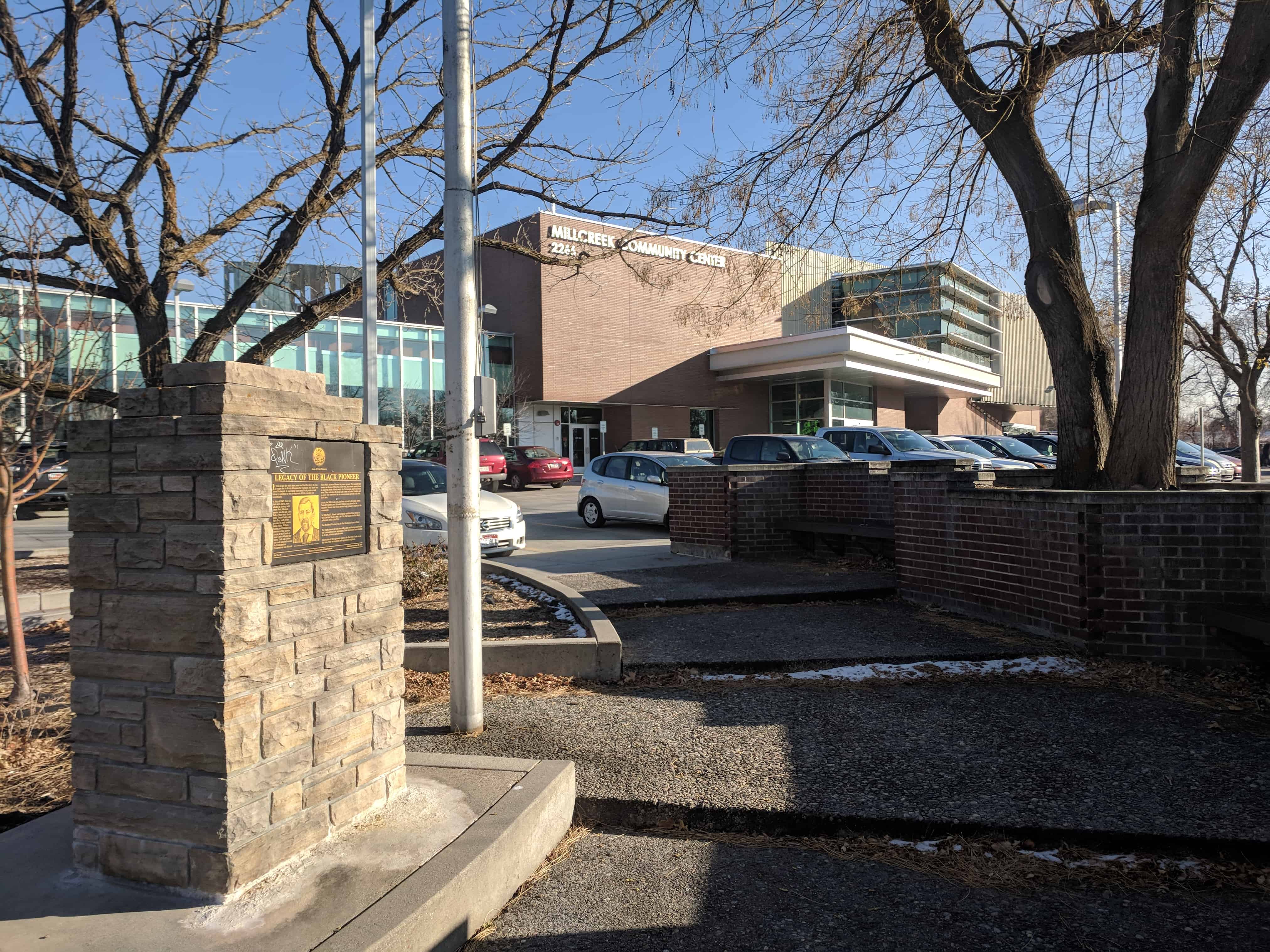
2017-12-09 14.42.32

Legacy of the Black Pioneer

In 1824-26 the first black man came into Utah Territory. He was a trapper for the Rocky Mountain Fur Company. His name was James Beckworth. In succeeding years many black people would follow to contribute to the development of Utah, socially and economically.

In July of 1847, three (3) black men, slaves, were selected to journey with Orson Pratt, Mormon apostle, into the Salt Lake Valley. They were: Green Flake (see his grave here), Oscar Crosby, and Hark Lay, each in turn provided by their owners, James Flake, William Crosby, and William Lay, members of the pioneer groups of the Church of Jesus Christ of Latter-day Saints. Utah was a slave state (territory) and remained so until the Emancipation Proclamation was effected.

Many black pioneers followed in pioneer groups. They assisted their owners as directed. When they were freed, the owners assisted them in acquiring lands of their own in the Cottonwood, and Fort Union areas. They cultivated the land, built homes and raised families and in every way contributed to the socio-economic growth of the Salt Lake area.

In this, the Mill Creek Area, land was secured by Sylvester James, Samuel Chambers, and Sylvester Perkins. Each proved to be successful farmers who would market their produce to leaders of the community.

In 1888 Paul C. Howell and his family established their home in the 12th-14th Ward in Salt Lake City. He became the first black policeman in Salt Lake City.

Don Bankhead Freeman was the first black child born in Utah.

The black pioneers of Utah have left a great and lasting contribution that is remembered and appreciated. Their descendants have excelled in the arts, athletics, and education.

Descendants of these pioneers reside in the East Mill Creek area at this time. They are respected and appreciated neighbors.”

Note: In 2011, this monument was to have been removed by Salt Lake County to make way for a new County Building – Millcreek Community Center, 2266 E. Evergreen Ave., Millcreek Township, UT 84109. It included a new Senior Center. Their announced intention was to replace the monument. Due to some questions concerning the historical accuracy of the original narrative and an attempt by someone to change the original wording by scratching an incorrect change to the plaque, new wording was proposed. Due to fiscal restraints, the county built around the monument without making any changes.

This monument is #16 in the series of S.U.P. Markers, located in Evergreen Park in Salt Lake.

Related:

  • Green Flake
2017-12-09 14.41.58

2017-12-09 14.42.39

2017-12-09 14.42.48

Woodruff Villa

06 Wednesday Dec 2017

Posted by Jacob Barlow in Uncategorized

≈ 3 Comments

Tags

Historic Homes, LDS Church, NRHP, Salt Lake City, Salt Lake County, utah

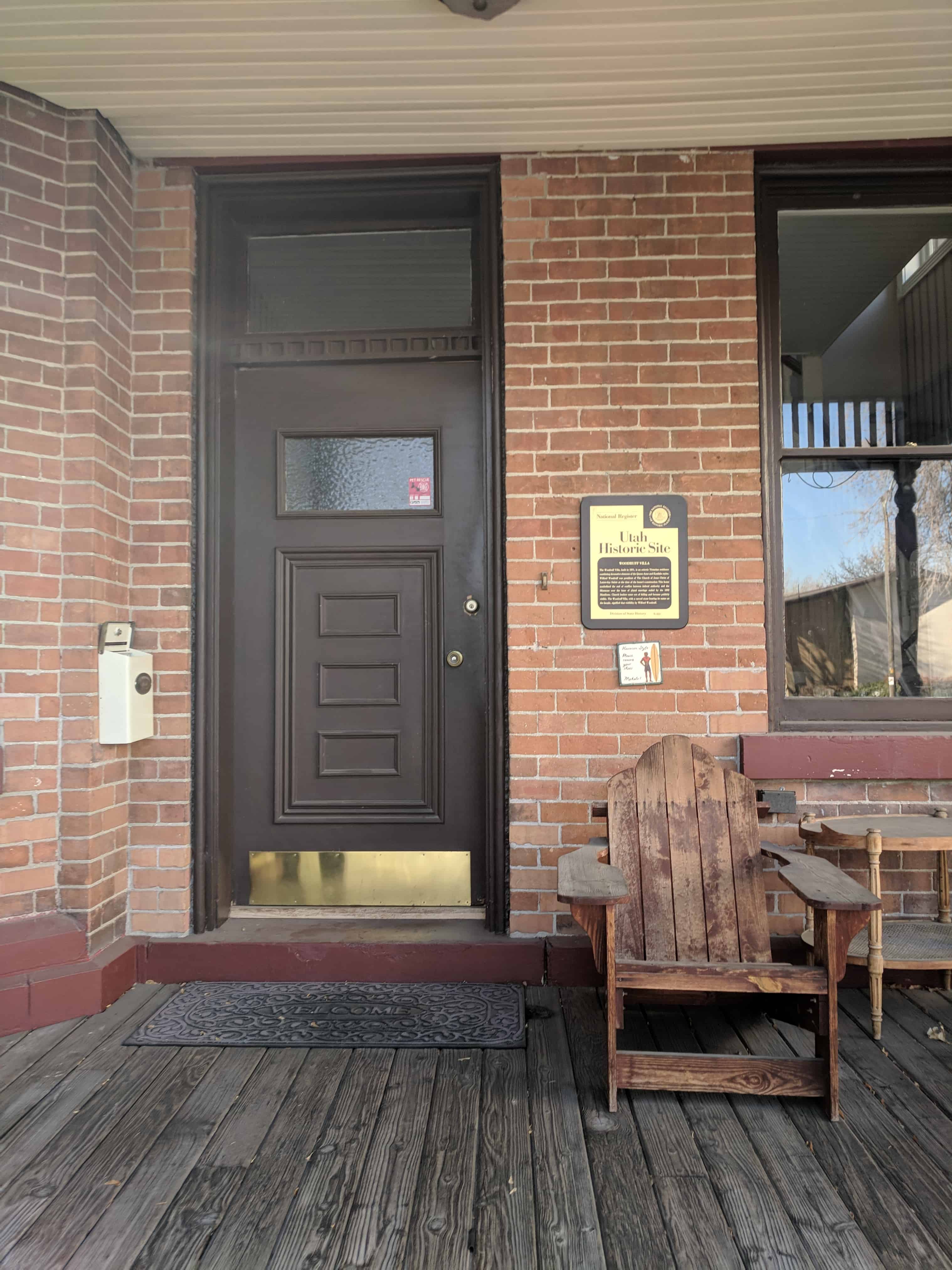
2017-12-05 13.17.14

Woodruff Villa

The Woodruff Villa, built in 1891, is an eclectic Victorian residence combining decorative elements of the Queen Anne and Eastlake styles.

Wilford Woodruff was president of The Church of Jesus Christ of Latter-day Saints at the time of the house’s construction.  This home symbolized the end of conflict between federal authority and the Mormons over the issue of plural marriage ended by the 1890 Manifesto.  Church leaders came out of hiding and became publicly visible.  The Woodruff Villa, with a carved stone bearing its name on the facade, signified that visibility by Wilford Woodruff.

See also:

  • Asahel Hart Woodruff House
  • Daynes / Woodruff Home
  • Wilford Woodruff Farm 1850
  • Wilford Woodruff Gravesite

Located at 1622 South 500 East in the Liberty Wells Historic District in Salt Lake City, Utah

2017-12-05 13.17.05
2017-12-05 13.17.33
2017-12-05 13.17.28
(from county records)
← Older posts
Newer posts →

Follow Jacob

Follow Jacob

Blog Stats

  • 2,019,893 hits

Social and Other Links

BarlowLinks.com

Recent Posts

  • 83 N Street
  • First Company of Pioneers into the Valley
  • Blue Base – The Stand Filming Location
  • 926 E South Temple
  • 969 E South Temple

Archives


Loading Comments...