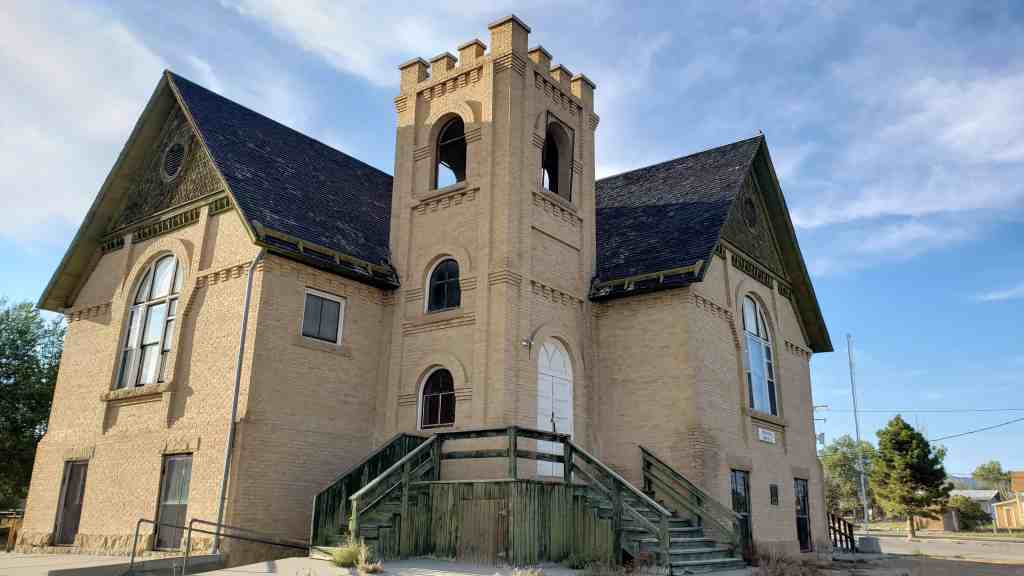
The Wellsville Tabernacle is one of two tabernacles in Cache Valley, and dominates the south end of the valley. Built during the years 1902 to 1908, it demonstrates the persistence of the Mormon village form, based on cooperative idealism. In spite of alterations, primarily to the tower, the architectural form and imposing scale make the tabernacle one of the four major landmarks in the Mormon settlements of northern Utah.
Plans for the Wellsville Tabernacle were prepared by the architect C.T. Barrett under the direction of Bishop Evan R. Owen. Ground was broken in 1902 by former Bishop William H. Maughn who had served as bishop for forty years.
The cornerstones were laid by Apostle Owen Woodruff and President Seymour B. Young in 1903. It was dedicated June 28, 1908 by Anton H. Lund of the Mormon Church’s First Presidency.
All the materials came from local sources. A rock quarry, a lime kiln and a brickyard were operated by local men. William S. Poppleton supervised the stone work, quarried in nearby Sardine Canyon. Job Miller Sr. made the red brick, which was laid by Fred Douglas and Co. Alex Hill provided the rough lumber from his sawmill in Blacksmith Fork Canyon. Thomas Thorpe Sr. directed the plaster work and the Brenchley Brothers did the iron work. Daniel and William Walters and Francis O. Gunnell were responsible for the carpentrywork. Professor Emil Hansed, a landscape gardener, supervised the planting of the lawn, shrubs, and trees. The total cost of the building was $65,000.
Located at 75 South 100 East in Wellsville, Utah and added to the National Register of Historic Places (#80003893) November 26, 1980.
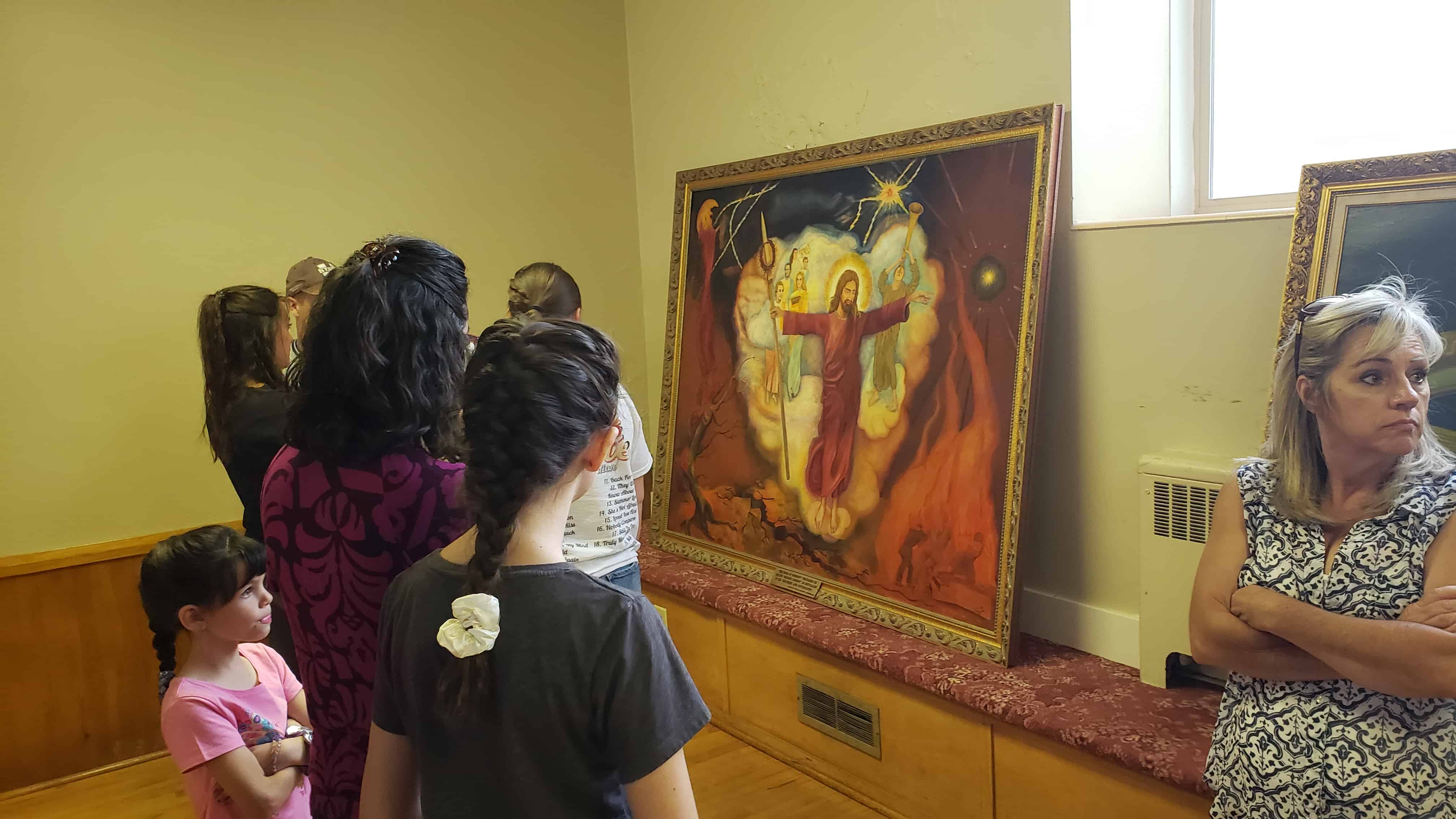
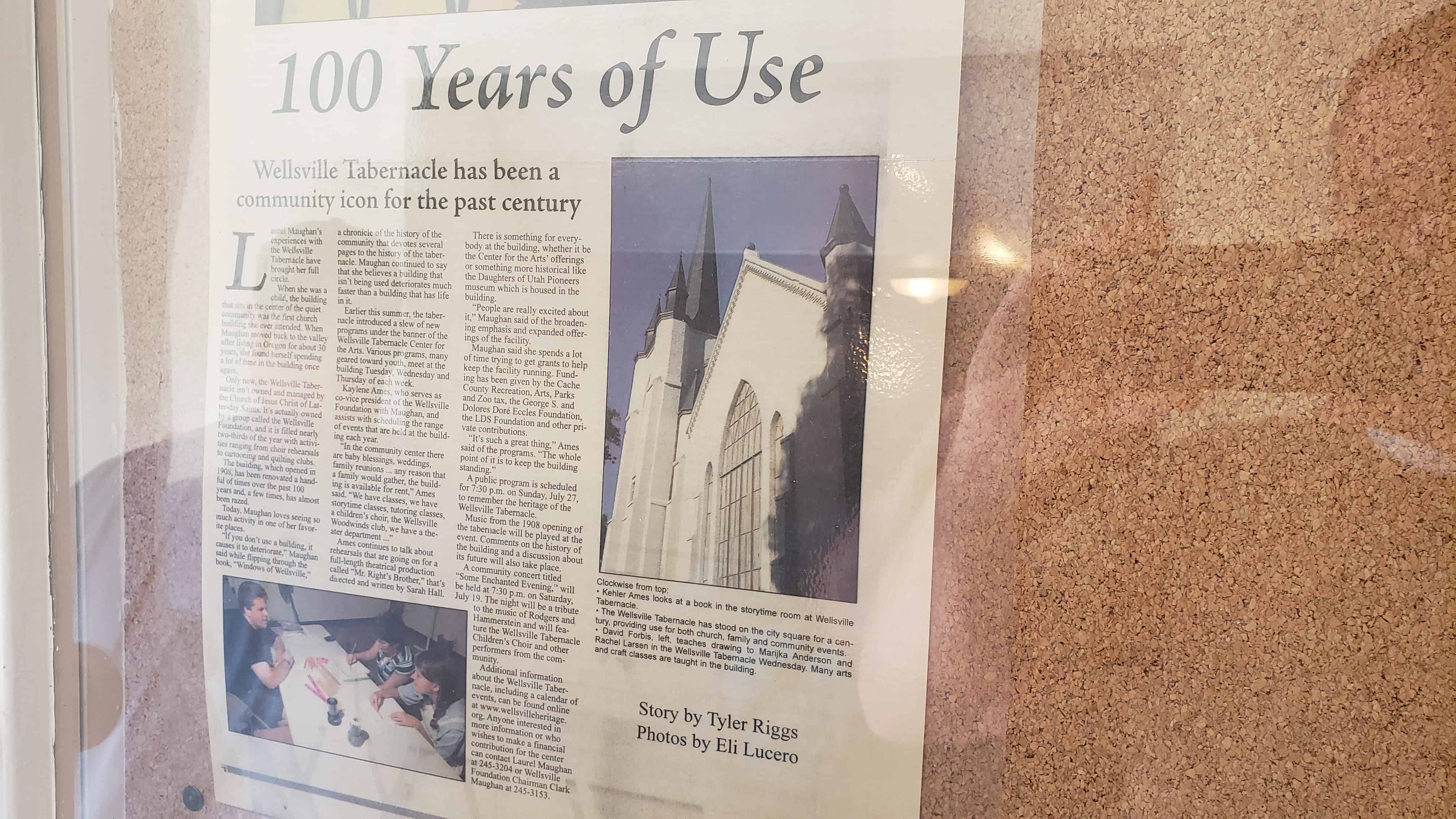
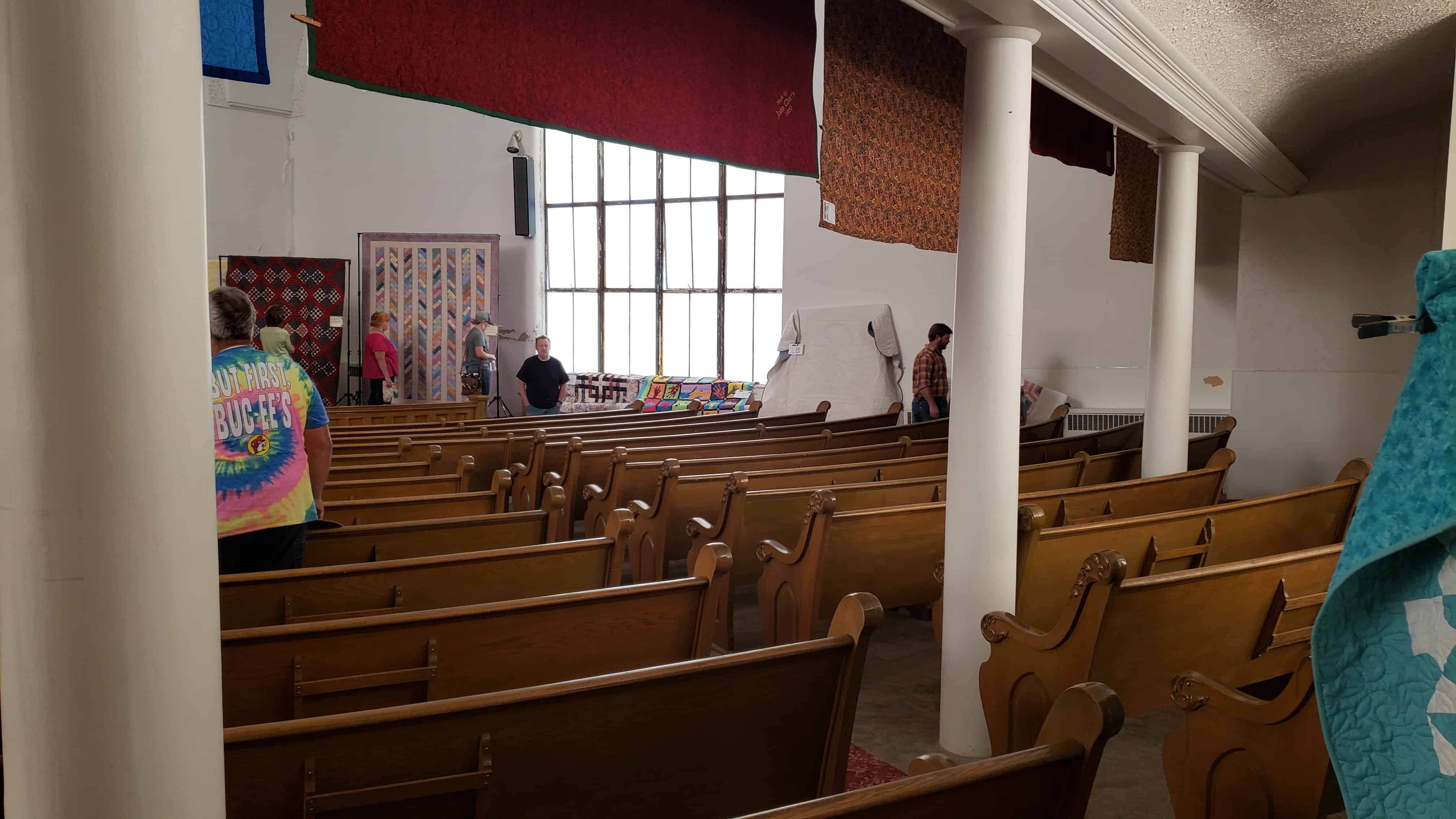
I stopped by the town celebration on September 6th, 2021 and they were letting people inside – they said nobody had been let inside for ten years. Here are some interior photos:
The Wellsville Tabernacle is one of two tabernacles in Cache Valley, and dominates the south end of the valley. Built during the years 1902 to 1908, it demonstrates the persistence of the Mormon village form, based on cooperative idealism. In spite of alterations, primarily to the tower, the architectural form and imposing scale make the tabernacle one of the four major landmarks in the Mormon settlements of northern Utah.
Plans for the Wellsville Tabernacle were prepared by the architect C.T. Barrett under the direction of Bishop Evan R. Owen. Ground was broken in 1902 by former Bishop William H. Maughn who had served as bishop for forty years. The cornerstones were laid by Apostle Owen Woodruff and President Seymour B. Young in 1903. It was dedicated June 28, 1908 by Anton H. Lund of the Mormon Church’s First Presidency.
All the materials came from local sources. A rock quarry, a lime kiln and a brickyard were operated by local men. William S. Poppleton supervised the stone work, quarried in nearby Sardine Canyon. Job Miller Sr. made the red brick, which was laid by Fred Douglas and Co. Alex Hill provided the rough lumber from his sawmill in Blacksmith Fork Canyon. Thomas Thorpe Sr. directed the plaster work and the Brenchley Brothers did the iron work. Daniel and William Walters and Francis 0. Gunnell were responsible for the carpentrywork. Professor Emil Hansed, a landscape gardener, supervised the planting of the lawn, shrubs, and trees. The total cost of the building was $65,000.
The Maynard Dixon and Edith Hamlin House and Studio are significant as the only structures in Utah closely associated with these nationally renowned artists. Dixon and his artist wife, Edith Hamlin, had this small complex of buildings constructed between 1939 and about 1947. It served as their summer home and studio during the last productive years of his life, during which he remained very active completing over 200 of his best known works. Dixon is regarded by many as the most significant modernist painter in the west in the first half of the twentieth century. This complex of buildings represents the culmination of Dixon’s career, serving as the peaceful place he wanted to be. A letter from Edith Hamlin to Milford Zornes follows:
“The memorial spot for Maynard is completed now with a trail leading up to the ridge… I had placed the ashes beneath the rock one early morning by myself. It is a beautiful lookout over the country that he loved and painted. The pleasant memories of his friends will be better than any ceremony when they climb up to that spot by themselves.” – Edith Hamlin, August 11, 1947
architecturally, the house, built in 1939, is a two-story log building with a steeply pitched gable roof, stone foundation, and board-and-batten gable ends. The studio, built in 1947, is a one-story rustic style building with two main rooms on the interior; its rustic styling, derived from Taliesin West, is evidenced by the use of natural materials – local, random course stone on the south end wall and foundation and logs along the other three sides; an approach claimed by some to be derived from visits by Maynard and Edith to the Frank Lloyd Wright complex in Scottsdale, Arizona, during their travels in 1939.
The Thunderbird Foundation for the Arts, established in 1999 for the restoration and preservation of the property, continues the vision of Dixon, Hamlin and Zornes with artist retreats, workshops, art events and day camps for people with special needs.
The Maynard Dixon and Edith Hamlin House and Studio are significant as the only structures in Utah closely associated with this these nationally renowned artists. Dixon and his artist wife, Edith Hamlin, had this small complex of buildings constructed between 1939 and about 1948. It served as their summer home and studio during the last several years of his life, during which he remained very active in his career as a painter and even completed some of his best-known work. Dixon is regarded one of the most distinctive and accomplished early 20th-century American painters of Western scenes. This complex of buildings represents the culmination of Dixon’s career, serving as one of his two primary residences (the other is located in Tucson, Arizona) until his death in 1946. Edith Hamlin, a respected artist in her own right, had the studio built the year after her husband’s death, and used it for a number of years as her art studio.
Maynard Dixon was a product of the West, and he was one of the West’s most eloquent proponents. Dixon was born in 1875 and raised in Fresno, California. The broad, open vistas of the largely unsettled San Joaquin Valley of his youth would affect his artistic expression. “No doubt these flat scenes have influenced my work. I don’t like to psychoanalyze myself, but I have always felt my boyhood impressions are responsible for my weakness for horizontal line.” His formal instruction in art ended in early 1893, at which time he embarked on what would become a very successful career as an illustrator of Western scenes. His paintings of Western landscapes and of the American Indians epitomized a land and a people that Americans wanted to romanticize. But the artist in him eventually “rebelled against portraying romantic notions about the West that he considered unrealistic.”
Dixon first began painting desert scenes in a simplified, tonalist and later impressionist manner. Later, after marrying the Depression-era photographer Dorothea Lange, he began seeking his own approach to modernism. Lange had been influenced by the New York modern photography movement. Dixon saw the simplicity of that approach and in 1921 made numerous compositions of the simple low horizon and discovered the power of the marching cloud formations on the prairies of the San Joaquin Valley near the family farm. Between 1921 and 1928, he used an approach called Cubist Realism in which geometric shapes combined with simple compositions made powerful messages. During the years 1930-1934 his imagery reflected much of what Dorothea Lange was attempting to report in the sad, stylized images of the Great Depression and turbulent views of city life. Dixon’s oeuvre is not stylistically classifiable. His life’s works do not fit into one major movement, although they show the influence of the Impressionists, the Modernists, the Cubists, the Realists, and painters of the old West (he especially idolized Frederic Remington).
Not always appreciated by the layman, Dixon’s approach is appreciated by connoisseurs and artists. He was a social critic and a poet, fearlessly painting commentaries on the plight of the Native American and of victims of the Great Depression and social unrest. He lived among the figures he painted, actually spending time among the Hopi, Blackfoot, and Navajo Indians, and living in undeveloped Western areas like Taos, New Mexico, and Mt. Carmel, Utah. His character and his work make him one of America’s greatest modernist painters.
Mt. Carmel Home and Studio
In 1939, after having spent the better part of his life traveling to the southwest from his base in San Francisco, Maynard Dixon decided to make his home in Mt. Carmel, Utah. Nestled among the cottonwoods alongside a small stream by a lush meadow, he and his wife, Edith Hamlin, built a summer home and studio. Their dream was to find serenity, make art in the surrounding areas, and to invite their artist friends to partake in the beauty of the Utah landscape. This dream became a reality. From 1939 until his death in 1946, Dixon would split his time between Mt. Carmel, Utah, where he spent the summer months, and Tucson, Arizona, where he lived during the winter.
Dixon and his previous wife, Dorothea Lange, and their two small boys first visited Long Valley and the town of Mt. Carmel in 1933. He immediately fell in love with the area. The Dixons made acquaintance with several local families Tait, Sorensen, Hoyt, Crofts, and others and he made numerous paintings in and around the town. They also spent much time in nearby Zion Canyon, where ideas for some of his greatest paintings were made. Upon returning to San Francisco, Maynard and Dorothea divorced.
In 1937, Maynard married Edith Hamlin, a noted San Francisco muralist, and immediately made plans to return to Mt. Carmel. In 1939, they purchased a two-acre piece of property with a meadow along a Mormon irrigation ditch and left plans for a log and stone summer home with Ervin Hoyt, a local contractor. When they returned the following spring, their home was almost finished. They soon purchased additional adjoining property (eventually totaling 20 acres) and started making other improvements and plans for the site. They kept the small garage they had lived in while the house was being built and added a fruit/wine cellar (referred to by them as the “cool house”) and a small guesthouse. Around 1943, Dixon charged his sixteen-year-old son, Dan, with the job of building the guesthouse. With the help of a local friend with building experience, Dan completed the log cabin that summer; it was enlarged by a stone and log addition on the north by Edith, probably in the late 1940s.
In the summer of 1942, the Dixons tried to supplement their income during that financially stressed first year of World War II by running a summer ranch at the complex. Only a few children of their friends signed up, resulting in only a short-lived, unsuccessful tenure of what Dixon referred to as the “Brat Ranch.”
Dixon last spent time at the Mt. Carmel complex in the fall of 1945. His emphysema, which had become increasingly worse, limited him to the more hospitable climate of Tucson during his last year. He died at his home in Tucson on November 11, 1946. The following year Edith carried his ashes to Mt. Carmel and buried them at the base of a large boulder on the hillside above the complex and installed a bronze plaque to his memory. She described the memorial in an August 1947 letter to a friend:
“The memorial spot for Maynard here is completed now with a trail leading up to the ridge where the white sandstone rocks containing the inscription plaque are located. We have planted some native shrubs and plants about the spot. . . and I had earlier placed the ashes beneath the rock one early morning by myself. It is a beautiful lookout over the country that he loved and painted, which association plus the pleasant memories of his friends will be better than any ceremony when they come through here and climb up to that spot by themselves.“
House
The house, built in 1939-40, is a 1-1/2 story log building with a steeply pitched gable roof, stone foundation, and board-and-batten gable ends. The entrance is set in the north gable end, which is dominated by a tall, narrow, stone chimney and an enclosed projecting vestibule, also constructed of stone. The gable roof over this entry is a slightly flatter pitch than the main roof. The logs are joined at the corners with saddle notches and are chinked with a stucco-type material. The footprint of the house is primarily rectangular, though there is an approximately six-foot extension to the east along the back half of the east wall. At the back of the house, an exterior wood stairway provides access to the upper floor. This stairway has been largely reconstructed in recent years due to deterioration. The windows are all multi-pane, and most of them are double-hung sash windows.
The interior features a living room with a full-height vaulted ceiling with exposed log rafters. A large stone fireplace occupies the north wall. A balcony from the upper floor overlooks the living area from the south. A kitchen and bathroom are located along the right or west side of the house, and a large bedroom suite occupies the back. Both the kitchen and bathroom were updated in the 1970s and other improvements have been made in them in recent years as well. A door on the west wall of the kitchen provides access to the patio and other buildings located to the west of the house.
Garage
The one-story building that now serves as the garage was the first building on the property, having been constructed in 1939. It served as the living quarters the first year until the house was finished. It is a simple gable-roof structure with vertical plank siding and a pair of hinged garage doors in the north gable end wall. An extension was added to the back of this building.
Studio
The studio, constructed in 1947-48, is a one-story rustic style building with two main rooms on the interior. The building’s rustic styling is evidenced by the use of natural materials local, random-course stone on the south end wall and foundation and logs along the other three sides. These materials are exposed on the interior as well. The logs are laid horizontally, joined at the corners with saddle notches, and chinked in between with clay. The south wall features a stone fireplace on the inside and a stone “terrace” (patio) outside. The exterior profile of the studio is dominated by a full-length clerestory window, which provides light to the interior of the building. The offset front and back shed roofs feature exposed log rafters, contributing to the overall rustic design.
Modifications were made to the southwest section of the studio in the 1998-99 with the enclosing of the rear room, which had served as a garage area, and the construction of a ten-foot southern extension there to provide a restroom, storage, etc. The roof of the extension matches the pitch of the original roof, and the vertical board-and-batten siding complements the stone and log of the original building without trying to replicate the historic appearance.
Bunkhouse/Guest Cabin
The bunkhouse/guest cabin is a one-story gable-roofed building consisting of the original one-room log section on the south (c.1943) and a later (late-1940s or 1950s) one-room extension on the north. 1 The extension features flagstone and log walls, multiple windows along virtually the full length of both the east and west sides, and a centered doorway with flanking windows in the north gable end.
The “Cool House” / Fruit Cellar
This small stone building is set into the hillside west of the house, with the back wall entirely below grade. A single opening, a doorway, is set in the gable end facing east. The building features exposed log purlins and board and batten siding in the gable ends. It was probably constructed in the early 1940s after the house was completed. Small stone wing walls seem to serve as both buttresses to the front corners of the building and as retaining walls for the hillside flanking the building. The interior consists of a single room with built-in shelves along the walls.
Outhouse
This single-hole, shed-roofed outhouse is located south of the bunkhouse, connected faintly by a barely discernable stone path. It has a wooden pedestal and seat, and vertical board siding on the exterior. It was probably built in 1939, before the house, with its indoor plumbing, was completed.
The “MD” Boulder
Located just up the hillside east of the studio, across the irrigation ditch, is the stone engraved with Maynard Dixon’s initials. Also engraved on the stone is the phrase “HIS PLACE,” indicating that this was one of Dixon’s favorite places. The engravings were made by Dixon himself sometime between 1939 and 1944. The stone is apparently natural to the area, appearing as an exposed outcropping of a larger stone embedded into the hill.
Maynard Dixon Memorial
Approximately 150 yards up the hill from the studio is a larger, upright stone bearing a memorial plaque to Maynard Dixon. This was installed by his wife in 1947. She also buried his ashes at the base of the stone, built a trail to the memorial from the studio, and planted native plants about the spot. The plaque bears Dixon’s signature emblem, a thunderbird, and the following inscription:
The Presbyterian Church entered Utah Territory and expanded rapidly between 1869 and 1883. Around 1911, they erected this building as the Ferron Wasatch Academy, one of forty such institutions in Utah. These private educational systems led to the establishment of higher education in Utah. It remained a church and school until 1942 when it was sold to the Ferron American Legion Post No. 42. It is in use today as a center for community activities.
Dedicated July 12, 1986 by Utah Outpost, Mount Charlie Chapter No. 1850, E Clampus Vitus.
The Ferron Church and associated manse are representative of the missionary activity of the Presbyterians in predominantly Mormon regions of Utah. Since the primary emphasis of the Presbyterian missionary effort was their educational programs, the buildings are also representative of the important influence the non-Mormon church programs had upon the development of public education in the state. Although the architect of these buildings is unknown, the church is one of the best examples of Late Gothic Revival architecture in this portion of the state.
The Presbyterian denomination has traditionally placed heavy emphasis upon missionary activity. Presbyterian missionary work in Utah dates back to June 13, 1869, when Reverend Melanchton Hughs preached his first service in Corinne, Utah. The period from 1869 to 1883 is seen as a time of remarkable expansion for the Presbyterians in Utah. On March 27, 1883, the Utah Presbytery reported “…33 stations with 41 buildings valued at $65,000. Sixty-six teachers were conducting schools with 1,789 enrolled There were about 350 members in the churches, with 13 ministers.”1 In 1905 Sherman H. Doyle wrote:
“Utah appeals with peculiar pathos to all interested in Christian missions. It is an ideal mission field. The people are there by the thousands. They are in ignorance, in superstition, and in irreligion. They are easily accessible in great numbers. No new tongue must be learned to preach the gospel to them. Their own best interests as well as those of our homes, of society, of our land, and of our church, demand their reclaim from the degrading superstitions of Mormonism. Can we resist such an appeal? Let us not even try; but rather in the spirit of the master let us be willing to spend and be spent in winning the souls of these deluded thousands to his cross and his crown.”
The most effective and extensively utilized Presbyterian proselyting method was the establishment of church schools, especially for elementary age children. When the Presbyterians began their missionary work in Utah, public education was very limited. The schools established by the Presbyterians and other Protestant churches as well as by the Catholics were the only alternatives to LDS operated or oriented schools. By 1887, 50,000 children had been educated in Presbyterian schools.- Presbyterian elementary schools were eventually established in thirty-three Utah towns. Although Mount Pleasant Academy and Westminster College are all that remain in operation today of the once extensive Presbyterian educational system, it has been judged a success by the church primarily because it helped force the establishment of public schools in Utah.
The Perron mission is notable because it was one of the few church and school complexes built in Utah after the 1869-1883 expansion period and because it was built in an area where a public educational system was already established.
Local informants indicate that Presbyterian missionaries came to the Ferron area about the turn of the century and that church services and elementary school classes were held in a two story frame building which is no longer extant. On February 15, 1908, the First Presbyterian Church of Ferron purchased two lots of land for the construction of a church building and a manse (clergyman’s residence). On March 28, 1908, the Emery County Progress announced:
The excavation for the new (Presbyterian) building has been completed almost sufficient rock for a 12-foot wall is on the ground. The building will be 51 ft. x 60 ft., with two stories and will accommodate church, school and academy, as well as provide for reading room, gymnasium and other school features. It is hoped that the building will be ready for occupancy early in September.
But hopes that the church would be completed later that year were soon dashed. Shortage of funding dictated that the construction proceed at a slower pace than was originally planned. The primary builders were Tom Jones and Mac McKenzie, both Presbyterian missionaries sent to the Ferron area around the turn of the century. These men worked on a volunteer basis, constructing the building as funds permitted. In 1910, the land the church was being built upon was mortgaged to the Board of the Church Erection Fund for $1,000 to help finance the completion of the building.
By March of 1911, at least part of the building was ready for occupation. The church and school remained in operation until 1942, at which time the building was deeded over to the Ferron American Legion Post. During its 30 year life as a mission, the Presbyterian Church building provided not only religious services, but also elementary schooling for grades 1 through 8. If students wished to continue in the Presbyterian educational system, they could attend high school at Wasatch Academy at Mount Pleasant and college at Westminster College in Salt Lake City. Local informants recall that the church school had a good educational reputation and that during the early period, it provided the only free lending library in town.
The nearby manse (parson’s residence) or “Cottage” as it was locally known, was probably built in or shortly after 1908. The first floor served as a residence for the minister and his family, while the second floor housed the unmarried female missionary school teachers. At one time the cottage and the church were connected by a covered walkway. The cottage is presently a private residence owned by Joel Swapp.
Located twelve miles south of Salt Lake City, Sandy City was founded in the 1850s as a farming settlement. The majority of these early farmers were members of the Church of Jesus Christ of Later- day Saints (LDS or Mormon Church) who were encouraged by their church leaders to pursue agricultural activities and establish self-sufficiency. When work on the Salt Lake LDS Temple began in 1852, Sandy became an essential way station as the granite for the building was cut from Little Cottonwood Canyon, located just east of Sandy. During the 1860s and 1870s, settlers came to Sandy with the promise of easy land grants in the less crowded south valley. In 1863, precious metals were discovered in the canyons located just east of town and the early history and development of Sandy parallels the history of the mining industry. The farming town soon changed to suit the clientele; hotels, saloons and brothels dominated Main Street. Sandy became an important diversified hub for farming, granite cutting, mining and smelting. In 1873, LDS church leader Brigham Young christened the town “Sandy” for its thirsty soil.
The first major period of development in Sandy is known as the Mining, Smelting and Small Farm Era, 1871-c. 7970. In 1871, a 160-acretown site was platted, a number of sampling mills and smelters were built and Sandy became a strategic shipping point. While the dominant economic force during the 1870s through the 1890s was mining, a local agricultural community also developed. New business enterprises arose to support the local agricultural community, new schools were built, and in 1893 the city was incorporated. By 1930, production in the mines had ceased; without the presence of miners, Sandy City began to clean up the saloons and brothels, and concentrate on civic improvements.
The Specialized Agriculture, Small Business, and Community Development Period, 1906-1946 is the second period of development in Sandy. The mining, smelting and small farm era was gradually replaced by a more diversified economy. The population of Sandy remained at approximately 1,500 between 1900 and 1940. During this time the city was defining itself as the political, economic, civic and social center for the southeast Salt Lake Valley. This second period of Sandy’s history laid the groundwork for the city’s eventual transformation from small town to suburb.
One of the earliest signs of community development was the creation of subdivisions from large farm parcels. During the first four decades of the twentieth century the majority of Sandy residents continued to live on farms. Most of these residents survived economically by combining subsistence farming with other occupations, primarily cottage industries and mercantilism; other farmers created large specialized agricultural enterprises such as sugar beet, poultry and dairy farms. Sandy residents also continued to work in the mining and smelter industries in nearby communities even after the smelters in Sandy closed down.
The core of the initial settlement in Sandy has several unique characteristics. The width of the residential streets are significantly smaller than most Utah towns laid out with the requisite ten-acre blocks as directed by IDS church leader Joseph Smith. The residences are primarily one-story residences with modest floor plans. The Sandy LDS Stake Recreation Hall is located in the square mile core of historic Sandy where the combination of small-scale homes and narrow streets lend a distinctive quality to the neighborhood.
By 1863, there were only four homes in the southeast area of the Salt Lake Valley. On March 2, 1883, the property on which the hall is built was purchased by the first LDS Church Bishop of Sandy Ezekial Holman, along with Emil Hartvicksen and Issac Harrison, et.al. On Septembers, 1884, they deeded the property to the Sandy LDS ward.
The first formal Sandy “ward” of the LDS church was organized in December 1882. One of the first orders of business was to build a twenty-six by forty foot wood-frame meetinghouse on the corner of 200 South and 400 East Streets. In 1893, work was begun on a new, more permanent brick meeting house; the foundation and basement walls were built and the corner stone was laid on March 27th of that year. As money was scarce, the pressed brick for the walls was not purchased until 1897, and the chapel was completed in May 1900. The building was Victorian Gothic in style; it had a steep gable roof, tall arched windows, and a tower with a pyramidal roof on the south elevation. Demolished c.1998, the building was located several yards south of the recreation hall.
In 1907, a wood frame recreation hall was built for dances, stage plays and musical programs. Brothers Byron and Lester Park were the first to use the recreation hall to show early black-and-white silent films. Horace Burkinshaw took over the job and the building became known locally as “Burk’s Theater.” The movies played on Tuesday and Thursday evenings; Horace’s wife Lottie and daughter Atha would accompany the silent films on the piano. The amusement hall was heated with wood stoves (in the late ‘teens (c.1917) the stoves caused the building to catch fire and it burned to the ground). In 1920 a new stake recreation hall was built on the same site; it was constructed of brick and had a gable roof. Beginning in 1925, Horace Burkinshaw showed “talking” movies in the new building.
The hall served the community well until the early 1930s when it was partially destroyed by fire. Sandy resident Zen Littlefield saw flames coming out of the roof of the building and immediately sounded the fire alarm (the fire station was just across the street to the west). By the time the firemen responded, it was too late to save the building; everything had burned except for the walls. Local contractor August Nelson was hired to rebuild the hall. In c. 1933, salvaging the existing walls, Nelson constructed a new bow roof. The bow shape of the roof gives the building the look of a warehouse. The building then served as meetinghouse for the Sandy Ward of the IDS Church until 1981 when a new building was constructed on another site. In 1988, the IDS Church allowed the building to be used by Laotian refugees.12 Today the building is used by the LDS Church as a recreation center.
August M. Nelson was born in Sandy on December 12, 1876, to Mads Swen and Elma (Akeson). He was an active member of the LDS church and served as a Bishop for 14 years. August married Mabel Electa Jensen in April of 1906. After marrying, August served a church mission in Sweden from 1906 to 1908. During this time Mabel was employed as a teacher for the Sandy School. August Nelson was a local contractor who was responsible for the construction of more than forty homes in Sandy. He became a prominent citizen in Sandy; at the time of his death he was president of the board of the Sandy City Bank. Nelson also served on the Sandy City Council and was secretary of two canal companies, Sandy Irrigation Co. and Sandy Canal Co. August and Mabel had three daughters (first names unknown) and four sons: M. Leo, Raymond A., Virden J. and Arval J. August passed away in November 1944, at the age of 67; Mabel in January 1948, at the age of 66.
The Sandy LDS Stake Recreation Hall meets the registration requirements as outlined in the 1997 National Register Multiple Property Documentation Form, Historic Resources of Sandy City. Built c.1920 and renovated c.1933, the recreation hall is associated with the history and development of Sandy between 1920 and 1950. Although the building has few stylistic details, what architectural features that there were are still evident. With a few exceptions, the fenestration patterns as well as the size of the openings have not been modified on the principal elevations. The Sandy LDS Stake Recreation Hall represents not only a community commitment, but also a level of prosperity in the economic development of Sandy City.
Located at 295 East 8800 South in the Historic Sandy district of Sandy, Utah
The above text is from the national register nomination form. Located at 295 East 8800 South in the historic sandy area of Sandy, Utah
The museum was added to the National Register of Historic Places (#91001527) on October 24, 1991.
From the national register’s nomination form: The Museum/Library Building of Mesquite, Nevada is significant as one of two of the only known surviving examples of National Youth Administration (NYA) activity in Nevada. It is eligible under criteria A arid C for association with this New Deal program and for the method of construction and design. Built in 1941 at the end of the program’s duration, the Museum/Library building is a vernacular adaptation of Pueblo Revival architecture, a style rarely seen in Nevada,
Setting:
Mesquite is situated on the Nevada/Arizona border not far from Utah. The nineteenth-century Spanish Trail cut through the vicinity, and Mesquite was serviced by the twentieth-century Arrowhead-Trail portion of the transcontinental highway. Mesquite was founded in 1880 when ten families, members of the Church of Latter Day Saints of Jesus Christ, moved from St. George, Utah to the north side of the Virgin River of southern Nevada. The Post Office called the community Mesquite from 1880 to 1887 when service was terminated. Unfortunately, the Virgin River was prone to flooding, endangering structures, canals and fields, A severe flood in 1882 caused many of the original settlers to leave the area which was abandoned entirely by 1891. It was, however, reestablished in 1895 by another, smaller group of Mormons who reinstituted cultivation of the fields. Postal service was resumed in 1897 to the community, there after called Mesquite. 1 The population has remained limited throughout most of the community’s history: In 1900 there were only 102 residents there; by 1940 it had grown to 515; and by 1980 it was home to 922 people, many of whom were descendants from the 1895 settlement.
Initially, settlers were attracted to area because of its temperate climate and available source of water from the Virgin River. This made the cultivation of cotton and grapes possible. Eventually, cotton was replaced by alfalfa.
Structures in the valley were originally adobe since the closest lumber supply was 85 miles away and the nearest railroad station was in Milford, Utah, 150 miles away. In 1900 telephone service reached the valley. In 1909 a Mormon temple was erected. About the same time the community constructed a lumber school building. This was replaced in 1923 by “A beautiful cement block building.” By 1923 there were four small stores in town. The community changed dramatically in 1981 with the construction of a major hotel/casino resort.
National Youth Administration – Criterion A:
The NYA was inspired largely by Eleanor Roosevelt who once said that “I have moments of real terror when I think we might be losing this generation.” While the Civilian Conservation Corps was created to care for the most desperate cases, those young people who no longer attended school and were dropping out of society, the NYA was organized specifically to assist young people who were in school and yet were threatened with the need to drop out because of lack of funds. Created on June 26, 1935 by executive order, it was initially attached to the Works Progress Administration.
There were two divisions of the NYA, one of which dealt with student work. This program provided funding for students, chiefly belonging to relief families, who needed support, to stay in school. The second program was designed to assist young people who had dropped out of school. This program provided training to these young people so that they could assume their place in the labor market as qualified workers.
Audrey Williams, who became the head of the new agency, decided that the national office would impose only the most general guidelines on the program to enable state and local officials to tailor the program to fit local needs. John Salmond points out that “By early 1937, more than 400,000 young people were receiving assistance, and the monthly number rarely dropped below 300,000 thereafter. By the time the program was terminated in 1943, more than 2 million young people had received assistance.
Initially the NYA worked on parks projects and community efforts which required little capital but a great deal of labor. This approach was largely abandoned by 1937, replaced by one which called for more technical training, since this was more in keeping with the spirit of the NYA. In 1939 the NYA began yet another transition as it postured itself in the federal effort to prepare for war. Increasingly the youth were trained in the defense industry and as Salmond points out, “From mid-1940, its nondefense function were progressively shed until by 1942 it was involved solely in the war effort.”
Nevada’s participation in the NYA was minimal. Although the New Deal was generally effective in Nevada, minimal participation was generally the rule due to limited population and to the fact that the state suffered less from the Great Depression than others. It consistently ranked at the bottom in the nation for the number of schools and students participating and for the amount of funds expended. The Final Report of the National Youth Administration; Fiscal Years 1936-1943 points out that between 1939 and 1940 only 38 Nevada schools and colleges participated in the NYA Student Work Program. At the same time, Nevada had only 301 students participating 213 in the School Work Program and 88 in the College Work Program. In comparison, Delaware, the next highest state, had fifty schools and 507 students involved. In 1940-41, for further contrast, Illinois had 25,466 students participating and Pennsylvania had almost 30,000. During the fiscal year 1941-42, Nevada’s enrollment dropped to 218 and by the following it diminished to 31, reflecting the national process of phasing out the NYA. Similarly, the Nevada Out of School pi-ogram employed 227 young people in 1940, 268 in 1941 and 187 in 1942. Between 1936 and 1943, $373,742 was distributed in Nevada through the NYA for both programs. This represents the smallest amount given to any state. Delaware, recipient of the next largest amount, received $794,928, while Pennsylvania, which received the most, was awarded $47,998,272.
The NYA in Nevada supported college students at the University of Nevada campus (located in Reno) who were employed to grade papers and to help professors. It appears that the program designed to employ young people not enrolled at the University took a variety of forms, but the specifics of the program are not documented in the state.
The building constructed by the NYA in Mesquite provides an excellent opportunity to understand how the program was implemented in Nevada for non-University students. Although construction of buildings was not a commonly funded goal of the NYA, the program occasionally supported such tasks as a means of employing and training NYA youth. Such buildings were constructed by boys working under qualified supervisors. In this case, Walter Warren Hughes, a local resident, acted as supervisor and builder. There is only one other known example of the NYA building program in Nevada: in Lovelock, Nevada, the NYA funded the construction of a Vocational Agriculture building also in 1941.
The building in Mesquite, Nevada was constructed in 1941. This structure was originally intended to serve the community as a museum and library. It housed the Mesquite Branch of the Clark County Library for about a year after which it was used as a clinic and hospital. The building served in this capacity until 1977 when it was vacated. Following a hiatus of several years, the Boy Scouts assumed control of the building, which in 1985 became a community museum.
The modest size of the Mesquite Museum/Library corresponds to the limited population of Mesquite in 1940 (510 people) and to a sluggish agricultural community. Indeed, no architect was hired for the project and funds for the construction of the building ran out by the time the walls had reached the top of the windows. Volunteers finished the project and lumber was donated for the roof: five students traded their labor at Johnny Bower’s lumber mill, located in the Pine Valley Mountains, for the material. A shift in the size of rocks provides evidence of this break in construction: smaller stones are used to the top of the windows above which larger rocks, which took less time to set in place, are used.
Initially the NYA project employed between fifteen and twenty-five high school students who earned fifty cents a day fqr work. About five worked at a time. The students hauled rock from the nearby Virgin River.
A newspaper article in the Las Vegas Review Journal at the time of the ground breaking in January, 1941 pointed out that “When completed, the building will house old pioneer and Indian relics as well as mounted specimens of insects and birds prevalent in the Virgin Valley. In connection there will be a school library which will be open to the public.” The article also pointed out that the students received training in “rock masonry, carpentry, plumbing, blacksmithing, and landscaping of the grounds.” The fact that the building, which continues to serve the community, was completed stands as testimony to the New Deal program and to the voluntary efforts of Mesquite’s youth who donated their time when funds ran out to make the project a success.
Vernacular Adaptation to Pueblo Revival Architecture – Criterion C
The Mesquite Museum/ Library building is constructed in a vernacular adaptation of Pueblo Revival style architecture. This style is rarely found in Nevada. The only other known example is in the Lost City Museum, constructed by Civilian Conservation Corps (CCC) workers in 1935 in Overton, Nevada, about 25 miles to the southwest. The Lost City Museum was erected to house artifacts gathered from the Anasazi ruins at Lost City overlooking the Colorado River. The site was in danger of flooding caused by the rising waters of Lake Mead, produced by the Hoover/Boulder Dam project. CCC workers were employed to build the museum and to create replicas of the ruins for museum use. The Pueblo-Revival style architecture was considered appropriate for a museum facility designed to house Anasazi ruins since those prehistoric Native Americans, although inhabiting only a small portion of the state, traditionally employed pueblo architecture. Since the Lost City facility was constructed only a few years before the construction of the Mesquite NYA project, and since the Mesquite building was also intended as a Museum to “house [in part] Indian relics,” it seems clear that Hughes, the project supervisor, selected this style of architecture as appropriate. As one of the few historic uses of Pueblo Revival architecture in Nevada, the Mesquite Museum/Library is of considerable significance. That it represents a vernacular adaptation influenced by yet another New Deal project makes it all the more impressive.
The Samuel Singleton House is significant as one of the best preserved examples of a frame Eastlake Cottage in Southeastern Utah, a late-developing area of the state where few architecturally elaborate structures were built. Examples of full-blown Eastlake style occurred infrequently in Utah, which was still relatively isolated at the height of the style’s national popularity. Eastlake ornament on simpler cottages, like Samuel Singleton’s, was often removed later for want of maintenance. The Singleton house is also significant for its association with one of the area’s earliest and most prominent settlers. The house, constructed in 1896, symbolizes the transition from the Castle Valley frontier of the late 1870’s and 1880’s to a community society by 1900. Samuel Singleton, who arrived in Castle Valley in the 1870’s, played an important role in this transition which saw the evolution of housing from dugouts and log cabins, to more substantial brick and wood frame homes. The Samuel Singleton House, constructed in 1896 for one of the area’s most prominent livestockmen, merchants and businessmen, symbolizes the changes that occurred during the twenty-year period that Castle Valley and Ferron evolved from a livestock frontier to a permanent community.
Southeastern Utah including the communities of Bluff, Moab and the Castle Valley settlements of Huntington, Castle Dale, Orangeville, and Ferron was the last large area of Utah to be settled by Mormons. The large area, located on the Colorado Plateau rather than the Great Basin, was separated from the earlier Mormon towns of Sanpete, Iron, and Washington Counties by the Wasatch Plateau. The miles of rugged canyons and deserts offered little promise of settlement and only hard work for the livestockmen who hoped to feed their animals on its land.
Nevertheless, by the mid 1870’s the need for new rangeland, primarily by livestockmen from Sanpete and Utah valleys, brought a small, but important number of herders and cattlemen into Castle Valley, many of whom stayed to make it their home. These herders were, for the most part, sons of first generation Mormons. They had grown up on the Mormon frontier and while there was no question of their loyalty to the Mormon Church, the frontier experience in Utah made their generation distinctly different from that of their fathers – most of whom had grown up in the East or England and Scandinavia. As young men, many of these second generation Mormons, spent many weeks in the wilderness herding cattle and sheep. Not visiting a community of church for long periods, they let their hair grow while their language and mannerisms took on the color and roughness of the cattlemen’s frontier.
This was the world of Samuel Singleton, born November 9, 1859, in American Fork, Utah, to John Singleton and Hannah Binns. John Singleton died in 1865 and Samuel Singleton was required at an early age to assume the duties of helping to support his family. As a consequence, Samuel received little formal schooling, but instead, as soon as he was old enough, began to work for various cattle and sheep men in the American Fork area. At the age of 14, he accepted a job with Billy Grant, a sheepman in the Salina Canyon area. He was offered $25 per month as a cook. He worked for Grant only a short time then took a job with Tom Simpers, a cattleman in the area. Saving most of his $25 a month wage, in a little over a year Samuel earned $300 which he gave to his mother to study obstetrics and children’s diseases under Dr. Pratt. According to family accounts, “This profession made her an independent individual and she became one of prominent women of American Fork”.
After providing his mother the $300, Samuel Singleton continued working with cattlemen in Castle Valley, but began taking his wages in cattle in order to build up his own herd. During this time, he married Clara Bill Lowey, January 17, 1884. They had first met in 1879 when Clara came from Manti to stay with her half-sister Eunice Molen, wife of Mike Molen, a Castle Valley cattleman.
Samuel Singleton’s success in the livestock business became the springboard to other local business ventures. Following the custom in other Mormon communities, church leaders in Ferron decided to open a cooperative store. The Ferron bishopric asked Samuel Singleton to organize the cooperative and travel to Salt Lake City to purchase $250 worth of goods for the store. The $250 was not sufficient to outfit the store and Singleton invested $1600 of his livestock earnings. The cooperative store was successful and Singleton continued as manager for several years until he purchased stock from other stockholders and became the owner of the store.
A roller mill was organized as a cooperative in 1897. Samuel Singleton was one of the principle stockholders of this establishment. A creamery was also needed in the area so he organized another stock company in about 1905 for the establishment of a creamery. In order to make this a more successful enterprise, he and another stockholder, William Killpack, went to Iowa and purchased a carload of Jersey cows which was sold to the dairymen of Ferron.
The Emery County bank was organized in 1906. Sam, an ardent supporter of the bank, was a stockholder and became vice-president; he later became the president and held this position until his death.
It was after he became a merchant the the Singleton House was constructed in 1896. The work was done by local craftsmen, Tom Jones and Will McKenzie were carpenters and Swain Ross the painter. The interior was lined with adobes from an older house in Ferron. Yellow was the original color and the house has not been painted any other color.
Samuel Singleton was also active in local politics running as Perron’s first Mayor after its incorporation in 1900 and as an Emery County Commissioner. He died July 5, 1929. The house remained in the possession of his widow, Clara Bell Singleton until May 1, 1955 when she sold it to her grandson and present owner, Samuel M. Singleton.
Samuel M. Singleton was born in Ferron and is currently (1979) Principal of the San Rafael Junior High School in Ferron. He has been involved in education in Emery County since 1948 teaching at South Emery High School in 1948 then 1952 to 1963 and at Emery County High School from 1963 to 1973 when he became Principal at San Rafael Junior High School. Mr. Singleton is active in the Singleton family organization and was the principal editor of A History of John Singleton of American Fork, Utah, and His Ancestors and Descendants. Mr. Singleton is currently committed to the preservation of the house and its retention by the Singleton family.
The Singleton House is a wood frame pattern book cottage. It is built following an H-plan, the least common of the “alphabet” play types common in early Utah. The front façade is composed of two projecting gabled bays, one hexagonal and one rectangular, connected by a sloped-roof porch. Although the porch balusters are gone, the turned porch columns and full-width spindle band remain. The gables over the bays are covered two-thirds in alternating plain and imbricate shingles, with the upper third in wood siding painted in a brick-like pattern. All of the front and side windows are one-over-one sash, with the upper sash done in round rich glass set in rectangular frames and Eastlake surrounds. Outside doors open from every room but one. The interior includes a cherrywood fireplace. The interior ceilings have been lowered from eleven to eight and a half feet.
The museum building started as a library and was one of only two National Youth Administration (NYA) projects in Nevada. Volunteers finished the building when NYA funds were diverted to the war effort. Clark County operated a branch library at this site for about a year.
Hospital – Circa 1943
Due to rationing and the difficulty of travel during World War II, the building was converted to a hospital and later a medical clinic. It operated under the direction of nurse Bertha Howe until 1977.
Virgin Valley Heritage Museum – 1985
After the City incorporated in 1984, the building became City property and was converted to a museum. Mementos and artifacts from the area were generously donated by Virgin Valley residents. In 1991 the building was listed on the National Register of Historic Places.
Fire House – Circa mid-1950’s
The building northwest of the museum served as the first fire station in Mesquite and was staffed by volunteer firemen. The first fire engine was a four-wheel drive army truck donated by Nellis Air Force Base.
This is Mesquite Historic Marker #1 (see others on this page) located at 35 West Mesquite Blvd in Mesquite, Nevada.
Built c. 1918, the Panguitch Carnegie Library is significant as one of sixteen remaining Carnegie libraries of the twenty-three built in Utah. Thirteen of the sixteen library buildings maintain their original integrity and are included in the Carnegie Library Thematic Resource Nomination. In addition to making significant contributions to public education in their respective communities, these libraries are Utah’s representatives of the important nation-wide Carnegie library program, and they document its unparalleled effect in the establishment of community-supported, free public libraries in Utah.
Located at 75 East Center Street in Panguitch, Utah. It is on the National Historic Register (#84000148).
I really liked seeing the cool clinker brick on the face near the entrance.
The Panguitch Carnegie Library was built c. 1918 with a $6,000 grant from millionaire/philanthropist Andrew Carnegie. Carnegie funded the construction of over 1650 library buildings in the U.S., 23 of which were built in Utah communities. The conditions upon which all Carnegie grants were given were that the recipient community donate the building site and provide an annual maintenance budget of at least 10% of the grant amount.
The Panguitch Carnegie Library was one of the smallest of the Carnegie libraries built in the state. The $6000 grant received by the town was much less than the $10,000 or more that was given to 17 of the 23 Utah towns that built Carnegie libraries. Parowan also received $6000, and Tooele received only $5000. The property upon which the library was built was purchased by the city in February 1916, soon after the city received the Carnegie grant. Architect of the building was probably Isaac L. Wright of Richfield, who worked in the Richfield area from about 1912 to 1919. The library building was evidently completed in 1918, as indicated by the minutes of the city council meeting of May 22, 1918 in which the lighting and furnishing of the building was discussed.
The Panguitch Carnegie Library was apparently not the first library to be established in the town but it has certainly been the most long-lasting, having continued to serve as the town’s library up to the present. The building has also served the city in other capacities, although auxiliary uses of Carnegie library buildings were disapproved of by the Carnegie Library Board. The basement and west room of the building have been used extensively for city meetings and even as city offices.
The Panguitch Carnegie Library is a one story rectangular brick building with a raised basement and a flat roof. It was designed in no particular style, but the balance of the decorative elements and openings on the façade, and the suggestion of a classical portico in the frontispiece of the entrance give it a slightly classical flavor.
The façade is symmetrical, with a raised entrance centered between two bands of windows. There are three panels per window band, and each band has a transom with an elliptical upper edge. Each transom is accented by squares of stick work. Above the windows are decorative ledges supported by brackets. Below the windows are pairs of double hung sash basement windows. An arch motif links the openings on the façade. The transom over the entrance is arched, as is the opening of the frontispiece, the transoms over the large front windows, and the contrasting dark brick relieving arches of the large front and basement windows. The most prominent feature on the façade is the brick and frame frontispiece at the entrance. Brick piers frame the entrance and are topped by truncated frame piers and an entablature with dentils under the cornice.
No alterations have been made to the exterior of the building, therefore it maintains its original integrity.
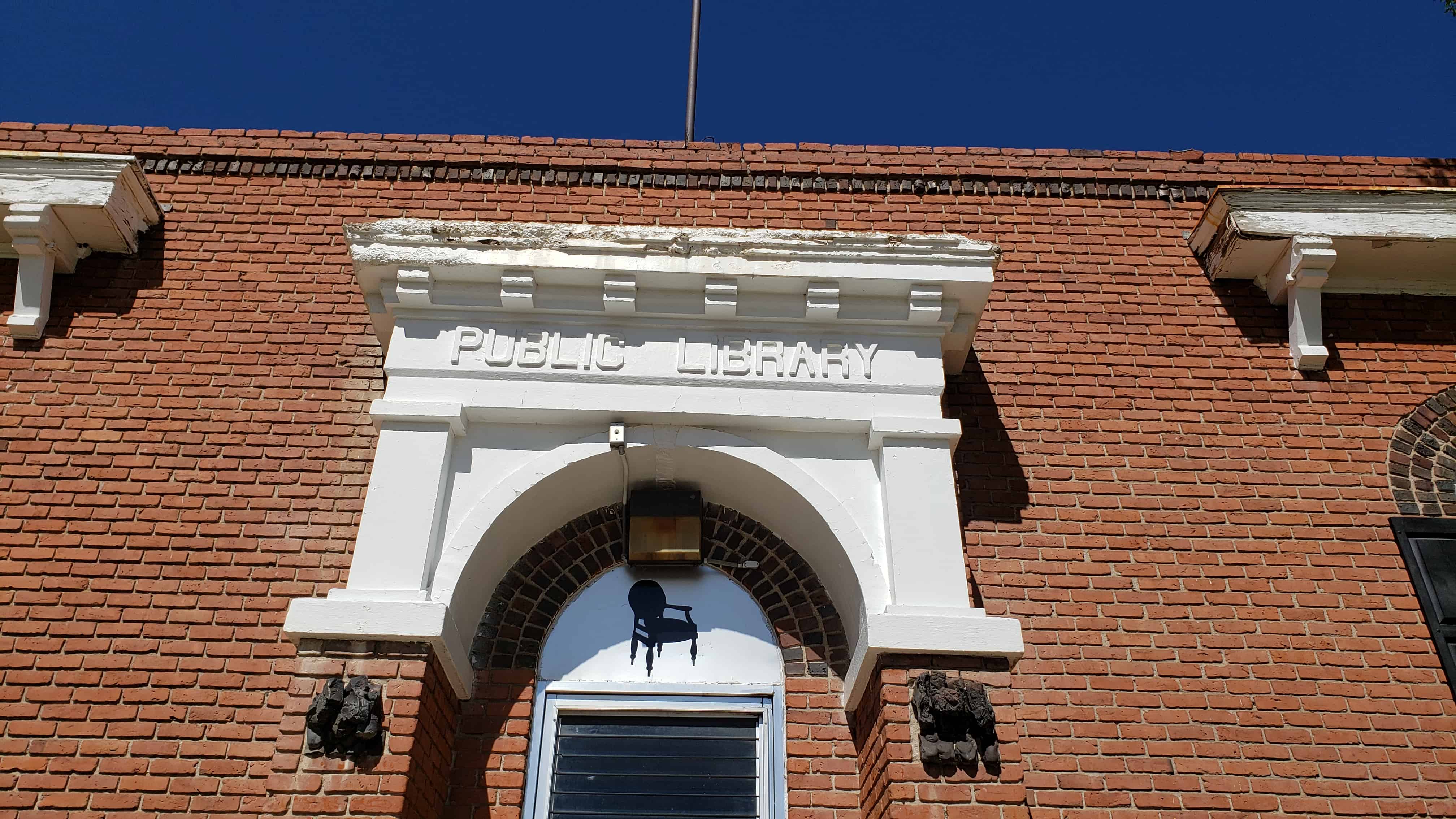
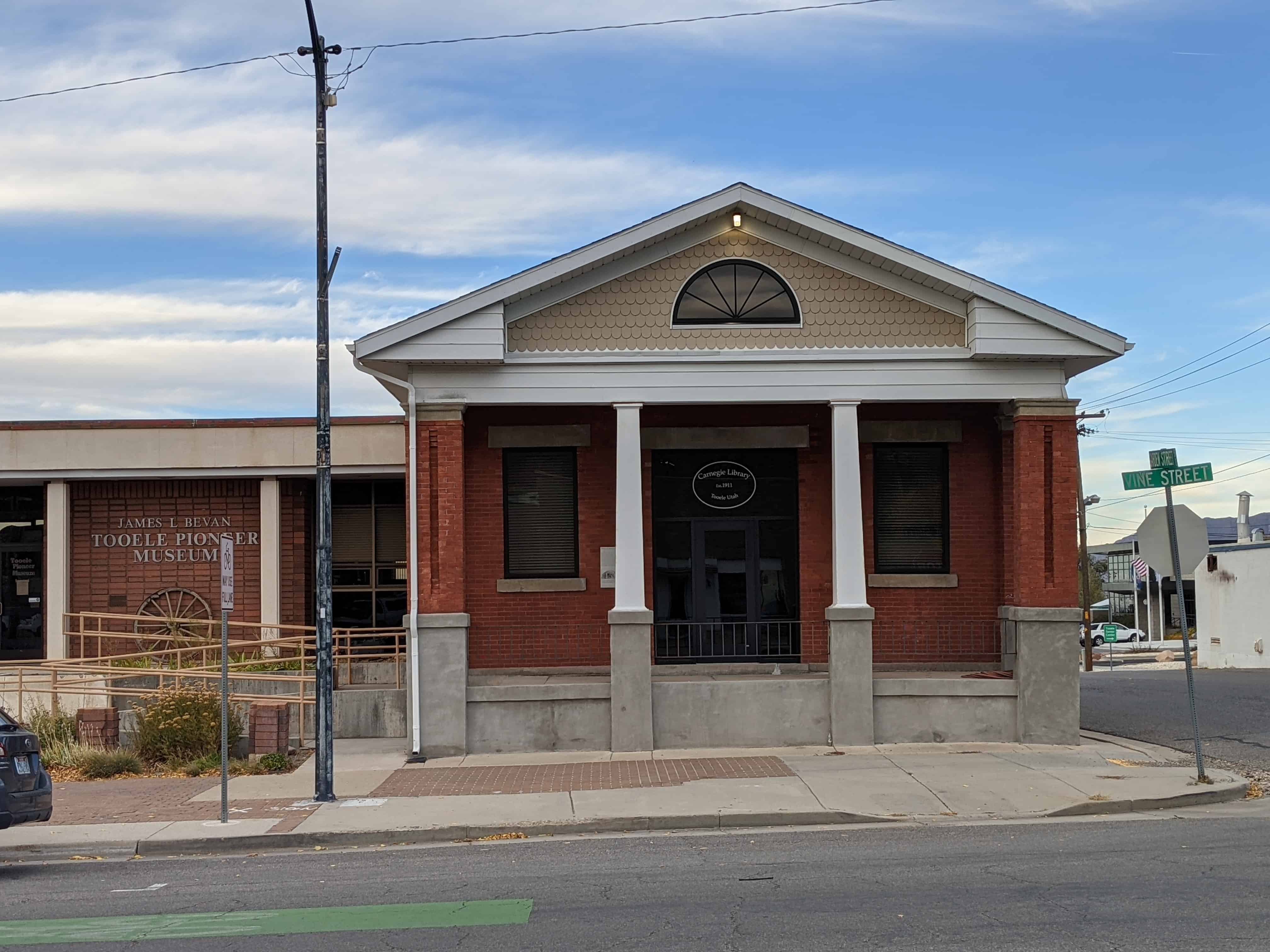
Built in 1911, the Tooele Carnegie Library is significant as one of sixteen remaining Carnegie libraries of the twenty-three built in Utah. Thirteen of the sixteen library buildings maintain their original integrity and are included in the Carnegie Library Thematic Resource Nomination. In addition to making important contributions to public education in their respective communities, these libraries are Utah’s representatives of the important nation-wide Carnegie library program, and they document its unparalleled effect in the establishment of community-supported, free public libraries in Utah.
Located at 47 East Vine Street in Tooele, Utah and added to the National Historic Register (#84000420) on October 29, 1984.
The Tooele Carnegie Library was built in 1911 with a $5000 grant from millionaire/philanthropist Andrew Carnegie. Carnegie funded the construction of over 1650 library buildings in the U.S., 23 of which were built in Utah communities. The conditions upon which all Carnegie grants were given were that the recipient community donate the building site and provide an annual maintenance budget of at least 10% of the grant amount. The city of Tooele provided the books and building site for the library, and promised to provide at least $500 per year for the upkeep and operation of the library building. Designed by Salt Lake City based architect Frank M. Ulmer, the Tooele Carnegie Library, which, complete with books, cost a total of $6500, was officially opened on May 10, 1911.
Although the Carnegie library was the first building constructed and used specifically for library purposes in Tooele, it was not the first library organized in the city. The Tooele City Library Association was first organized in February 1864 under a territorial legislative charter. Due to financial difficulties brought about by the Association’s involvement in the construction of a social hall in the town, the book collection was taken over by the Tooele (LDS church) Ward Ecclesiastical Board in 1878. Members of the library were assessed annual dues to cover the operation expenses of the library and to pay the $35 annual salary of the librarian. The library operated out of the social hall (known as the Opera House), which it shared with other community activities. A private, fiction library was opened in Tooele in 1893 by William C. Foster, secretary of the library association. Foster, who operated his library until his death in 1906, rented out books for a fee of 25tf per month. The $5000 Carnegie grant enabled the city to replace those private, user-funded libraries with the city-supported Tooele Free Public Library. It has continued to serve as the city’s library up to the present, although the original building was expanded in 1973 by a major addition on the west. Despite that addition, the building retains its original integrity.
The Tooele Carnegie Library is a long rectangular building set on a slight hill so that from the façade it appears to be a one story building, but it actually drops off to two stories in the rear. It is oriented gable end to the street, resembling a temple-form building, with a door centered between two windows, and has a portico spanning the façade. The low pitch of the gable roof, the domestic scale of the building and porch, and the use of fish-scale shingles in the gable section are reminiscent of bungalows that were being built at the same time. The symmetrical arrangement of openings on the façade, the returns of the cornice, and the wide frieze of the entablature, however, counter the domestic character and emphasize Classical Revival influences.
Alterations to the Tooele Carnegie Library include the addition of a large brick wing on the west side of the building in 1973, which cuts into the west wall of the library building, and the painting of the exterior brick walls (n.d.). These changes, however, do not substantially affect the original integrity of the building. The addition was set back far enough that the façade of the library is completely unaffected by the addition. The 1973 addition visually joins the library building with the 1867 stone Tooele County Courthouse/City Hall on the west, although the addition is joined to the courthouse only at the roof level and the two buildings neither share a common wall nor are connected on their interiors. The Tooele County Courthouse/City Hall was listed in the National Register in 1983.
This Carnegie Library in Beaver is built in a Federalist Revival Style. Its plan is rectangular, with the broad side to the street. It has a flat roof and the front façade has a central door and two windows on either side, all of which are arranged with bilateral symmetry. The window detiling and the cornice are the most interesting architectural features on the exterior. The main windows are quite large and are filled with small panes of glass and wooden mullions. The windows are all arched and above them are arched transom windows with swag-like mullions. There are side lights as well and all the glass is outlined and emphasized with broad bands of decorative brickwork. The cornice is approximately 3 feet wide and is overhanging and banded with molding. Besides this, there are several decorative brick patterns and 2 brick string courses on the exterior. This brick is yellow color and was imported to Beaver. On the interior, the building still retains its original high ceilings, book cases, and furnishings. Only a month ago were the original hardwood floors covered with indoor/outdoor carpet.
Built in 1917 at 55 West Center Street in Beaver, Utah
The library is an excellent example of the Federalist Revival Style and is the only building designed so clearly in this style in Beaver. The building is one of a series of small town libraries built to enhance the cultural and educational life of rural areas by the Carnigie family. That it has remained totally unaltered until 1979 is a tribute to its excellent design and workmanship.