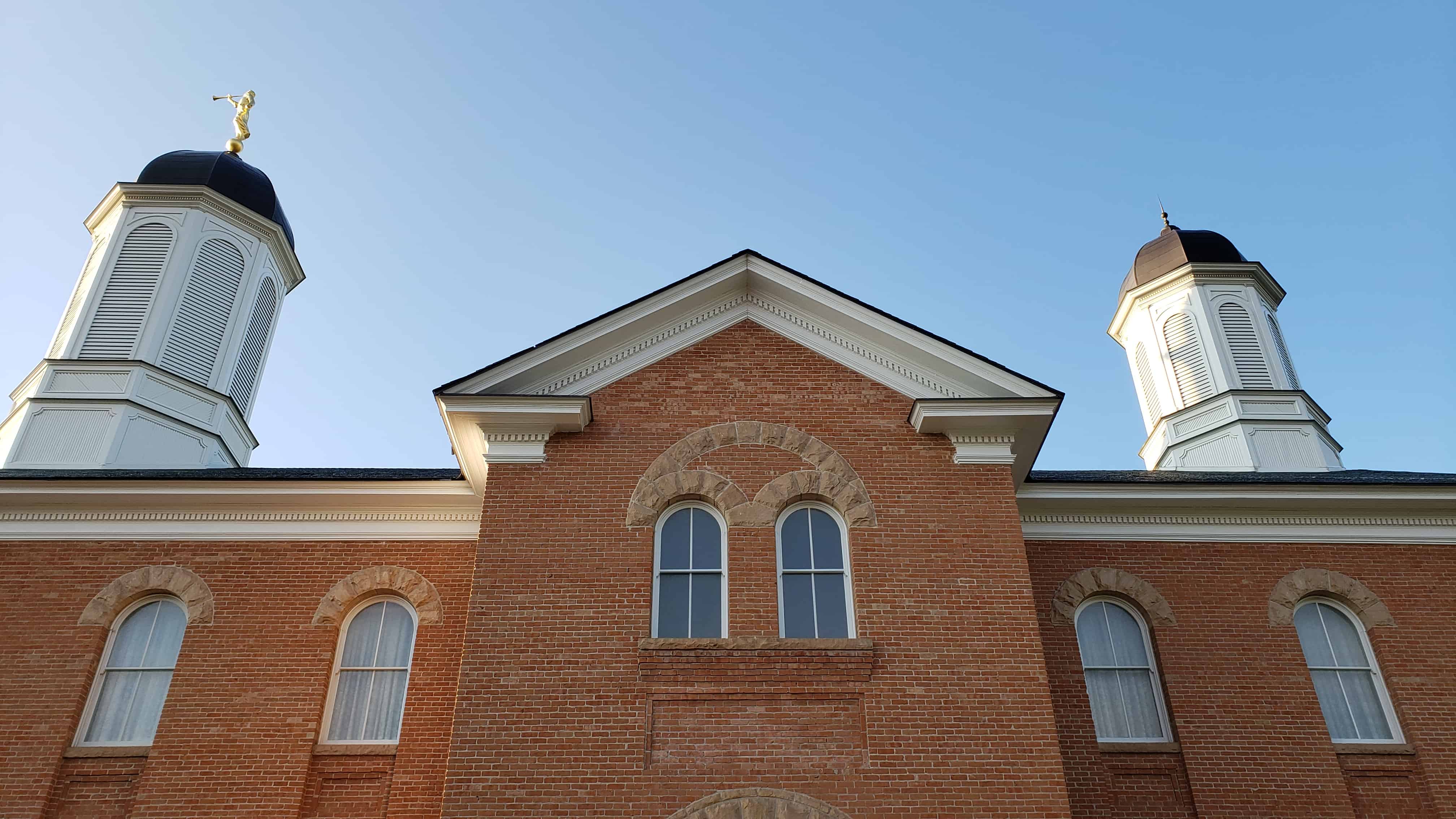
Gothic-style Church built of brick in 1888 during the last years of an intense period of missionary activity by the Presbyterians in Utah. Architect was William Allen of Kaysville. Marker placed October 1973 by Alpheus and Ivy Harvey.
Located at 94 East Center Street in Kaysville, Utah on a parcel located at 80 East Center with another home.
(text of the Historic Tour Marker) Relief Society Granary – Built 1877 The granary was built by the Brigham City Co-op to store wheat collected for the needy by the Relief Society, the LDS Church women’s organization. The wheat was obtained by women and children gleaning in the fields after men had harvested the grain.
This is #89000455 on the National Register of Historic Places.
Located at 100 North 400 East in Brigham City, Utah
(text of the SUP Marker) In 1876, Harriet Snow, Box Elder Stake Relief Society President was asked by the LDS General Relief Society President, Emmeline B. Wells, to join with women’s groups throughout the LDS Church to gather and store wheat against a time of need from drought, crop failure, or insect plaque. Women and children went into the fields after the men completed the harvest and gleaned and stored first in the basement of the courthouse, and then in an upper bedroom of Harriet Snow’s home.
Harriet requested a granary be built and in 1877 Lorenzo Snow, her husband, authorized the construction of this rock building on what was known as Co-op Square. The granary was well-constructed of rock and brick. Primary children gathered glass to be crushed and worked into the mortar to help keep mice out. The women of the Relief Society kept the granary clean and used lime to keep bugs away. The stored wheat was used mostly for local needs, but at times wheat was sent outside Box Elder County. One such day of need arrived in 1898, when wheat was sent to Parowan and other southern Utah settlements that were suffering from drought. In 1906 a train car of flour from the Relief Society granaries was sent to earthquake-devastated San Francisco. At intervals unused wheat was sold and replenished to keep it fresh.
The need for small, local granaries eventually passed, and this building was sold in 1913 to the Box Elder School District to store food for school lunch programs. Because of its thick walls, the building was used for cold storage. When use of the building ceased in 1967, it slowly fell into disrepair. In 2008 the Box Elder Chapter of the Sons of Utah Pioneers emptied the building of the old freezers, re-built the collapsing roof and refurbished the inside.
This durable old building, the Brigham City Relief Society Granary, today stands as a reminder of the hard work, frugality and vision of the Pioneer settlers of Brigham City and Box Elder County.
(this kiosk was built as an Eagle Project by Scott Shakespear and the Varsity Team 801 with the support of the Box ElderChapter of the Sons of Utah Pioneers. S.U.P. Monument #148)
(text from the NRHP Nomination form) Constructed c. 1877, the Brigham City Relief Society Granary is significant primarily for its association with the Mormon Church-sponsored Brigham City Mercantile and Manufacturing Association (the “Co-op”). The Co-op was a highly successful socio-economic cooperative that dominated the local economy during most of its years of operation, 1864-1895. It was also a model for Mormon cooperatives established throughout the Utah Territory in the 1870s. Most of the other co-ops failed quickly, and none approached the level of success attained in Brigham City. The Relief Society Granary is one of only five remaining buildings associated with the Brigham City Co-op; only four of the five are eligible for National Register designation. The granary is also significant for its association with the Relief Society, the women’s organization of the Mormon Church, which used the building for its grain storage program from the late 1870s until 1913. Relief Society granaries were built in most of the 200-plus Mormon communities during the late 1800s, but only eight have been located, identified and evaluated as eligible for National Register nomination.
This small stone granary was constructed by the Brigham City Co-op for the Brigham City Relief Society. The Relief Society is the women’s organization of the Church of Jesus Christ of Latter-day Saints (Mormon Church), and the Co-op was the church-based cooperative that was involved in virtually every aspect of Brigham City life during the 1860s-90s. The building was constructed by Co-op workers on the northwest corner of the block known as Co-op Square, where a number of Co-op manufactories were built.
The Brigham City Co-op was an outgrowth of communitarian ideals that had been part of the Church of Jesus Christ of Latter-day Saints (Mormon) philosophy from its beginning. In Kirtland, Ohio, on February 9, 1831, while the church was still in its first year, Church President Joseph Smith instituted the law of consecration requiring the people to turn over to the church any surplus property or possessions for the support of the poor. The United Order, an economic cooperative system, operated for a time in Kirtland and then was discontinued.
After the Mormons migrated to Utah from Nauvoo, Illinois, in the 1840s and 50s, church leaders encouraged the settlers in Utah communities to again implement the cooperative system. Part of the reason was to encourage patronage of Mormon enterprises rather than non-Mormon ventures, which were seen as a threat and intrusion in the Mormon settled region. Over 200 cooperatives were established and in operation in Mormon communities between 1868 and 1884 as part of the churchwide effort referred to by historians as the Cooperative Movement. Cooperatives were formed within the local Mormon wards (congregations) for community welfare purposes rather than mere profit. Their methods of operation ranged from businesslike joint-stock corporations to more communal arrangements where members shared everything. The Brigham City Co-op was an example of the joint-stock approach.
The earliest and most successful Mormon cooperative was in Brigham City. Lorenzo Snow, one of the founders of the town and a member of the church’s governing Council of Twelve Apostles, established the Brigham City Co-op in 1864 with the formation of a co-op mercantile store.5 The Co-op went on to form 19 different departments encompassing commerce, industry, agriculture, horticulture, and construction. These departments employed most of the available workers in Brigham City for three decades. Though the Co-op operated until 1895, its first 15 years were its most successful. The demise of the Co-op was brought on by natural disasters, changing attitudes about the role of the Mormon Church in business, legal and financial attacks against the Co-op, and changing hierarchy within the church. One by one, all of Brigham City’s cooperative departments were either abandoned or taken over by private interests. The Co op ceased operation in 1895.
Only five Co-op buildings remain standing. They include the Flour Mill (1856), Woolen Mill (1869-70), Planing Mill (c.1876), Relief Society Granary (c.1877), and Mercantile Store (1891). The Woolen Mill has been extensively altered by later additions, though it still functions as a woolen mill. The 1856 Flour Mill predated the Co-op by eight years, but it functioned as a Co-op industry during the 1860s and ’70s.
Though the granary was built and owned by the Co-op, it was used by the Relief Society for its grain storage program. Grain storage was just one of the duties assigned to the Relief Society after the organization was revived in 1867. Other responsibilities included the following: (1) systematic retrenchment; (2) establishment and operation of cooperative stores selling home-produced merchandise; (3) promotion of home industry, silk in particular; and (4) nursing, midwifery, and hospital maintenance.
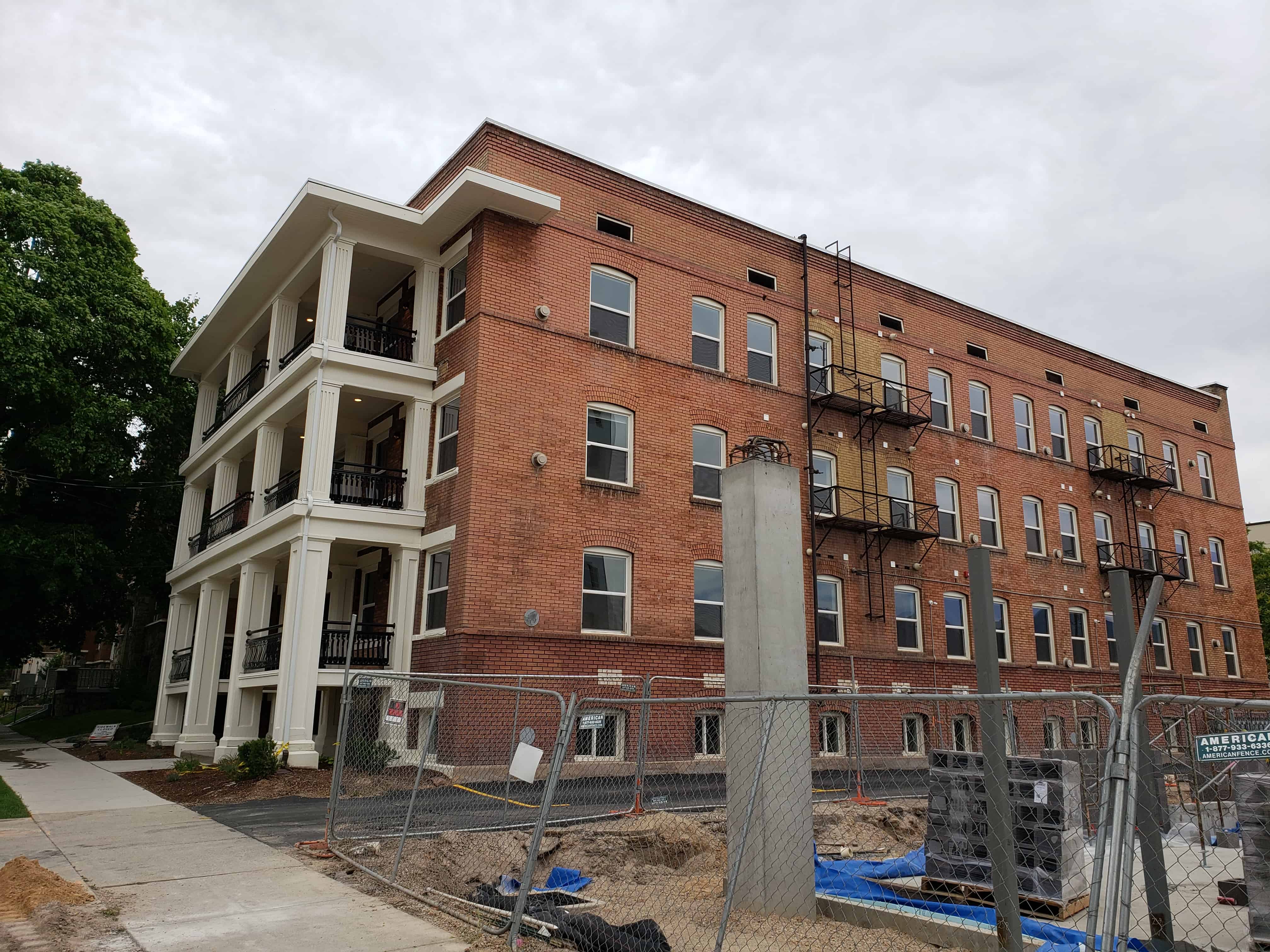
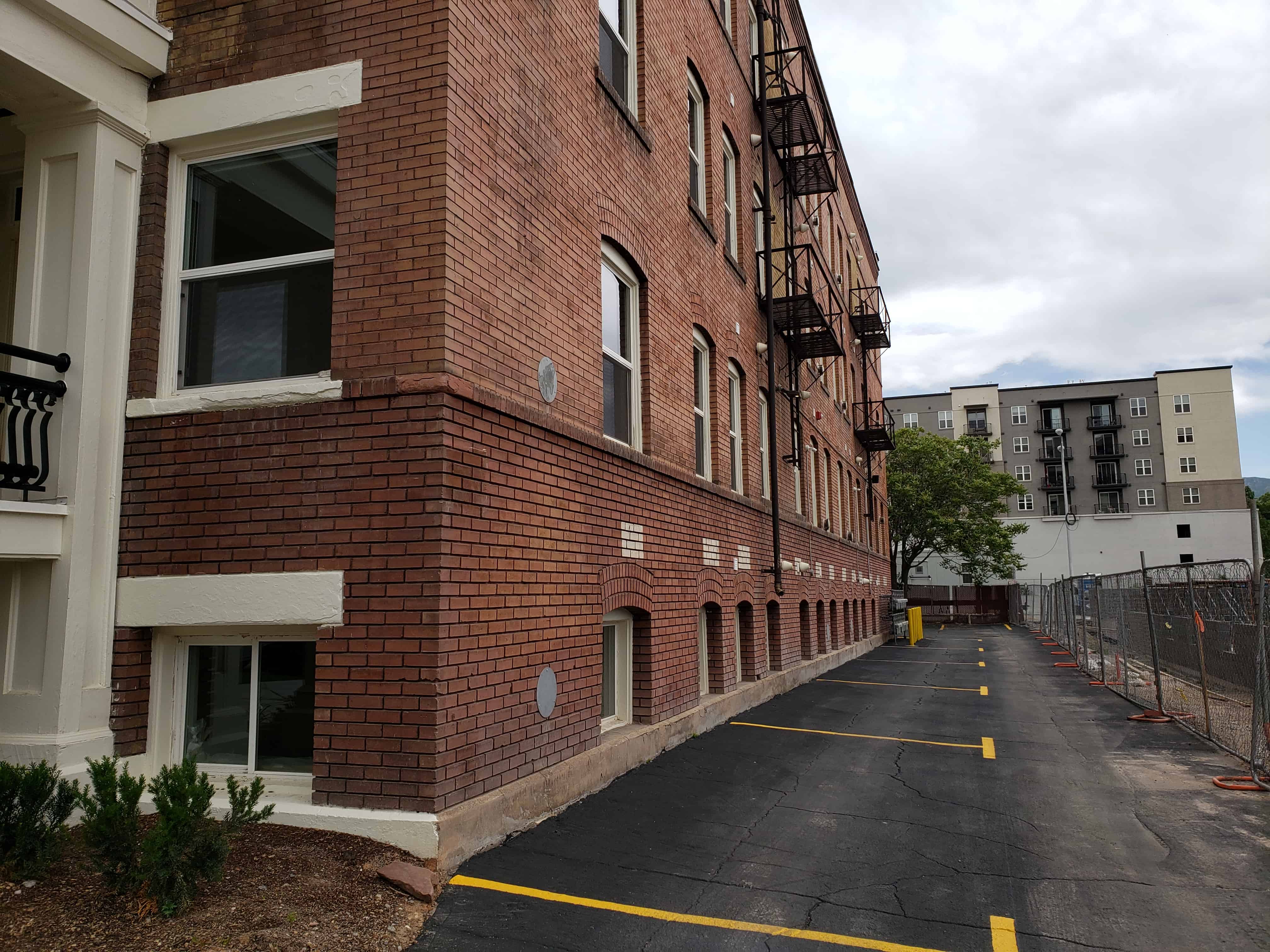
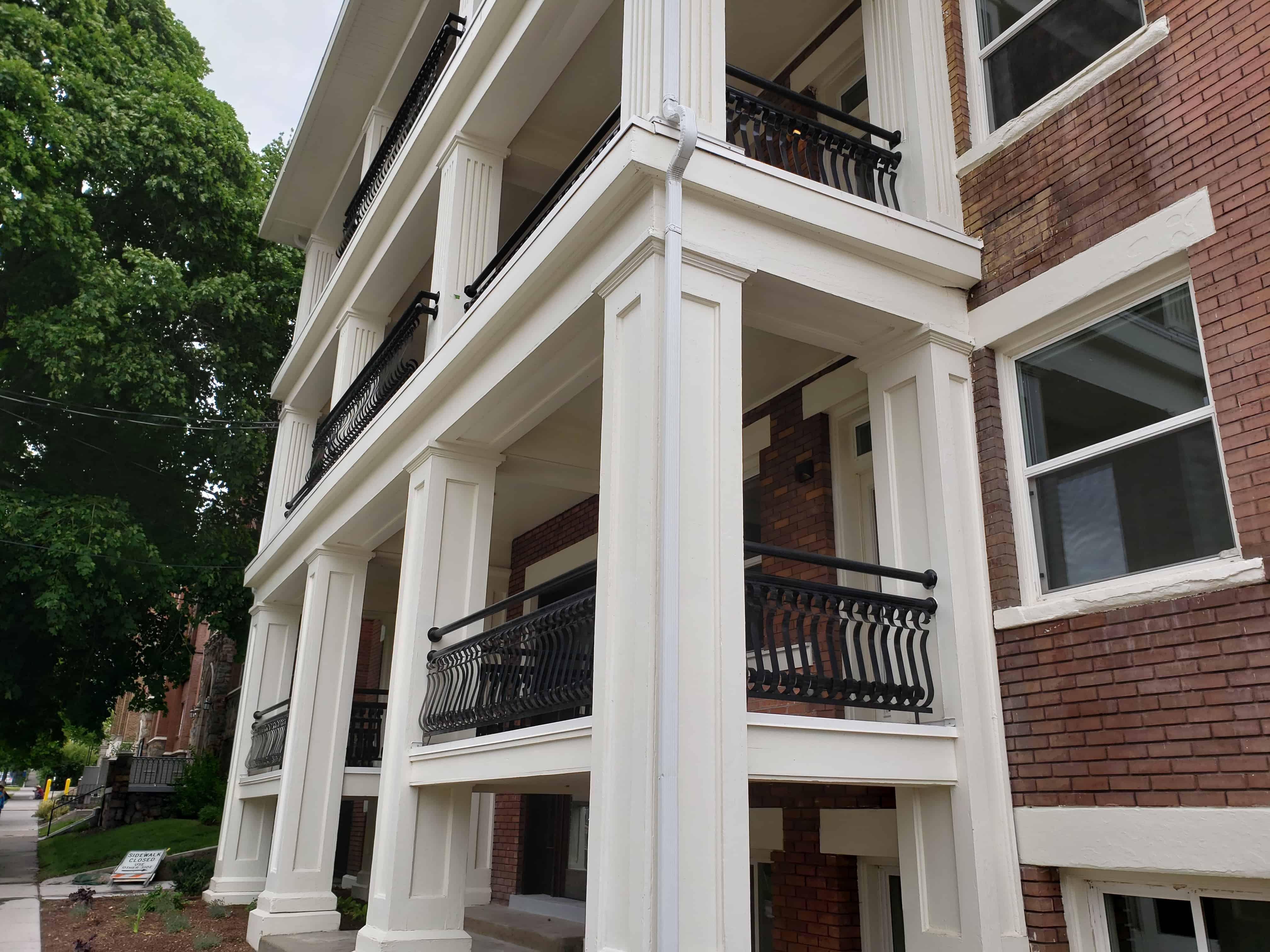
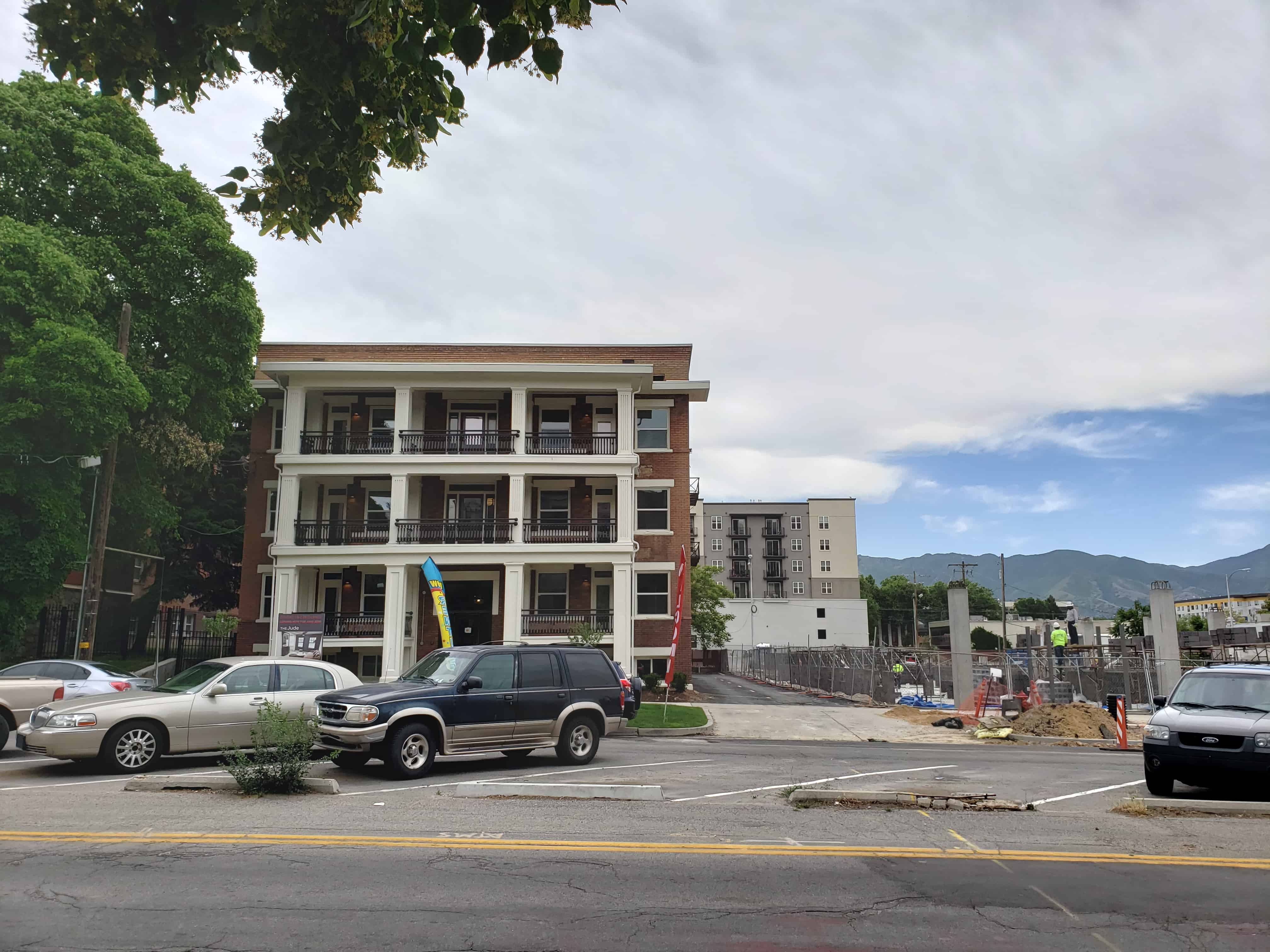
This complex predates its Los Gables neighbors by nearly two decades but both ended up on the register this year. It, too, is a 3 1/2-story brick building but in the Neoclassical Revival design. But what the Palace Apartments preserves is a piece of Salt Lake City’s rapid urban growth heading in the 1900s.
“The Palace Apartments is an early 20th-century example of an urban apartment block, one of 180 blocks that were built in Salt Lake City between the 1890s and the 1930s,” historians wrote. “The city’s residential growth in the late 19th and early 20th centuries is represented by two competing types of housing: suburban homes and urban apartment blocks.”
The building has stood for over a century now. Following years of neglect, historians wrote that “substantial renovations” were conducted last year. Now known as the Jude Apartments, the building is helping provide housing for the newest wave of Salt Lake City urban growth.
The Green River Presbyterian Church / Green River Bible Church
Built in 1907, this small wooden church is a good example of the Victorian Gothic architectural style. It is composed of intersecting wings with a tower set into the entrance angle. The principal wing is nearly two stories high and has a broad, steeply pitched gable roof. The front projecting wing is smaller, perhaps a story-and-a-half, but has the same pointed roof shape as the larger section to the rear. The tower is a full two stories and the roof a unique mixture of hip and tower element. The tower roof itself is hipped, but it is clipped at each corner by square battlements that protrude upward to a point just below the apex of the hip. Each wing contains large Gothic arched, stained-glass windows with pointed-arch wooden tracery. The two visible sides of the tower have round-arched paired windows on the second story. Above each of these windows is another small round window which is framed beneath a decorative pointed arch of applied wood. Over the tower’s front door is a slightly flared hipped roof canopy. The wooden frame sits on a rusticated stone foundation and is covered with clapboard siding. Originally, the building was white with brown trim.
In 1963 a four room addition was put on the west end for Sunday School rooms, and storage. In 1986 the old paint was removed and the church repainted white with gold trim. The interior walls were originally painted plaster and moveable chairs were used for seating. In the 1970’s, carpet was placed over the wooden floors, and pine pews replaced moveable chairs. In 1985, the interior plaster walls were replaced with insulation and sheetrock and all woodwork was restored and refinished. In 1986, the church received a new asphalt roof. Despite these changes and perhaps because of them the building retains much of its historic integrity.
Located at 320 West Main Street in Green River, Utah and added to the National Historic Register (#88002998) on January 5, 1989.
Constructed in 1906-07, the Green River Presbyterian Church is architecturally significant at the local level as an excellent example of the Victorian Gothic style. It is also historically significant as the first church built in the town and as an important early example of the “community church” phase of Protestant church activity in predominantly Mormon Utah. Unlike nineteenth-century Protestant church buildings in Utah, which were erected as part of the missionary effort among the Mormons, twentieth-century churches were constructed with the sole purpose of serving local congregations. The relatively small number of non-Mormons in Utah communities often prompted members of various Protestant backgrounds to band together in a community church arrangement, even though one faith may have sponsored the congregation and the construction of the building. Such was the case with the Green River church, which was loosely affiliated with the Presbyterian Church but had several different denominations represented among its original members. Although the church acted solely as a religious structure, its significance is derived from its unique architecture and early representation of the historical theme of Protestant community churches.
The first Protestant congregation in Green River was established in March 1906 under the direction of Rev. J.K. McGillivray, a Presbyterian pastor. There were 29 members of the original congregation, representing eight different denominations. Immediately after Rev. McLain W. Davis took over the pastorate in December 1906, he proposed the project to construct a building for the congregation. Land for the new church (five lots valued at $1000) was donated by the Green River Land and Townsite Company, and over $2200 were raised locally through donations, labor subscriptions and a variety of fund-raising activities, such as chicken pie suppers. There was also a $1000 grant from the “Board of Church Erection” of the Utah Presbytery to assist with construction costs. Ware & Treganza, a prominent architectural firm from Salt Lake City, was hired at a cost of $125 to design the new structure. Work on the project probably started in the spring or summer of 1907. The building was dedicated on October 20, 1907, though it had been used for some time before its completion. Total cost of the facility, which included an organ and chairs, was almost $4500. The building functioned as a Presbyterian church until 1958, when the Presbytery of Utah was no longer able to provide a full-time minister. Since 1959 the church has been a nondenominational community church, though its historical role has always been that of a community church.
The Green River Presbyterian Church was constructed at a time when the community of Green River was emerging as an official town. A makeshift settlement known as Blake City had been located at this site as early as 1879 along the newly established mail route connecting Salina, Utah, and Ouray, Colorado. The site of the settlement was at a favorable crossing of the Green River. In 1883 the Denver and Rio Grande Western Railroad established an east/west line along that route, helping ensure the existence of the settlement. The town took on the name Green River in 1895, but it was not until 1906 that the first town council was elected and a new townsite laid out. Green River was officially incorporated in 1910. This period of municipal growth corresponded with the local “Peach Boom,” during which the peach industry was introduced and thrived. Other community advances at that time were the construction of a two-story brick school in 1910, the erection of a metal-truss wagon bridge across the Green River in 1910, the establishment of a Mormon ward (congregation) in 1904, and the formation of a Presbyterian congregation in 1906 and the construction of their building in 1907.
The Green River Presbyterian Church represents a new phase of Protestant activity in Utah cities, a “community church” phase. The evangelical zeal that had sustained Protestant missionary efforts in Utah during the 1870s-90s was extinguished by the turn of the century. Nationwide economic depressions during the 1890s greatly reduced donations from church contributors in the eastern U.S., and the perceived need for missionary work among the Mormons was significantly lessened with the 1890 Manifesto denouncing polygamy by Mormon church president Wilford Woodruff. The establishment of a viable Utah public school system in the 1890s also had a negative effect on Protestant missionary efforts in Utah. These efforts focused on providing Mormon children with schooling as a first step toward conversion. The combination of these factors in the 1890s brought an end to the Protestant evangelical missionary period in Utah.
The community church phase of Protestantism in Utah represents a local desire for Protestant religious services and the willingness of the various churches to support congregations of mixed denominational background. Most Utah towns were at overwhelmingly Mormon, so there were relatively few Protestant churches, usually only one per community (except in the larger cities). No single denomination had enough congregants to justify the expense of a building and minister, so ecumenical community churches were the practical solution. Affiliations with the sponsoring institutions were maintained for a number of years (e.g. Green River Presbyterian Church, Magna Community Baptist Church), but they usually became weaker with time. Most of the congregations eventually became nondenominational community churches.
The Brinton-Dahl Home is significant as a very well maintained example of an elaborate example for it’s size and location of a pattern book, Queen Anne influenced residence. The design includes an unusually complex flared roof form which dominates the front and side facades of the house. It is one of the most attractive farm houses built in the Big Cottonwood area of the Salt Lake Valley, and one of the few which survives. It stands on a rise above the surrounding area. A. brick cellar and milk house are included in the site.
History of early residents: The Brinton-Dahl Home was constructed in 1885 as a two family residence for Caleb Dilworth Brinton and his younger brother, David Branson Brinton. David’s rapidly expanding family occupied the larger west side, while Dilworth and his wife, the former Emily Elizabeth Maxfield, who were childless, lived in the smaller east portion. David soon moved and Dilworth lived in the house until 1904.
Caleb Dilworth Brinton was born in Savannah, Andrew Co., Missouri on November 21, 1848, on route to Utah. His accomplishments include exploring southeastern Utah for colonization, hauling stone for the Salt Lake Temple and construction work. He stated, “There is nothing pertaining to the opening up, building and colonization of a new and desolate country in which I have not taken an active part.” He filled two missions for the Mormon church and worked in the Salt Lake temple. About 1904 a nephew, David Brinton Bagley, remembers going to the house to take his Saturday bath because it “was the only place in the neighborhood that had running water in the house”.
However, of greater significance than the prominent Brinton family was the Mormon pioneer family of Alexander Dahl who bought the Dilworth Brinton farm in 1904. Alexander Dahl was born August 11, 1831, in Frederikstad, Norway. He and his brother, Christian, joined the Mormon church and immigrated to America in 1854. Christian died on the way to Utah, but Alexander arrived in Salt Lake City on September 27, 1855. In 1857 he served with Lot Smith in Echo Canyon during the Utah War. After his release he walked over 200 miles to Spanish Fork to join a community of Scandinavian Mormons. In Spanish Fork he met sixteen year old Ellen Yorgensen.
Ellen was born in Lyngby Malmohus, Sweden on March 9, 1842. She arrived in New York City with her family in 1856 after a rough ten week voyage during which forty-five of the passengers died. The family worked for a short time in New York to earn funds to continue their journey to Utah. In Keokuk, Iowa they contributed their means to assist less fortunate members of the Mormon church to migrate to Utah. Ellen worked as a nurse and a baby sitter, learning the English language from the children for which she cared. A. year later on her trek to Utah she gave her place in the wagon to an expectant mother. Ellen’s long career as a midwife began when she assisted the mother in the birth of the child.
assisted the mother in the birth of the child. In 1857 Ellen’s family moved to Spanish Fork. Ellen received several offers to become a plural wife. She refused indignantly. When she met Alexander Dahl he was so shy that she was sure he would want only one wife. According to reports it took only a little persuasion to convince Alexander to marry her.
The Dahls were among the first settlers in East Jordan (Midvale) They started their family in a dug-out, but later built a large adobe home. Alexander found no employment in his trade as a carpenter so he began buying land and became a dairy farmer. After forty-five years residence in Midvale, Dahl sold his property to U.S. Steel for the Midvale smelter. They bought a farm and house from Dilworth Brinton in Big Cottonwood where they started a dairy.
Alexander Dahl died on February 11, 1911, and Ellen died November 8, 1912. The Dahls were among the first residents of Big Cottonwood to establish a commercial dairy business. They built a large cow barn and milked about fifty cows, at first selling their milk from a cellar near their house and delivering milk to various outlets in the area. A. neighbor, D. Brinton Bagley, reported that in 1905 the great Dahl milk truck with enormous wooden wheels and chain drive was the first automobile he remembers seeing. The milk was cooled in an adobe trough within the milk house, which still stands, through which ran a constant stream of cold water from one of the farm’s three or more flowing wells. About 1911 the Dahl Brothers opened a retail outlet at 478 East 2nd South which advertised “High Grade Milk, Cream, Buttermilk, etc., all from our own tested cows. Baby Milk a speciality ” Later business improved to the point that they bought milk from small producers. The Dahl Brothers were the sons and the daughter of Alexander Dahl.
The Dry Fork Valley Petroglyphs are probably among the most photographed, well- publicized and best known examples of aboriginal rock art in the state of Utah and in the Western United States. The site was thoroughly photographed by Albert Reagan in 1931, who published his material in numerous journals (Reagan 1931, 1932, 1933). Frank Beckwith’s work also helped make the site famous, calling it the “best in the state” (Beckwith 1935:40). The site is considered to be the type site for the Vernal Style, attributed to the Fremont Culture, but it may be pre-Fremont. Wormington has the following comments on the petroglyphs in the Vernal area: “In Dry Fork Canyon, 8 miles from Vernal, Frank Beckwith found numerous pictographs (Beckwith, 1955). Two panels are shown in Fig. 59 (p. 145). The shape of the bodies, the elaborate necklaces and belts, the horned headdresses, and the lines below the eyes all suggest Fremont work. It is interesting to note the presence of two crownlike headdresses. The magnificent headdresses of flicker feathers found in Mantle’s Cave and a similar specimen reported from the Fremont area would probably be depicted in such a manner. The head carried by the individual in the lower panel is also of interest. It could be a mask, but masks are not likely to have necks. Perhaps, as Reagan and Beckwith have suggested, it represents a trophy head. The head in the upper panel is more mask-like.” (1955:145).
The evidence, however, does not clearly point to a specific Fremont cultural affiliation for this art style. The headdresses found in cave deposits noted above are probably associated with earlier Basketmaker components at the sites. In addition, the shield figures are found in a much wider area than that assigned to the Fremont Culture, as far north as Pictograph Cave in Montana. Many of the figures do closely resemble those found along the Fremont River, which are also generally ascribed to The Fremont Culture. Again, it should be noted that cave deposits adjacent to the panels in both Dry Fork and the Fremont River contain much cultural material that could be ascribed to an earlier Basketmaker II or III level of technology.
Thus, there is still considerable question regarding the exact dating, cultural affiliation, and meaning of this distinctive rock art. Nevertheless, there can be no question regarding its significance, aesthetic value, and importance for understanding the cultural affiliation of various prehistoric populations.
Located at 6228 McConkie Road in Vernal, Utah and added to the National Historic Register (#75001828) on September 25, 1975.
The site is located in Dry Fork Valley, a major tributary of Ashley Creek, a narrow valley with permanent water, approximately 8 miles northwest of Vernal. The site consists of numerous separate panels along the base of the yellow Navajo sandstone cliffs which form the north and east side of the Dry Fork Valley. The panels are scattered along the cliff for about 2 miles, with the greatest concentration behind the McConkie ranch house. There is a long talus slope below the cliff which is about 100 to 150 ft. high. The site overlooks the whole lower portion of the Dry Fork Valley.
This site, one of the most well-known in the Western United States, is considered to be the type site of the Vernal Style. It is characterized by elaborate anthropomorphs, generally with trapezoidal bodies, headdresses, necklaces, earrings, kilts and other decorations. They commonly hold shields and masks, the latter have been interpreted by many as severed heads (Wormington 1955:145). By far, the main focus of the panels is on the elaborate anthropomorphs Every panel has several, and in many panels this is the only figure present. Animals are also present but they are insignificant, as are the occasional geometric designs. At least two of the panels show what are apparently bears, either “fighting” or “dancing” with the anthropomorphs. In general, the ornaments (necklaces, earrings, kilts, and headdresses) are more deeply carved than the anthropomorphs themselves. In several cases weathering has almost completely obliterated the figures except for these ornaments. Often, other anthropomorphs have been superimposed on these older figures. Red pigment is present on a few of the panels, but is badly faded. In some cases it was used to accentuate the carvings, on others if apparently represents all that remains of earlier pictographs.’ The panels resemble those in Nine Mile Canyon, to the south, in being small and scattered along the valley walls for a great distance.
During the I930’s, many of the panels were numbered by Albert Reagan and chalked in by Reagan or Frank Beckwith for identification and photographic purposes. Most of the chalking and numbers still remain. None of the panels appear to be marked by vandalism, and the site is very well protected by the McConkies who charge admission to the site and conduct tours. The site is presently visited by many hundreds of visitors each year and maps are available in Vernal giving directions to the site for tourists.
On February 3, 1916, the Daughters of the Utah Pioneers, along with several other civic groups, presented the idea of establishing a public library to Mayor Joseph J. Richardson and the Smithfield City Council. Constructed in 1921 at a cost of $20,000, the Smithfield Carnegie Public Library is significant as the first public library in Smithfield and is a fine example of the work of Fred. W. Hodgson, a prominent local architect who designed many other buildings in Cache Valley. The Smithfield Public Library was one of more than 1,400 public libraries established throughout the U.S. between 1898 and 1920, primarily through grants from Andrew Carnegie, a multi-millionaire and steel magnate who felt that the rich had an obligation to use their excess wealth for the benefit of mankind. Carnegie hoped to stimulate a community’s commitment to establishing a free library program by giving it much, but not all, of the money required to build the library, with the understanding that the community would be responsible for furnishing and maintaining it; this was the case in Smithfield. Continually used as a public library, the building is a key historic resource within the community of Smithfield. A new addition to the building was completed in 2014.
The Vernal Utah Temple of The Church of Jesus Christ of Latter-day Saints, formerly the Uintah Stake Tabernacle.
On February 13, 1994 it was annouced that the vacant tabernacle would be converted into a temple for the LDS Church.
The Uintah Stake Tabernacle is devoid of Gothic detail common in church architecture and is a more simplified and almost civic variant of the Georgian New England Church form. Of over forty tabernacles built in Utah, it is the only one existing in the eastern part of the state. Built during the years between 1900-1907, it is the most significant symbol of the Mormon culture in the Uintah Basin, one of Utah’s last frontiers to be settled by members of the Church of Jesus Christ of Latter-day Saints. The Uintah Stake Tabernacle is also on the Utah Register of Historic Places.
Built in 1887, the Vernal Tithing Office is historically significant as one of 32 well preserved tithing buildings in Utah that were part of the successful “in kind” tithing system of The Church of Jesus Christ of Latter-day Saints (Mormons) between the 1850s and about 1910. Tithing lots, which usually included an office and several auxiliary structures, were facilities for collecting, storing, and distributing the farm products that were donated as tithing by church members in the cash-poor agricultural communities throughout the state. Harley Mowery, a local stone mason of English descent, was contracted to construct the stone tithing office. The building was saved from demolition in 1958 when it was moved from its original site to its current location by the Daughters of Utah Pioneers.
This historic tithing office is located at 186 South 500 West in Vernal, Utah and is now the DUP Museum. It was added to the National Register of Historic Places (#85000286) on January 25, 1985.
Built in 1887, the Vernal Tithing Office is historically significant as one of o 30 well preserved tithing buildings in Utah that were part of the successful w “in kind” tithing system of The Church of Jesus Christ of Latter-day Saints (LDS or Mormon church) between the 1850s and about 1910. Tithing lots, which usually included an office and several auxiliary structures, were facilities for collecting, storing, and distributing the farm products that were donated as tithing by church members in the cash-poor agricultural communities throughout the state. Tithing offices were a vital part of almost every Mormon community, serving as local centers of trade, welfare assistance, and economic activity. They were also important as the basic units of the church-wide tithing network that was centered in Salt Lake City.
The Vernal Tithing Office was built in 1887 at the request of Samuel R. Bennion, stake president of the Uintah Stake of The Church of Jesus Christ of Latter-day Saints. Harley Mowery, a local store mason of English descent, was contracted to construct the stone building.
The Vernal area, like most of Utah in the nineteenth century, was a cash-poor agricultural area, so tithing donations by church members were necessarily farm products. These were stored in the tithing office and its auxiliary buildings and structures, such as granaries, barns, and corrals. Produce was stored in the half basement under the tithing office to keep it cool and prolong its usefulness.
It is uncertain how long the Vernal Tithing Office functioned under its original use, but its importance as a storage and collection facility probably decreased dramatically during the first two decades of the twentieth century as “in kind” tithing contributions were replaced by cash donations. The building was saved from demolition in 1958 when it was moved from its original site to its current location by the Daughters of Utah Pioneers. The LDS church had offered to give the building to the DUP if they would move it from the property, which was to be sold to Mountain States Telephone and Telegraph Company. After purchasing land across the street from the Old Tabernacle, and with the help of the telephone company which donated $500 to the cause, the DUP moved the tithing office to its current location.
The Vernal Tithing Office is a one story stone single cell temple-form building with a gable roof. The stone is cut and coursed. Typical of the Greek Revival temple-form building, it is oriented gable end to the street and has a boxed cornice with a wide fascia. The gable end orientation is meant to imitate monumental classical buildings. 1 The temple-form building was the preferred building type for religious buildings in Utah in the late nineteenth century. A door is centered on the facade and there is a single six over six double hung sash window on each side of the building. A frame hood which dates out of the historic period is attached over the door. It has a boxed cornice and a gable roof which repeats the pitch of the main roof. The hood is unobtrusive and could easily be removed. A low one story modern addition is attached to the rear of the tithing office. Its style does not complement the building, but because it is built of similar materials, having a stone veneer, and because it is a low building with a flat roof, it does not affect the original character of the tithing office. The attachment of the modern addition affects only the rear of the tithing office, and its penetration into the original fabric appears to be minimal.
The Vernal Tithing Office is an excellent example of an early tithing office form. Like the tithing offices in Kanosh, Escalante, Parowan, Leeds and Pine Valley, it is a simple traditional form with a minimal amount of exterior decoration.
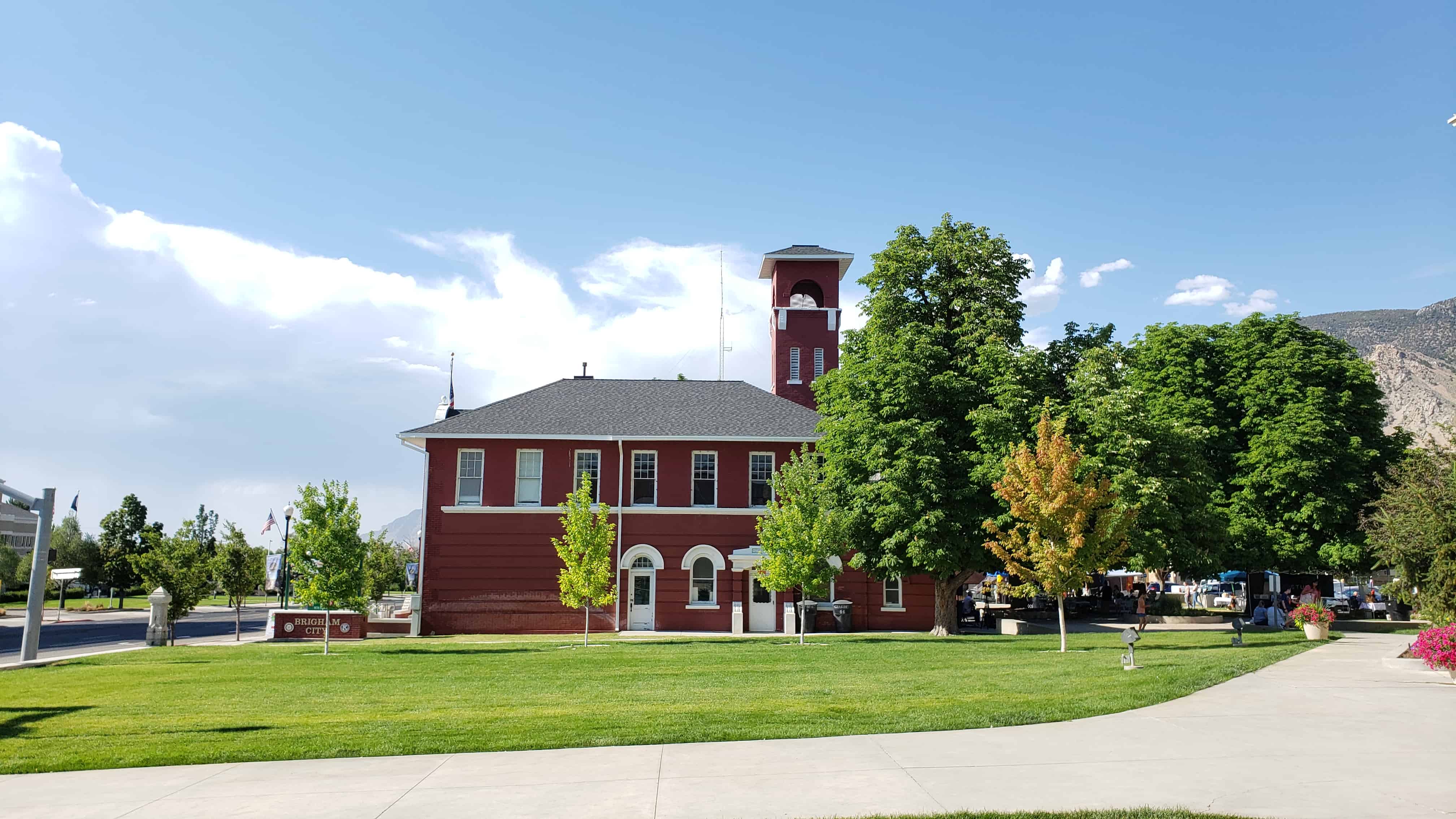
Constructed in 1909 at a cost of about $7000, this building originally housed the city fire department on the main floor and city offices on the second floor. It also had a jail cell in the southeast corner and “hobo apartments” in the basement. This was the first city hall built in Brigham City, the city offices having been previously located in the adjacent county courthouse. In 1935 the fire department moved out, and the fire-truck bay on the façade was replaced with the existing brick façade to better accommodate city office use of the main floor. The building continued to serve as the city hall until 1974. Designed by local architect Andrew Funk, this building is the only example of the Spanish Colonial style in Brigham City.
Constructed in 1909 and remodeled in 1935, the Brigham City Fire Station-City Hall is historically significant as the first fire station and city hall constructed in the town and as the center of municipal government and services for over twenty-five years. It originally housed the fire department and city offices, the latter having been previously located in the adjacent Box Elder County Courthouse. Community growth and commensurate expansion of city services led to the removal of the fire department to new facilities and the remodeling of this building for enlarged city offices in 1935. It continued to serve as the city hall until 1974. The building is also architecturally significant as the only example of the Spanish Colonial Revival style in Brigham City.
In the January 3, 1907, edition of The Box Elder News, a persuasive article supported the idea of constructing a city hall-fire station and made a case for it to be located north of the county courthouse so that the government offices would be centrally located. Two years later, in May 1909, the proposal won approval from the city council, which gave the go ahead for construction on a site just north of the courthouse. A frame library building that was on the site had to be moved back off Main Street (east) to accommodate the new fire station.
The following description of the proposed building was given in the local newspaper.
Basement containing store rooms for electrical and water works supplies, under the main floor. In the east end will be built a cement room for the accommodation of tramps and other undesirable citizens who wish to lodge with the city. At the northeast end of the basement will be the hose tower which will rise to a height of seventy feet. In the top of the tower will be a belfry. The ground floor will be given over to the Firemen for truck stalls, excepting a corner of the southeast end, where a jail cell will be put in. This cell will not connect in any way with the “hobo” apartments underneath, but will be used for the more respectable “drunks, etc.” The stairway leads up from the main entrance on the west end and the upstairs will be divided into five rooms viz: a large assembly room for the city council and the public, two city offices, fireman’s library and lavatories. The building will be constructed of reinforced cement and pressed brick, with a Spanish metal tile roof, in all to cost approximately $7,000.
In the July 22, 1909, edition of the paper, it was reported that architect Andrew Funk and Supervisor M.L. Nichols staked off the ground for the erection of the fire station, which was “16 feet east of the east Main street walk line, and 16 feet south of the north side walk line of the avenue running east and west.” Contractor Lars Hansen was to begin the work as soon as the excavation was completed. 5 The concrete foundation was underway by August 5, 1909 6 , and the completion of the building was celebrated by a Fire Department Social and Ball which was held in the large dancing hall of the Opera House and reported in the March 10, 1910 newspaper.
By 1934 the Fire Department was looking for more room to house their equipment, and in early 1935, the city purchased the Glover property at First West and Forest to build a new facility. The old fire station was to be remodeled to house the expanding city offices. Plans for this remodeling were drawn up by Salt Lake City architect Carson B. Wells (formerly of Brigham City), and they included a new front with a Main Street entrance, and the main floor would be converted into office rooms.
In June of 1935, the fire department moved out of the old fire station, and the remodeling of this structure began. The remodeling was finished by mid-September 193510 at a cost of around $6500. The Box Elder News gave a detailed report of its new appearance.
The new front is of red pressed brick, with black rodded joints and the rest of the building and tower have been painted to match the front. The main entrance is at the front of the building and the doors and windows are surrounded with ornamental white granite. At the entrance is an eight-foot terrace decorated with ornamental white granite, with an imitation red tiled floor. In the two front corners of the Terrance are large sixteen-inch flood lights to illuminate the front of the building. In the peak of the front of the building has been placed a neat Neon lighting effect by LeRoy Campion. The office space in the building has been doubled, the vault enlarged, and provision made for rest rooms and lavatories. The main room has a plaster Paris cornice where the walls meet the ceiling and a beautiful arch spans the center of the room. A large oak counter will separate the lobby from the offices. In the lobby is a fine drinking fountain and the floor will be covered with imitation tiled inlaid linoleum. The floor in the office space will be covered with imitation tiled green linoleum. The council chamber and rooms on the second floor have been renovated and redecorated and a cornice has been placed where the walls and ceiling meet in the chamber . . . . Local workmen have been employed on the job. Amos Larsen assisted in painting the brick; Alma Thompson and Edgar Rasmussen painted the roof and exterior; among the carpenters on the job were John J. Johnson, Fred Kelly, Alf Jorgensen and others; Joseph Earl did the plastering and cornice work, and the pressed granite work was done by Hans Pella. The electric wiring and lighting was done by Deverell Petersen, under supervision of City Electrician Orion Eskelsen. Architect Carson F. Wells of Salt Lake City drew the plans, and Councilman A.M. Hansen supervised the construction in behalf of the city. A sixty-foot steel flag pole was erected on the city hall grounds yesterday at the top of which a beautiful American flag was unfurled to the breeze.
In 1965 an annual report called “Progress-1965” published by Brigham City Corporation documents the use of the building: The main floor office under the direction of City Recorder Tolman Burke handled all business affairs of the city including maintaining all official records, water, sewer, and miscellaneous charges. There were seven employees under Mr. Burke in this office. Upstairs was the large southeast room for the Circuit Court which also doubled as the city council chambers. The judge’s office was in a small northwest corner room. The Police Department occupied the two other upstairs rooms with the dispatch office in the southwest corner and the Chief of Police’s office in the northeast corner room with a restroom located between the judge’s office and Chief of Police’s office on the north side of the building. In the basement of the building were rooms for the public works department, the inspection department and the civil defense headquarters.
In August of 1966, the police department moved out of the upstairs of this city building and into a remodeled facility which has since been torn down, but was located northwest of the First Security Bank building on Main Street.
After this move, $5,000 of remodeling to this upstairs part of the building was underway by October 1966. A new coat of paint was applied throughout, and the Circuit Court room received new drapes. A new city clerk’s office replaced the police dispatcher’s office in the northwest corner, and a mayor’s office replaced the Chief of Police’s office in the northeast corner.
The city offices were becoming more and more cramped for space, so the city council decided to erect a new city government building. In January of 1973, groundbreaking for a new city hall building began. The new structure was built just north of this old city hall building on Main Street. The architect was Ralph Edwards, and the contractor was Reid Oyler. The cost of the new structure was around $560,000. The new city hall was completed mid-December of 1973, and the city officials and employees vacated their offices in the old building to move into the more modern one on December 29, 1973.
Two months later in February 1974 the Brigham City Chamber of Commerce was negotiating with Harold Felt and the city council to lease the main level of the old city hall. Although Mayor Felt would have preferred tearing the building down and building another for the Chamber of Commerce, a negotiation was finally reached and a lease was signed around the first of March 1974 with Mayor Felt and Boyd Newman, president of the Chamber of Commerce, for the Chamber’s use of the building.
Renovation of the main level was accomplished by the Chamber of Commerce for around $6500 by late spring of 197423 while the upstairs part of the building was used by the Alcohol Counseling and Information Service. The second floor, however, was not taken good care of and soon ran into a state of disrepair. Around 1980, the Knights of Columbus Fraternal organization took over the upstairs part of the building with the understanding that they would do maintenance and custodial care.