• About JacobBarlow.com
  • Cemeteries in Utah
  • D.U.P. Markers
  • Doors
  • Exploring Utah Email List
  • Geocaching
  • Historic Marker Map
  • Links
  • Movie/TV Show Filming Locations
  • Oldest in Utah
  • Other Travels
  • Photos Then and Now
  • S.U.P. Markers
  • U.P.T.L.A. Markers
  • Utah Cities and Places.
  • Utah Homes for Sale
  • Utah Treasure Hunt

JacobBarlow.com

~ Exploring with Jacob Barlow

JacobBarlow.com

Tag Archives: utah

William D. Roberts House

06 Thursday Nov 2014

Posted by Jacob Barlow in Uncategorized

≈ 1 Comment

Tags

historic, Historic Homes, Provo, utah, utah county


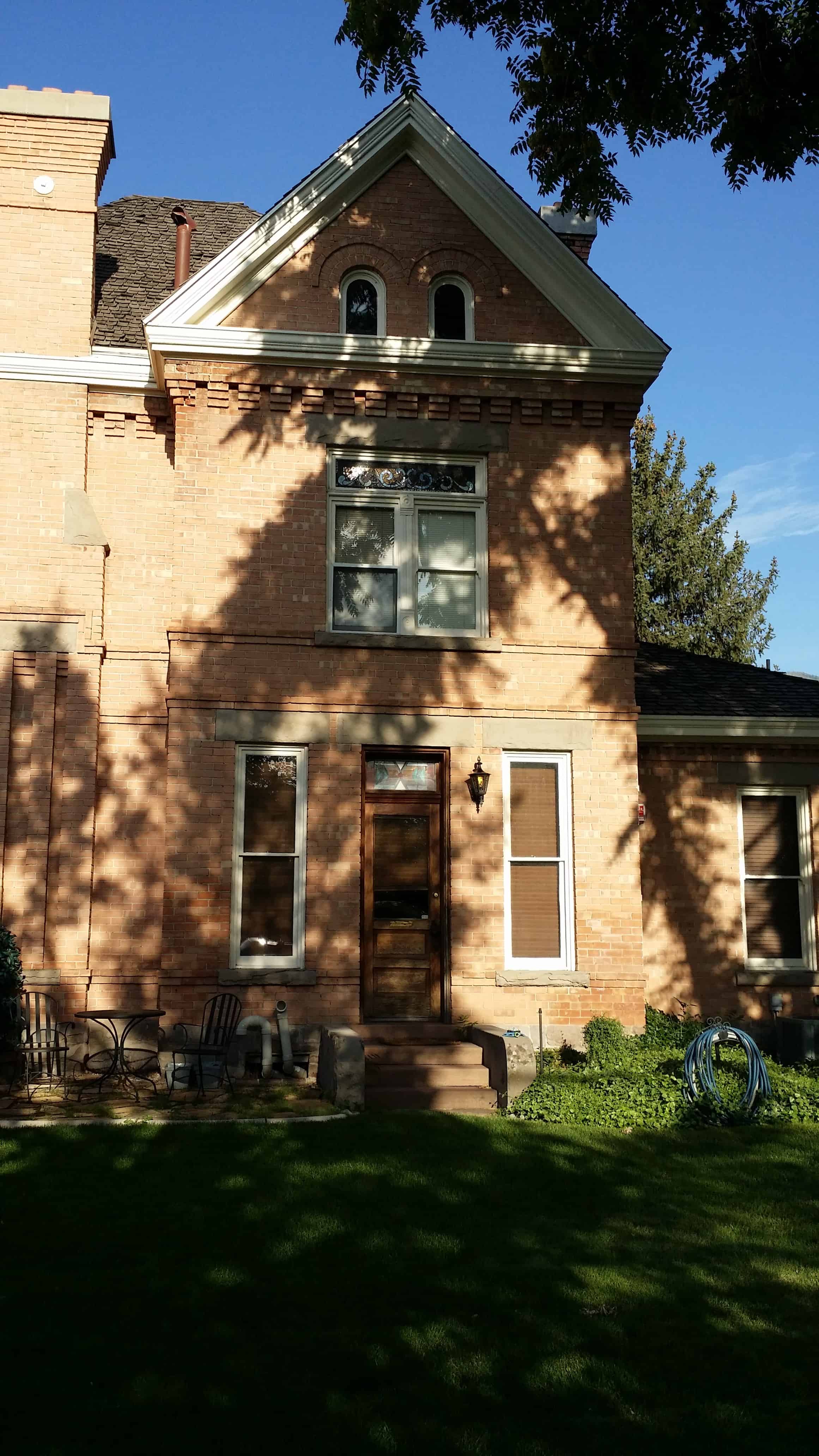
The William D. Roberts House is located at 212 North 500 West, it is a historic building located in Provo, Utah, United States. It is listed on the National Register of Historic Places.

William D. Roberts was a central figure in the City of Provo’s development. His home, located at 212 North and 500 West, was built in 1875 in the Greek revival style. The William D. Roberts House was designated to the Provo City Historic Landmarks Registry on August 22, 1996.

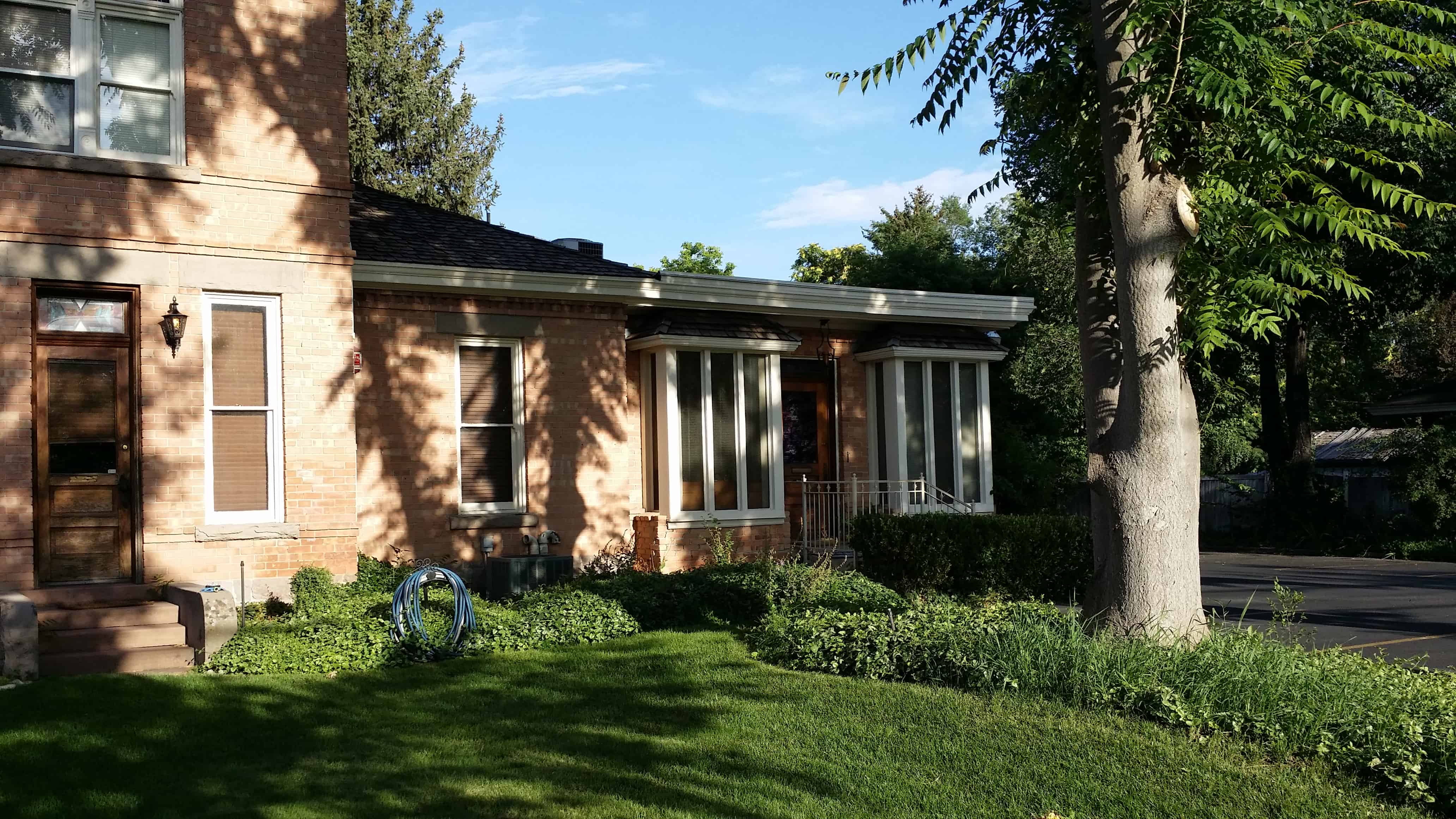
The William D. Roberts house was constructed in 1875. A two story home with a gable roof, this home is “The best-preserved example in Provo of a house that displays the traditional form and Greek Revival detailing of the pioneer period while concurrently reflecting the increased verticality of the early Victorian influence in Utah (Randall p. 1).” The use of the Greek revival style is evident in the decorative features of the building. The home contains a boxed cornice as well as six over six double hung sash windows with pedmimental window heads. The doors also exhibit these window heads. There have been several alterations made to the structure since it was originally made, such as alterations on the facade, and extensions made to the house, the home still retains much of its original character.

Born in Winchester, Illinois, on September 4, 1835, William D. Roberts was approximately ten when his family relocated from Illinois to Garden Grove, Iowa. After a subsequent move to Lancaster, Missouri, his family relocated yet again to Provo Utah in 1851. It was in Provo that William D. Roberts joined the Church of Jesus Christ of Latter Day Saints. Eventually Roberts fulfilled two missions for the church, one in California and one in Great Britain. He also became a member of the Seventies; a general authority in the church. Later in 1851, William, his brother Bolivar, and their father left for California. Once in Placerville, then known as Hang Town, Their father practiced medicine while William and Bolivar mined for a living. This pursuit did not prove as fruitful as planned, as William was not able to afford making it back to Utah until 1855, and at that time only made it with two twenty dollar gold pieces after the four years in California.

Once back in Provo, Roberts fulfilled several assignments of note. Roberts was assigned among a group of men to find Chief Tintic and his company of men, who had been harassing the settlers. Also, Roberts was one of the men who left Utah to help the pioneer Saints make it all the way to Utah when many were trapped within the cold in 1856. In the year 1857, on their way to trade with emigrants in Sweet Water, both Roberts and a man by the name Daniel Jones were abducted by Crow Indians, but rescued the next day by travelers heading towards California. In 1858 Roberts worked in freighting and carrying passengers between Salt Lake City and Los Angeles, California.

On February 6, 1862, Roberts wed Maria Julia Lusk in Lancaster, Missouri, and subsequently he brought her to live with him in Provo. William Roberts became active in the community of Provo, serving as a member of the City council from 1878 to 1881, as an alderman from 1884 to 1885, and as the first postmaster in the state of Utah. He also participated in the first brass band put together in Utah county, as well as in Provo’s first dramatic association. William Roberts died on March 8, 1912.

Related Posts:

  • Hotel Roberts
  • 2014-08-24 19.07.49
  • 2014-08-24 19.07.53
  • 2014-08-24 19.08.19
  • 2014-08-24 19.08.34

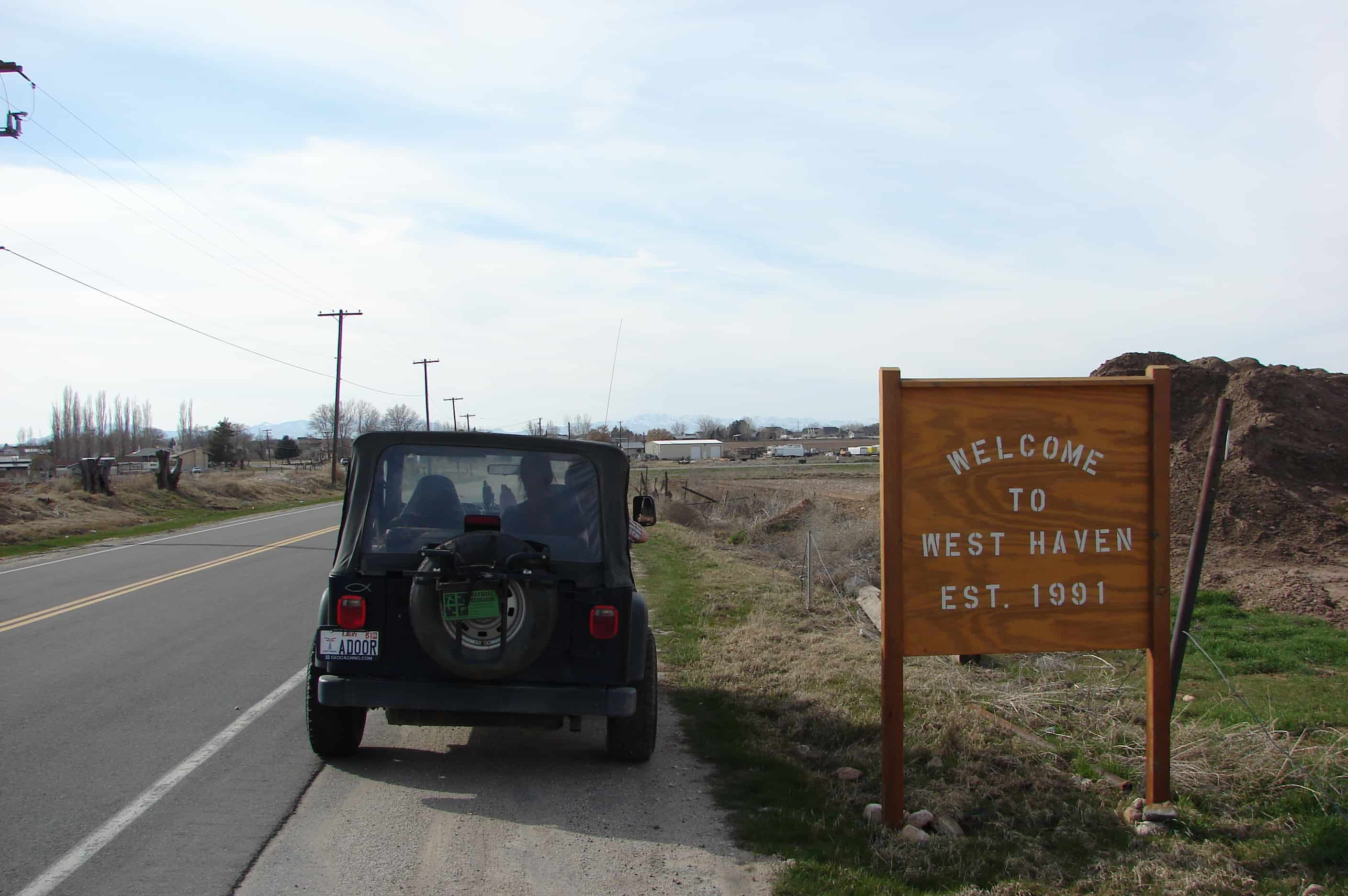
West Haven, Utah

05 Wednesday Nov 2014

Posted by Jacob Barlow in Uncategorized

≈ 3 Comments

Tags

Hooper, Ogden, utah, Weber County, West Haven

picture31march08-029

West Haven City (Weber) is located approximately thirty-five miles north of Salt Lake City, west of the Wasatch Mountains in Northern Utah. The confluence of the Weber and Ogden rivers is located inside the north-eastern corner of the city. The city is bordered on the east by Ogden, on the south by Roy and on the west by Hooper and on the north by Marriot – Slaterville.

On July 4th, 2003 the city marked the 10th annual West Haven Days celebration. The yearly event, held in the West Haven City Park and hosted by the mayor, city council and members of the city parks committee, begins at 7:00AM with a flag ceremony followed by a breakfast and an auction. Other activities throughout the day include: a variety of booths, food vendors, games, entertainment, a car show, a rodeo and fireworks.

West Haven boasts a City Park which includes an Historical Monument. Future plans provide for a River Parkway Trail that would include a fishing bridge, a pedestrian tunnel under 21st Street, picnic tables, places to rest and points of historical interest. Plans have this trail connect with the Weber County Centennial Trail.

Related Posts:

  • Green Brothers
  • Dallas Green Farm and Home
  • Kanesville School
  • Wallace and Eva Peterson Home
  • Secrist Acres
  • West Haven by address

Silver Row

05 Wednesday Nov 2014

Posted by Jacob Barlow in Uncategorized

≈ 4 Comments

Tags

historic, Historic Homes, NRHP, Provo, utah, utah county

Built in 1890, the Silver Row Apartments were very representative of the times in the state of Utah. Row houses, such as these, were prevalent in the larger cities of Utah and represent much of the lower-income residential architecture of the time period. Few of these examples remain today, making these apartments a valuable and significant asset to the state of Utah’s history. The Silver Row Apartments were designated to the Provo City Historic Landmarks Registry on April 26, 1996.

The original owner of Silver Row was David P. Felt. Felt was born in Salt Lake City in 1860. After marrying Nora Civish, Felt relocated to Provo, Utah. Silver Row was built by him about 1890, but after three years Felt sold the apartments to Samuel S. Jones and Henry J. Maiben. Maiben stayed in one of the units with his family until he died, and his family stayed until the early 1920s. Samuel Jones sold his interest in the property in 1902. In 1920 Joseph Nelson, an architect, bought the apartments and sold them six years later to George P. Parker, a wealthy judge residing in Provo. Parker retained the property until 1958, when Silver Row was purchased by Thomas O. And Judity W. Parker. B. Park Brockbank attained the apartments in 1973, after which Robert L. Gunther did in 1976. The title passed to Bob and Pop Investments, Inc. In 1977, after which it passed to John A. Riding in 1978.

2014-08-24 19.01.40
2014-08-24 19.01.42
2014-08-24 19.01.53
2014-08-24 19.01.57
2014-08-24 19.02.01

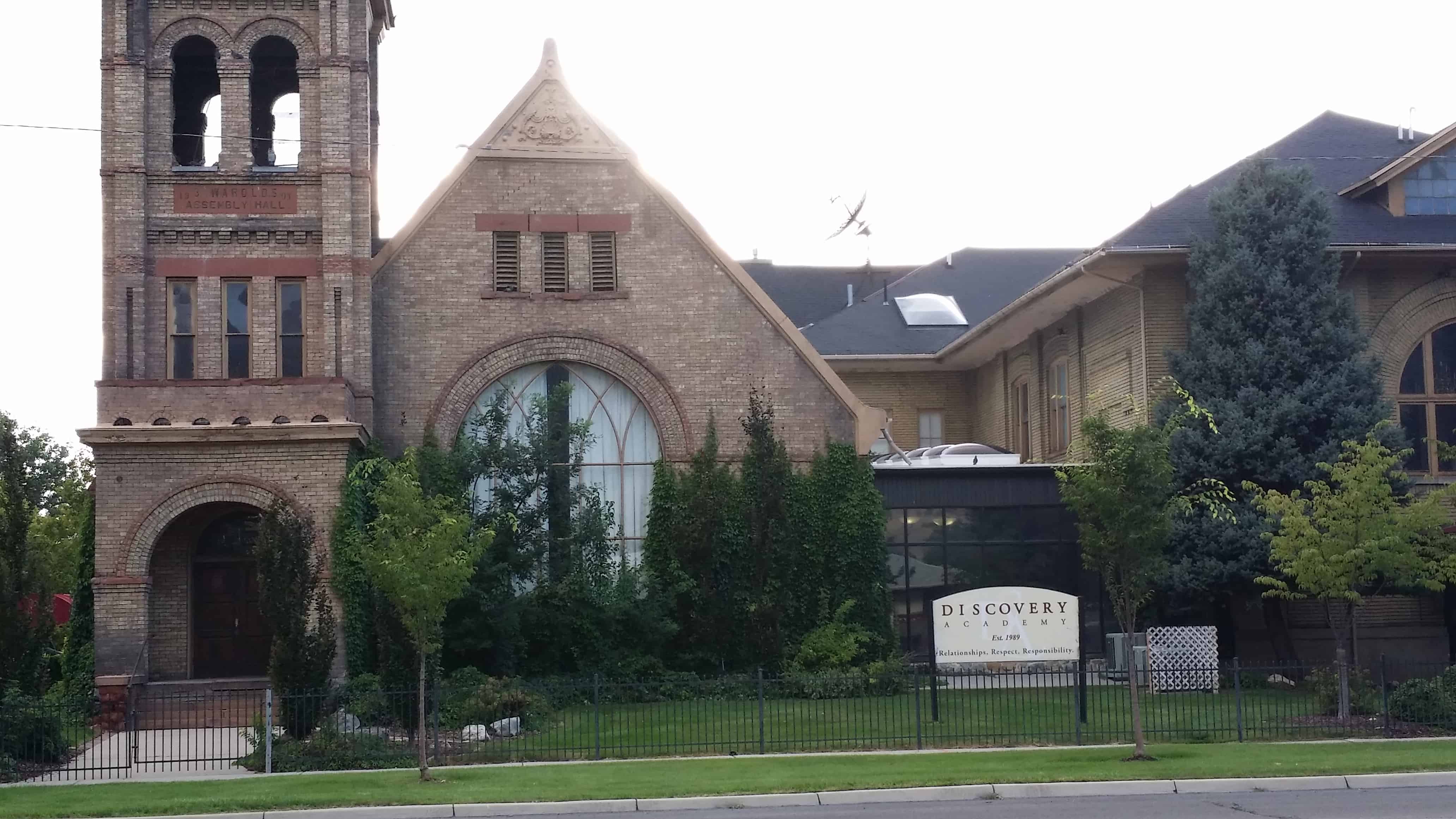
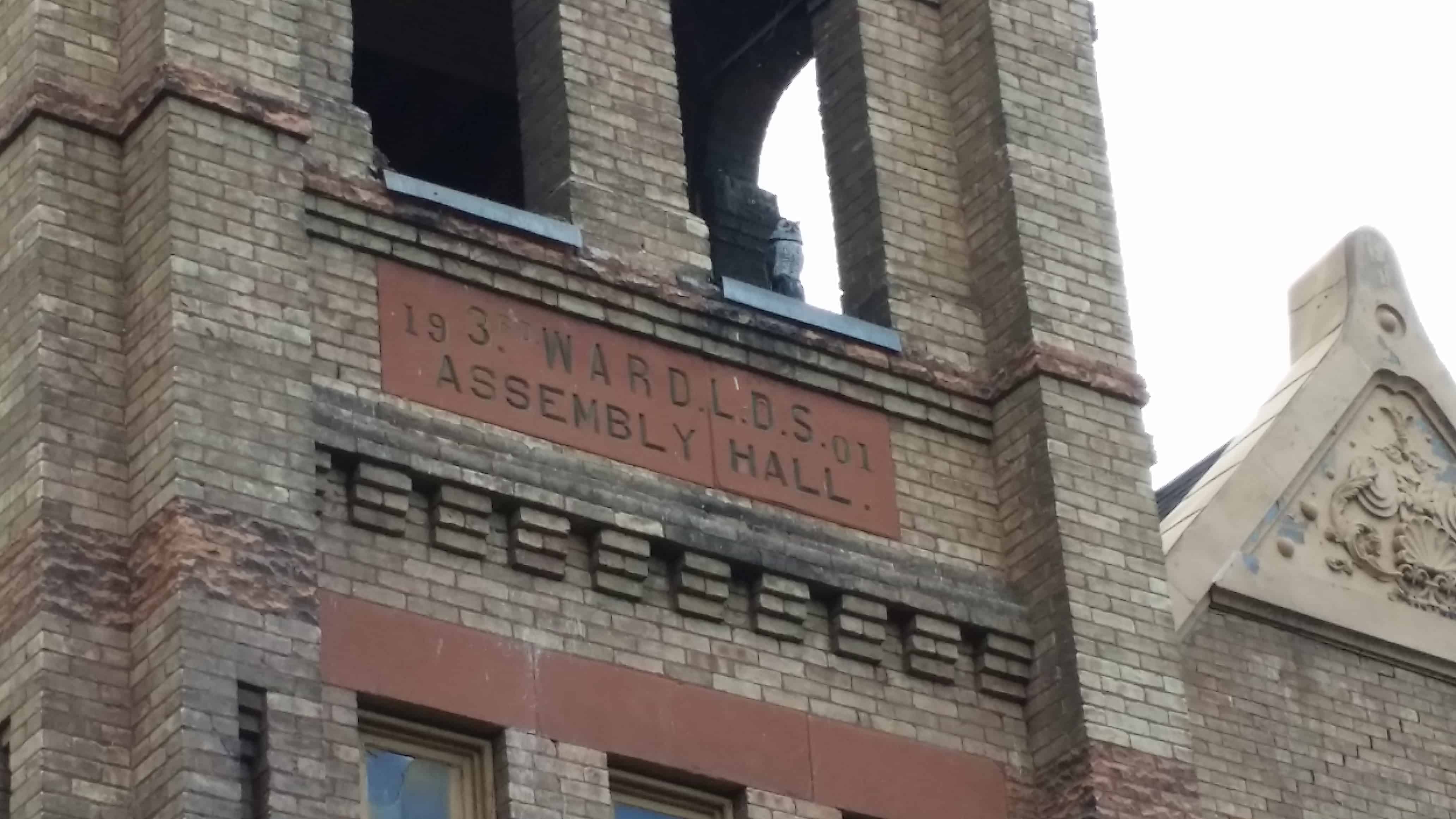
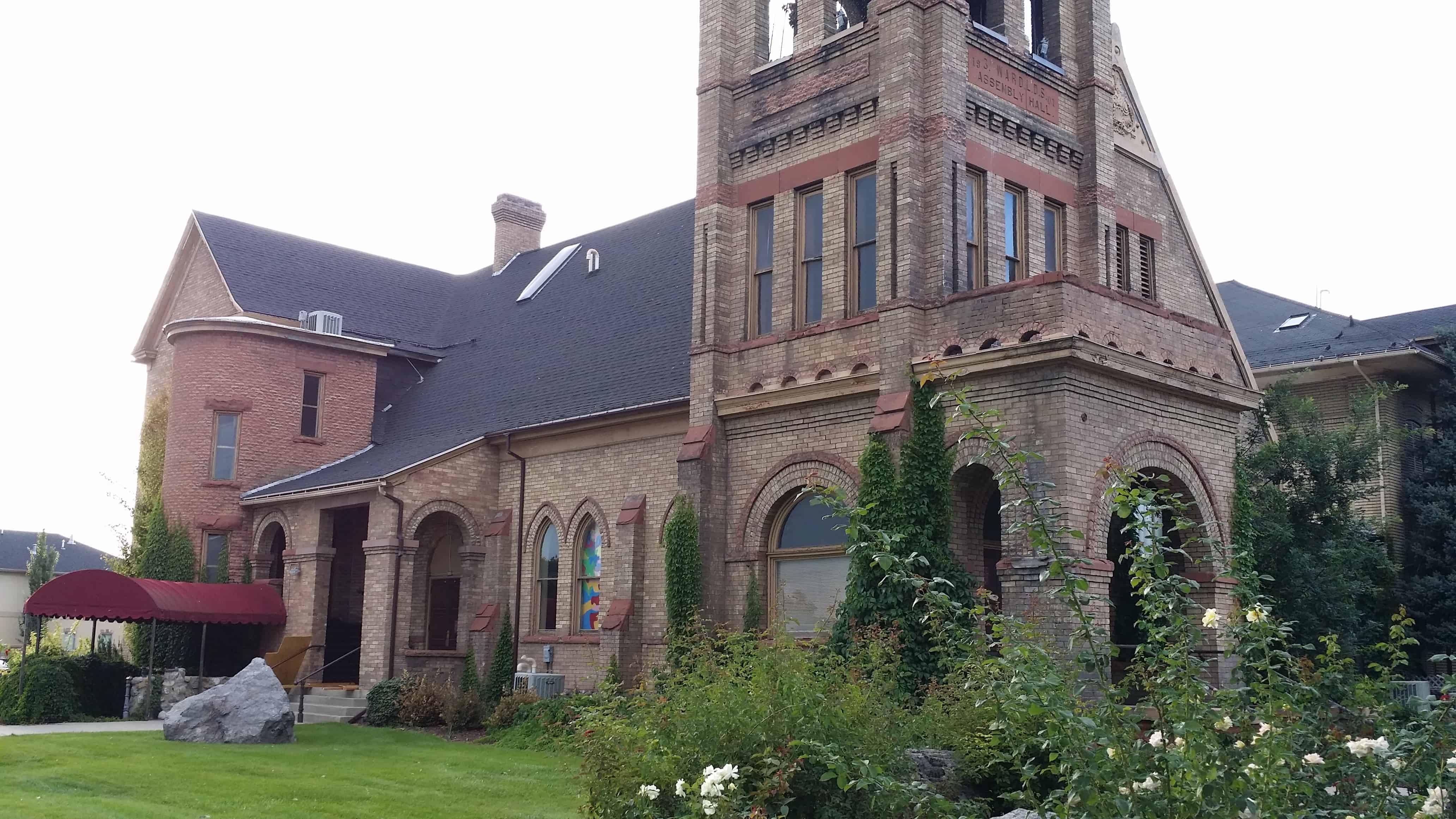
Provo Third Ward Chapel and Amusement Hall

03 Monday Nov 2014

Posted by Jacob Barlow in Uncategorized

≈ 4 Comments

Tags

Chapels, historic, Historic Buildings, NRHP, Provo, utah, utah county

The Provo Third Ward Chapel is a historic building located in Provo, Utah. It was listed on the National Register of Historic Places on April 2, 1979.

Under the direction of Bishop Thomas N. Taylor, the Provo 3rd Ward chapel was completed in 1903, exemplifying one of the first English Parish Gothic churches in Utah. The building was designed by architect Richard C. Watkins, native of Provo. The cornerstone was laid in a ceremony on April 25, 1901. An adjoining amusement hall was built in 1913, and the entire interior was redone in the late 1930s under the direction of architect Fred L. Markham.

In 1901 the recently formed Provo Third Ward of the Utah Stake was responsible for the construction of a new chapel. Using primarily local materials and locally employed workers, Bishop Thomas N. Taylor, also the mayor of Provo, and his building committee composed of Arthur Dixon, Edgar Perry, and H. J. Maiben, undertook the project. The cost of the new building was $11,000 and it was completed in 1903. The chapel received an organ that had been used in the Provo Tabernacle in 1907. The adjoining amusement hall was added in 1913, but only the top floow was finished at an additional cost of $15,000. In 1926 the lower floor of the amusement hall was completed for an additional $5,600. The Provo Third Ward Chapel and Amusement Hall served not only as a chapel for worship, but also provided the Saints with a place to interact socially in forms of dance, musicals, sports, etc. During World War II the amusement hall was transformed to serve as army barracks for Army Specialized Training Units associated with Brigham Young University.

Related Posts:

  • Utah Social Halls, Opera Houses, and Amusement Halls
  • 2014-08-24 18.53.01
  • 2014-08-24 18.53.08
  • 2014-08-24 18.55.11
  • 2014-08-24 18.55.19
  • 2014-08-24 18.55.47

Provo West Co-op

02 Sunday Nov 2014

Posted by Jacob Barlow in Uncategorized

≈ 2 Comments

Tags

Co-op, historic, NRHP, Provo, utah, utah county

Constructed c.1866 and remodeled c.1890, this building is historically significant as one of the oldest extant examples of stores that were developed in the cooperative merchandising movement sponsored by The Church of Jesus Christ of Latter-day Saints during the late 1800s.  The cooperative system was devised by LDS church leaders in order to encourage trading among church members and to combat the increasing outflow of financial resources to non-Mormon businesses.  In 1869, this cooperative movement had its start in Provo with the formation of the Provo Cooperative Institution, which was later known as the East Co-op.   The West Co-op was established later that same year in this building, which had been purchased from A.J. Stewart, a Provo merchant, who had built it about three years earlier.

466 West Center Street in Provo, Utah

2014-08-24 18.45.47
2014-08-24 18.45.51
2014-08-24 18.46.04
2014-08-24 18.49.03
2014-08-24 18.49.12
  • (from county records)
  • (from county records)
  • (from county records)

R. Spencer and Kitty Hines Mansion

01 Saturday Nov 2014

Posted by Jacob Barlow in Uncategorized

≈ 1 Comment

Tags

historic, Historic Homes, NRHP, Provo, utah, utah county

R. Spencer and Kitty Hines Mansion

This Victorian Eclectic Style house was constructed in 1895 for Russell Spencer and Kitty Leetham Hines.  R. Spencer Hines was involved in mining, real-estate, and other business ventures including the operation of a drug store/saloon.  After his death in 1898, Kitty Hines continued to live in the house until 1903 when it was rented to several individuals including Bert and Sarah Bowen who purchased  the house in 1922.  Their daughter, Maude, inherited the house and lived in it with her husband, Benjamin Frank Roper, for 34 years.

The Hines Mansion is located at 383 West 100 South in Provo, Utah and was added to the National Register of Historic Places (#78002702) on July 12, 1978.

The R. Spencer and Kitty Hines Mansion is one of the homes built for Prove’s first generation gentry. It was built in 1895 for R. Spencer Hines (1848-1898) and his wife Kitty (1858-1937) with money acquired from mining, business and real-estate ventures. It was built as a showplace during the recovery from a major boom and bust period in Provo’s economic history. It expressed Hine’s economic security and served as the base from which Kitty sallied forth as business woman and society grand dame.

Kitty Ann Leetham Hines was the daughter of Ann and John Leetham who had settled in Provo in 1852. Pioneering involved farming, building and fighting Indians Leetham is listed as a “Provo Indian War Veteran.” In 1872, Leetham became involved in the mining ventures in Utah Valley, opening a smelter near Goshen, which proved unsuccessful. He formed a business relationship with Russell Spencer Hines who married Leetham’s daughter, (1875), moved to Provo and established himself as a businessman.

One of the businesses which Hines operated was a drug store – saloon. Under Provo ordinances, liquor could be sold for medicinal purposes only at drugstores. Twice during the 1880’s Hine’s was brought before city court for selling more liquor than drugs. Hole’s Palace Drug Store at 104 West Center was managed by Charles A. Hedquist who later married Hine’s daughter, Ann, and took over the business – establishing with his brother, Alex, a drugstore chain.

After Hine’s death in 18,98, Kitty was left to manage an -estate valued at $28,000. She became involved in several ventures – the Hines-Kiinber Grocery and Heat Company, the Lead-Bullion Mining and Milling Company, the Lost Josephene Gold Mining Company, the State Bank of Provo and the Provo Mining Company (Kitty was vice-president of this company organized by her brothers in 1901. It controlled the old Leetham mines in Tintic. The company was sold for $20,000 to the U.S. Smelting and Refining Co. in 1914.)

Some have said that Kitty went through the estate with indecent haste. The plat records do indicate financial difficulties involving Sheriff’s deeds, mortgages and tax sales. In 1906 Kitty moved out of her home and eventually to California. She rented her home to several persons. Bert and Sarah Bowen were among them. In 1922 they bought the home after it had been fired by an arsonist.

Bert Bowen was a saloon keeper and miner. His daughter Maude, an elementary school teacher, married Benjamin Frank Roper, a miner turned deputy sheriff. The Ropers inherited the home and lived in it for 34 years, so that it became called the “Roper Place”.

The Hines home is an expression of local pride and prestige – built by a mysterious, some would say scandalous “gentile” (a Masonic symbol marks Hine’s gravestone) for the daughter of one of Provo’s finest families.

Built with funds gardered from that era’s money-making schemes – mining, real estate, saloon keeping – built by local craftsmen using local materials, the home was recognized in its day by the community and in publications as one of Provo’s finest.

Lakeview, Utah

20 Monday Oct 2014

Posted by Jacob Barlow in Uncategorized

≈ 2 Comments

Tags

Geneva, Lakeview, Orem, Provo, utah, utah county

  • 1

What used to be called Lakeview is now just know as part of Orem, is a nice area near Utah Lake.

Related Posts:

  • Lakeview Tithing Office

Riverton, Utah

17 Friday Oct 2014

Posted by Jacob Barlow in Uncategorized

≈ 19 Comments

Tags

Riverton, Salt Lake County, utah

picture6aug07-035

Riverton Posts:

  • Dome Church Foundation Stones
  • Beckstead-Butterfield House
  • Early Riverton and the Magnificent Dome Church
  • Riverton Tithing Yard Hill and The Tithing Yard
  • Parks in Riverton
  • Riverton Cemetery
  • Riverton Elementary School / Riverton City Hall
  • Riverton Posts sorted by address

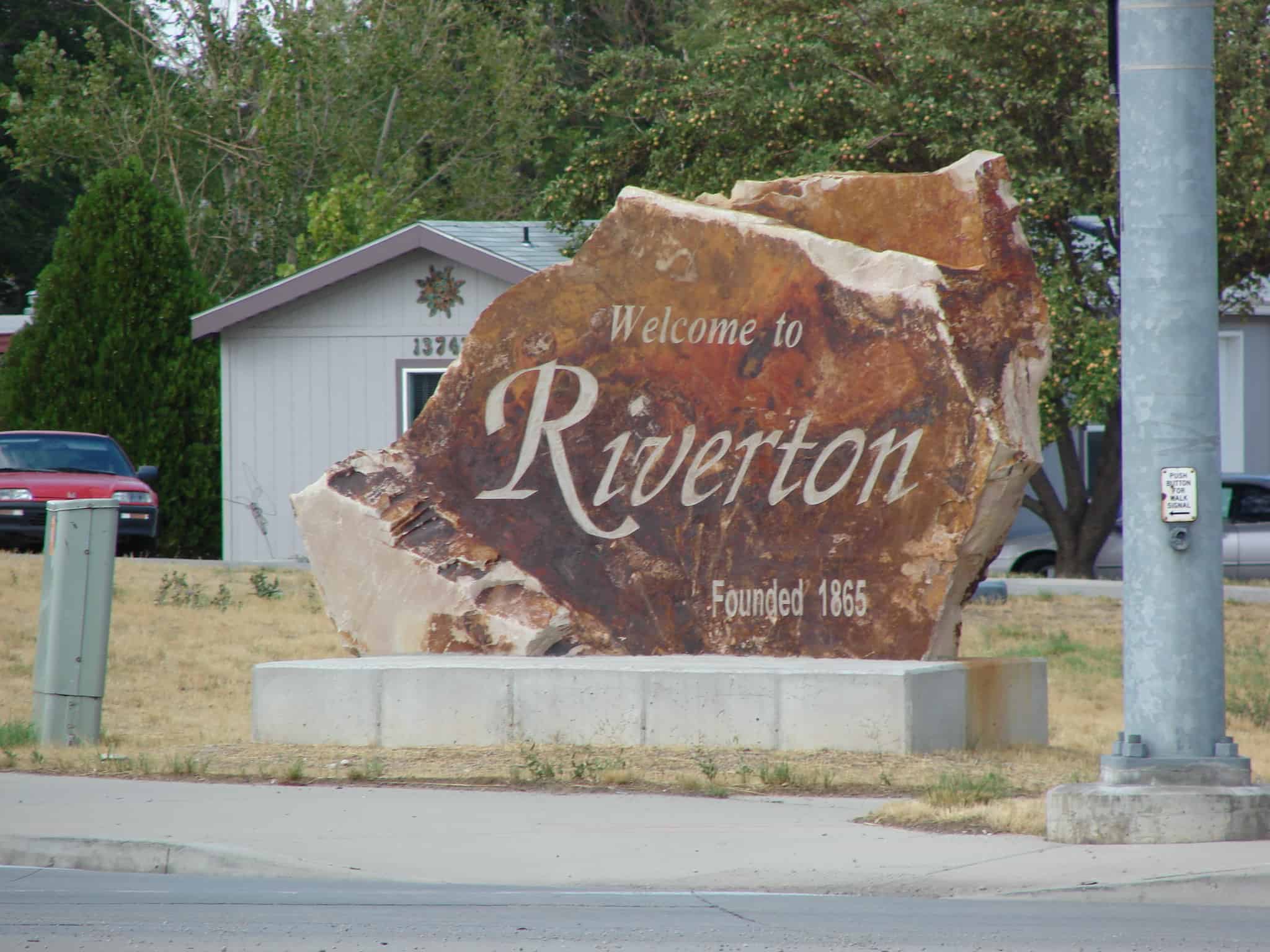
Situated near the southern end of the Salt Lake Valley, Riverton is located on a low plateau west of the Jordan River approximately twenty miles south of Salt Lake City. For most of its history Riverton was an agricultural community, but widespread residential development that began in the late 1960s has largely transformed it into a bedroom community.

The earliest area settlers lived in scattered dugouts and primitive log houses bordering the river on the bottomlands. Archibald Gardner was the first person to live in Riverton, and early settlers paid tribute to his pioneering efforts in the mid-1850s by calling the area Gardnersville. The size of the settlement long remained small because water was available for the bottomlands only near the river. Begun in 1870 as a local cooperative undertaking, the South Jordan Canal, when completed in 1876, opened up the benchland to farming and settlement. The community expanded again when the larger Utah and Salt Lake Canal, financed wholly by Salt Lake County, was finished in 1881. Construction of these canals, which are still in use, was undertaken with only basic tools and contracted manual labor.

Riverton came under the jurisdiction of the West Jordan Precinct in its early years. In 1867 the settlement politically became part of the South Jordan Precinct. A judicial precinct was established locally in 1879, and the name of the small settlement, boasting little more than a hundred people, was officially changed from Gardnersville to Riverton.

Riverton’s residents reflected the predominant religious affiliation characteristic of most rural Utah towns. Much of the cultural, educational, and community life revolved around activities sponsored by the local wards of the Mormon Church. In the early years, Mormons met in the dugouts and log homes of members, often in the home of Nicholas Thomas Silcock, the community’s first branch president (called in 1870). Many of the activities and traditions in the community were initiated in a church setting during years when it was principally an agricultural community. As in other predominantly Mormon Utah communities, there was an overlapping and mixing of ecclesiastical and civic roles and actions. In 1886, with 233 members in thirty-five families, Riverton was organized as a ward with Orrin Porter Miller as its first bishop. Members met in a combination meetinghouse/schoolhouse which had been built in 1879. By 1900 there were 517 members (ninety-two families) and construction was begun on a new meetinghouse. Completed in 1908, this domed structure in the Romanesque style was designed by Richard Kletting and was generally recognized as one of the finest LDS meetinghouses in a rural setting. It was demolished in 1940.

Public schools in the community had their beginnings in private homes and in a one-room schoolhouse which was built in 1879. A two-story brick school was built in 1892 on Redwood Road; it served students through the eighth grade. In the mid-1920s a new elementary school and junior high school were constructed on this site. As population increased in the 1970s and 1980s, the Jordan School District constructed additional elementary schools and a middle school within the boundaries of the community.

In the decade of the 1890s, farming in Riverton underwent a transformation, shifting from simple farms supplying family needs to commercial farming. This paralleled a similar development in Utah agriculture. Although the farmer normally still owned his land, he specialized in what he grew or raised and used his cash profits to buy most of the things he needed. The local agricultural economy was severely tested during two extended periods of drought–one at the turn of the century and another in the early 1930s. Crops that were grown by commercial farmers in Riverton included alfalfa, sugar beets, tomatoes, and wheat. The livestock industry in Riverton was represented by sheep, dairy cows, and poultry. Commercial production and marketing of these agricultural and livestock products was accomplished through the establishment of various businesses, including an alfalfa feed mill, a canning factory, an egg-processing plant, and a dairy cooperative.

A central business district developed which was centered at the intersection of Redwood Road and “Herriman Road” (12,600 South). On the northeast corner of this intersection, a two-story commercial building was constructed by sheepman/developer Daniel Densley in 1893. Several businesses were accommodated on the first level of this building and the upper floor was used for dances, plays, and large community gatherings. Another sizable business was a retail store built by Thomas P. Page about the turn of the century. It was regarded for many years as the largest concern of its kind in the county outside Salt Lake City. The Page-Pixton (later Page-Hansen) store sold everything from building materials, coal, and dry goods to groceries, grain, and housewares. The Jordan Valley Bank was started in 1905 as a community bank. This bank was a casualty of the Great Depression, and many people suffered financially when it closed its doors. For a time, the town also housed many automobile dealerships.

Although the move was controversial, in 1946 Riverton incorporated, operating under a town board form of government. The most pressing problems which city officials have dealt with in the latter part of the twentieth century have been those associated with the rapid increase in the city’s population. To illustrate, in 1970 the city had a population of 2,820, a figure which expanded to 11,700 in 1992. This has made a tremendous difference in land use as farmland has been converted to residential use. This change is great in view of the fact that approximately 94 percent of Riverton’s land was agricultural in 1960. Riverton has increasingly become a popular country-style suburb, an inevitable development as a consequence of the Salt Lake Valley’s expanding population.

The First Oregon Trail

17 Friday Oct 2014

Posted by Jacob Barlow in Uncategorized

≈ Leave a comment

Tags

Bear Lake, Cache County, historic, Logan, Oregon Trail, utah

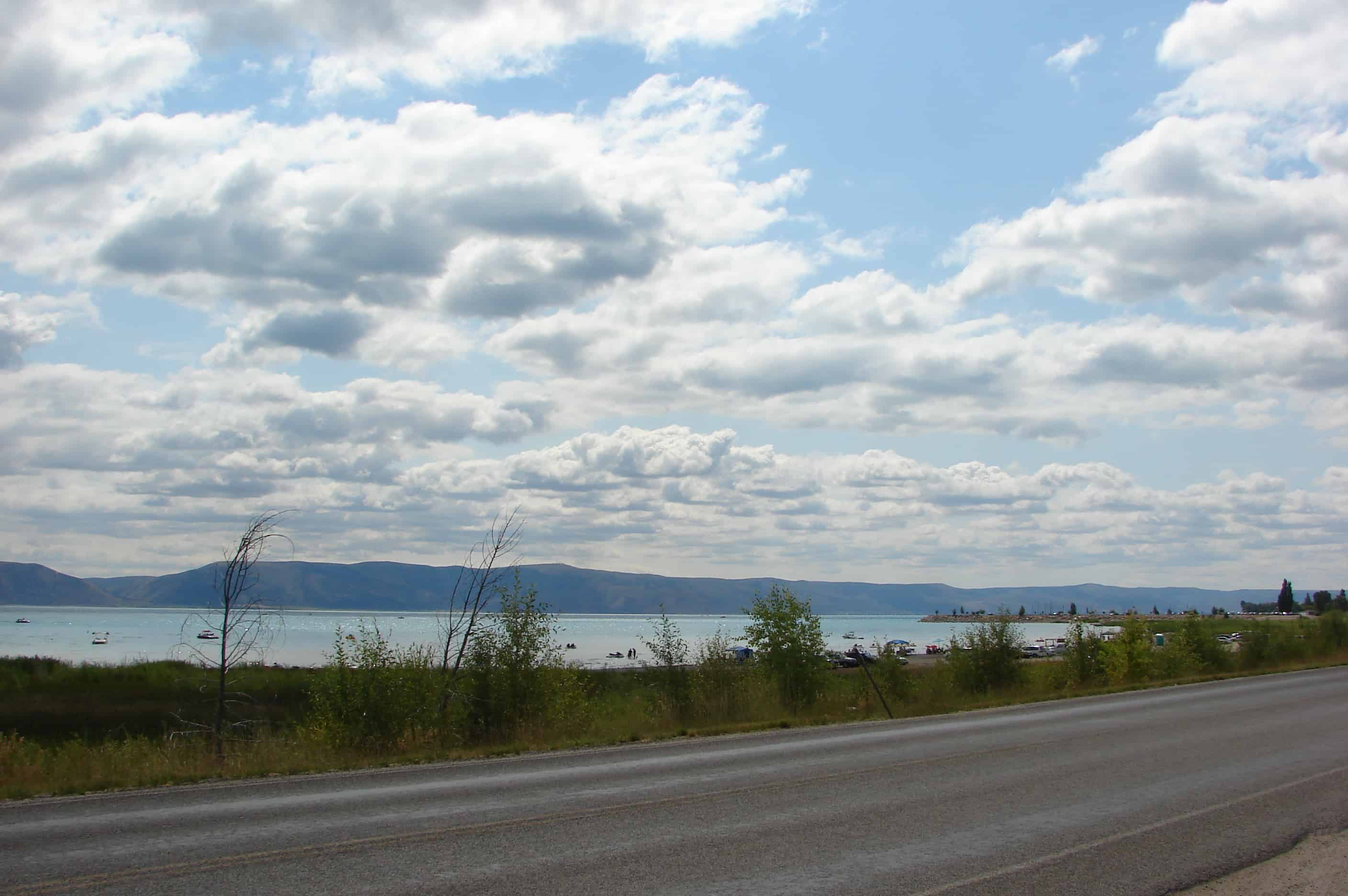
picture16aug08-017

The first covered wagons came into the Rocky Mts. in 1830, they made their way as far west as Fort Washakie in Wyoming. Efforts were made to find passable wagon trails through the Mountains to the Pacific Coast, which goal was finally reached. At that time, the entire northwest Mt. area was known as Oregon Country & western travel was either to the “Oregon” or the “California” regions. While early maps give the probable location of the first Oregon Trail north of here, well marked wagon ruts & stories of Indians & Settlers indicate that the first wagon migration to “Oregon” followed the Southwesterly shores of Bear Lake. Leaving this valley through a canyon to the Northwest, then to the upper reaches of the Bear River. Additional color is given this belief because this was the site of an important trappers’ rendezvous as early as 1827, & well marked trails were followed for many years in & out of this valley.

picture16aug08-018

Joseph Olpin House

17 Friday Oct 2014

Posted by Jacob Barlow in Uncategorized

≈ Leave a comment

Tags

historic, Historic Homes, NRHP, Pleasant Grove, Soft-rock constructed, utah, utah county

2014-08-22 18.27.40

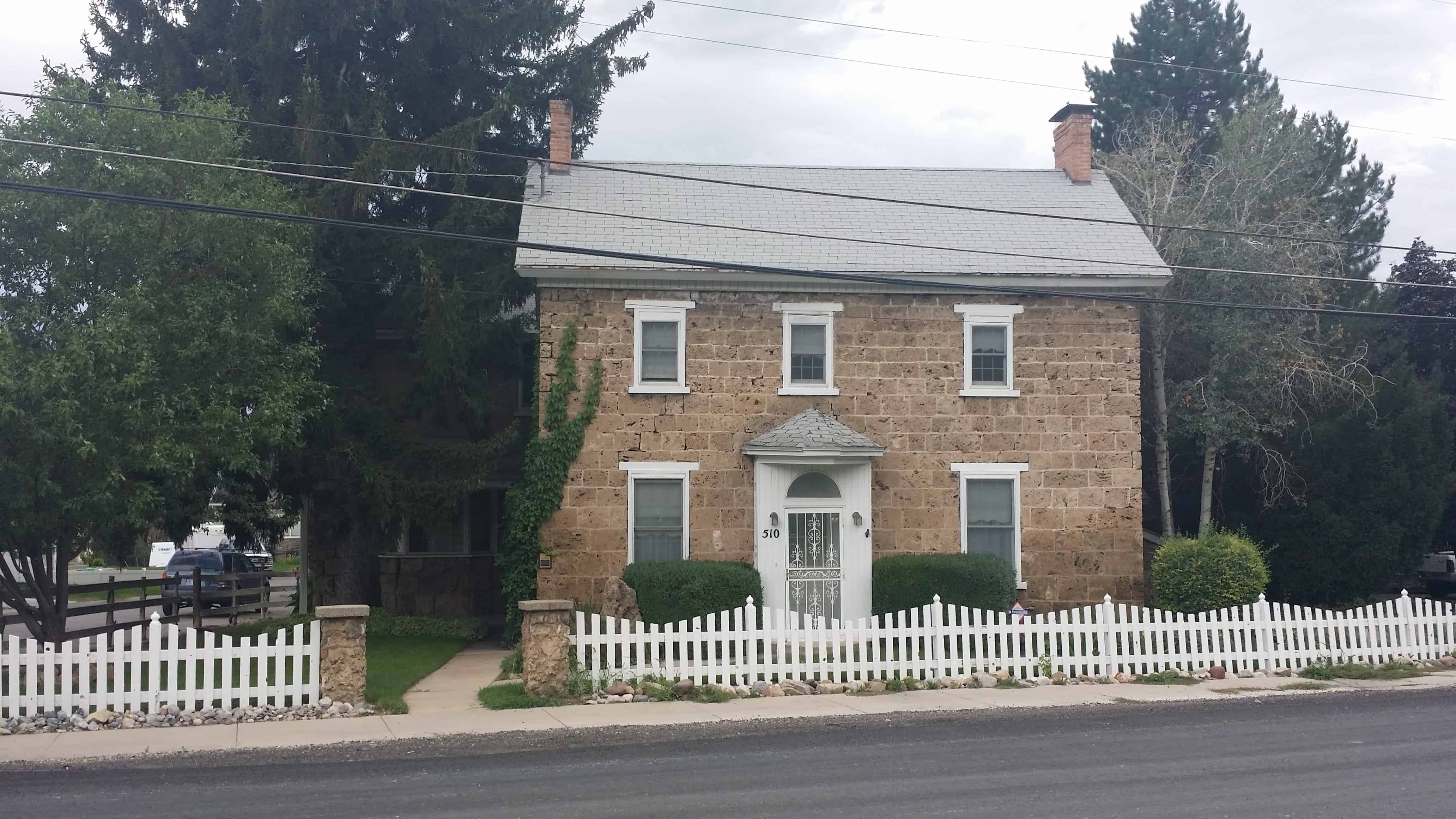
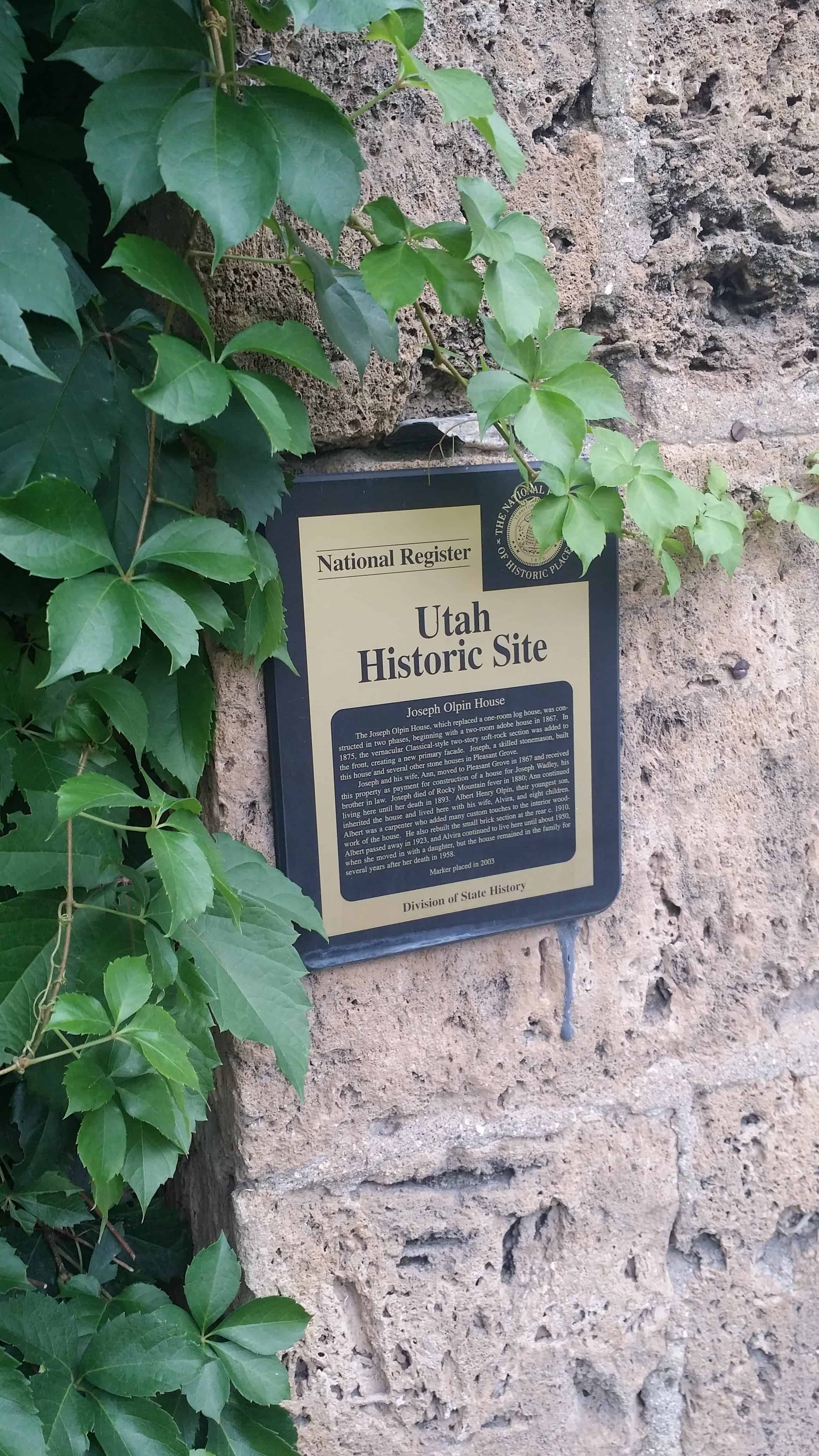
The Joseph Olpin House, which replaced a one-room log house, was constructed in two phases, beginning with a two-room adobe house in 1867. In 1875, the vernacular Classical-style two-story soft-rock section was added to the front, creating a new primary façade.  Joseph, a skilled stonemason, built this house and several other stone houses in Pleasant Grove.

Joseph and his wife, Ann, moved to Pleasant Grove in 1867 and received this property as payment for construction of a house for Joseph Wadley, his brother in law.   Joseph died of Rocky Mountain fever in 1880; Ann continued living here until her death in 1893.  Albert Henry Olpin, their youngest son, inherited the house and lived here with his wife, Alvira, and eight children.  Albert was a carpenter who added many custom touches to the interior wood-work of the house.  He also rebuilt the small brick section at the rear c. 1910.  Albert passed away in 1923, and Alvira continued to live here until 1950, when she moved in with a daughter, but the house remained in the family for several years after her death in 1958.

Located at 510 Locust Avenue in Pleasant Grove, Utah and added to the National Register of Historic Places (#77001320) on November 7, 1977.

Related:

  • Utah’s oldest homes
2014-08-22 18.28.09

The Joseph Olpin House, built ca. 1875 by the owner, a stone mason, is one of the early pioneer homes of Pleasant Grove. It is a fine example of Utah vernacular architecture and has historic associations with the Mormon religion and the development of education in the State.

Joseph Olpin was born in Gloucester, England, in 1839. His father joined the Mormon Church in that country, and Joseph was baptized by him in 1845. Joseph Olpin came to Utah in 1856 at the age of 17.

Olpin lived in Salt Lake City, until 1863, when he moved to Rockport. He remained there until moving to Pleasant Grove in 1867 at the suggestion of Joseph Wadley, his brother-in-law. Olpin received the land on which the house stands from Wadley as payment for construction of a house for him. Olpin originally built a one-room log house on the site, later replaced by a two-room adobe. Olpin’s skill as a stone mason was widely sought by residents of Pleasant Grove, and he built many of the stone houses still standing in the area.

Olpin built the two-story soft stone house in 1874 or 1875. He died January 17, 1880, in Pleasant Grove. The house passed to Albert Henry Olpin, the youngest of his four sons. Albert Olpin was a carpenter by trade and was responsible for much of the woodwork in the house, including the curving wooden staircase in the central hall. He also built the brick addition at the rear ca. 1908-1910.

While on a church mission to South Carolina in 1901-1903, Albert Olpin was severely beaten by a mob. This incident is symbolic of the anti-Mormon tensions which continued into the 20th Century.

Dr. A. Ray Olpin, past president of the University of Utah, is the oldest son of Albert and Alvira Olpin. He was born in the house in 1898. Dr. Olpin headed the University from 1946 to 1964. During these years the institution experienced tremendous growth, enrollment increasing from c. 7,000 to c. 18,000 over the period.

The house remained in the Olpin family until 1943, when the President’s mother sold it. The home is currently the private residence of Mr. and Mrs. Edward Platt who wish to complete its restoration.

The Joseph Olpin Home is a two-story rectangular building of stone with a one-and-a-half story rear addition of brick. The front and sides are coursed ashlar, while the foundation and back are of nibble construction. The front is symmetrical, three bays wide, with wooden lintels above six-over-six windows. Two single stack, banded brick chimneys, recessed slightly from each gable end, straddle the ridge.

At the rear of the original stone building is a one-and-a-half story brick broken salt-box addition, with a hipped roof porch. The addition is of stretcher bond. The rear door and window bays of the ground floor of the addition have segmented arches. The rear bays have corbeled voussoirs. The two smaller windows of the upper story of the addition have plain wooden lintels which break into the frieze. Both the addition and original building have a plain boxed cornice with simple mouldings and a plain frieze. The addition has two single stack brick chimneys, one at the peak of the ridge, recessed from the gable end, and the other on the shallow slope of the roof.

Both the original structure and the addition are of vernacular styling. The condition of the building is good and the integrity is excellent. The plan consists of two rooms flanking a central hall on the first floor of the main building. The addition houses a kitchen and pantry area. The original curving wooden staircase still stands in the hall. The upper floor served as bedroom space.

← Older posts
Newer posts →

Follow Jacob

Follow Jacob

Come wander with me on Youtube.

Blog Stats

  • 2,100,524 hits

Social and Other Links

BarlowLinks.com

Recent Posts

  • Scout Monument
  • Provo High School Seminary Building
  • 821 E 100 S
  • 820 E 100 S
  • 817-819 E 100 S

Archives

Loading Comments...