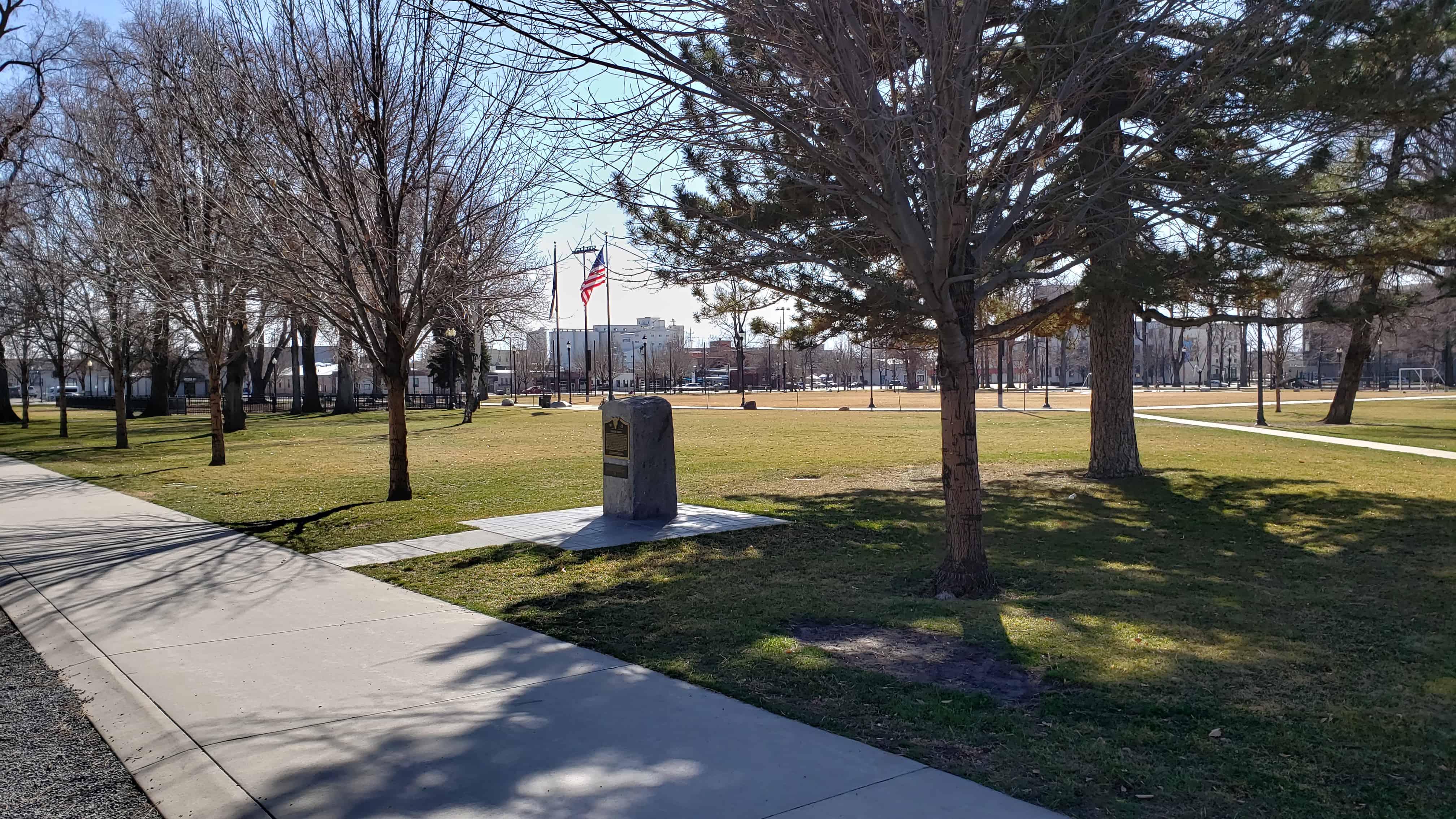
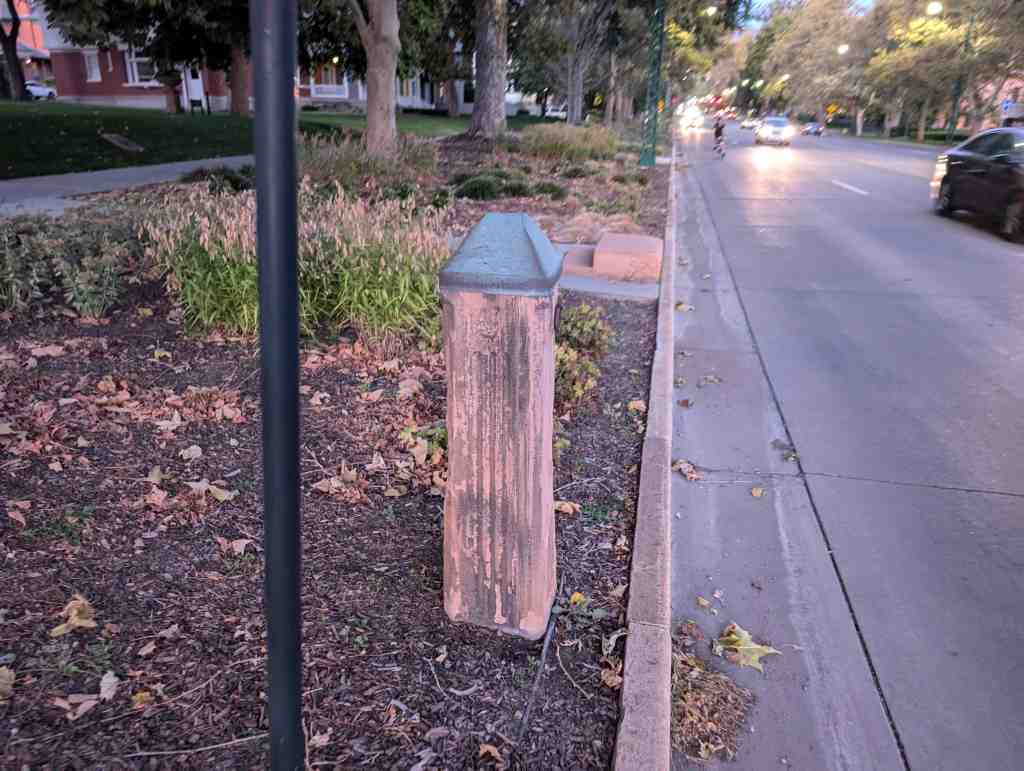
In 2020 the monument was moved from the center of the park to the northeast corner and a new plaque was added to it.
The plaque reads:
Pioneer Sqaure
This monument marks the site of the “old fort” in which the Mormon pioneers wintered in 1847-48 and in which some of the settlers resided for several years. Brigham Young laid the foundation stones on August 10, 1847, for 4 of the 17 houses erected of logs and sun-dried mud blocks. On August 11, 1847, the first adobe in the 9-foot wall was laid. The houses formed part of the wall that enclosed this 10 acre block, as protection against Indians. The fort was completed in November, 1847. On July 24, 1898, Pioneer Square was dedicated as a public park. The improved park was opened July 24, 1903.
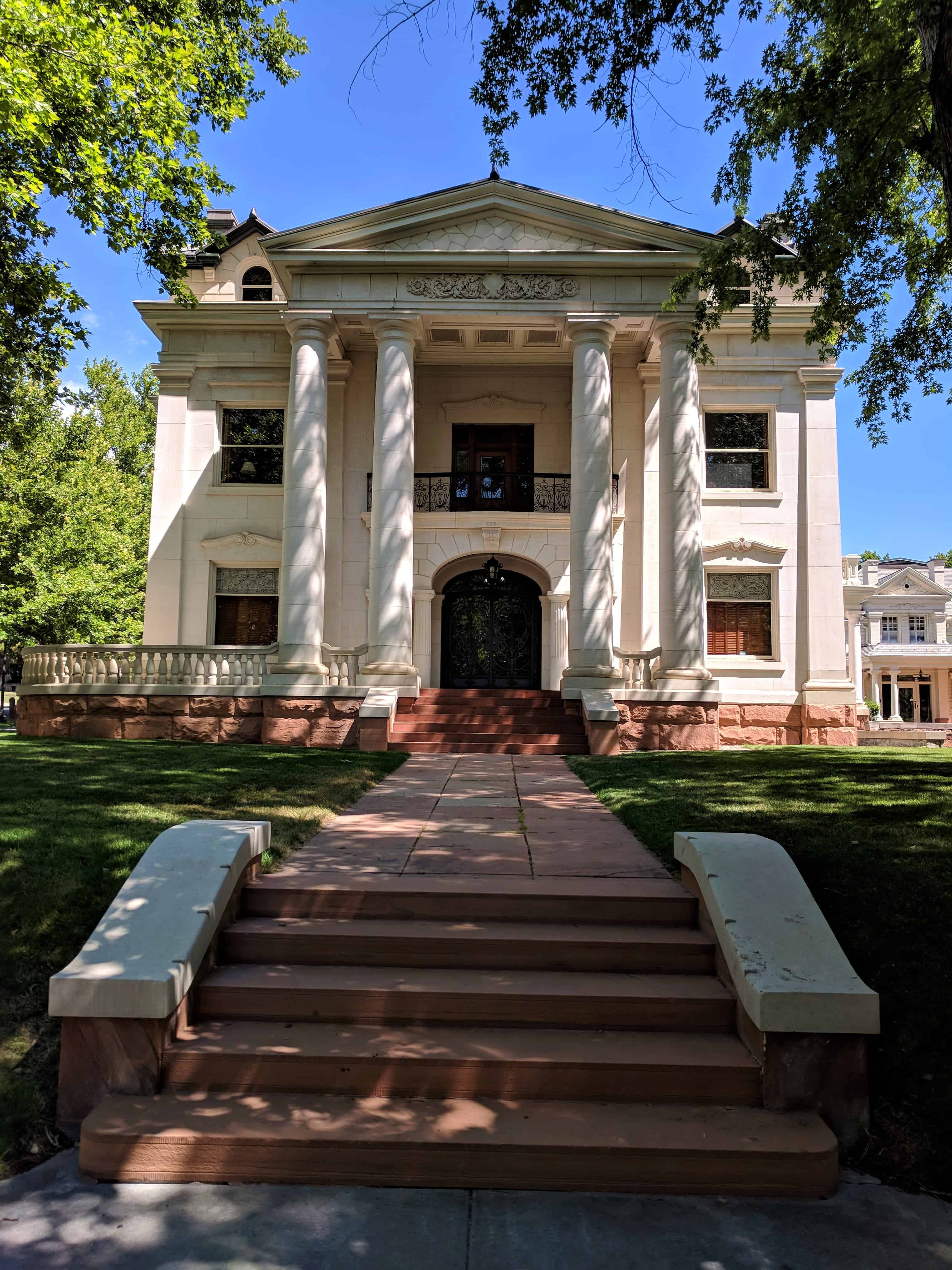
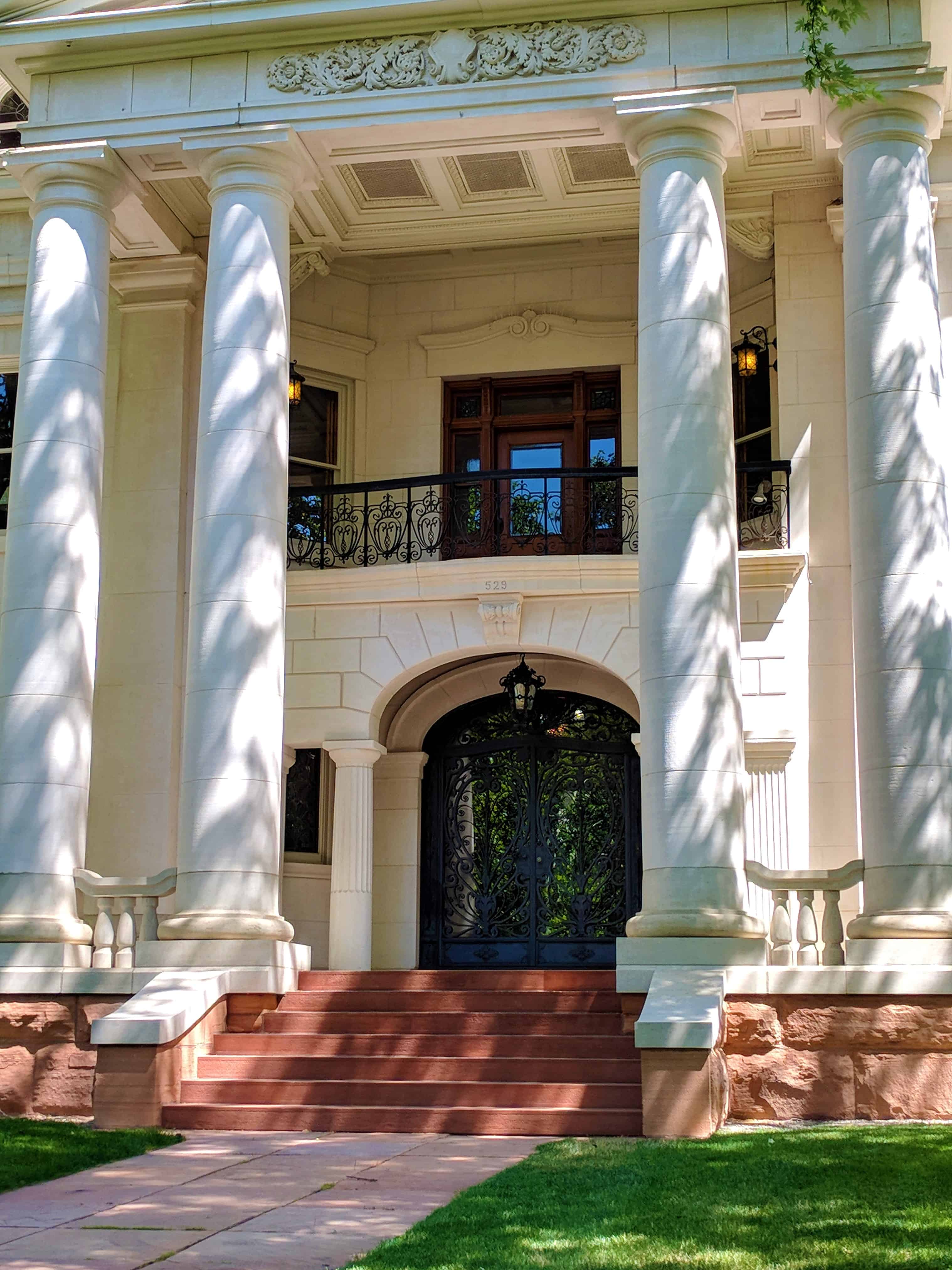
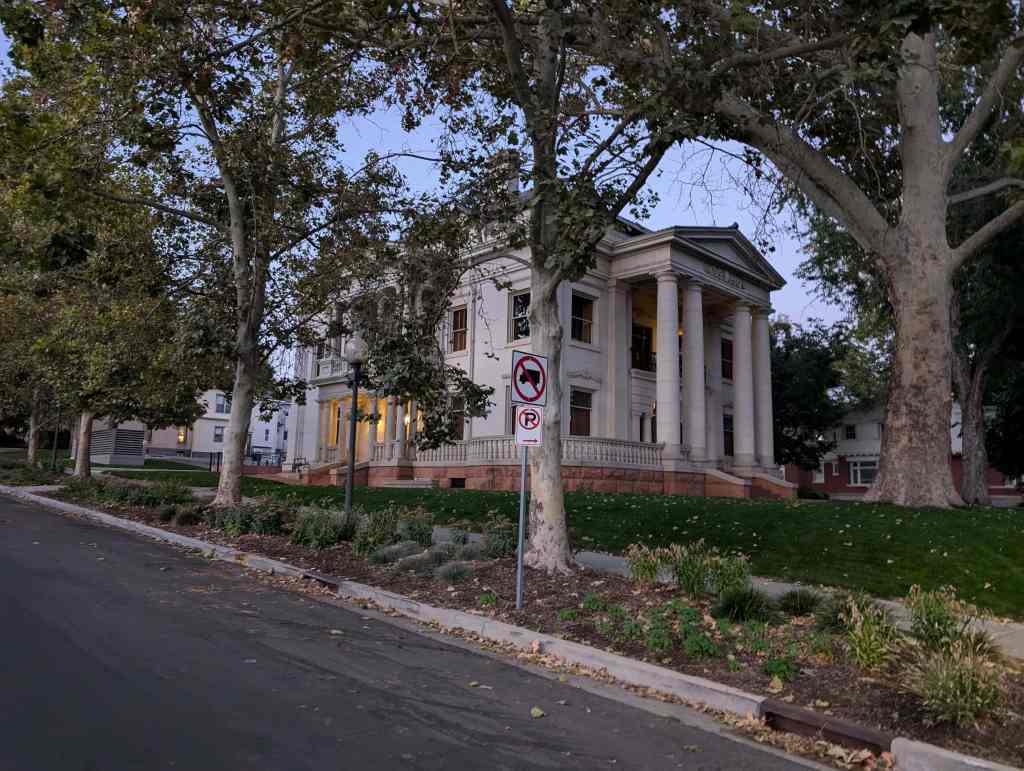
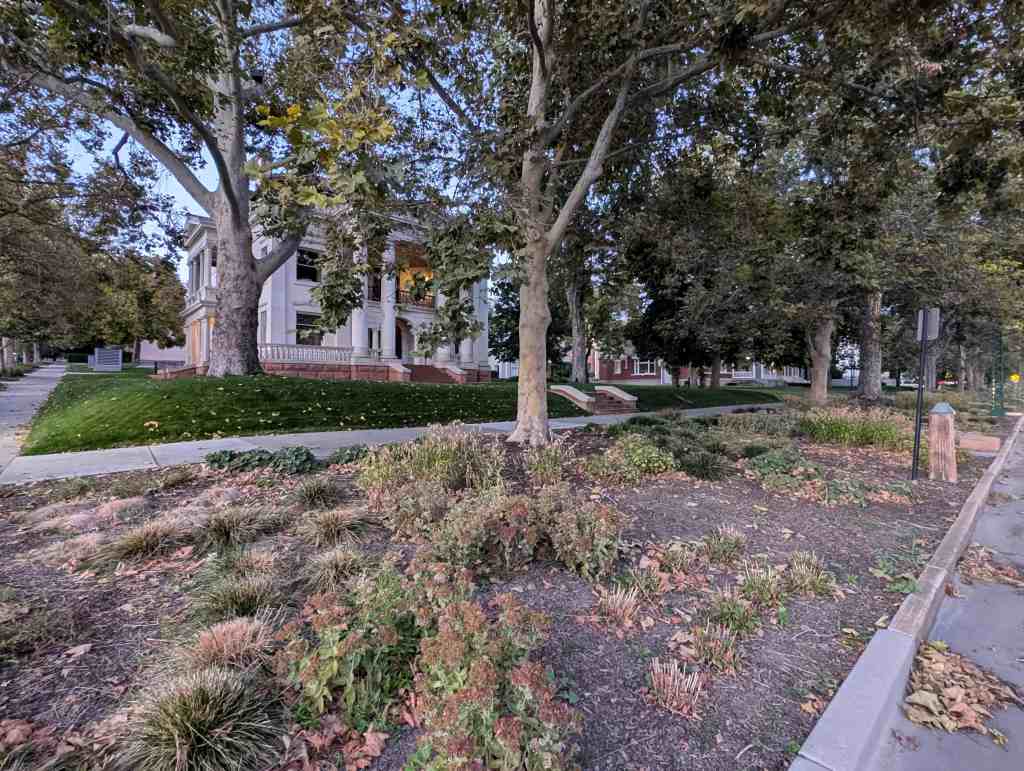
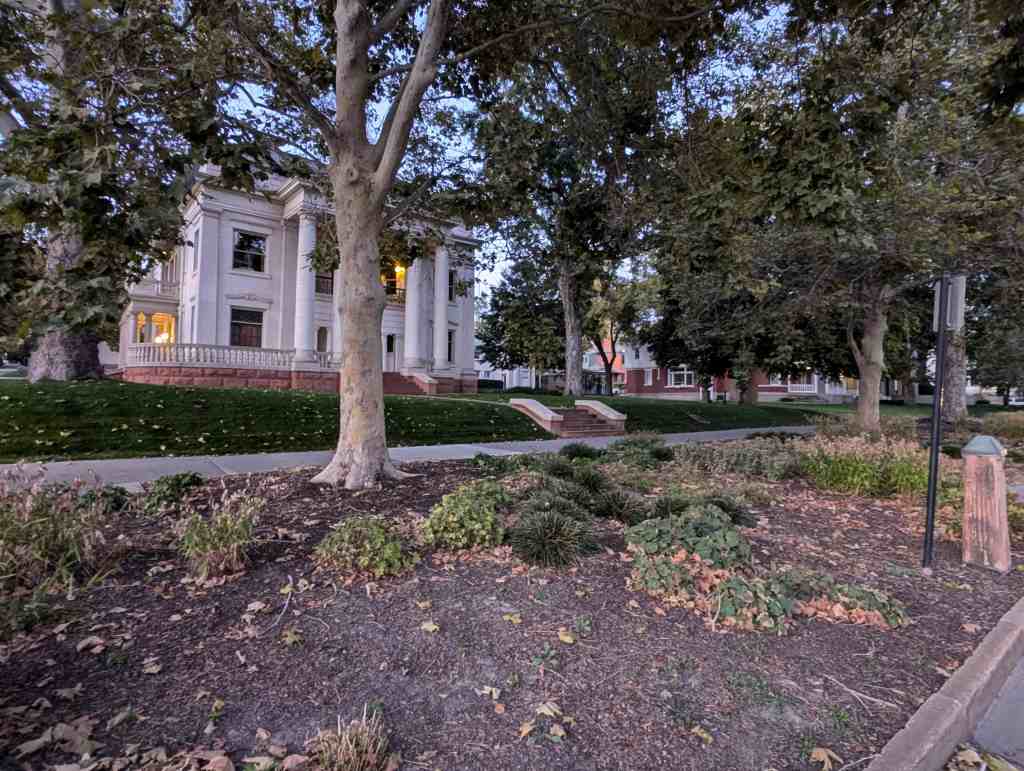
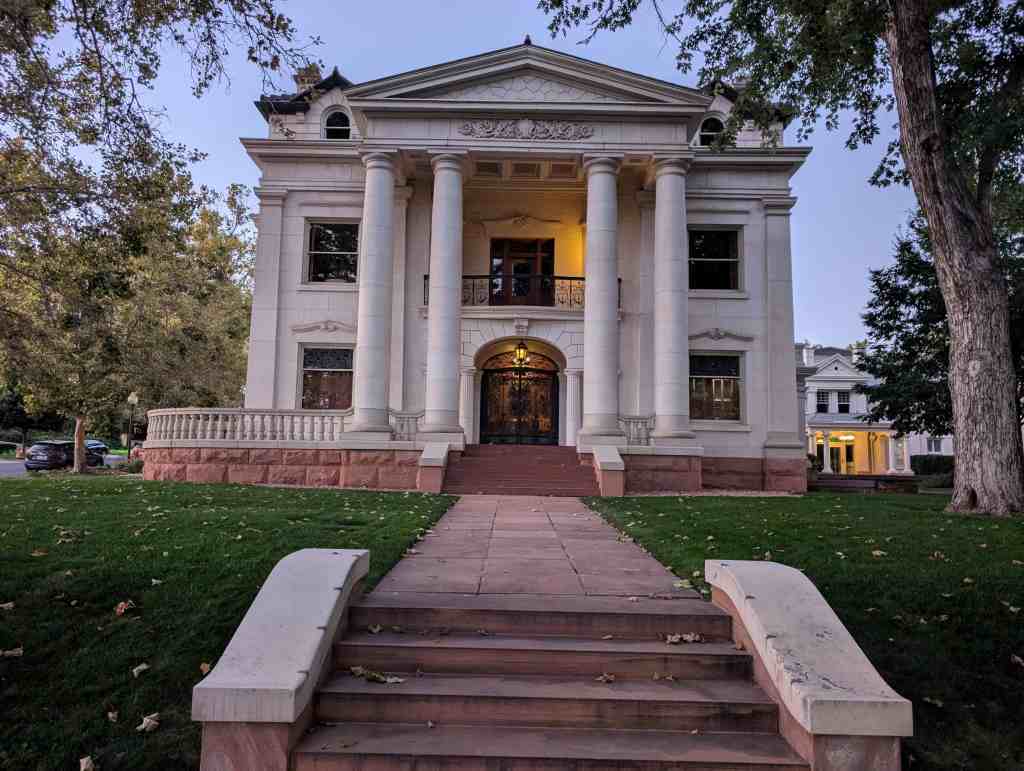
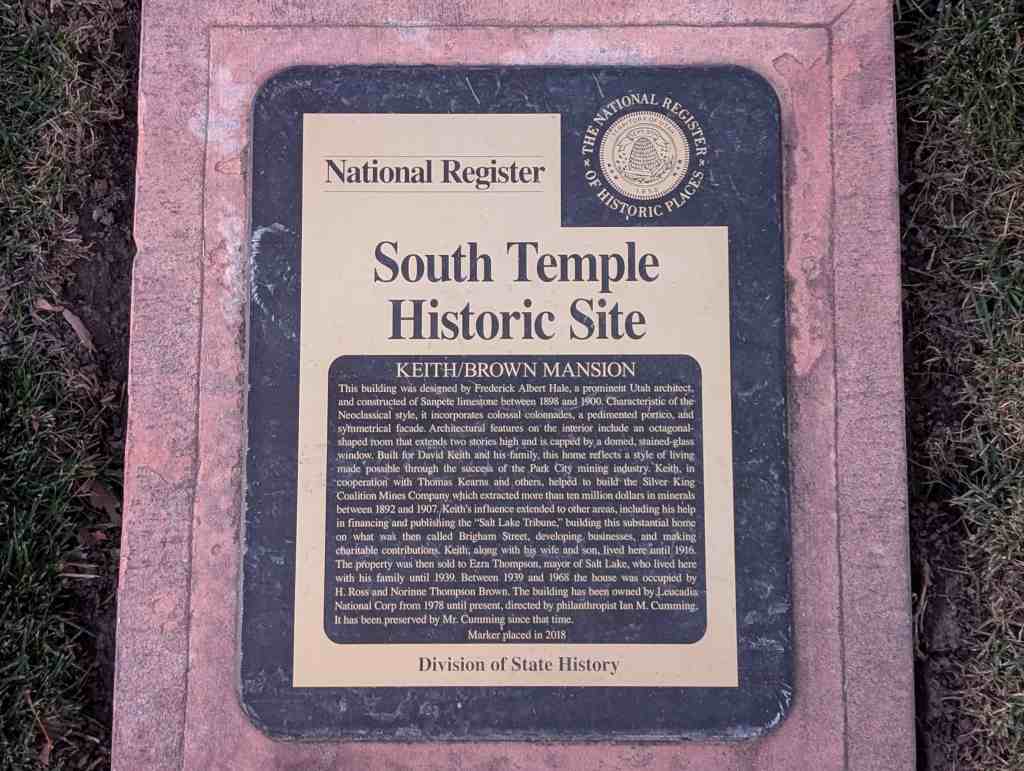
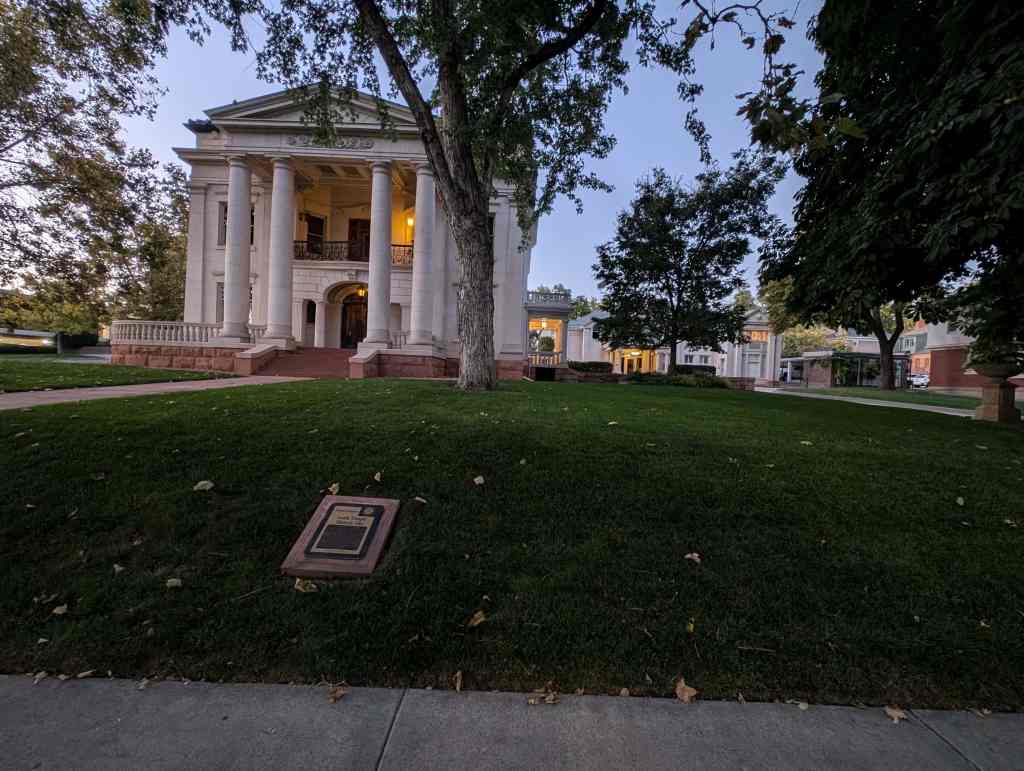
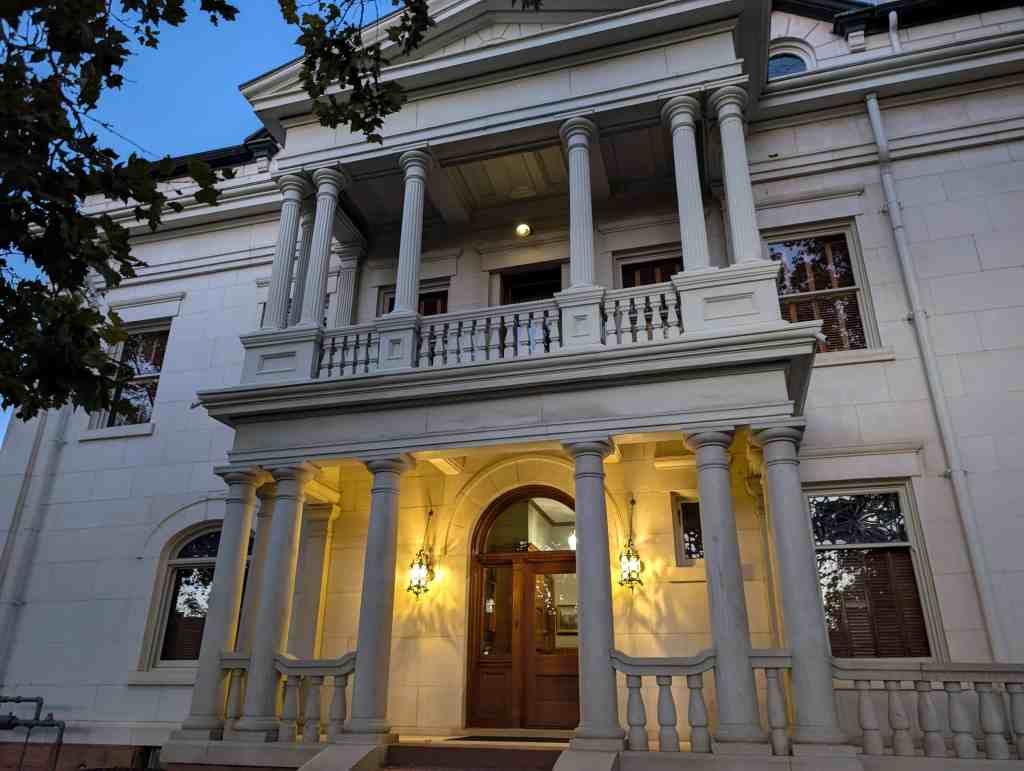
This building was designed by Frederick Albert Hale, a prominent Utah architect, and constructed of Sanpete limestone between 1898 and 1900. Characteristic of the Neoclassical style, it incorporates colossal colonnades, a pedimented portico, and symmetrical façade. Architectural features on the interior include an octagonal-shaped room that extends two stories high and is capped by a domed, stained-glass window. Built for David Keith and his family, this home reflects a style of living made possible through the success of the Park City mining industry. Keith, in cooperation with Thomas Kearns and others, helped to build the Silver King Coalition Mines Company which extracted more than ten million dollars in minerals between 1892 and 1907. Keith’s influence extended to other areas, including his help in financing and publishing the “Salt Lake Tribune”, building this substantial home on what was then called Brigham Street, developing businesses, and making charitable contributions. Keith, along with his wife and son, lived here until 1916. The property was then sold to Ezra Thompson, mayor of Salt Lake, who lived here with his family until 1939. Between 1939 and 1968 the house was occupied by H. Ross and Norinne Thompson Brown.
Built 1898-1900 for David Keith, mining magnate.
Architect: Frederick Albert Hale Purchased and renovated 1914 by Ezra Thompson former Mayor of Salt Lake
Presently owned by H. Ross and Norinne Thompson Brown.
Leased and renovated 1969 by Terracor
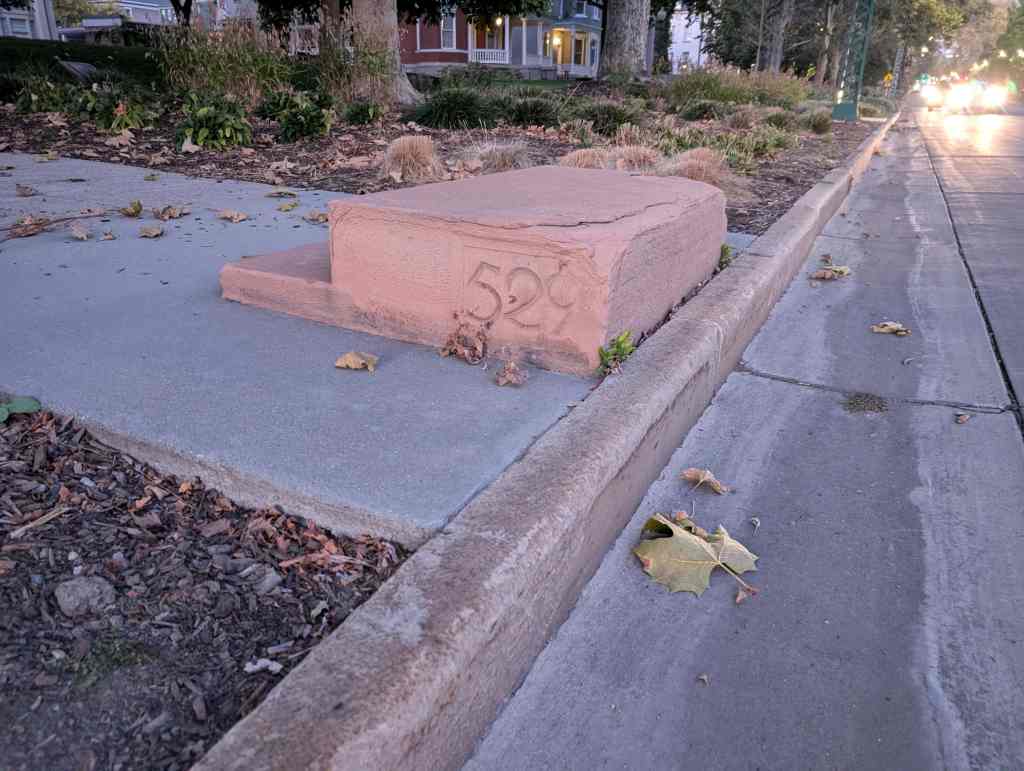
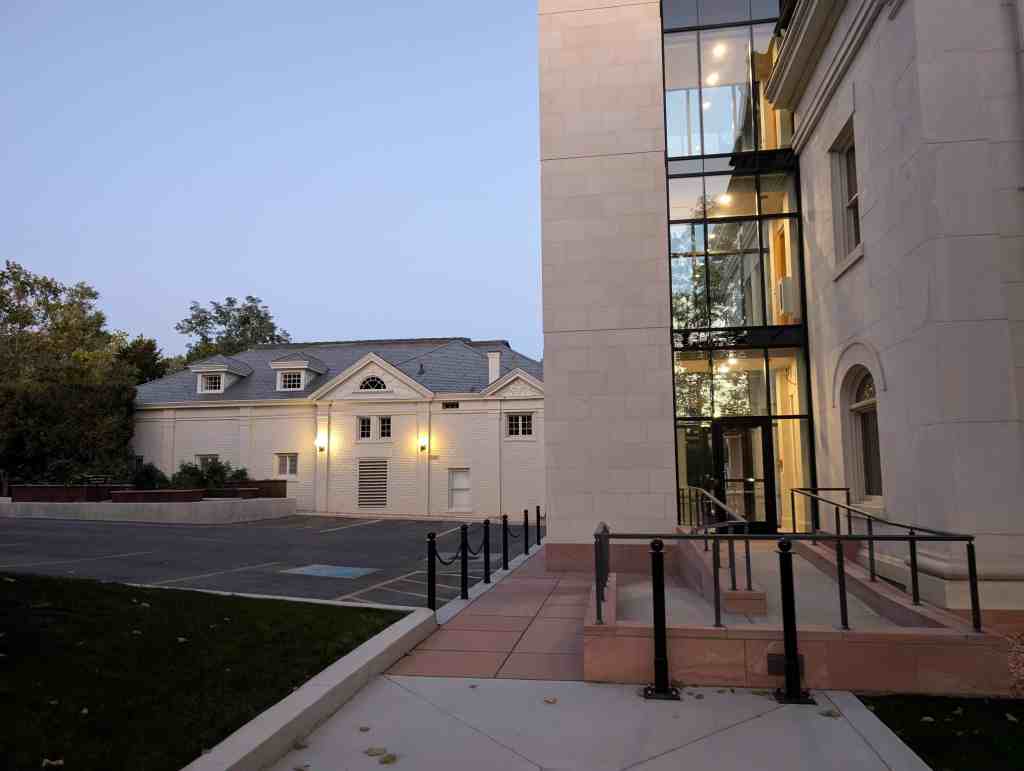
Located at 529 East South Temple in The Avenues neighborhood in Salt Lake City, Utah (535 East for the carriage house) and added to the National Register of Historic Places (#71000849) on May 14, 1971.
Built of Sanpete limestone in 1898-1900, this three-story mansion was designed by Frederick Albert Hale, who was also architect for the Alta Club, the Salisbury Mansion, the Salt Lake Public Library (Hansen Planetarium), the Continental Bank Building, and the Administration Building for the University of Wyoming.
With wealth obtained from his interests in the Silver King Coalition Mines at Park City, Mr. David Keith built his lovely mansion on Brigham Street in Salt Lake City, where he lived with his wife and son until 1916. The property was then sold to Ezra Thompson, whose family lived in the home until 1939.
The Thompson’s daughter, Norinne, then wife of H. Ross Brown, lived in the home between 1939 and 1968 when Terracor Corporation received from them a twenty-five year lease on the property. The company has since spent over $250,000 in restoration and renovation. The company now uses it for business purposes.
This mansion and carriage house reflect the quality living in early twentieth century Utah, made possible because of the wealth of Park City’s mines.
David Keith, the youngest of fourteen children, was born in Nova Scotia n 1847. Twenty years later he set sail for California to seek his fortune. His mining know-how and business acumen produced limited rewards there and in Virginia City, Nevada. Because he was an authority on water sumps, he s later employed at Park City, Utah in 1883. There, in cooperation with Thomas Kearns and others, he helped build the Silver King Coalition Mines Company, which extracted some ten and one-quarter million dollars worth of mineral between 1892 and 1907.
With this affluence, Keith and Kearns became influential in Utah, financing and publishing the new Salt Lake Tribune, building lovely homes, developing businesses, and making charitable contributions. Both men were members of Utah’s Constitutional Convention.
Keith died in 1918. His wife followed in death soon after, leaving the business empire to their son, David.
The home is important because of its quality architecture, because it tells much of the mining wealth’s story in Utah, and because David Keith was himself a prominent figure in the American West’s history.
Carriage House
(from Preservation Utah’s walking tour) David & Mary Keith Mansion 529 E. South Temple 1900, Frederick A. Hale, SLC Tours can be arranged by calling Utah Heritage Foundation, (801) 533-0858, at least two weeks in advance.
David Keith made his fortune on a lucky hunch. Orphaned at the age of 14, Keith went to work as a miner. He eventually became a foreman in a Park City silver mine where he met another hard-working miner, Thomas Kearns (see entry #15). Keith and Kearns leased an undeveloped Park City mine after noticing a rich ore vein headed toward the property. Their hunch about the ore proved correct. The two men became multi-millionaires and remained lifelong friends, business partners, and neighbors.
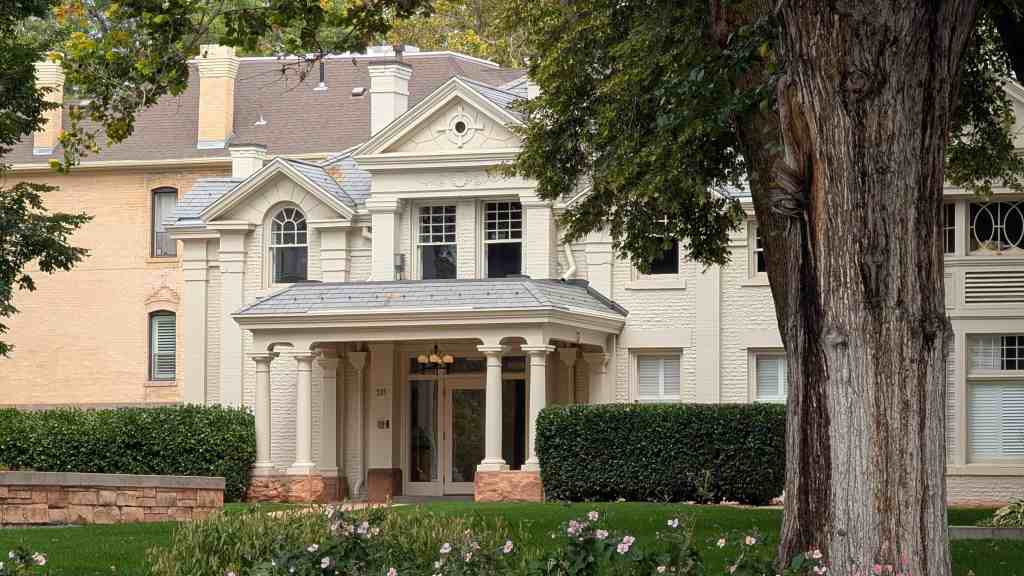
The newly-wealthy Keith and his second wife, Mary, hired Frederick A. Hale to design this stately mansion on fashionable South Temple Street. The mansion’s Neoclassical facade features a pedimented portico supported by four colossal columns. The interior is organized around an octagonal rotunda of polished cherrywood with a beautiful stained glass skylight. The carriage house, located to the east of the mansion, housed a bowling alley, shooting gallery, and servants’ quarters.
The Keiths lived in the mansion until 1916 when they sold the property to their neighbors, the Ezra Thompson family. Members of the Thompson family lived in the house until 1969 when Terracor acquired it and adapted it for office space. After a fire caused severe damage to the mansion in 1986, Terracor conducted an extensive restoration and continues to operate in the building today.
The Ivanhoe apartment building, constructed in 1908 by the Finch, Rogers, and Mulvey investment firm for the cost of approximately $50,000, is one of many downtown area apartments built in Salt Lake City during the first three decades of the twentieth century, representing a period of unprecedented expansion, growth, and urbanization.
The 1908 Ivanhoe 19-unit apartment building boasted the newest flooring, tiling, lighting, and heating of the time. Its exterior was constructed of light buff-pressed bricks with white sandstone trimming. The Neo-Classical and Colonial Revival style featured stamped metal cornices with block modillions, brackets, classical porticoes at the entrances, bay windows, and horizontal brick banding on the first floor. The primary feature of the building was a handsome court between the two wings of the building which opened onto the street.
The building was designed by local architect Bernard O. Mecklenburg, who worked on many prominent commercial, religious, and residential structures throughout Utah during the early 1900s, including the Broadway Hotel, Bank of Vernal (also known as “the Bank that was sent by Mail”), Maryland (Mecklenburg) Apartments, and Cathedral of the Madeleine (in collaboration with Carl M. Neuhausen).
See other historic apartment building in Salt Lake City here.
417 East 300 South in Salt Lake City, Utah
From the NRHP nomination form: Constructed in 1908, the Ivanhoe Apartments is a U-shaped three-story brick building with a parapet roof, sandstone foundation and Neo-Classical/Colonial Revival styling. No significant alterations have been made to the building.
The Ivanhoe is a variant of the basic “walk-up” type apartment building. The basic walk-up contains six units, is three stories in height, one apartment deep and two units in width across the façade. It has a central entrance/stairway with two apartments opening off each landing. The Ivanhoe incorporates three basic walk-up units in its U-shaped plan one at the back and one each along the sides with a courtyard in the center. Unlike the basic walk-up, the Ivanhoe does not have projecting front porches, though it does have balconies over the entrances. Also unusual are the interior rear stairways on the side units; the rear units have external frame porches and stairways on the back of the building.
Neo-Classical and Colonial Revival features include the stamped metal cornice with block modilions, brackets, classical porticoes at the entrances, bay windows, horizontal brick banding on the first floor creating a quoin-like effect, and six-over-one double-hung windows.
Constructed in 1908, the Ivanhoe Apartments is one of over 180 “urban apartments” built in Salt Lake City during the first three decades of the twentieth century, a period of unprecedented expansion and urbanization. Over 60 percent of those buildings are either listed or eligible for listing in the National Register. Urban apartments are significant under Criterion C as a distinct and important type of residential building in the city. Apartments are remarkably consistent with one another in terms of building plan, height, roof type, materials, and stylistic features. These and other characteristics mark them as a new and distinct type of early twentieth century residential building. Under Criterion A, urban apartments are significant for their association with the rapid urbanization of Salt Lake City during the 1890s-1930 period. The growth that took place during those decades spurred the construction of two opposing types of housing in the city: urban apartments and suburban homes. Suburban homes represent a rejection of urban conditions. Apartments, on the other hand, document the accommodation of builders and residents to the realities of crowded living conditions and high land values. They were a significant new housing option that emerged in response to the growth that transformed Salt Lake City into an urban center during the early twentieth century.
The building permit for the Ivanhoe Apartments was issued on April 2, 1908, to Finch, Rogers and Mulvey, an investment firm. Estimated cost of the 19-unit building was $30,000. Harry L. Finch, Richard E. Rogers and Martin E. Mulvey were partners in the firm which had the apartments constructed. In August 1908 they transferred ownership of the building to their newly created corporation, Ivanhoe Investment Company. The building remained in Ivanhoe ownership until 1943, when it was purchased by Jedd L. and Mary E. Jensen.
Soon after the building permit for these apartments was issued, the following article describing the proposed building appeared in the Salt Lake Tribune.
Ground already has been broken for a new apartment building on Third South near the corner of Fourth East, to cost $65,000, and which promises to be unique for this sort of building in Salt Lake. The structure, which is being financed by the Finch-Rogers Mulvey company, will have a frontage on Third South of 100 feet, with a depth of 110 feet. The feature of the building will be the handsome court between the two wings of the building, opening on the street, and so arranged that all of the apartments will open on the court. There will be grass plots, a fountain and statuary in the court, which is expected to make the new building especially attractive as a summer residence.
There will be twenty apartments of five and six rooms. All of the interior finish will be of hardwood and the hallways and bathrooms will be tiled. Heating and lighting will be of the latest and most approved design. The exterior will be constructed of light buff pressed bricks, with white sandstone trimming. A garage for automobiles will be located at the rear of the building, with a driveway at the side. The foundation already has been completed, and it is expected that the building will be ready for occupancy by July 1. Plans were drawn by B.O. Mecklenburg, architect.
Bernard O. Mecklenburg was an accomplished local architect. He was born in Nebraska in 1878 and came to Salt Lake City in 1898. He practiced architecture here until 1919, when he moved to Los Angeles. His work includes completion of the Cathedral of the Madeleine, additions to Holy Cross Hospital, the Mecklenburg Apartments, and a number of substantial residences in the city.
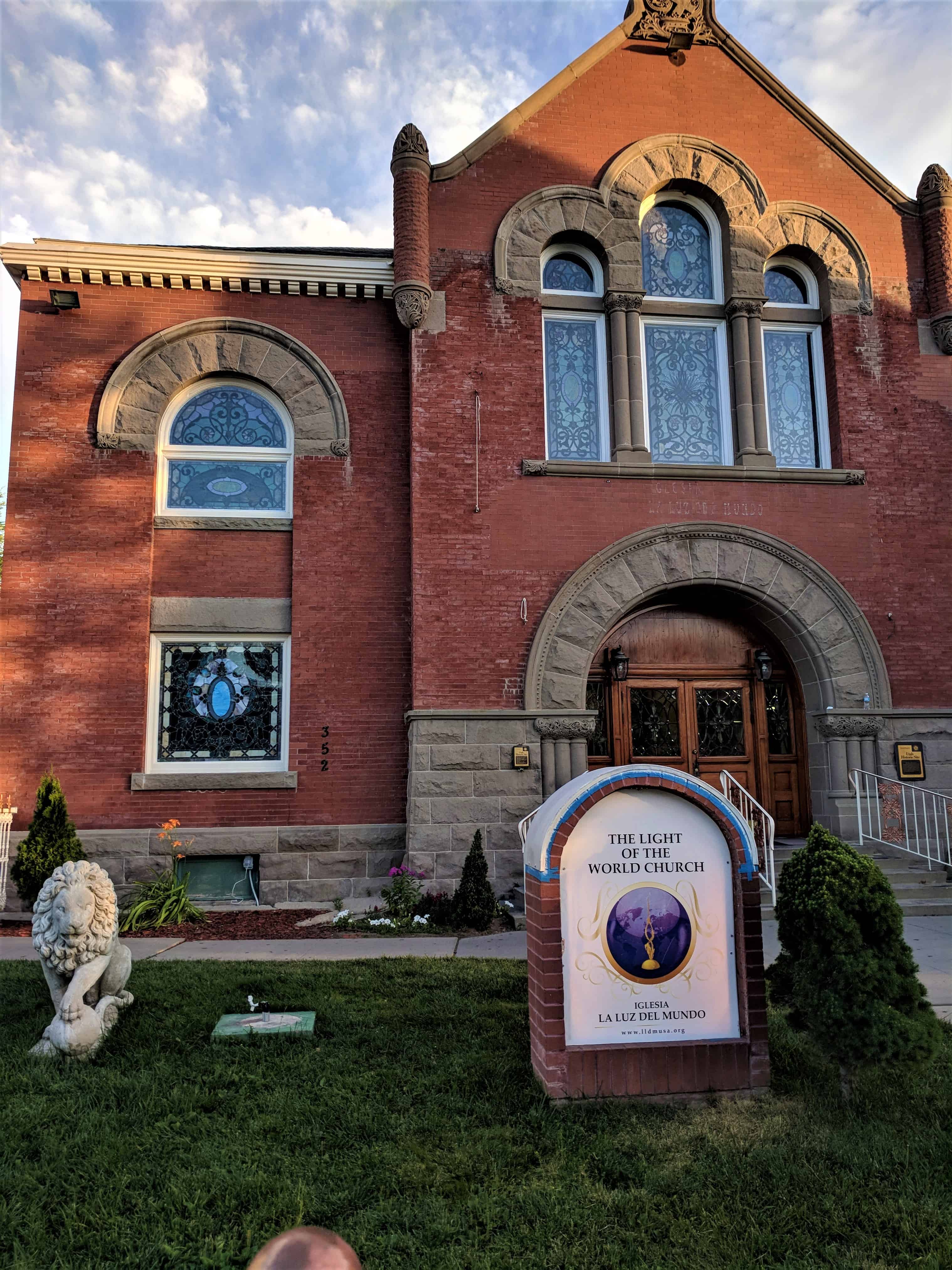
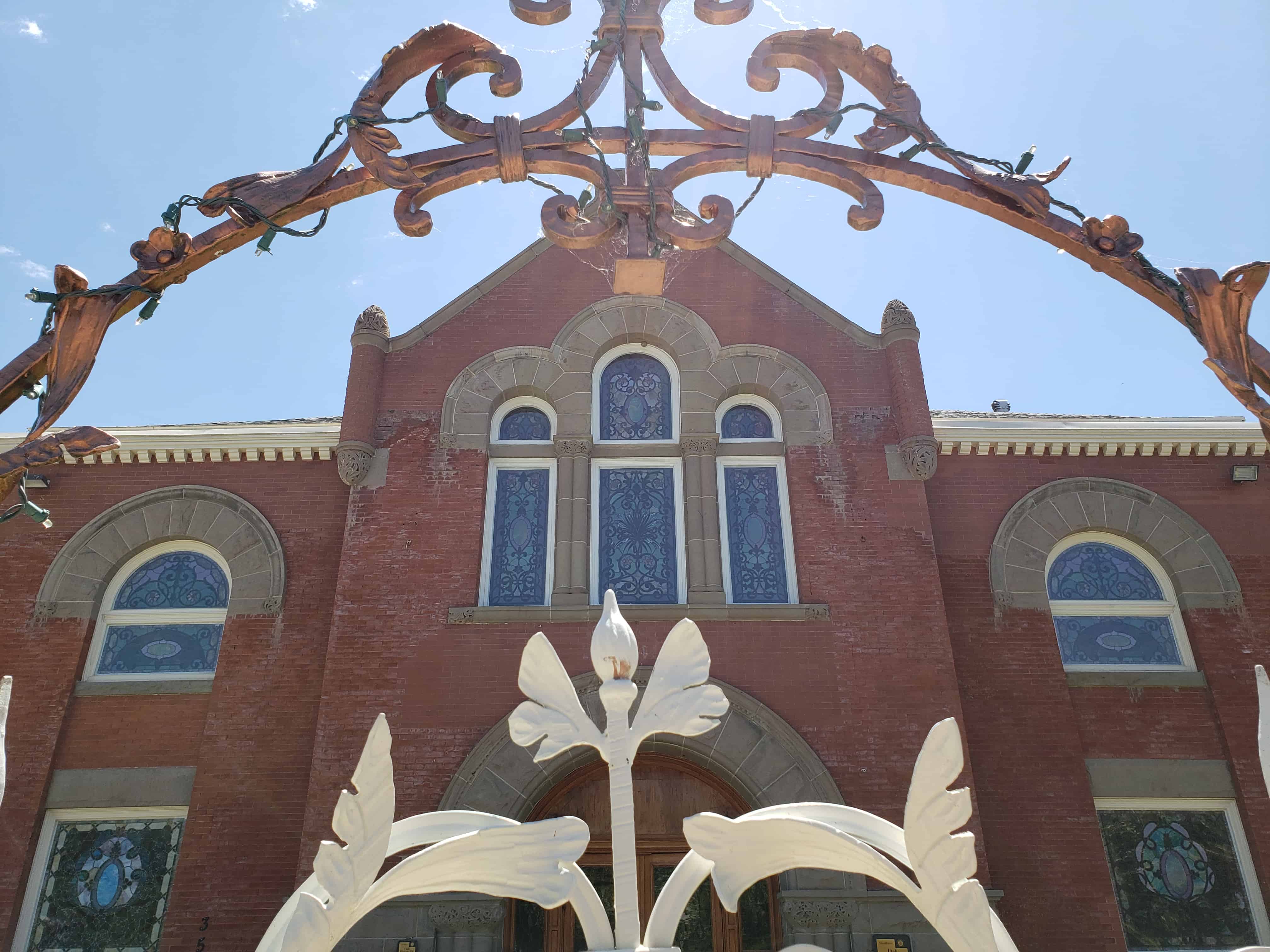
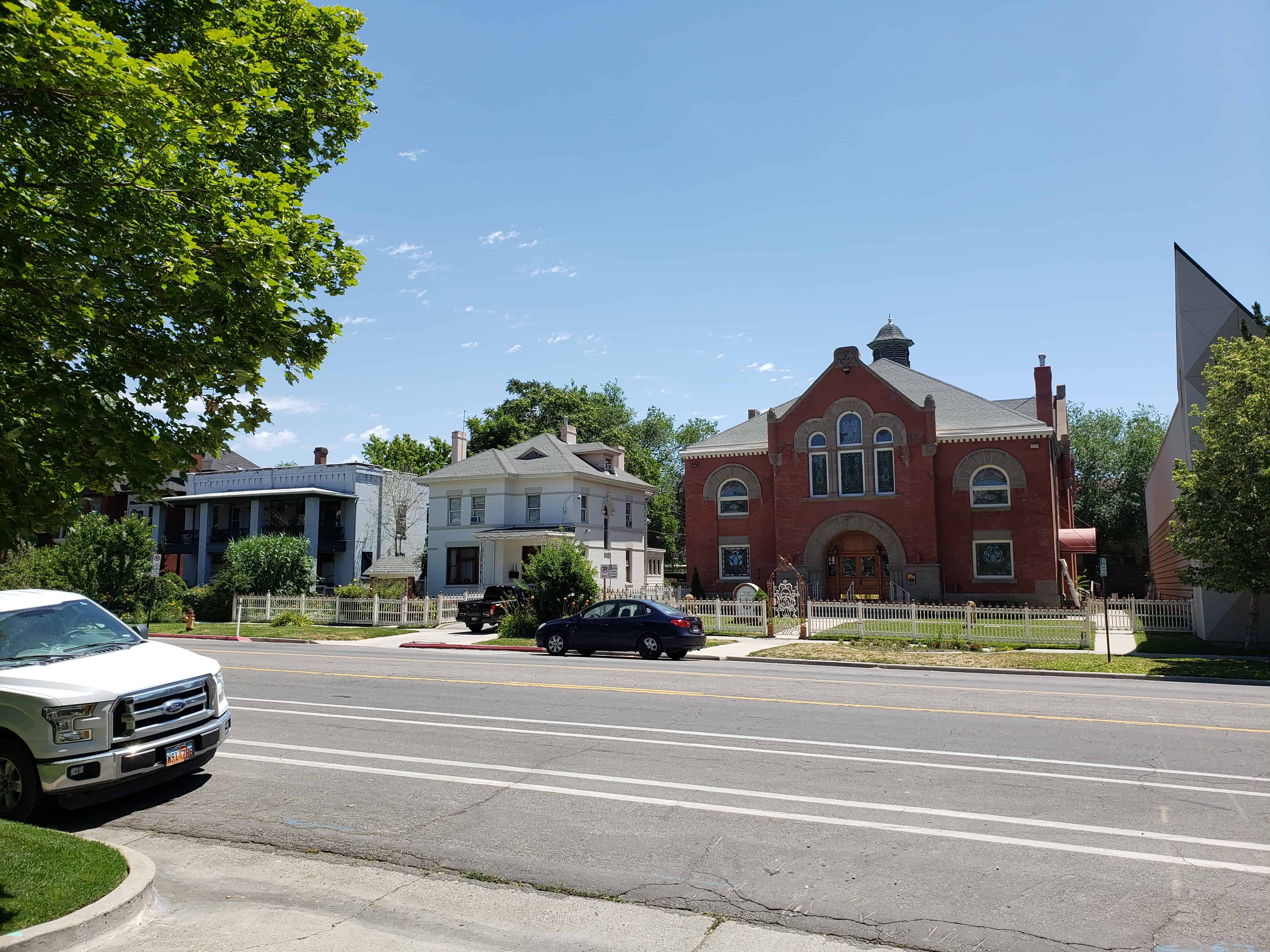
The First Church of Christ, Scientist in Utah was organized in Salt Lake City on July 17, 1891. The Church, designed by architect Walter E. Ware, was constructed of brick and kyune sandstone. Dedicated on November 27, 1898, the building is the oldest Christian Science Church in Utah and one of the oldest continuously used Christian Science churches in the world.
This church is located at 352 East 300 South in Salt Lake, the home at 360 E 300 S is on the same parcel.
At 11:30 p.m. Saturday, February 16, 1924, Officers William N. Huntsman and Brigham H. Honey Jr. heard a shot fired outside the State Café, 46 W. Broadway, which was being robbed. Both officers pursued the suspect to this location and a gun battle ensued. Huntsman, 26, was killed immediately, while Honey, 34, died several hours later. They are buried near each other in the Salt Lake City Cemetery.
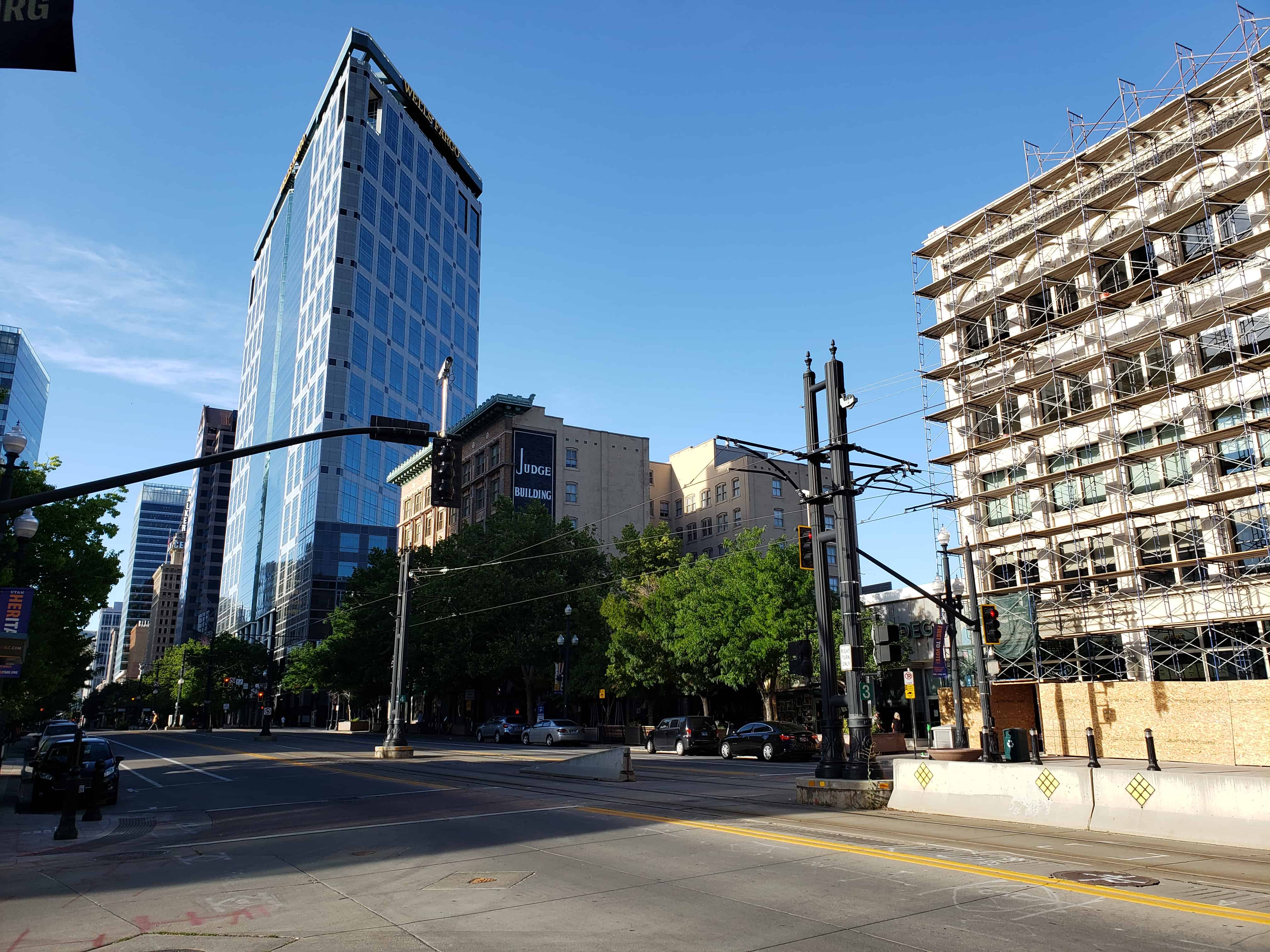
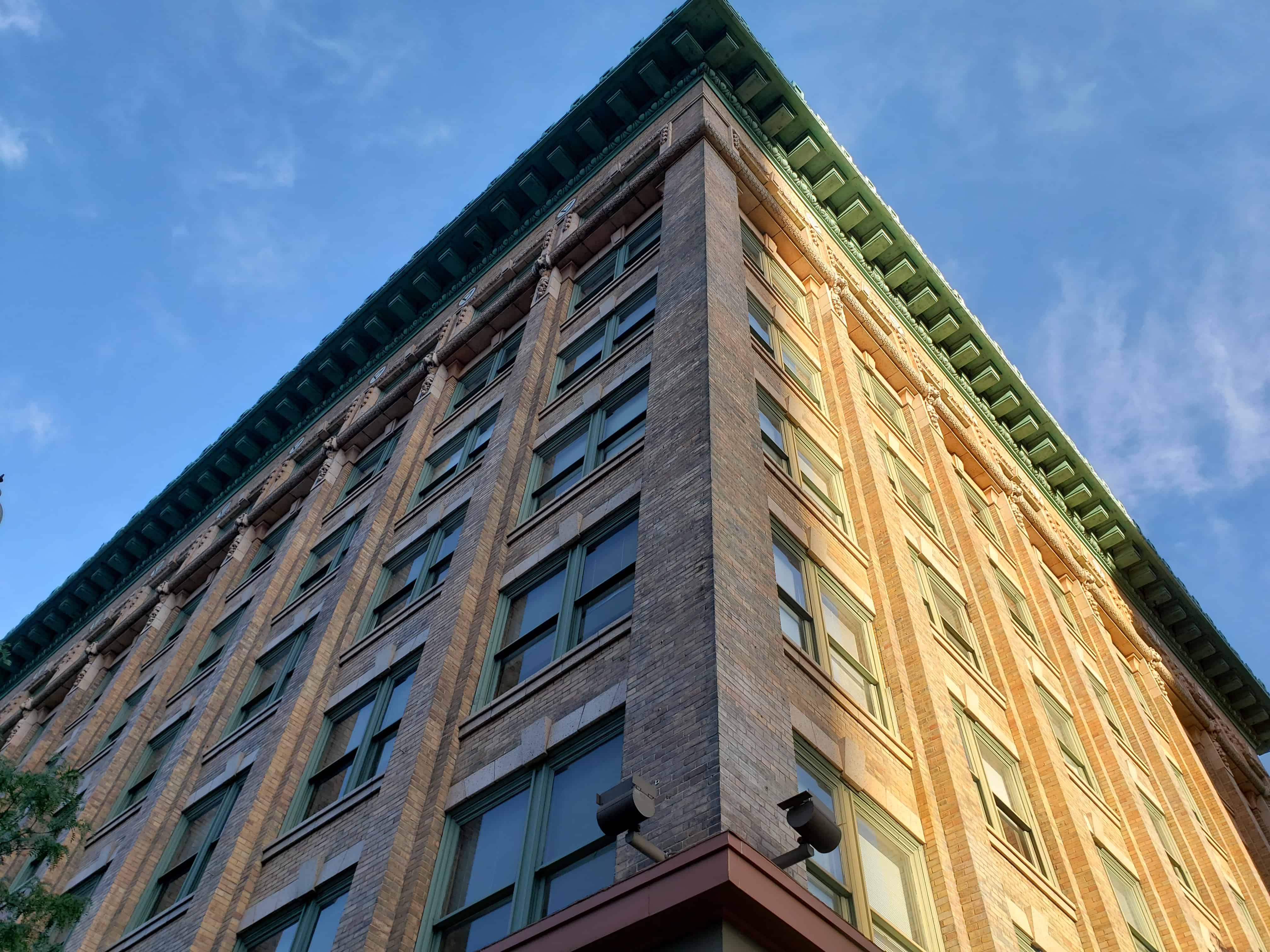
The Judge Building was built by a business savvy widow. Mary Judge was married to John Judge, a partner with Thomas Kearns and David Keith in developing the Silver King Mine in Park City.
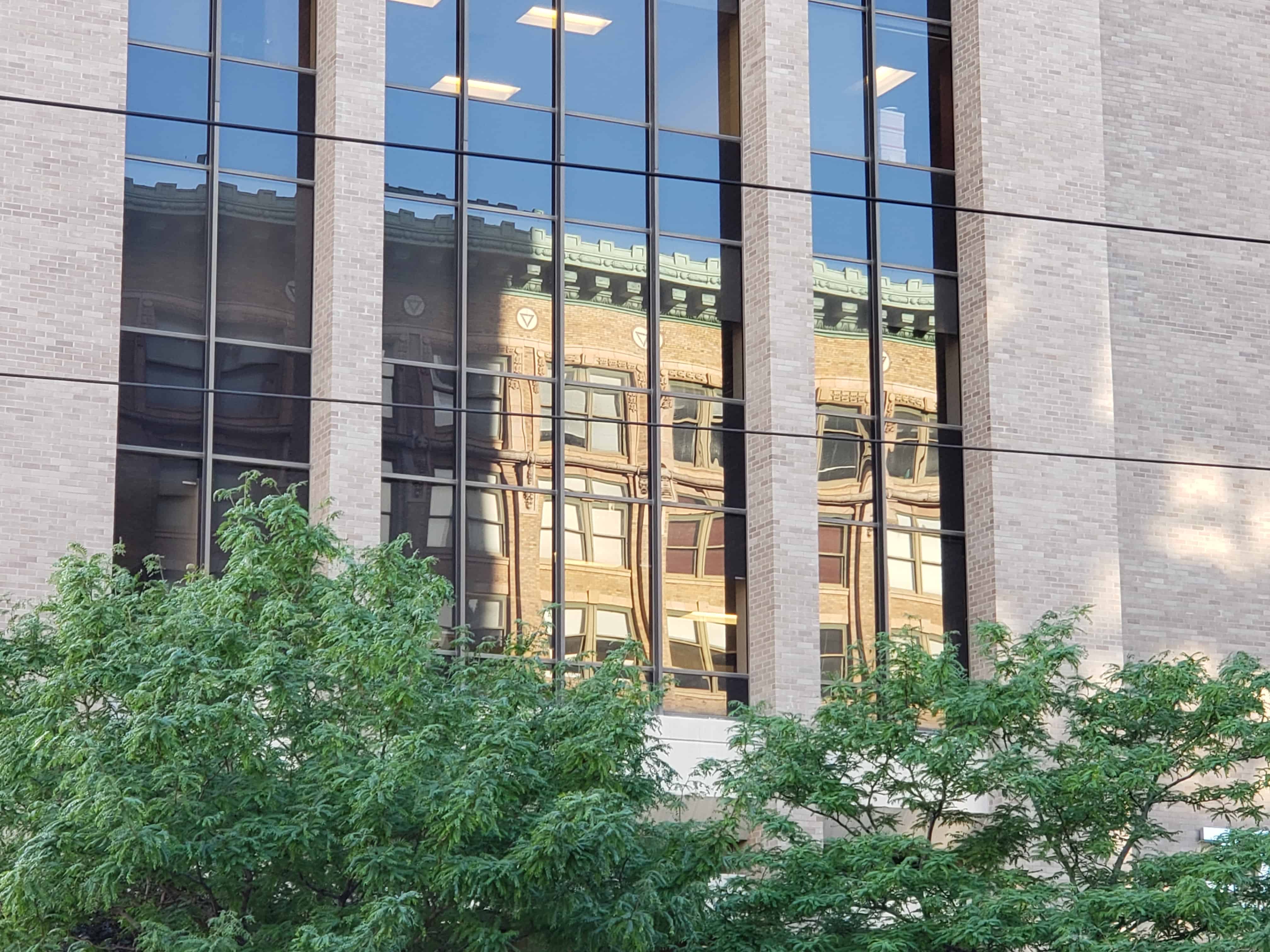
After John’s death, Mary multiplied her fortune with investments in real estate and mines. In addition to proving herself a capable businesswoman, Judge donated generously to a variety of charities. The Judge Building was once known as the Railroad Exchange Building. By 1909, 22 railroad companies had their Salt Lake offices here. The Commercial style building features a copper cornice, colorful ceramic tile triangles, and swags of carved stone fruit above the seventh-story windows.
Utah businessmen Orange J. Salisbury shared Samuel Newhouse’s goal of shifting the center of Salt Lake City’s business district to the south. He financed the construction of several commercial buildings in Salt Lake City, including the Felt Building. Designed by Richard Kletting, the Felt Building is an early example of Sullivanesque architecture in Utah. It also features the first terra-cotta facade in the state. What the Felt Building lacks in color, it makes up for in exuberant detail. Note the relief portraits of classical Greek figures in the round arches, dentilled cornice, foliated frieze, and decorative capitals atop the pilasters between the bays.
1902-1905, James Knox Taylor, Supervising Architect of the Treasury
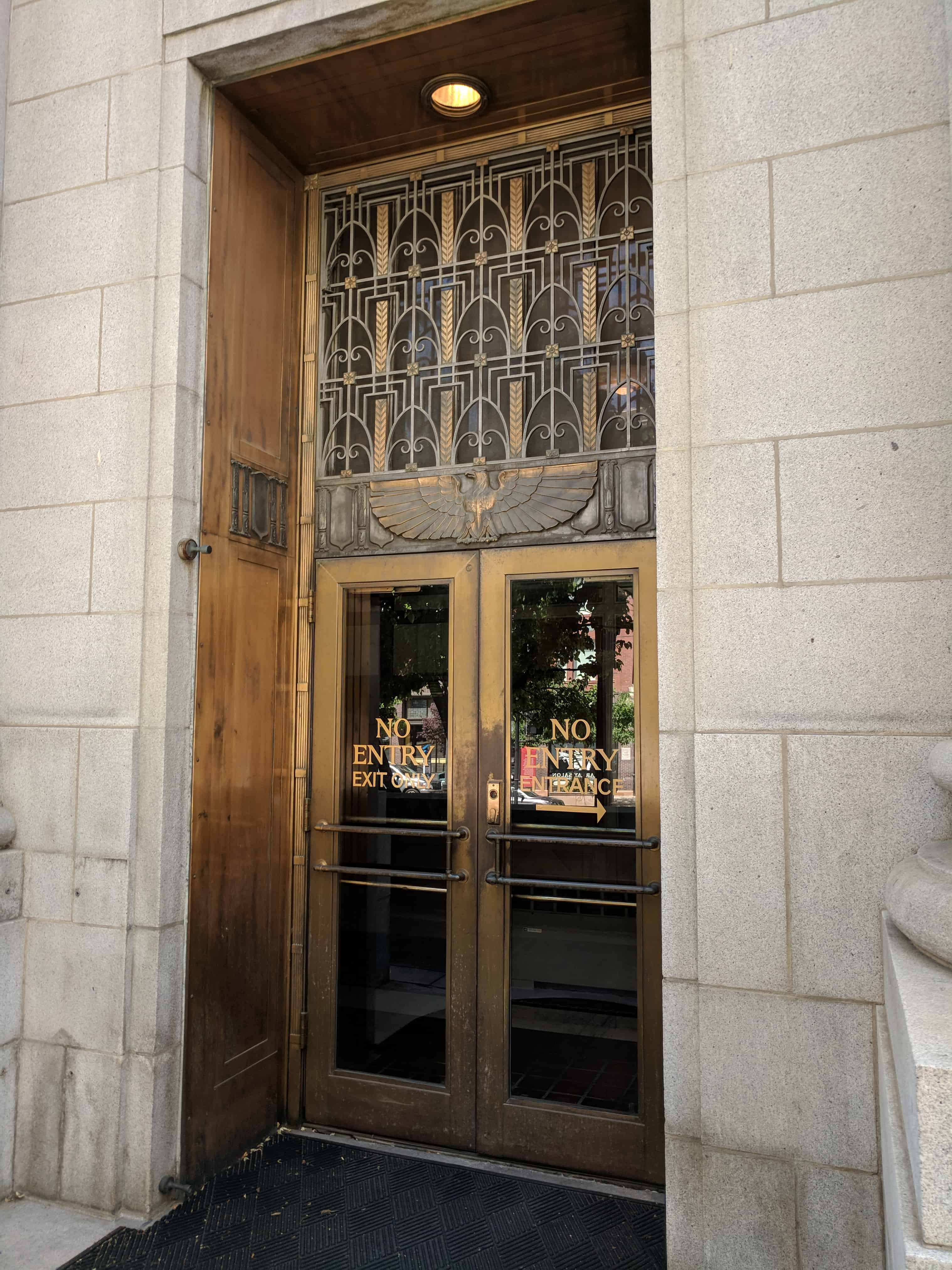
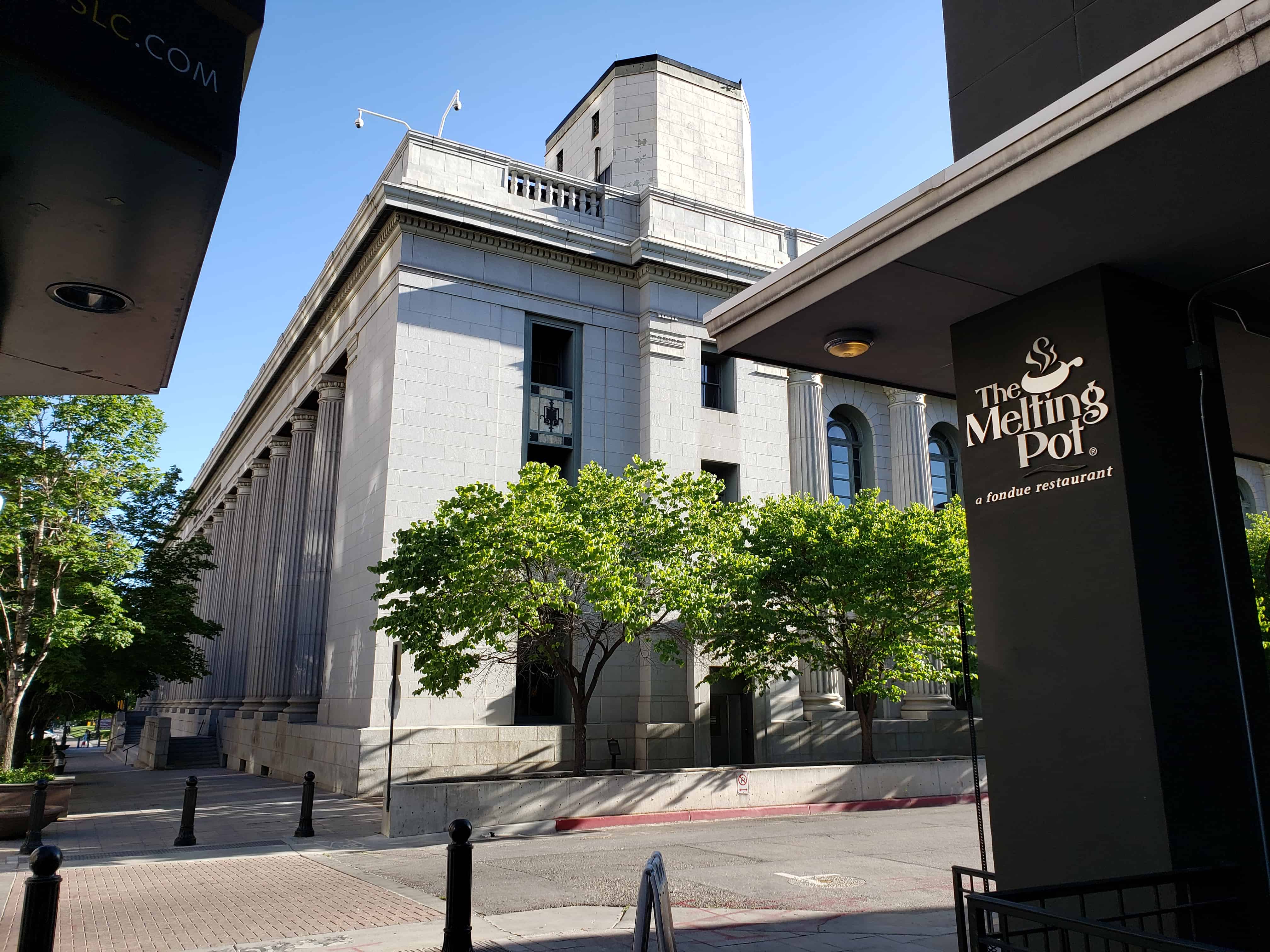
After Utah became a state in 1896, the Federal Government began planning a building to house federal offices in Salt Lake City. The Treasury Department considered two sites for the building. After vocal opposition from many of Salt Lake City’s leading non-Mormon businessmen to a site offered by the LDS Church near Temple Square, the federal government purchased this site. Completed in 1905, this building was one of the earliest examples of Neoclassical style architecture in Utah. Originally serving as a combination post office, courthouse, and federal building, it became the anchor of the non-Mormon south downtown business district.
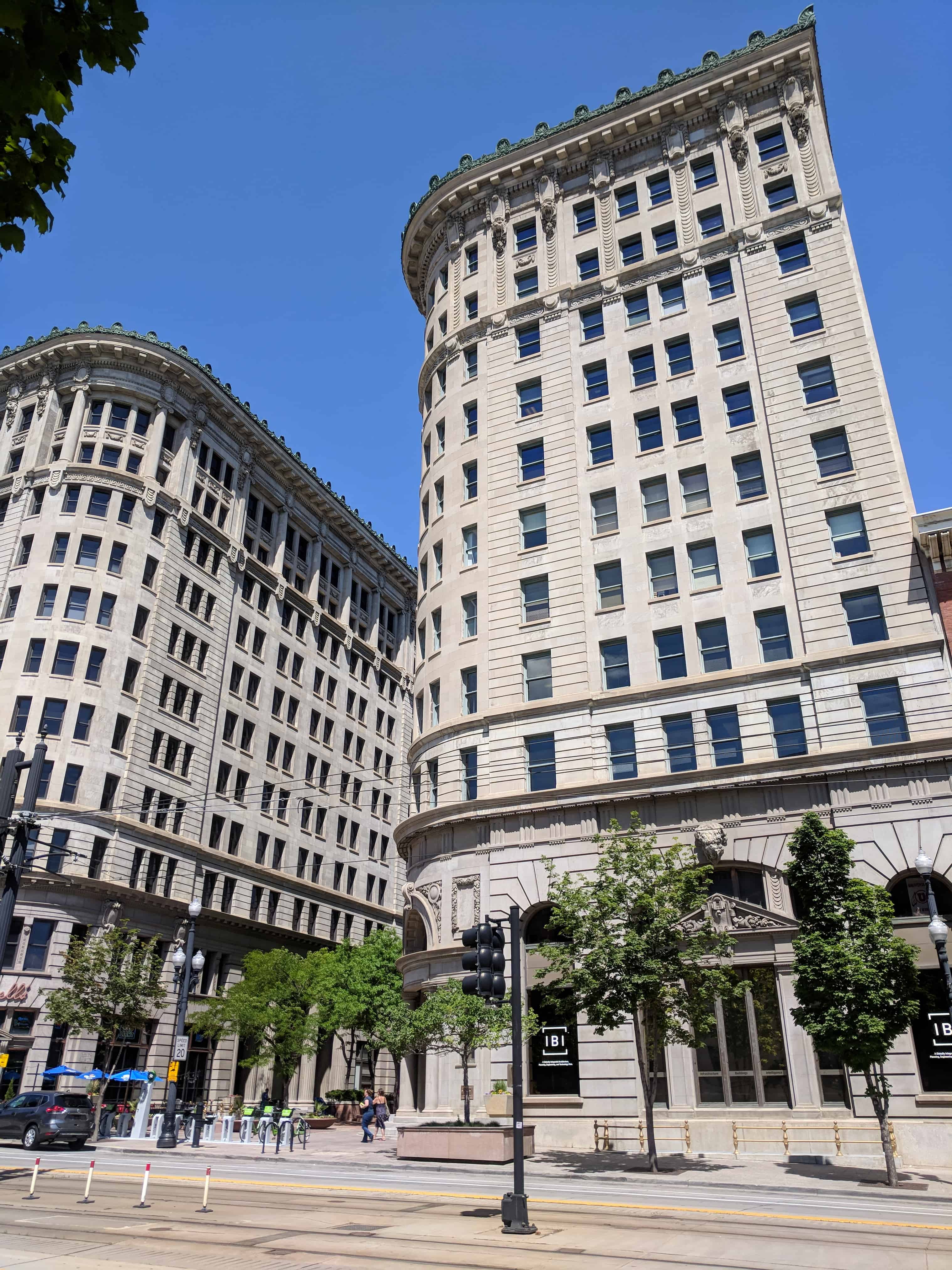
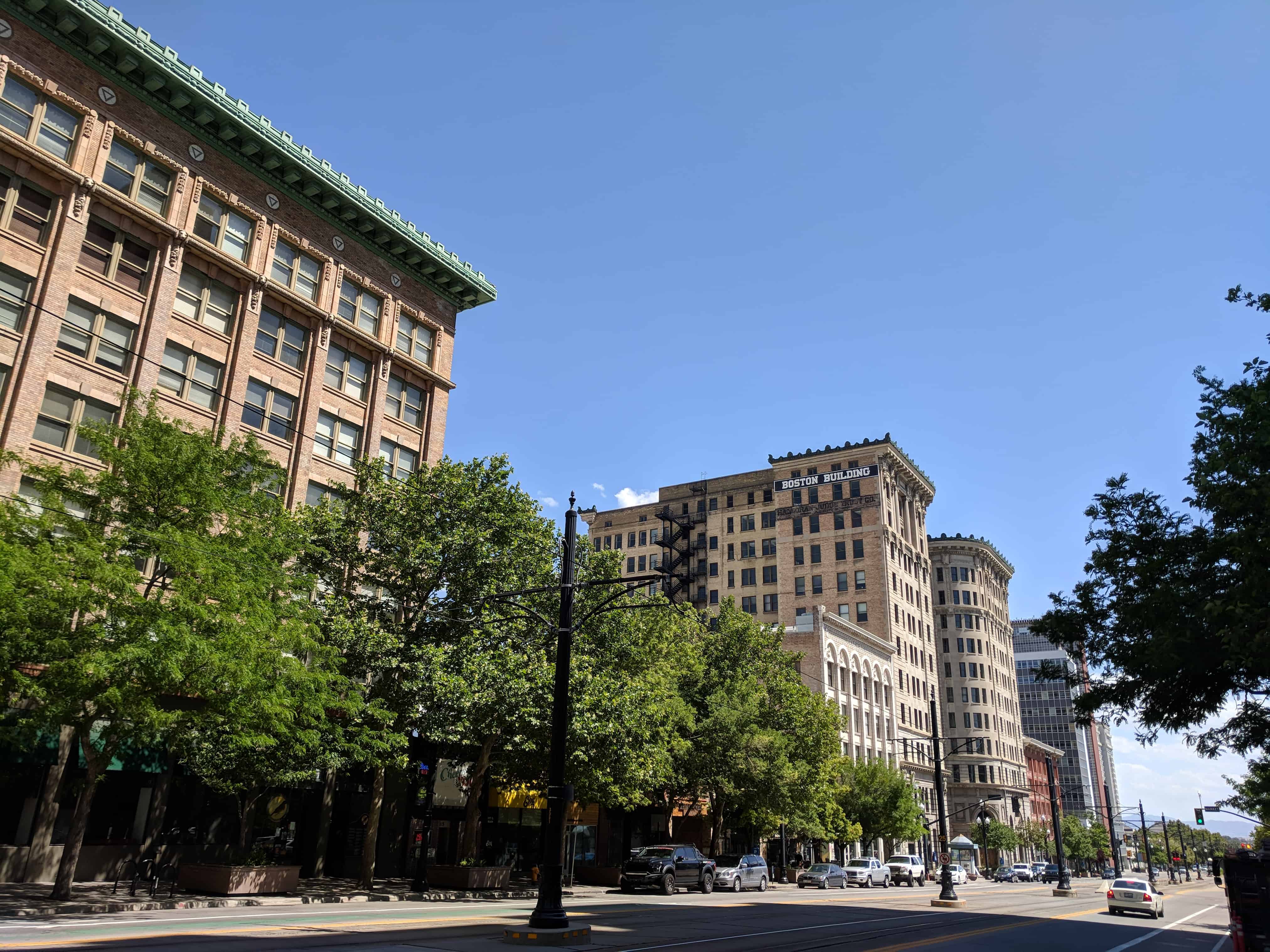
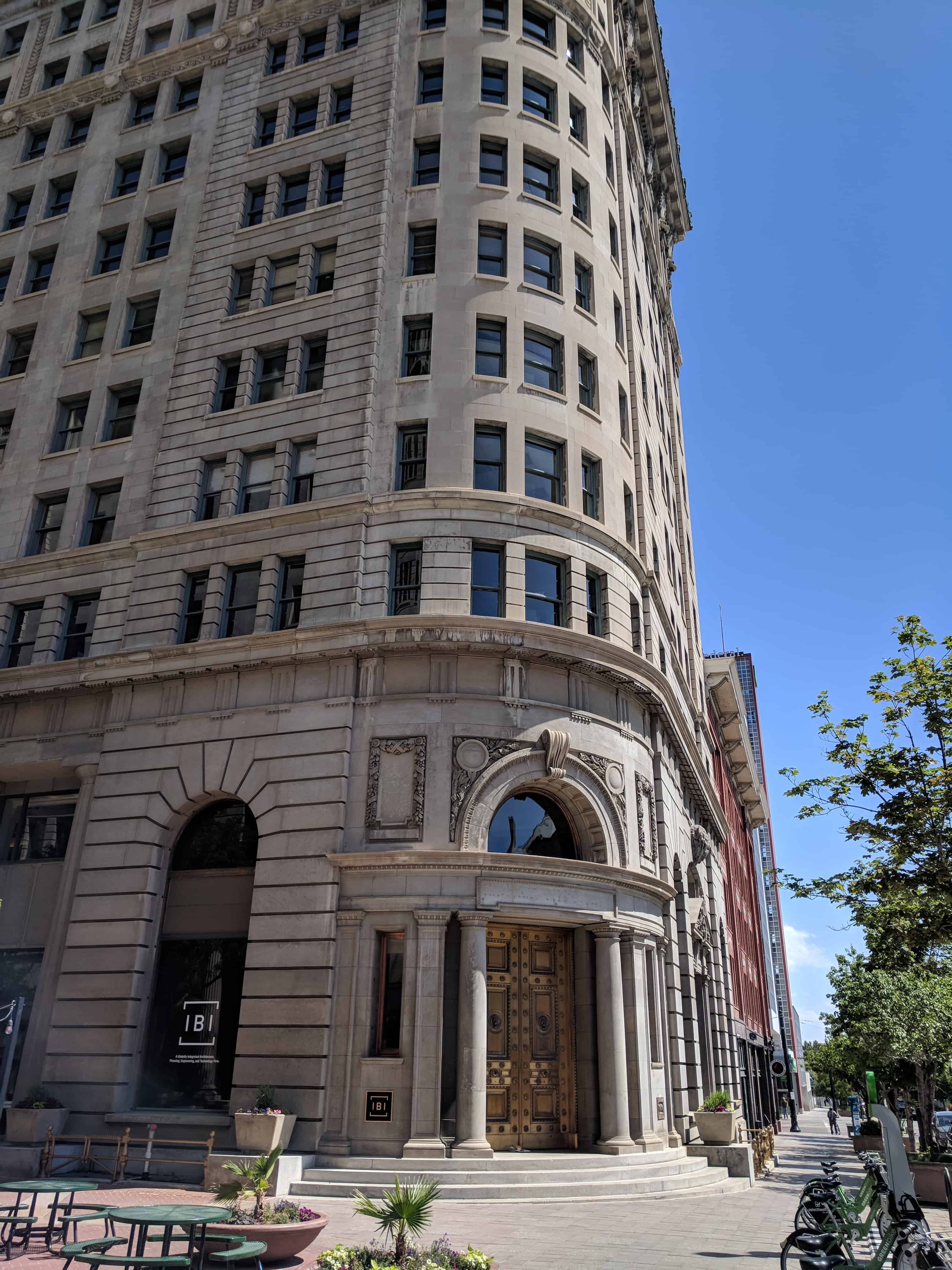
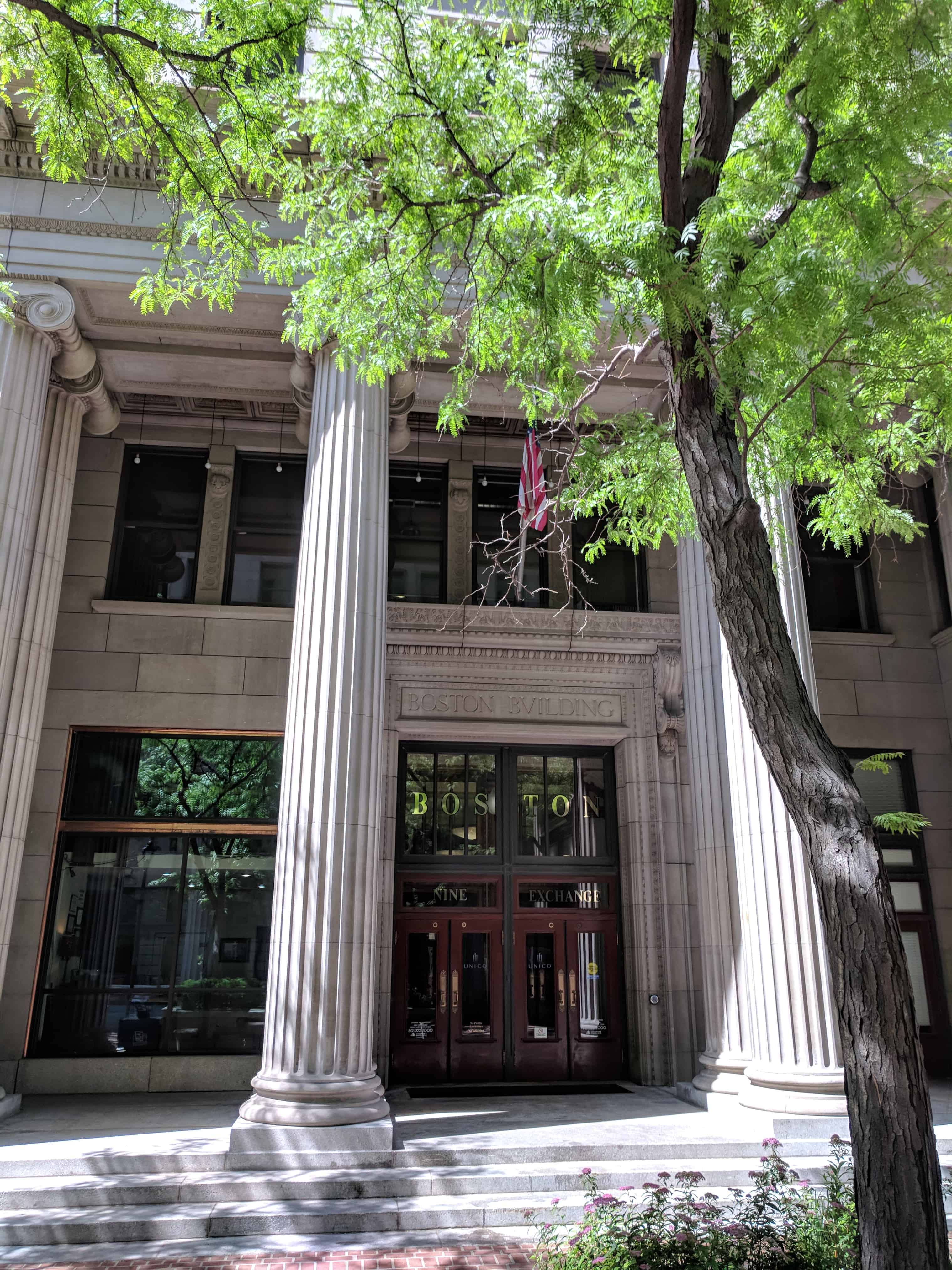
These twin buildings in downtown Salt Lake City really stand out to me. They were Utah’s first skyscrapers and were built by one of the state’s wealthiest mining magnates, Samuel Newhouse.
The buildings are located at 9 E Exchange Place (Boston) and 10 E Exchange Place (Newhouse) in Salt Lake.
The Boston and Newhouse Buildings 1907-1909, Henry Ives Cobb
Mining Magnate Samuel Newhouse began his south downtown empire by financing the construction of these two buildings.
Newhouse intended to construct a similar pair of buildings at the east end of Exchange Place, but went bankrupt before he could undertake this project.
The Boston and Newhouse Buildings are considered Utah’s first “skyscrapers.” Attempting to bring some of the sophistication and prestige of the East to Salt Lake City, Newhouse hired famous Chicago/New York architect Henry Ives Cobb to design these towers.
Take a moment to look at the elaborate stone ornamentation on these buildings from the west side of Main Street.
In 1865 the Military Governor of the Territory of Utah requested the Baptist Mission Society to begin work in Utah, feeling that the already established Presbyterian, Methodist, Episcopalian and Congregationalist churches were insufficiently vigorous in evangelizing among the Mormons.
No missionaries could be spared by the Baptists, and until the Reverend George W. Dodge took up his appointment in 1871 as Superintendent of Indian Affairs for the Territory of Utah, no clergyman was available to care for the handful of resident Baptists.
The Reverend Dodge immediately began a campaign to induce the Baptist Missionary Society to support a missionary in Utah. Although willing in principal, the Society had a personnel and financial problem created by the enormous burden it had shouldered in opening schools and missions for blacks in the South during this reconstruction period. However, in October 1871, they assigned the Reverend Seweel Brown to officially open a mission in the area, but specifying that he was to divide his time between Evanston, Wyoming, and Salt Lake City. This responsibility was difficult to discharge and the Reverend Brown stayed at his post for no more than a year.
It was not until 1881 that another Baptist missionary, the Reverend Dwight Spencer, was dispatched to Utah, and with greater financial support from the Missionary Society finally established a Baptist presence in Utah on a permanent basis. On August 1,1883, the First Baptist Church of Salt Lake City was organized with 16 charter members. The denomination flourished, and by 1900 several other churches and mission stations had been created in the Salt Lake City area, including, in 1896, the Rocky Mountain Region’s first black church, Calvary Baptists.
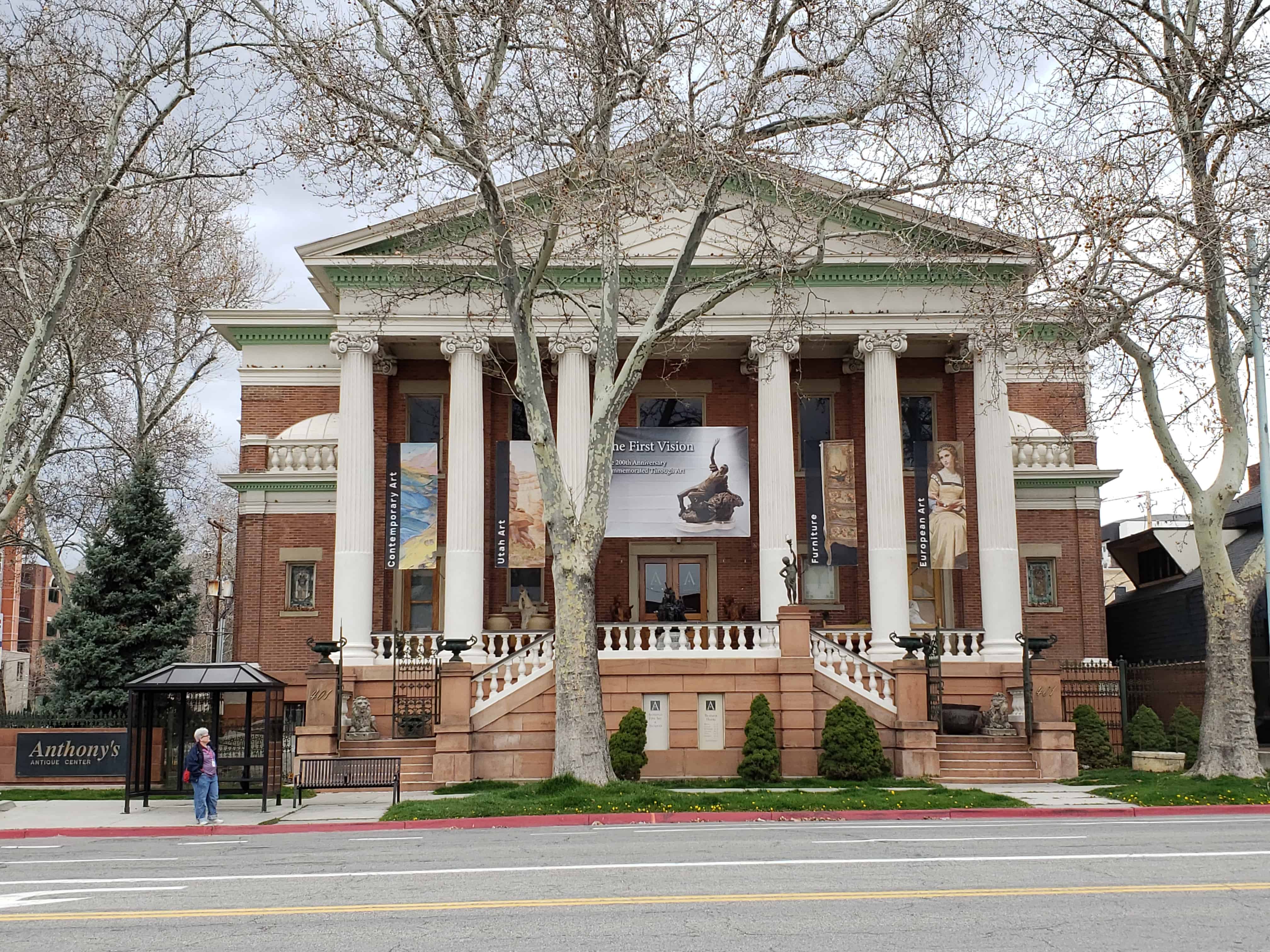
The growth of Salt Lake City and the changing pattern of residential development caused two congregations to come together in 1908. The well-established First Baptist Church and the Eastside church merged to form Immanuel Baptist Church. The reason for the coming together was simple; both had outgrown their pioneer structures and with the new stature of the Baptist Church as an established member of the community, it was decided that a large and impressive building would further enhance that prestige.
Accordingly, a lot was purchased at the corner of Fourth East and Second South streets in what was then one of the finest areas of the city. An architect, J. A. Headlund, was hired at a cost of $1,371.50 and given instructions to design a distinguished building. The Greek Revival structure that came from his pen was indeed impressive, and totally satisfied the parishmen of Immanuel Baptist.
Finished in 1911, but not dedicated until 1915, Immanuel Baptist took its place as one of the showplace churches of Salt Lake City. However, even at this late date, and despite the growth in the number of Baptists, the major financial contribution toward the construction of the building came from the Baptist Missionary Society. Financing for the $80,000 project as a whole, and the mortgage holder, was the Zim’s Savings and Trust Company, owned by the Mormon Church.
Despite the magnificence of their new building, the Immanuel Baptist Church did not experience any rapid new growth. The hoped-for growth in prestige is difficult to evaluate and it must be assumed that the social class categorization of Protestant denominations would limit Baptist influence as much in Utah’s power elite as elsewhere in the nation.
Immanuel Baptist enjoyed an increase in members and an important role in providing for Baptist servicemen during World War II. The huge Army and Air Force installation in Salt Lake County created a need for special support efforts in areas of recreation and opportunities for religious worship. Eventually, the changing demographics of Salt Lake City after World War II caused Immanuel Baptist’s role to be reassessed and the decision made to remove the congregation to a more suburban setting.
The contribution of this building to Salt Lake City lies principally in the dignity and refinement that it adds to its neighborhood. The history of the Baptist Church in Utah is similarly given a suitable monument to the earnest endeavors of the clergy and lay people who struggled to operate a Baptist community under circumstances that were difficult and often inhospitable.
John A. Headlund, the architect, was born in Engelholm, Sweden, in 1863, and trained at the Architects’ Institute in Chicago. He worked in Colorado Springs for Van Brunt and Howe before coming to Utah in 1891, where he designed a large number of school buildings in Salt Lake County, Park City, and Heber.