• About JacobBarlow.com
  • Cemeteries in Utah
  • D.U.P. Markers
  • Doors
  • Exploring Utah Email List
  • Geocaching
  • Historic Marker Map
  • Links
  • Movie/TV Show Filming Locations
  • Oldest in Utah
  • Other Travels
  • Photos Then and Now
  • S.U.P. Markers
  • U.P.T.L.A. Markers
  • Utah Cities and Places.
  • Utah Homes for Sale
  • Utah Treasure Hunt

JacobBarlow.com

~ Exploring with Jacob Barlow

JacobBarlow.com

Tag Archives: Historic Churches

Sandy Second Ward Chapel

03 Friday Mar 2023

Posted by Jacob Barlow in Uncategorized

≈ Leave a comment

Tags

Chapels, Churches, Historic Churches, Historic Sandy, NRHP, Salt Lake County, Sandy, utah

Sandy Second Ward Chapel

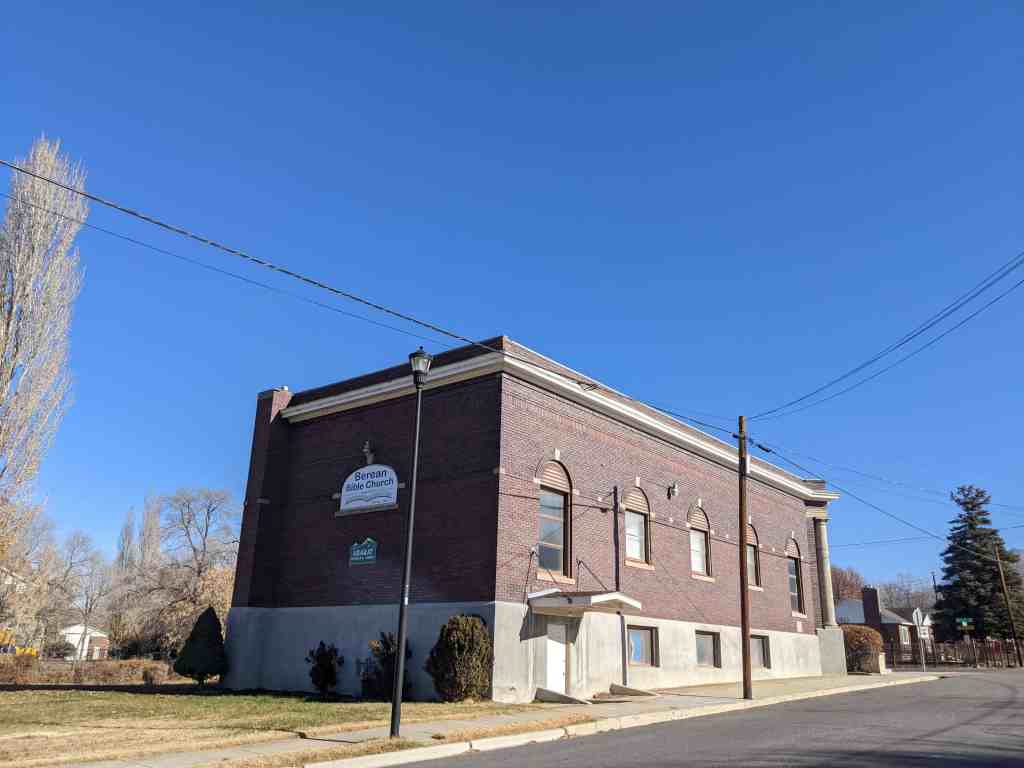
This Classical Revival structure was built by Joseph Don Carlos Young, noted LDS Church architect, in 1921. Andrew Hansen, a local farmer and builder, supervised the construction. The cost of the chapel was $20,000. It was dedicated December 11, 1927, by LDS Apostle George Albert Smith.

The Sandy Second Ward Chapel was built during a time of emphasis on multiple-use buildings and architectural experimentation. The building combines a large chapel area, classrooms, and recreation space. The building was converted to a Baptist church in 1962 and is still being used for religious worship. It retains its historic integrity and remains in excellent condition.

Located at 8630 South 60 East in Sandy, Utah and added to the National Historic Register (#97000638) on July 9, 1997

The Sandy Second Ward Chapel, built in 1921, is being nominated under two contexts:
1) Mormon Meetinghouses and Tabernacles in Utah, 1847-1936; and
(2) Historic Resources of Sandy City: Specialized Agriculture, Small Business and Community Development Period, 1906-1946.
The Classical Revival structure combines a large chapel area, classrooms, and recreation space. The chapel represents the third phase of Mormon (LDS) meetinghouse building during which there was an emphasis on multiple-use buildings and architectural experimentation. The architect, Joseph Don Carlos Young, was serving as the official LDS Church architect at the time he designed this building. The chapel is of local significance as the only surviving historic LDS chapel in Sandy. The building was converted to a Baptist church in 1962 and is still being used for religious worship. The chapel retains its historic integrity and remains in excellent historic condition.

The Sandy Second Ward Chapel is located near State Street, northwest of Sandy’s historic downtown. The area was originally collection of small farms. The property was purchased from LeGrande Young by Josephine Jensen in October 1893. She sold it five months later to M.L. Freed. The taxes were not paid so it was taken over by the county until sometime before 1921 when Morinda Lundberg, a postmistress in Sandy redeemed it and donated it to the Sandy Second Ward.

At the turn of the century, the congregation of Church of Jesus Christ of Latter-day Saints (LDS or Mormon) church members had only one meetinghouse, a gothic revival style structure completed in 1897. As the town’s LDS population grew, mostly due to the number of second generation church members, it became necessary to divide the congregation. On January 1, 1921, church officials decided to create the Sandy Second and Third Wards. The First Ward continued to meet in the 1897 meetinghouse, and the Second Ward began to hold their meetings in the local school.

The Second Ward began almost immediately to build their own meetinghouse. The cost of the structure was $20,000. The architect was Joseph Don Carlos Young, LDS church architect. Local farmer and builder, Andrew Hansen supervised construction.

The chapel was dedicated December 11, 1927 by George Albert Smith. James P. Jensen was the first Bishop with counselors, A.R. Gardner and Robert Larsen. G. Leonard Ohlson was clerk. Clyde Swenson was chairman of the building committee. The first bishopric served sixteen years.

As an LDS meetinghouse, the building saw little modification. On December 17, 1924, an electrical fire reportedly caused $1,000 damage to the chapel. 19 Additional lots with residences were acquired in 1950. The residences were perhaps used by the Second Ward for additional meeting space. Within a decade, the building was considered inadequate for the growing congregation. A new building was constructed large enough to house both the First, the Second and the 13th Wards, and was officially dedicated on March 27, 1966.

The building and grounds of the old Second Ward Chapel were deeded to the Anchor Baptist Church on May 7, 1962. The Anchor Baptist Church used for six years, during which time, they were constructing a new building on 5600 South near Highland Drive. They could not handle the financial obligations of both buildings. On May 17, 1968, the property was deeded to the Baptist Mid Missions Inc., and a congregation of Berean Baptists currently uses the building.

Architecture:

The Neoclassical, or Classical Revival, style enjoyed many years of popularity in Utah and the rest of the United States. Between 1900-1925, buildings such as banks, courthouses, post offices and churches employed the Greek and Roman classical motifs.

More conservative than the contemporary Beaux Arts Classicism, neoclassical buildings were usually symmetrical, monumental forms with facades highlighted by colonnades and porticos. The Sandy Second Ward Chapel is a relatively simple version of the style, but the building includes several distinguishing elements: the raised basement, the Tuscan columns at the entry, the arched windows, the parapet and the accentuated keystones. 22 The chapel is a unique interpretation of the style with an asymmetrical curving façade (which pre-dates the Art Moderne movement by nearly a decade).

Architect:

Joseph Don Carlos Young was born on May 6, 1855. He was the son of Brigham Young and Emily Dow Partridge Young, and was one of the first native Utahns to be formally educated in architecture. He attended the Rensselear Polytechnic Institute in New York. Joseph Don Carlos Young designed a number of commercial and residential buildings in Salt Lake City, but is primarily remembered as one of the official architects of the LDS Church (c. 1883-1930). He directed the completion of the interior of the Salt Lake Temple and designed the LDS Church Office Building (now known as the administration building). He took a part in designing several LDS Chapels. Young utilized a variety of styles, but primarily designed Neo-Classical and Renaissance Revival buildings. The Sandy Second Ward Chapel represents a relatively simple and refined statement of his work. Joseph Don Carlos Young died in 1938.

Narrative Description:

The Sandy Second Ward Chapel, built in 1921, is located at the corner of 8640 South and 60 East in Sandy City. The current address of the building is 8630 South 60 East. The building is located on the southeast corner of a 0.77 acre property. Two residences are also on the property, but do not contribute to the historic significance of the chapel. The building has received only minor exterior and interior alterations since its original construction.

The building is constructed of dark maroon brick on a concrete foundation. In plan, the structure is L-shaped, with the longer end, approximately 90 feet, running parallel to 8640 South. The shorter end is approximately 45 feet and is parallel to 60 East. The main entrance is at the curved intersection of the two sides, and is accessed by ten curvilinear concrete steps. The exterior brick walls rise from a plastered concrete foundation and water table to a parapet which runs along the street facades of the building. The parapet hides the two intersecting gables of the asphalt-shingled roof.

The parapet is capped by a coping of rowlock brick. Two feet below the parapet is a metal cornice. A rowlock course of brick is found directly belong the cornice. A second cornice extends over the main entrance and is supported by four columns. The visual line of this cornice is continued around the building by a course of soldier brick. Three courses of brick, one header and two stretcher, are “punched out” and circle the building at the window arches.

The building elevation is divided into bays by thirteen large round arched windows. The window arches are of rowlock brick and accented by lug sills, impost blocks, and keystones made of a cast aggregate resembling granite. The original windows had sixteen panes and hinged at the bottom to open inward. The semi-circular windows were “spoked” with wooden muntins. The windows were replaced in the 1980s by one-over-one fixed windows and the arches have been filled in with vinyl lap siding. The main entrance was originally two doors under an elliptical arch, also accented with a keystone and impost blocks. They have been replaced by a single door with sidelights. The fanlight over the doors was replaced by a single sheet of glass in 1980s, but has been more recently covered by plywood.

The most prominent Classical elements on the building are the four columns at the main entrance (two of which are currently hidden by a pair of large evergreens). The columns are made of the same granite-like cast aggregate and are Tuscan with a slight entassis. The only other decorative elements are two signs which read “Berean Baptist Church”. One is above the main door and the other is on the otherwise blank west wall under an elliptical arch. According to the Pastor Wesley Clem, the original stained glass window in that space was removed (date unknown).

Another blocked window is also on the west side at basement level. The other basement windows are used, though the glass and frames have been replaced. Two exterior doors, one on 8640 South and the other at the rear, access the basement level.

The main floor of the building is above a raised basement and has three sections: foyer, classrooms and chapel space. The main entrance originally opened to a wedge-shaped vestibule and a foyer with a high ceiling. The vestibule was partitioned to make closet space and a pair of windowed doors was installed at the foyer entrance in 1995. Access to the chapel from the foyer is through a pair of doors to the west. At the south is a staircase with one landing to the lower level, while on the east wall is a door leading to a small office. On the north side of the foyer are two doors leading to classrooms. Some type of door, possibly a folding door, originally allowed the rooms to be made one large room, but the opening has been blocked. One corner of each room has been converted to a closet.

Entrance to the chapel from the foyer was through a large, arched opening now enclosed by two doors, installed in the 1980s. The chapel floor slopes two feet from the back to the front of the chapel. The space of the chapel has changed little since the original construction, although a major remodeling of the pulpit area took place when the Baptist congregation modified the chapel for their worship services in the 1960s. The original pews were removed and replaced by others in the 1980s. Drywall has been applied to the interior walls of the chapel and the windows no longer appeared arched from the inside. The drywall also covers a row of stenciling which decorated the chapel. The ceiling has been sprayed with asbestos and the lighting fixtures have been updated. Insulation materials were added to the majority of the main floor rooms at the same time the drywall was applied during the 1980s.

A second arch spans the podium area. The original molding and a plaster dove in relief at the center of the arch are still intact. The arched opening was originally flanked by dark wood Tuscan columns and a pair of heavy curtains. The columns have been removed and the sides enclosed as dressing rooms for the baptismal font. An original staircase down to the basement level is now accessed from the south dressing room. Another staircase leads to the rim of the baptismal font. The font area was constructed in 1969. Previous to that date, the building had no font. The baptismal font was built at the back of the podium and can be partially viewed by the congregation through a arched opening. The back of the font, as well as the floor and walls of the dressing rooms, is tiled in squares of beige.

Above the font is a Latin cross tiled in a slightly darker color. The ceiling above the font has a latticework screen which is original.

The basement runs the full length of the building. The balustrades of both staircases are original, as are the doors and much of their hardware. There was originally one restroom, with a dirt floor, at the east end of the basement. The room was enlarged by excavation and made into two restrooms. Under the foyer area are two classrooms and two closets, all finished in drywall. Similar work is in progress in the classrooms and hallway under the chapel. A large room, probably recreational space, is at the west end. This space originally could be enlarged by some type of folding door leading to the classrooms, now blocked as well.

The ceiling of the basement was originally sloped to match the floor above. A drop ceiling is currently being installed to give a space a uniform ceiling height. Under the podium and font are storage rooms.

The building occupies the southeast corner of a 0.77 acre property. Associated with the building currently, but not during the historic period, are two residences at the northwest corner. The front building (8595 South 40 East) is a 1950s cottage used as housing for the Berean Baptist missionaries. The back building (8597 South 40 East) is reportedly from the 1880s and is currently the home of the associate pastor. This building has been altered substantially. Both are white with lap siding.

There are two small aluminum sheds next to the back residence. A large gravel parking area adjoins the houses. The rest of the property is landscaped with grass. An irrigation ditch runs along the north side of the site. A smaller, disused ditch is on the east. Sidewalks are found on the south and west sides. Four large evergreens flank the entrance. A row of poplars has recently been planted along the east side of the site.

Historic Context: Mormon Meetinghouses and Tabernacles in Utah, 1847-1936

The history of Utah is closely tied to the Church of Jesus Christ of Latter-day Saints. More commonly known as Mormons, members of the church played a significant role in the early settlement and subsequent growth of the state of Utah. It is not surprising therefore that the religious buildings of the Mormons comprise one of the principal segments of the state’s architectural heritage. Within the larger theme of Mormon religious architecture, eight specific historic contexts have been identified [See the Multiple Property Submission, Mormon Church Buildings in Utah. 1847-1936]. The Sandy Second Ward Chapel is significant within the third phase of the context “Mormon Meetinghouses and Tabernacles, 1847-1936”.

The most common types of nineteenth-century Mormon religious buildings were the meetinghouses and tabernacles. Designed as assembly halls for regular Sunday services, these buildings differed principally in size and scale. Tabernacles were typically large buildings with a seating capacity sufficient to accommodate the membership of several LDS wards, with wards being the smallest unit of ecclesiastical jurisdiction within the LDS Church. Smaller Mormon towns consisted of a single ward, while the larger communities were subdivided into several such districts. Every ward had a meetinghouse, or ward meetinghouse. Wards were further organized into larger geographical groupings called stakes, and usually (though not always (each stake had its own tabernacle. Tabernacles and meetinghouses were generally placed in a central location within the gridiron plan of the Mormon town. There are approximately 20 tabernacles and 237 meetinghouses remaining in Utah that were constructed prior to 1940.

Tabernacle and meetinghouse design went through five significant periods of historical development. The first period is associated with the early years of Mormon western settlement and begins with the arrival of the Saints in the Great Salt Lake Valley in 1847 and extends until around 1870. During this phase, the smaller meetinghouses were likely to serve a variety of functions such as schoolhouses, city halls, and social centers.

A second period of LDS Church tabernacle and meetinghouse architecture was ushered in by the ecclesiastical reforms of the late 1870s. A significant number of new religious buildings appeared throughout the state during the years between 1870 and about 1885. These buildings were generally larger and more substantial than those of the settlement period. At this time also it became characteristic of Mormon communities to have separate buildings for different functions. Another result of this increased building activity was that many of the first-period structures were demolished to make way for the new ones.

The expansion activities of the LDS Church were curtailed during the 1880s and 1890s as the leadership’s attention was increasingly consumed by the struggle with the U.S. Government over the doctrine of polygamy. Under pressure from Congress, The Mormons disavowed the practice of plural marriage in 1890 and the way was paved for Utah to become a state in 1896. Nearly twenty years of political conflict, however, had left the church in confusion and disarray. Beginning in about 1898, a serious revitalization program was launched that included, among other things, a restructuring of the hierarchy, a return to financial solvency, a revival of faith and commitment among the membership, and a rebuilding of the church architecture.

As a symbol of rededication, a massive church building effort was initiated in 1898 that lasted until the end of World War I and into the 1920s. This period of architectural development may be considered one of “activation”, as the church moved to strengthen its institutional base in Utah and surrounding states. It was during this time that the first “modern” meetinghouses appeared. These multi-functional buildings gathered all the activities of the local church under one roof. Ward buildings now included an assembly hall or chapel, the offices of the bishop, a room for the women’s auxiliary, and classrooms for Sunday school. Designs varied. On one side, a conservation faction within the church hierarchy favored the Neoclassical and Colonial Revival, while on the other, progressive groups championed Prairie School and Arts and Crafts designs. All in all, the early years of the twentieth century mark one of the richest periods in LDS Church architectural history.

The fourth period in tabernacle and meetinghouse development spans roughly a thirty-year period between 1925 and 1955 and represents a time of both consolidation and experimentation. The multi functional building became the mainstay of the building program, but designs ranged from the Moderne to the Colonial Revival. The LDS Church grew rapidly during the 1940s and 1950s and the need for new meetinghouse construction was even greater. Standardization increased, and there was a drive toward architectural efficiency that eventually lead to the creation of the LDS Church Building Department in 1954. The work of building department architects remains the final and fifth stage in the development of Mormon religious architecture in Utah.

The Sandy Second Ward Chapel is significant within the third phase of meetinghouse development. There are currently 29 meetinghouse buildings remaining in Utah from the third phase. The construction dates of these buildings ranged from 1899 to 1925. Sandy Second Ward Chapel represents the multi-functional and architecturally rich meetinghouse of the third phase, but it was also designed by an official church architect, a practice which would become more common in the fourth phase. The building was used by the LDS Church until the 1960s when it was replaced by a non-historic chapel.

The remaining Period III meetinghouses are as follows:

  1. American Fork Second Ward Meetinghouse, Utah County (Historic District)
  2. American Fork LDS Third Ward, Utah County
  3. Clearfield Ward Chapel, David County
  4. Clinton Ward Meetinghouse, Davis County
  5. Enterprise Meetinghouse, Washington County (National Register listed)
  6. Eureka LDS Wardhouse, Juab County (Eureka Historic District)
  7. Hanksville Meetinghouse School, Wayne County (National Register listed)
  8. Heber First Ward Meetinghouse, Wasatch County (major addition)
  9. Heber Second Ward Meetinghouse, Wasatch County (National Register listed)
  10. Hyrum First Ward Meetinghouse, Cache County (National Register listed)
  11. Kaysville Tabernacle, Davis County (State Register)
  12. Leamington LDS Church, Millard County
  13. Levan Ward Chapel and Amusement Hall, Juab County
  14. Logan Sixth Ward, Cache County (Logan Historic District)
  15. Moab LDS Meetinghouse, Grand County (altered)
  16. Moab Star Hall, Grand County (National Register listed)
  17. Murray First Ward, Salt Lake County (NR documentation started)
  18. Murray Second Ward Meetinghouse, Salt Lake County
  19. Murray Tenth Ward (formerly Grant Ward House), Salt Lake County
  20. Prove Third Ward Chapel and Amusement Hall, Utah County (National Register)
  21. SLC 453 S 1100 E, Salt Lake County (University Historic District)
  22. SLC 160 S University, Salt Lake County (University Historic District)
  23. SLC Cannon Ward LDS Church, Salt Lake County
  24. SLC Fifth Ward Meetinghouse, Salt Lake County (National Register listed)
  25. SLC Ensign Ward Meetinghouse/Amusement Hall, Salt Lake County (Avenues H.D.)
  26. SLC Guadalupe Center (LDS 16th Ward), Salt Lake County
  27. SLC Miracle Rock Church (LDS 34th Ward), Salt Lake County
  28. SLC New Hope Center, Salt Lake County
  29. Sandy Second Ward Chapel, Salt Lake County (NR documentation started)

History of Sandy:

The first half of the twentieth century was a period of transition for the city of Sandy. The mining, smelting and small farm era was being replaced by a more diversified economy. In some ways the town still resembled the earlier predominantly agricultural community founded by Mormon settlers in the 1860s, especially as the “boom town” economy created around the mining industry waned. The population of Sandy remained around 1,500 for the four decades between 1900 and 1940. However, the city was defining itself as the political, economic, civic and social center for a major portion of the southeast Salt Lake Valley. This period of Sandy’s history laid the groundwork for city’s eventual transformation from small town to suburb.

The transition began with the failure of several canyon mines which fed Sandy’s economy. As sampling and smelting plants shifted to other locations, Sandy’s impact as a mining town diminished.

While the dominant force in the economy of Sandy during the 1870s, 1880s and 1890s was undoubtedly that of mining, the local agricultural community had not ceased to develop. The local agricultural economy saw Sandy through the mining boom and subsequent depression.

The community was also seeing a great deal of civic development. The city of Sandy was incorporated on September 26, 1893. By 1911 the city was managing its own water resources and had a volunteer fire brigade of twenty-five, complete with two fire trucks. Utah Power and Light began servicing Sandy in 1913, and by 1914 the city was managing a park and a cemetery.

Economically, the city was changing dramatically. The depletion of the mineral resources in the Alta area and the loss of the smelting and sampling industries had changed the economic structure of Sandy City significantly. Moreover, a series of national and local depressions beginning in 1893 and continuing to the onset of World War II had made small-scale single-crop agricultural enterprises nearly impossible. Sandy farmers had an especially difficult time, needing to overcome the additional challenges of water scarcity and the arid, sandy soil.

Fortunately irrigation methods improved steadily through these years, and several Sandy farmers were able to successfully continue to raise hay and grain. Despite the success of these specialized agricultural industries, most farming in Sandy during the first half of the twentieth century was purely subsistence level. Between 1900-1920, the number of farms doubled, but nearly all were very small scale. Eighty-five percent of the farms were smaller than forty-nine acres. Six farms were between two hundred and one-thousand acres, and one farm was 1,217 acres.

During the first half of the twentieth century, the majority of Sandy residents continued to live on their farms. Most managed to survive economically by combining subsistence farming with other occupations, primarily cottage industries and mercantilism. The majority of occupations were highly diversified. Sandy appeared to have at least one resident involved in occupations associated with early urbanization: a physician, a dentist, a barber, a plumber etc. The most common business listed was dry goods. The Sandy City Bank founded in 1907, employed four, and had the largest deposits of any bank in the southern portion of the Salt Lake valley. Several residents listed their civic responsibilities: city treasurer, postmaster, marshal, justice of the peace.

As the non-Mormon or “Gentile” population moved out of Sandy with the decline of the mining industry, Mormonism continued to be the dominant religion. By the 1920s, the LDS population had grown large enough to require the construction of two new ward buildings. The Sandy Second Ward meetinghouse was completed in 1921 and the Third Ward in 1926. In addition to the three LDS wards, the 1927-28 gazetteer lists two other congregations: the Sandy Congregational Church and the Inter-Mission (Swedish/Lutheran) Church.

Before the 1900s, transportation between Sandy and other towns in Salt Lake County had been limited to pedestrian or horse traffic on rutted, dirt roads. Several railroad lines and mining related spurs had converged at Sandy by the 1880s, but the service they performed was primarily freight. The extension of the State Street streetcar line from Murray to Sandy on July 4, 1907 gave Sandy residents easier access to the shops and recreations of Salt Lake City.

A few residents may have commuted to work in Salt Lake, but the city generally remained self-contained. Buses began to replaced streetcars in the 1920s, at about the same time State Street’s south end was paved for automobile traffic. The last streetcar to operated in the Salt Lake Valley was discontinued in the 1946. By that time, automobiles were becoming increasingly more common, even in Sandy.

The original township of Sandy had expanded to the west of the railroad tracks with the boom of the mining industry. After the turn of the century growth was slower. At the west boundary of the city, commercial buildings as well as bungalows and period cottages appeared along State Street, the main artery to Salt Lake City. The institutional buildings, both civic and religious, were also made of brick and exhibited a variety of popular styles and decorative elements. Of the remaining large commercial and institutional buildings, examples ranged from the Renaissance Revival to PWA Moderne.

The Specialized Agriculture, Small Business, and Community Development Period in Sandy was a time of transition from farmlands and mining industries to quiet neighborhoods and small town civic pride. The architecture of the historic square mile of Sandy, as it is called, illustrates this transition, and stands in marked contrast to later development. In the years since World War II, Sandy has plated nearly 300 subdivisions and annexed over 10,000 acres, making it one of Salt Lake’s largest “bedroom” communities. Though Sandy’s city center has been moved adjacent to the mall, the city’s historic downtown is a distinctive reminder of Sandy’s small town past.

Moab L.D.S. Church

02 Thursday Mar 2023

Posted by Jacob Barlow in Uncategorized

≈ 1 Comment

Tags

Chapels, Grand County, Historic Buildings, Historic Churches, Historic Markers, Moab, museums, NRHP, Schools, utah

Moab L.D.S. Church

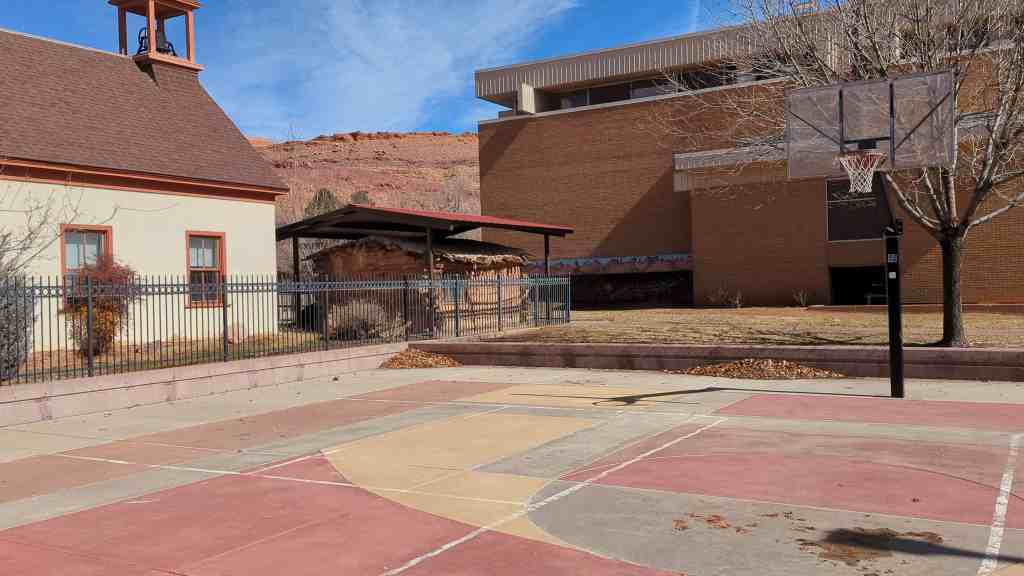
Constructed of adobe in 1889, the Moab L.D.S. Church was built nine years after the establishment of Moab in 1880. Angus Stocks supervised the laying of the foundation and adobes. Within a few years of the original construction, an addition was made to the rear of the building. The church was used by the Moab Ward until 1925 when a new church was built and this church deeded to the Grand County School District. In 1937 the Grand County Camp of the Daughters of the Utah Pioneers began holding meetings in the building and have continued to use the building, with the exception of a ten year period between 1954-1964 when it was used for classrooms.

The Moab L.D.S. Church is located at 45 North 200 East in Moab, Utah and was added to the National Historic Register (#80003907) on November 28, 1980.

Related:

  • Early L.D.S. Church (D.U.P. Marker located here)
  • Elk Mountain Mission (D.U.P. Marker located here)
  • Moab Cabin (located here)

This 1889 stuccoed adobe structure is emblimatic of the LDS origins of Moab and the continuing importance of religion in the life of that community and is significant as a late example in Utah of a church building which exhibits the Greek Revival influence. It is of typical pioneer architecture, constructed of locally-available materials through the efforts of many local citizens, and its T-shape plan reveals the rapid growth of LDS Church membership during Moab’s early years of settlement. This structure was also the only religious building in Moab until 1910, when the Baptist chapel was formally dedicated.

The Moab area was long of interest to many groups because the Colorado River could be easily crossed at that point. Moab (then unnamed) was on the Old Spanish Trail, it became the site of the Mormon Elk Mountain Mission in 1854-55 and was sporadically used as grazing lands for cattlemen from both Utah
and Colorado in the 1860s and 1870s. Both Utes and Piutes claimed the land, and were partially responsible for the quick demise of the Elk Mountain Mission.

The present town of Moab dates its official founding from the establishment of the post office on March 23, 1880. The town served as a regular stop on the mail route from Salina, Utah to Ouray, Colorado, the first and only route in southeastern Utah and much of western Colorado. As a fragile link to the outside world, it was of tremendous importance to settlers in the area who tended to congregate at mail stops, hence increasing the population of towns like Moab. Most of those early settlers of Moab were Mormons, and on February 15, 1881, visiting church officials organized the Moab Ward with Randolph H. Stewart, bishop, Alfred G. Wilson, first counselor, and Orlando W. Warner, second counselor.

At the time of the Ward’s founding, Moab was part of the Emery Stake. However, in 1884 the Moab ward became part of the San Juan stake and began acquiring property. The Church lot was sold for $100 by the patentee, Leonidas L. Crapo, to Bishop Stewart and Counselor Warner in 1884. The bishop, a polygamist with three wives, was sorely pressed by the “raids” of the time and in 1885 transferred the land solely to Warner for $500. The following year Warner deeded all of Lot 1 to the Moab LDS Church Trustees-in-Trust: Henry Holyoak, Jefferson A. Huff and David A. Johnson.

In 1888 the building program began. “For the first part of the building, O.W. Warner, Henry Holyoak, and O.D. Allan were appointed as the building committee. Labor, money, and building materials were donated by the Church members. Angus Stocks supervised the laying of the foundation and the adobes (which) were made in the Jonathan Huff place.. .Hyrum Alien supervised the hauling of rock…from the canyon east of Moab. J.H. Staniford supervised the carpenter work. Lumber, shingles, windows and doors were ordered from Salt Lake City. Everyone with a team and wagon helped with the hauling.. .Bill Bliss cut the stones for the foundation and Angus Stocks laid them. Mr. Bliss helped make adobes on the Huff place. John Holyoak, Mrs. Mary Murphy, and their two oldest boys hauled the adobes to the Church site.” “Grandpa” Henry Holyoak cut logs from Pack Creek to make lumber at his sawmill. Many other community members aided in construction.

However, even as the church building rose, the town population also increased. When church members congregated for the first service in 1889 the building proved too small to hold them. Builders added another room sometime prior to 1900, giving the building its present “T” plan. For many years children attended Sunday school in the basement.

In 1902 the Moab LDS Church incorporated, and the Trustees-in-Trust deeded the land to the bishop, David A. Johnson, who immediately deeded the land to the Moab Corporation of the LDS Chruch, all in that year. Until 1925 this building continued serving as a church, until the population of the faithful
increased beyond the capacity of this structure. A new church was built at a cost of $30,000, and a newer one for $200,000. In 1925 the first church was deeded to the Grand County School District, who still retains ownership.

From 1925 to 1937 this building remained vacant. On November 3, 1934 the Grand County Camp of the Daughters of Utah Pioneers was organized and began meeting in private houses and in the Relief Society rooms of the newer LDS Church. As their membership expanded, they needed more space, and in 1937 the School Board allowed them to begin meeting in the original IDS Church. At their first meeting there, on May 26, 1937, “Daughter Mary presented the Daughters with an Organ” which still remains at the Hall. On October 28, 1937, “Daughter Mabel Johnson donated a stove for the rooms of the DUP. It was decided that members would take turns in furnishing coal and kindling for the fires and should also take turns in starting the fires, on meeting nights.” Finally, the Daughters installed linoleum removed from the local hospital, for which they had made curtains. At the April 28, 1938 meeting the Daughters organized a committee for gathering relics.

Since that time the original church has served as the DUP meeting rooms and Relic Hall with the exception of a ten-year period from 1954-64. During this period of Moab’s uranium boom, the school district reclaimed the building for use as classrooms and added the door at the left rear of the building to
permit easy access. They also installed a new, lower ceiling in the front part of the structure in a room then used for band class.

The Moab L.D.S. Church is a one story, gable roof building, originally built with an I plan, but later extended to a T plan. It was built of adobe with a rock foundation and later stuccoed over. A belfry is mounted on the ridge of the roof over the main entrance. Slender chimneys with decorative brick coursing occur at each end of the extension. Greek Revival influence is evident in the orientation of the church with the gable end to the road, and in the boxed cornice which returns on the gable ends. The single door on the façade has a Greek Revival-type of pediment. According to an old photograph, a small circular window was centered over the door which no longer exists. There are three two over two double hung sash type windows on each side of the original building. With two exceptions the same type of window was used on the extension. A six over six double hung window with a transom has been used on the rear and on the north wall of the extension. Alterations to the original structure include the major rear addition, the elimination of the circular window, and the lowering of an interior ceiling. A rear door with a
frame extension over it was added to the rear extension and the larger windows also may not be original. The stuccoing of the entire building dates later than the construction of the original building and its extension.

Providence Church

01 Wednesday Feb 2023

Posted by Jacob Barlow in Uncategorized

≈ 3 Comments

Tags

Cache County, Historic Churches, Historic Markers, NRHP, Providence, utah

Construction of this building began under the direction of Bishop William Budge in 1869, ten years after the settlement of Providence. It was completed in 1873 at a cost of $12,800 and replaced a 32 x 16 foot hewn log structure erected in 1860. Reddish colored limestone, quarried near Dry Pole Canyon on the mountainside directly to the east, was used by head mason James Henry Brown in the 30 inch thick, 20 foot high walls. Known as “The Hall” and then as “The Church,” the meeting house had an excellent plank dance floor, a stage and proscenium at the east end of the hall, and a pump organ. It was a community center for dances and plays as well as religious services. In about 1877, a two-story rock vestry was added on the east. Other major additions and alterations were made in 1926, 1948, and 1968; however, the Old Rock Church of Providence is one of the best remaining examples of early Utah pioneer meeting houses.

Related:

  • The Old Rock Church
  • Providence Pioneers
  • The Providence Players

Located at 10 South Main Street in Providence, Utah

The First Presbyterian Church of Manti

20 Friday Jan 2023

Posted by Jacob Barlow in Uncategorized

≈ Leave a comment

Tags

Greek Revival style, Historic Churches, Manti, NRHP, oolite limestone, Presbyterian, Presbyterian Churches, Sanpete County, utah

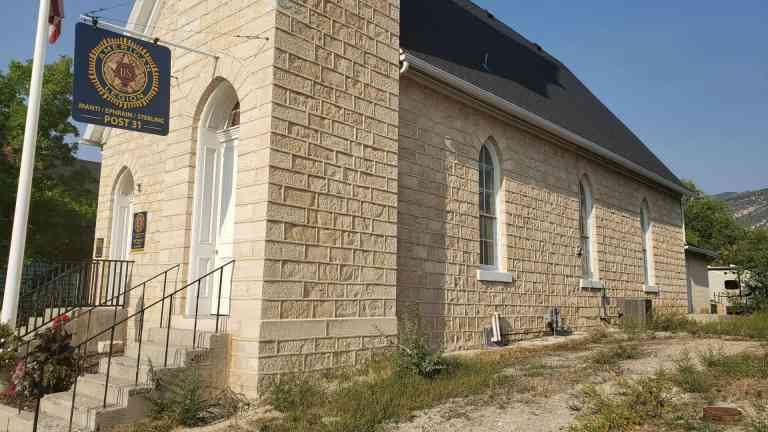
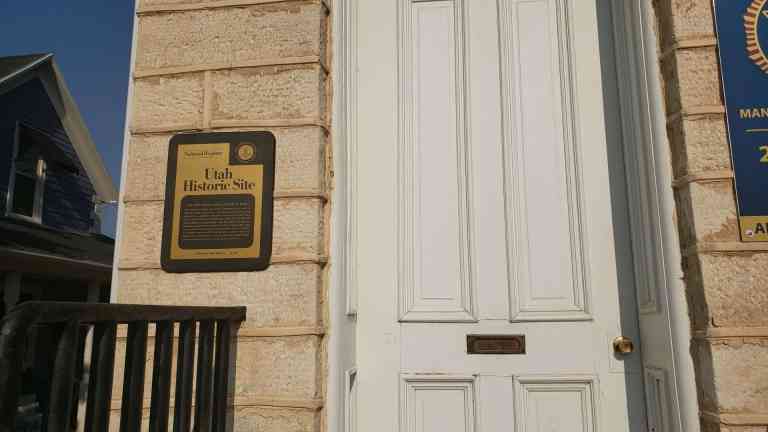
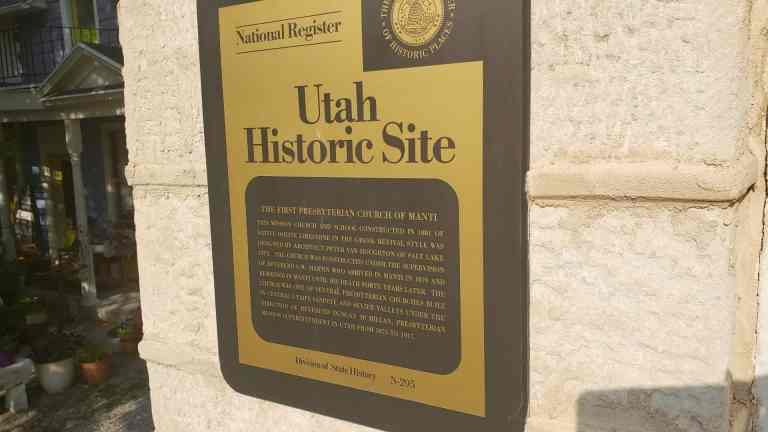
The First Presbyterian Church of Manti

This mission church and school constructed in 1881 of native oolite limestone in the Greek Revival style was designed by architect Peter Van Houghton of Salt Lake City. The church was constructed under the supervision of Reverend G.W. Martin who arrived in Manti in 1879 and remained in Manti until his death forty years later. The church was one of several Presbyterian churches built in central Utah’s Sanpete and Sevier Valleys under the direction of Reverend Duncan McMillan, Presbyterian Mission Superintendent in Utah from 1875 to 1917.

Located at 165 South Main Street in Manti, Utah and added to the national register of historic places (#80003951) on March 27, 1980.

From the national register’s nomination form:
The First Presbyterian Church of Manti is significant because it documents the important role of a non-Mormon religious organization in stimulating improved educational opportunities in Utah and because the circumstances surrounding its being brought into existence place aspects of Mormon settlement into a new perspective. The building is a distinguished addition to the built environment of Manti.

Presbyterianism was established in Utah on June 11, 1869, with the arrival of the Reverend Melancthon Hughes to begin a pastorate in Corinne, Utah. Although begun with work in a Gentile boom town, Presbyterianism in Utah quickly became a determined missionary and youth education program aimed principally at converting Mormons.

As a religion whose own beliefs demanded an educated understanding of Christian doctrine, and whose style of religious organization was democratic, Presbyterians perceived Mormonism as a perversion, “a sort of cross between Roman Catholicism and Protestantism with vestigal marks of paganism, too eclectic to be evangelical and yet too evangelical to be wholly non-Christian.”1 Similarly, the authoritarian nature of the Mormon Church and its internal discipline was seen as “despotic suppression of liberty among its votaries and victims.” Convinced that Mormonism was both false and un-American, and, strengthened by the resolve that “Christianity and patriotism are natural allies … the Presbyterian Church discovered that it had mission work in Utah requiring intellectual strength, fervent piety, and executive ability.”

The missionary who epitomized these qualities, the Reverend Duncan McMillan, was also the man who brought into being the Presbyterian missionary strategy in Utah of offering superior educational facilities that would in time create an educated populace who would turn away from Mormonism. McMillan’s first venture demonstrated his ability to capitalize on available opportunities. Hearing of a group of disaffected Mormons in Sanpete County, he received permission from the Presbytery of Utah to proceed to Mt. Pleasant.

When he arrived on March 3, 1875, the Reverend McMillan found a group of potential converts in the Mt. Pleasant Liberal Club. These people were former members of the Mormon Church, either apostate or excommunicated, who had been growing in number since 1862 when a rift in the local Mormon Church organization had produced the defection of a sizeable number of Swedes. They had been joined over the years by others, Anglo-American and from the other Scandinavian groups, whose common bond was that they were now no longer Mormon. Politically they supported the Liberal Party against the People’s (Mormon) Party in territorial politics, but religiously they were adrift.

Since they had progressed far enough in organization to have completed a Liberal Hall just the year before, the situation for the Reverend McMillan was well-nigh perfect … to have both a congregation and a meeting place.

The other situation from which the Reverend McMillan was able to profit was the poor quality of public schools in Utah. While Mormon communities had generally established schools as among their settlement priorities, the nature and product of this schooling left much to be desired. Lack of trained teachers and an irregular and often-interrupted school year meant that most children received an indifferent education at best, but often, none at all. Fashioning benches with his own hands, McMillan opened his first school in Mt. Pleasant on April 20, 1875, with 35 students in attendance.

After overcoming some initial financial problems and with the help of other ministers and a corp of dedicated female Presbyterian missionary teachers, McMillan would establish congregations or schools throughout Sanpete and Sevier counties and in other parts of Utah territory. His school at Mt. Pleasant would become the Wasatch Academy, still operating and listed on the National Register.

In 1877 two former Mormon missionaries, Andrew Jenson and Andrew Nelson, called on McMillan and invited him to start a school in Manti. McMillan quickly called upon his brother and sister-in-law to undertake the project The school grew to 122 pupils, the largest of any school in Sanpete County,’ and a congregation was begun with twelve new Presbyterian converts. The most active elder of the new church was Andrew Nelson, a polygamist with four wives, 24 children, and 118 grandchildren. In order to accommodate to his new Presbyterian sensibilities, Nelson abandoned three of the wives.

McMillan, always sensitive to charges levelled by other Presbyterians that the Utah mission to the Mormons was inordinately expensive, triumphantly reported:

there are more converted Mormons in that one church than in all the churches of Salt Lake City put together …. Now I should like those pious economists to know that our noble, wealthy, Presbyterian Church has “wasted” only $75.00 in the conversion of those ten families, and the planting of Presbyterianism in the midst of this wilderness of sin.

The First Presbyterian Church of Manti had been firmly established by the time the Reverend G. W. Martin and family arrived in 1879 to take up the post of minister. The Reverend Martin would remain at his post in Manti for over forty years, and during that time would witness both the first flush of success as Presbyterian schools and churches sprang up in Sanpete and Sevier county under the prodding of the dynamic McMillan and, sadly, he also witnessed the gradual stagnation of Presbyterian effort. Because the Presbyterian schools had offered solid curricula and able, well qualified teachers, Mormon parents had rarely hesitated to take advantage of this educational opportunity for their children. But by the mid-1890s Mormon Stake Academies and the improved public education system made the Presbyterian schools less attractive, and gradually with the exception of Wasatch Academy the mission schools went out of existence. Proselyting, after the first harvest of Mormon dissidents, became increasingly difficult and conversions were slow. The Manti congregation dwindled through migration and reconversion to Mormonism, and when the Reverend McMillan died in 1917 the Presbyterian Church in Manti died with him. However, unlike some of his firey colleagues, the Reverend Martin was held in considerable esteem by the Mormon community of Manti. They valued his educated (a B.A. from the University of Ohio and a B.D. from Union Theological College) commitment to civic affairs in their community, and his consistently friendly and broad-minded attitude toward Mormonism. His funeral, in the church he had built and served for forty years, was attended by dignitaries of the Mormon Church who had offered the Manti Tabernacle to accommodate the large crowd who attended the service.

Subsequently the First Presbyterian Church of Manti, with its bell that had once rung for city curfews as well as church services, fell into disuse and disrepair. It is currently operated as a lodge hall.

The Assumption Greek Orthodox Church

10 Thursday Nov 2022

Posted by Jacob Barlow in Uncategorized

≈ 1 Comment

Tags

Byzantine style, Carbon County, Greek Orthodox, Historic Churches, NRHP, Price, utah

The Assumption Greek Orthodox Church

Organized and built by the Greek immigrants of Carbon County. Dedicated August 15, 1916 by Reverend Mark E. Petrakis. Built in traditional byzantine style.

The Hellenic Orthodox Church of the Assumption is located at 61 South 200 East in Price, Utah and it was added to the National Register of Historic Places (#73001861) on April 11, 1973.

The following is from the nomination form for the National Register:

The Hellenic Orthodox Church of the Assumption at Price, Utah was dedicated August 15, 1916. The Greek immigrant was the last of the Europeans to come to America and the church at Price was the thirty-third Greek Orthodox Church established in North and South America.

In 1900 there were only three Greeks in Utah, During the Carbon County coal miners’ strike in 1903-1904 Greeks were first brought into the Price area as strike breakers. By 1916 there were 3,000 young Greek men working in the coal mines of Carbon County.

“To the Mormons the Greeks were interlopers among the ‘white’ population; they were clannish, would not marry outsiders, and thought they were an exceptional people with the only true religion on earth…. The Mormons were also clannish, would not marry outsiders, and thought they were an exceptional people with the only true religion on earth,” (Helen Zeese Papanikolgs, Toil and Rage in a New Land, p.143.) The result was a clash of cultures which was intensified by the abuses suffered by the Greeks in the coal mines and camps.

Plans were drawn as early as 1912 for a Greek Orthodox Church, however it was not until August 15, 1916 that construction had been completed and the church was consecrated.

The leaders of the movement to construct a church were Stylian Staes, Emmanuel Salevurakis and Gust Pappas. In 1914 a church had been established in Helper. During 1914 the Greeks from Price met with those of Helper in an effort to convince them that there should be a permanent church building erected in Price, (The church services at Helper were held in a Greek Coffee House.) Eventually the Helper Greeks agreed to aid in the construction of a church in Price.

An attempt was made to secure the donation of a plot of land by Price City, however this was voted down by the Price City Council The land was finally purchased from Lars and Sadie Gunderson for $800.00.

On March 7, 1916 bids were opened for the construction of the church, Lars Gunderson had submitted the lowest bid, $11,336,00, for construction of the church without a heating plant, and the bid of $968,00 for a furnace.

On the day of consecration special trains ran from all the coal camps bringing men to Price for the celebration. They were met at the station by the Sunnyside Italian band which escorted the men to the church. The procession to the church was characterized by shouting and the shooting of guns for good luck to the church.

The church was very important to the Greek population of the county. It gave them a sense of security and stood as a symbol that they had made a permanent settlement. This encouraged the Greek men to send for their wives or, for the majority who were single, to request that Greek girls be sent over for them to marry. In the beginning most of the Greek men had come to America with the idea of earning as much money as possible and then returning to their homeland.

The construction of the church was also significant because it came at a time when foreigners, especially Southern and Eastern Europeans, were regarded as an inferior menace to America. In this respect the church served as a sanctuary for the Greeks from both the intolerance of the American public and the abuses of the coal mines.

The immigrants served by the church were an important element in Utah history sharing in strikes, labor wars, attempted lynchings, Ku Klux Klan attacks, mine explosions and accidents, the Depression and war. In their own way the early Greek immigrants who built the Greek Church of the Assumption were just as much pioneers as were the Mormons who came to Utah more than fifty years earlier.

The original church was of traditional Byzantine construction in which the dome rests on a square supported by four pillars with the nave of the church in the form of a cross. It was built of yellow colored brick with a foundation of cement.

In 1940-41 a new entrance, two towers on the outside front, and an inside balcony were added. The original wooden columns were replaced by four cast Corinthian columns.

A fire in 1945 caused considerable smoke and water damage. The altar and environs were badly marred. A new tableau was built and the Rev. Zoygraphos of Texas, a Greek priest and iconographer, was commissioned to paint new icons for the entire church to replace the original ones ruined by the fire.

The icons, religious images painted on panels, have been called the “Bible of the Unlettered.” They cover the iconostasion or altar screen. The central large figure on the middle door of the altar m screen, the Royal Gate, which slides open to reveal the altar, is of Christ the Arch Priest, while other icons always include Christ on the right, Virgin and Child on the left, etc. The second and third rows above show scenes from the life of Christ and the twelve Apostles respectively. There are icons on the two sides of the church, while the four pendentives depict the Evangelists: Matthew, Mark, Luke and John, The most awe-inspiring scene of all fills the concavity of the top of the dome and is a symbolic representation of God the Father, surrounded by an angelic host, holding the world in His left hand. The vertical walls of the dome are covered by portraits of Old Testament prophets and contain numerous round, stained and leaded glass windows; they cast a subdued, even light on the contents of the dome.

Another artifact of singular beauty is the massive brass and crystal chandelier which hangs by a huge iron chain from the center of the dome. It was a feature of the original church and the sum of $560 was raised for it by the Greek miners of Hiawatha, a coal mining camp of southwestern Carbon County. It was also extensively damaged by the fire, but was repaired and restored at a cost close to its original value.

In 1961 the church was again enlarged, however the basic integrity of the church has been maintained in spite of two remodelings and one fire-induced renovation. In fact, these programs have added to and enhanced the structure while producing much-needed space. On each side of the church are three of the original stained and leaded glass windows. Another is in the east end of the church behind the altar. A dozen of the original small, round, stained and leaded windows augment the sides of the dome. The size of the building as it now stands is 87 feet 8 inches long by 43 feet six inches wide.

Goldfield Methodist Episcopal Church

14 Friday Oct 2022

Posted by Jacob Barlow in Uncategorized

≈ Leave a comment

Tags

Episcopal, Historic Churches, Methodist

Goldfield Methodist Episcopal Church, built in 1912 and currently the community center.

Located in the Goldfield National Historic District in Goldfield, Nevada

Dutch Flat Methodist Episcopal Church

13 Wednesday Jul 2022

Posted by Jacob Barlow in Uncategorized

≈ 1 Comment

Tags

Dutch Flat, Episcopal, Historic Buildings, Historic Chapels, Historic Churches, Methodist, Placer County

Dutch Flat Methodist Episcopal Church
936 Stockton Street in Dutch Flat, California

Started 1859 and completed 1861, this chapel has been in use since its completion.

Grantsville First Ward Chapel

30 Thursday Jun 2022

Posted by Jacob Barlow in Uncategorized

≈ Leave a comment

Tags

Grantsville, Historic Chapels, Historic Churches, NRHP, Tooele County, utah

The Grantsville Meetinghouse constructed in 1865-66 is locally significant as one of a limited number of early LDS meetinghouses still standing that was built in the traditional style of early church buildings, based on the Greek Revival temple form, and in traditional building materials, adobe that was plastered over. It is particularly unusual among early meetinghouses in that the vestry was attached at the rear of the building and not on the front as was most common. The building served as a center for religious and community activities in the early days of Grantsville and is a reminder of the importance of the church in all aspects of pioneer life. A 1952 addition is not included in the historic register nomination.

The Grantsville First Ward Meetinghouse is located at 297 West Clark Street in Grantsville, Utah and was added to the National Register of Historic Places (#82004165) on February 11, 1982.

Related:

  • Grantsville Fort Historic Marker
  • Oldest Churches in Utah

In 1848, Thomas Ricks and Ira Will-is built the first structure on what is present day Clark Street in Grantsville. The building was a herd house used by the two men who were herding stock for Brigham Young and Bishop Edwin D. Wooley.

On October 10, 1850, Joseph McBride, Harrison Severe and their families arrived and established Willow Creek. In March of 1851, the families moved across the valley and resided in the settlement of Pine Canyon. The reason for this move was for protection against the Indians in the area who had been raiding cattle from the white settlers. In December of that year, McBrides, Severes, and five other families returned to establish a permanent settlement. It was at this time that the first “branch” of the IDS Church was established at Grantsville. In 1852, the townsite was surveyed by Jesse W. Fox under the direction of Colonel George W. Grant, an officer in the Nauvoo Legion. Grant had been chosed by Brigham Young to help the Saints protect themselves against the Indians in the area. In 1853, the town was renamed “Grantsville” in honor of Col. Grant.

In March, 1854, Elder Wilford Woodruff called for more volunteers to help settle the area. This call took place at a conference of the church held in the tabernacle in Salt Lake City. In 1853, a fort was begun and by fall of 1854, it was nearly completed. The fort wall had a five foot thick base that gradually narrowed to an eighteen inch thickness at the top. The wall was twelve feet high. It was during this period of time that the first meetinghouse was built. The log structure had a dirt floor and was approximately 20′ x 16′. The building served as the hub of community life. It was located in the area west of the chapel that is now Cooley Street. In 1865, plans were made for a new meetinghouse. The building was to be located within the fort walls. The building would be made of adobe bricks and the clay for these bricks came from the pits located a quarter mile north of the building.

In July of 1865, construction of the building began under the direction of Hugh Alexander Ross Gillespie, a native of Scotland who had come to Tooele in 1853. Gillespie is also responsible for building some of the structures at Camp Floyd and bad come to Utah to work on the Salt Lake City Temple. The building was completed in June of 1866 at a reported cost of $10,000. The building was 60 feet in length and 38 feet wide, with a vestry located on tbe back of the building that was 22 feet by 18 feet. The “Presiding Elder” of the Grantsville Branch at the time of construction was Thomas H. Clark.

Dedicatory services for the building were held July 14, 1866. Those attending the services included Brigham Young, Wilford Woodruff, George Albert Smith, and Franklin D. Richard, with the dedicatory prayer being offered by George Q. Cannon. At these services, Brigham Young blessed the Saints and requested that there should be not dancing in the new meetinghouse. Members of the community are proud of the fact that every man who is or has been president of the LDS Church, has spoken in this building with the exception of Joseph Smith.

In 1877, the Grantsville Ward was established and William Jefferies became the first bishop of Grantsville. During these early years, the church continued to serve as the hub of the community, as did the log structures in the 1850s and early 1860s. The meetinghouse was the center of social and community life, as well as religious life. By the early part of the Twentieth century. Grantsville had grown to the point that the ward was divided and the Grantsville Second Ward was established. This took place in 1914. It was at this time that the Second Ward Meetinghouse was built on Main Street. This building was recently demolished (1980). The addition on the eastern end of the First Ward building was added in 1952 to provide classroom space. The meetinghouse was used until 1978, when a new building was built. After the move to the new building, discussion as to the use of this building took place. Plans included demolition at one point. There was also speculation about the city buying it. When the city decided not to buy the building, Tate Mortuary of Tooele purchased the building. In the future, the building will be used for viewings and funeral services.

The Grantsville Ward Meetinghouse is a one story, gable roof, rectangular structure whose style is derived from the Greek Revival temple form. It is situated gable end to the street. Classical elements include a boxed cornice with returns on the gable ends, and quoins. The pattern of the quoins is repeated around the door which is centered on the facade.

The meetinghouse was constructed of adobe, and then stuccoed. The thickness of the walls exceeds two feet. Wood shingles have been replaced by asphalt shingles on the roof. A vestry was added to the rear of meetinghouse. It has a gable roof and a cornice similar to the meetinghouse.

The façade is symmetrical, the door centered between two windows. Above the door is a medallion on which is printed, “LDS Chapel, First Ward, 1866.” All the windows on the meetinghouse and vestry are the double hung sash type, and those on the meetinghouse have a transom over them.

The main assembly room has undergone extensive remodeling. The choir loft was removed to make way for a bigger rostrum area. In 1952 a complex of classrooms and other auxiliary rooms was added to the east of the chapel, it detracts only slightly fromthe original integrity of the building and is not included as part of the nomination.

American Fork 3rd Ward Meeting House

12 Sunday Jun 2022

Posted by Jacob Barlow in Uncategorized

≈ 1 Comment

Tags

American Fork, Gothic Revival, Historic Chapels, Historic Churches, Jacobethan Revival, NRHP, utah, utah county, Victorian Eclectic

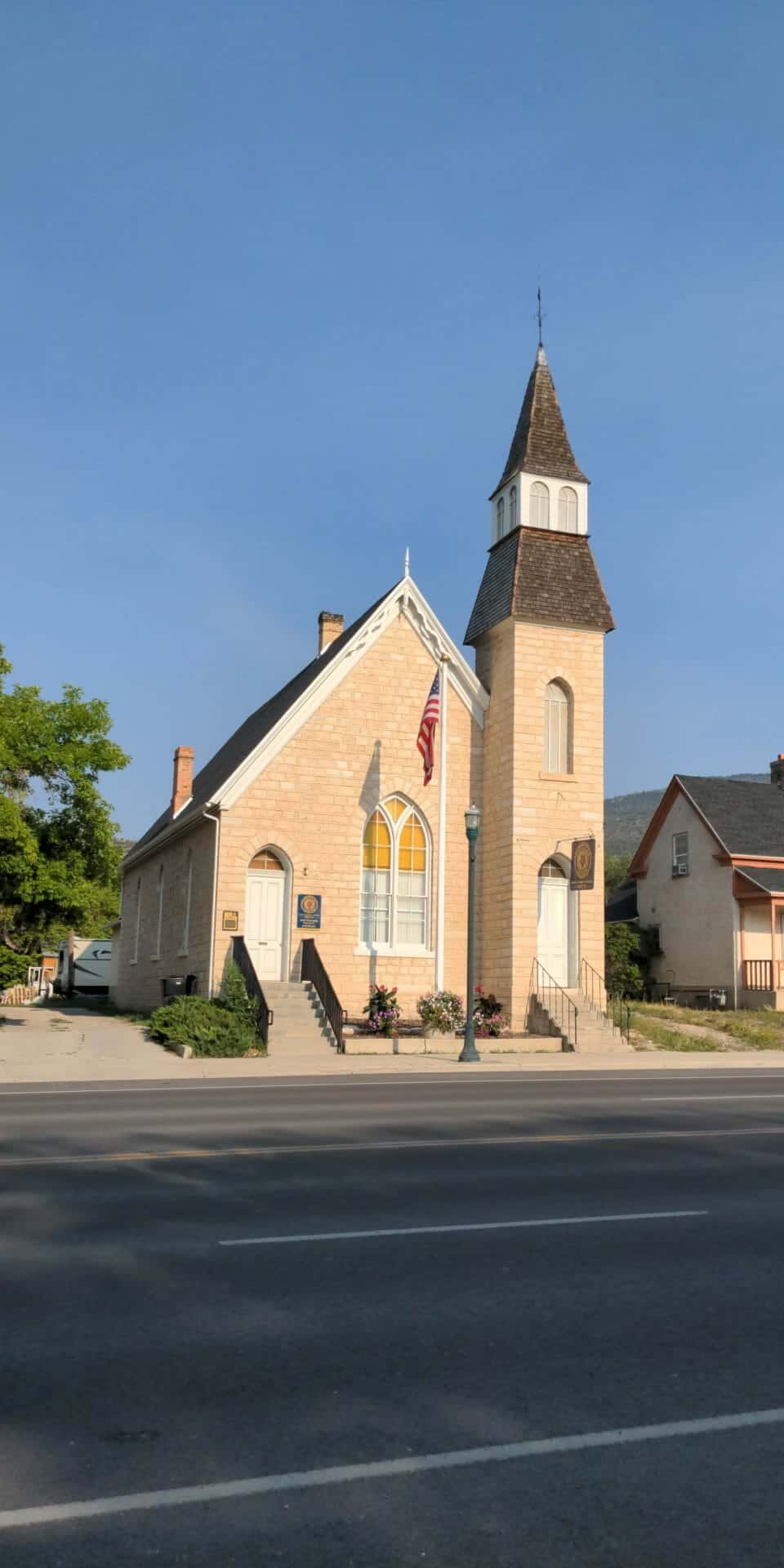
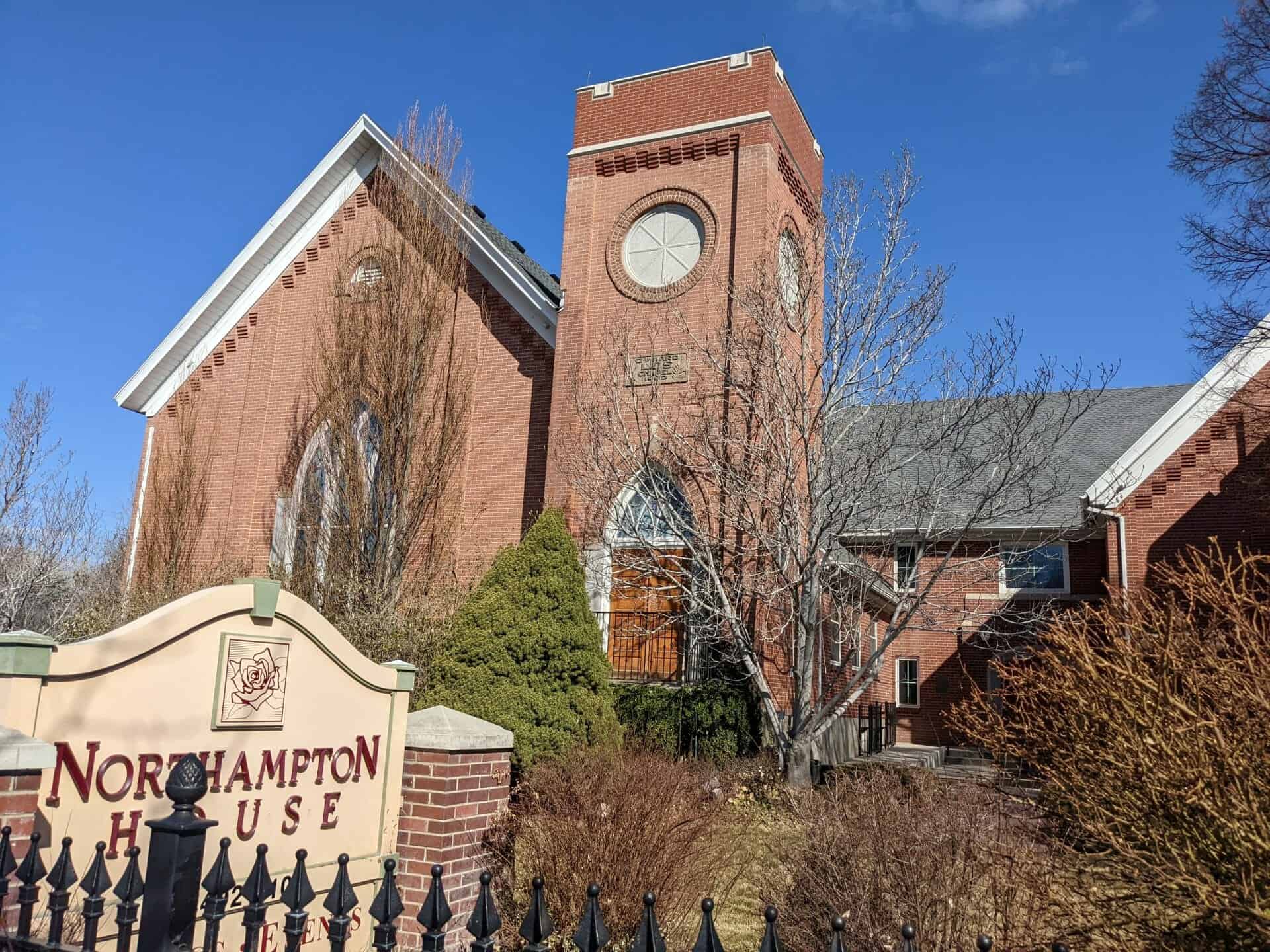
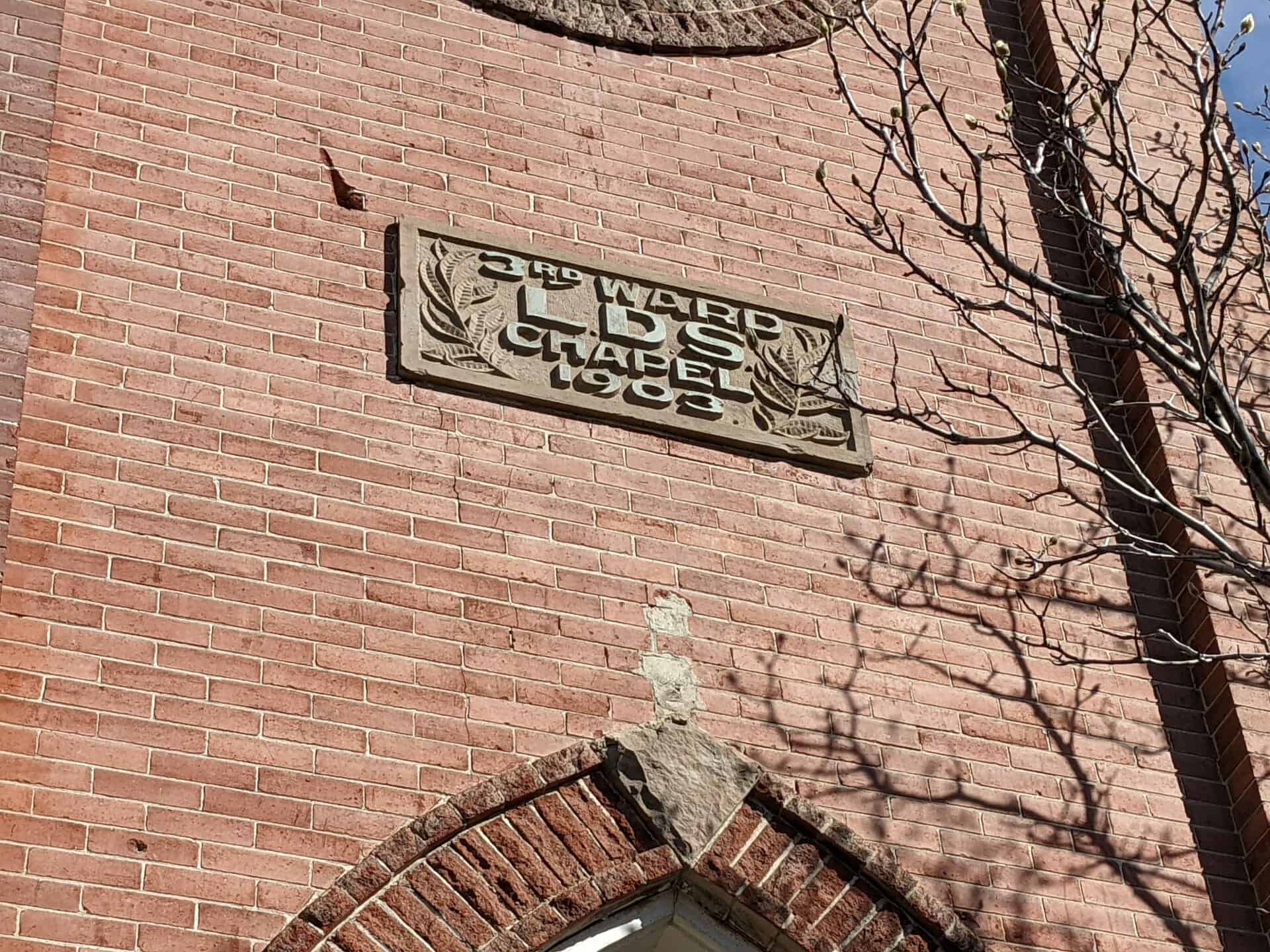
The American Fork 3rd Ward Meetinghouse, constructed in 1903 and expanded in 1938 and in the 1950’s, is significant for its association with the growth of The Church of Jesus Christ of Latter-day Saints (LDS or Mormon Church) in northwest American Fork and for its importance to the community and the patterns of social life seen in its use.

Architecturally, the building is significant as an artifact documenting evolution of and influences on architectural styles and customs of the LDS Church during the first half of the century. This era, when the church (officially) established standardized design for its church buildings, is believed by architectural historians to be the golden age of Mormon meetinghouse architecture.

This building is one of four meetinghouses designed and built by local craftsmen and ward members in American Fork, and it reflects the popularity of the Gothic Revival and Victorian Eclectic styles in church buildings during this era. The 1938 addition of a Jacobethan Revival-style recreation hall and classroom wing, designed by the church architectural department, reflects the church’s policy of including all church functions under one roof; previously separate amusement halls had been the policy. The 1958 addition and interior renovation, designed by Clifford Evans Architects, was a conservatively modern attempt to adapt the original structure to a growing ward membership.

The church sold the building in 1995 due to its limited size. After being a daycare center, it was purchased in January 2001 by the Hawker family, who then initiated the extensive renovation, working closely with the National Historic Register to preserve its historic value. The grand opening of Northampton House, a wedding, banquet, and reception hall, took place in October 2001.

Located at 198 West 300 North in American Fork, Utah and added to the National Register of Historic Places (#02001554) in 2003.

Narrative Statement of Significance

The American Fork Third Ward Meetinghouse, built in 1903 and expanded in 1938 and the 1950s, is significant under the “Meetinghouses & Tabernacles” context of the Mormon Church Buildings in Utah: 1847-1936 multiple resource nomination, for its association with the growth of the Church of Jesus Christ of Latter-day Saints (LDS or Mormon Church) membership in the northwest portion of American Fork, Utah. The building is significant under Criterion A for its importance to the community and the patterns of social life seen in its use. The building is also significant under Criterion C as an important document of the influences on and changes in architectural styles and customs of the LDS Church during the first half of the twentieth century. The original 1903 chapel is one of four churches, designed and built by local craftsman and ward members, and reflected the popularity of the Gothic Revival and the Victorian Eclectic in turn-of-the-century church construction. The1938 addition of a recreation hall and classroom wing, designed and directed by a strong church central architectural department, was Jacobethan in style and reflected the church’s policy of including all church auxiliaries and functions under one roof. The 1958 addition and interior renovation, designed by a Salt Lake firm with ties to the church, was a conservatively modern attempt to adapt the original structure for a growing membership. Between January and September 2001 the American Fork Third Ward Meetinghouse was extensively rehabilitated to adapt the building for use as a reception center. This work was being completed as a historic tax credit project, and included the restoration of several original features. The building is in excellent condition and is a contributing historic resource of American Fork.

HISTORY OF THE AMERICAN FORK THIRD WARD MEETINGHOUSE

In the summer of 1850, three years after members of the Church of Jesus Christ of Latter-day Saints arrived in the Salt Lake valley, pioneers camped in the area now known as American Fork while traveling to Provo, fifteen miles to the south. Impressed by the area, Arza Adams and Stephen Chipman asked permission from Brigham Young to establish a cattle ranch, but were instructed to survey several tracts for settlement. The initial pattern of settlement in 1851 differed from the traditional Mormon villages because the settlers chose to first live and farm along the creek where they had access to water rather than build on the small orderly town lots. Indian unrest resulted in the construction of a fort in 1853, and from then on the settlement was less dispersed and the town grew within the town site. For most of the 1850s through 1870s, American Fork residents relied on ranching and subsistence farming, lived in simple log and adobe homes, and held meetings in an adobe building, also used as a school. The city was incorporated on June 18, 1853, as Lake City, and later the name was officially changed to American Fork in 1860.

Economic growth came in the late nineteenth century as the city became stable enough to strengthen municipal institutions and support mercantile trading. The Deseret Telegraph Company established an office in American Fork in 1867. By 1870, a narrow gauge railroad was built to the nearby canyon to support mining activity, and a major event occurred in 1873 when the Utah Southern Railroad extended its service to American Fork.

Mining brought cash to support a growing mercantile base, and brickyards and lumber mills allowed residents to construct more substantial and stylish homes and businesses. When the Denver & Rio Grande Railroad reached American Fork in 1883, the city was experiencing intensive commercial growth and municipal maturity. Between 1890 and 1900, the population of the city grew from 1,942 to 2,732.

The American Fork Ward of the LDS Church was organized on May 5, 1851, and was the social focus of the practically the entire town for fifty years. On January 13, 1901, a general reorganization of the LDS Church in Utah County took place. The original Utah Stake of Zion (a stake is equivalent to a diocese), which once encompassed all LDS wards (equivalent to parishes) in the county, was divided into three stakes. The northern portion of the county, which included American Fork, became the new Alpine Stake. Six months later, on July 14, 1901, the American Fork Ward was divided into four wards, each comprising a quadrant of the city. A committee was appointed in each of the four wards to locate a site on which to building a ward chapel. The four buildings were completed by 1905, and all were rectangular buildings with towers at one corner and Gothic Revival details. Local carpenter, Arthur Dickerson (1874-1949) designed the Third Ward. The four ward bishops bought the brick together because they could get a good price for such a large quantity. All four chapels were later expanded (1920s-1930s) to include recreation hall and additional classrooms. Of the four buildings, only two are extant: the Second Ward Meetinghouse, which was listed in the National Register of Historic Places in 1992, and later incorporated into the American Fork Historic District in 1998; and the Third Ward building. The Fourth Ward building was destroyed by fire on June 28, 1975, and the First Ward was demolished in the late 1960s.

The American Fork Third Ward included all the members living in the northwest quadrant of the city. A corner lot at 190 West 300 North belonging to the Thomas Shelley (1822-1903) family was acquired by John R. Hindley (1863-1947), first bishop of the Third Ward, for the sum of four hundred dollars in May 1902. On October 3rd, Hindley transferred the deed to the American Fork Third Ward to be administered by him as bishop and by his successors. Excavation on the building commenced in April 1903. Members began holding services in the basement as soon as the first room was finished. The chapel was completed by 1905. With few exceptions, the labor to build the edifice was donated by ward members. The building was completed at a cost of $9,099.75. Both the Third and Fourth Ward chapels were dedicated on March 17, 1907. A photograph taken on that Sunday morning indicates a crowd of more than 200 in attendance at the Third Ward service. An interior photograph taken that year shows the chapel with metal frame, theater-type seats, elaborate woodwork in the podium-pulpit area, and a large coal burning stove to provide heat. A second smaller stove was located in the basement. According to Ellen Tracy, historian of the Third Ward, the “grounds were lovely with grass and trees. North of the building were hitching posts for those who had to come with horse and buggy or wagons. And back of the hitching posts was a grove of trees and grass where many socials were held.” The manuscript history of the ward notes a second dedication on September 3, 1908, by Joseph F. Smith.

The ward grew steadily and by July 1915, the northern-most portion of the ward boundaries was given to the Highland and Alpine Wards, with a transfer of 95 members. The ward continued to grow, but for many years the original chapel was more than adequate especially since extremely large groups could by accommodated in the Alpine Stake Tabernacle, built between 1909 and 1914. In 1929, with a ward membership of 659, a committee was formed to discuss the building of an amusement hall. During the previous decade the LDS Church had instituted a policy of including all ward auxiliaries and functions under one roof. For example, the Third Ward Relief Society (the ladies’ auxiliary) converted an old school house to a Relief Society Hall in which they held meetings for eighteen years. The anticipated construction was postponed; however there appears to have been some minor renovation work in the chapel and basement by contractors of the Chipman Mercantile Company completed in 1929. By 1932, the ward was paid off the debt for this work and began again to consider an addition. In June 1937, the ward approved plans for a new recreation hall and classroom block provided by the church architectural department, and work commenced exactly one year later. The general contractor for the project was again Chipman Mercantile of American Fork. Electrical work awarded to Samuel F. Grant of American Fork, and Utah Fuel Supply of Salt Lake City was awarded the heating contract. Work proceeded so quickly that by October 1938, the building committee was able to report the brickwork was complete and the shingling nearly complete. The building was mostly finished by 1939 and more than double the existing floor space. The recreation hall included a basketball court, stage area, and projection room (movies were a popular ward social event in the 1930s and 1940s). The classroom wing included twelve classrooms, a Relief Society room, bishop’s office and kitchen. Other amenities included new restrooms, a cloakroom, and remodeling of the basement.

Though the project was not completely finished until 1942, the majority of work took less than a year partly because more paid labor was used than in previous projects. Final cost was about $30,000, with the general church fund providing sixty percent of the cost and the ward financing forty percent. This left the ward with a hefty debt on the building. Several methods of fond raising were used. The ward held benefit banquets, including a January 1939 dinner held for the general public in the basement of the tabernacle. In 1940 the Relief Society raised funds by sewing a quilt featuring the names of all the officers who had served in various ward capacities since 1901. One enthusiastic member issued a challenge to the priesthood that he would match dollar for dollar all funds donated by other ward members. The amount was considerably more than he anticipated, but he came through and paid up. The completion of the new wing raised enthusiasm in the ward. The year 1939 was a banner year for perfect attendance awards.

Throughout the first half of the twentieth century, American Fork was a primarily agrarian community. Though only a few residents participated in large-scale agricultural production, most families supplemented their employment by having vegetable gardens, small orchards, and chicken coops on their large lots. Growth in the community was slow, the population of American Fork increased by less than 700 between 1910 and 1940. World War II brought the Geneva Steel Plant and thousands of defense workers to Utah County. Many stayed in the area, and by 1950, the population of American Fork had jumped to 5,126. The large lots within the Third Ward boundaries began to be subdivided to accommodate the post-war housing boom. In January 1950, with a ward membership of 1,022, the Third Ward was divided creating the Eighth Ward whose members lived on the east side of 100 West. The division necessitated staggering meeting times in order to share the building. The Eighth Ward later moved into a new building with the Sixth Ward.

In April 1956, a committee was organized to study possible additions and renovations to the Third Ward
building. The accepted proposal was projected at a cost of $48,850. Dal Allred of Clifford Evans Architects, a Salt Lake firm with long-standing ties to the LDS Church designed the classroom-office wing to the west, and a substantial remodel of the chapel. Renovation work began on February 29, 1957, when the men and boys of the ward removed the original chapel seats. Meetings were held in the Alpine Stake Tabernacle during the construction. The ward held seven building-fund banquets and other entertainments to help defray construction costs. Virtually all of the building received some type of renovation, but the most significant alteration was made in the chapel where the original podium pulpit was removed and a new one built at the opposite end. All new landscaping and expanded parking facilities were also included in the project. The final cost of the 1957-1958 work was estimated at $85,885.77. Four hundred fifty members (out of a ward population of 940) attended dedication services on December 14, 1958.

The design of the renovation was intended to accommodate two wards in the building, which occurred in March 1959 when the ward was again divided. The new Tenth Ward took all members north of 500 North. A new chapel for the Tenth Ward was built in 1964. In October 1973, the Third Ward was combined with parts of the Seventh Ward to form a new Sixteenth Ward, an event that Ellen Tracy describes as “a real blow to the older 3rd ward members.” The building continued to be used by members of the LDS Church until it was sold in October 10, 1994, when it was deemed inadequate. The Briar Rose Preschool acquired the property and immediately remodeled the building for school use. The building was sold in 1999 to the Chapel Hill Academy, and in January 2001 was acquired by the current owner. In September 2001, a complete adaptive reuse renovation of the building was completed as an historic preservation tax credit rehabilitation project. The building is currently known as the Northampton Reception Center.

ARCHITECTURE

The first meetinghouse in American Fork was a vernacular Greek Revival-style hall, built of adobe brick in
1861 (now demolished). The four ward meetinghouses built between 1901 and 1905 represent a period of
change during which the LDS Church, following the pattern of other Christian denominations, considered the Gothic Revival style appropriate for church buildings.2 The character defining features of these Gothic-style meetinghouses were asymmetrical facades, crenellated towers, and pointed-arch windows with wooden tracery. In plan, the meetinghouse was typically a rectangular hall with classrooms and offices located in a wing or in the basement. The church hierarchy usually employed local builders (often members of the ward) when professionally trained architects were not available. James H. Pulley (1856-1934), a local builder-carpenter, is known to have designed the Second and Fourth Wards. Arthur Dickerson, a local builder and member of the ward’s building committee designed the Third Ward building. Arthur Dickerson was born in American Fork in 1874. He is listed on the 1900 census of American Fork as a carpenter. According to his obituary, Dickerson was an “inventor, building contractor and musician.” In addition to designing and constructing buildings, he also made violins and guitars, and dabbled in poetry. He died in Idaho in 1949.

The practice of employing local builders and architects for meetinghouse designs was common in the church until 1920. After World War I, due increasing membership and building expenses, LDS Church leaders created a centralized architectural department where standardized plans could be produced in order to erect meetinghouses more quickly and less expensively. The plans for the 1938 addition were generated by the LDS Church Architectural Department and reflect the influence of head architect Joseph Don Carlos Young (1855- 1938), who designed for the church from the 1890s to his retirement in 1936. Between 1921 and 1936, his influence permeated the design of most LDS meetinghouses produced during this period. Young used a wide range of architectural vocabulary in his designs. Most of the meetinghouse designs were based on his innovative design of a U-shaped chapel and amusement hall. This standard plan was used in a number of wards and was nicknamed the “Colonel’s Twins.” Decoration on the buildings varied, but usually incorporated Georgian and Federal-style architectural motifs. The American Fork meetinghouses were an adaptation of the U-plan to existing chapels. The Third Ward’s Jacobethan Revival (a style based on 17th century English architecture) ornamentation is subtle and complements the Gothic-style of the original chapel. The 1958 addition and renovation, while just outside of the historic period, is also an important feature of the building. The west wing is somewhat of an aberration in the church’s architectural department of the 1950s. Standardized plans, most featuring Colonial Revival exteriors and modern interiors, were available in a range of sizes and configurations to accommodate variations in membership numbers and sites. Adapting and renovating older buildings was becoming increasingly rare, as the church was embarking on an ambitious program of chapel building. The three building phases of the Third Ward represent changes in LDS Church architecture throughout the twentieth century.

Narrative Description

The American Fork Third Ward Meetinghouse is a two-story, brick church building, constructed in three phases between 1903 and 1958. The original chapel space, constructed in 1903-1905, was designed in an eclectic Gothic Revival style. In 1938, a recreation hall and classroom wing was constructed to the east and north with modest Jacobethan decorative elements. The building was again expanded in 1958 in a wing to the west and north. Through the years minor alterations have been made to the exterior of the building, none of which substantially affect the building’s overall architectural integrity. The interior was extensively remodeled during the construction of the 1958 addition. The building is currently undergoing a major rehabilitation for adaptive reuse as a reception center. This work, which is a historic preservation tax credit project, is designed to restore many of the original features of the building as well as adapt the building to a new use.

The original 1903 footprint was a 53 feet x 80 feet rectangle with a square tower and entrance vestibule at the southeast corner. The 1903 building sits on a rock-faced, ashlar, stone foundation. The brick is red tap brick laid in a running bond with flush mortar joints. Decorative brick elements included corbelling at the cornice line, square colossal pilasters (projecting above the roofline for a slightly castellated effect), and rock-faced brick accenting the window hoods and round tower windows. Windows and door transoms were pointed, gothic-arches. A large stained-glass window was located on the south elevation. The upper tower windows had a floral design. The main floor of the sanctuary was above a raised basement. Steps leading up to multi-panel, double doors were located on the tower’s south elevation, and the north end of the east elevation. A grade-level entrance to the basement was located on the east side of the vestibule. Sandstone was used for lintels, sills, impost blocks, keystones, and the date block above the tower entrance. The cornice was plain and the eaves of the simple gable roof were slightly belcast. The roof of the tower was pyramidal with patterned shingles. On the interior, the sanctuary featured a raised podium and pulpit at the north end. The podium featured Victorian-gothic ornamentation such as a lathe-turned balustrade and gothic-designs in the woodwork. Metal frame theater-style seats were used (instead of pews), and a large pot-bellied stove was mounted next to the podium to heat the space. Ward histories indicate in 1929, the basement, originally used for classroom space, was expanded and remodeled.

In 1938, the first major addition was built to the east and the north. This addition effectively doubled the floor space of the original building, with a recreation-social hall to the east, a two-story auxiliary wing (classrooms, restrooms, and kitchen) to the north, and a foyer connecting the new space to the old. The new addition is constructed on a concrete foundation with no basement. The brick is laid in common bond with headers every sixth course. The south elevation of the addition features corbelled brick and pilasters similar to the 1903 building, but the decorative elements are Jacobethan rather than Gothic Revival. The south elevation of the social hall features a projecting entrance wing with a crenellated parapet and cast concrete window and door surrounds. A second, recessed entrance (also with a cast concrete surround) leads into the connecting foyer. On the interior the foyer has stairs to the second floor classrooms and a cloakroom. The hall is open with a stage to the north and a projection room (above the projecting entrance wing). The classrooms, restrooms, kitchen etc. are located at the rear of the building and can be accessed either from the foyer or the rear entrance.

Both the north and east elevations of the 1903 building were significantly impacted by the 1938 addition. In addition, the pilaster caps and belcast eaves were probably removed at this time when a new roof was installed on the structure.

In 1958, a major remodeling took place when the west wing was added. The 1958 wing is also two stories, and construction included additional excavation of the original basement. The wing sits on a raised concrete foundation and is constructed of red brick laid in a common bond similar to the 1938 addition. Although the 1958 addition features pilasters, there is little ornamentation such as corbelling. The windows are steel-sash, multi-pane windows and the doors were multi-paneled wood. The wing sits sufficiently back from the south elevation and does not impact the main facades of the 1903 and 1938 portions. The main feature of the 1958 addition is the entrance on the west elevation. On the interior, the space is divided into an entrance vestibule, classrooms, offices, and a large mechanical room in the basement.

According to the construction drawings for the 1958 addition, the 1938 wing was left intact with little or no alterations. However, several significant changes were made to the 1903 portion of the building. On the exterior, the stone foundation was encapsulated in concrete and the steps to the tower entrance removed. The cornice was replaced and the roofline simplified. Louvers were installed in the attic vents. The tower roof was removed and replaced with a built-up roof deck, a new crenellated brick parapet, capped with cast concrete, and new metal steeple. New cast concrete panels replaced the original upper tower windows. A chapel annex (quiet room) was added to the chapel’s east elevation. The gothic windows on the west elevation were replaced with steel-sash versions of the same design. The wood sash of south elevation window and transom was left intact, however, the original stained glass was replaced with a blue-green, marble-patterned milk glass. On the interior, the changes were even more significant. All original finishes and furnishings in the chapel were removed. A new podium was built at the south end changing the orientation of the congregation and new pews were installed. The new design was modern, with simple lines and light, tan-colored woodwork.

About 1970, the stained-glass window and tower entrance were bricked-in, probably due to the difficulty of replacing broken glass. The aluminum soffits around the entire perimeter of the building were installed in the 1980s. A more major alteration was the replacement of the wood doors on all main elevations with glass and aluminum (probably 1970s or 1980s). Metal stairs were added to the west (supported by wing walls) and north elevations for additional egress from the second floor, and necessitated converting two windows into doors. When the property was sold in 1994, church officials had the steeple removed before transferring the deed. The building was used as a preschool between 1994 and 2000. Alterations made during this phase included the removal of pews and from the chapel space and the demolition of the stage area in the recreation hall. The steep stairs to the projection room were removed at an unknown date.

Between January and September 2001, the building was rehabilitated for use as a reception center. Alterations to the exterior were minor. Most were designed to restore the historic integrity of the building. The window-blocking brickwork from the south elevation was removed and a new stained glass window was installed in the original wood sash. Stained glass was also installed in several panes of the gothic windows on the west elevation, and the windows on the tower. The original entry doors in the tower were rehabilitated. New wood doors (designed with six panels similar to the tower doors) were installed on the south and west elevation entrances. All brick, sandstone and concrete was cleaned and repaired. The exterior metal stairs were removed. A new glass entrance was created on the north elevation where the original stage entrance and loading doors were located. Handicap access ramps were created on the south and north elevation, and also at a new basement entrance in the southwest corner of the building. A new cast concrete balustrade was created for the tower balcony and the southeast entrance. The exterior work has restored many of the lost historic features of the building.

On the interior, all 1958 and subsequent finishes were removed. The chapel and recreation hall were
rehabilitated for use as reception hall (west and east halls respectively). The west hall (chapel) and annex
rooms were given new paint, carpet and contrasting woodwork in the Victorian Eclectic style. A new staircase (designed with a lathe-turn balustrade similar in style to the original 1903 podium) was built at the north end. The east hall (recreation hall) is simpler in design with a rough stucco finish and a hanging lattice of flowers under the ceiling. Alterations to this area include partition walls at the south end and a new staircase on the west wall. The south foyer staircase (1938) was also rebuilt with a marble and wood mantelpiece installed in the foyer area. The west foyer was left intact with new finishes. A chair lift was installed in the corridor. The existing kitchen and bathrooms were upgraded. Existing classrooms were converted to bride’s rooms, office space and meeting rooms. The basement was refinished for use as meeting rooms, storage and a floral shop. All interior work was sensitive to and compatible with the original historic features of the building while addressing issues such as code compliance, egress, access and a new community-based usage.

The building faces south on a one-acre parcel of land. An additional parcel is used for parking to the east. A third parcel (to the north and east) was recently acquired by the current owner and will also be used for parking. A small brick utility shed (non-contributing circa 1980) sits on the northeast corner of the original parcel. The property is on the corner of 300 North and 200 West, with sidewalks and grassy parking strips along the streets. There are mature trees on all the landscaped portions of the property with sidewalks leading to the primary entrances. A number of shrubs and other plants are located at the base of the building. Exterior lighting, stone retaining walls and patio space was part of the landscape upgrades included in the adaptive reuse. The property is located in a hilly residential neighborhood just north of American Fork’s historic downtown. There is a mix of housing stock ranging from early adobe settlement homes (1870s & 1880s) to very recent residential construction. The American Fork Third Ward is in excellent condition and is a contributing historic resource of the neighborhood.

B’nai Israel Temple

06 Monday Jun 2022

Posted by Jacob Barlow in Uncategorized

≈ 1 Comment

Tags

B'nai, Historic Churches, Israel, Jewish, NRHP, Salt Lake City, Salt Lake County, Temples, utah

B’nai Israel Temple

Designed by Philip Meyer, a native of Germany and a nephew of local retail magnate Frederick Auerbach, the B’nai Israel Temple was constructed in 1890-91. Henry Monheim, a local architect, supervised the construction. It is one of the few remaining structures built by Utah’s early pioneer Jews and reflects their importance in the development of the economy, government, and educational institutions of the state. The design of this Romanesque Revival style building was reportedly based on the Fasanenstrasse Synagogue, a famous Jewish temple in Berlin. While the main elevation is rusticated Kyune sandstone, the side walls and the drum beneath the dome are brick.

The Congregation B’nai Israel was organized in 1881 and built a small synagogue in 1883 at First West and Third South. Following a division in the synagogue, the orthodox Congregation Montefiore built a new synagogue at 355 South Third East, and the reform B’nai Israel congregation built this temple. It was sold in the early 1970’s when a new temple was built for combined local Jewish congregations. It has since housed several commercial enterprises including a restaurant and offices.

Located at 249 South 400 East in Salt Lake City, Utah

← Older posts
Newer posts →

Follow Jacob

Follow Jacob

Blog Stats

  • 2,017,138 hits

Social and Other Links

BarlowLinks.com

Recent Posts

  • Dome Church Foundation Stones
  • Broom Factory and Wagon Train Terminal
  • West Jordan Museum
  • Kane Springs Rest Area
  • 1140 E Harvard Ave

Archives


Loading Comments...