White City was started by developers Ken White and Cannon Papanicholas in 1955. Ken White named “White City” and it became listed as a “census designated place” by the US Census Bureau. The first homes were built along Galena Drive in 1957. White City Water Company was developed to service the area owned by these developers. Later, in 1961, Sandy Suburban Service District was started to service this same area. Edgemont Elementary was the first school built, one of three elementary schools and one middle school within walking distance. The majority of White city was built in the fifties and sixties. White City was granted the status of township by The Salt Lake County Council on September 26, 2006.(*)
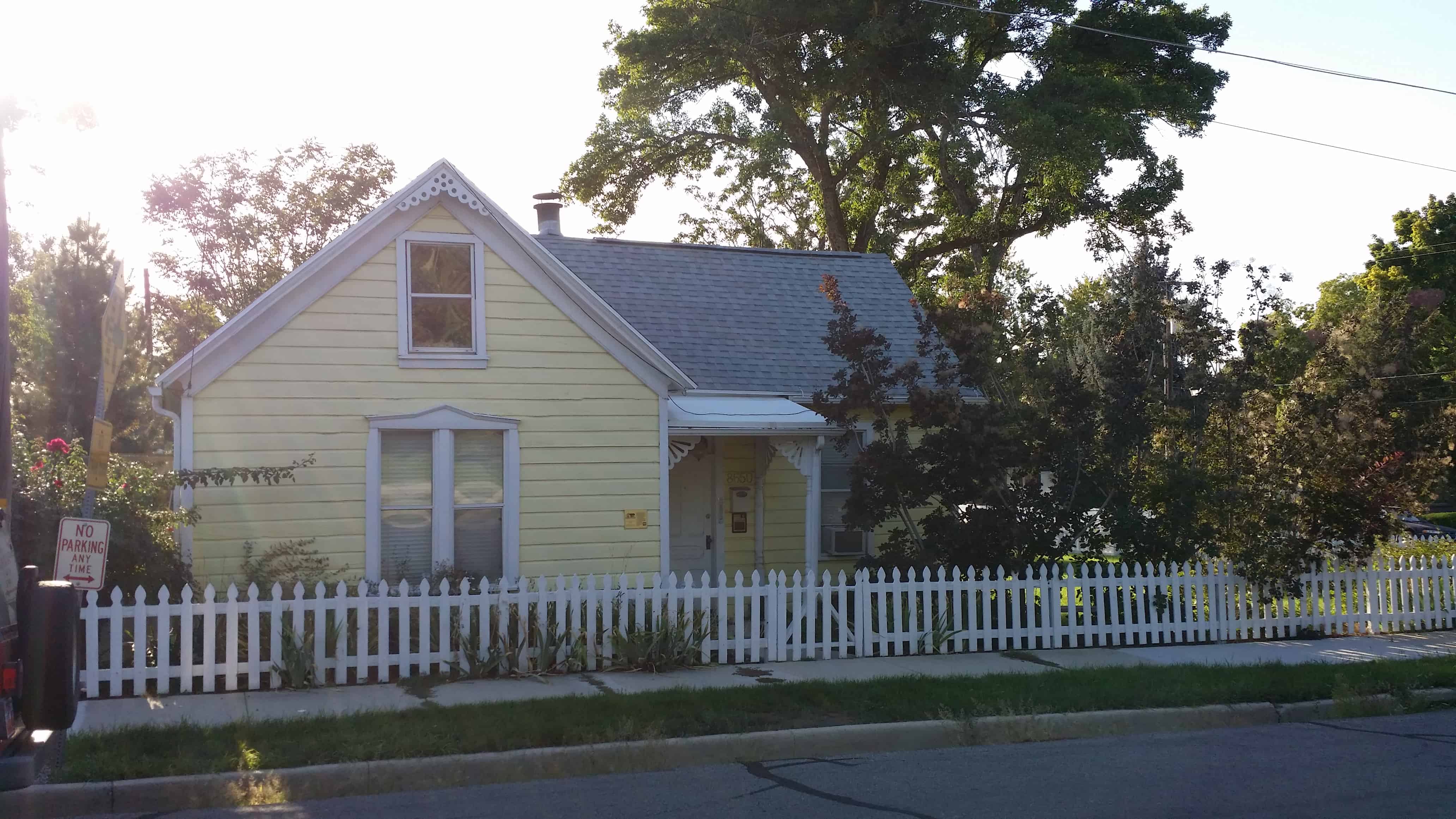
The Jensen-Jensen House, build c. 1909, is significant for its association with Sandy’s historical development. This one-and-one-half-story house was historically Victorian in form and most likely in style as well. The house has had a number of alterations, it retains its c. 1938 historic integrity.
Jens P. and Eleanor probably built the home; however, they did not stay here for long. In 1911 the house was sold to one of Jen’s sons by his first marriage, James P. Jensen, and his wife Belle for $1,000. James found employment with the Studebaker-Consolidated Wagon Company as an accountant. Later he purchased from his in-laws Crapo’s Grocery Store located on Main Street in Sandy, and the Jensen’s ran the popular store until 1975.
The above text is from the plaque on the home, placed in 2002. The home is located at 55 East Pioneer Avenue in the historic sandy area of Sandy, Utah
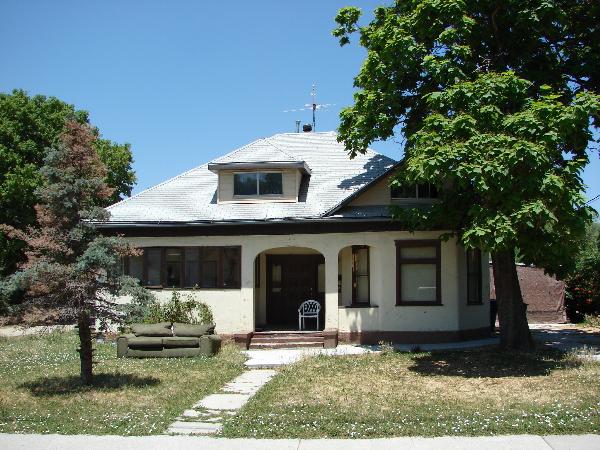
Built in 1904, this single story brick structure is one of the best preserved examples of the cross-wing plan in Sandy. It retains a majority of its original Queen Anne and Victorian eclectic detailing and is expressive of the local craftsmanship and use of native materials. The main entry to the house has been created with an angled vestibule placed at the inside corner of the intersecting wings. the gables at the projecting and intersecting wing are triangulated by a full cornice return and were originally detailed with a variety of patterned shingles.
This building was constructed by it’s owner, John W. Farrer, and may be among the best work of this local builder. John and Harriet Worthington Farrer sold this home in 1909 to Nephi Anderson, a local farmer, who sold the home to Bertram and Maude Vincent in 1918. Bertram died the following year and his wife continued to live in the home and supported herself and her young family by working in the garment industry.
The above text is from the plaque on the home, placed in 1994. The home is located at 39 East Pioneer Avenue in the historic sandy area of Sandy, Utah
In 1849, eight families were sent to settle what would become Union. According to A Union, Utah, History by Steven K. Madsen, “Jehu Cox, the first settler of Union, donated ten acres of his farming land for the establishment of [a] fort.” “By 1854, a total of 23 homes had been built inside the fort – the population stood at 273,” Madsen continued. The population according to the U.S. Census Bureau was 484 in 1880, 602 in 1890, and 757 in 1900. Between 1848 and 1872, other settlements included Butler Bench, Poverty Flats, and Danish Town.
What was once Union is now parts of Cottonwood Heights, Midvale, and Sandy. Within the Cottonwood Heights area, Butler and Union Precincts (a basic form of county government) were established in 1877, as were Butler School District 57 and Union School District 23. The Unified Jordan School District would not be created until 1905.
The Archibald and Violet Gardner House, built in 1893 and remodeled in 1937, is significant for its association with an important period of development in Sandy’s history. The original home appears to have been constructed by Albert and Annie Swope and was subject to a sherrifs sale in 1898, after which it most likely served as a rental unit until it was purchased by Archibald and Violet Gardner in 1906. In 1937 the Gardners extensively remodeled and added to the house in the style of a Mission/Spanish Colonial Period Revival cottage. Archibald was employed for a long time in Sandy’s mining industries and later was a cashier and the Sandy City Bank during 1907-37. He held a variety of offices in Sandy city government, serving as mayor from 1932 to his death in 1940. Violet taught dancing in the house for many years.
The above text is from the plaque on the home, placed in 1997. The home is located at 31 East Pioneer Avenue in the historic sandy area of Sandy, Utah
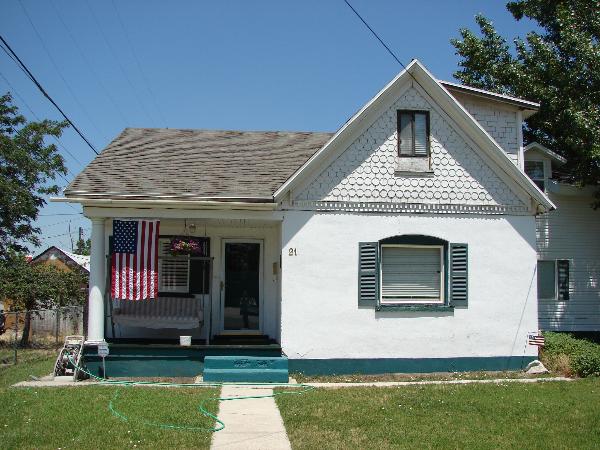
The John and Annie Johnson house, Built c. 1888, is significant for its association with Sandy’s historical development, it is a one and one-half story cross wing house built of adobe brick and wood frame and covered with stucco. The house retains many of its original Victorian Eclectic details. Additions include a large dormer on the east side of the main gable and a large addition to the rear.
The property was first owned by William and Amoryllis Vincent, a prominent early Sandy couple who owned most of the property on Pioneer Avenue. In February of 1894, John and Annie took out a mortgage of $2,200, and this transaction either represents construction of the house or, most likely, a remodeling of an existing building. This house has had several subsequent owners.
The above text is from the plaque on the home, placed in 2000. The home is located at 21 East Pioneer Avenue in the historic sandy area of Sandy, Utah
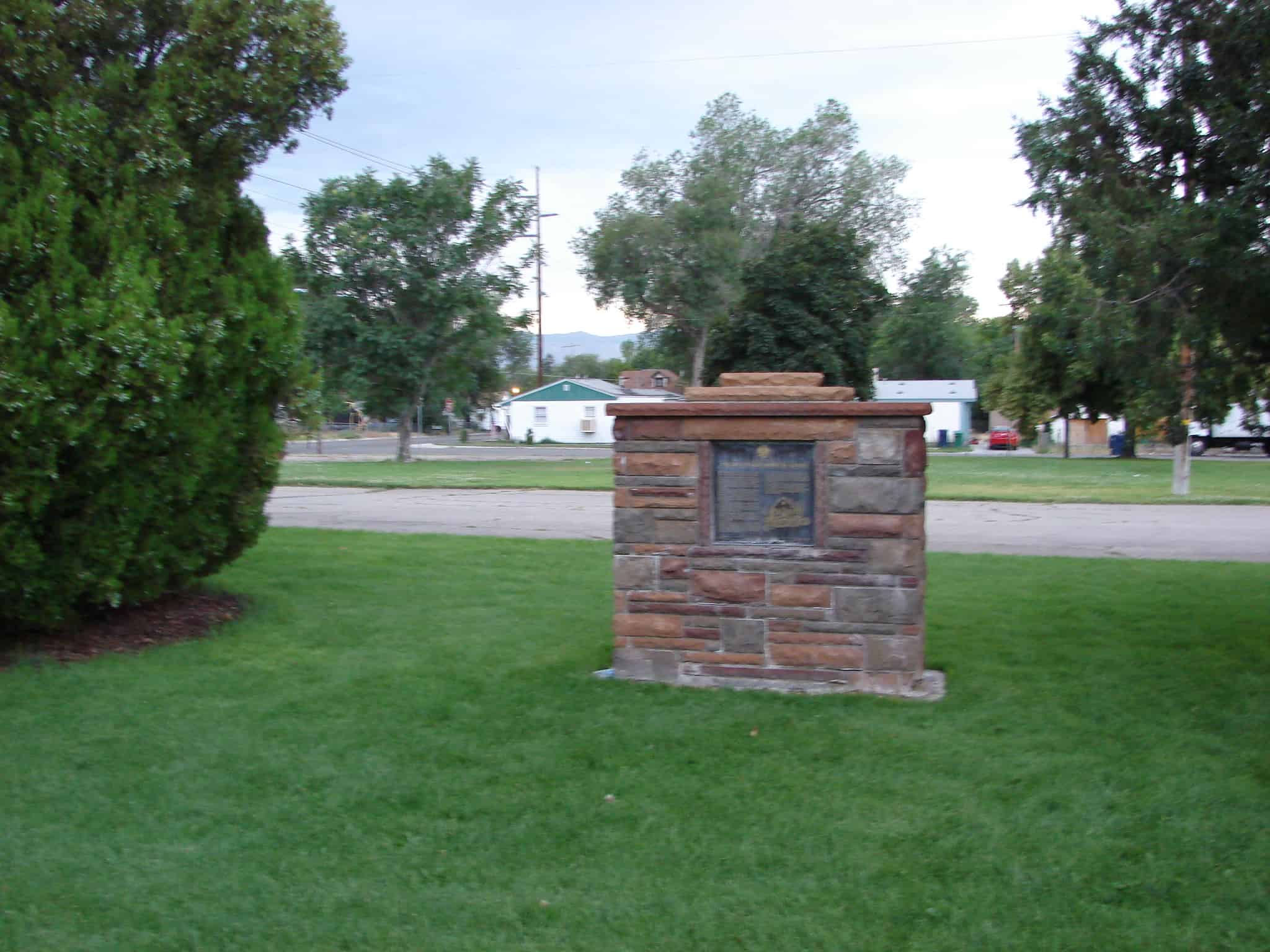
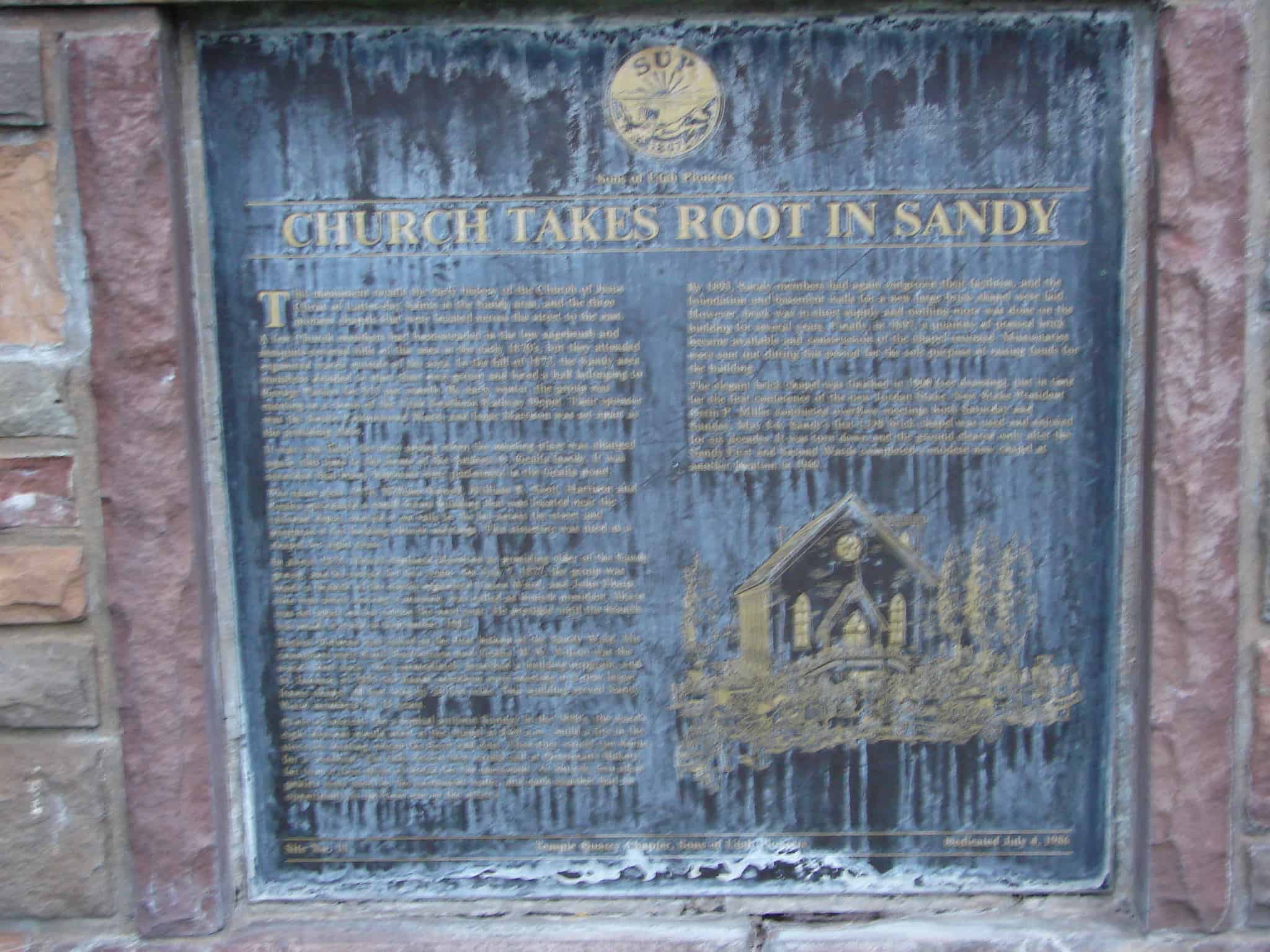
The text below is from Sons of Utah Pioneers historic marker #11, which has two plaques, Church Takes Root in Sandy and Early Sandy Schools. Located at 8780 South 280 East in the historic sandy area of Sandy, Utah
This monument recalls the early history of the Church of Jesus Christ of Latter-day Saints in the Sandy area, and the three pioneer chapels that were located across the street to the east.
A few Church members had homesteaded in the low sagebrush and mesquite-covered hills of this area in the early 1870’s, but they attended organized wards outside of the area. In the fall of 1873, the Sandy area members decided to start their own group and hired a hall belonging to George Parker for $15 per month. By early winter, the group was meeting in a room of the Utah Southern Railway Depot. Their sponsor was the South Cottonwood Ward, and Isaac Harrison was set apart as the presiding elder.
It was very likely the next spring when the meeting place was changed again, this time to the home of the Andrew O. Gealta family. It was recorded that many baptisms were performed in the Gealta pond.
The same year, 1874, William Newell, William R. Scott, Harrison and Gealta purchased a small frame building that was located near the railroad depot, moved it on rails to the lot across the street and prepared it for holding church meetings. This structure was used as a chapel for eight years.
In about 1875, Newell replaced Harrison as presiding elder of the Sandy group, and he served for two years. On July 7, 1877, the group was made a branch of the newly-organized Union Ward, and John Sharp, who was away serving a mission, was called as branch president. Sharp was set apart on his return the next year. He presided until the branch was made a ward in September, 1882.
Ezekial Holman was called as the birst bishop of the Sandy Ward. His counselors were Emil Hartvicksen and Gealta. W.W. Wilson was the ward’s first clerk. They immediately launched a building program, and by January of 1883 the Sandy members were meeting in a new larger frame chapel, 40 feet long by 26 feet wide. This building served Sandy Ward members for 18 years.
(Note of interest: On a typical autumn Sunday in the 1880’s, the ward’s eight deacons would meet at the chapel at 8:00 a.m., build a fire in the stove for heating, sweep the floor and dust. Then they would run home for a “washup.” On their return they would call at Osterman’s Bakery for two or four slices of bread for the sacrament. At church, two silver goblets were used for the sacrament water, and each member had an opportunity to sip from one or the other.)
By 1893, Sandy members had again outgrown their facilities, and the foundation and basement wall for a new large brick chapel were laid. However, brick was in short supply and nothing more was done on the building for several years. Finally, in 1897, a quantity of pressed brick became available and construction of the chapel resumed. Missionaries were sent out during this period for the sole purpose of raising funds for the building.
The elegant brick chapel was finished in 1900 (see drawing), just in time for the first conference of the new Jordan Stake. New Stake President Orrin P. Miller conducted overflow meetings both Saturday and Sunday, May 5-6. Sandy’s first LDS brick chapel was used and enjoyed for six decades. It was torn down and the ground cleared only after the Sandy First and Second Wards completed a modern new chapel at another location in 1960.
The Sandy Historic District is a Historic District in Sandy, Utah that covers most of the city’s pre-suburbanization extent. It is essentially the area east of State Street, west of 700 East north of 9000 South, and south of Pioneer Avenue (8530 South; near the northern boundary of the city of Sandy). About half of the National Register of Historic Places listings in Salt Lake County outside of Salt Lake City are in Sandy, and the large majority of those are within the Historic District.






 A list of