Lindon Ward Chapel 400 North and Main Street in Lindon
The Lindon Ward Chapel, originally built for the Pleasant Grove 2nd Ward of The Church of Jesus Christ of Latter-day Saints, was dedicated by Reed Smoot of the Council of the Twelve Apostles in 1891.
Construction of the chapel was a community effort. The property was donated by Joseph Wm. Ash. Every able-bodied man and boy contributed labor to the construction. Horses hauled clay from the foothills and pulled the mill to make adobes for the walls of the chapel.
In December 1890, construction was far enough along for a dance to be held. Proceeds from the dance were turned over to the building fund. Alfred E. Culmer, architect and project director, passed away before the final completion of the building. His funeral was the first to be held in the chapel.
The main hall contained two potbellied stoves— one in each corner. The benches ran the full width of the chapel with isles on each side. An upper gallery above the front door could be converted into a classroom by closing a set of curtains.
The chapel was torn down in 1941 with plans to build a new one. The iron fence on the north side of the property and several large pine trees remain.
Alfred Harper built this house in 1876 of honeycombed limestone quarried from nearby American Fork Canyon. It is said that he traded his homegrown vegetables and flowers for the rock. Before the building was completed, Harper had to leave his family and home to serve a three-year mission in New Zealand for the LDS church. On his return he finished the house and planted vines he’d brought from New Zealand. The vines eventually grew to surround the building.
Locals called it “The Big House,” and it became a gathering place for community and church activities.
One of the most notable features of the property was a well, complete with bucket and dipper, that passers-by were welcome to use to quench their thirst. Church-goers, children, and even the occasional tramp made good use of the clear, cold water.
In 1987, the Harper House was listed on the National Register of Historic Places, the nation’s official list of cultural resources worthy of preservation. The register recognizes the accomplishments of all peoples who have contributed to the history and heritage of the United States.
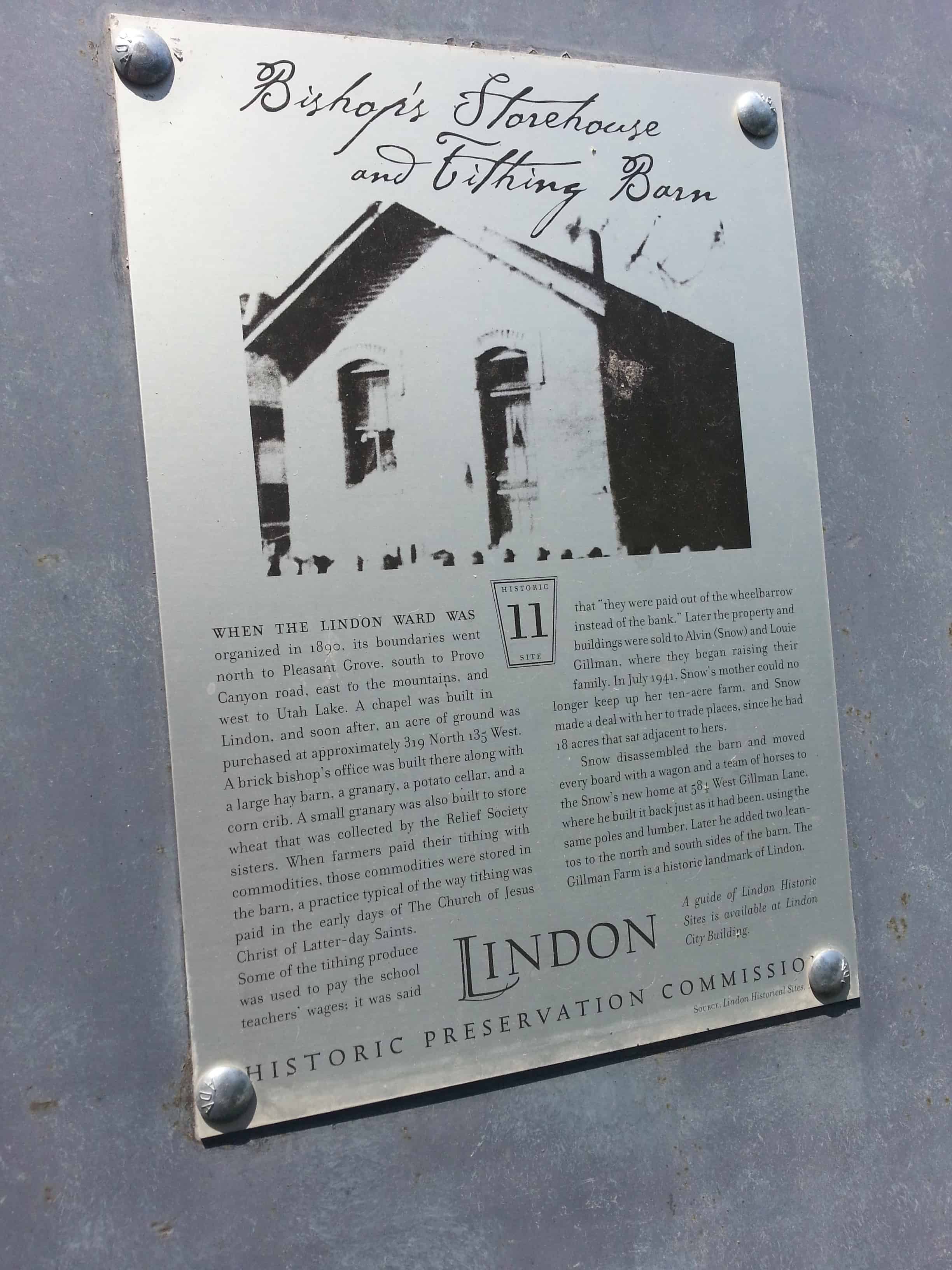
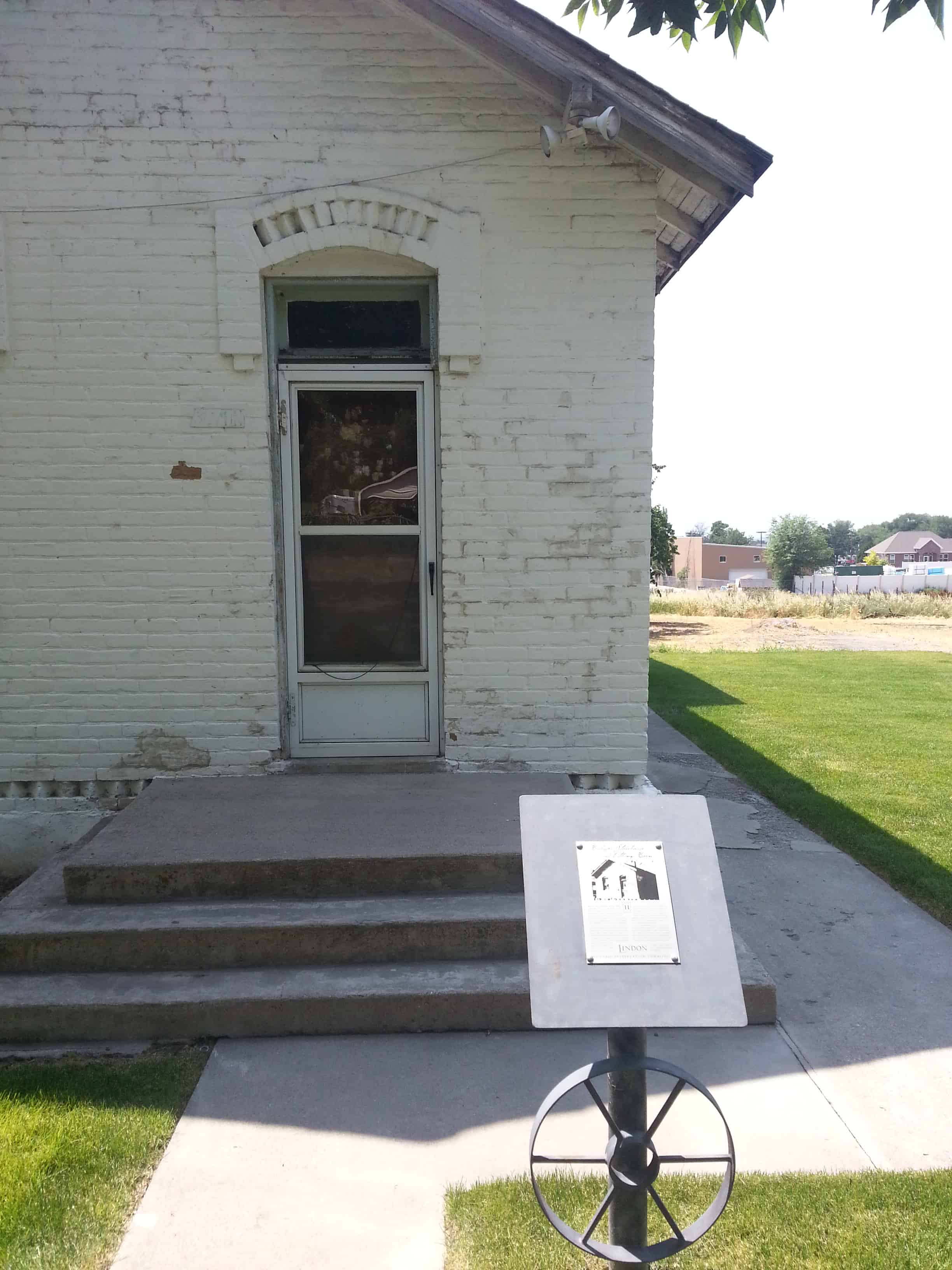
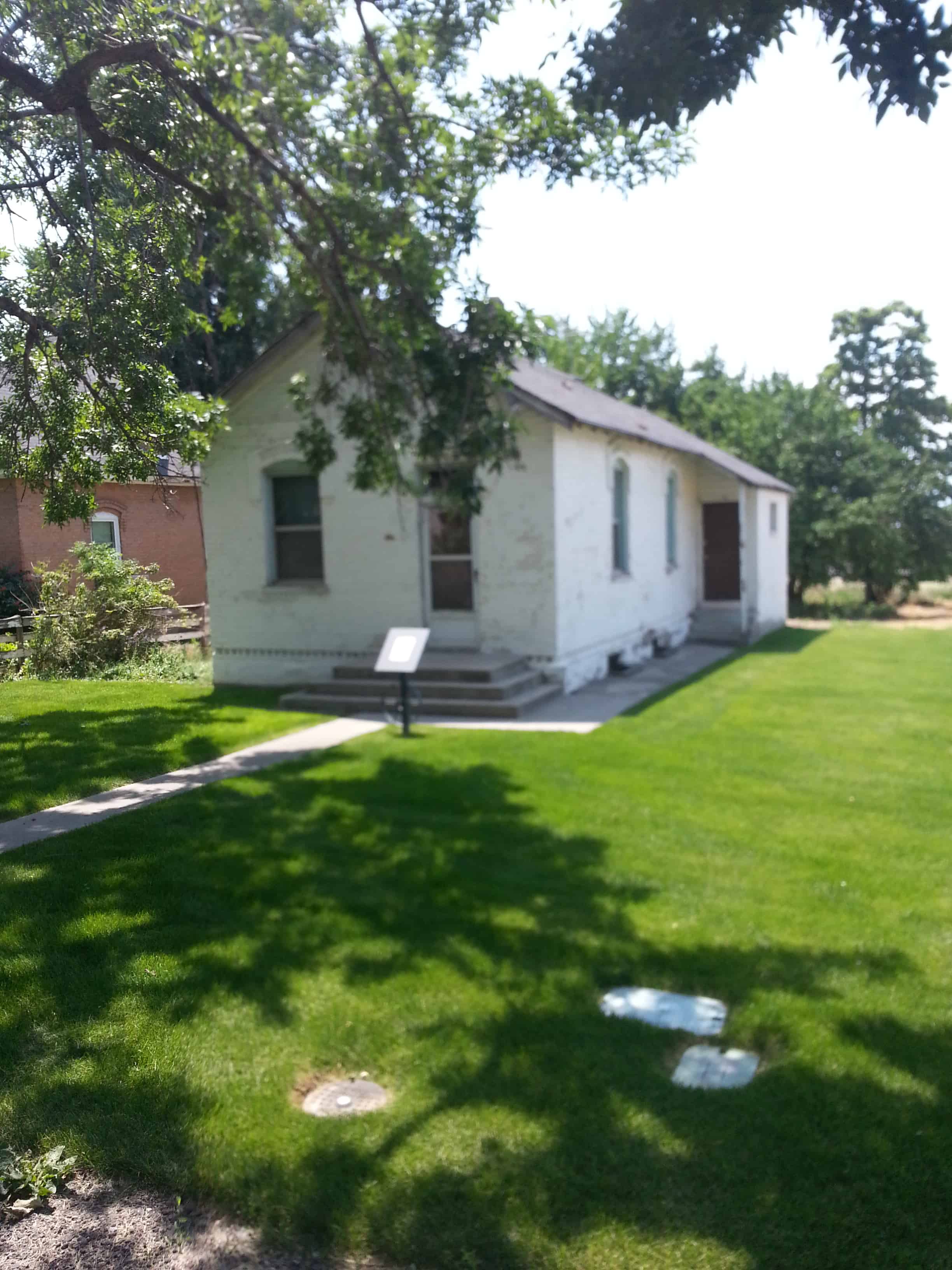
Bishop’s Storehouse and Tithing Barn 319 North 135 West in Lindon.
When the Lindon Ward was organized in 1890, its boundaries went north to Pleasant Grove, south to Provo Canyon road, east to the mountains, and west to Utah Lake. A chapel was built in Lindon, and soon after, an acre of ground was purchased at approximately 319 North 135 West. A brick bishop’s office was built there along with a large hay barn, a granary, a potato cellar, and a corn crib. A small granary was also built to store wheat that was collected by the Relief Society sisters. When farmers paid their tithing with commodities, those commodities were stored in the barn, a practice typical of the way tithing was paid in the early days of The Church of Jesus Christ of Latter-day Saints. Some of the tithing produce was used to pay the school teachers’ wages; it was said that “they were paid out of the wheelbarrow instead of the bank.” Later the property and buildings were sold to Alvin (Snow) and Louie Gillman, where they began raising their family. In July 1941, Snow’s mother could no longer keep up her ten-acre farm, and Snow made a deal with her to trade places, since he had 18 acres that sat adjacent to hers.
Snow disassembled the barn and moved every board with a wagon and a team of horses to the Snow’s new home at 584 West Gillman Lane, where he built it back just as it had been, using the same poles and lumber. Later he added two lean-tos to the north and south sides of the barn. The Gillman Farm is a historic landmark of Lindon.
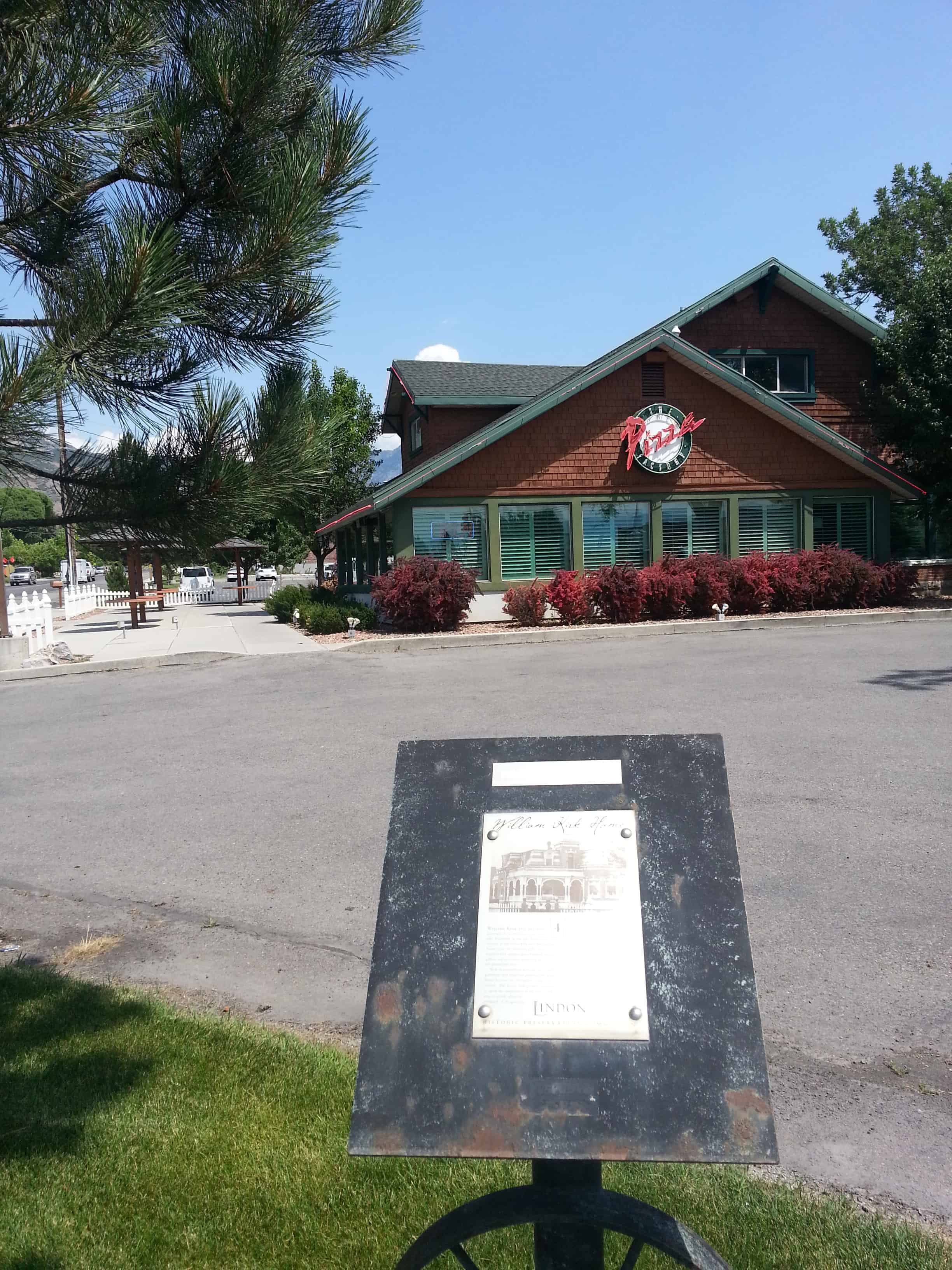
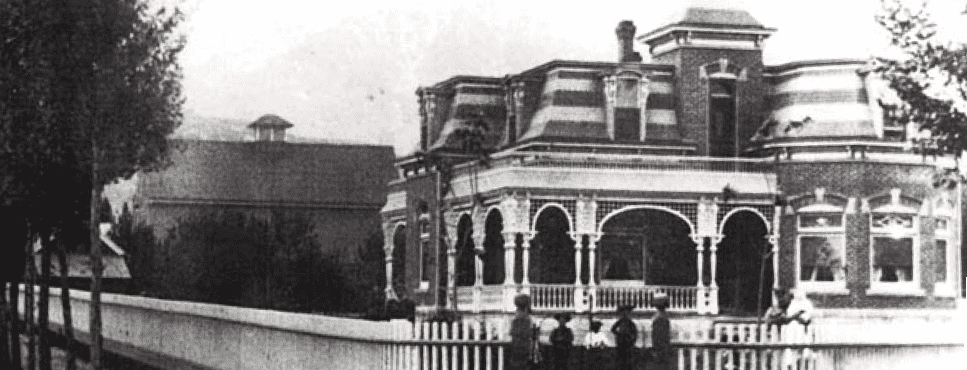
William Kirk and his sons were well-to-do sheepmen in Lindon who flourished in the late nineteenth century. In the 1880s, Kirk built the original house in the late-Victorian gothic style, with a gabled roof, stained-glass windows, porch pillars, and decorative woodwork, as seen in the photograph above.
With its immaculate grounds, tree-lined pathways, and beautiful gardens, the Kirk home became the showplace of the community. The house and grounds seemed to spark the imagination of the local youth, who, it is told, often daydreamed of its gracious living and fantasized of exploring the attics for hidden treasure.
Later the property was purchased by Lester West. Influenced by the utilitarian post-war era, West remodeled the structure by removing the top story of the house and putting on a different style roof. Most of the exterior decorative work was also removed.
The house has been used over the years for a variety of purposes, including a boys’ home. In 1996 the house was bought by Fireside Pizzeria and renovated into a restaurant.
I hiked up to the Escalante Cross again today, for more information check out this link.
I always enjoy that hike and just wanted to share the pictures this time.
I found the following online: Recent accounts have reported sightings of a ”shadowy wolf-like figure” near the foothills of Mt. Loafer. Sightings have been reported in the same general area as the Escalante Cross. The 37 foot cross towers over the small town of Spanish Fork on Dominguez hill. The cross is said to be a landmark planted in honor of the Dominguez and Esclante expedition. However, this is not the original cross planted by Silvestre Vlez de Escalante and Francisco Atanasio Domnguez in 1776. It is said that a similar cross, like the one we see today, was originally planted by the two Franciscan Friars. Journal entries found, written by these Christian explorers, tell us the cross was planted to warn off an ”evil entity” which was said to have haunted the travelers in their sleep. Tormented by howling, and sightings of this ”creature”, the explorers left abruptly, without explanation. The cross we see today was planted in 1981, in place of the original. Little do most Spanish Fork residents know, the terrifying history behind the so-called ”Escalante Cross.”
Walker’s Service Station
370 North State Street in Lindon
The first service station in Lindon was built by Bill Cobbley. In 1930 he sold it to Richard L. Walker, who remodeled the building, added a retail location for groceries and hardware, and renamed the business “Walker’s Service.” Richard’s son Ivan became heavily involved in the family business in the early 1950s and has guided the company’s growth ever since. Beginning in the early 1970s, Ivan began adding additional service station locations. As time passed, carwash bays and convenience stores became an integral part of the business. Recently,
the development of fast-food franchises in conjunction with the stores has been highly successful. At the present time there are 20 Walker’s locations in 17 communities throughout Utah. The Walker’s mission is to provide quality gasoline at competitive prices, fast friendly services, and a good future for its employees.
In 2007 the Walker’s franchise was sold to Tetco, and a few years later it was bought by 7-Eleven.
The Amusement Hall
150 North State Street in Lindon
The Lindon Amusement Hall once occupied this site. Constructed in 1900, it was built in a shape resembling a “T,” with overall dimensions of 70 feet by 30 feet. The exterior walls were made of rustic lumber, and the interior was lined with ceiling lumber.
On the east end, a stage was situated about three feet above the hall floor. The curtain was canvas, handpainted with an outdoor scene of a girl sitting beside a standing boy playing a violin. The curtain would roll up on a large roller and lights would rise up through holes in the floor, giving the effect of floodlights. The hall was the setting for three-act plays, one produced each month of the winter. Silent films were shown on Thursdays, and often three dances were held per week.
Even though the hall was not elaborate, it was a place for people from all over Utah County to gather and have good time.
Around 1940, the hall was converted into a cannery. Many different types of produce were canned, tomatoes being the most common.
Lindon Elementary School – Main Street and Center Street
In 1900 the settlers of Lindon voted to erect a new school on the corner of what is now Main and Center, and a four-room school and well were built, at a combined cost of $5,200. There was not any indoor plumbing; the students had access to outdoor privies. Wilford W. Warnick was the first principal of the school.
During the years between 1911 and 1935 an addition was built onto the school which included four more classrooms, a furnace room, and indoor restrooms. The children and teachers alike appreciated the new modern facilities.
In 1943 when Geneva Steel was established, the school population soared; hallways were converted into classrooms and some teachers had as many as 58 pupils.
On Christmas night in 1948, a fire began in the furnace room of the school and caused considerable damage. The destroyed areas were rebuilt in September 1949, with the addition of lavatories, a kitchen, and a lunch room.
In the summer of 1966 the old school was torn down, including the additions, and a new school was built to accomodate the growing population of Lindon. The new school cost $510,000 and was dedicated November 6, 1967.
Lindon Elementary School and its grounds have truly been an asset to the community, serving our young people well over the years and helping them to make valuable contributions to our society.
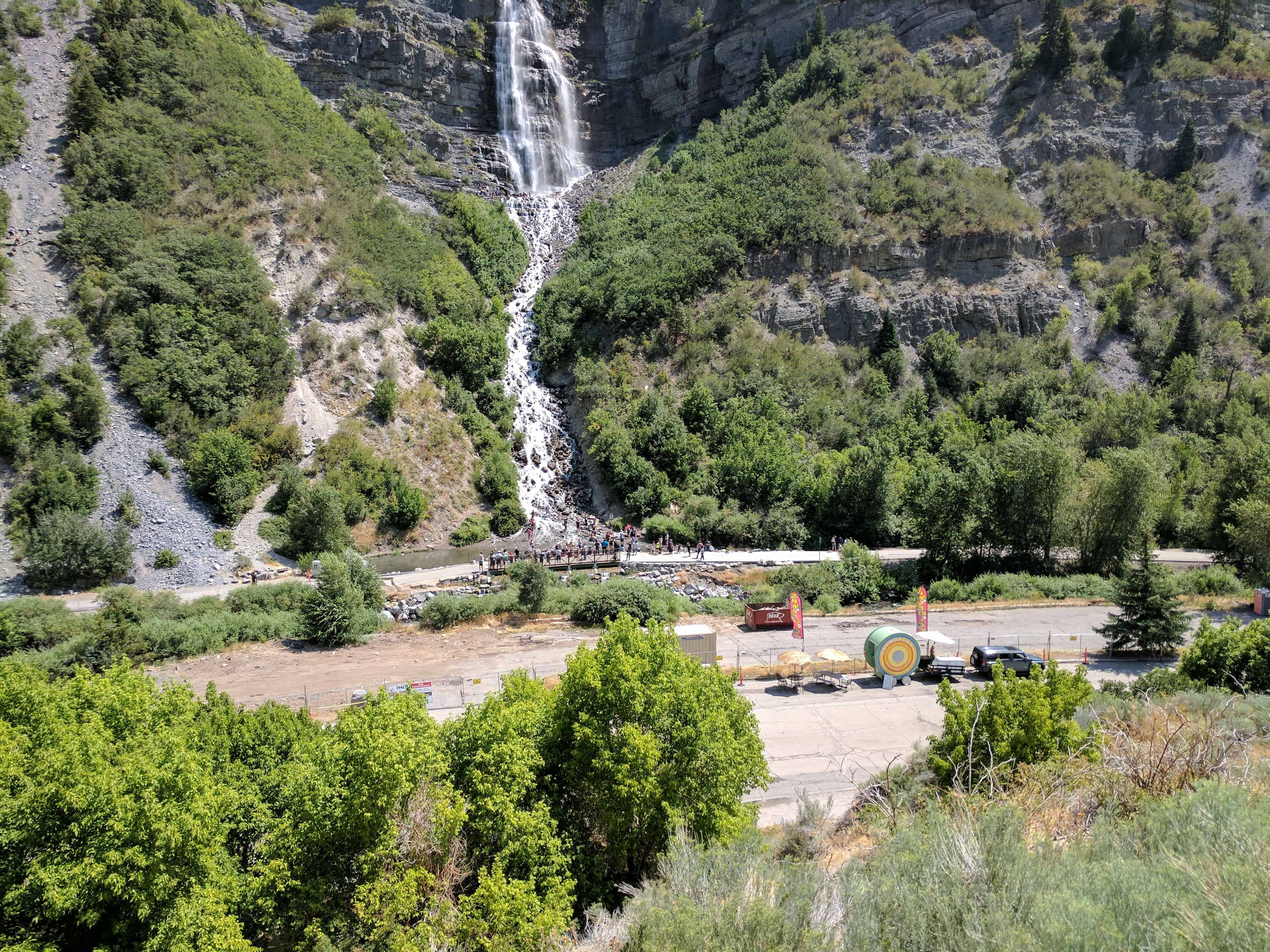
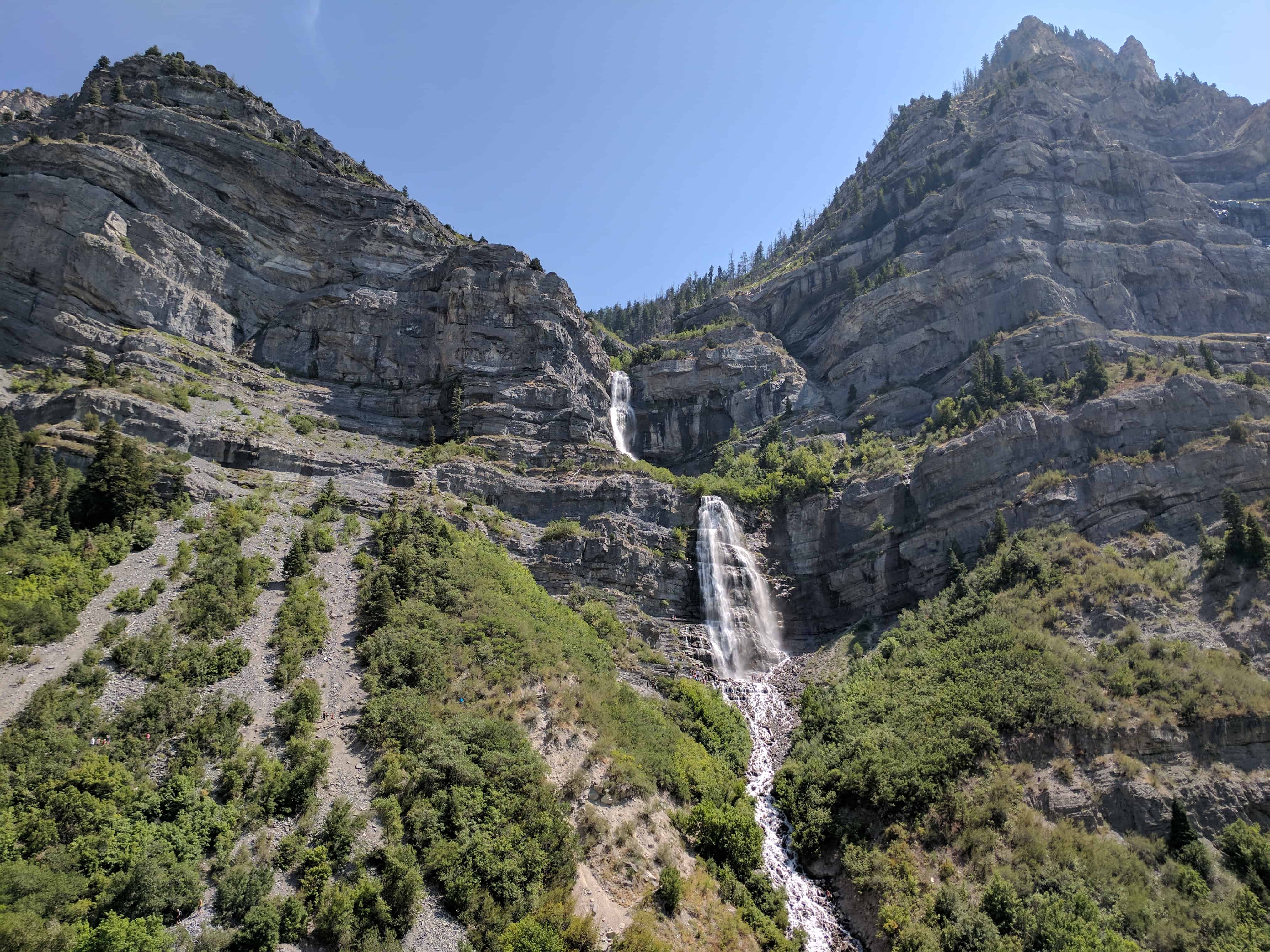
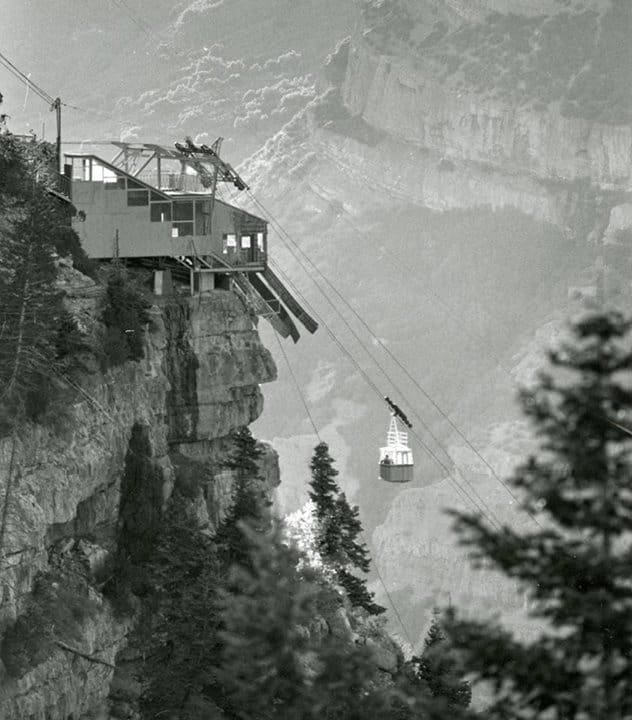
Bridal Veil Falls is a 607-foot tall waterfall in the south end of Provo Canyon, Utah. An aerial tramway service to the top of the falls was built in 1967 and the small, six-passenger tramway functioned as a recreational attraction until an avalanche destroyed the tram in early 1996. When the tramway was in operation prior to the 1996 avalanche, it was heralded as the WORLD’S STEEPEST AERIAL TRAMWAY, although that claim is difficult to ascertain. The magnificent falls are just four miles up the Provo Canyon. The falls are a favorite with visitors and locals alike. They can be seen from a scenic highway pullout or by taking an exit to where the base of the falls meets the Provo River. There is a small, cold swimming hole, and if you look carefully, you will find a dirt path that will take you up the mountain a bit for a closer view of the falls. The surrounding area is great for summer hiking and several trailheads begin at the falls. Bridal Veil falls is not only a summer attraction. In the winter, an icefall just to the right of the falls attracts experienced ice climbers. The icefall has been aptly named the Stairway to Heaven. The falls were a feature point along the route of the Heber Creeper tourist train until the train discontinued its service past the falls. The train tracks in front of the falls were removed and converted into a recreational trail. Now The falls and a small park just west of the falls (Bridal Veil Park) can also be accessed via U.S. Highway 189.(*)
Bridal Veil Falls – The Legend
Many moons ago, an Indian named Norita and a brave from a rival tribe, named Grey Eagle met and fell in love. They planned to meet near a streamlet high on the mountainside and elope to a land far away from both their tribes. On that fateful night, instead of her lover, Norita was confronted by braves from her own tribe. Fearing her lover had been destroyed she leapt from the high ledges.
Mother Nature was touched by her wild beauty, and she caught up Norita’s streaming tresses and made from them a Bridal Veil of falling water. From her flowing gown an alter was formed on the face of the mountain. Then her spirit was sent out as a mist, causing a green carpet to spread over the mountainside.
The intruders fled while her saddened lover stood and gazed down a the strange yet beautiful transformation. His grief was more than he could bear, so out of compassion for his sorrow, Mother Nature molded his massive frame into the mountain and stretched his mighty shoulders high into the heavens like silent sentinels to guard over his loved one. His cries of anguish were softened into love calls to whisper forever.
Bridal Veil Falls descends over step-like rock beds in the lower part of the Oquirrh Formation which was formed during the Pennsylvanian period. Pennsylvanian rock types, in rough order of decreasing abundance are: limestone, sandstone, shale, dolomite, halite, sylvite, conglomerate, and other minor salts.
In Utah, Pennsylvanian rocks and fossils are mostly of Marine Origin. The most commonly found are brachiopods, bryozoans, corals and crinoids.
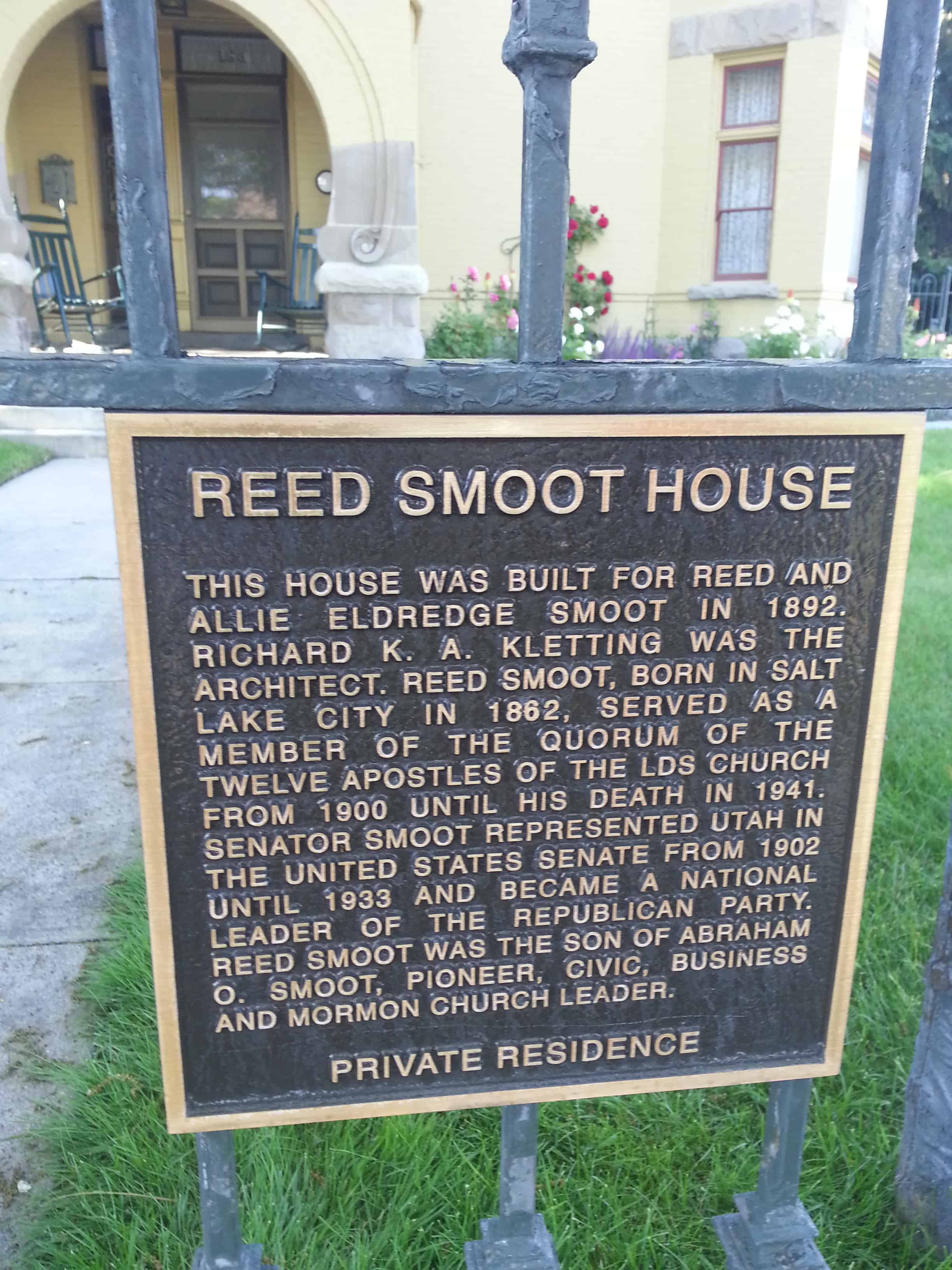
This house was built for Reed and Allie Eldredge Smoot in 1892. Richard K. A. Kletting was the architect. Reed Smoot, born in Salt Lake City in 1862, served as a member of the Quorum of the Twelve Apostles of the LDS Church from 1900 until his death in 1941. Senator Smoot represented Utah in the United States Senate from 1902 until 1933 and became a national leader of the Republican Party. Reed Smoot was the son of Abraham O. Smoot, pioneer, civic, business and Mormon Church leader.
Located at 183 East 100 South in Provo, Utah and added to the National Register of Historic Places (#75001831) on October 14, 1975.
From the Nomination form for the national register: The nationwide campaign from 1903 to 1907 to unseat Senator Reed Smoot was, according to historian Thomas F. O’Dea, the “last major flareup of the Mormon-gentile conflict on a national scale.” Shortly after Smoot took his seat in 1903 against a background of decades of gentile animosity toward Mormons, a movement backed by petitions bearing more than 1 million signatures urged his expulsion from the Senate on grounds that he was a high official in an organization that, despite assertions to the contrary, countenanced polygamy and violated the constitutional tenet of separation of church and state. From 1904 to 1907 the Senate Committee on Privileges and Elections held hearings on the Smoot case, calling numerous witnesses and compiling 4,000 pages of testimony. Although the majority report recommended his expulsion, the Senate under pressure from President Theodore Roosevelt refused to concur, and Smoot retained his seat. -Thus ended the last major episode in a religious and political controversy that had rocked the federal system for decades. Until he left the Senate in 1933, no one, says Smoot biographer Milton R. Merrill, did more than he “in changing the public’s opinion from one of scorn and obloquy for the despised Mormons to one of respectful admiration.”
Throughout his Senate career Smoot was usually aligned with the “standpat” wing of the Republican Party not only because of his innate conservatism but because this group had supported him wholeheartedly in his fight to prevent expulsion. He was a leading Harding supporter in 1920, and at the Republican National Convention in Chicago, it was Smoot, says Harding biographer Andrew Sinclair, who informed the press that “Harding had been chosen by the Senate bosses and would be nominated.” This statement became the basis for a political legend that a coterie of Senators had engineered Harding’s selection in a “smoke-filled” room.
It was Smoot, says Harding biographer Andrew Sinclair, who informed the press that “Harding had been chosen by the Senate bosses and would be nominated” after the famous meeting in the “smoke-filled room” of the Blackstone Hotel. Actually, those in attendance had been unable to reach a decision, but since Smoot f s statement proved correct, it became the basis for a political legend that a coterie of Senators had engineered Harding’s selection.
During the 1920’s Smoot, according to his biographer Milton R. Merrill, became “known as the watchdog of the Treasury” because of his demand for reduced Federal spending and lower taxes. His area of greatest expertise, however, was the tariff. An extreme protectionist, Smoot in 1930 as chairman of the Senate Finance Committee played a leading role in the drafting and passage of the Hawley-Smoot Tariff. This measure, says historian John D. Hicks, “raised American import duties to an all-time high” and was “so unsound economically that it drew the opposition of nearly every reputable economist in the United States.” Its high rates in turn caused 25 nations to raise their levies on American products in retaliation, thus worsening the Nation’s depressed economy.
In 1932 Smoot went down to overwhelming defeat as a result of the Democratic landslide. After leaving the Senate in 1933, he returned to Utah and devoted most of his time to church affairs. He became a bitter critic of the New Deal, expressing his opposition in no uncertain terms. On February 9, 1941, while vacationing in St. Petersburg, Fla., he died of heart and kidney disease at the age of 79.
Smoot’s area of greatest expertise was the tariff. According to tariff historian F. W. Taussig he was “an out-and-out protectionist of the most intolerant stamp.” His Hawley-Smoot Tariff, says historian John D. Hicks, “raised American import duties to an all-time high,” drew the opposition of nearly every reputable economist in the United States, caused 25 nations to raise their levies on American products in retaliation, and worsened the Nation’s depressed economy.
Smoot paid $4,000—excluding cost of the heating plant, hardwood floors, and certain other trim — to have this 2 1/2-story, beige-painted, red brick house built in 1892. He drew the preliminary specifications himself, and architect Richard K. A. Kletting completed the design. Smoot made his permanent home here until his death, and the little-altered dwelling remains in the Smoot family. The Senator’s primary Washington, D.C., home has been demolished, and he occupied his only other known extant residence only 5 years. Thus this Provo house clearly memorializes Smoot best.
Biography
Reed Owen Smoot was born January 10, 1862, in Salt Lake City, Utah, to Abraham 0. and Anne M. Smoot. The Smoots were one of Utah’s leading Mormon families, and Reed was the child of one of his father’s several wives. After receiving his basic education in church schools, he entered Brigham Young Academy (later University) as a member of its first class in 1877. Upon graduation in 1879, Reed joined his father’s business in Provo. By the time he was 18, he was manager of the Provo Co-op Institute, a general store, and 5 years later was managing the Provo Woolen Mills. Within a few years he had acquired widespread business and agricultural interests, and by the time he was 35, Smoot had accumulated a considerable fortune. At the same time, he advanced in the hierarchy of the Mormon Church. In 1900 he was ordained as one of the Quorum of Twelve Apostles, a position in the church second only to the presidency.
Appearance of home
Reed Smoot paid $4,000—excluding cost of the heating plant, hardwood floors, and certain other trim — to have this 2 1/2-story, beige painted, red brick house built in 1892. He drew the preliminary specifications himself, and architect Richard K.A. Kletting completed the design. The stately dwelling remained the Senator’s permanent home until his death in 1941, and his descendants retain the structure today. Little-altered and in excellent condition, the dwelling holds many original Reed Smoot furnishings, including Mrs. Smoot’s china, her collection of pitchers, and his collection of paintings by Lee Green Richards and other artists. The only other extant Reed Smoot residence is a white-painted brick house at 4500 Garfield in Washington, D.C. He occupied that dwelling from 1929 to 1933. His previous Washington home, at 2521 Connecticut Avenue, where he lived from 1910 to 1929, has been demolished. Clearly the structure that best memorializes Senator Smoot is the Provo residence.
The south-facing house consists of a nearly square, hip-roofed main block; a similarly rendered wing affixed to the eastern half of the rear façade; a full-height, hip-roofed pavilion projecting from the northern half of the west side; and three full-height, gable-roofed, pedimented pavilions. One of the latter juts from the northern half of the east façade, a second springs from the southeast corner of the main block, forming a 45° angle with the south and east walls; and a third thrusts forward from the western half of the front façade. All these sections rest on a rusticated stone foundation that rises some 3 feet above ground everywhere except on the rear wing. In addition the walls of every section rise to the same height and are encompassed by a box cornice resting on a band of brick corbeling. The main block and four pavilions are additionally belted by a rusticated stone water table; a two-row brick stringcourse at first-story window-sill level; a similar stringcourse at second-story window-sill level; and a one-row brick stringcourse that outlines the arches above the second-floor windows. Three corbeled, brick chimneys pierce the dwelling’s irregular roofline: one stack rises from the rear slope of the rear-wing roof, while the other two soar upward from the Juncture of the main block with the east and the west pavilion.
Three porches or porticoes grace the Smoot House. Projecting from the south pavilion, a one-tier, square-shaped, brick portico rests on rusticated stone piers, carries a solid, paneled, brick deck railing, and shelters the front entrance. Brick corbeling and stone medallions decorate the portico, radiating brick voussoirs form a semicircular arch over a single opening on both the east and west sides and a horseshoe arch over the front access steps. In contrast a light, airy, one-story, hip-roofed veranda with turned wood support posts, treillage, and balustered railing crosses the east side of the rear wing and abuts the north side of the east pavilion, where there is a seldom used side entrance. The third porch is a second-story, screened sleeping room, which rests on two simple, wood pilasters and a wood post, and which fills the angle formed by the west side of the rear wing and the north side of the hip-roofed pavilion. Underneath the sleeping porch, three wood steps ascend to a stoop before the house’s rear door in the west wall of the rear wing. The porch also shelters the full basement’s access steps, which descend between the solid-railed stoop and the pavilion wall.
Fenestration in the Smoot House is irregular, but all windows have stone sills and are set in wood frames. Generally, first-floor windows are rectangular and have flat arches of radiating brick voussoirs. Notable exceptions are the first-floor openings in the pavilions, where massive, rusticated stone lintels top the windows. Most second-story windows, except those in the rear wing, have semicircular transoms under similar arches of radiating brick voussoirs. Each pavilion is one bay wide and has one window on each floor plus a small, multipane, round-arched window in the pedimented gable end. These help light the house’s attic, as do a hipped dormer on the east slope of the mainblock roof, another on the opposite slope, and a swept dormer on the front slope. The windowless front façade of the exposed portion of the main block highlights a round, carved stone, inscription plaque bearing the date of construction.
The main entrance to the residence is a transomed, single door set under the front portico and composed of four lower wood panels, a middle glass panel, and three upper wood panels. Left of the door is a wide, transomed sidelight. Inside, the house differs little from its appearance during Senator Smoot’s residency. Beautiful oak woodwork remains unfinished and in excellent condition. The major changes, other than removal of some of the Senator’s furniture, are the addition of some new carpeting and some new wallpaper, although in the latter instance the family attempted to match the original patterns.
On the first floor, the house follows a modified side-hall plan. The front door opens into a foyer, and along its left wall a two-flight, open, balustraded stair rises to the second floor. In the right foyer wall a double, sliding, oak door gives access to the parlor with its original furniture. A similar door in the rear or north parlor wall opens into the dining room. This chamber has original furnishings too, and is also accessible from Smoot’s sitting room and office north of the stair. Lying beyond the sitting and dining rooms is the original kitchen, which, except for a huge ice box, contains modern equipment.
Upstairs, the second floor follows a central-hall plan. Here the left front room served as the Smoot’s nursery, and the right front as their master bedroom. Their original bedroom furniture remains. Beyond each of these chambers, on each side of the hall, is another bedroom, and in the rear wing there is a bath and maid’s room. Between the servant’s chamber and the right, rear bedroom, a narrow enclosed stairway rises to the unfinished attic and descends to the kitchen.
The Smoot House sits on a tree-shaded, corner lot and retains part of the wrought-iron fence that once surrounded the property. In the rear stands a small, rectangular, gable-roofed, frame garage or carriage house. An office building occupies the lot rear of the Smoot House, but the neighborhood remains essentially residential.