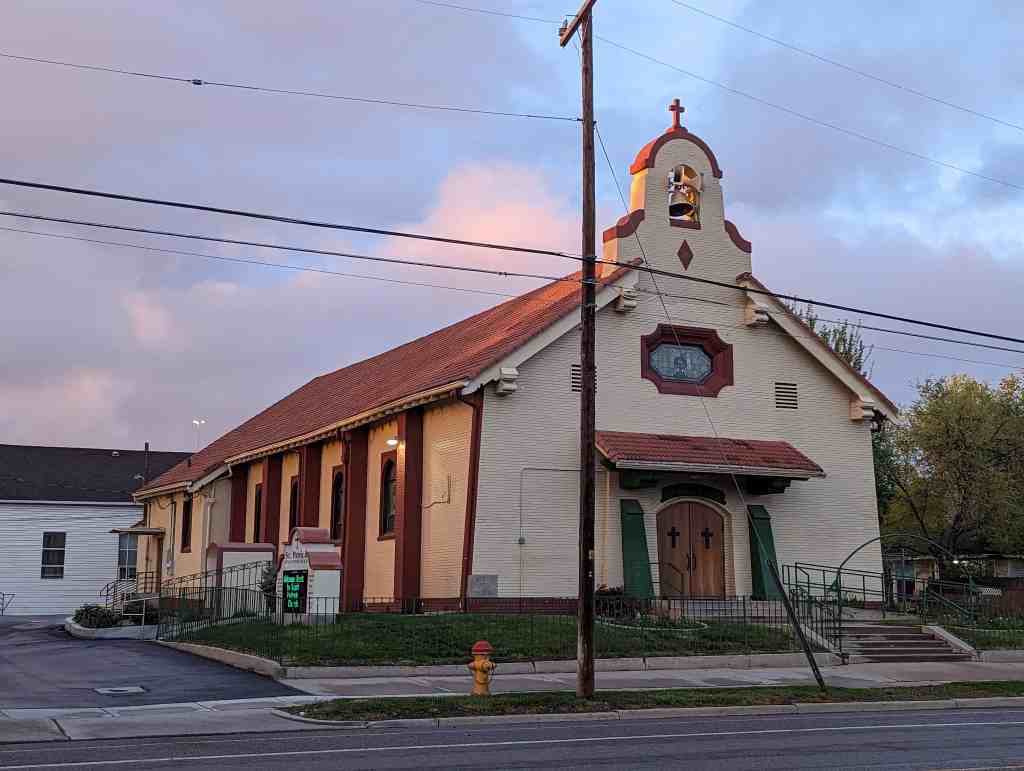
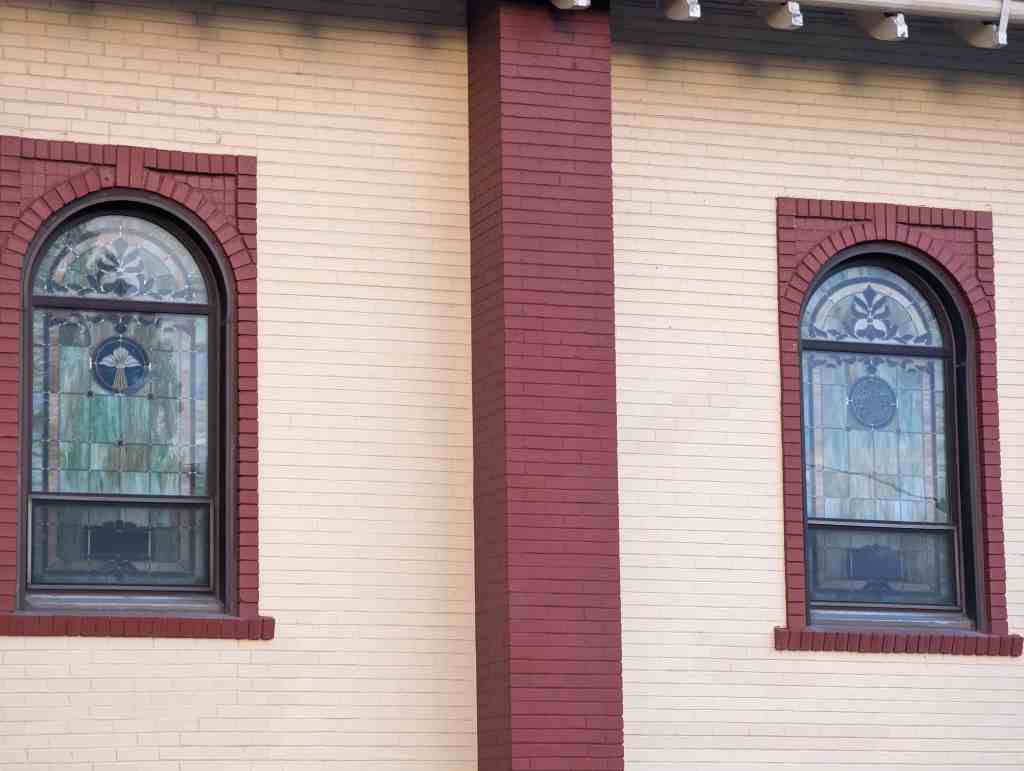
St. Patrick Roman Catholic Church
21 Wednesday Jun 2023
Posted in Uncategorized

21 Wednesday Jun 2023
Posted in Uncategorized
17 Sunday May 2020
Posted in Uncategorized
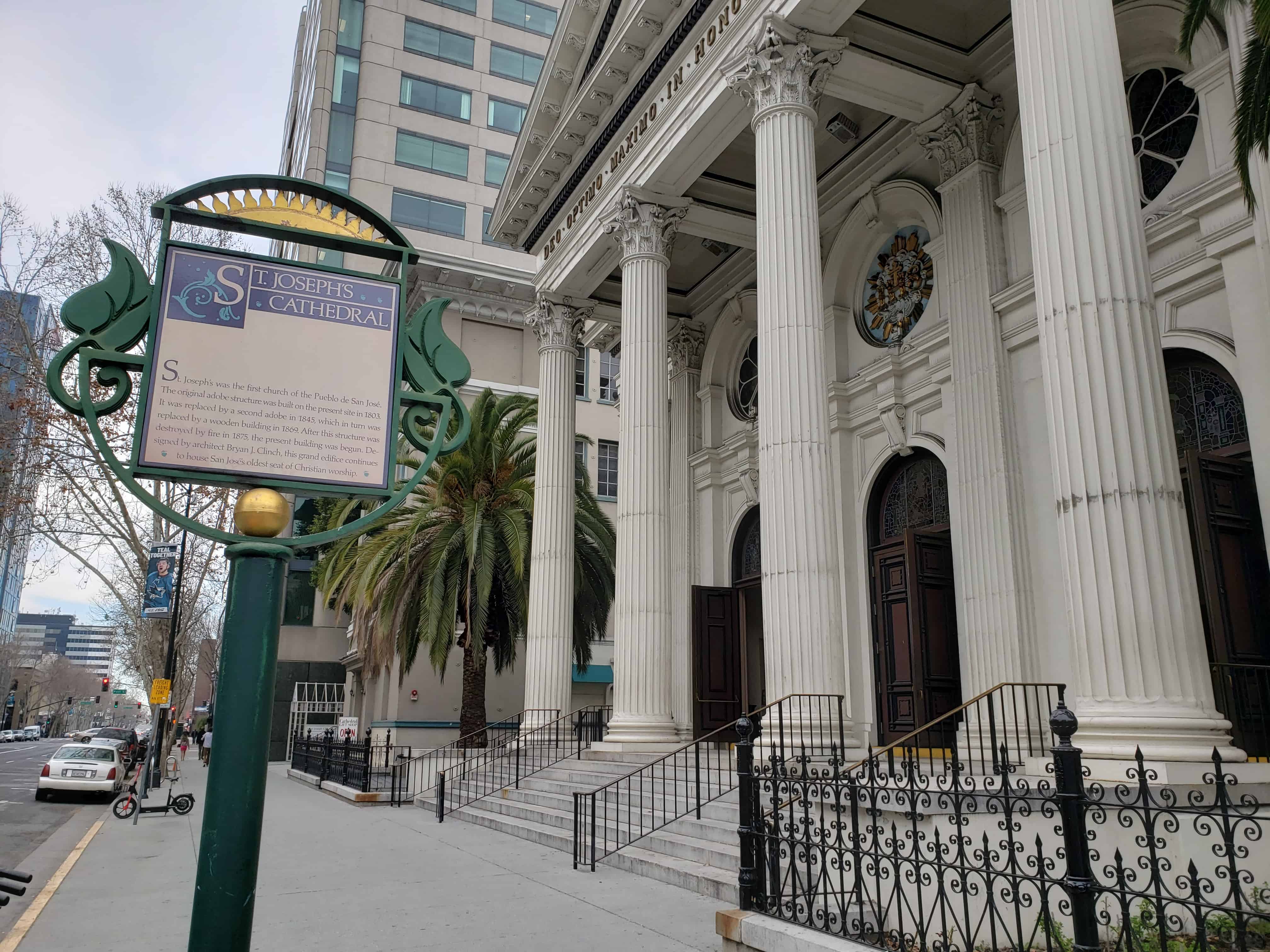
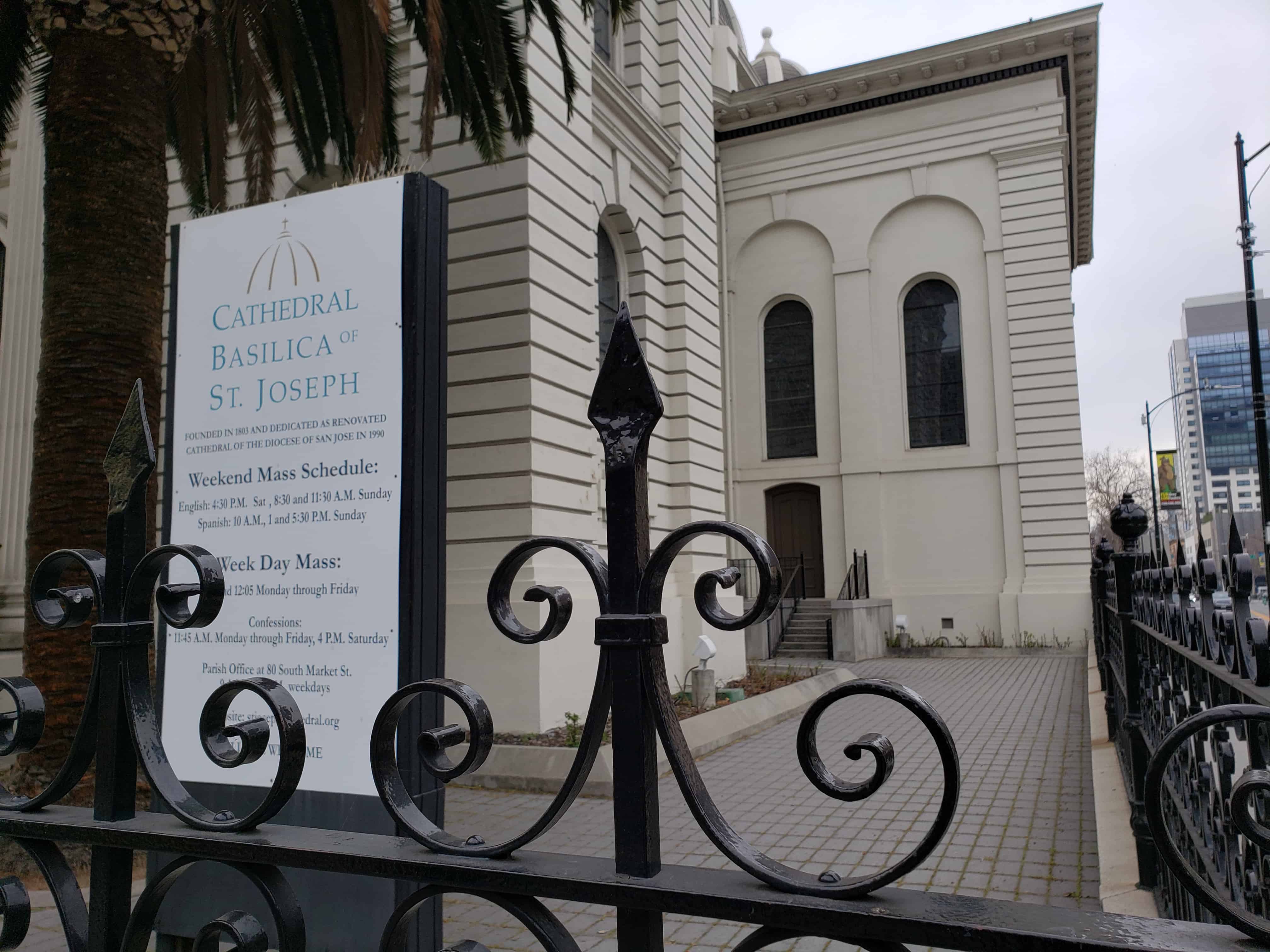
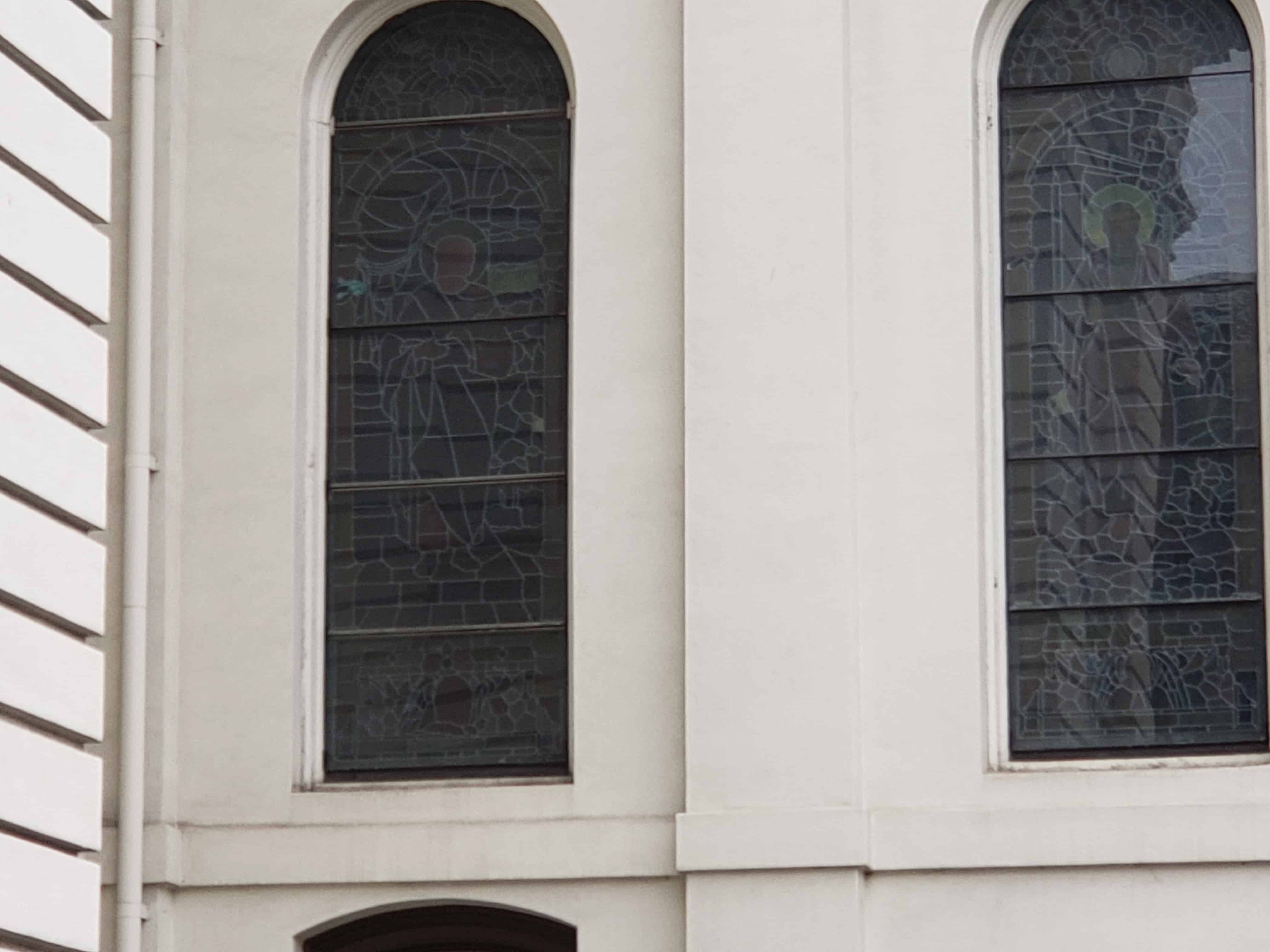
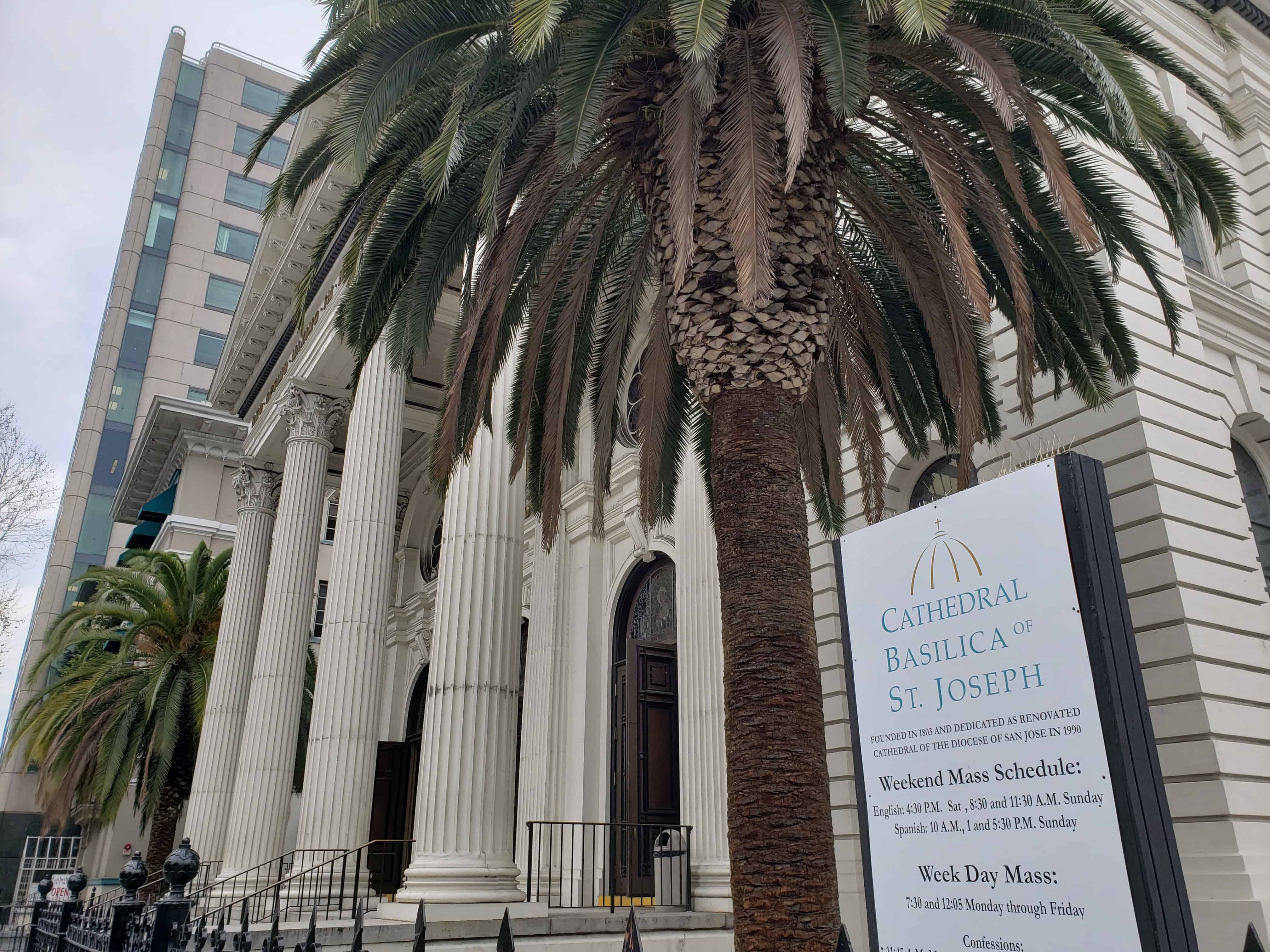
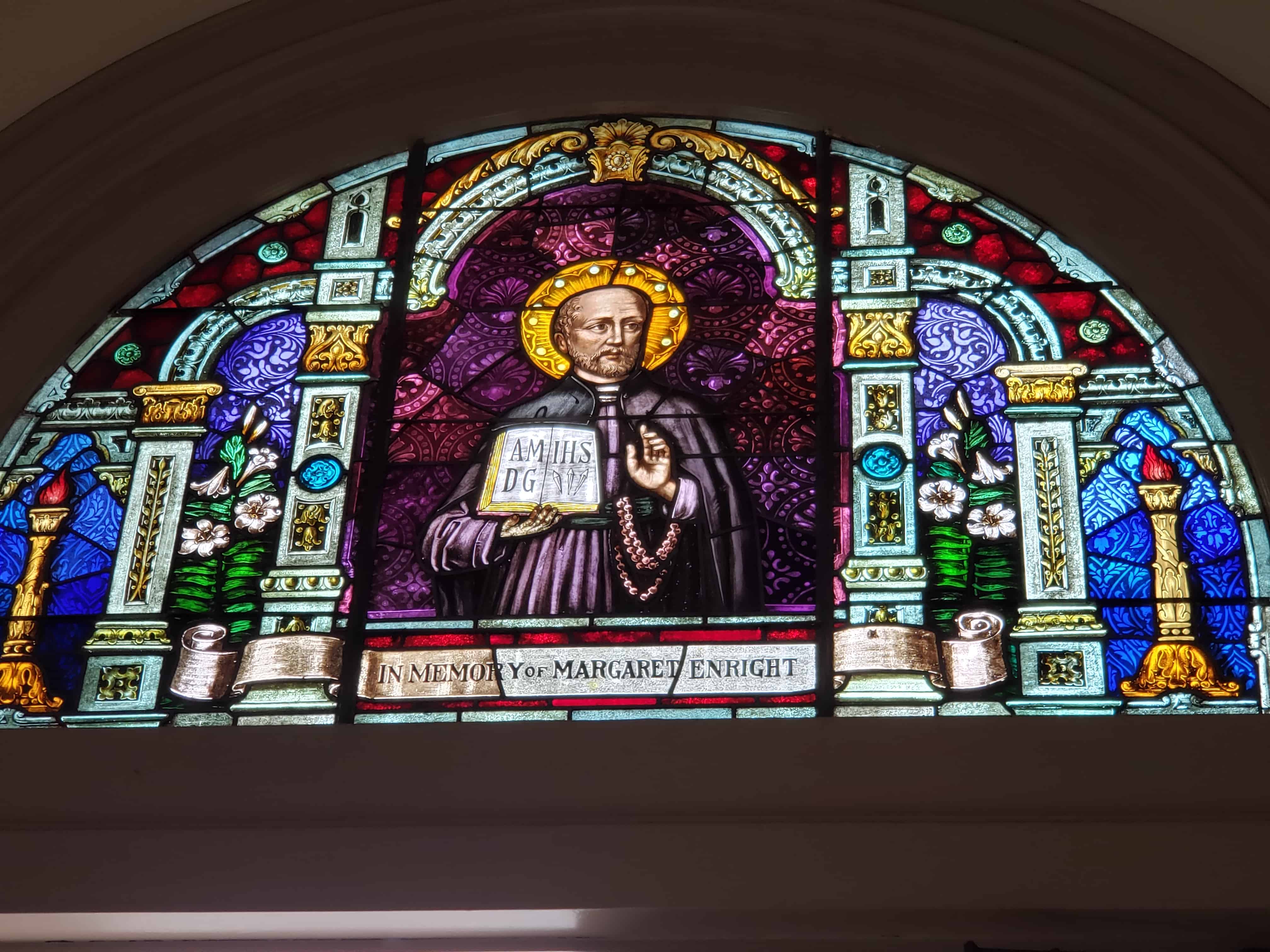
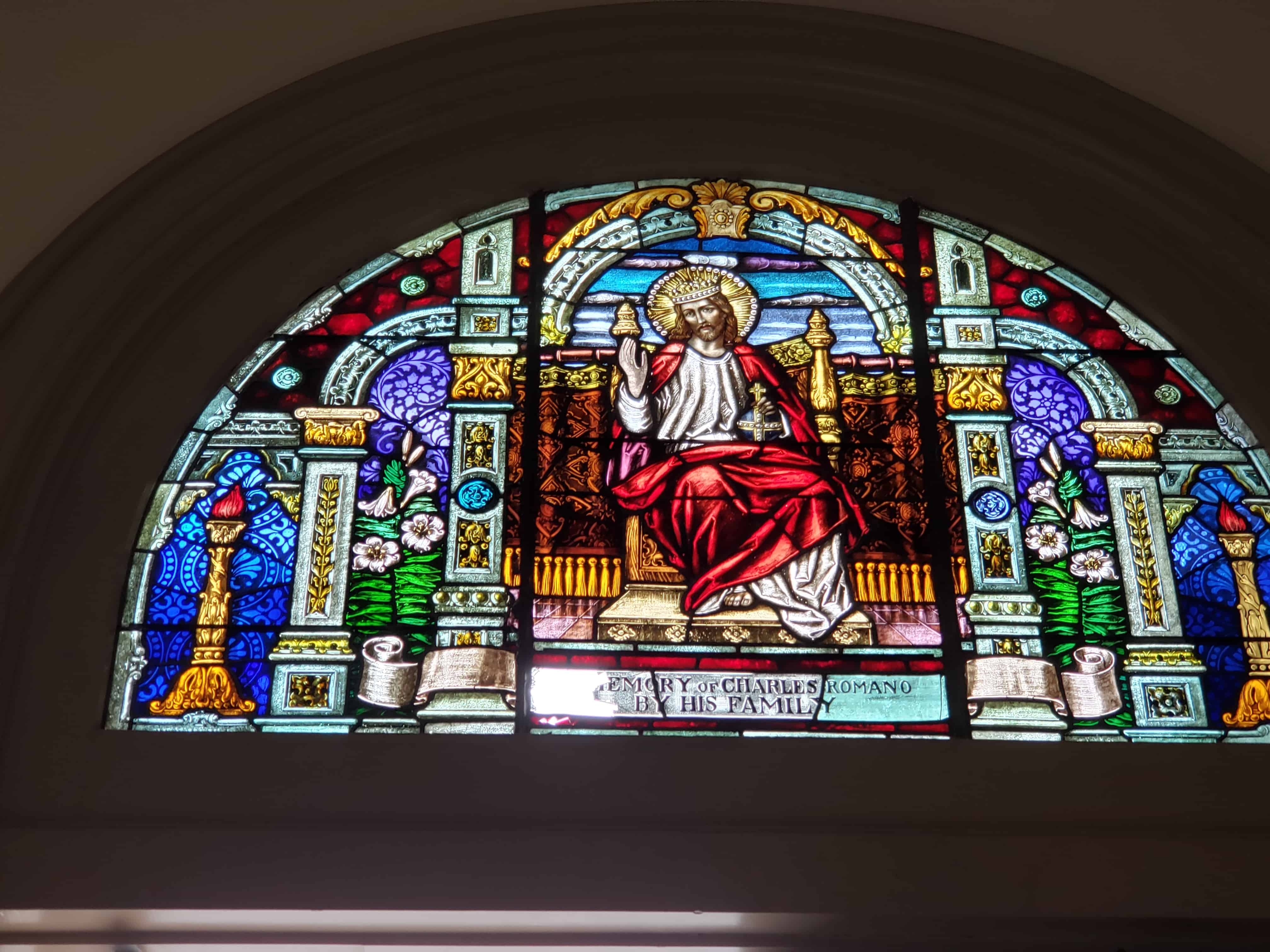
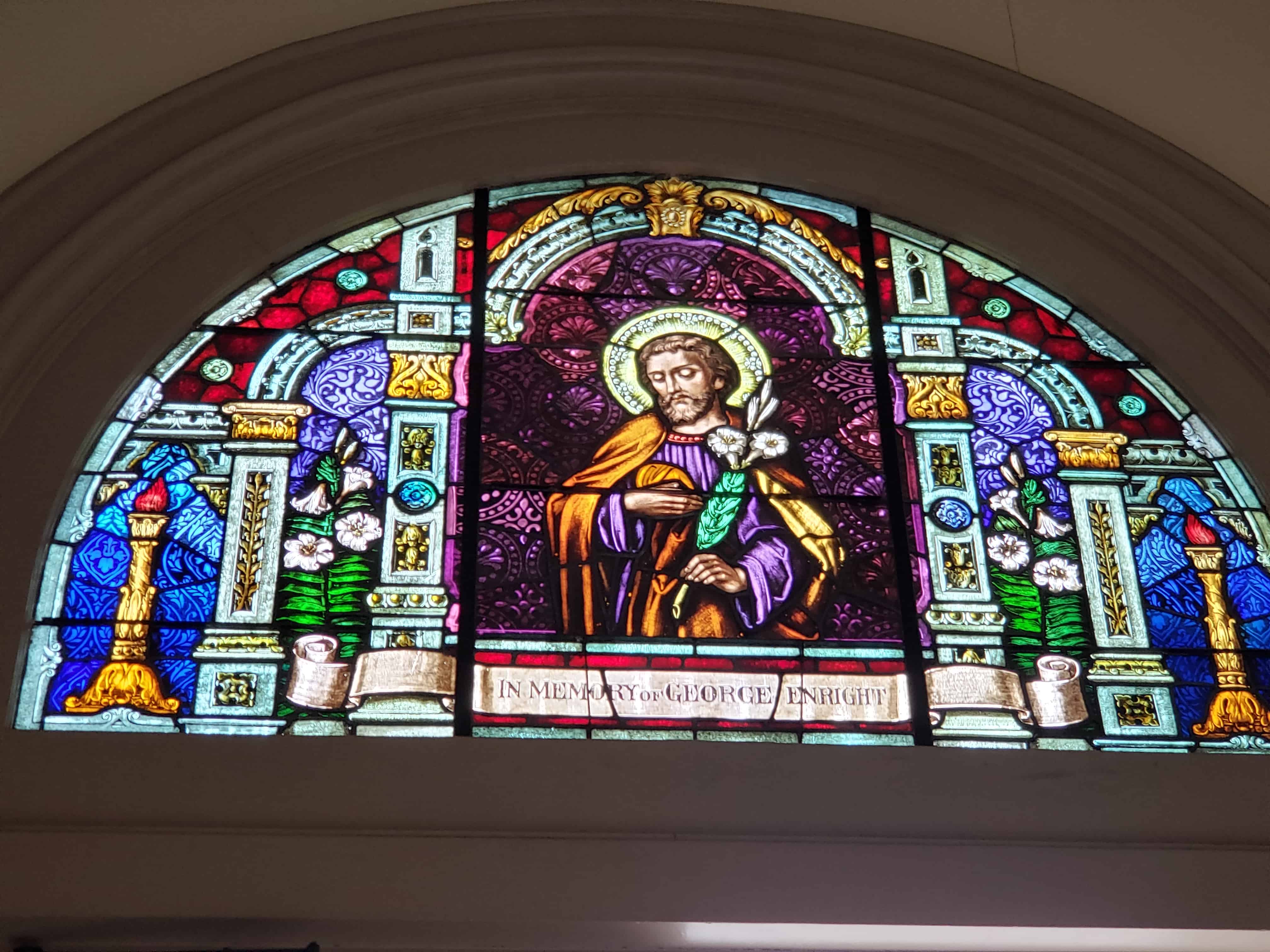
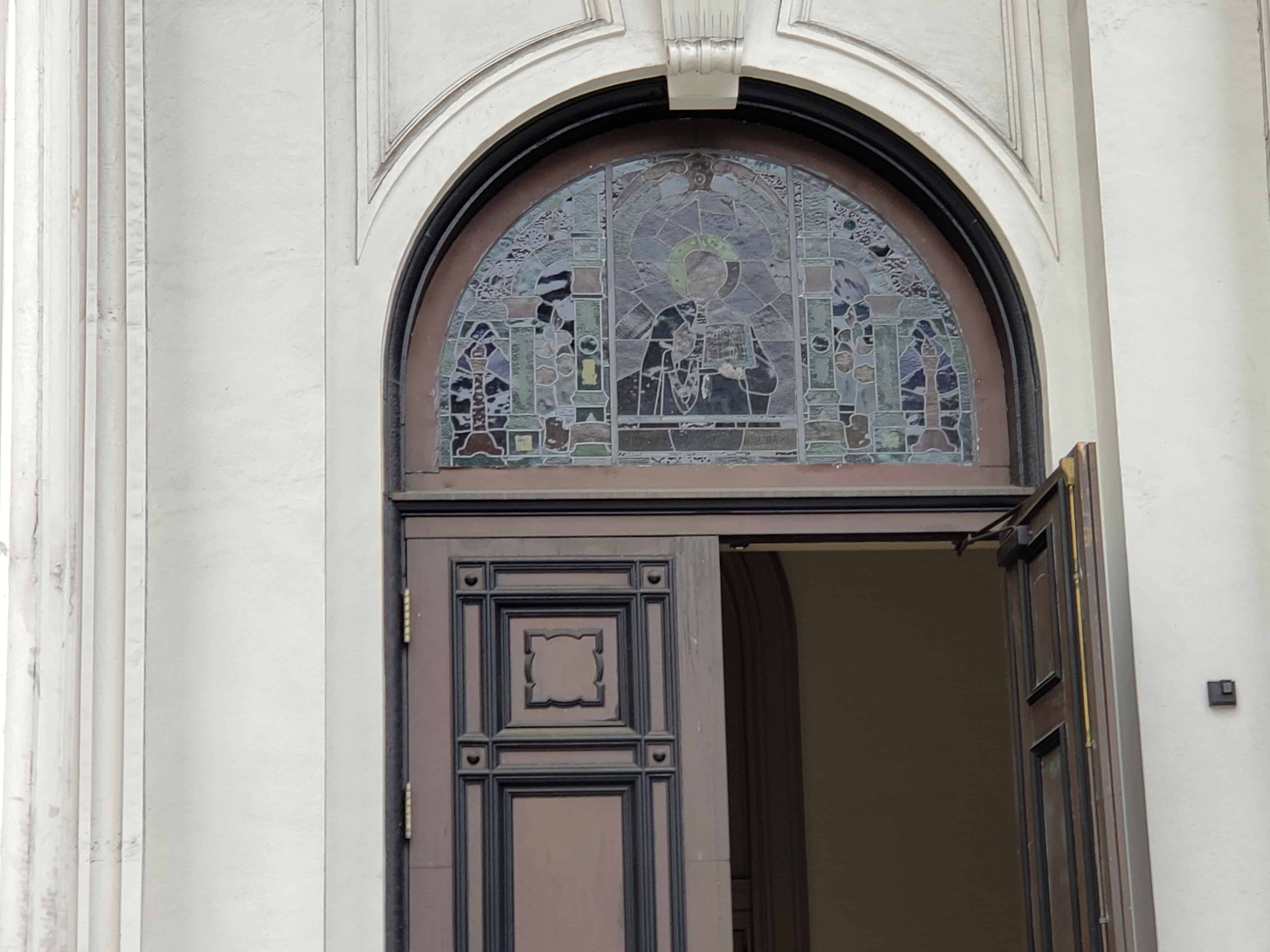
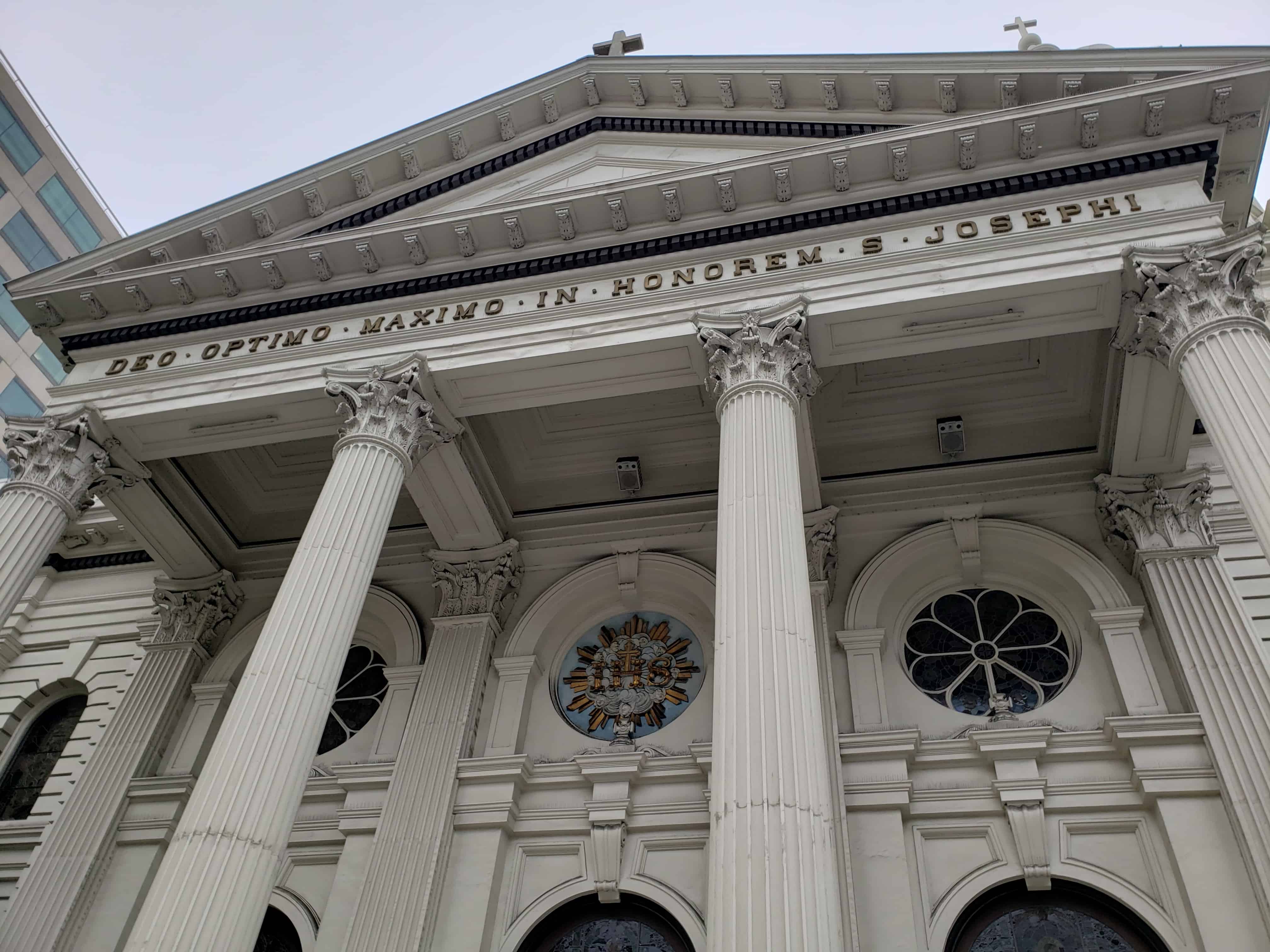
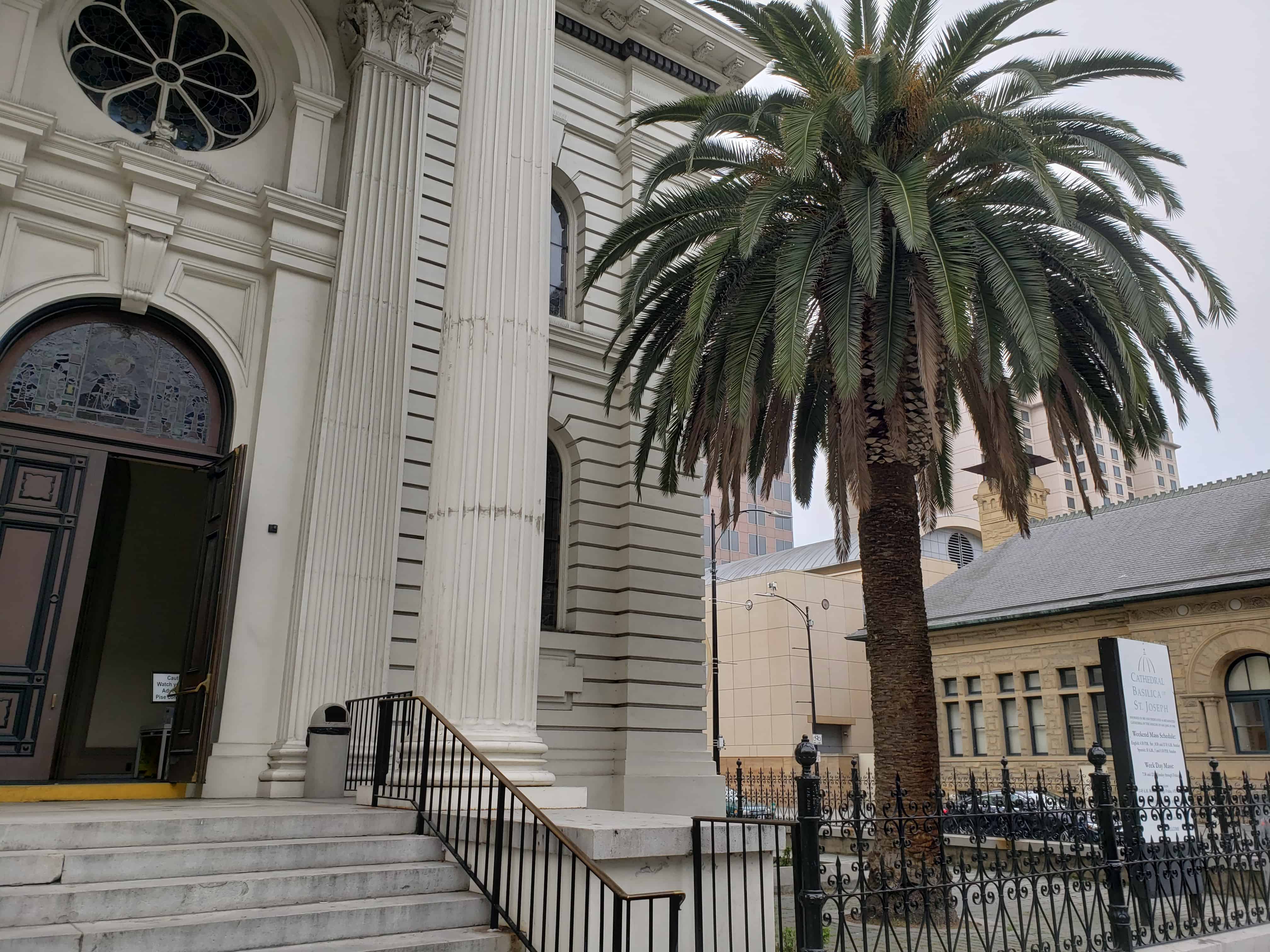
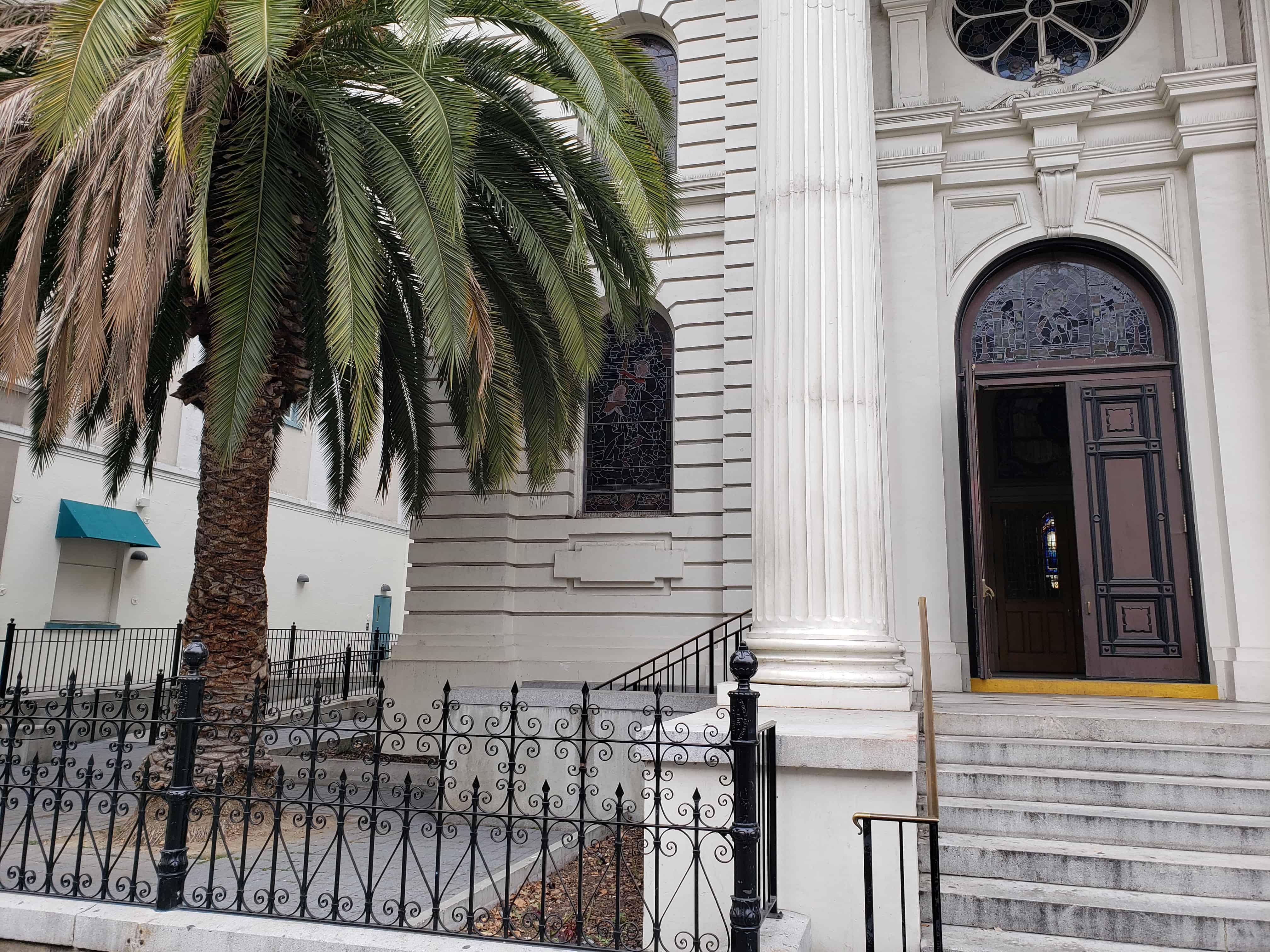
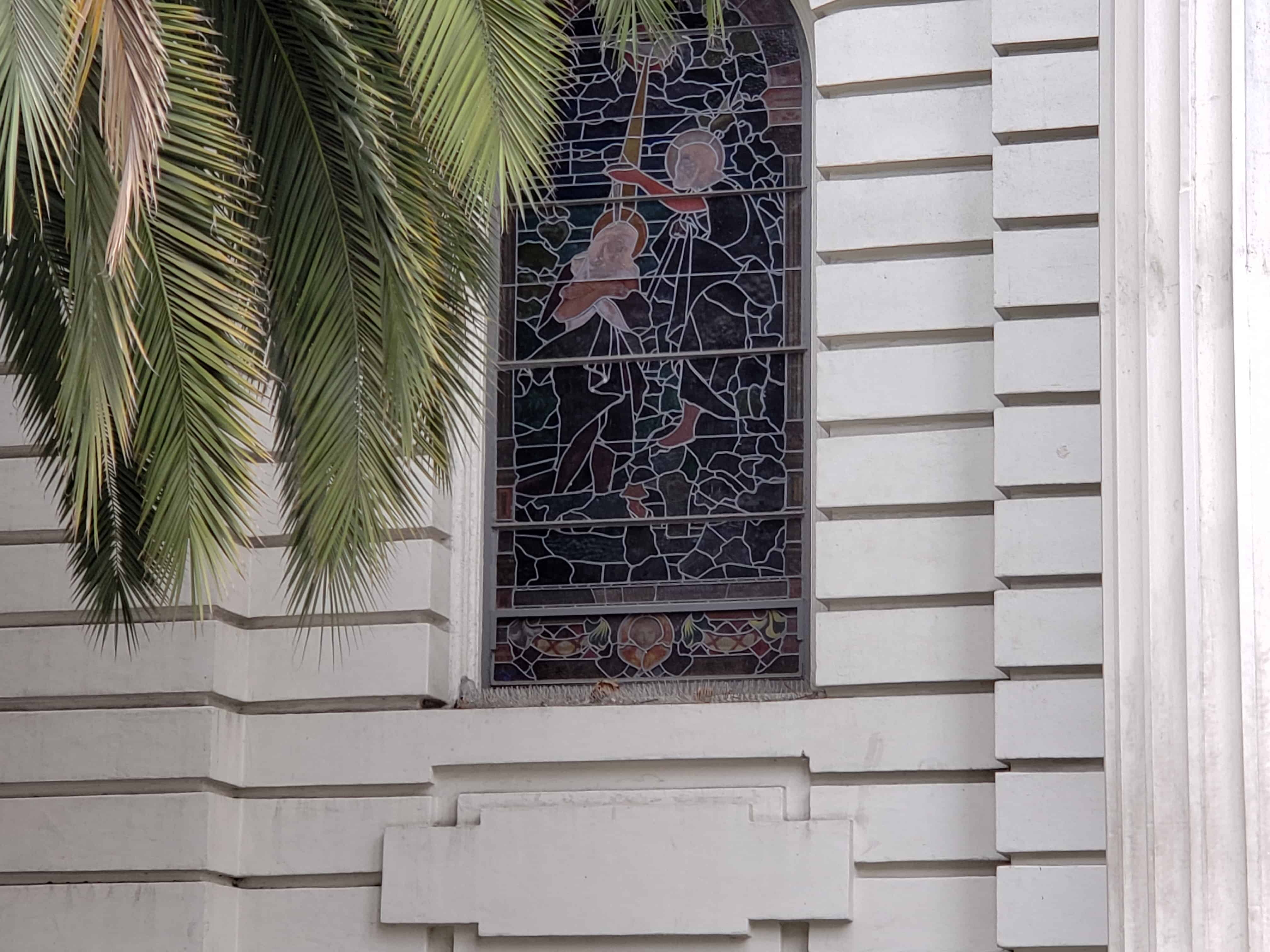
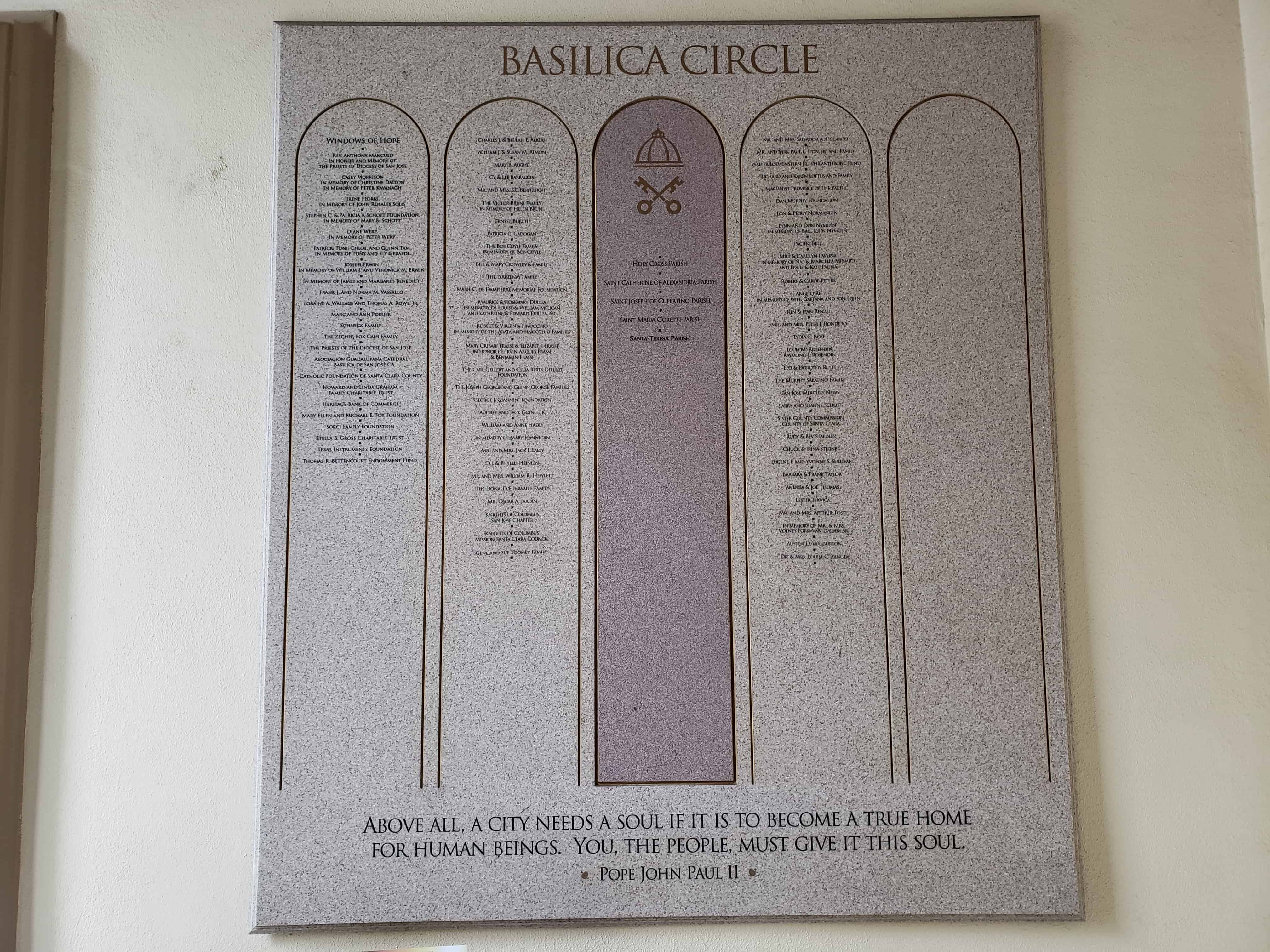
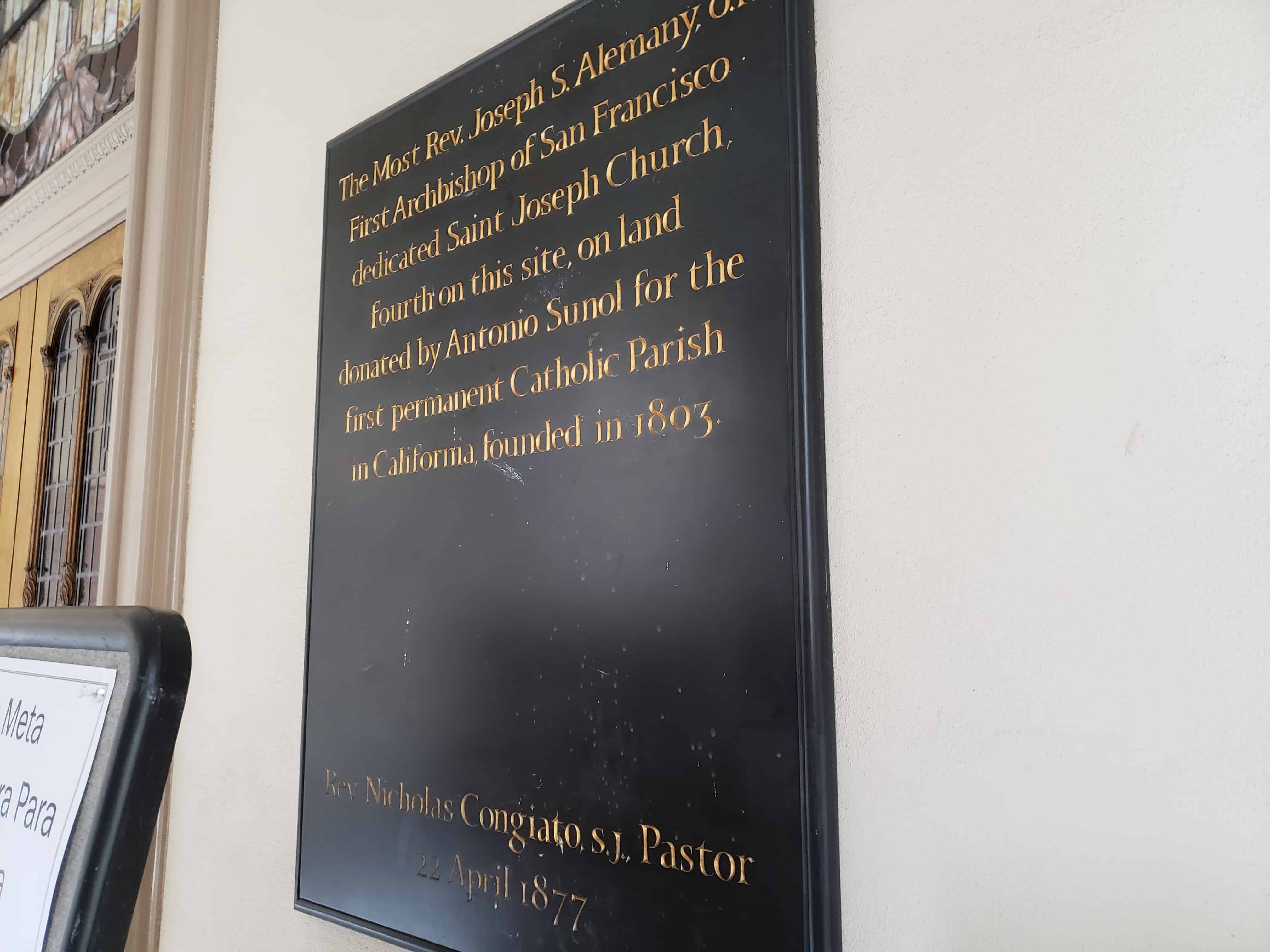
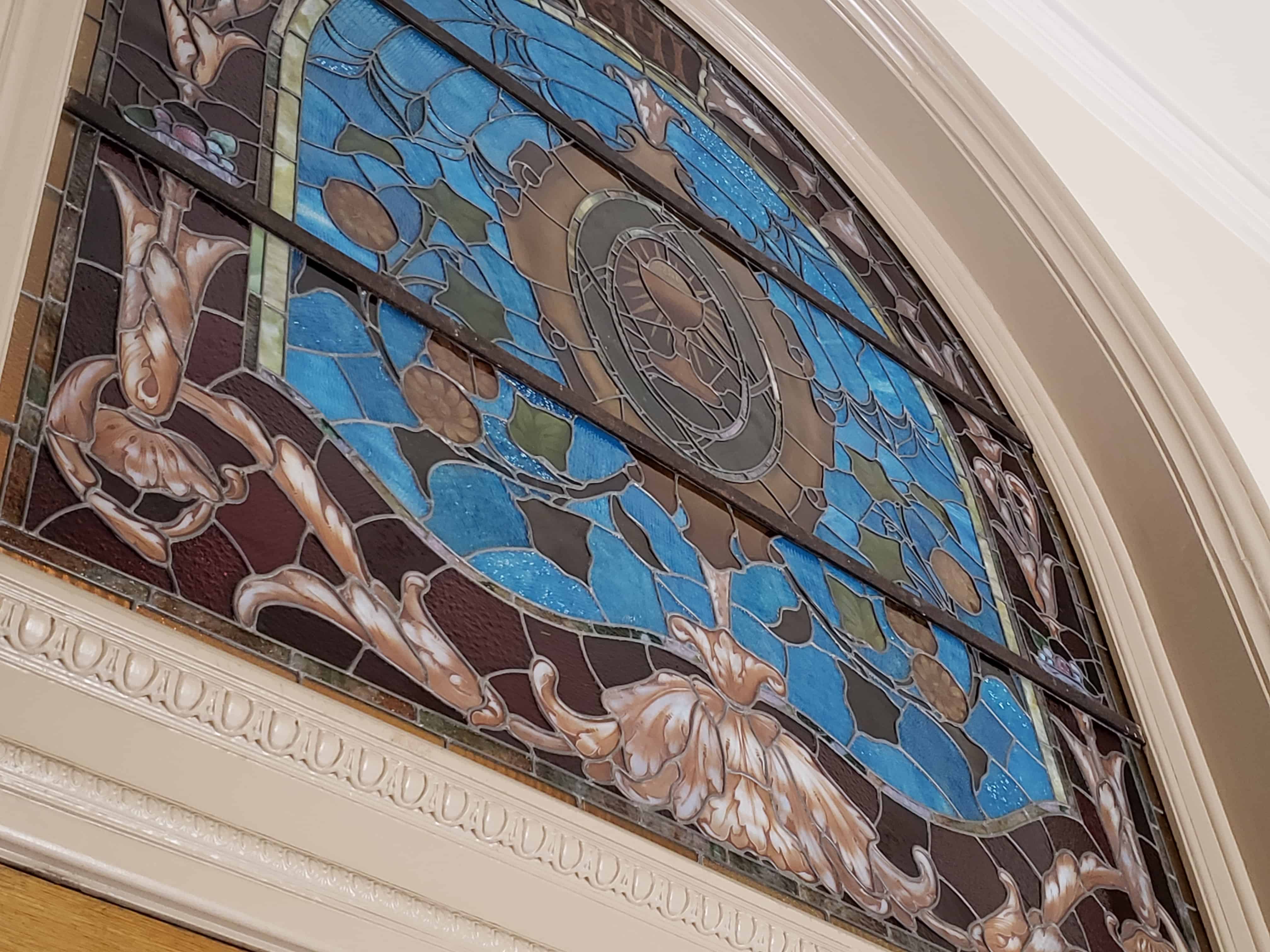
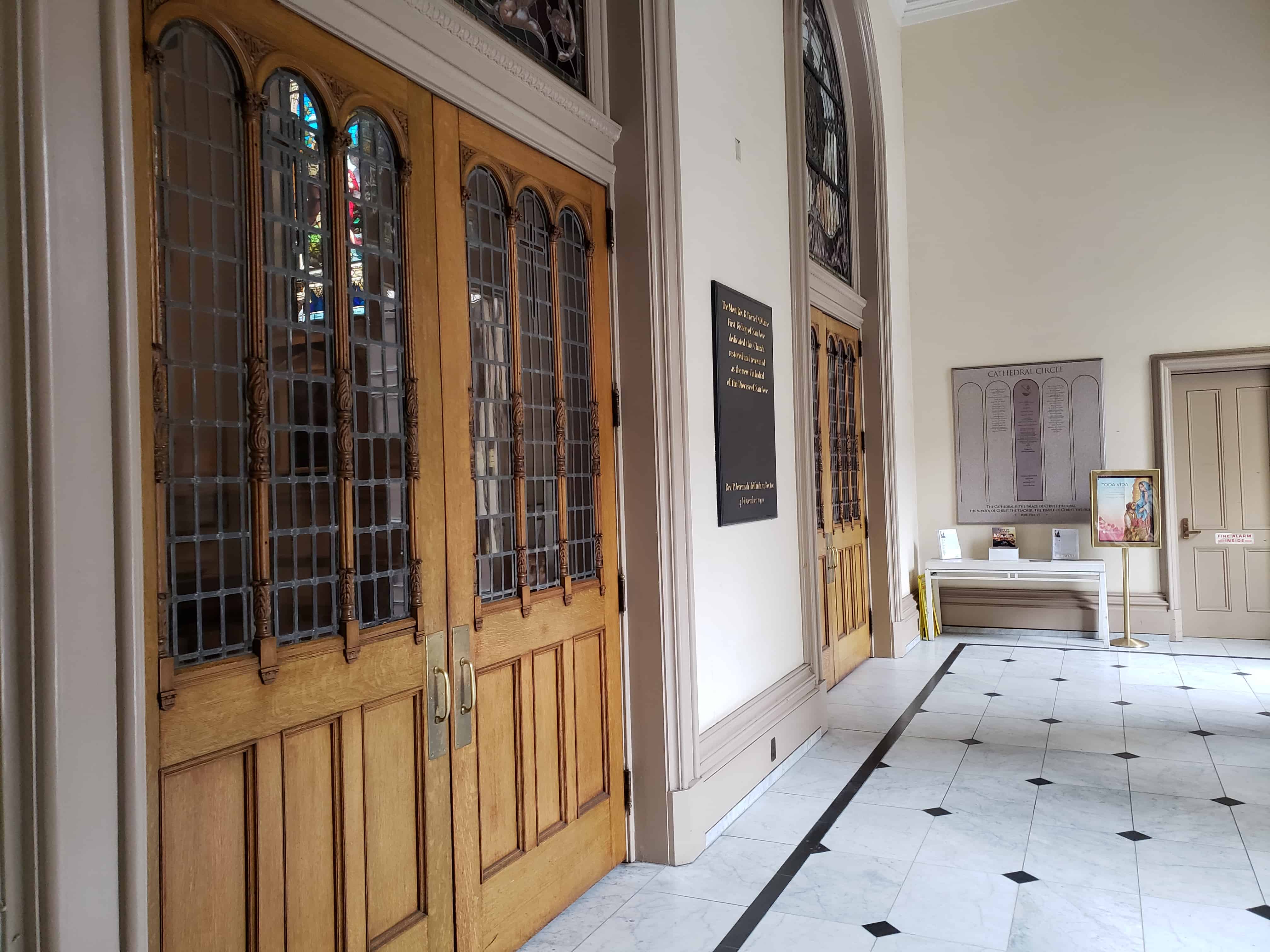
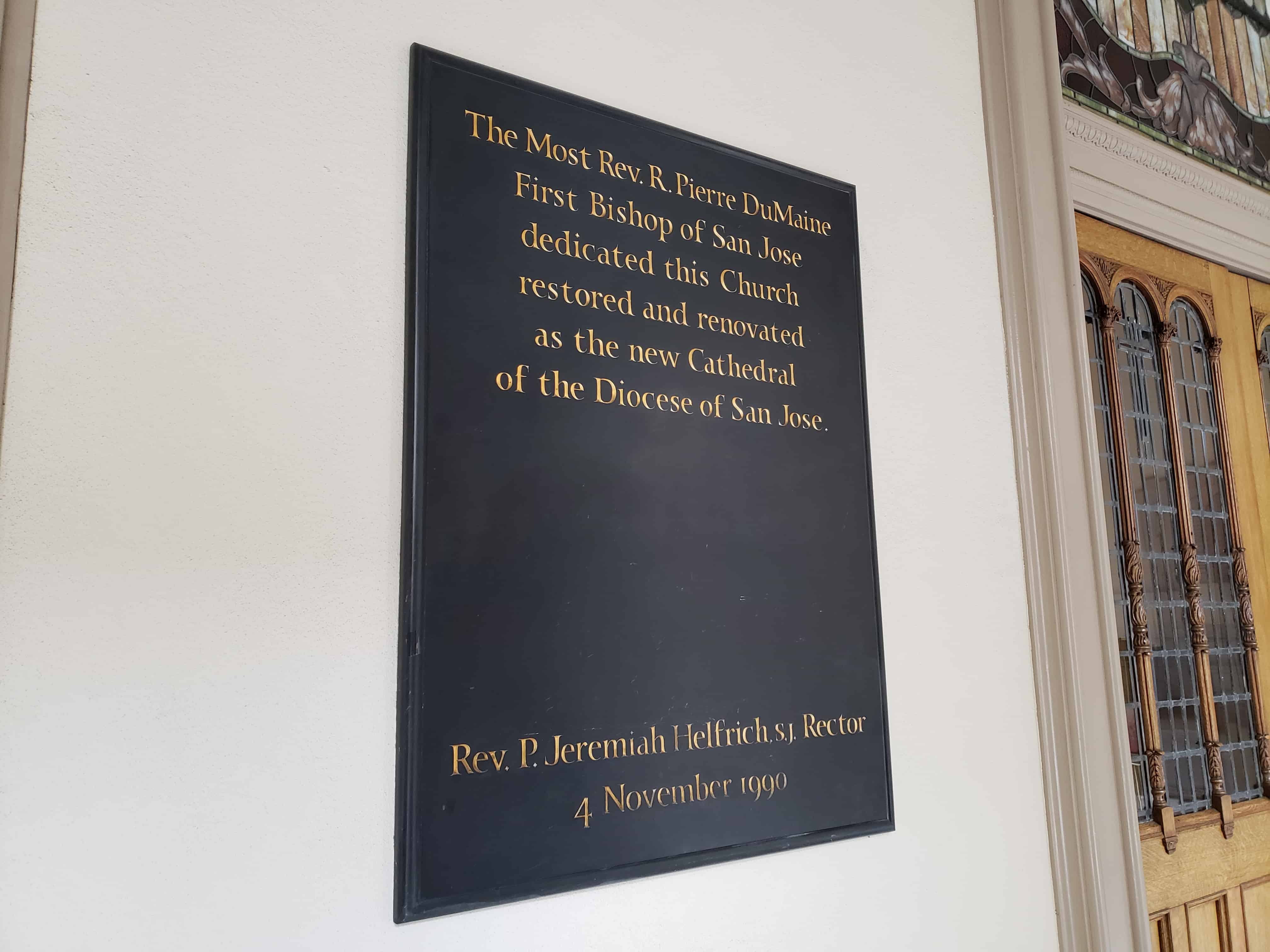
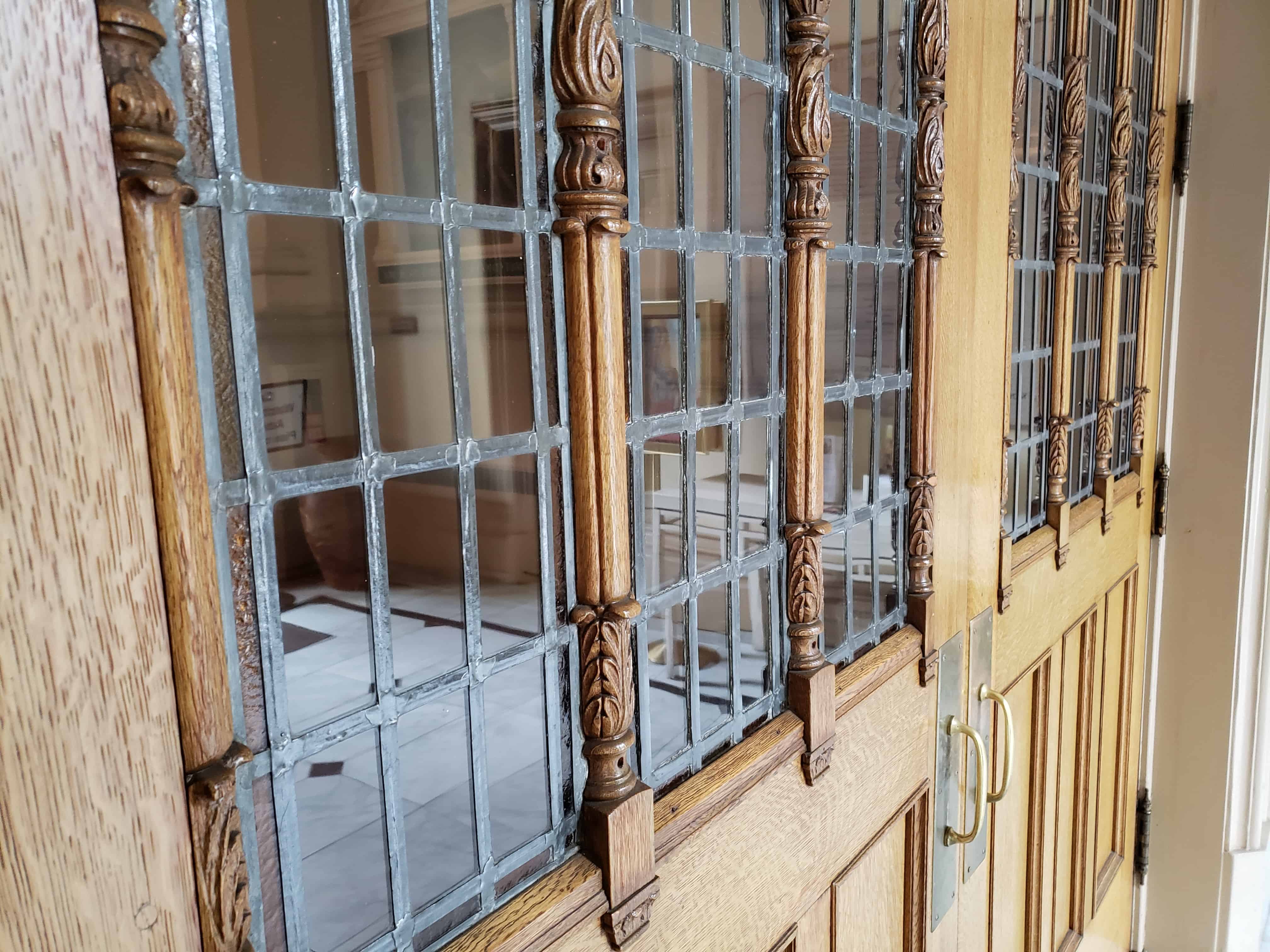
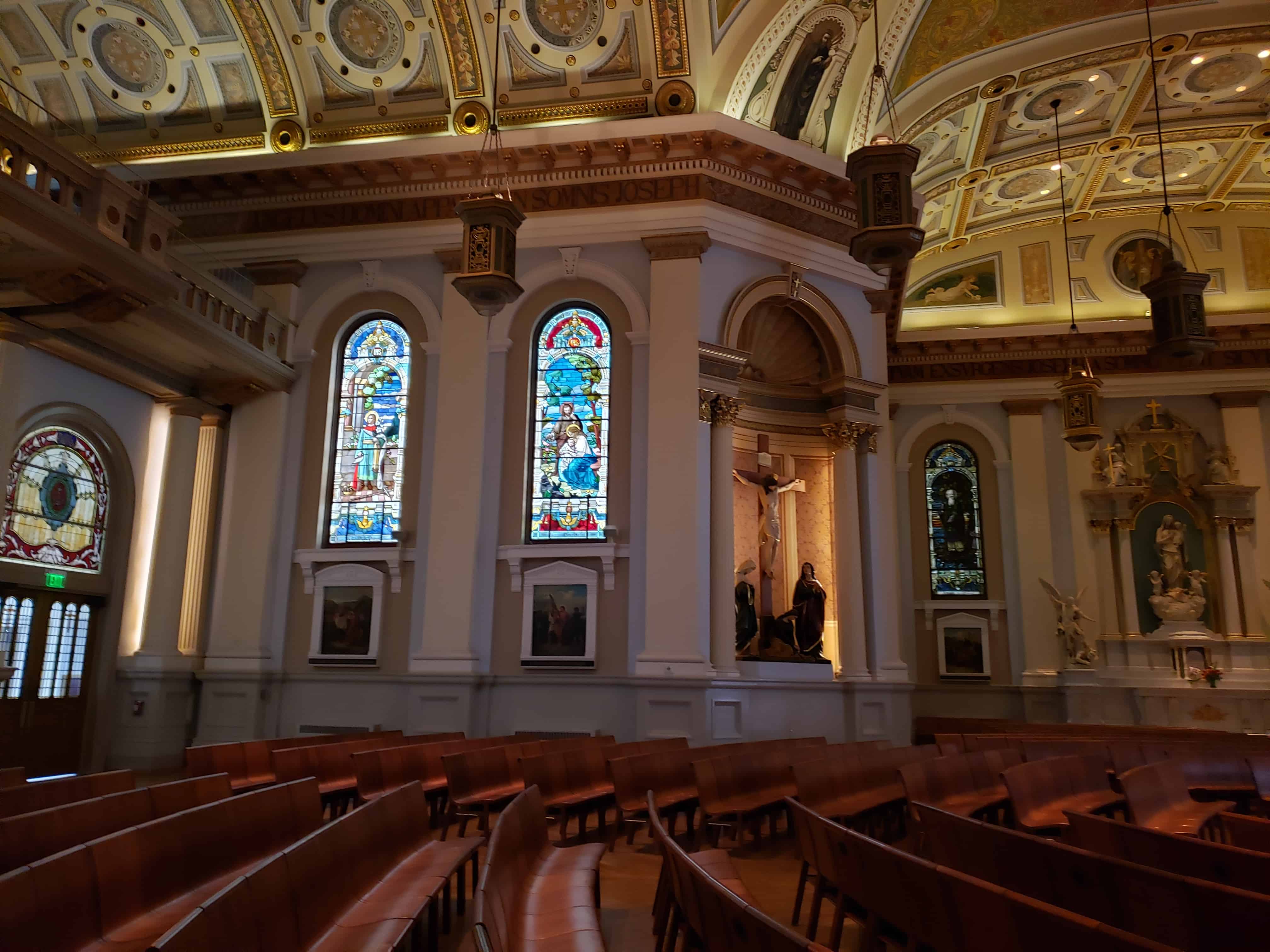
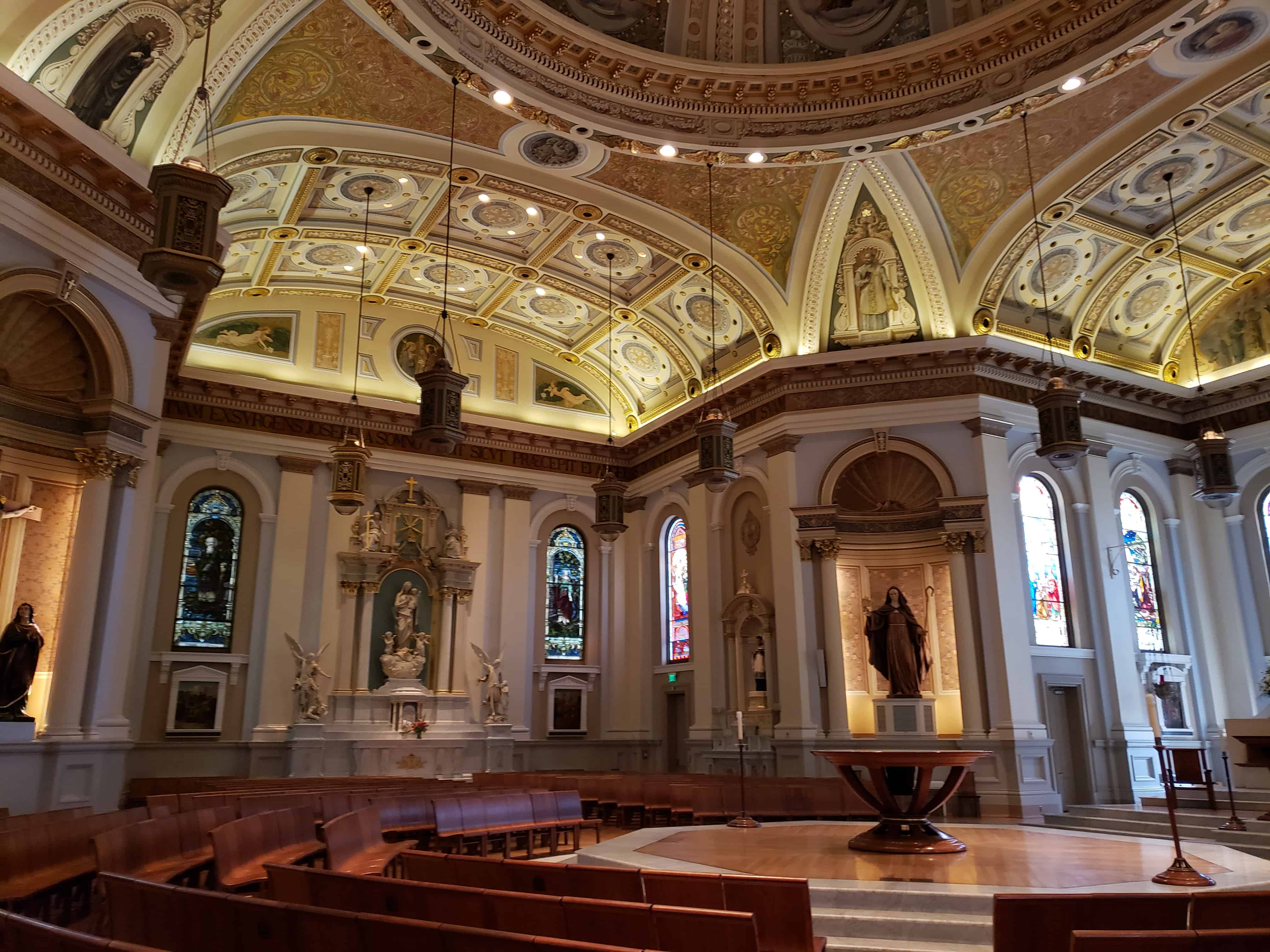
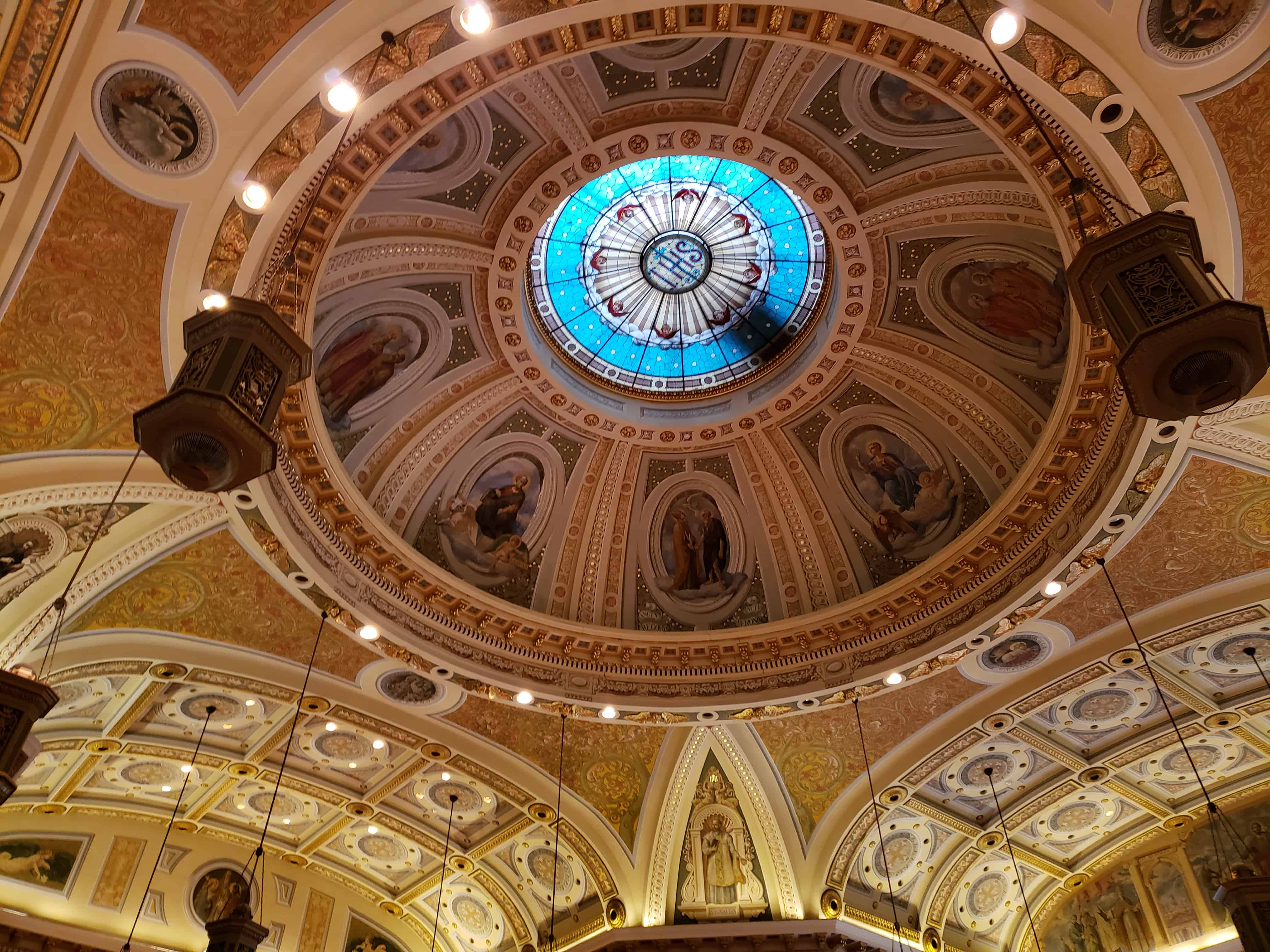
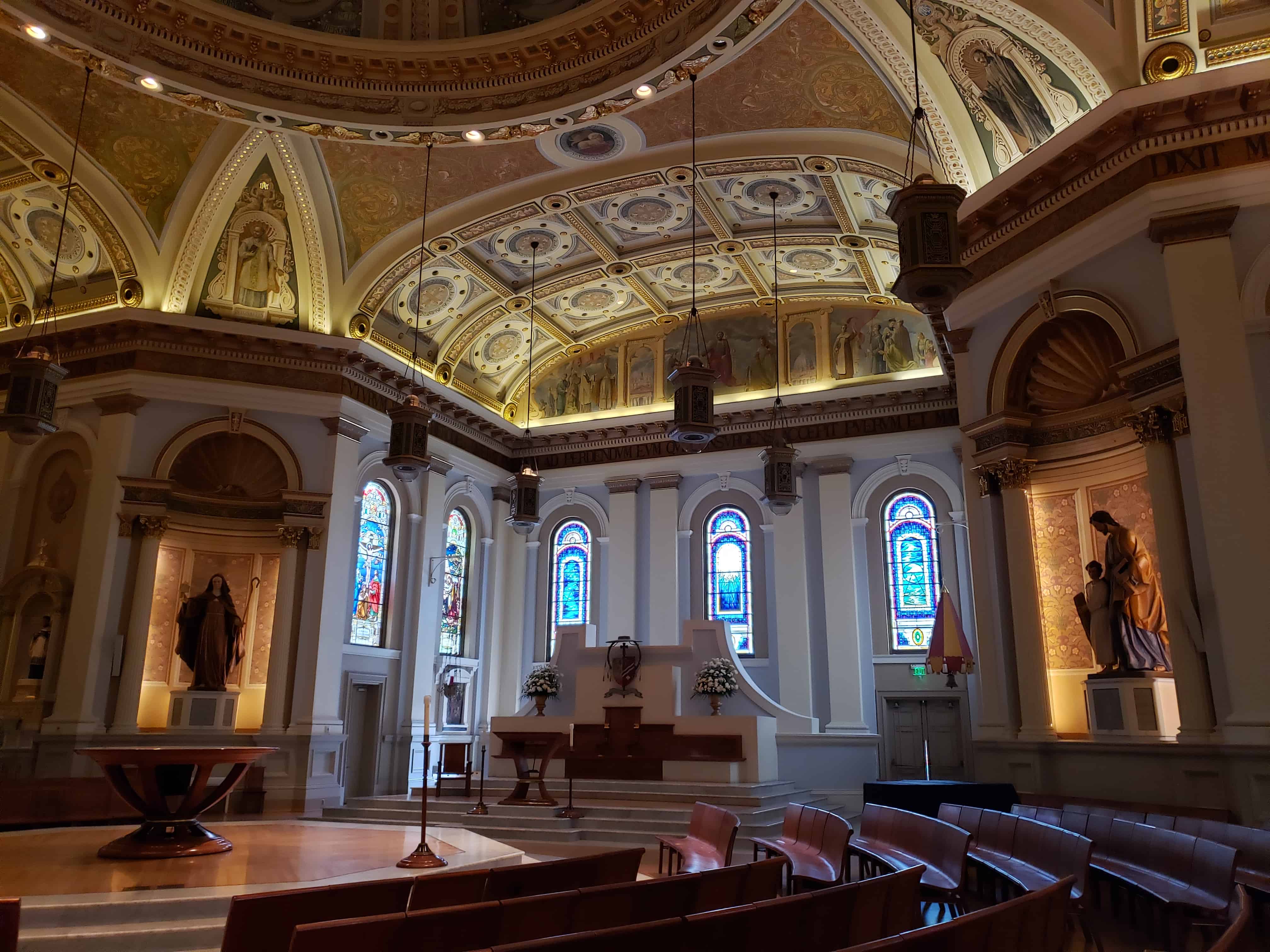
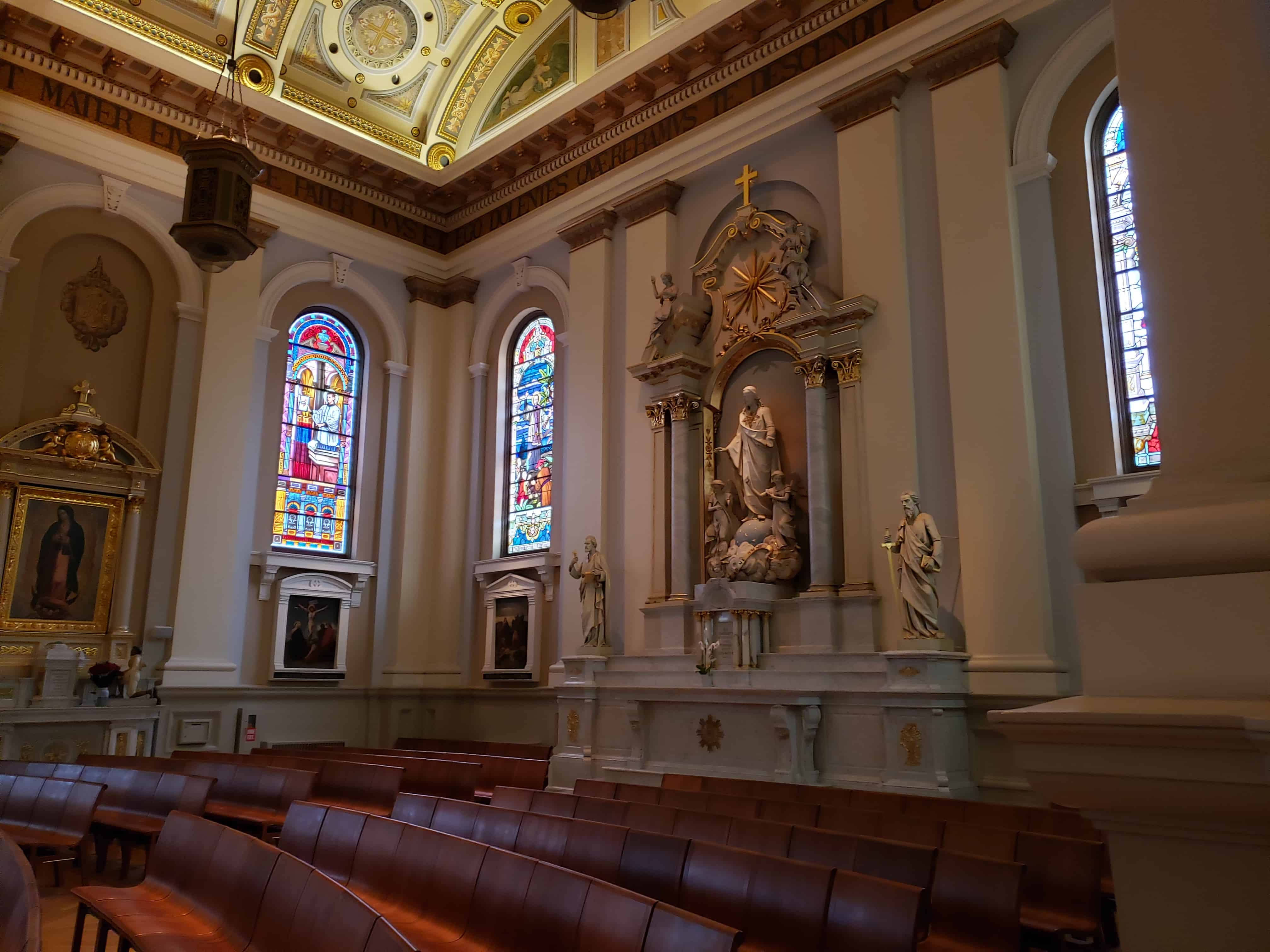
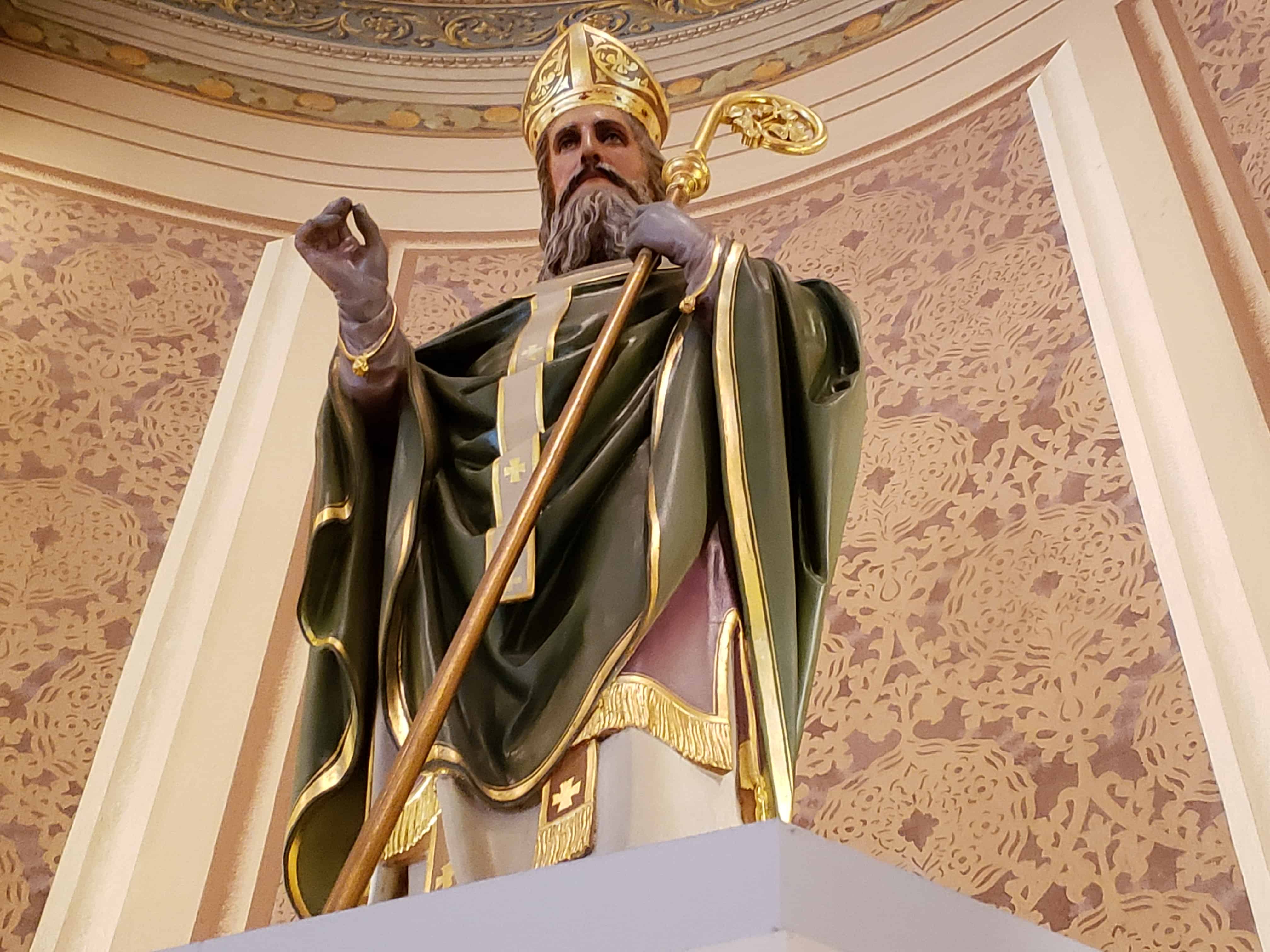
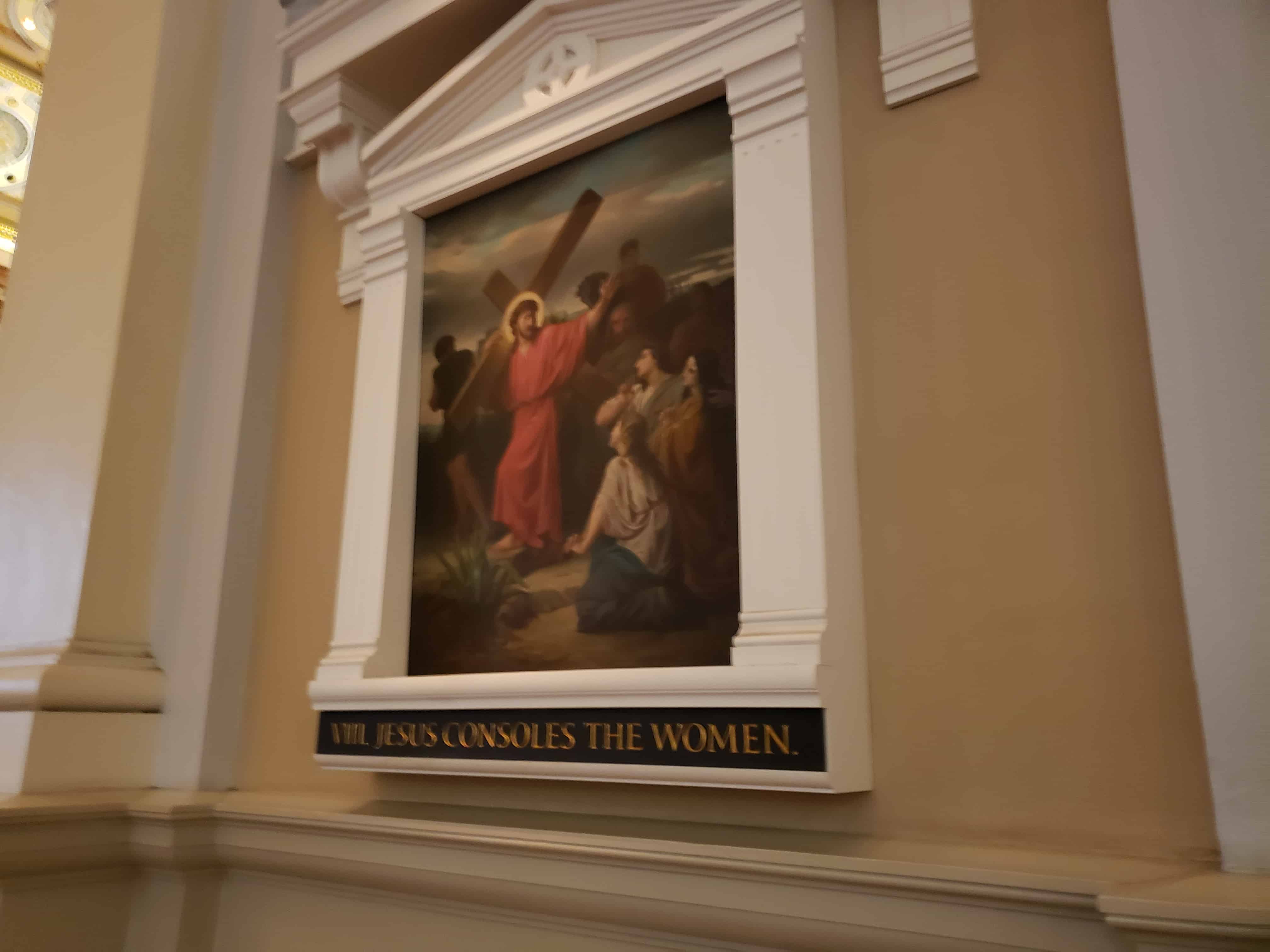
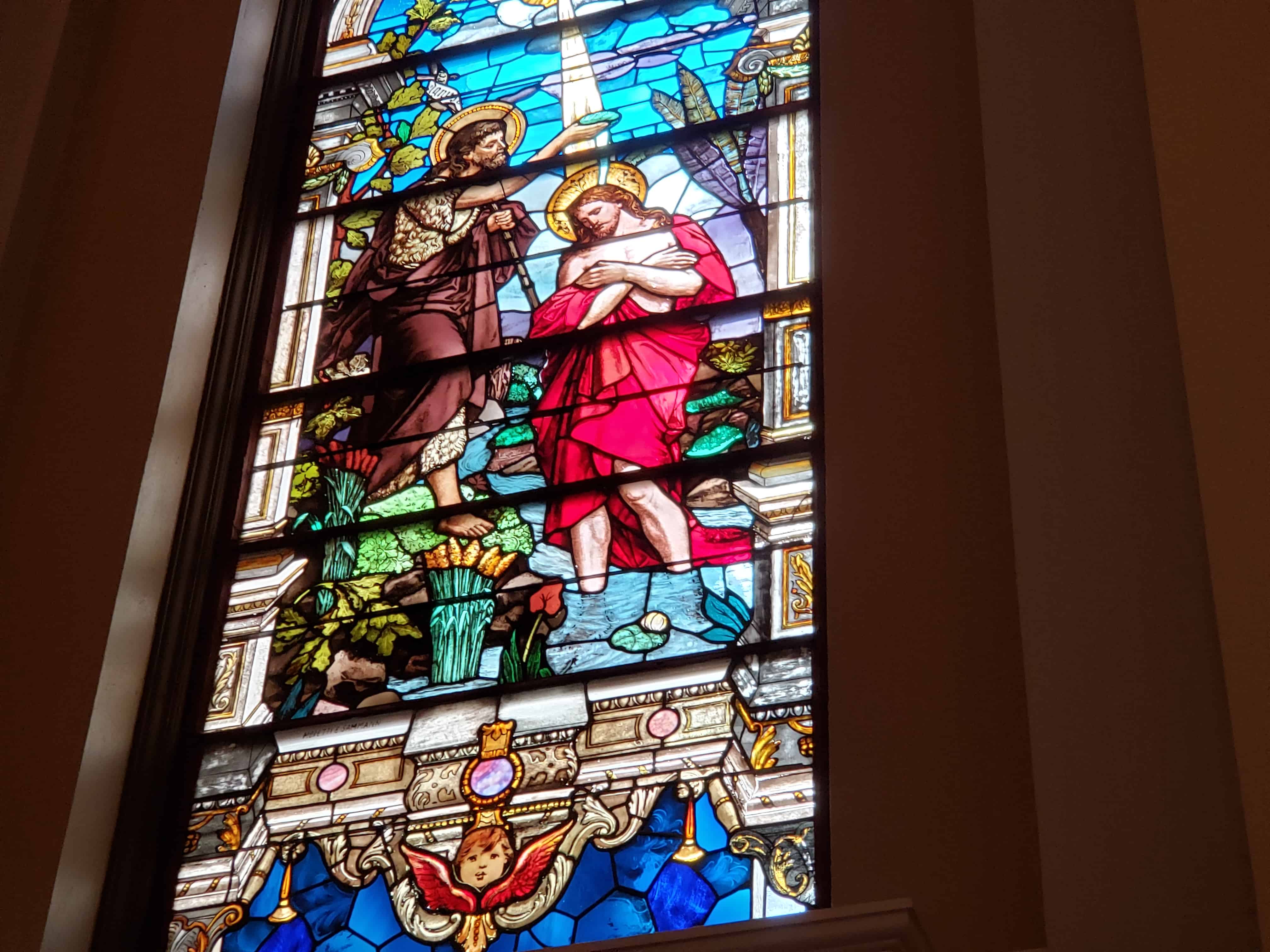
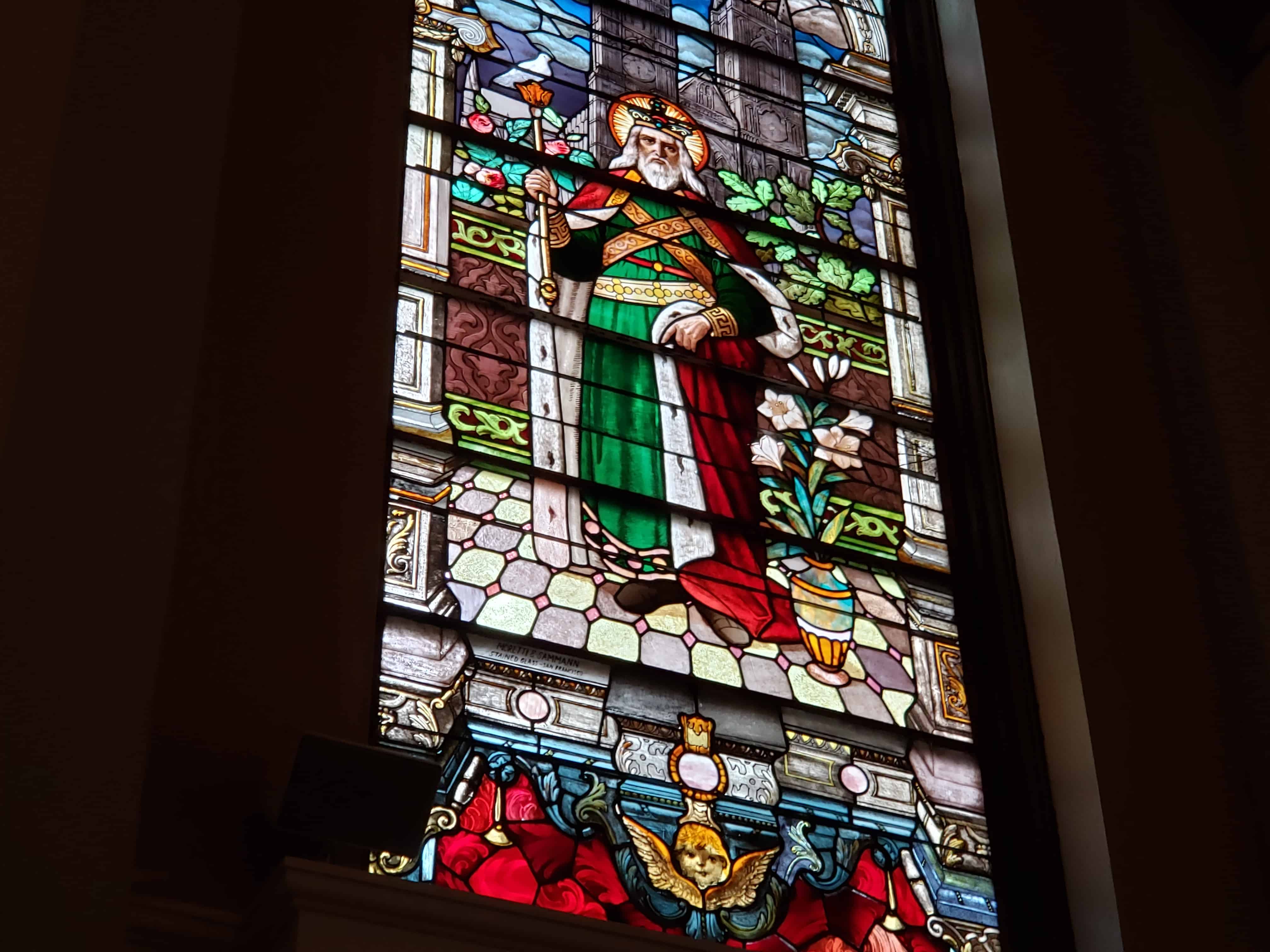
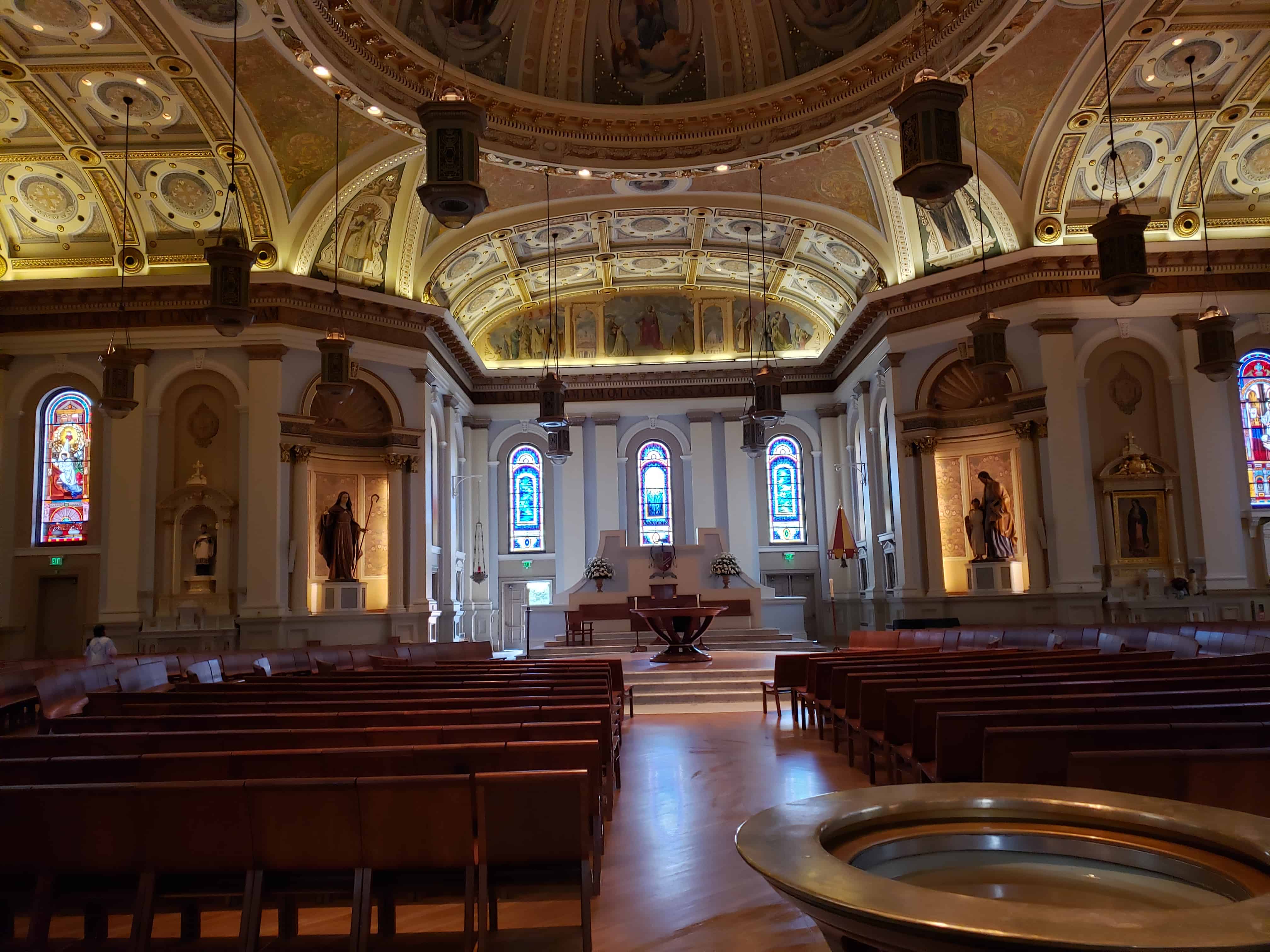
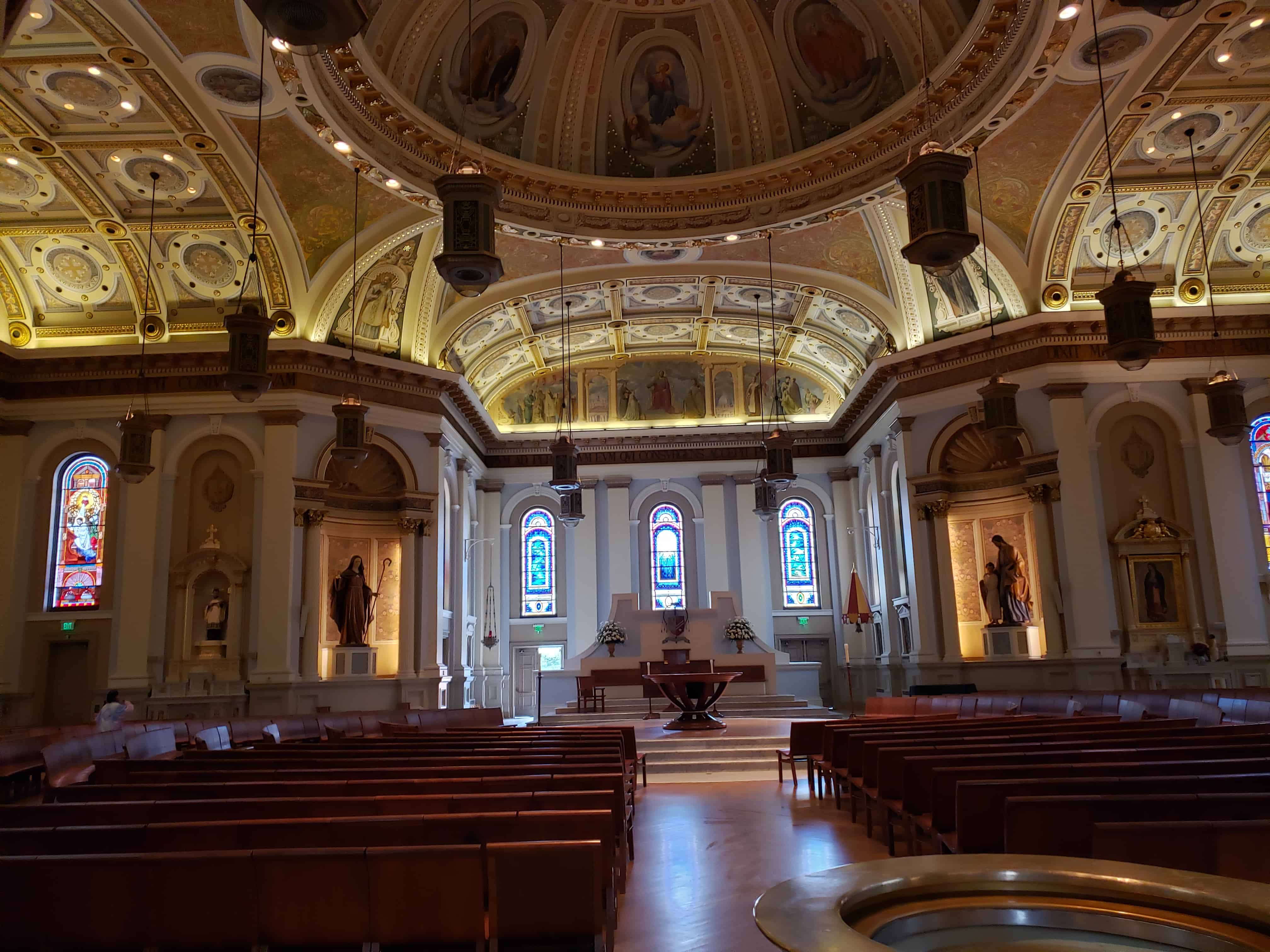
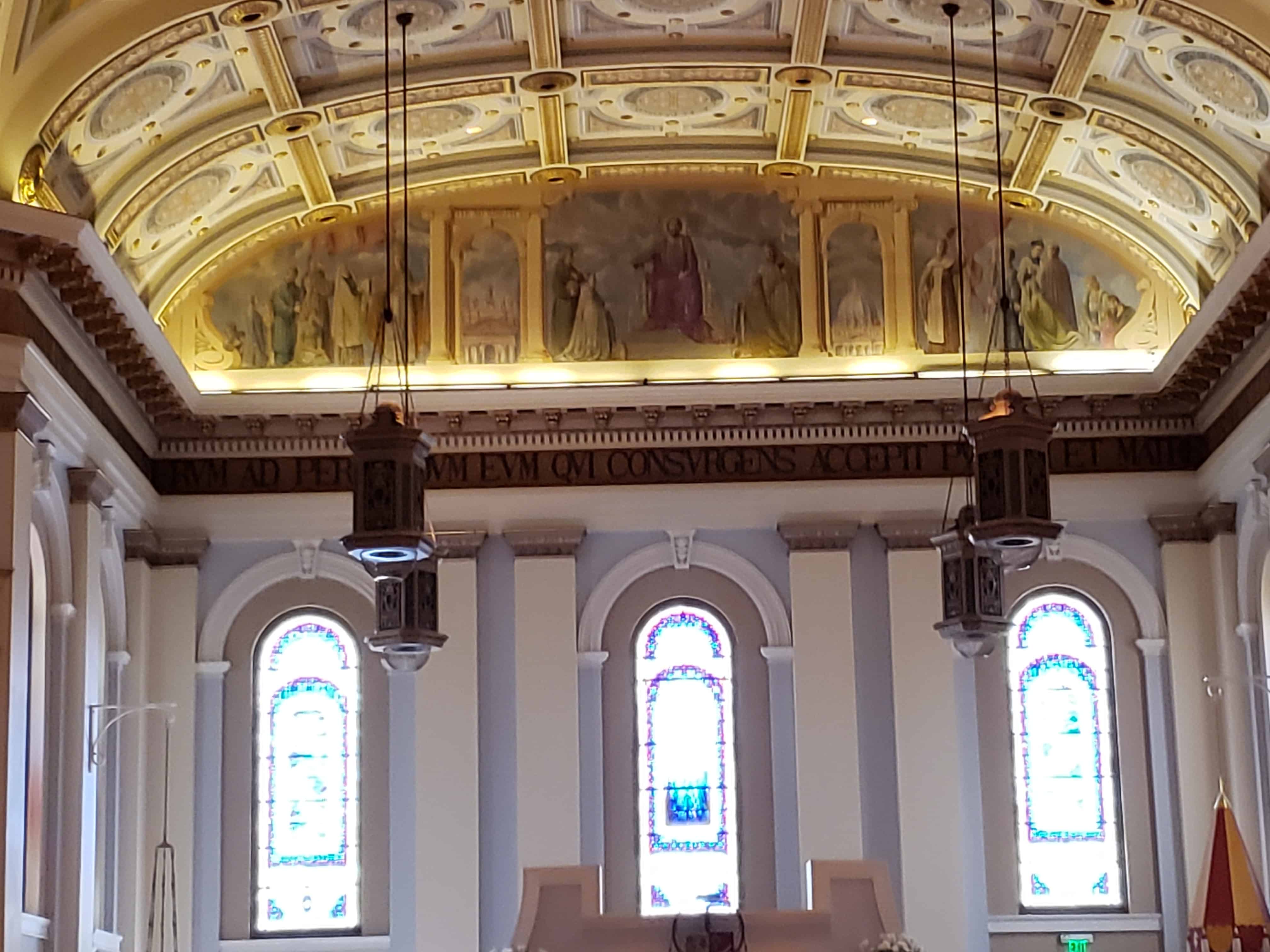
Cathedral Basilica of St. Joseph
80 S Market St, San Jose, California
St. Joseph’s was the first church of the Pueblo de San Jose. The original adobe structure was built on the present site in 1803. It was replaced by a second adobe in 1845, which in turn was replaced by a wooden building in 1869. After this structure was destroyed by fire in 1875, the present building was begun. Designed by architect Bryan J. Clinch, this grand edifice continues to house San Jose’s oldest seat of Christian worship.
California Historical Landmark #910

29 Wednesday Apr 2020
Posted in Uncategorized
Tags
Catholic, Historic Churches, NRHP, park city, Schools, summit county, utah
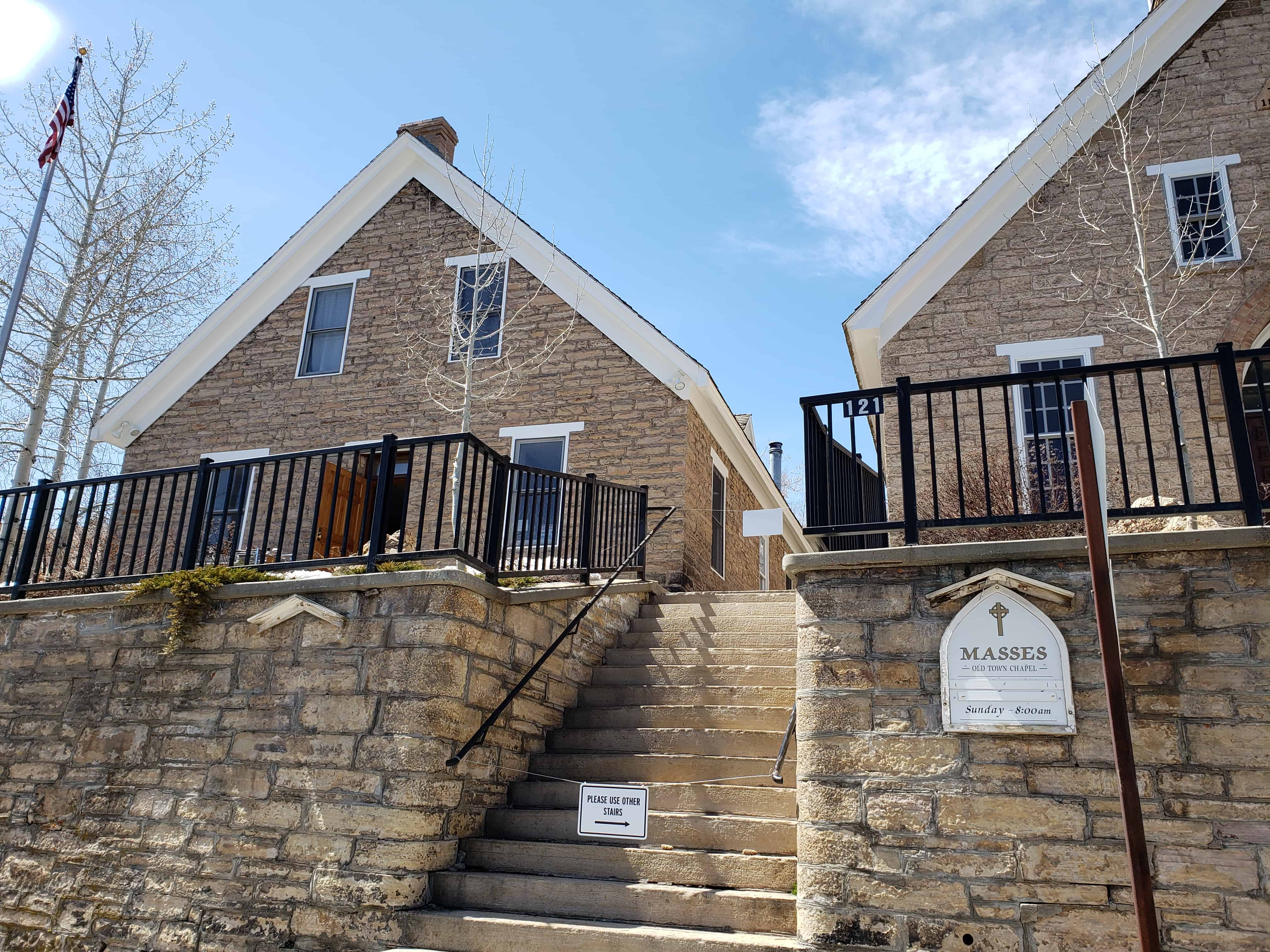
St. Mary of the Assumption Church and School
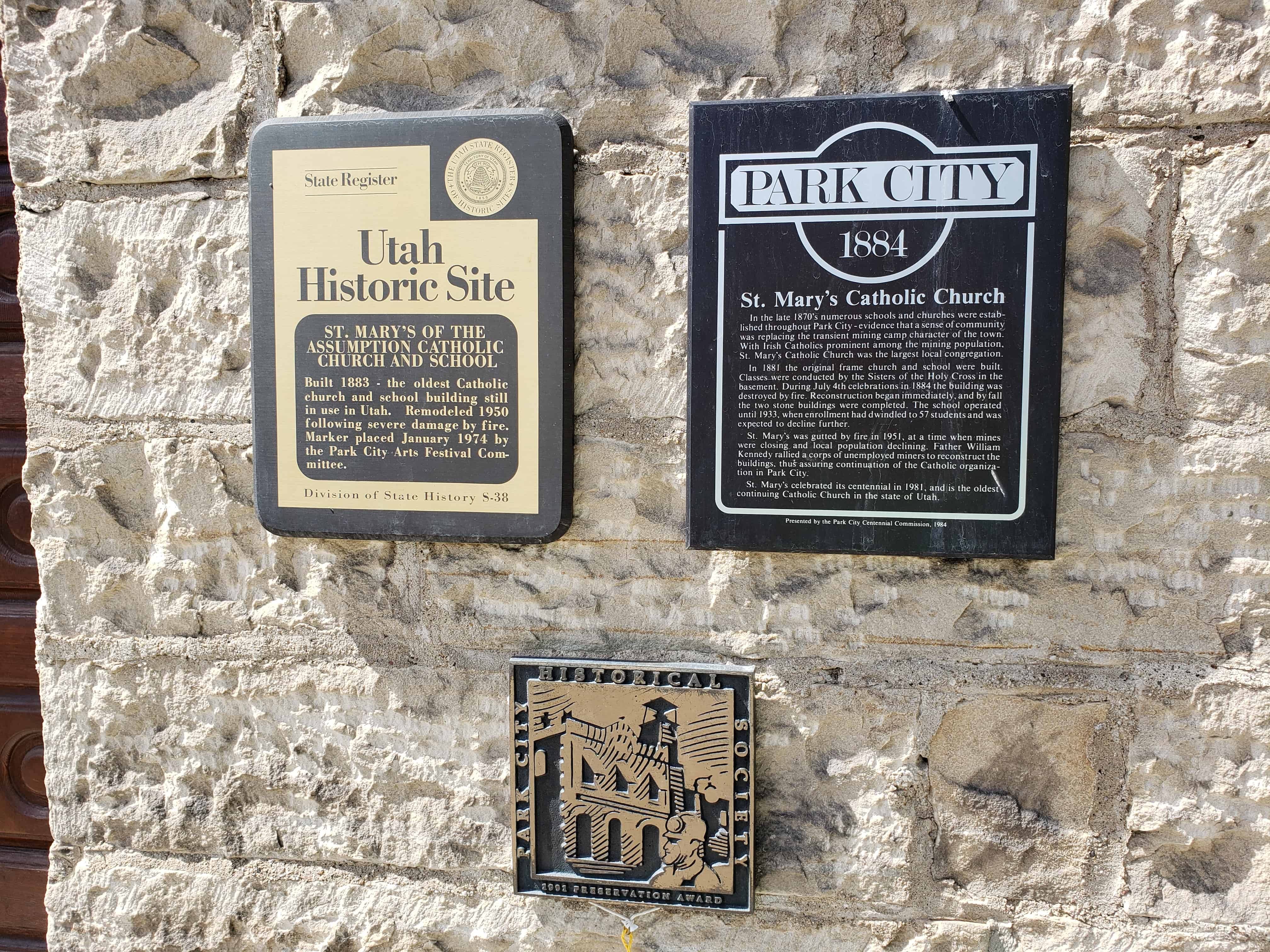
Built in 1883, this is the oldest Catholic church and school still in use in Utah. Remodeled in 1950 following severe damage by fire.
Located at 121 Park Avenue in Park City, Utah and added to the National Register of Historic Places (#79002512) on January 25, 1979.
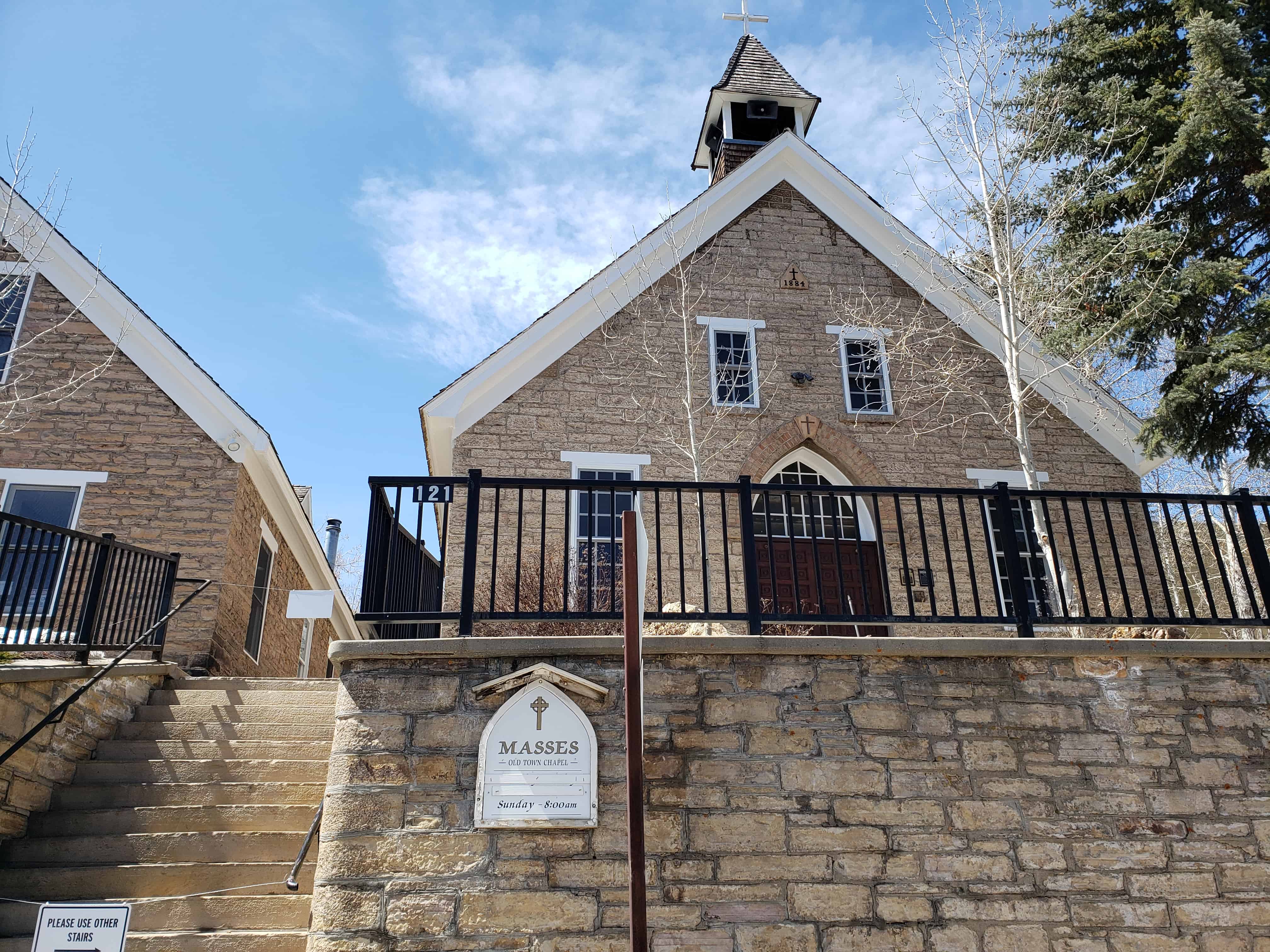
St Mary’s Catholic Church
In the late 1870’s numerous schools and churches were established through Park City – evidence that a sense of community was replacing the transient mining camp character of the town. With Irish Catholics prominent among the mining population, St. Mary’s Catholic Church was the largest local congregation.
In 1881 the original frame church and school were built. Classes were conducted by the Sisters of the Holy Cross in the basement. During July 4th celebrations in 1884 the building was destroyed by fire. Reconstruction began immediately, and by fall the two stone buildings were completed. The school operated until 1933, when enrollment had dwindled to 57 students and was expected to decline further.
St. Mary’s was gutted by fire in 1951, at a time when mines were closing and local population declining. Father William Kennedy rallied a corps of unemployed miners to reconstruct the buildings, thus assuring continuation of the Catholic organization in Park City.
St Mary’s celebrated its centennial in 1981, and is the oldest Catholic Church in the state of Utah.
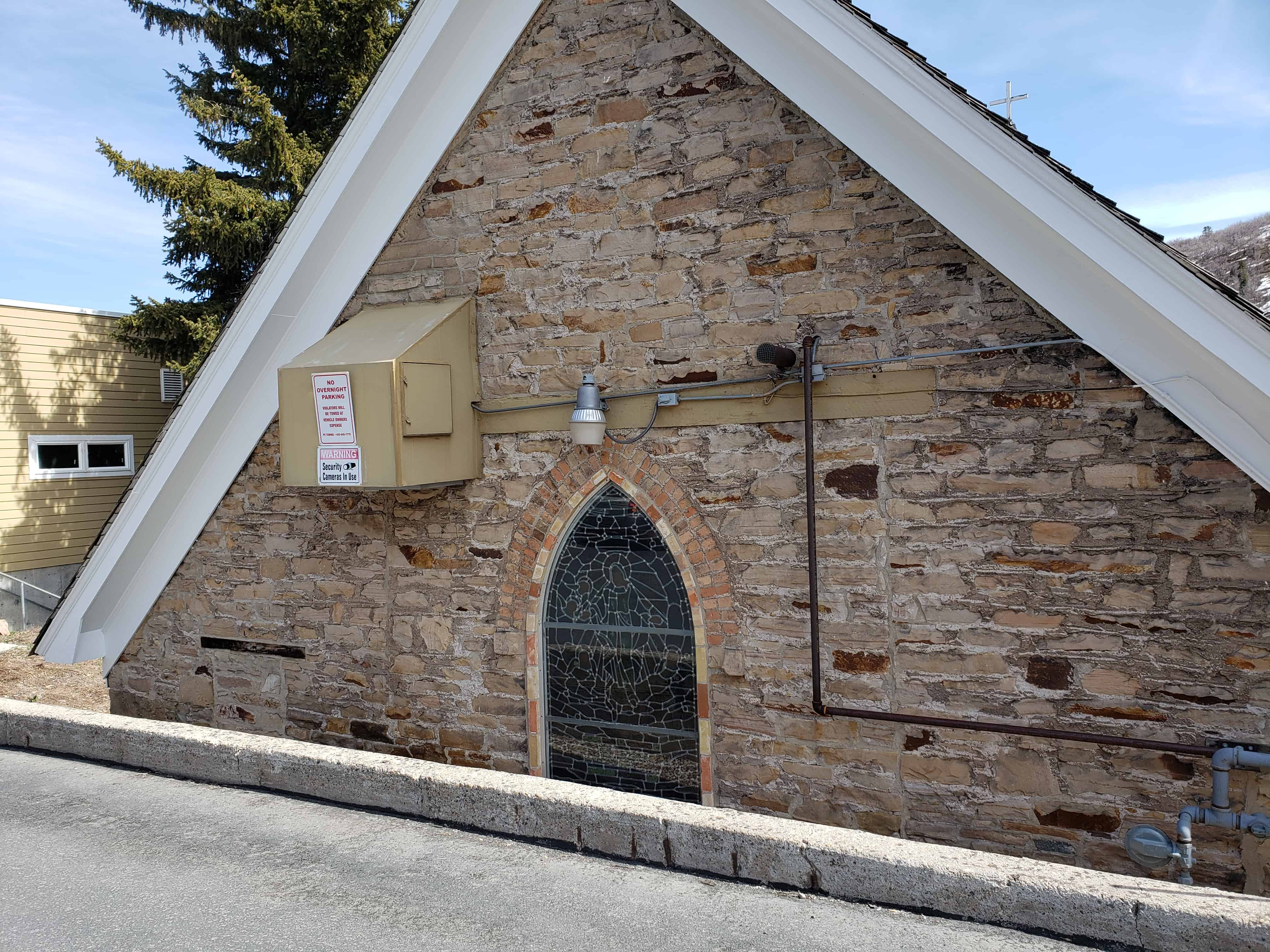
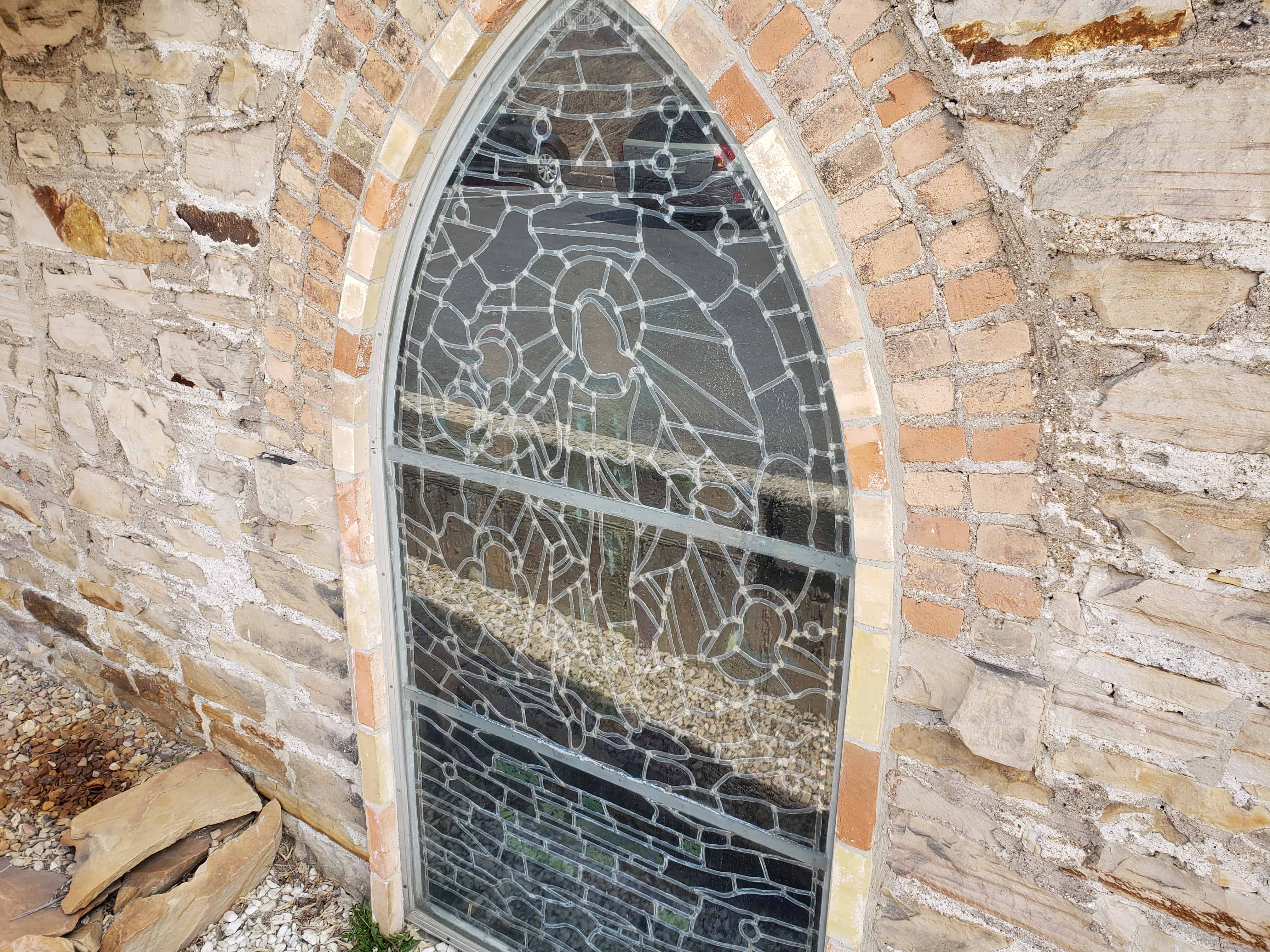
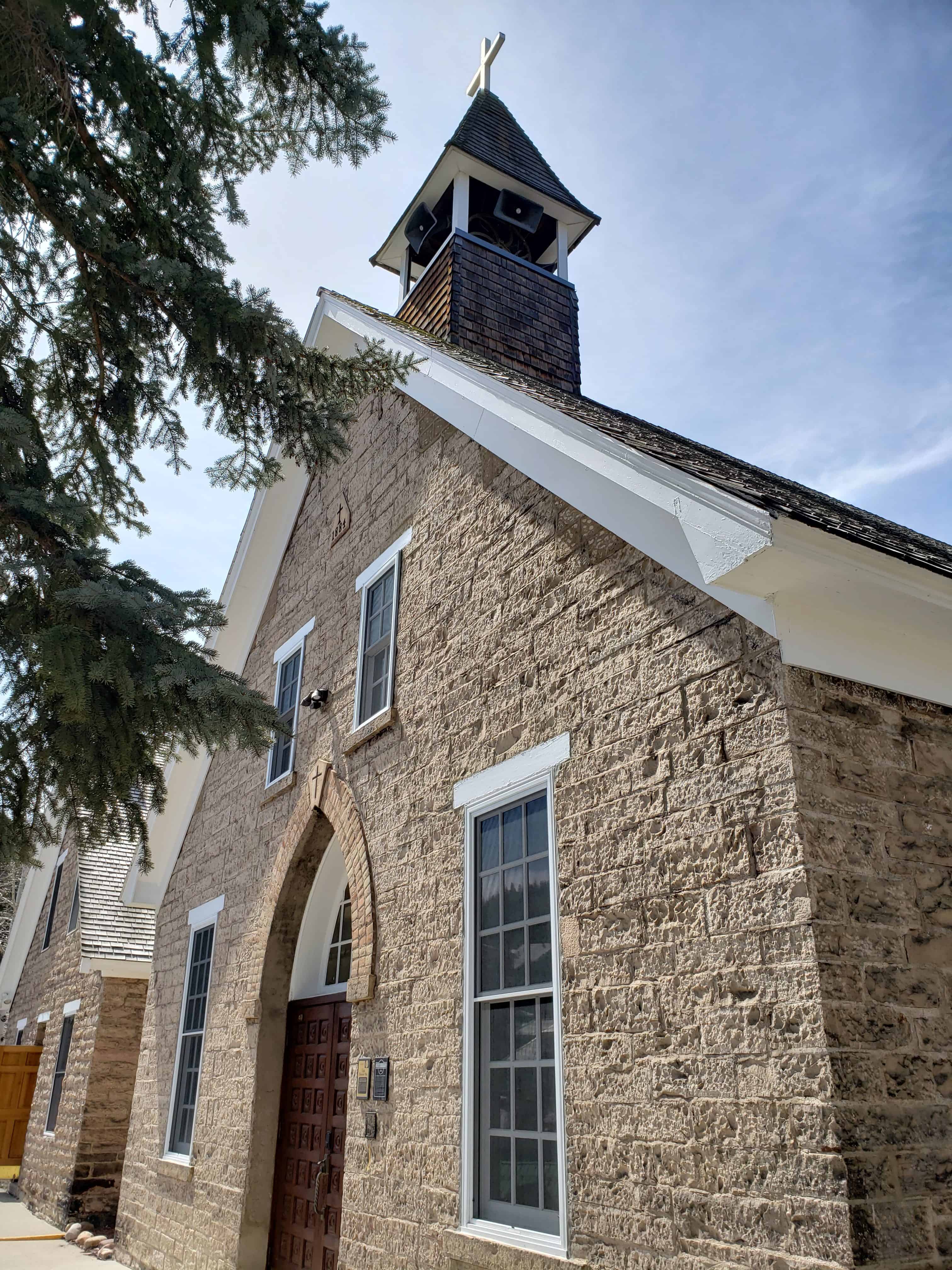
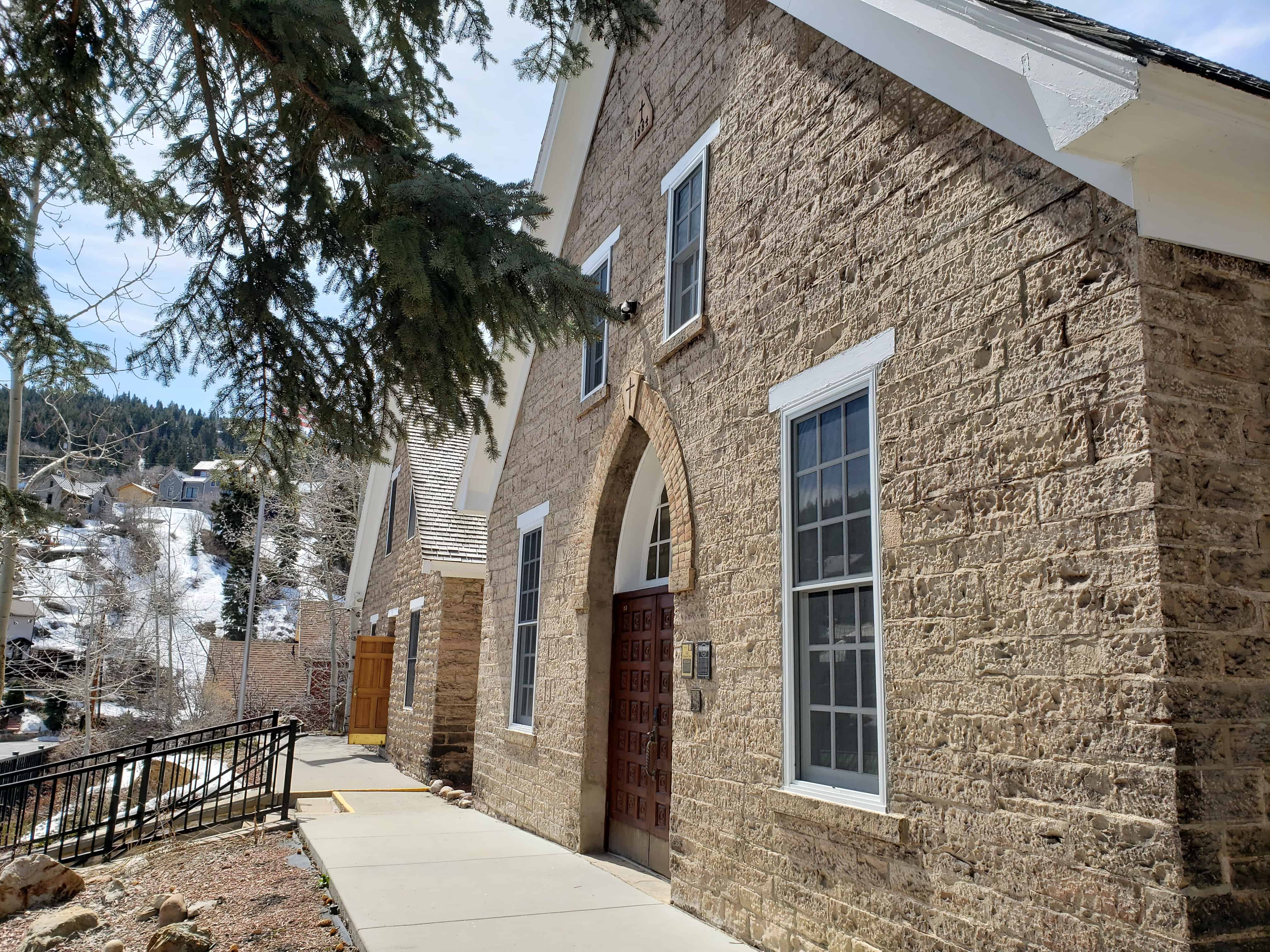
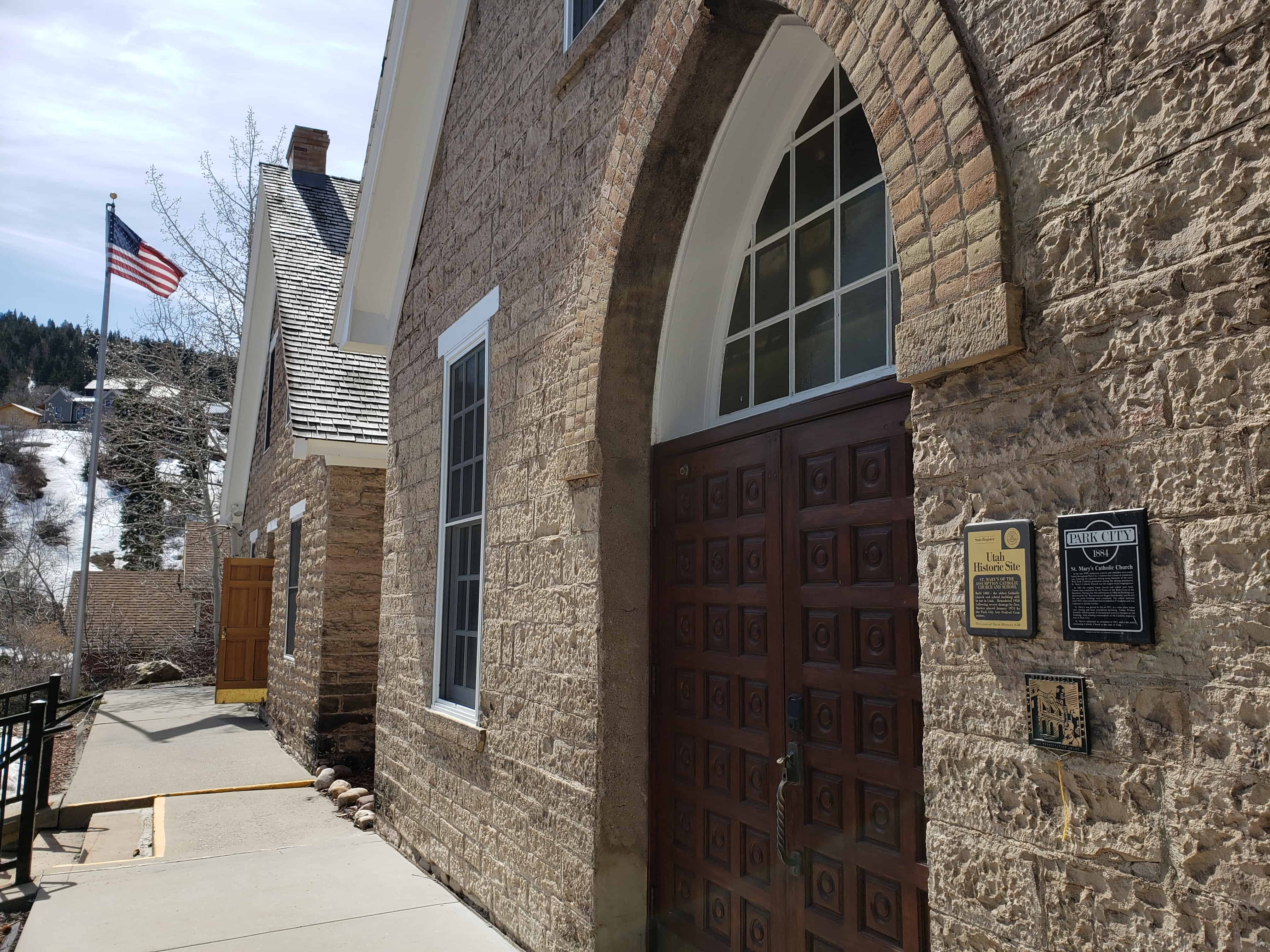
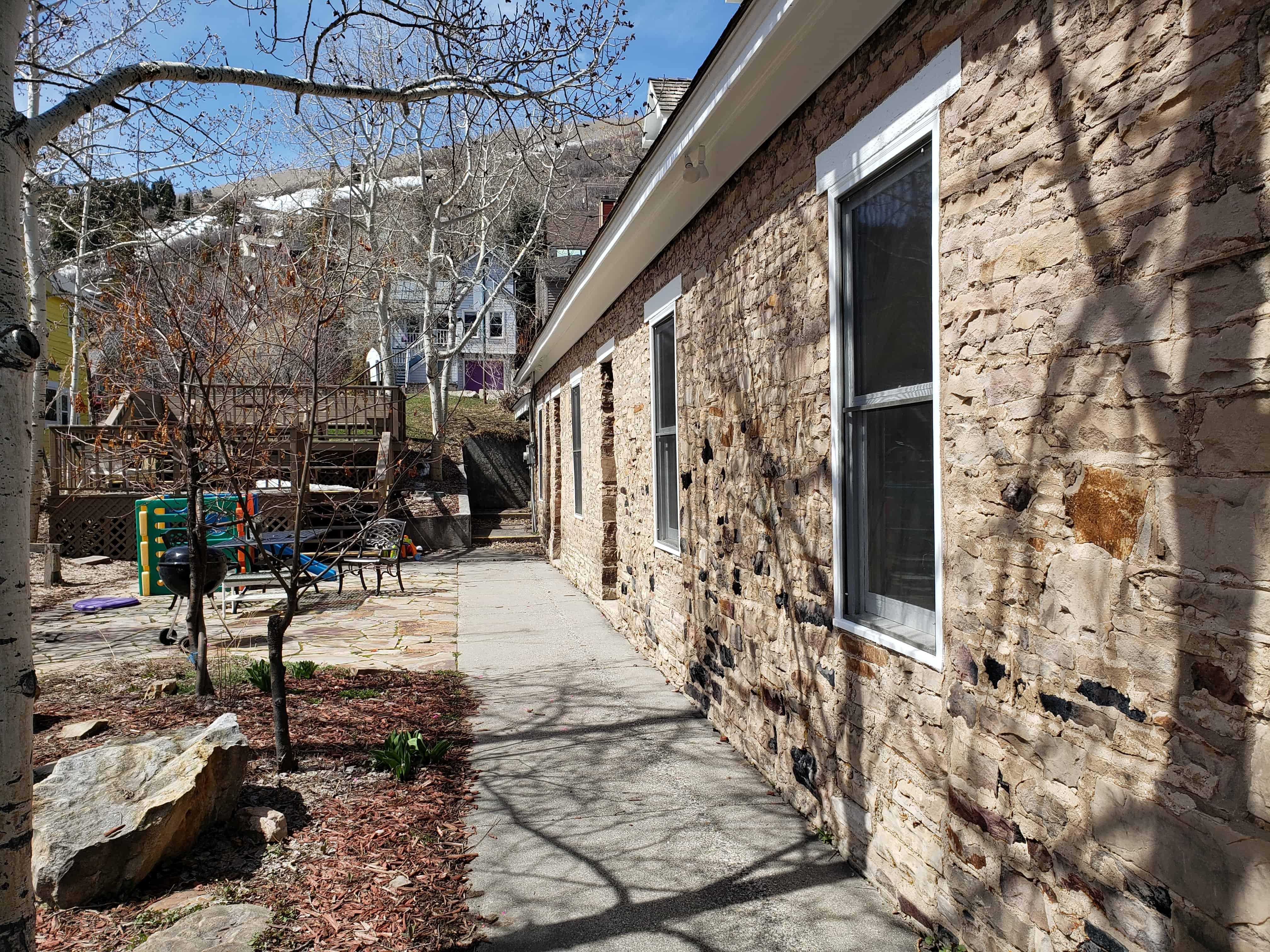
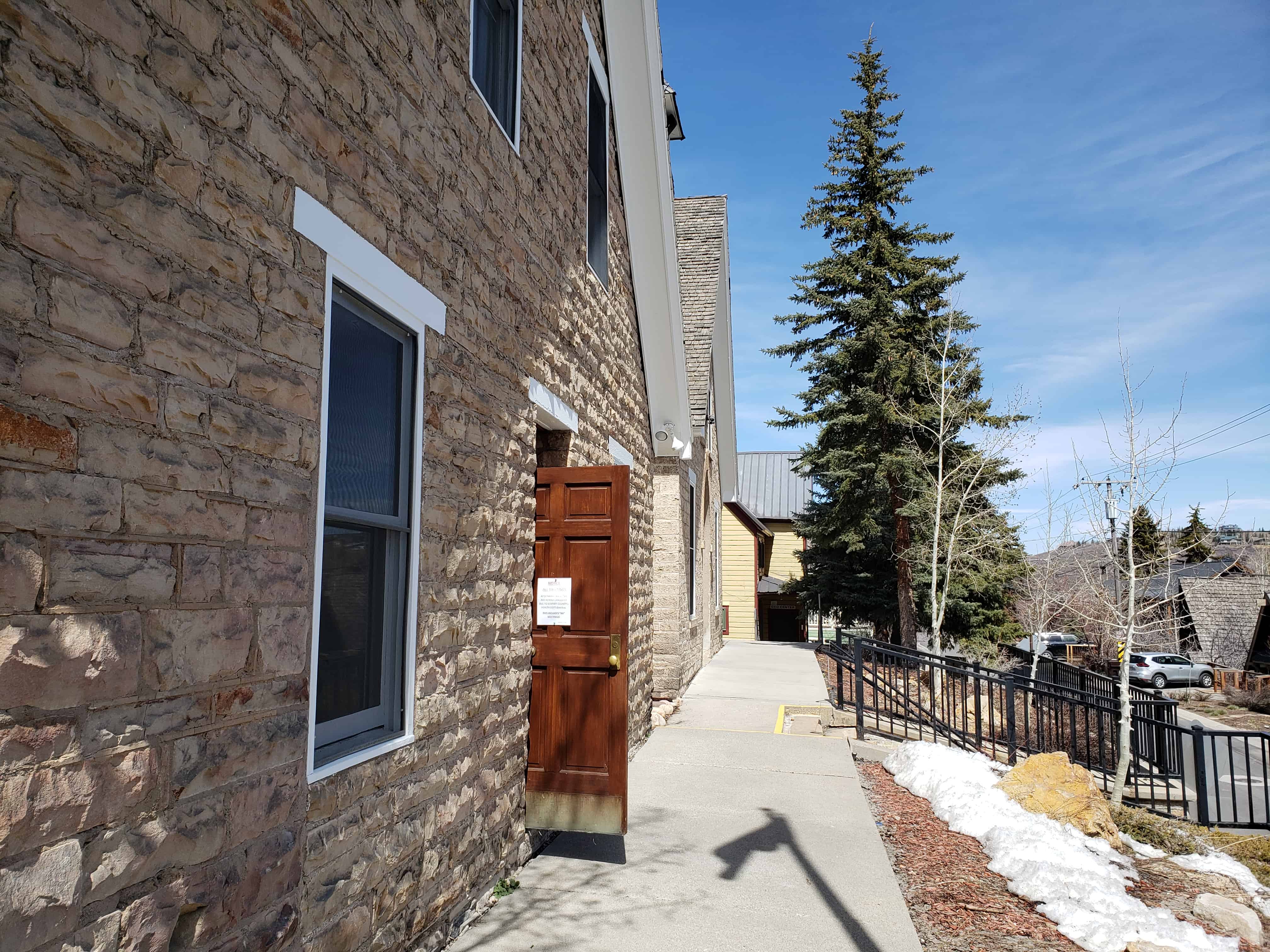
St. Mary’s is the oldest remaining Catholic Church in the state of Utah. The church and school, rebuilt in 1884 after a fire, represent both the successes of pioneer missionary efforts of the Catholic Church in Utah, as well as early educational endeavors in the mining town of Park City.
Catholic missionary work effectively began in the Utah area with the efforts of Father Lawrnece Scanlan. 1 In 1865 the Territory was placed under the jurisdiction of the Right Reverand Eugene O’ Cornell, Bishop of Marysville, California, with Father Edward Kelly appointed pastor. Kelly’s tenure was ephemeral since in October, 1866 Utah was transferred to the jurisdiction of the Rt. Reverand Joseph P. Machebeuf , Vicar Apostalic of Denver. After the appointment of several priests to the area, Scanlan came to Utah in 1873, and promptly began to establish missionary stations in a vast parish which included all of present-day Utah and a portion of Nevada.
Beginning in the late l860’s mining in Utah attracted numerous miners and entrepreneurs. Mining camps sprang up in many parts of Utah, and Irish Catholics were prominent among the mining population. Park City, Utah quickly attained the label of a “bonanza camp.” Located some thirty miles east of Salt Lake City, the camp, comprising mostly non-Mormons (Gentiles), was visited in 1873 by Scanlan, who made regular trips until 1878.
Mass was said in Simon’s Hall, the present site of the Claim jumper Hotel, and occasionally at Digman’s Hall. Father Denis Kiely aided Scanlan, and between the years of 1881 and 1881!-, Park City priests were Fathers Donohue, Tierney, and Blake.
These meeting places proved to be too small, therefore, in 1881 a frame church and school was erected upon a lot on the western slope of the canyon-Park City’s first church. Scanlan had asked the Sisters of the Holy Cross to open a school in Park City, and the request met with compliance. The necessity of both a church and school were viewed as important in fostering Catholicity. In 1882 Sisters Alexis, Martina, Aurea, and Joseph arrived in Park City from South Bend, Indiana, followed by Sister Elise, Superior. They taught school, which was attended by Catholic as well as Protestant children.
Amid the festivities of July 4, 1881, a fire destroyed the church and school. Reports circulated that the fire was the work of an arsonist, who had threatened to take revenge upon the townspeople. The fire began at about 8:00 p.m., near a door in the west end of the building. Firefighters experienced difficulty in laying a water line; thus, the structure was lost.
Park City’s Catholics quickly united and work commenced almost immediately on the erection of a new chiirch and school. By July 19, 1884 workers were in the process of construction, with reports stating that the two buildings were to be each 33 x 60 feet, with 10 foot walls, and iron roofs of a steep pitch. The two stone structures cost an estimated $10,000, and by fall school had begun.
St. Mary’s church still serves the Park City community. High scholarship was always equated with the elementary school, which maintained a regular curriculum as well as such classes as bookkeeping, and sewing and fancy needlework. The school’s excellence attracted both Catholic and non-Catholic students. In December, 1887, enrollment was listed at 145 students. Economic fluctuations caused student numbers to rise and fall, but in 1933 the school closed.
Park City’s St. Mary of the Assumption Church remains as the oldest intact, functioning Catholic Church in the state of Utah. The mining boom of the late nineteenth century accounted for much of the state’s early Catholic population. In addition, the missionary efforts of Lawrence Scanlan, later Salt Lake City’s first Bishop, are embodied in both the church and school. It is these structures which aid in the understanding of the link between mining and the “coming of the Gentiles” to Utah.
St. Mary of the Assumption School and Church are both rectangular, stone structures. The two-story school typifies the small annex school of pioneer Utah, while the church is one story with an attic, and also has window openings on the attic level of the facade. The buildings sit side by side and are connected at the rear. Both have limestone foundations, and are constructed of buff-colored limestone. Roofs are wood frame, steeply pitched, with wood cornices. At present, the school’s roof is covered with metal (originally tin), while the church roof is green asphalt shingles, which replaced a metal roof after a fire in 1950.
The school facade has one central entrance with a transom light. The windows through- out are two-over-two, double-hung wood frame; two windows flank the entrance door with two above on the second story level. In addition, two dormers exist on the south end, each with wood frame, two-over-two double hung windows.
A stone giothic arch, with a castle stone keystone adorning a cross, spans the central entrance of the church’s facade. On either side of the entry are? two nine-over-nine wood frame double-hung windows. Two window openings exist on the attic level, appearing as second story windows and symmetrical in appearance to those of the school. A stone marker, with a cross and engraved date of “1884”, is above the attic windows. A bell tower, topped with a cross, near the front of the roof, is much smaller and less ornate than the original.
The exterior of the buildings remains much the same; however, some door and window place- ments on the sides of the structures have changed throughout the years (evident in the Sanborn maps for 1889, 1900 and 1907).
A stone retaining wall that remains was added in front of the buildings between 1900 and 1907. Alterations and changes have occurred in the interiors. The building is still used as a church with the school occasionally used for missions and other events.
05 Sunday Apr 2020
Posted in Uncategorized
Tags

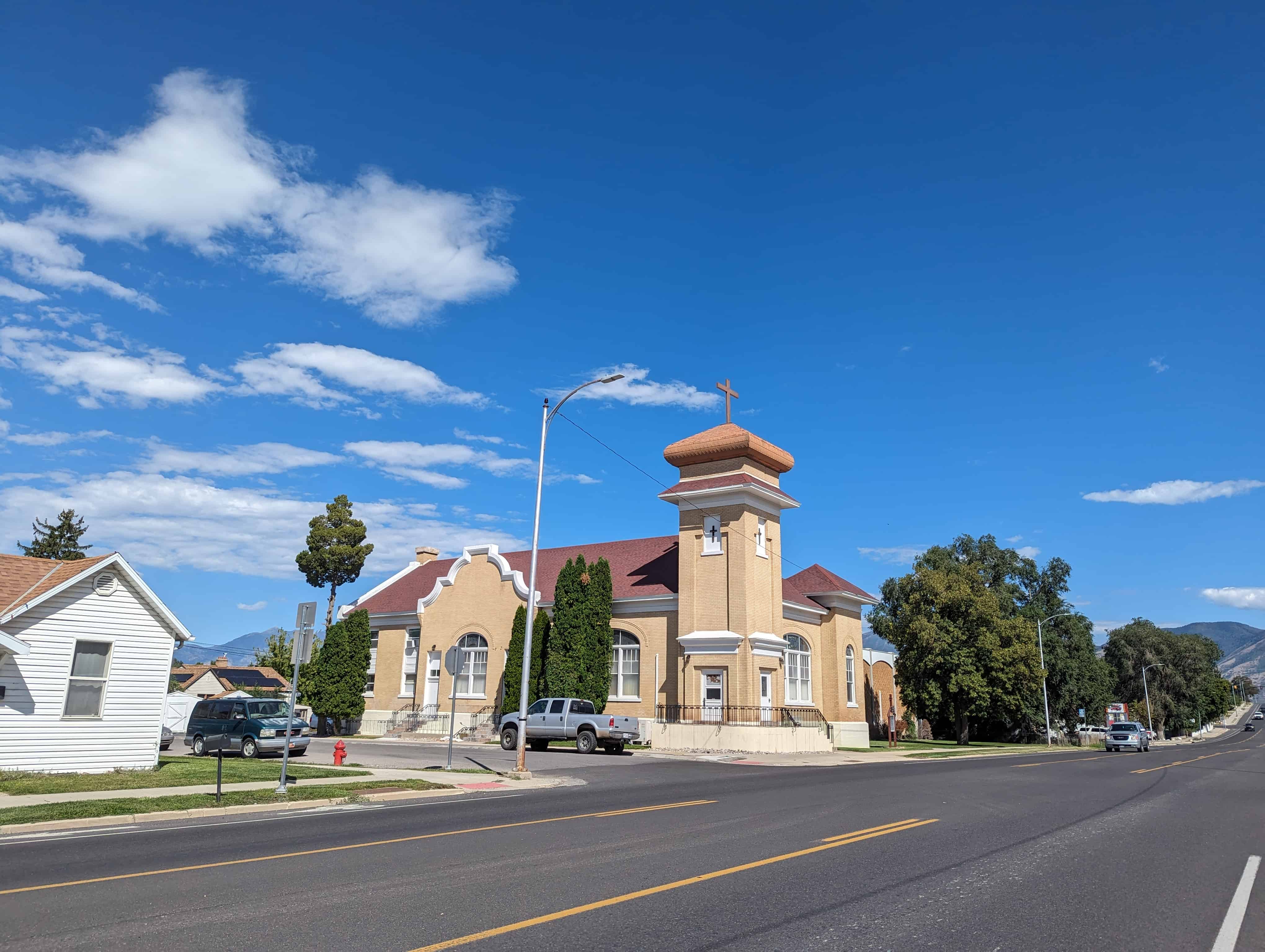
The San Andres Catholic Church at 315 E 100 N in Payson, Utah.
Originally the Fourth Ward Meeting House when it was built in the 1800’s, this was the second chapel in Payson.

26 Wednesday Sep 2018
Posted in Uncategorized

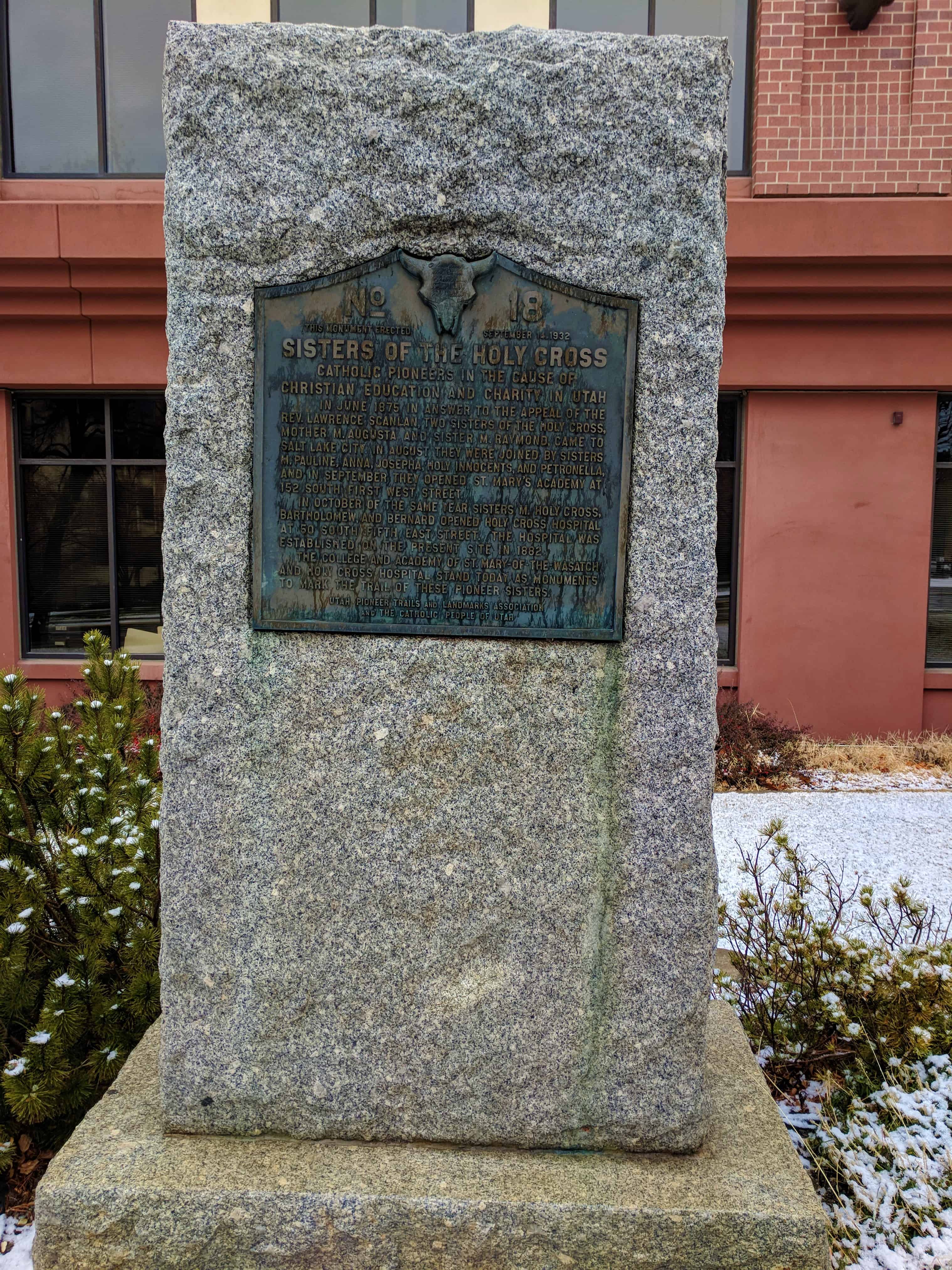
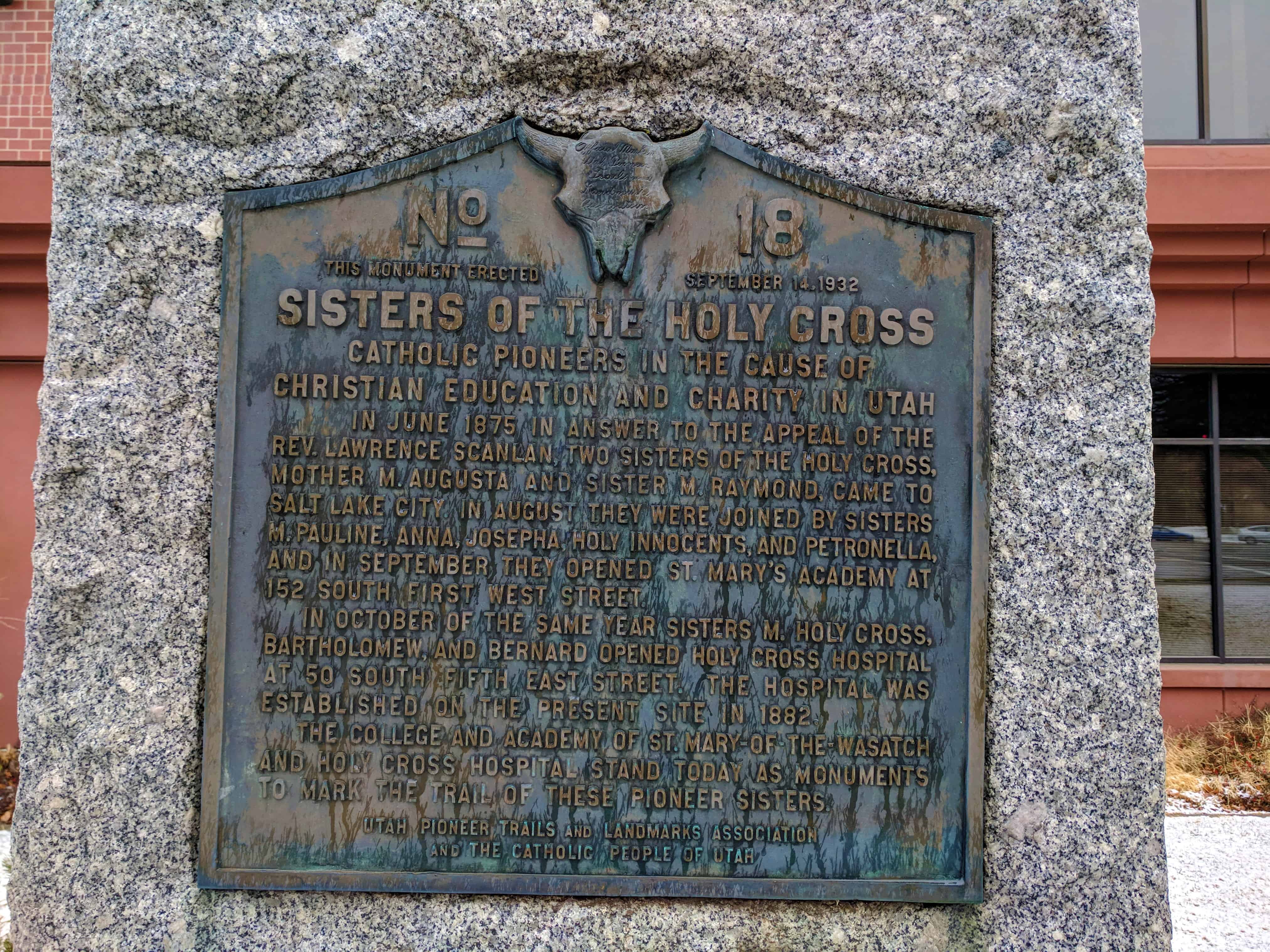
Sister of the Holy Cross
Catholic Pioneers in the Cause of Christian Education and Charity in Utah In June 1875 in answer to the appeal of the Rev. Lawrence Scanlan, two sisters of the Holy Cross, Mother M. Augusta and Sister M. Raymond, came to Salt Lake City. In August they were joined by Sisters M. Pauline, Anna, Josepha, Holy Innocents, and Petronella, and in September they opened St. Mary’s Academy at 152 South First West Street. In October of the same year Sisters M. Holy Cross, Bartholomew, and Bernard opened Holy Cross Hospital at 50 South Fifth East Street. The hospital was established on the present site in 1882. The College and Academy of St. Mary-of-the-Wasatch and Holy Cross Hospital stand today as monuments to mark the trail of these pioneer Sisters.
This is U.P.T.L.A. Marker #18, merged with the S.U.P. Markers listed here. This marker is located at 1051 East 100 South in Salt Lake City in front of the Salt Lake Regional Medical Center.

09 Thursday Mar 2017
Posted in Uncategorized


20 Sunday Nov 2016
Posted in Uncategorized

The historical marker reads as follows:
MISSION SAN LUÍS REY DE FRANCIA
Founded June 12, 1798 by Father Lasuén, then president of the California missions, and administered by Father Peyrí, Mission San Luís Rey is notable for its impressive architecture-a composite of Spanish, Moorish, and Mexican.
The following text was copied from Wikipedia.
Mission San Luis Rey de Francia was founded on June 13, 1798 in what is now the town of Oceanside, California. In 1816, Mission San Antonio de Pala was established twenty miles inland as its asistencia (“sub-mission”). The local Payomkowishum tribe became known as the Luiseño, after the San Luis mission. An early account of the mission was written by one of its Luiseño neophytes, Pablo Tac.
No services were held at the Mission for 46 years. It was not until 1892 when two Mexican priests were given permission to restore the Mission as a monastery; Father Joseph O’Keefe was assigned as an interpreter for the monks. It was he who began to restore the old Mission in 1895. The cuadrángulo (quadrangle) and church were completed in 1905. Today, Mission San Luis Rey de Francia is a working mission. It is cared for by the people who belong to the parish, and is still being restored. There is a museum and visitors center at the Mission, as well as a small cemetery.


Located at 4050 Mission Ave in Oceanside, California.
Also located here:
Related:
07 Friday Oct 2016
Posted in Uncategorized
Tags

Saint Ambrose – 339 – 397 A.D. Bishop of Milan Father and Doctor of the Church Defender of the Orthodoxy

27 Monday Jun 2016
Posted in Uncategorized
Tags
Catholic, Churches, Downtown SLC, Historic Buildings, Historic Churches, Salt Lake City, Salt Lake County
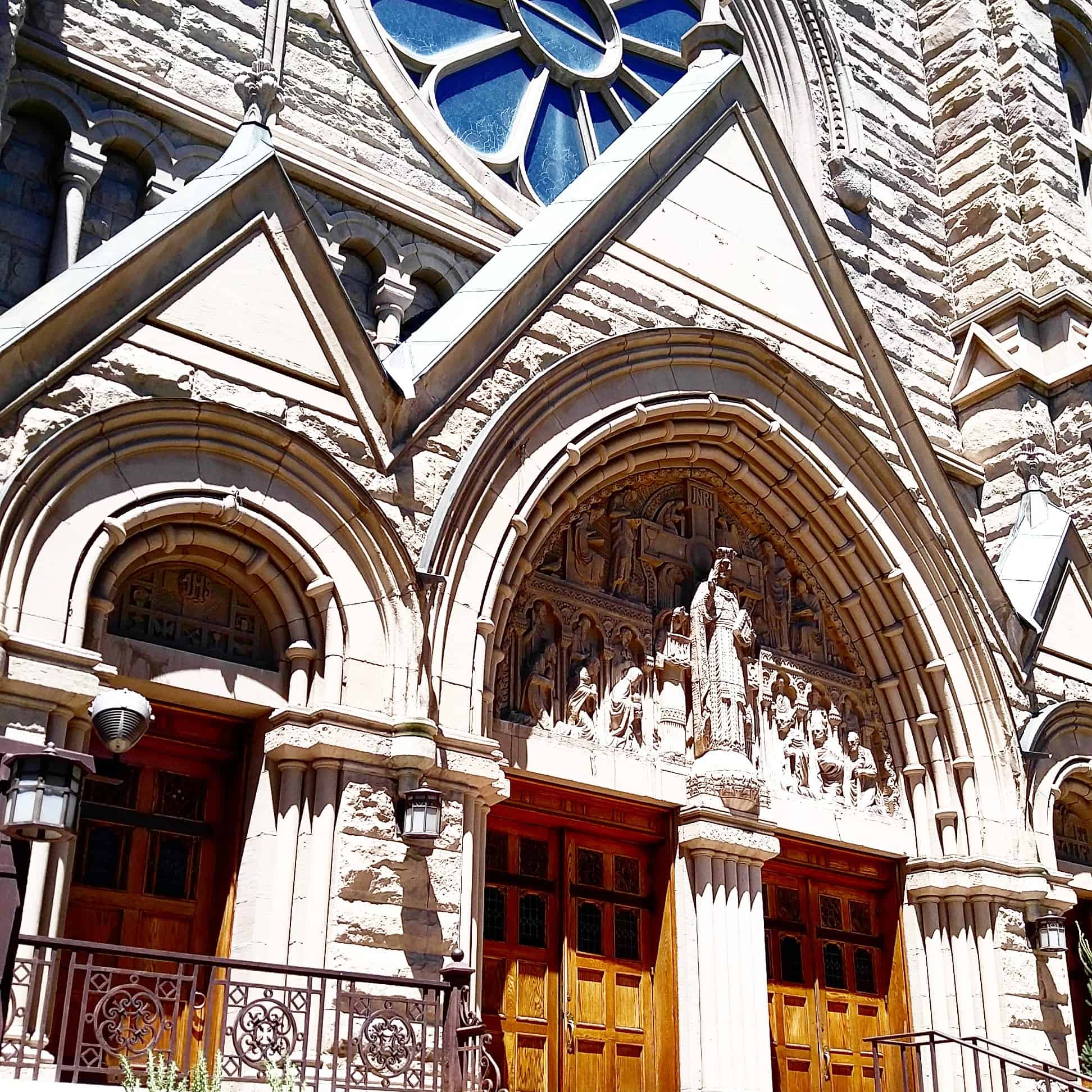
The Cathedral of the Madeleine is a Roman Catholic church in Salt Lake City, Utah, United States. It was completed in 1909 and currently serves as the cathedral, or mother church, of the Diocese of Salt Lake City. It is the only cathedral in the US under the patronage of St. Mary Magdalene.
The cathedral was built under the direction of Lawrence Scanlan, the first bishop of Salt Lake. It was designed by architects Carl M. Neuhausen and Bernard O. Mecklenburg. The outside is predominantly a Neo-Romanesque design, while the inside tends more toward the Neo-Gothic. Construction began in 1900 and was completed in 1909. It was dedicated by Cardinal James Gibbons, Archbishop of Baltimore.
The Cathedral is located at 331 East South Temple (technically the parcel is 27 C Street in The Avenues) in the South Temple Historic District in Salt Lake City, Utah and was listed on the National Historic Register (#71000845) on March 11, 1971.


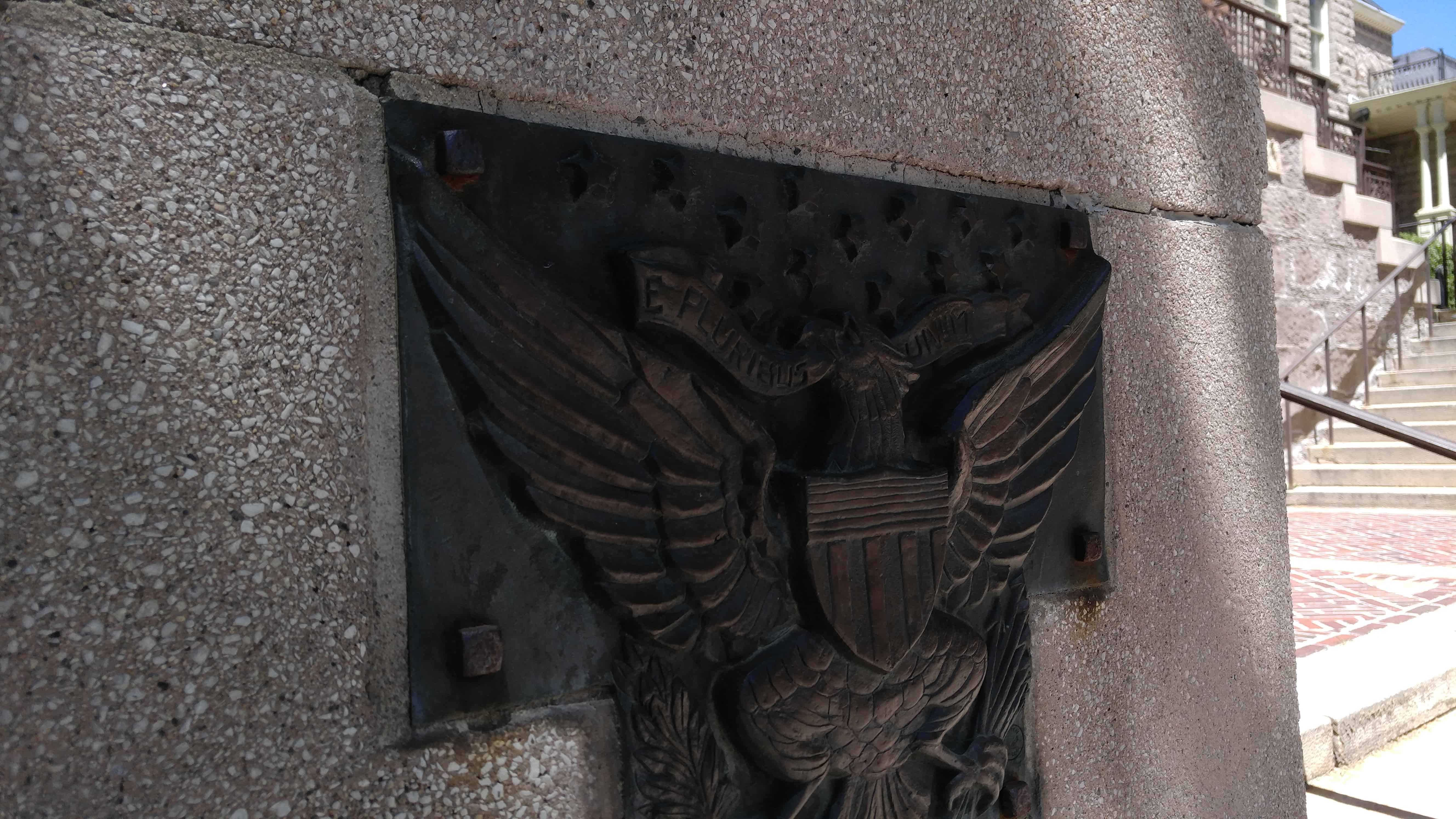


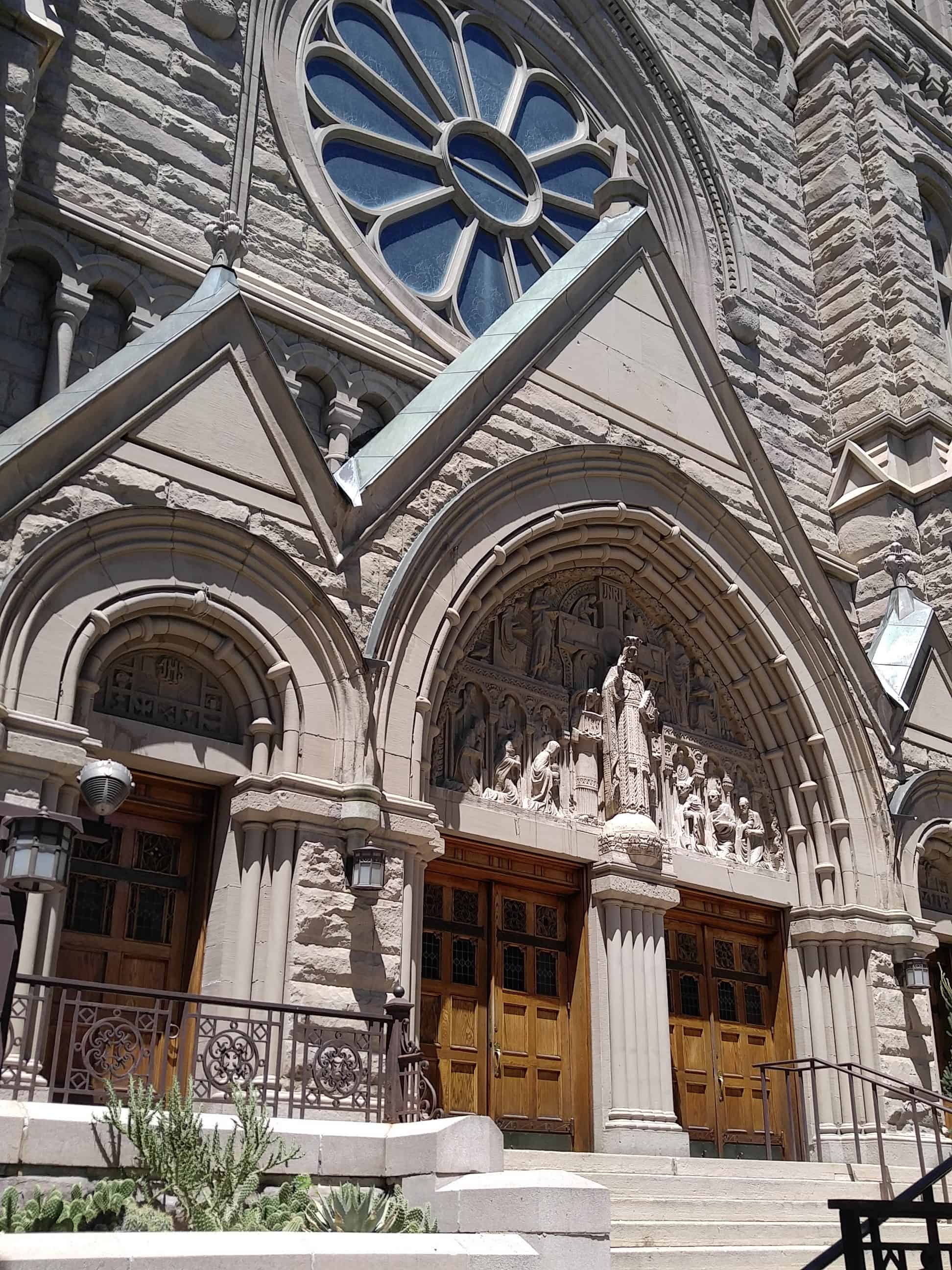


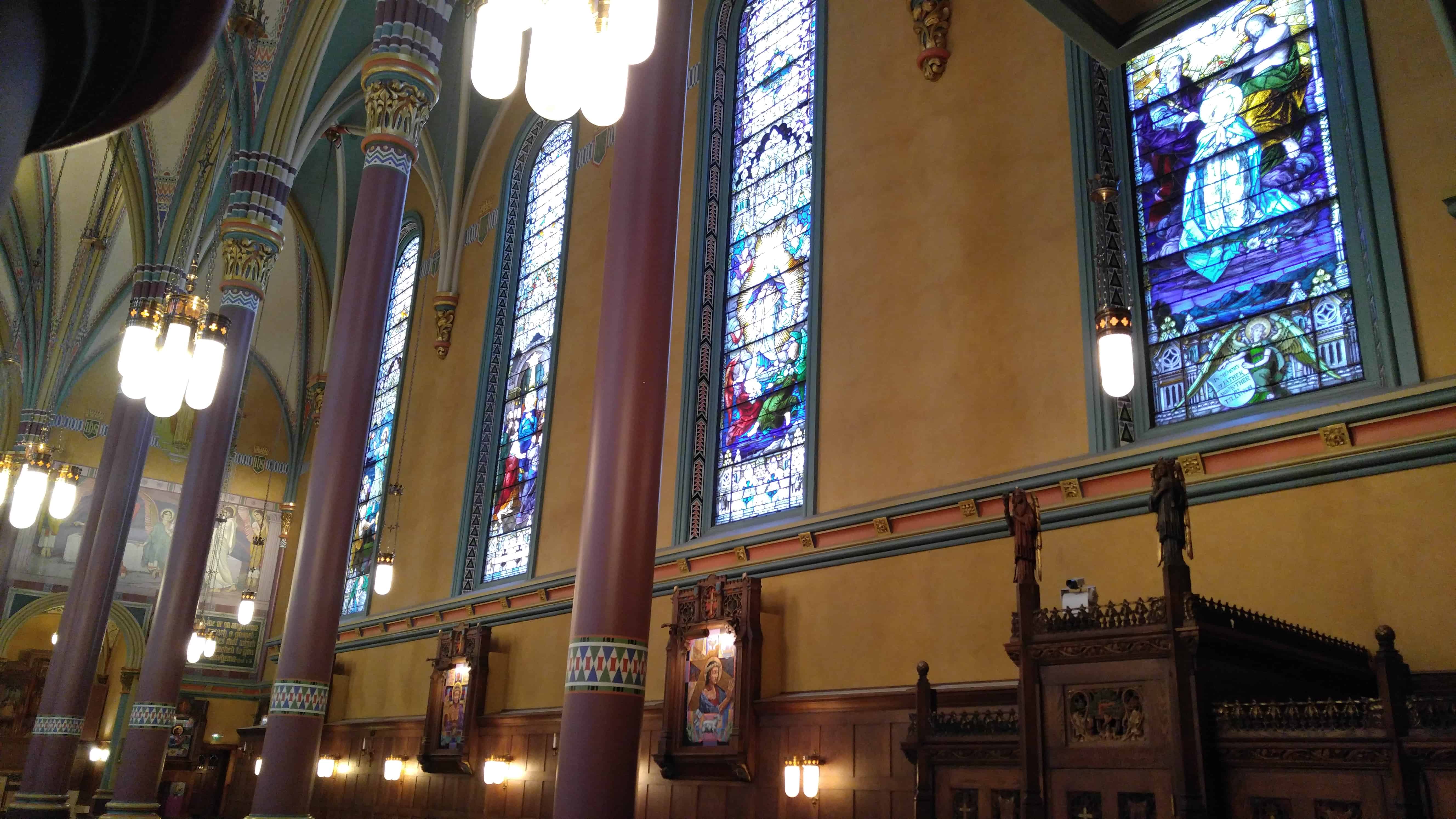


The Cathedral of the Madeleine has a very interesting history in which four important facets of Utah and American history are expressed. First of all, it was designed by Architect C. M. Neuhausen, and demonstrates his attachment to H. H. Richardson’s architecture, popular in America at the turn of the century. Some writers suggest that the influence of Sir Christopher Wren is also evident as a result of the Irish background of Bishop Lawrence Scanlon.
Secondly, the Cathedral represents the missionizing efforts of Catholicism in settling the American west. Fathers Antanazio Domingues and Silvestre Velez de Escalante were the first white men to explore into Utah. In addition, in 1776, the “Pious Fund” established by the early Jesuit Padre Kino and Father Salvatierra, for building churches in the Californias (1697), became available after more than two centuries of “controversy,” Allowing a ruling by the Hague Tribunal in 1902. Monies from these Jesuit funds were paid to the “Bishops of the Californias” of which $124,080.54 sent to the Salt Lake Diocese for building the Cathedral, a fitting tribute to the long and continuing impact of the Catholic missions on the American west.
Thirdly, much of the money used to build and furnish the Cathedral came rom Utah mines, which also provided the first attraction for major Catholic emigration to Utah. Such names as David Keith, Thomas Kearns, Mrs. Mary Judge and others are among the contributors. The Father of Utah mining, General Patrick Connor, was a Catholic. Many of the thousands of miners who came to exploit Utah’s minerals were and still are Catholics. Between 1873 and 1915 all were directly affected by the Cathedral builder, Father Scanlon.
Finally, the lovely Cathedral is the crowning, tangible monument to the extensive and effective labors of Bishop Lawrence Scanlon. Father Edward Kelly had been assigned to Salt Lake City in 1866, and his successor, Father Patrick Walsh, came in 1871. They had purchased land and built the first Catholic Church in Salt Lake City, yet the edifice retained a debt of $6,000 Scanlon arrived in 1873.
Under Scanlon’s direction, churches were built in most of the mining and larger communities of Utah. all parishes in Utah before his death, and all charitable and educational institutions as well, including All Hallows College, St. Mary’s Academy, St. Ann’s Orphanage, and Holy Cross Hospital.
The Cathedral itself evolved slowly. In 1889, land was purchased from Don Carlos Young for about $39,000. Ground was broken on July 4, 1889, but the cornerstone was not laid until July 22, 1900. By 1907 the building was almost finished except for the spires. At that time Bernard O. Mecklenburg was hired as a new architect. Construction was completed and the structure dedicated August 15, 1909. It was a day for celebration, especially by Utah Catholics. Construction costs have been estimated at over $300,000 plus furnishings.
Bishop Scanlon worked successfully with Mormon and civic leaders, who held him in high regard. His death May 10, 1915 was mourned by all Utahns. In tribute to him, his remains were placed in the crypt under the Sanctuary. The words of Bishop Keane, given at the time the Cathedral was dedicated, pay eloquent tribute to this structure:
“This magnificent temple is a confession of faith of the Catholics of Salt Lake. Families will come and go, revolutions will arise, but Temples such as this remain as lasting monuments to those who built them, monuments to the living faith in human hearts.“

(from Preservation Utah’s walking tour)
The Cathedral of the Madeleine
331 E. South Temple 1899-1909, Carl M. Neuhausen (1899-1907), SLC, and Bernard O. Mecklenburg (1907-1909), SLC
Open to the public M-F, 7:30 am-9 pm, Sat. & Sun., 7:30 am-7 pm. Guided tours available Fridays at 1 pm and Sundays at 12:30 pm.
The mining fortunes that gave rise to South Temple’s grandest mansions also helped fund the construction of Utah’s first Catholic cathedral. The Cathedral of the Madeleine was built between 1899 and 1909 under the direction of the Right Reverend Lawrence Scanlan. It was designed by prominent Utah architect Carl M. Neuhausen as a Romanesque-style building with round Roman arches and rough-cut stone. Later, when Bishop Scanlan acquired additional funds for the project, the towers and pointed Gothic style portico were added to the plans. Upon Neuhausen’s death in 1907, Bernard O. Mecklenburg was hired to complete the roof and towers. While the exterior of the cathedral was substantially complete by 1909, the interior remained quite plain. In 1915, the Right Reverend Joseph Glass embarked on a three-year project to enhance the interior. Under the direction of noted American architect John Comes, the finest craftsmen of the day created paneling, painted murals, and carved wooden altarpieces for the building. The resulting ornate, polychrome interior is an outstanding example of the Gothic Revival style popular in the early 20th century. Comes also oversaw the completion of the exterior of the cathedral with the addition of the tympanum carving, tower gargoyles, and bi-level front steps.
Both the exterior and interior of the cathedral have undergone extensive restoration to preserve their historic character. The National Trust for Historic Preservation recognized the excellence of the interior restoration with a prestigious Honor Award in 1994.