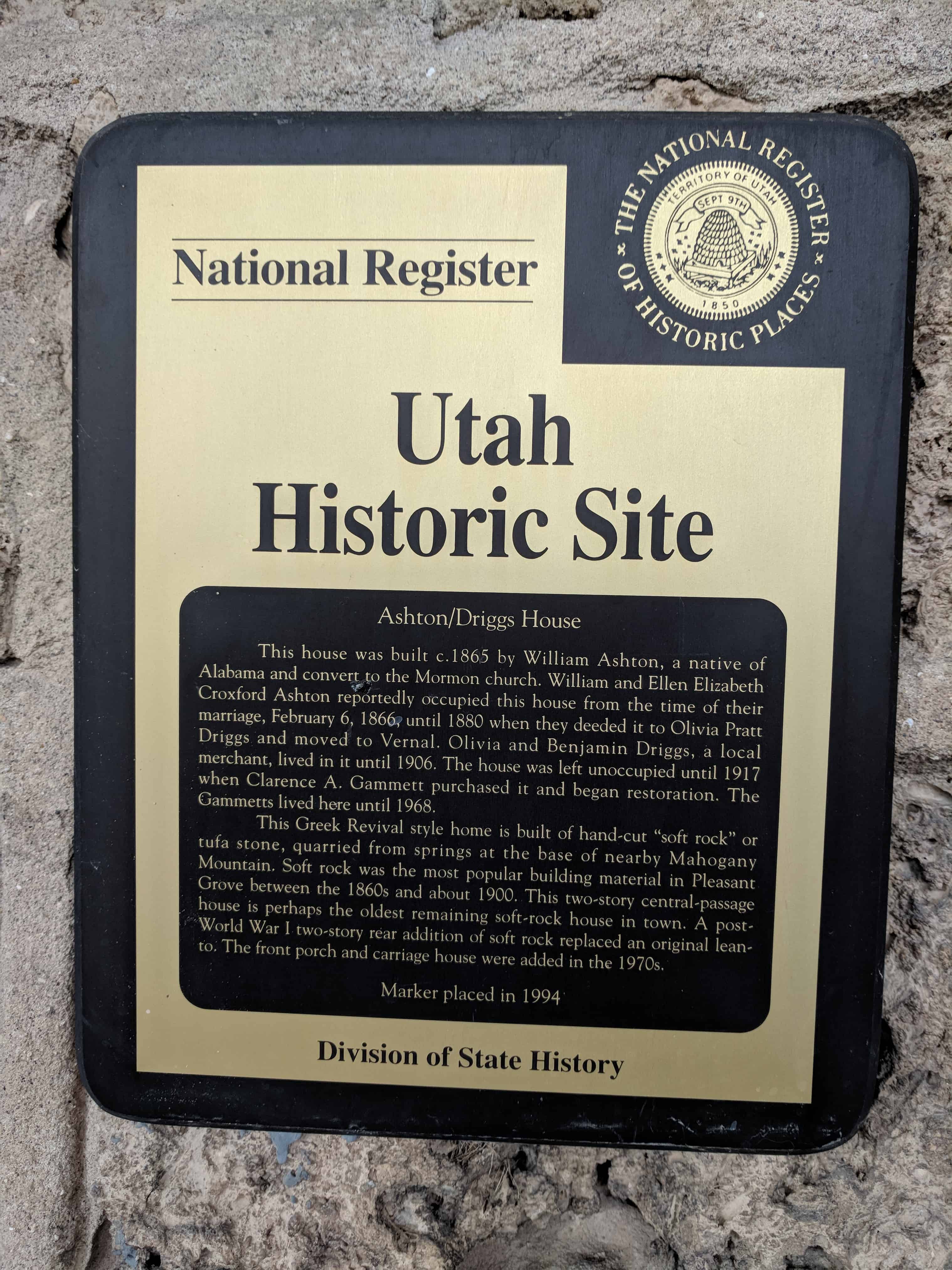
This house was built c.1865 by William Ashton, a native of Alabama and convert to the Mormon church. William and Ellen Elizabeth Croxford Ashton reportedly occupied this house from the time of their marriage, February 6, 1866, until 1880 when they deeded it to Olivia Pratt Driggs and moved to Vernal. Olivia and Benjamin Driggs, a local merchant, loved in it until 1906. The house was left unoccupied until 1917 when Clarence A Gammett purchased it and began restoration. The Gammetts lived here until 1968.
The Greek Revival style home is built of hand-cut “soft rock” or tufa stone, quarried from springs at the base of nearby Mahogany Mountain. Soft rock was the most popular building material in Pleasant Grove between the 1860s and about 1900. This two-story central-passage house is perhaps the oldest remaining soft-rock house in town. A post-World War I two story rear addition of soft rock replaced an original lean-to. The front porch and carriage house were added in the 1970s.
The Ashton-Driggs House is located at 119 East 200 South (Battle Creek Drive) in Pleasant Grove, Utah and was added to the National Historic Register (#72001261) on April 14, 1972.
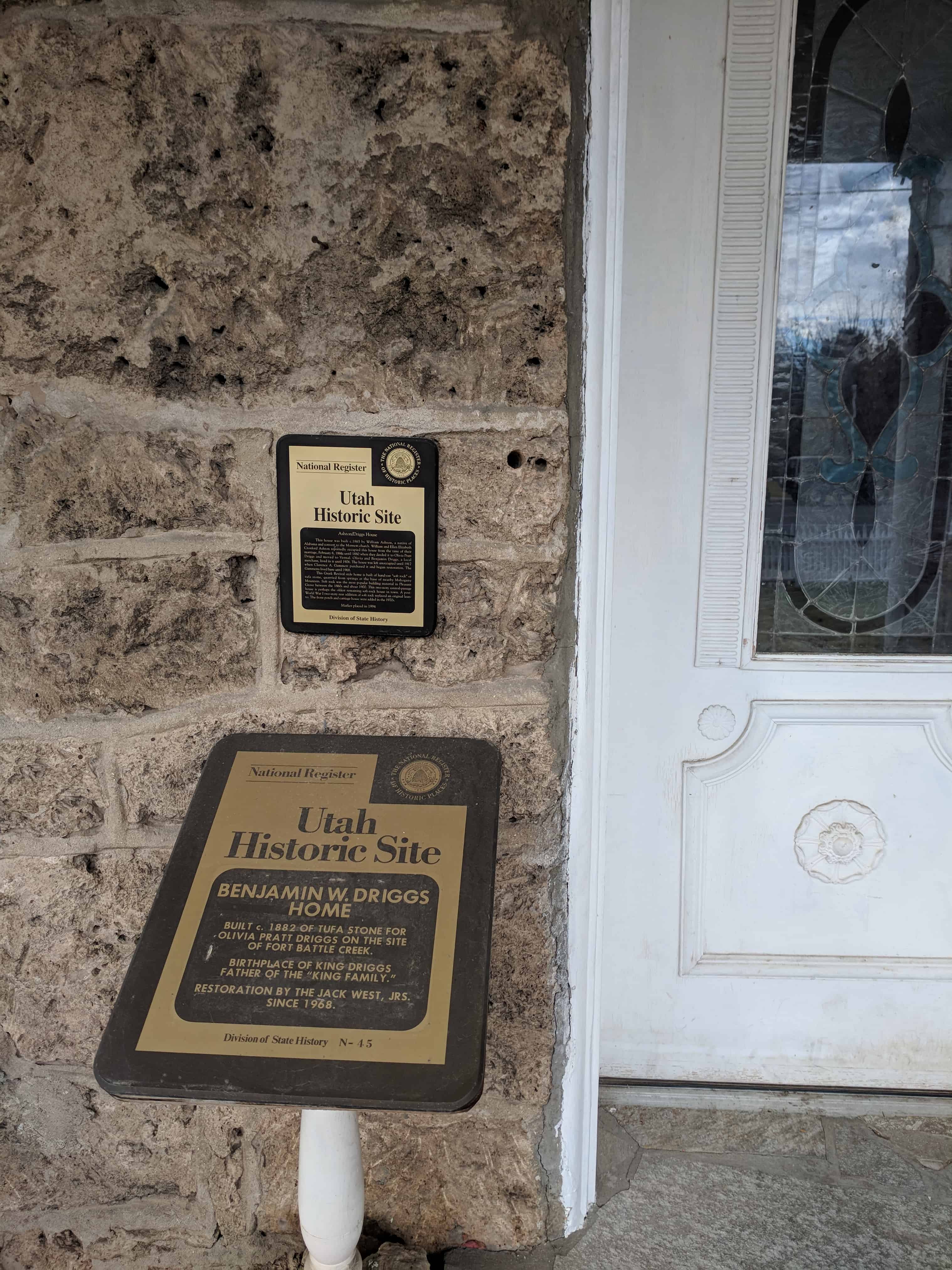
Benjamin W. Driggs Home Built c.1882 of tufa stone for Olivia Pratt Driggs on the site of Fort Battle Creek. Birthplace of King Driggs, father of the “King Family.” Restoration by the Jack West, Jrs. Since 1968.
The home was built c. 1882 by Benjamin Woodbury Driggs for his first wife Olivia Pratt Driggs. It Is significant because of the people that have lived there, because it is a unique stone home, and because it has been restored with loving care.
The site is within the area of the original stone fort of Battle Creek, The Driggs purchased the property In 1882. Benjamin Driggs was a pioneer, colonizer, railroad builder and owner of the Battle Creek Co-op, a successful general mercantile establishment. Olivia was the eldest daughter of the noted Mormon, Parley P. Pratt. She bore 12 children. William King Driggs, who was the 12th and the only one to be born in the rock house, is the forefather of the television personalities, The King Family.
The home is unique with its 2′ thick walls, built of rich colored and textured “soft rock” or tufa stone, quarried from the lower slopes of Mt. Timpanogas in a quarry just four miles to the north. It is one of the best examples of the stone homes in Utah and certainly one of the most important *n terms of the recent attention and care it has received.
The restoration of the home began in 1917 when Clarence A. Gammett purchased the abandoned home. Then ensued a careful restoration of the home and gardens. After the death of the Gammetts, the home was purchased by lack West, Jr. In 1968. He and his family continued the restoration with quality effort and have carefully gathered furnishings authentic to the original era of the home. The Wests, upon completion of their restoration project, held an open house and gala affair hosting more than 2,500 persons.
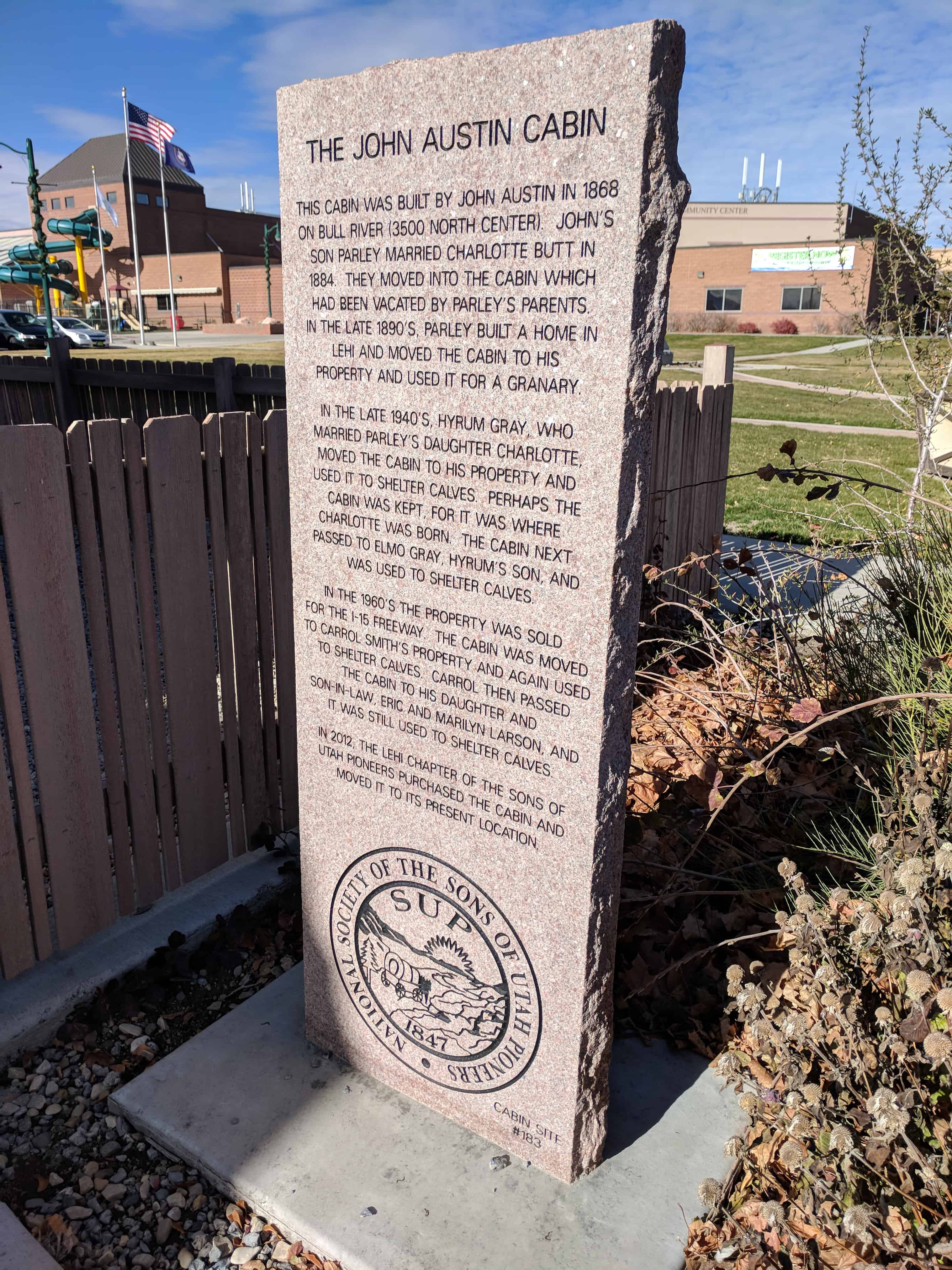
This cabin was built by John Austin in 1868 on Bull River (3500 North Center). John’s son Parley married Charlotte Butt in 1884. They moved into the cabin which had been vacated by Parley’s parents. In the late 1890’s Parley built a home in Lehi and moved the cabin to his property and used it for a granary.
In the late 1940’s, Hyrum Gray, who married Parley’s daughter Charlotte, moved the cabin to his property and used it to shelter calves. Perhaps the cabin was kept, for it was where Charlotte was born. The cabin next passed to Elmo Gray, Hyrum’s son, and was used to shelter calves.
In the 1960’s the property was sold for the I-15 Freeway. The cabin was moved to Carrol Smith’s property and again used to shelter calves. Carrol then passed the cabin to daughter and son-in-law, Eric and Marilyn Larson, and it was still used to shelter calves.
In 2012, the Lehi Chapter of the Sons of Utah Pioneers purchased the cabin and moved it to its present location.
Update: I’ve since found out that the home was built in 1896 and has been used as a filming location for Touched by an Angel and Benji: Off the Leash! (2004).
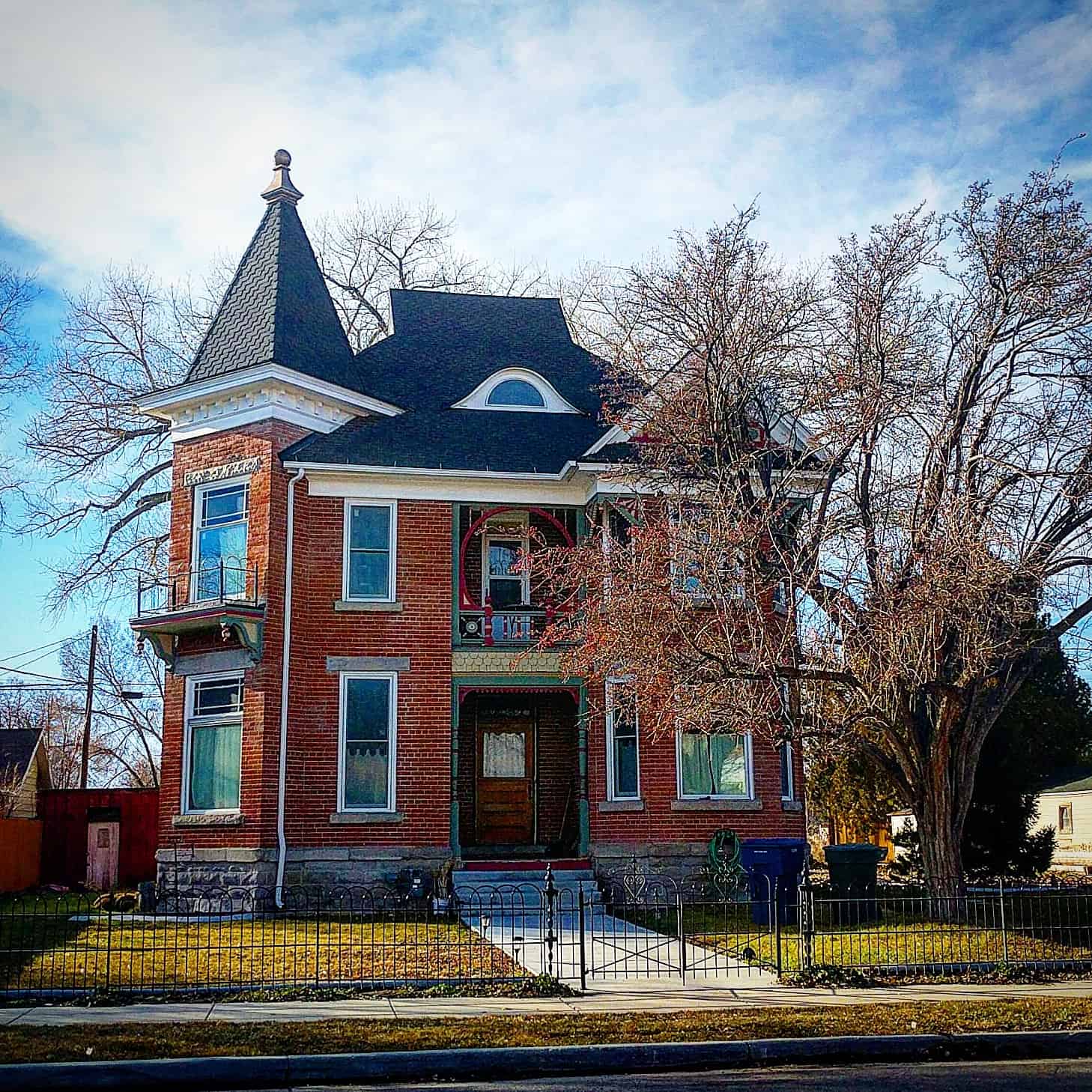
From Preservation Utah‘s Fairpark Homes Tour: Built around 1895 for Theodore and Sophia Jane Lane McKean, this home housed their large family – nine children, plus five more Sophia later raised from Theodore’s second wife, who passed away young. Theodore, a livestock raiser and state stock inspector, earned awards for his animals and served as LDS bishop (1902–1910), known for his generosity. Sophia led the Relief Society for 25 years, often hosting meetings at the house. The couple lived in the home until their deaths in 1934 and 1942.
Architecturally, the McKean House is a prime example of Victorian Eclectic style and undoubtedly the most elaborate example in the neighborhood. It has an exuberance that is a hallmark of the style, including asymmetry, an angled corner bay and tower, bracketed awnings and cornices, an “eyebrow” roof window, a decorative porch, and a finial. The borrow and mix approach central to the Victorian Eclectic is evident in the Queen Anne and Eastlake influences, which appear in the colored glass window panels, bulls-eye gable decoration, and sunburst eave brackets.
Despite its elaborate design, more typical of the Avenues, the McKeans chose to build here in Fairpark – likely for the large plot needed for Theodore’s livestock and their deep family roots in the neighborhood. They had both grown up in the neighborhood and were children of pioneers who settled in the area quite early. Several of their children remained in the area, continuing the family’s multi-generational presence. The McKeans were also an example of families who both lived and carried on their business in the neighborhood.
Erected about 1852 by President Brigham Young as the Official Residence of the President of the Church of Jesus Christ of Latter-day Saints and occupied by him from the time it was completed until his death in 1877.
From 1852 to 1855 it also served as the Executive Mansion of Governor Brigham Young of the Territory of Utah.
It was also the home of presidents Lorenzo Snow (1898 – 1901) and Joseph F. Smith (1901 – 1918), both of whom died here.
The Beehive is the State Emblem signifying industry.
The Utah Historic Site plaque says the Beehive House was built in 1854 of adobe brick, the architect was Truman O. Angell and it was the home of Brigham Young, the 2nd President of the Church of Jesus Christ of Latter-day Saints and 1st Governor of the Territory of Utah.
Tourstop 5 in the Salt Lake City Tour says: The Beehive House served as Brigham Young’s residence, office, and reception area for official visitors. At the time the house was built, Young was both president of the LDS Church and Utah’s territorial governor. The Beehive House was designed by Young’s brother-in-law, Truman O. Angell. Angell was also the architect for the Lion House and the Salt Lake LDS Temple. Built of stuccoed adobe, the Beehive House features a two-story veranda, an observatory, and a cupola topped with a beehive. Young’s son added a three-story wing to the north when he remodeled the house in 1888. In the early 1960s, the LDS Church restored the Beehive House to resemble its 1888 appearance.
(from Preservation Utah’s walking tour) The Beehive House 67 East South Temple 1853-1855, Truman O. Angell, SLC 30-minute guided tours available every 15 minutes Monday-Saturday, 9:30 am-4:30 pm, and Sunday, 10:00 am-1:00 pm.
The Beehive House served as Brigham Young’s residence, office, and reception area for official visitors. It was designed by Young’s brother-in-law, Truman O. Angell. Angell, one of Utah’s prominent early architects, also designed the Lion House and the Salt Lake City LDS Temple. The Greek Revival style Beehive House features a two-story veranda, an observatory, and a cupola topped with a beehive. Young’s son added a three-story wing to the north after he purchased the house in 1888.
In addition to the Beehive House and the Lion House, Young’s walled estate fronting South Temple also included the White House, a family schoolhouse, carpenter shop, barns, orchards, and gardens. The Eagle Gate at the intersection of South Temple and State streets marks the original entrance to Young’s multipurpose compound. The Eagle Gate also provided access to City Creek Canyon to the northeast. See the marker on the northeast corner of the intersection for a history of the Eagle Gate.
In the early 1960s, the LDS Church restored the Beehive House and opened it as a house museum. Guided tours of the building are available daily.
From the nomination form for the National Historic Register:
The beautiful old mansion Is the pioneer home of Brigham Young, but It in 1851. Today’s workmen, under the direction of architects (all grandsons of Brigham Young) have done a remarkable job of restoration. The outside adobe brick walls have been painted in the original straw-colored yellow, which gives the manor a gay, but antique appearance of the original.
The Beehive House was built to meet the dual needs of Brigham Young, second president of the Church of Jesus Christ of Latter-day Saints and first governor of the state of Deseret, later Utah Territory. Above all, however, the Beehive House was a home for his family. It was also used as an official mansion where the Mormon leader received and conferred with other Church leaders, state and federal dignitaries, and entertained prominent traveling officials. During the life of Brigham Young, many famous people were entertained in the Beehive House, including President Ulysses S. Grant, Emperor Dom Pedro of Brazil, General William T. Sherman, Ralph Waldo Emerson, Mark Twain, Jay Gould, Horace Greeley, and even the midget Tom Thumb and his tiny wife.
In 1893, the Church purchased the historic building to make it the official residence of its presidents. Lorenzo Snow and Joseph F. Smith were the only two succeeding presidents to live in it. After the death of President Smith, the house stood vacant for a number of years, and was again remodeled and maintained as an away-from-home residence for young women who came to the city to work or attend school.
In 1959, when the Church decided to restore the Beehive House, a committee made up primarily of descendants of Brigham Young was chosen to carry out the task. Research and detective work on the part of this committee took 18 months to complete, and included the use of old manuscripts describing the house, the search for Brigham Young’s furnishings, and the discovery of “clues” beneath old plaster to find tell-tale evidences of still earlier construction. The “Manuscript” had been written by Clarissa Young Spencer who lived in the Beehive House from childhood until after her marriage.
Heavy coats of paint and wallpaper were peeled away, revealing the original colors and patterns. False ceilings were torn down, exposing ornate medallions which pioneer craftsmen installed in 1854.
With restoration and furnishing complete, the lovely mansion is now open for tours to the public. In its location, it is near Temple Square, a National Landmark, and the Lion House, which adjoins it on the west, and which is also a National Landmark.
The design of the Beehive House follows the 19th century Greek revival in architecture. The architect was Truman O. Angel, who also designed the many-spired Salt Lake Temple, Some of the original drawings for the Beehive house, fortunately, were found in the archives of the Church Historian’s Office shortly after work on the restoration had begun in 1959, and proved invaluable in the complete restoration of the home.
As originally built, the main part of the house consisted of two stories and an attic, surmounted by a beehive-shaped cupola, the traditional Mormon symbol of industry which was to give the home its name. Surrounding this tower is a a steel-railed (originally was wood) “widow’s watch,” reminiscent of the colonial coast.
Since the death of Brigham Young, the Beehive House has undergone two major alterations. The first was made by a son who purchased the home in 1888. Under this remodeling, the rear section was rebuilt into a three-storied wing. The formal dining room downstairs also was extensively remodeled, and an upstairs sitting room and parlor added.
The “adobe” walls were found to be in remarkably good condition. When later additions were torn out (during restoration), the walls revealed the exact location of stairs, halls, doorways, partitions and roof lines as described in the old manuscripts and original plans. With restoration, wide pine board floors, laid with square nails replaced the hardwood (not original.)
In the 1850’s, Brigham Young had a nine-foot high cobblerock wall erected around the Beehive House as protection from unfriendly intruders and as a make-work project for men who needed employment. Portions of this same wall (recently pushed back 23 feet to widen State Street north of Eagle Gate now border the home on the north and east sides. A low wrought-iron fence stands in front of the house where the big wa11 once stood.
The oak-finished door, now painted white, with its silver doorknob opens onto the main hallway. The doorbell system installed by Brigham Young was discovered and restored. Downstairs were Brigham Young’s bedroom, the Parlor and kitchen; on the second floor the “long hall” for entertaining guests, and Brigham Young:1 s offices.
The lovely home is now authentically restored and furnished with furniture from Brigham Young and his family, and from other period furniture at a cost to the Church of Jesus Christ of Latter-day Saints approximating one-half million dollars.
Built by President Brigham Young and used by him as a residence from about 1855 until his death in 1877. On the lower floor were the dining room and kitchens. On the next floor were the living rooms and large parlor; and on the top floor were the bedrooms.
It was in this house that President Young died. Later the building was used for school purposes and as a social center for women and girls. The lion is a replica of one that occupied a similar position on a prominent home in Vermont, the State where President Young was born and spent his youth.
In 1869, Brigham Young founded the Young Women organization in the Lion House.
The Utah Historic Site plaque says the Lion House was constructed 1855-56 as a residence for Brigham Young and his family. The Lion House takes its name from the recumbent lion set on top of the front portico. The House was designed by Truman O. Angell and built of stuccoed adobe. Brigham Young, second president of the Church of Jesus Christ of Latter-day Saints and first territorial governor of Utah, died in this house on August 29, 1877. Since its construction, the Lion House has functioned as a community social center.
Tourstop 4 in the Salt Lake City Tour says: The Lion House takes its name from the carved lion on top of the front portico. The House was constructed with adobe blocks, a common building material during Utah’s settlement period. Brigham Young, second president of the Church of Jesus Christ of Latter-day Saints built the Lion House for his wives and children. He and some early Church members practiced the Old Testament principle of polygamy which was officially ended in 1890. The basement contained a dining room which could accommodate 70 people. On the main floor were sitting rooms and bedrooms for wives with children. The second floor had bedrooms for children and childless wives – one under each of the 20 steeply-pitched gables.
(from Preservation Utah’s walking tour) The Lion House 63 East South Temple 1854-1856, Truman O. Angell, SLC Restaurant open to the public Monday-Saturday, 11:00 am-2:00 pm, and Thursday-Saturday, 5:00-8:30 pm. No tours available. The Lion House is one of several houses built on South Temple by Brigham Young, the second president of the LDS Church and Utah’s territorial governor.Young’s presence on South Temple made it Salt Lake City’s most prestigious residential street. For many years, South Temple was informally known as “Brigham Street.” Brigham Young intended the Lion House to be a model for polygamous living arrangements. As many as 20 of his wives and dozens of his children lived here at one time. The basement contained a dining room which could accommodate 70 people. On the main floor were sitting rooms, a “prayer room,” and bedrooms for wives with children. The second floor had 20 bedrooms for childless wives and older children, one under each of the 20 gabled dormer windows. Brigham Young died in the Lion House in 1877. Some of his wives and children continued to live in the house until the 1900s. Today the building contains a reception center and restaurant.
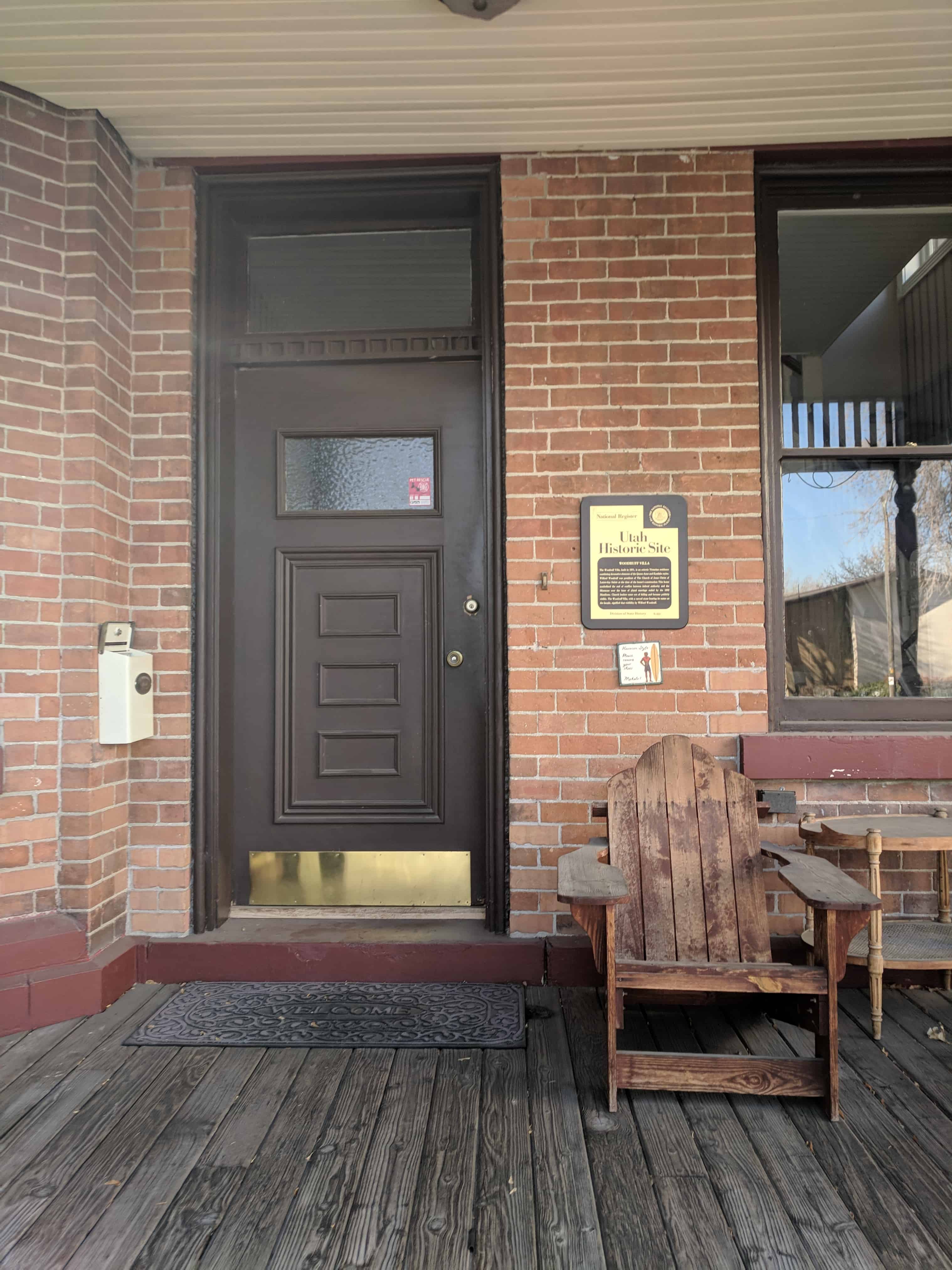
The Woodruff Villa, built in 1891, is an eclectic Victorian residence combining decorative elements of the Queen Anne and Eastlake styles.
Wilford Woodruff was president of The Church of Jesus Christ of Latter-day Saints at the time of the house’s construction. This home symbolized the end of conflict between federal authority and the Mormons over the issue of plural marriage ended by the 1890 Manifesto. Church leaders came out of hiding and became publicly visible. The Woodruff Villa, with a carved stone bearing its name on the facade, signified that visibility by Wilford Woodruff.
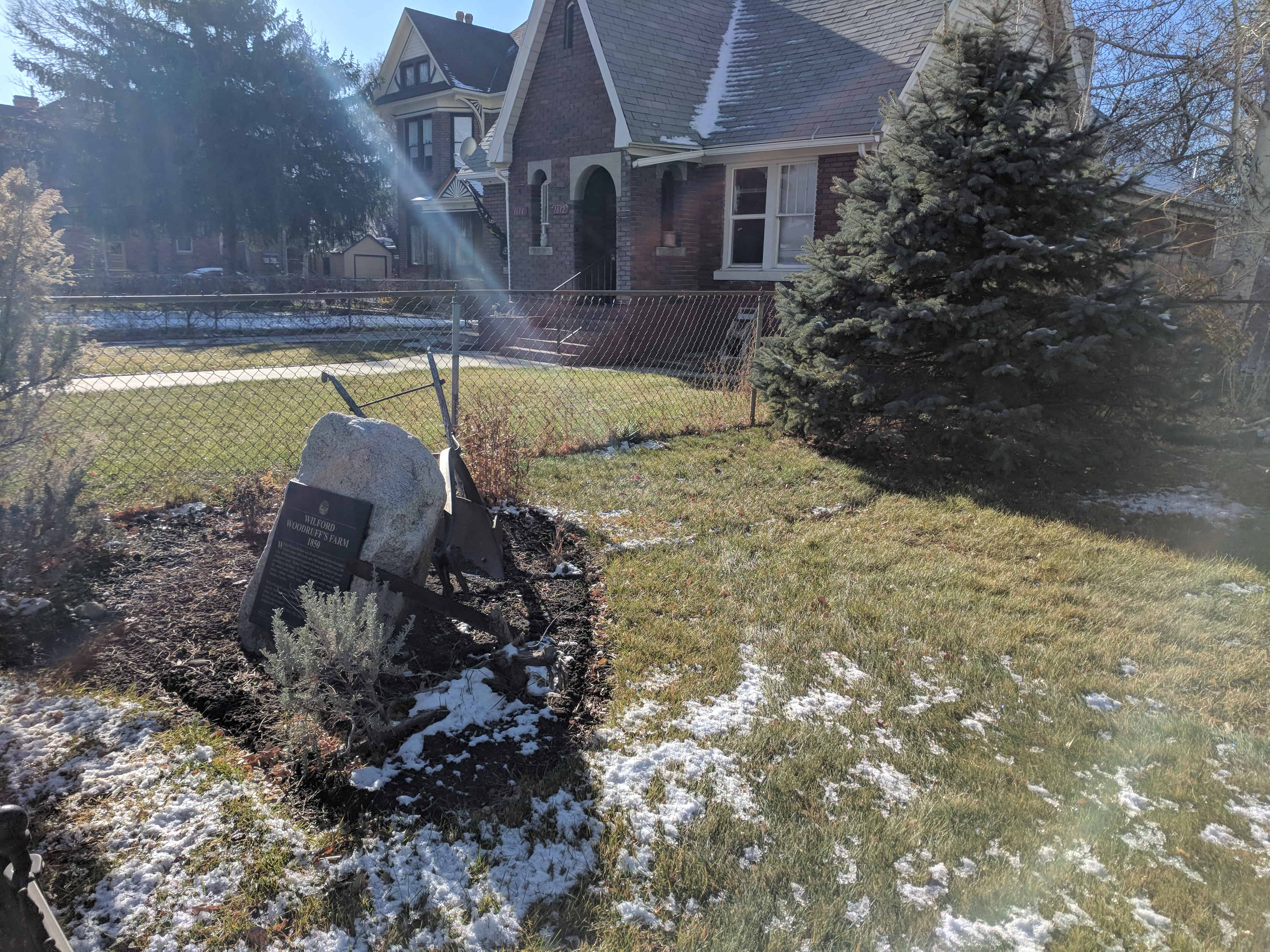
Wilford Woodruff’s Farm was 20 acres located between Kensington Ave. (about 1500 South) and 1700 South and 300 East to 500 East. This rich farmland was irrigated with water from Parleys Creek and Emigration Creek. Wilford Woodruff farmed here for over 45 years, providing for his family. He also grew numerous experimental crops. His journal makes reference to wheat, potatoes, cotton, sugar cane, melons, currants, madden, indigo, strawberries, apples, grapes, and “bushels of crickets”.
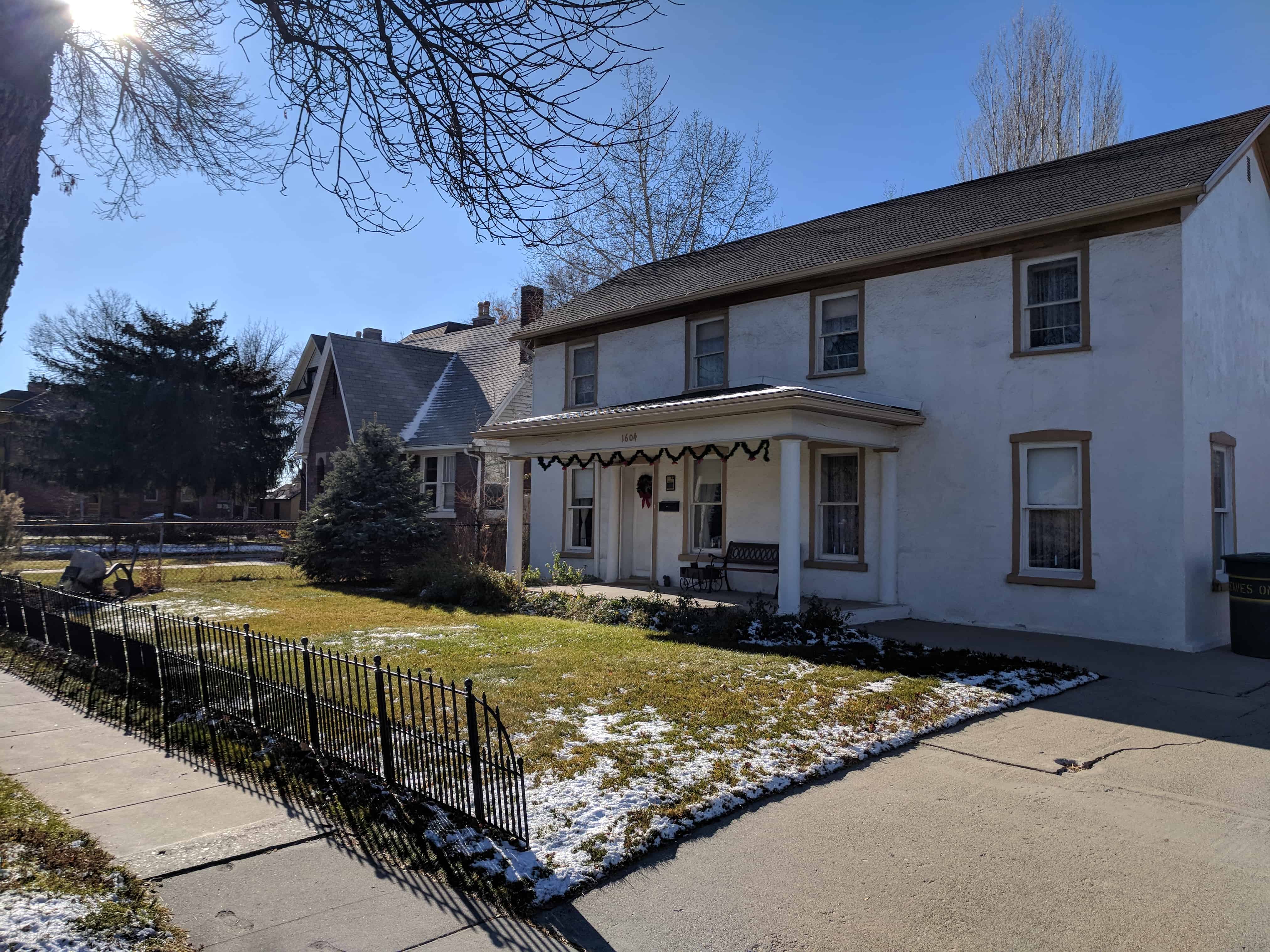
Wilford Woodruff, one of the first pioneer settlers of the Salt Lake Valley, was the fourth President of the Church of Jesus Christ of Latter-day Saints. He and other Mormon Pioneers came here to escape persecution for their religious beliefs. Four of the original Woodruff family homes remain on 500 East and 1590, 1604, 1622, and 1636 South.
The Wilford Woodruff Farmhouse was built in 1859-1860. It is a two-story log home designed in a pioneer Classical style, which includes hand-hewn logs, adobe brick, square nails, and plaster mixed with horsehair. It is still on its original foundation located on what was once a twenty-acre farm.
Wilford Woodruff was a pioneer in the first company of settlers in the Salt Lake Valley. He became the fourth President of The Church of Jesus Christ of Latter-day Saints. He lived in this house from 1865 to 1891 with his wife Emma, but also had other residences. It was while residing here that he issued the Manifesto in 1890, officially ending the practice of plural marriage in the Church. Wilford Woodruff helped build the Salt Lake Temple and dedicated it in 1893. He was also well known as a missionary, historian, and legislator. Additionally he was a prominent horticulturist, serving as president of the Deseret Agricultural and Manufacturing Society for many years.
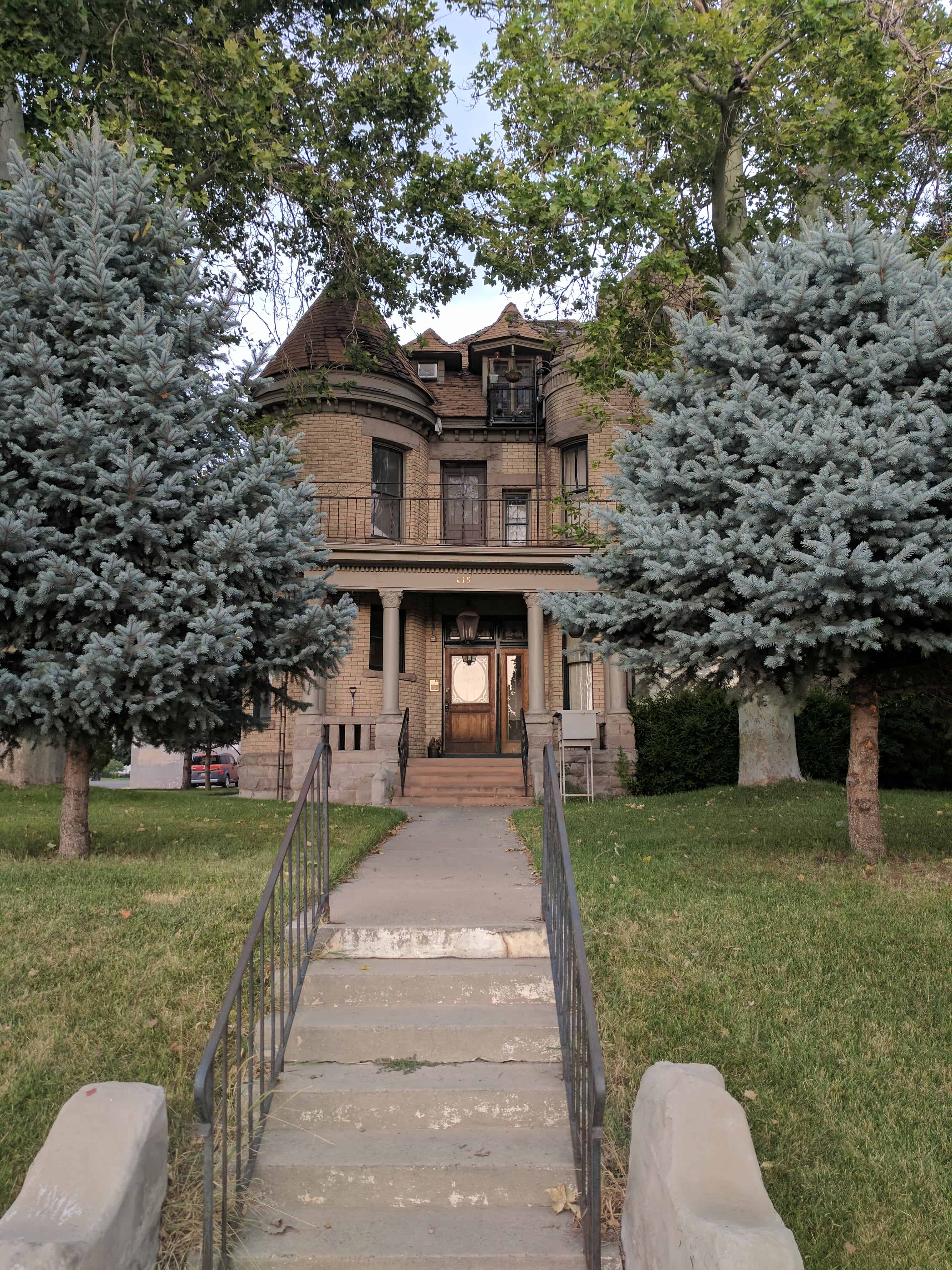
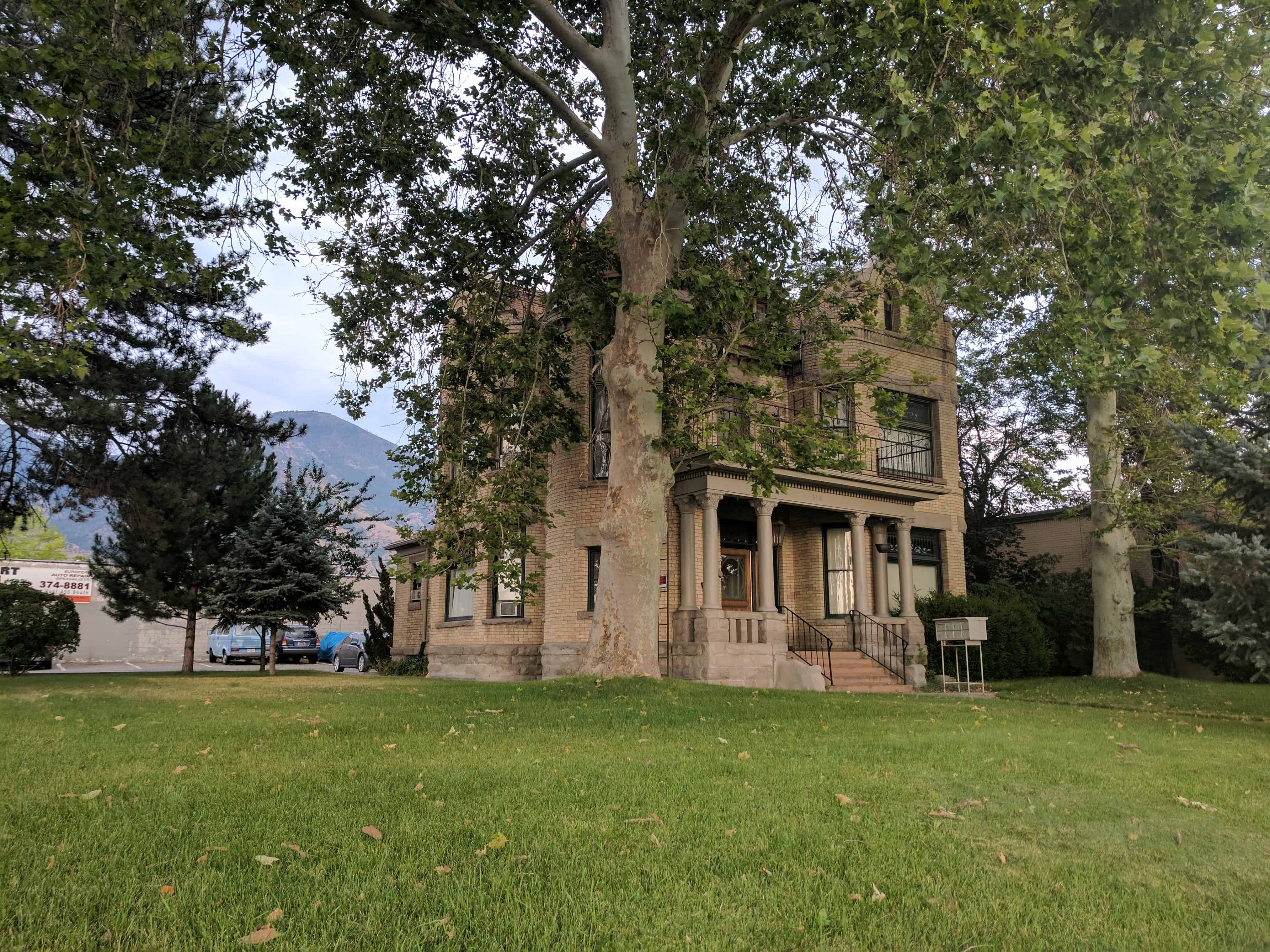
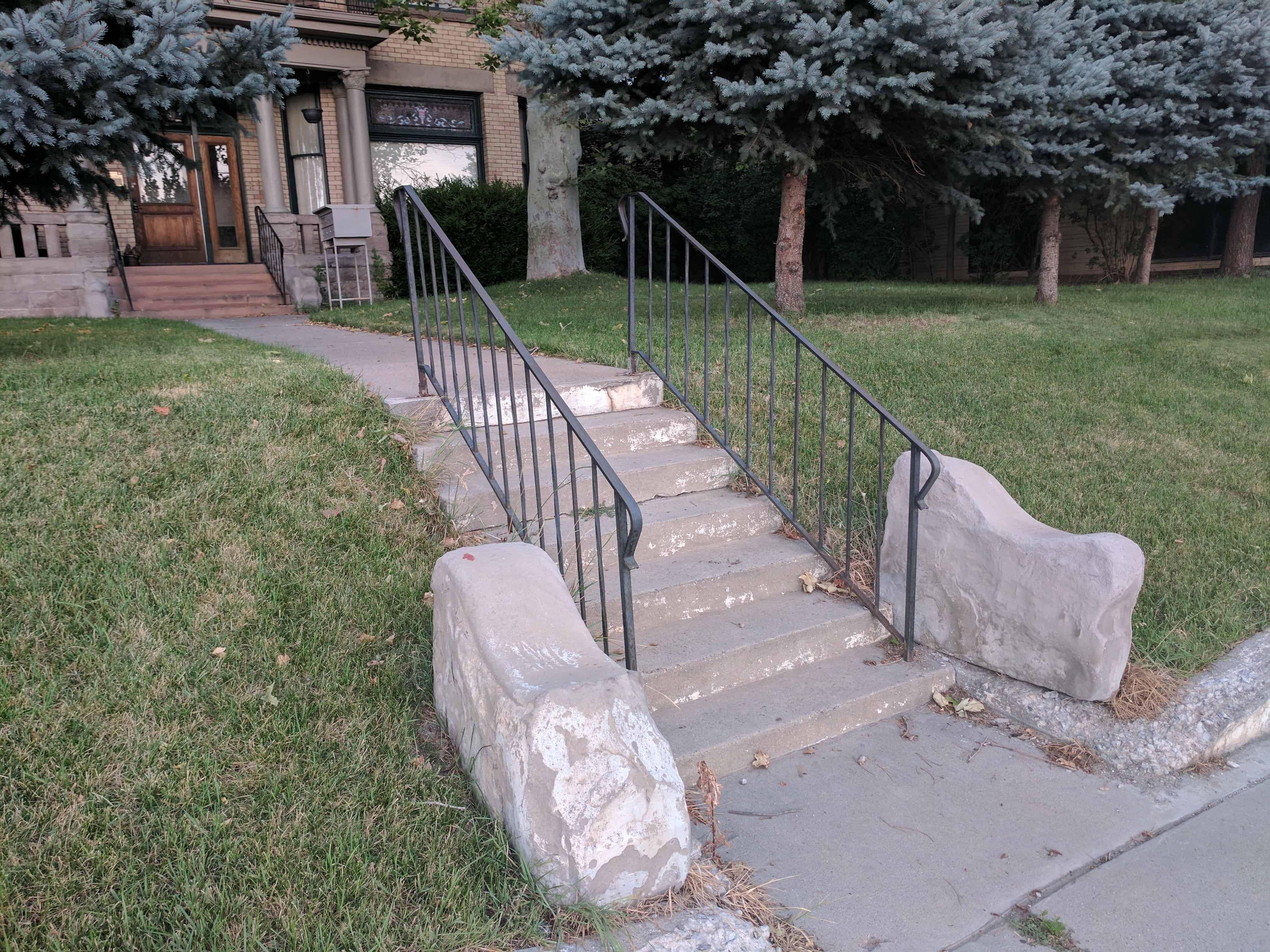
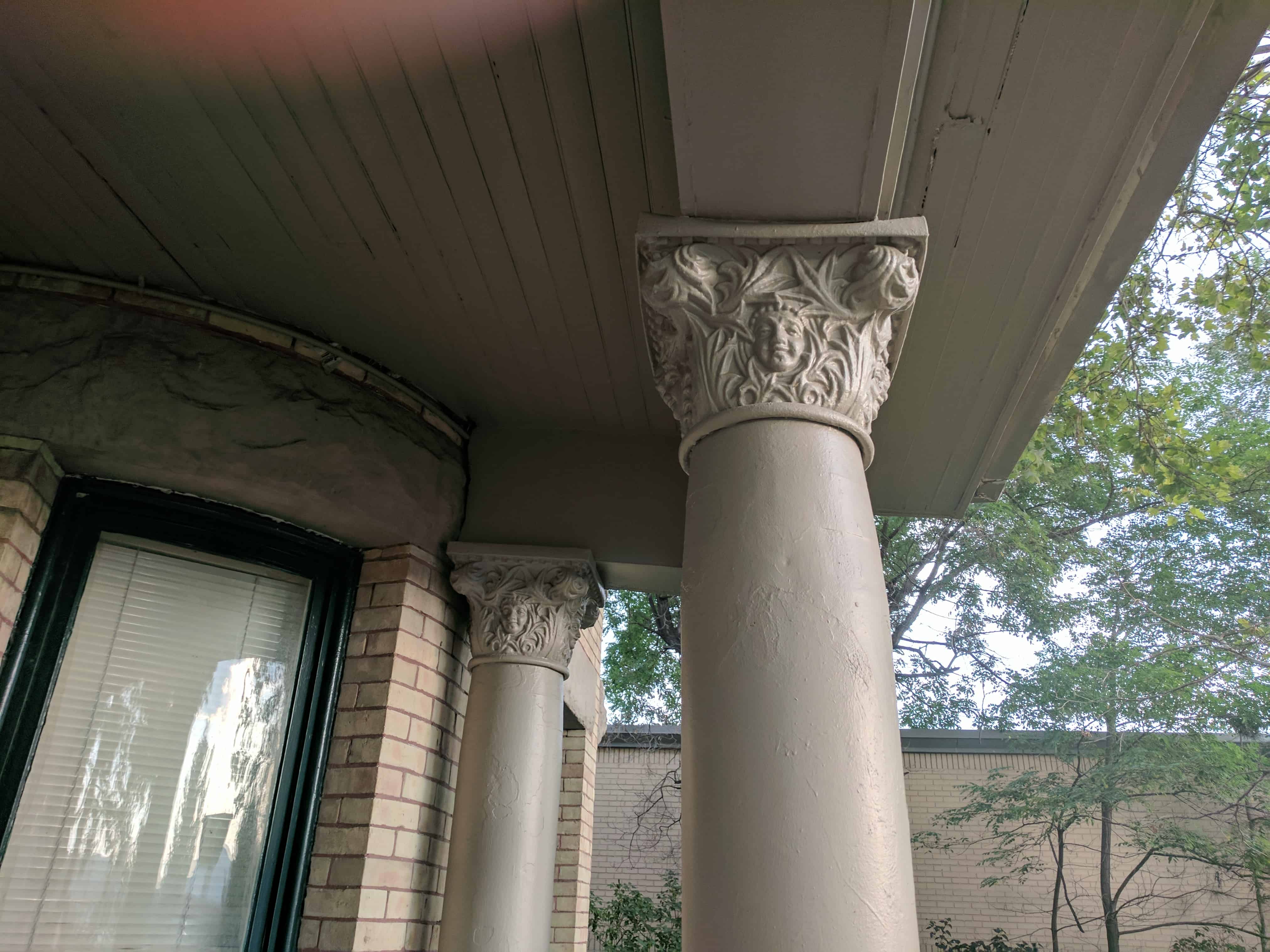
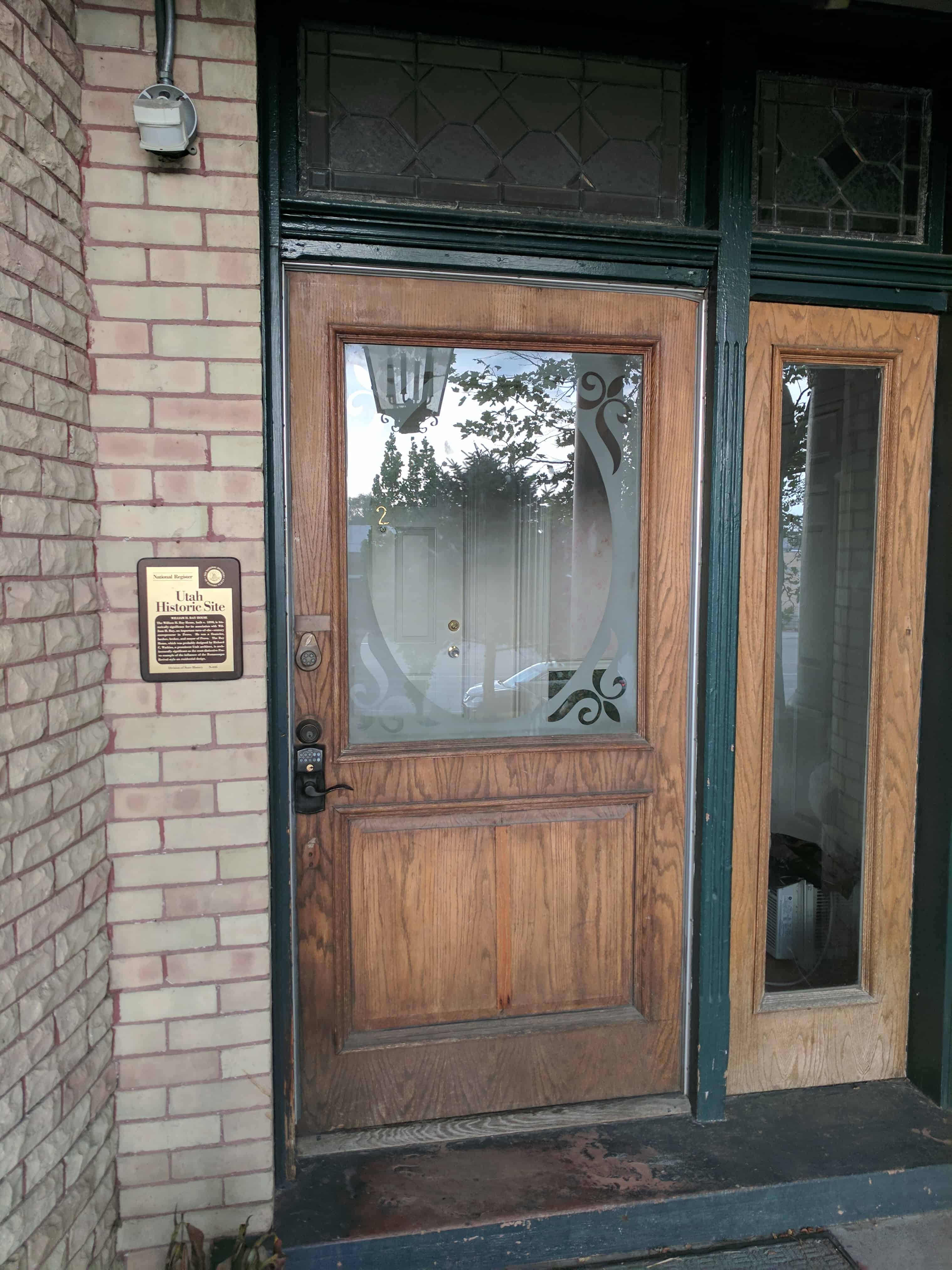
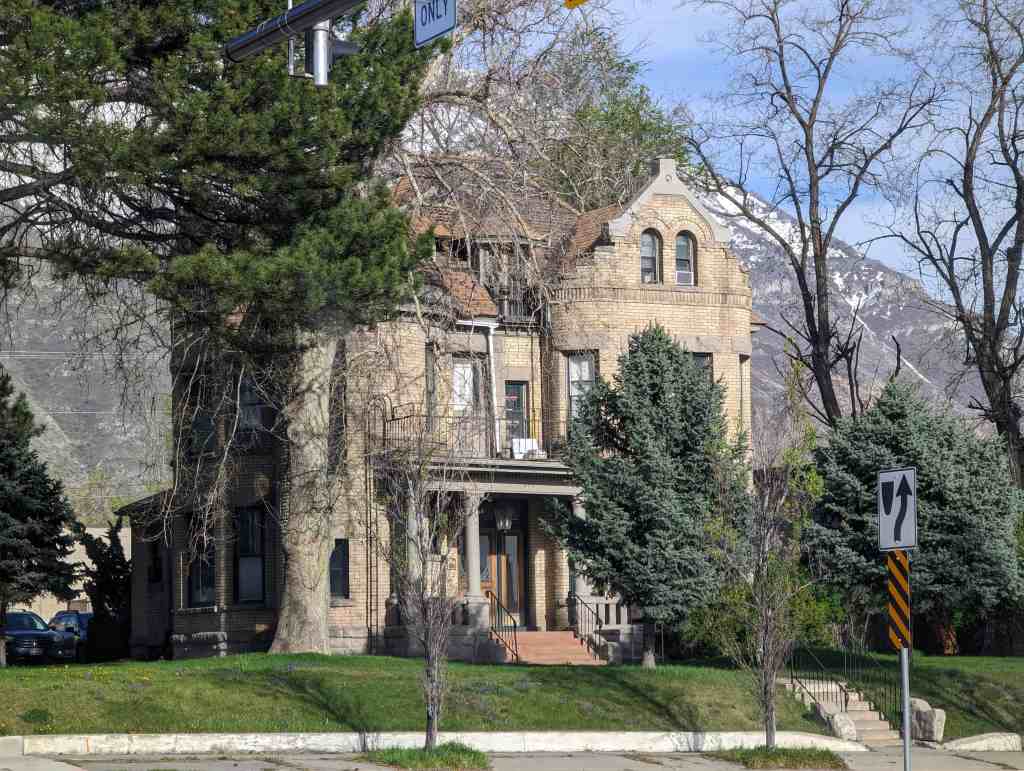
The William H. Ray House, located at 415 South University Ave in Provo, Utah. For other historic homes in Provo visit this page.
The William H. Ray House, built c. 1898, is historically significant for its association with William H. Ray, an important turn-of-the-century entrepreneur in Provo. He was a financier, banker, broker, and mayor of Provo. The Ray House, which was probably designed by Richard C. Watkins, a prominent Utah architect, is architecturally significant as the most distinctive Provo example of the influence of the Romanesque Revival style on residential design.