• About JacobBarlow.com
  • Cemeteries in Utah
  • D.U.P. Markers
  • Doors
  • Exploring Utah Email List
  • Geocaching
  • Historic Marker Map
  • Links
  • Movie/TV Show Filming Locations
  • Oldest in Utah
  • Other Travels
  • Photos Then and Now
  • S.U.P. Markers
  • U.P.T.L.A. Markers
  • Utah Cities and Places.
  • Utah Homes for Sale
  • Utah Treasure Hunt

JacobBarlow.com

~ Exploring with Jacob Barlow

JacobBarlow.com

Monthly Archives: December 2013

Settlement of San Bernardino

31 Tuesday Dec 2013

Posted by Jacob Barlow in Uncategorized

≈ 1 Comment

Tags

California, DUP, historic, San Bernardino, San Bernardino County

picture27dec07-140

In March 1851 Charles C. Rich and Amasa N. Lyman, Apostles of the Church of Jesus Christ of Latter Day Saints, Left Utah with 437 people to establish a stronghold for the gathering of saints in California. Jefferson Hunt, David Seeley and Andrew Lytle were captains of organized companies. They purchased the Rancho ‘De San Bernardino, selected a site for settlement, built a fort enclosing 100 homes and erected an adobe building for church and school. 1300 acres of grain were planted, grist and saw mills erected and roads made into nearby canyons. Local government was established and the population doubled. Before the call back to Utah by President Brigham Young in 1857, pioneers from Yerba Buena , England and the pacific had joined the settlement.

picture27dec07-138

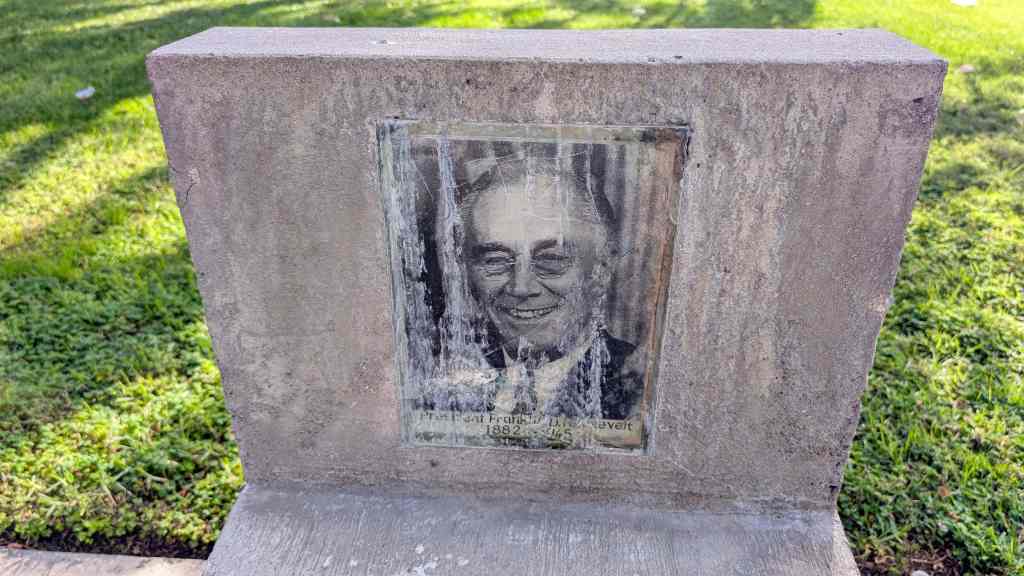
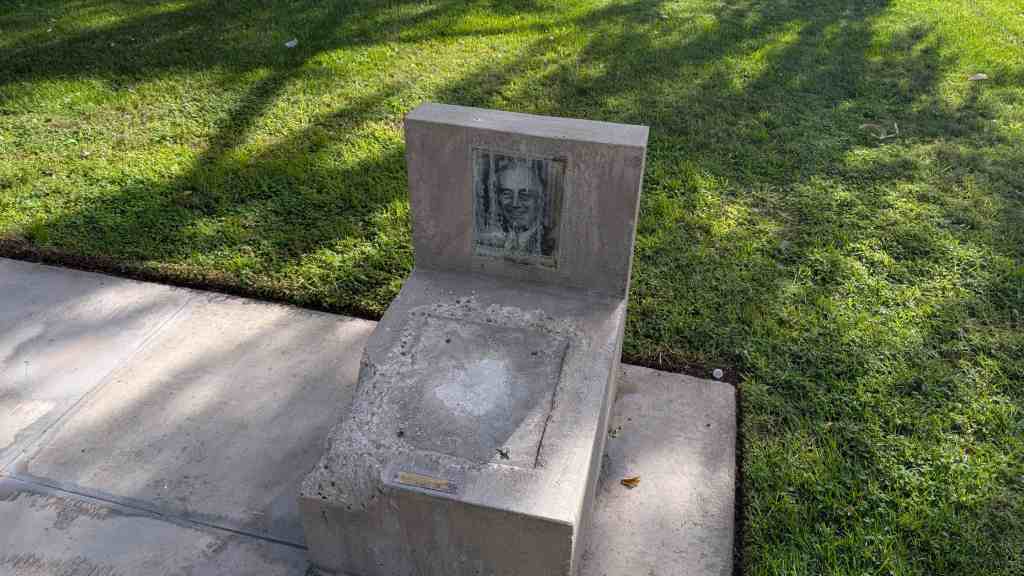
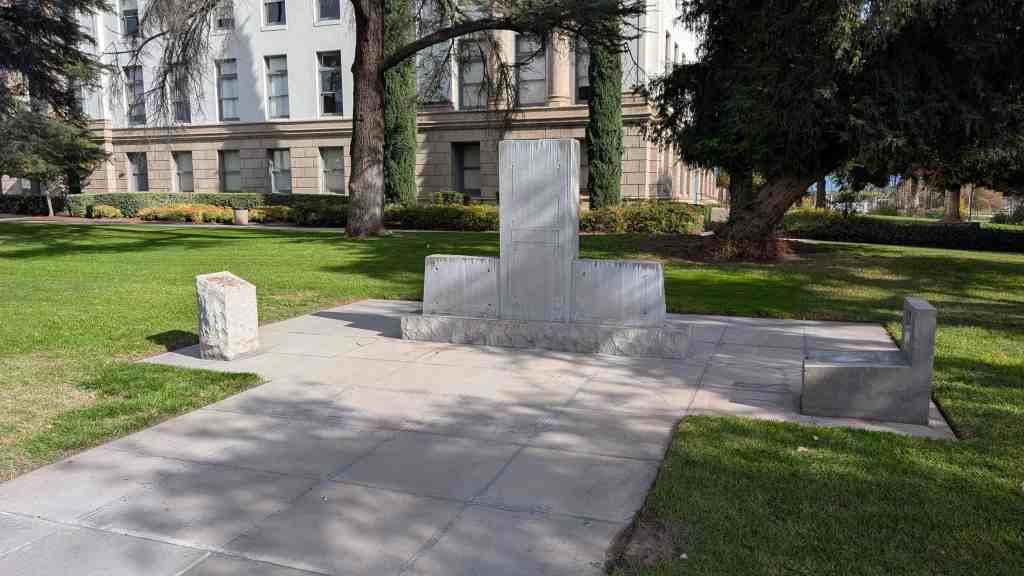
This is Daughters of Utah Pioneers historic marker #302 located at 303 North Arrowhead Avenue in San Bernadino, California.

  • D.U.P. Historic Markers

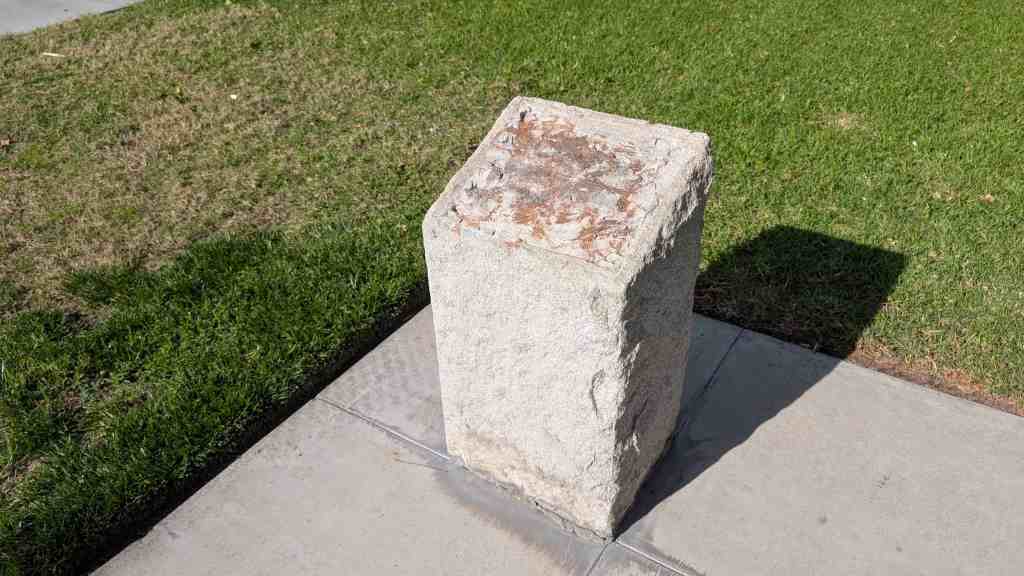
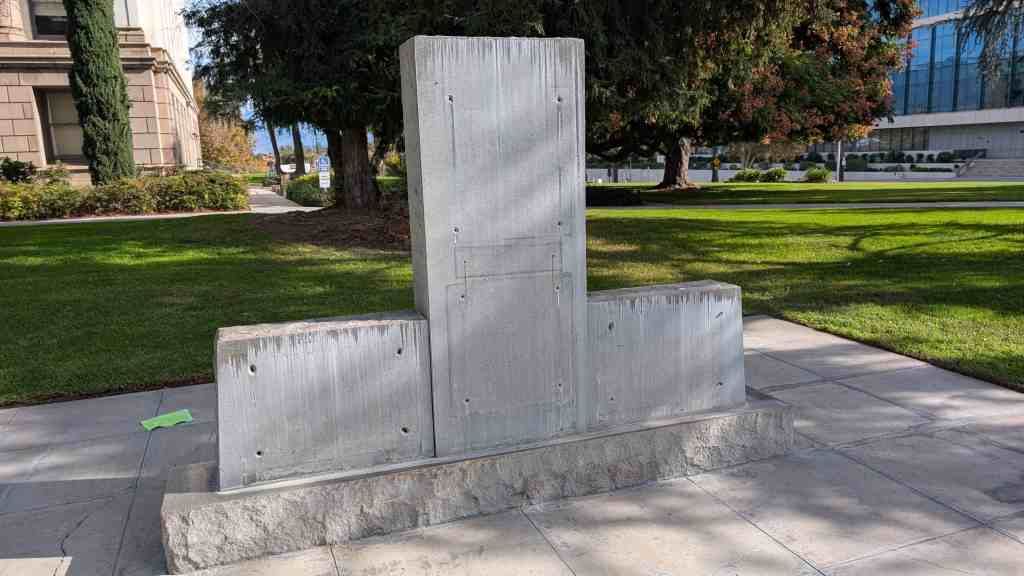
I stopped by in 2025 and the plaque is missing:
Palmyra’s Early Buildings

31 Tuesday Dec 2013

Posted by Jacob Barlow in Uncategorized

≈ Leave a comment

Tags

DUP, historic, Palmyra, spanish fork, utah, utah county

picture7sep07-067

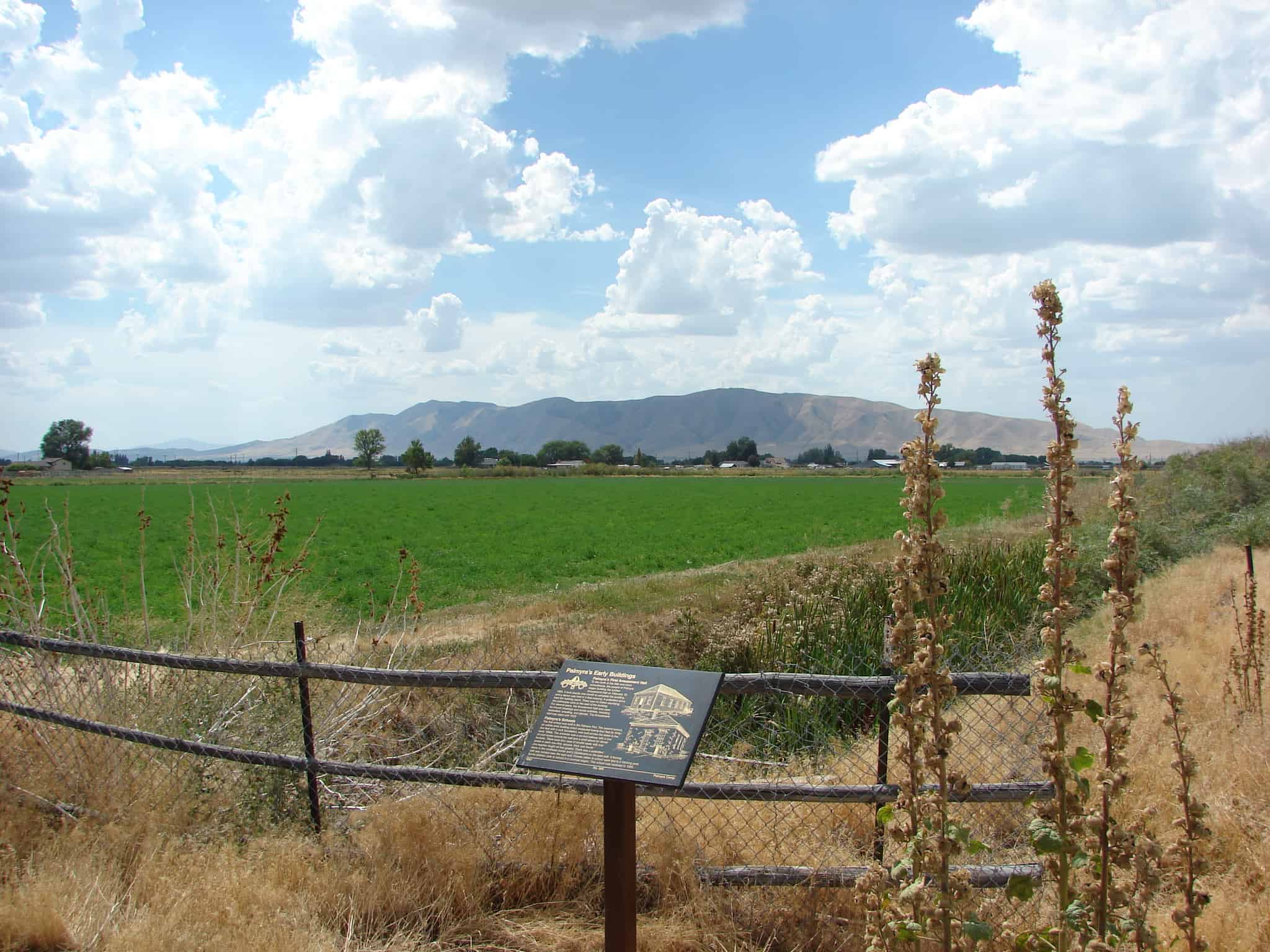
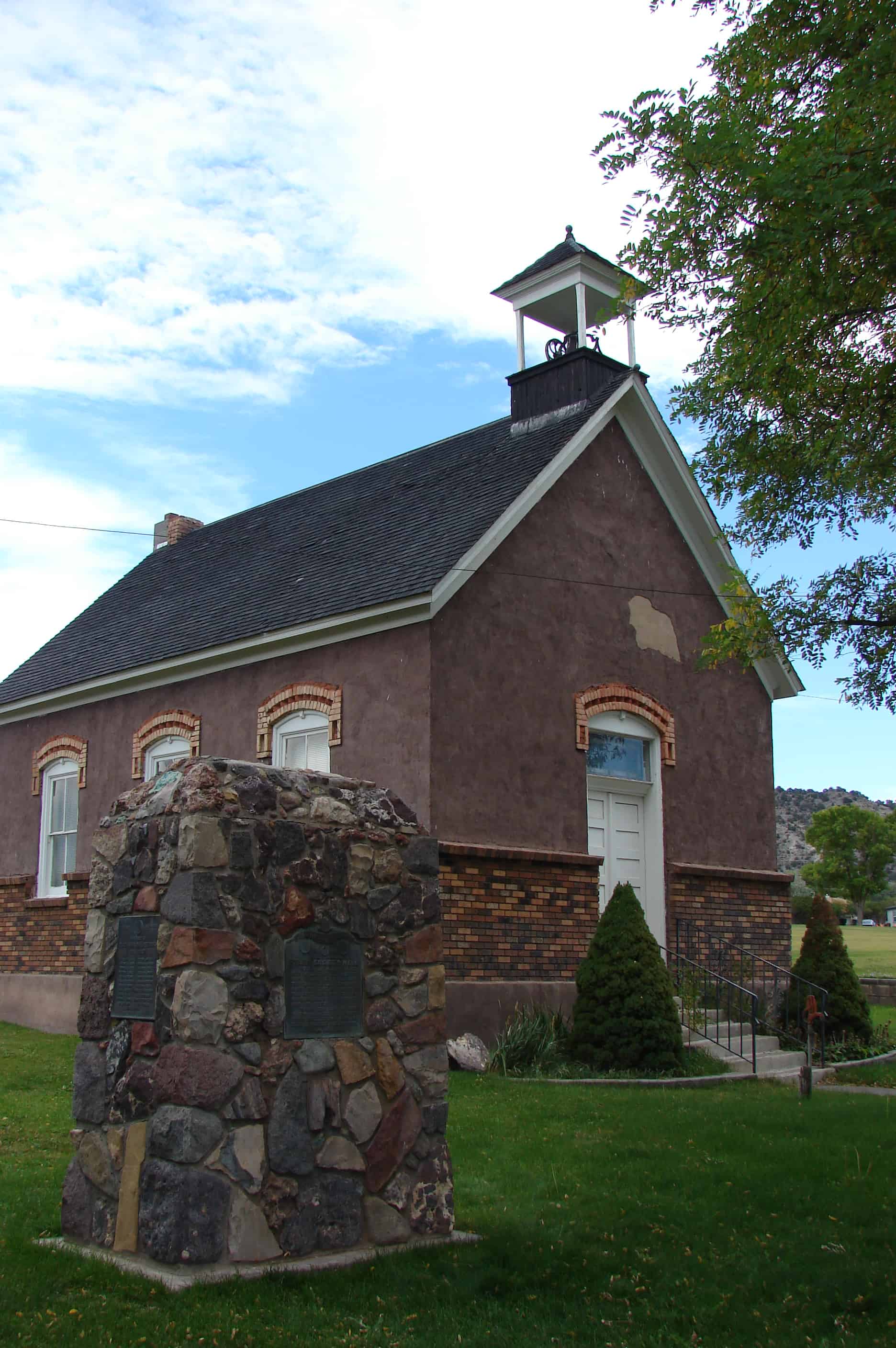
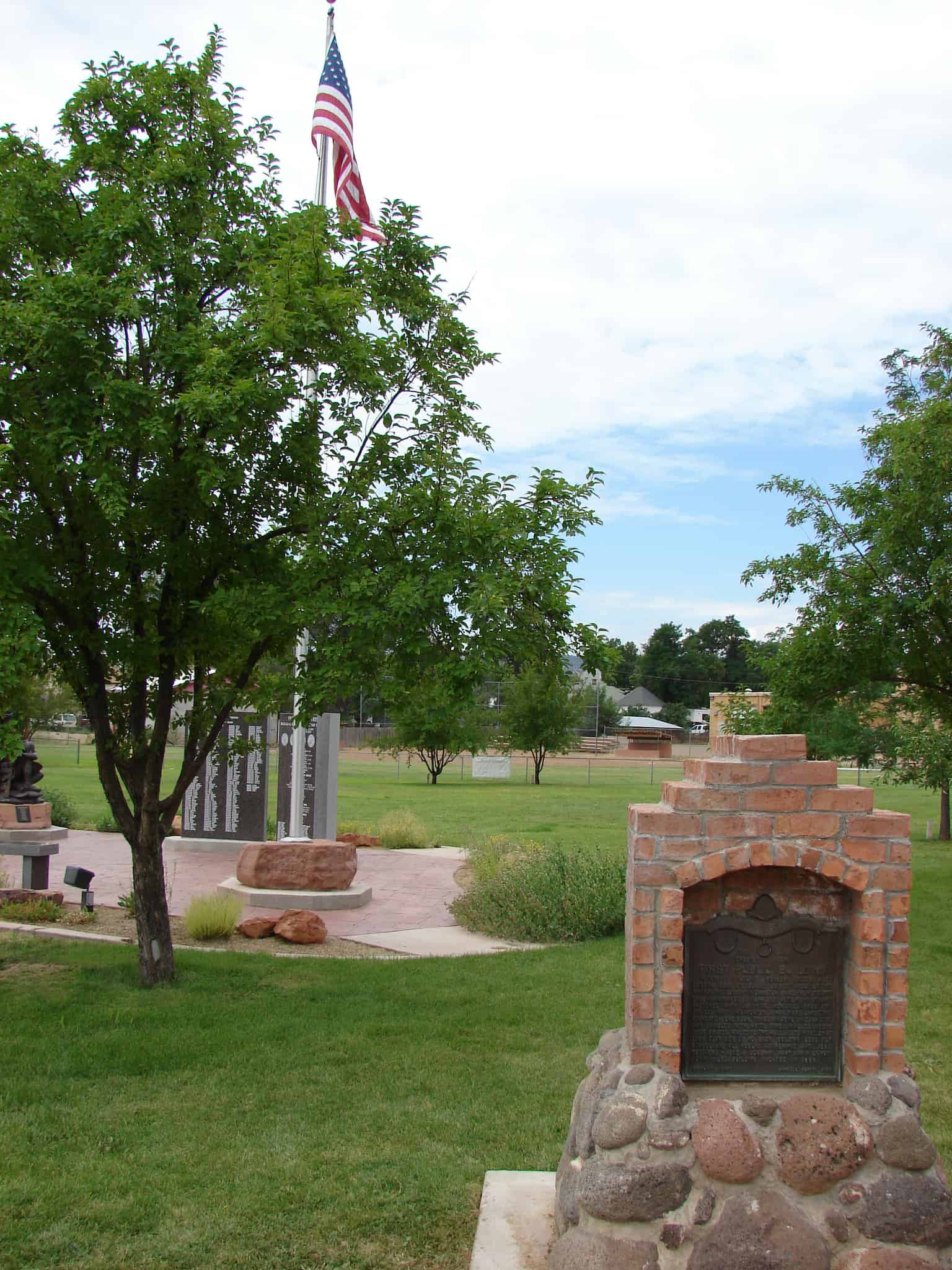
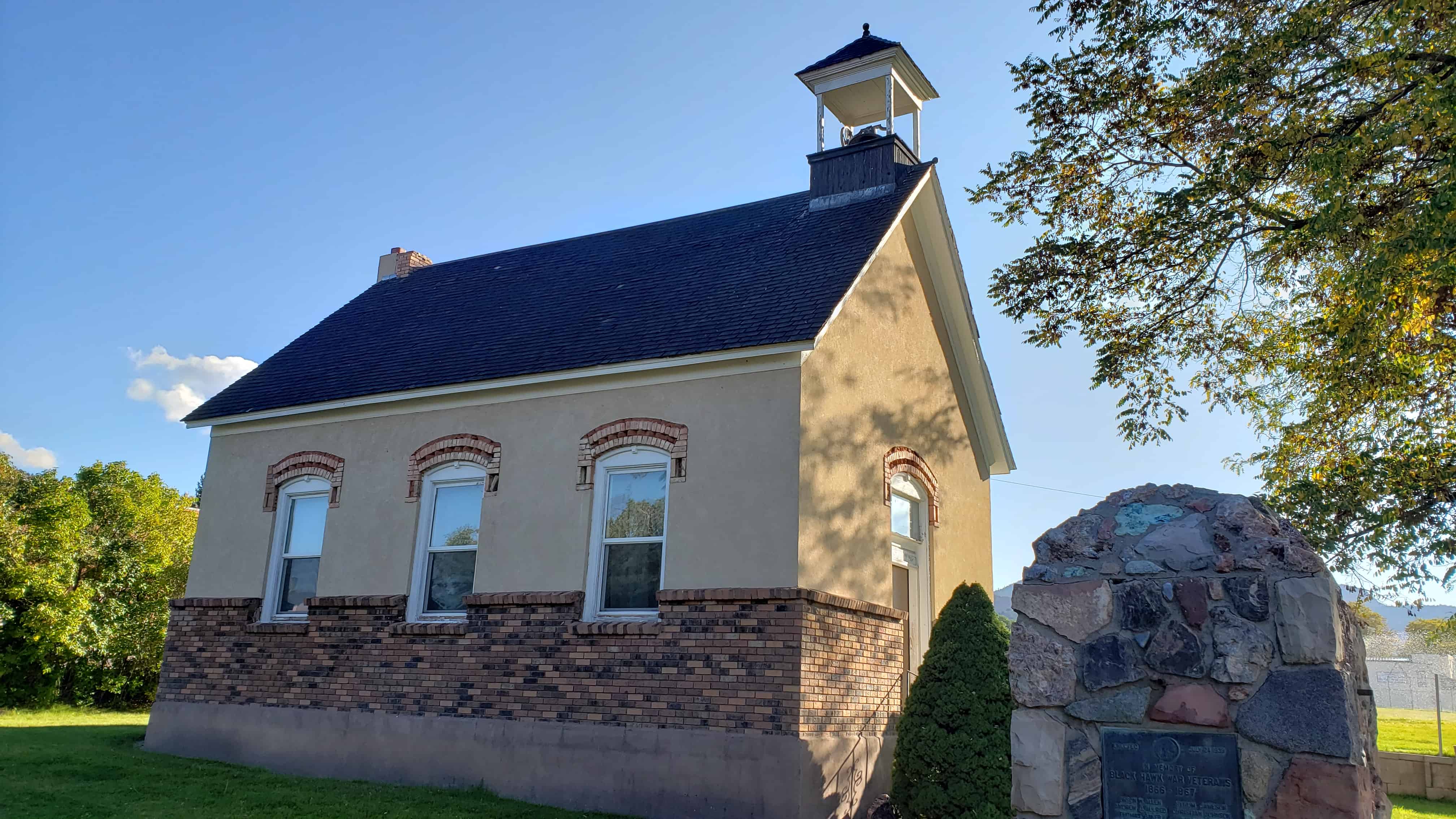
Here is D.U.P. Marker # 500, where we read of the first buildings in Palmyra, Utah.

Palmyra‘s First Amusement Hall

To the north of the little one-room schoolhouse, the people of Palmyra began building the lumber Amusement Hall on February 10, 1900. It took exactly one month to complete the building, and a dance was held in it that evening. A potbellied stove kept the building warm. There was no indoor plumbing; the outhouses were to the east of the building.
For several years, the Amusement Hall was used for church meetings and social activities, including basketball, wrestling, and dances. The Amusement Hall was used until 1933.

Palmyra’s Schools

The first school was built in the Palmyra Fort. The second school, an adobe brick building which measured twenty-four feet by thirty-two feet with a rock foundation, was built across the street in the early 1890s. The entrance was a six-foot hallway with a row of coat hooks around the wall and a shelf above for dinner buckets. There were four rows of double seats with one grade in each row – first, second, third, and fourth; one teacher taught all four grades. There was a potbellied stove in the northeast corner and a blackboard on the east wall. A flowing well was located near the east wall. Horses ridden to school were tied to a hitching post. Some children rode to school in a covered wagon. This school was replaced in 1920.

picture7sep07-066

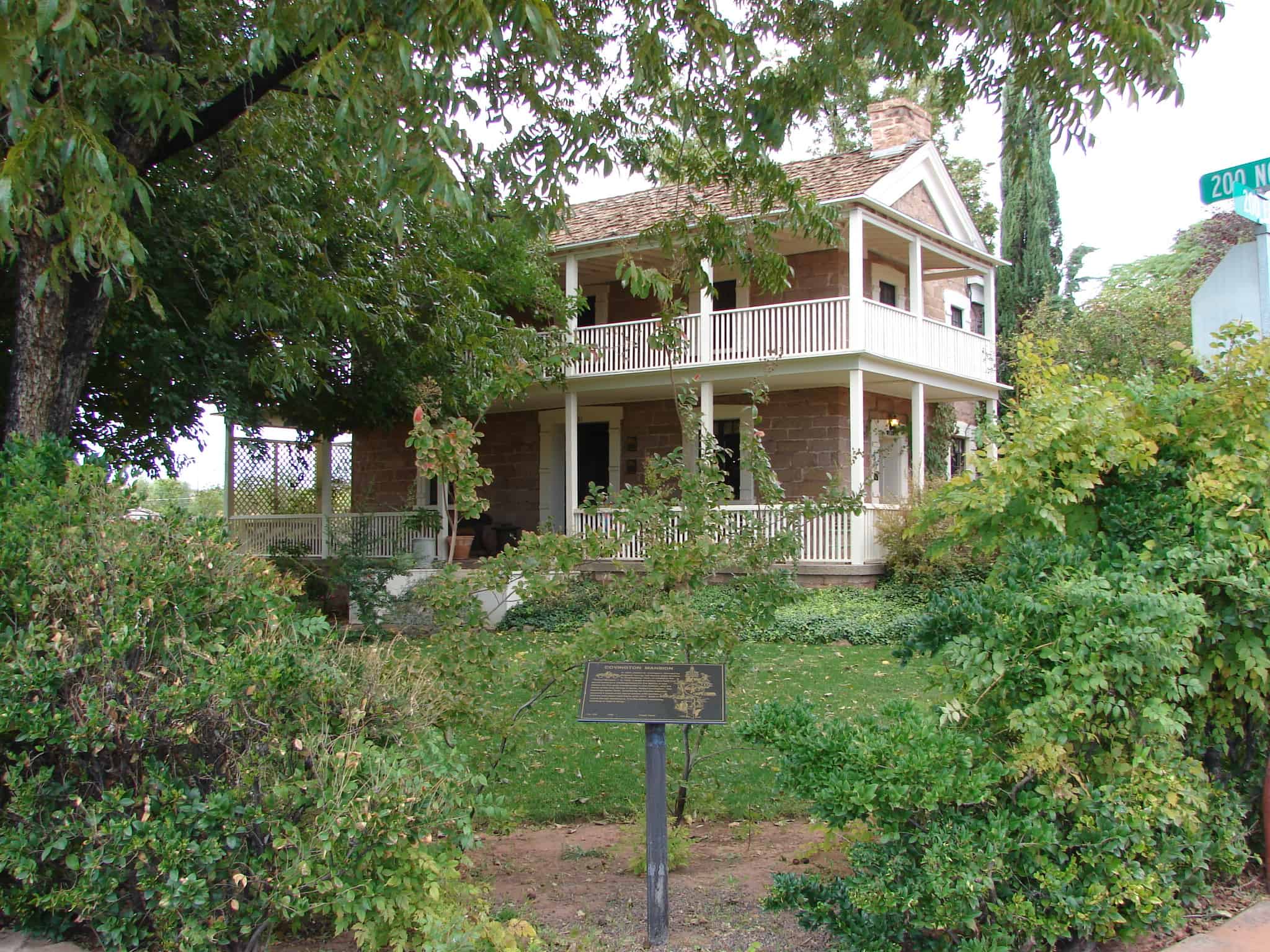
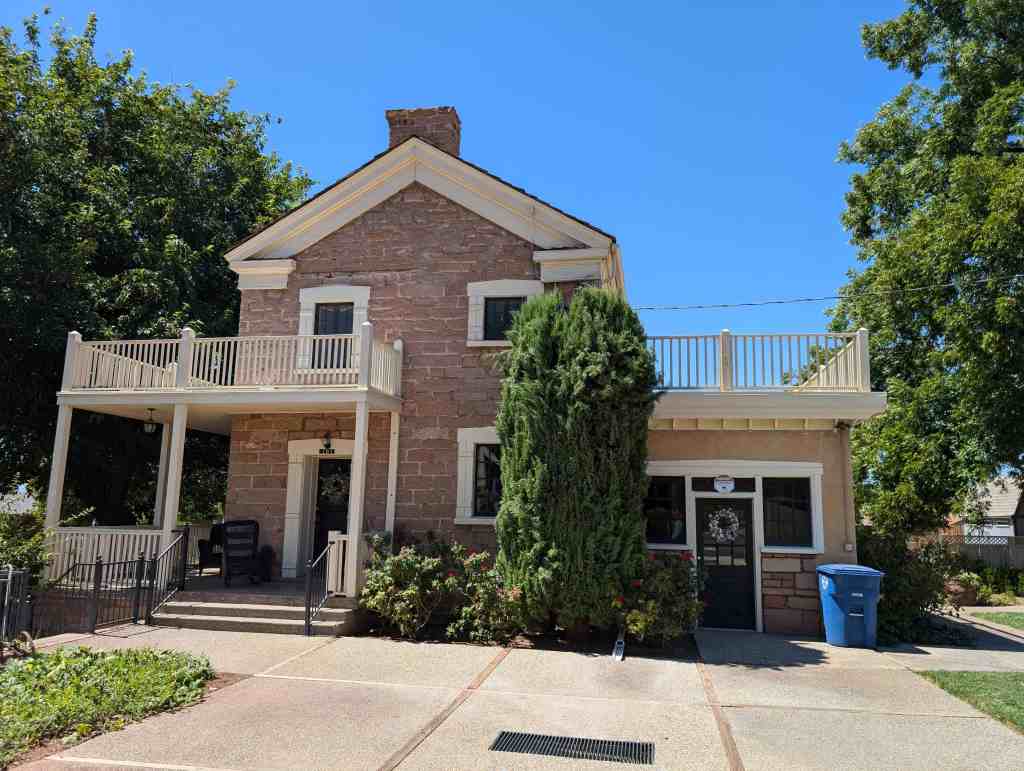
Covington Mansion

23 Monday Dec 2013

Posted by Jacob Barlow in Uncategorized

≈ 1 Comment

Tags

DUP, historic, NRHP, utah, Washington, Washington County

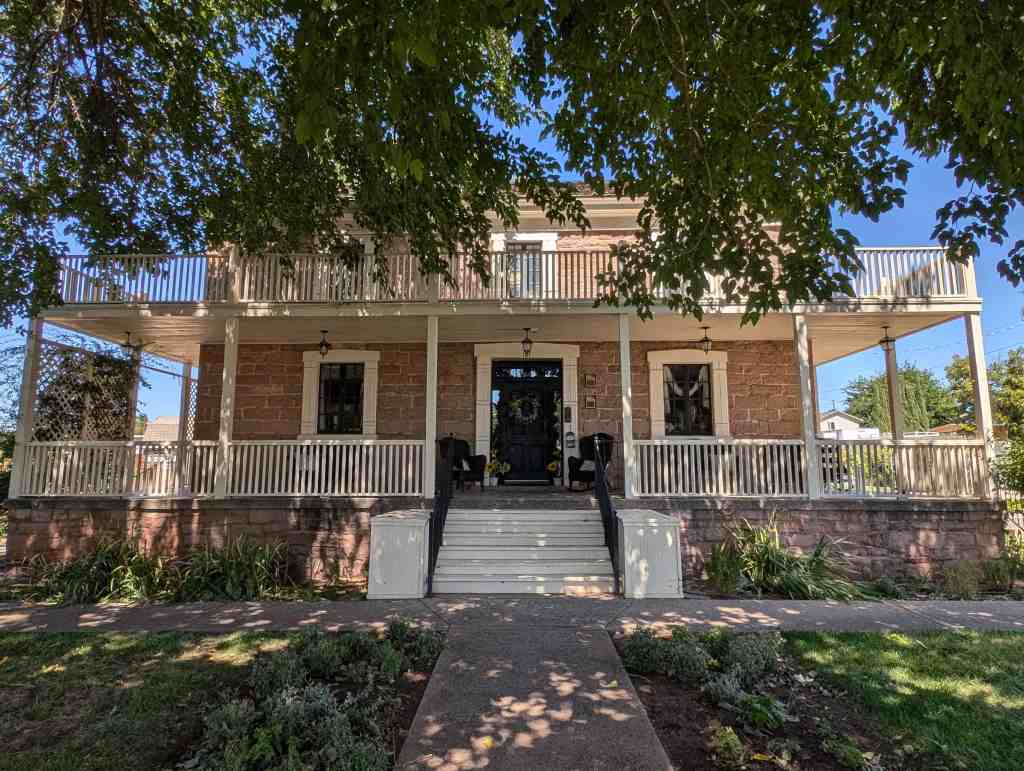
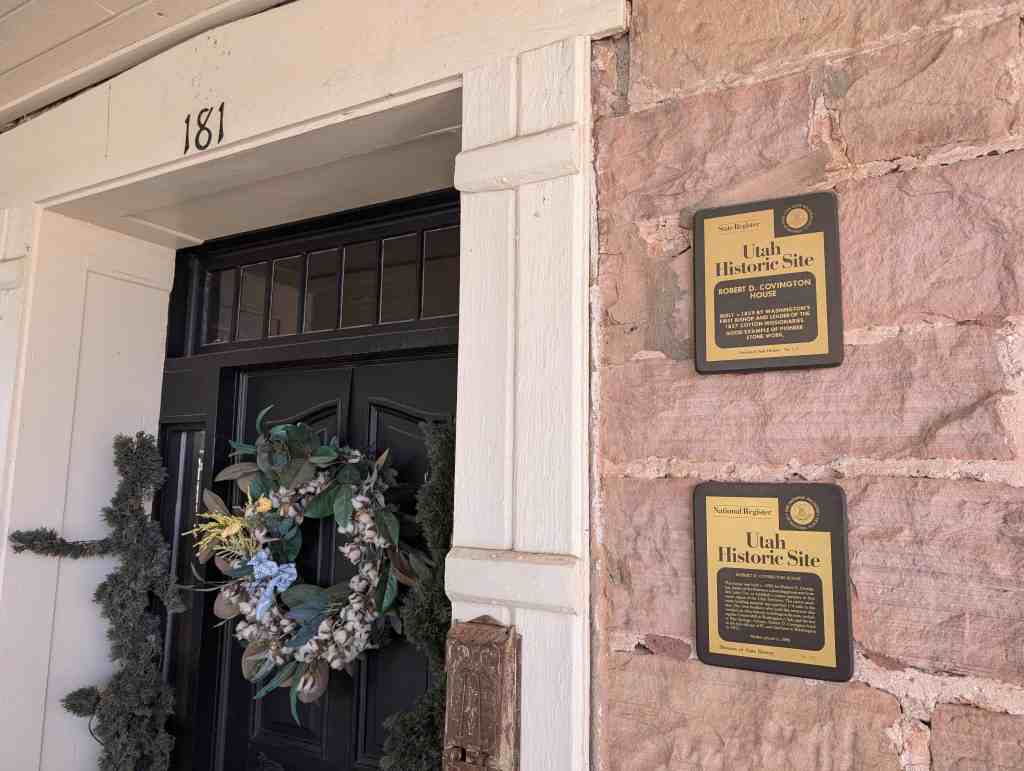
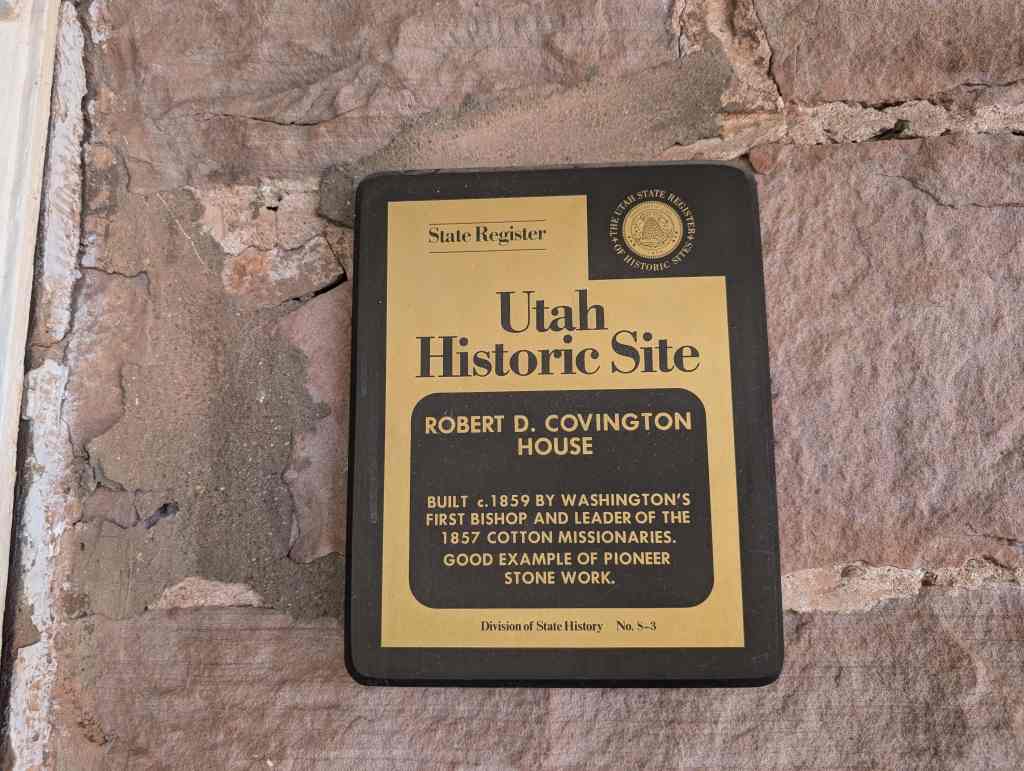
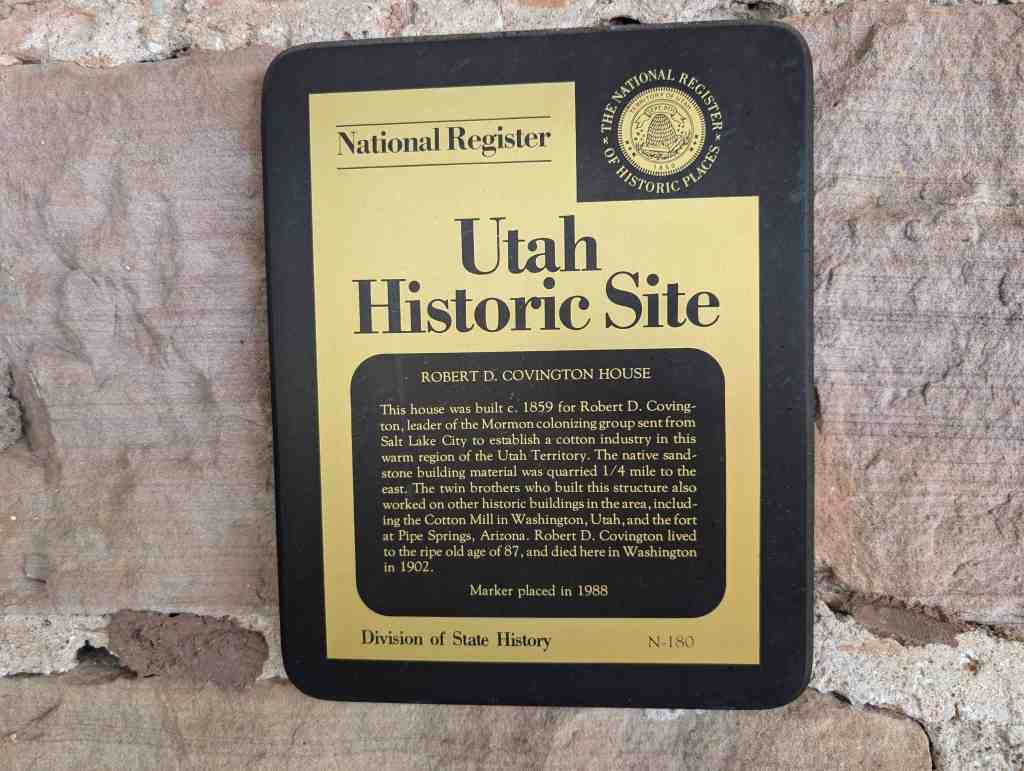
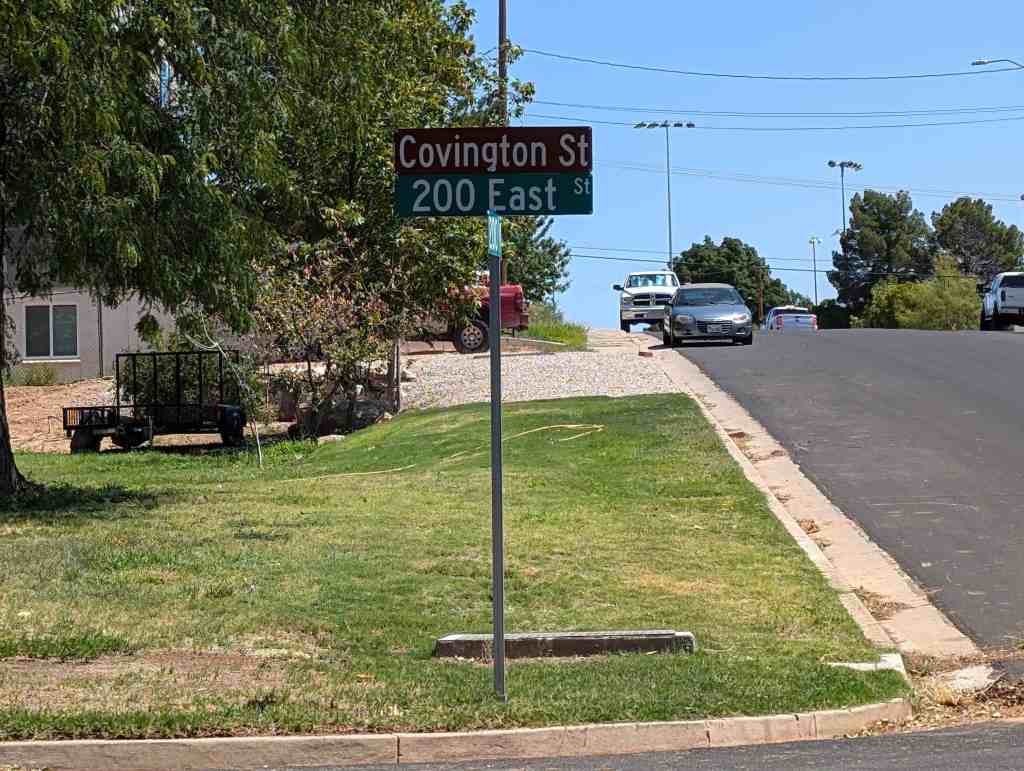
Robert D. Covington House

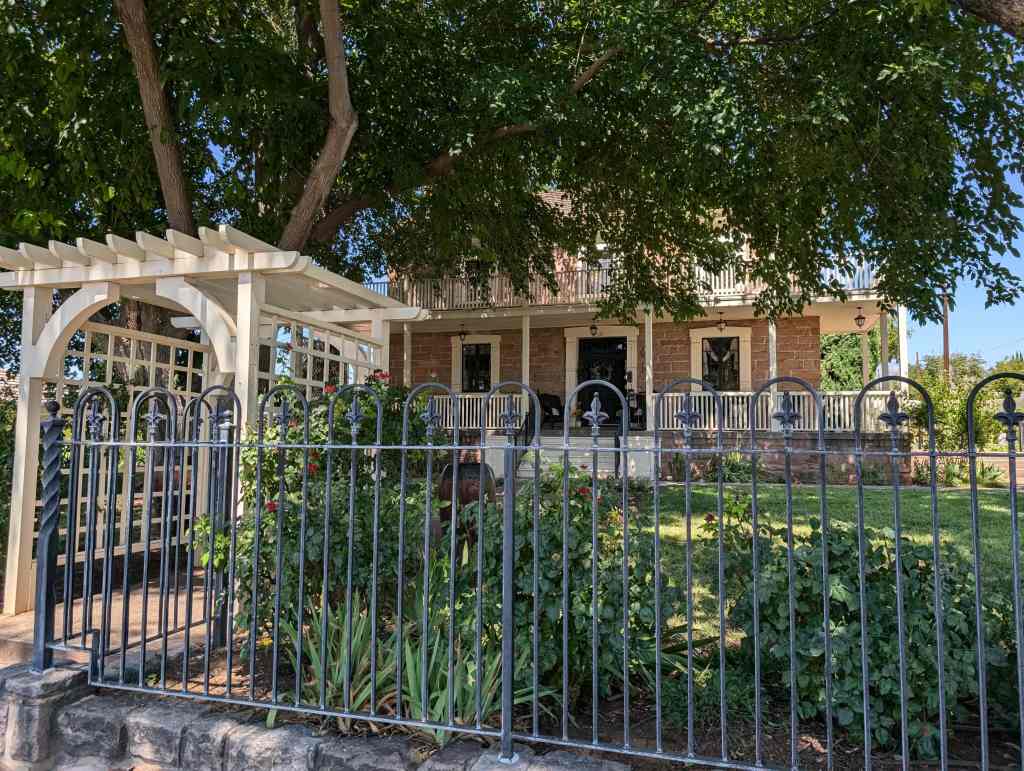
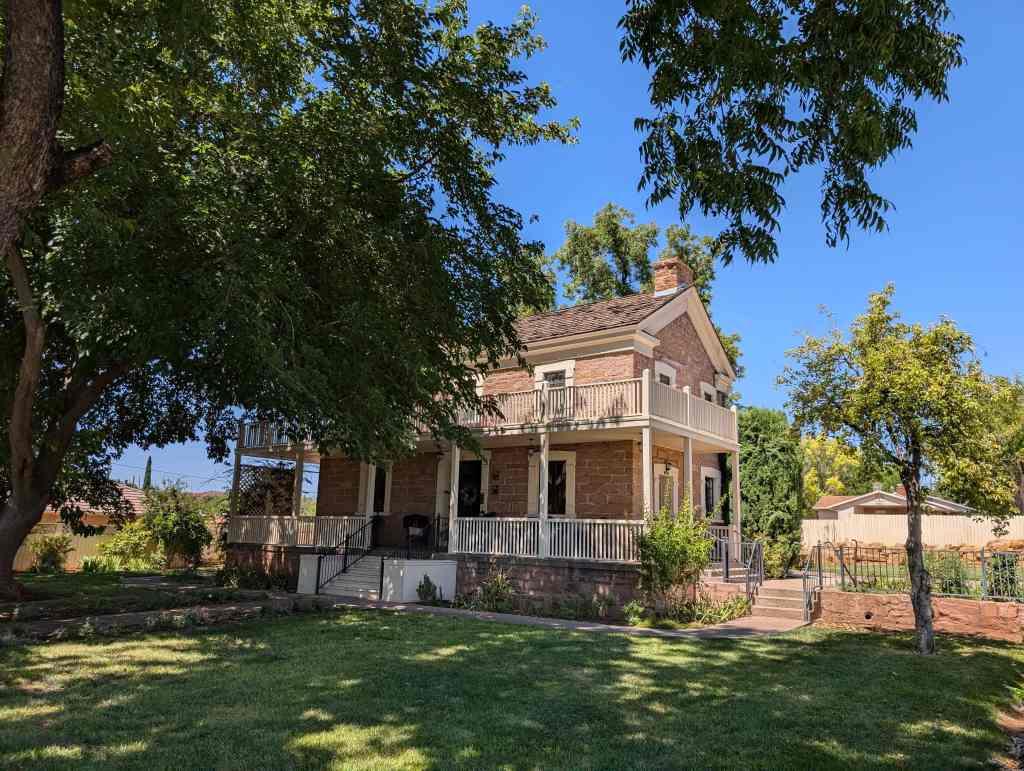
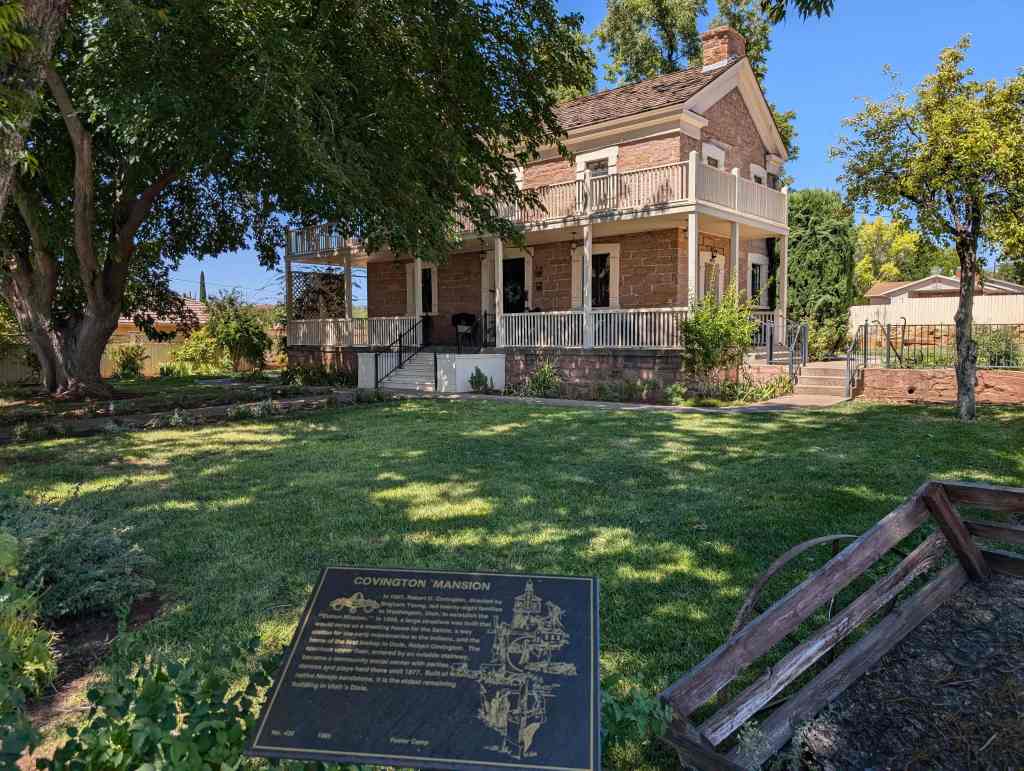
This house was built c. 1859 for Robert D. Coving- ton, leader of the Mormon colonizing group sent from Salt Lake City to establish a cotton industry in this warm region of the Utah Territory. The native sand- stone building material was quarried 1/4 mile to the east. The twin brothers who built this structure also worked on other historic buildings in the area, including the Cotton Mill in Washington, Utah, and the fort at Pipe Springs, Arizona. Robert D. Covington lived to the ripe old age of 87, and died here in Washington in 1902.

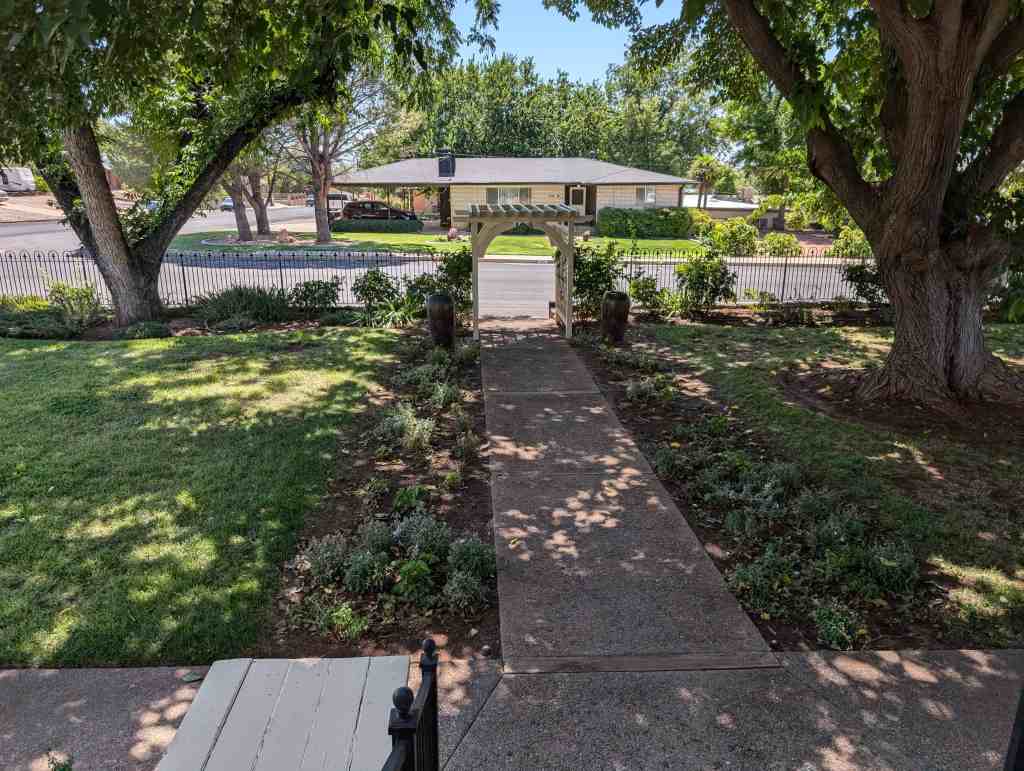
Located at 181 East 200 North in Washington, Utah.

picture13oct07-049

Covington Mansion

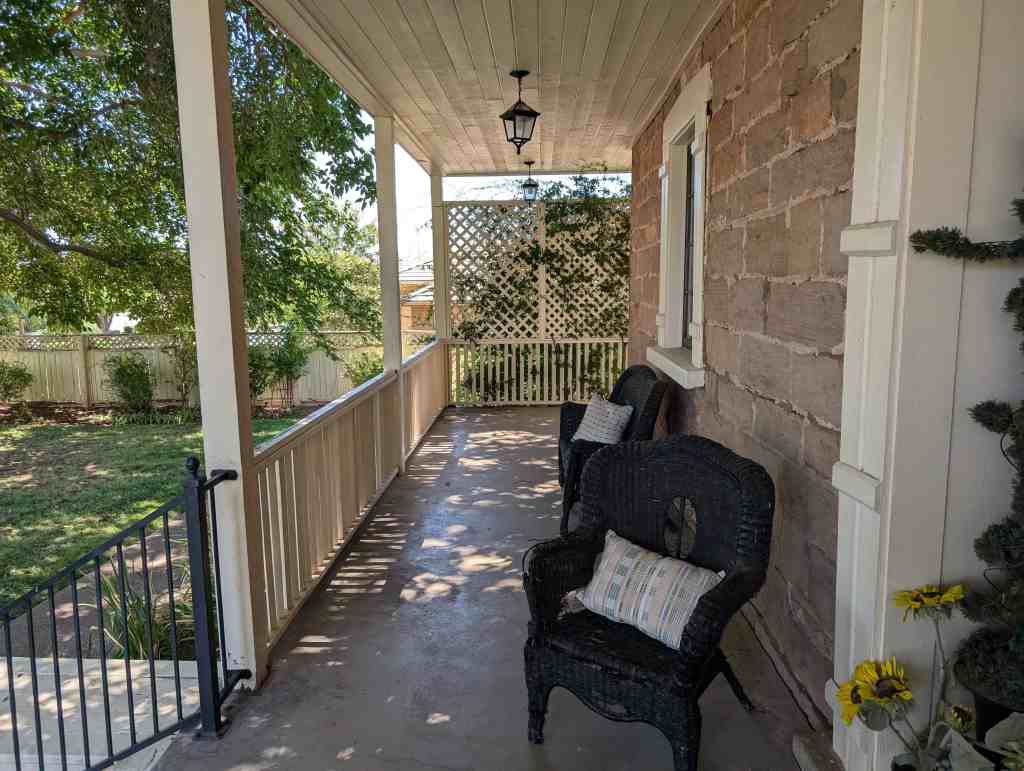
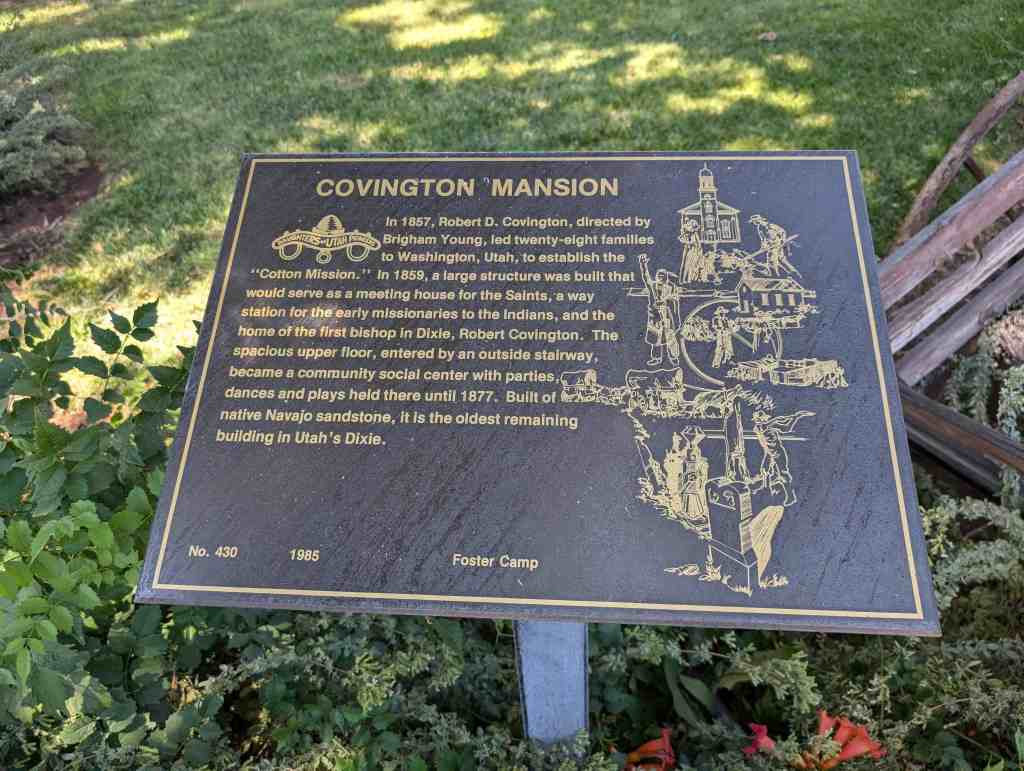
In 1857, Robert D. Covington, directed by Brigham Young, led twenty-eight families to Washington, Utah, to establish the “Cotton Mission.” In 1859, a large structure was built that would serve as a meeting house for the Saints, a way station for the early missionaries to the Indians, and the home of the first bishop in Dixie, Robert Covington. The spacious upper floor, entered by an outside stairway, became a community social center with parties, dances and plays held there until 1877. Built of native Navajo sandstone, it is the oldest remaining building in Utah’s Dixie.

picture13oct07-048

Daughters of Utah Pioneers Historic Marker #430

  • D.U.P. Historic Markers

The Kennedy Ditch

18 Wednesday Dec 2013

Posted by Jacob Barlow in Uncategorized

≈ 2 Comments

Tags

DUP, historic, Salt Lake City, Salt Lake County, utah

picture7sep07-114

The Kennedy Ditch was an early pioneer irrigation canal taken out of Parley’s canyon stream near 17th East. The construction was achieved as a co-operative work project, and the new channel named after its first Water Master, Charles Kennedy, a Utah pioneer of 1848. The area thus brought under cultivation. Covered 864 acres of small farm lands extending west of 13th East from near 21st South northward to 9th South, including this spot on Emerson Avenue.

picture7sep07-113

The above photos are of the marker I originally found is 2006, I’m not sure when it went missing – I think I started to notice that it was gone when driving by sometime around 2016 but it could have been much earlier and then in 2019 it was replaced with the plaque pictured below. The wording is almost exactly the same, they did remove the part about this spot being on Emerson Avenue, which it isn’t, so I’m assuming the marker was moved here sometime before I originally found it.

Relief Society Hall

18 Wednesday Dec 2013

Posted by Jacob Barlow in Uncategorized

≈ 1 Comment

Tags

Bicknell, DUP, historic, utah, Wayne County

  • picture27sep08-088

Built by the women of Thurber under the leadership of Sarah Gardner Meeks, President; Mary H. Bullard, 1st Counsellor; Eliza Jane Brinkerhoff, Amanda Haws Durfey, 2nd Counsellors; Viola Cutler Brinkerhoff, Secretary; Mary A. Gardner, Asst. Secretary; Melissa Meeks Snow, Treasurer. Building began June 1, 1897 when the town was moved to its present location. Completed September 19, 1899 and dedicated by President Willis E. Robinson.

Located at 90 West Main Street in Bicknell, Utah

Related:
  • Other DUP Markers


  • picture27sep08-087

First Public Building

18 Wednesday Dec 2013

Posted by Jacob Barlow in Uncategorized

≈ 1 Comment

Tags

DUP, Escalante, First, Garfield County, historic, utah

picture24jul07-127

In 1876-77 Escalante Pioneers erected a log building, 36×18 ft., located 20 feet west of this marker. The logs 18″ in diameter, came from Cyclone Lake Mountain by ox team. They were hewn by hand, fastened with oak pins, morticed ends and chinked with lime mortar. It had white sandstone foundation, one door, three windows on each side, and shingled with white pine shingles. Desks were boards hinged to the wall. Seats were split logs, flat side up, no back. Building used for school and all public gatherings until 1885. Teachers – Jane S. Coleman, Mary Ann P. Schow, John Miles. Building vacated in 1898.

picture24jul07-126

Other DUP Markers are listed at JacobBarlow.com/dup

Escalante

18 Wednesday Dec 2013

Posted by Jacob Barlow in Uncategorized

≈ 1 Comment

Tags

DUP, Escalante, Garfield County, historic, utah

picture24jul07-130

In 1866 a group of Mormon Cavalrymen noted this valley, while in pursuit of Indians, during the Black Hawk War.

In February, 1875, a company of men came from Beaver, Utah and explored the valley. The first permanent settlers arrived November 1875.

The town site was surveyed, homes built and a bowery erected.

July 4, 1876, in absence of a better flag, they hoisted a striped Navajo blanket.

The city was named for Father Escalante, a Spanish priest who visited Utah in 1776.

Organized as a Latter-day Saint Ward August 5, 1877.

Visit my collection of DUP Markers at JacobBarlow.com/dup

Spanish Fork Heritage Cemetery

18 Wednesday Dec 2013

Posted by Jacob Barlow in Uncategorized

≈ 2 Comments

Tags

Cemeteries, DUP, historic, spanish fork, utah, utah county

  • Image

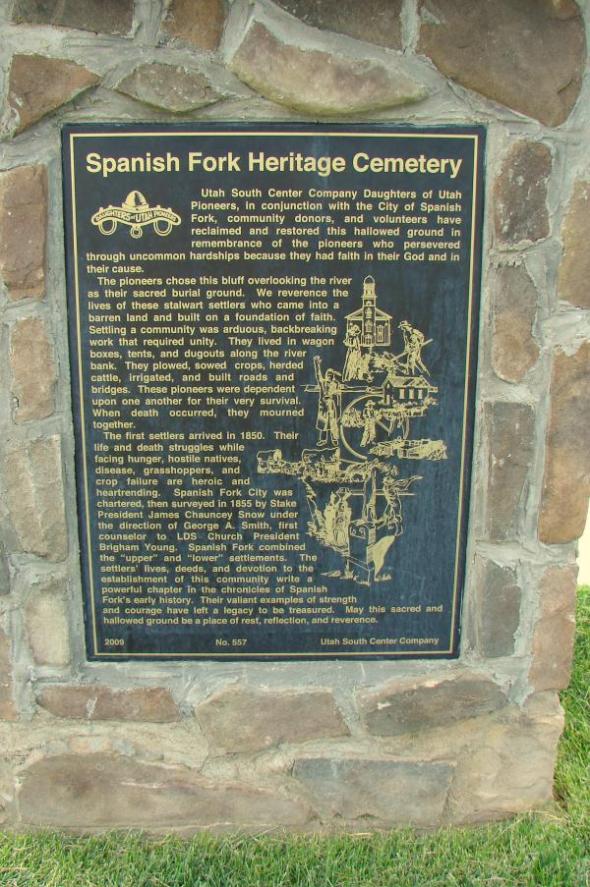
Utah South Company Daughters of Utah Pioneers, in conjunction with the City of Spanish Fork, community donors, and volunteers have reclaimed and restored this hallowed ground in remembrance of the pioneers who persevered through uncommon hardships because they had faith in their God and in their cause.

The pioneers chose this bluff overlooking the river as their sacred burial ground. We reverence the lives of these stalwart settlers who came into a barren land and built on a foundation of faith. Settling a community was arduous, backbreaking work that required unity. They lived in wagon boxes, tents, and dugouts along the river bank. They plowed, sowed crops, herded cattle, irrigated, and built roads and bridges. These pioneers were dependent upon one another for their very survival. When death occurred, they mourned together.

The first settlers arrived in 1850. Their life and death struggles while facing hunger, hostile natives, disease, grasshoppers, and crop failure are heroic and heartrending. Spanish Fork City was chartered, then surveyed in 1855 by Stake President James Chauncey Snow under the direction of George A. Smith, first counselor to LDS Church President Brigham Young. Spanish Fork combined the “upper” and “lower” settlements. The settlers’ lives, deeds, and devotion to the establishment of this community write a powerful chapter in the chronicles of Spanish Fork’s early history. Their valiant examples of strength and courage have left a legacy to be treasured. May this sacred and hallowed ground be a place of rest, reflection, and reverence.

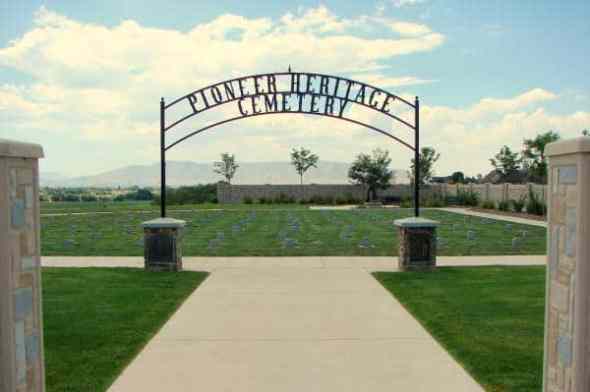
Located at the Pioneer Heritage Cemetery in Spanish Fork, Utah

  • Image

See other markers placed by the DUP at JacobBarlow.com/dup

Allred Point

17 Tuesday Dec 2013

Posted by Jacob Barlow in Uncategorized

≈ 2 Comments

Tags

DUP, historic, Loa, utah, Wayne County

picture27sep08-104

Early in 1876 Andrew Jackson Allred was called by Brigham Young to lead a group of settlers into Rabbit Valley, including ten members of the Allred family, W.W. Morrell and son Silas, William and Henry Maxfield. They built their homes east of Fremont River but due to floods, moved westward to a point of the hill. Here were established log cabins, trading post, store and post office. One half mile further south the first burr grist mill was erected. Mr. Allred served as first postmaster and Indian interpreter. Only the grave of little Silas W. Morrell remains in Fremont’s first cemetery.

Daughters of Utah Pioneers historic marker #271, located outside of Fremont, Utah

  • D.U.P. Markers
picture27sep08-103

Ingress Leaderboard

12 Thursday Dec 2013

Posted by Jacob Barlow in Uncategorized

≈ Leave a comment

I’ve had fun playing Ingress, but I love games with leaderboards so I can see how I’m doing. 

Here’s an unofficial one that will hopefully grow to more than twenty or so people.


https://docs.google.com/spreadsheet/lv?key=0Ai1m6dSmwsQVdDYtNGp6R3BlTVkzMXVoc1ZmWUZrVnc#gid=1

← Older posts

Follow Jacob

Follow Jacob

Blog Stats

  • 2,021,028 hits

Social and Other Links

BarlowLinks.com

Recent Posts

  • 83 N Street
  • First Company of Pioneers into the Valley
  • Blue Base – The Stand Filming Location
  • 926 E South Temple
  • 969 E South Temple

Archives


Loading Comments...