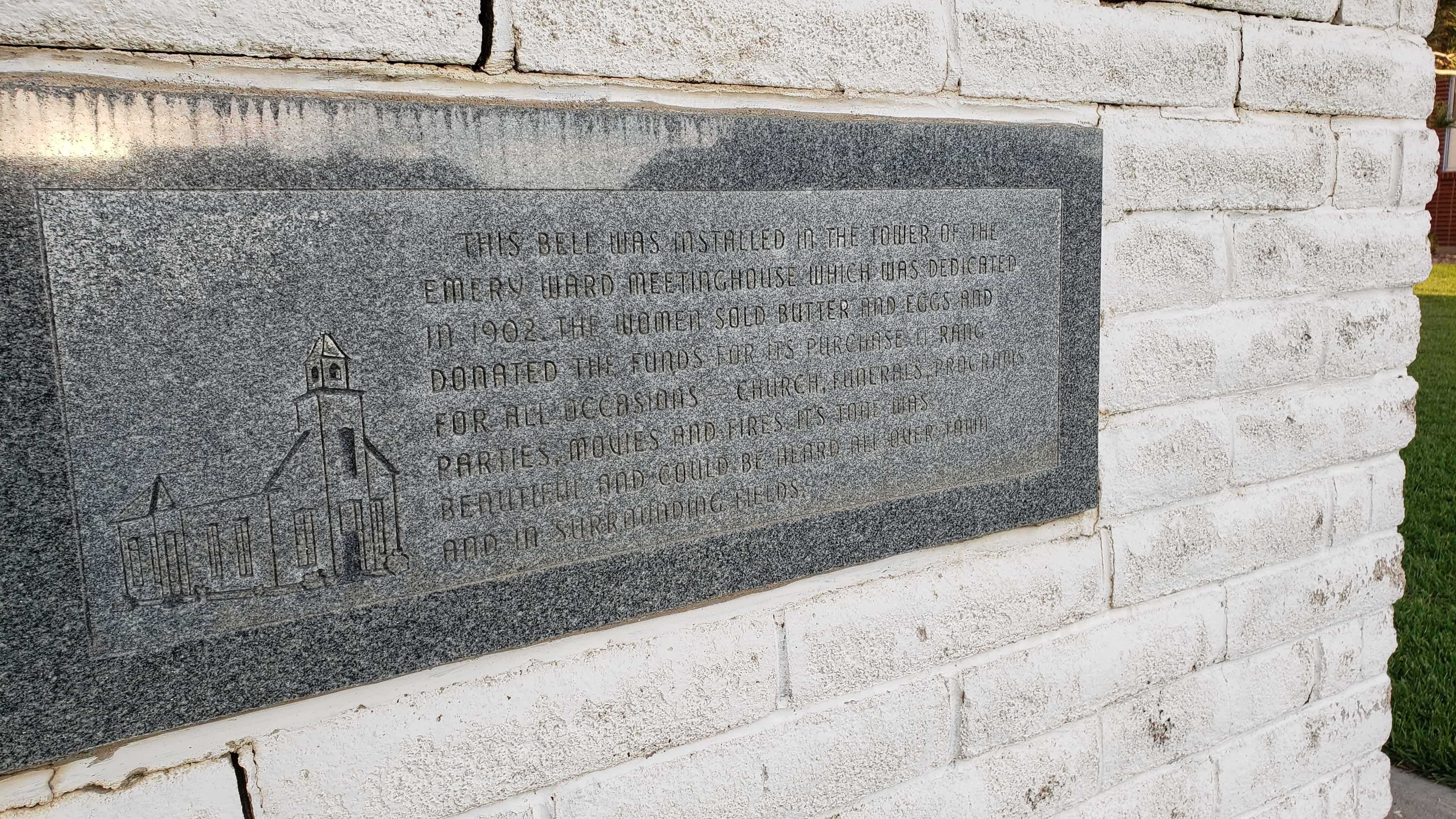
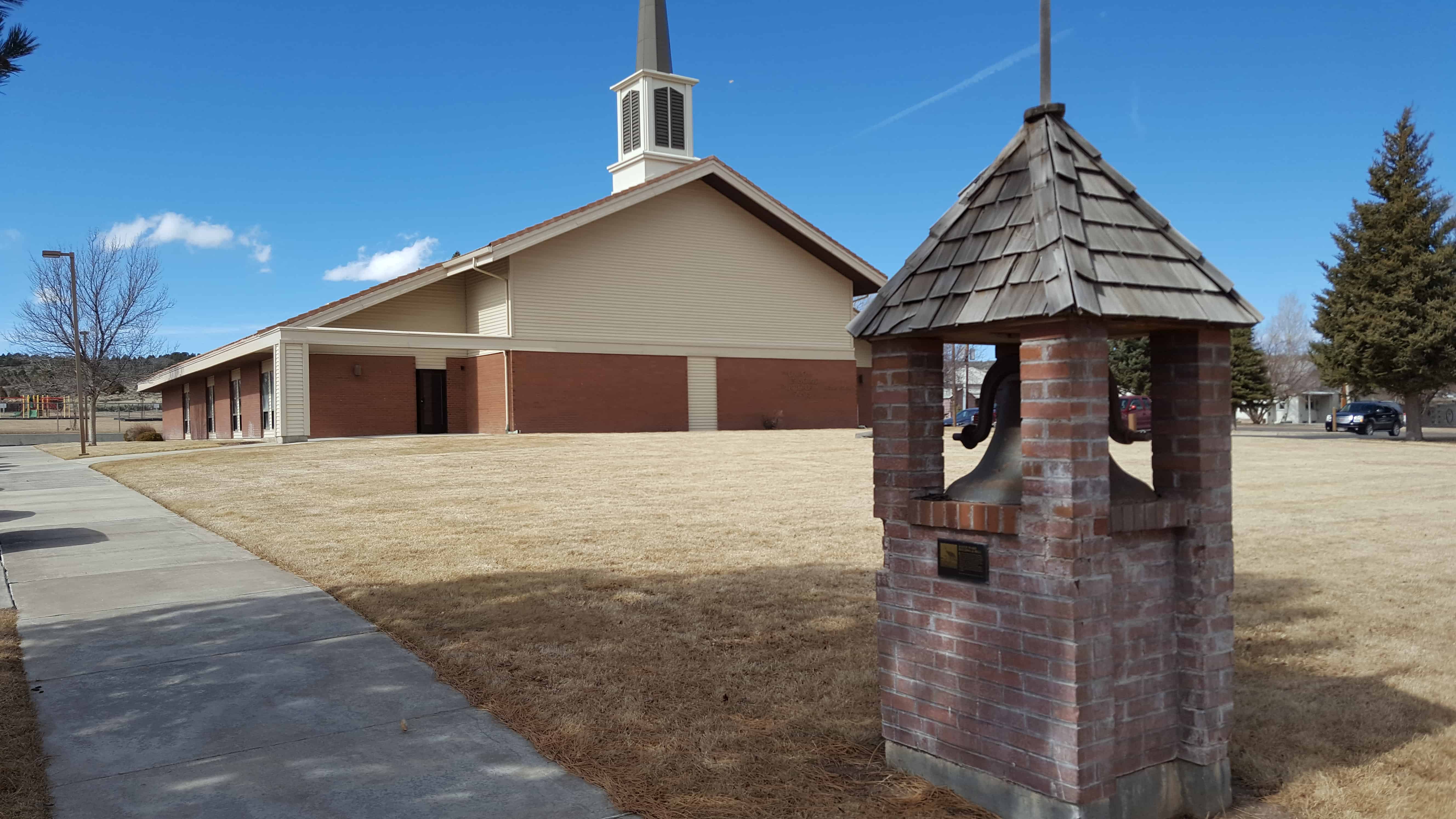
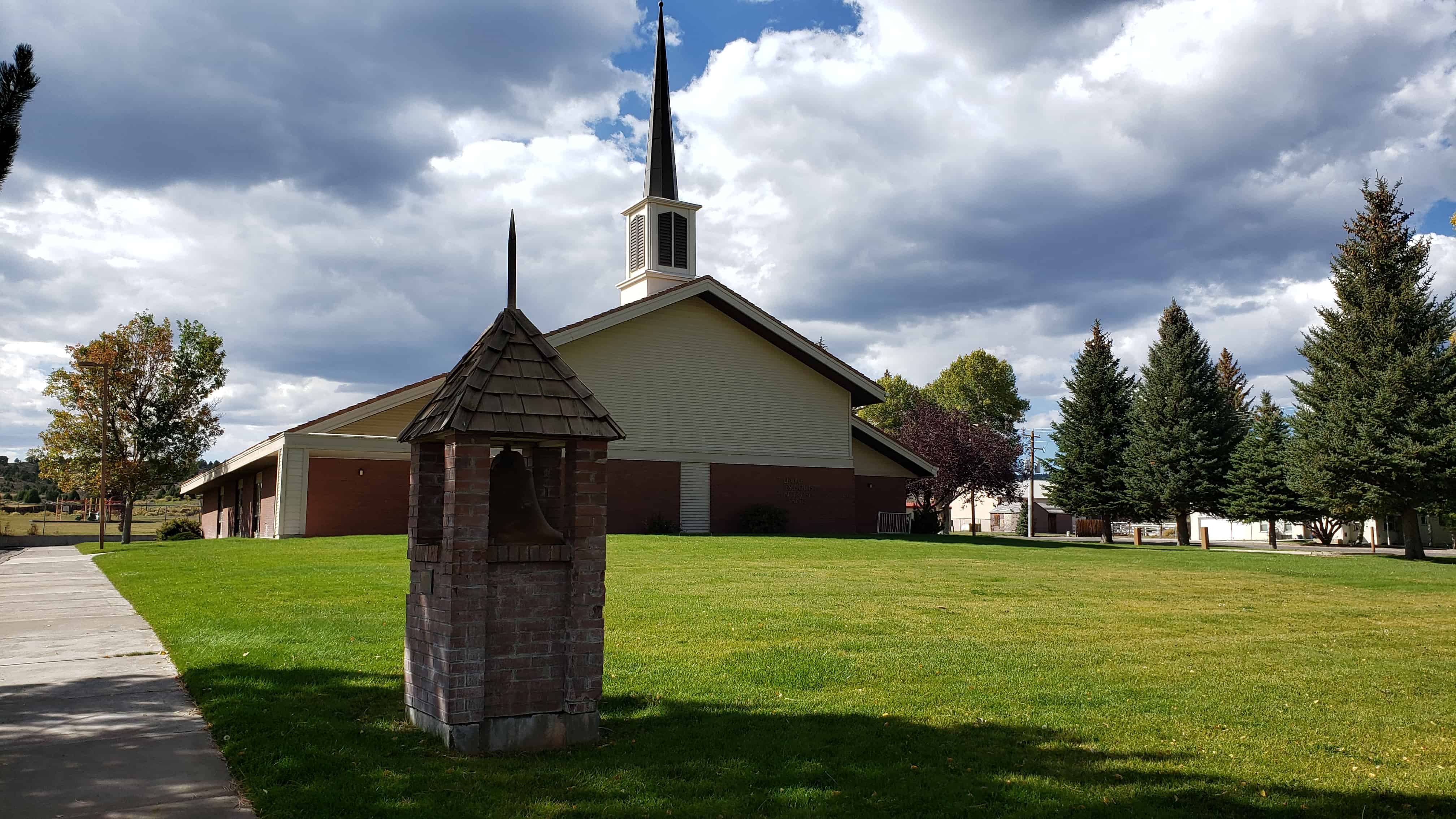
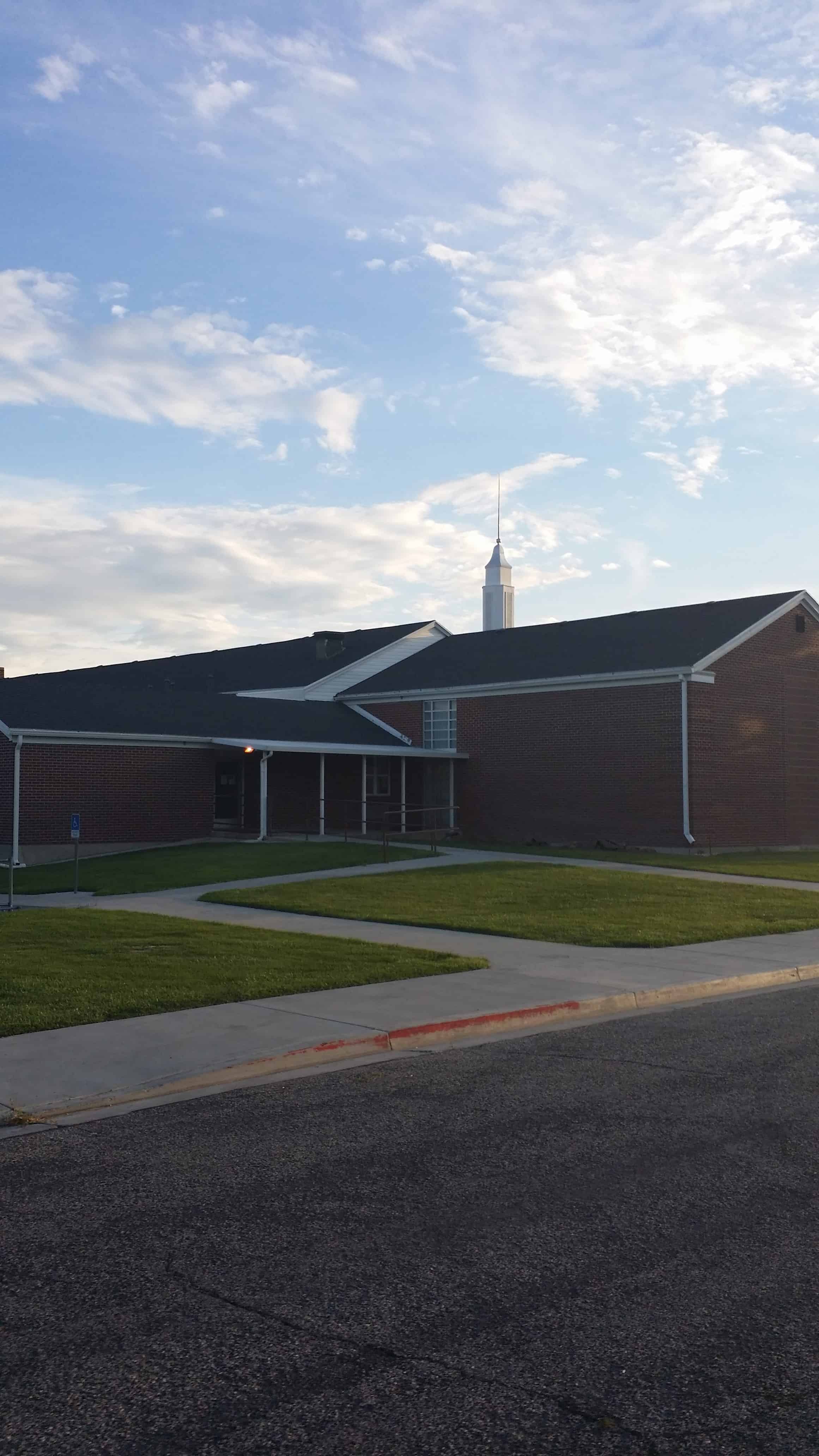
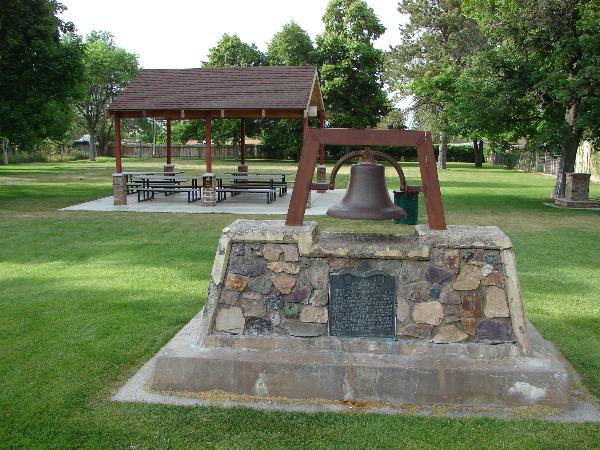
This bell was installed in the tower of the Emery Ward Meetinghouse which was dedicated in 1902. The women sold butter and eggs and donated the funds for its purchase. It rang for all occasions – church, funerals, programs, parties, movies and fires. It’s tone was beautiful and could be heard all over town and in surrounding fields.
Located at the Chapel at 70 North Center Street in Emery, Utah
In 1904 the Hatch LDS Ward building was erected on this lot. A vestibule was added in 1901, and the bell was purchased with donations from ward members. For many years it hung in the tower and rang out for all civic, social and church activities. School was held in the building until 1913. The building was razed March 3, 1983, when the new ward meetinghouse was built.
When the Willard Central School was constructed in 1902, a bell tower with a large brass bell was installed on the roof toward the front of the building. The bell was rung 15 minutes before school began and again at noon. Students vied for the privilege of pulling the bell cord. The ring could be heard a mile away warning dawdling students to hurry. Although the bell tower was remodeled in 1911-12, the bell remained in place for 37 years.
In 1939, during a remodeling of the school, the bell was removed from the roof and mounted on a circular rock foundation immediately in front of the school. The bell no longer rang but served as a memorial to bygone days.
The school was demolished in 1956 to make room for a new one. This monument, on the old playground, is constructed of rocks from the Fort Wall which was built between 1852-55 and which surrounded the old town of Willard.
Willow Creek Camp DUP Free-standing engraved granite plaque on post: This marker is also built of native stone as well as rocks from the fort wall. The rail was used in the first transcontinental railroad of 1869. Willow Creek Camp 1989
Methodist Episcopal Church Peak Enrollment 127 in 1915 1870 – 1957
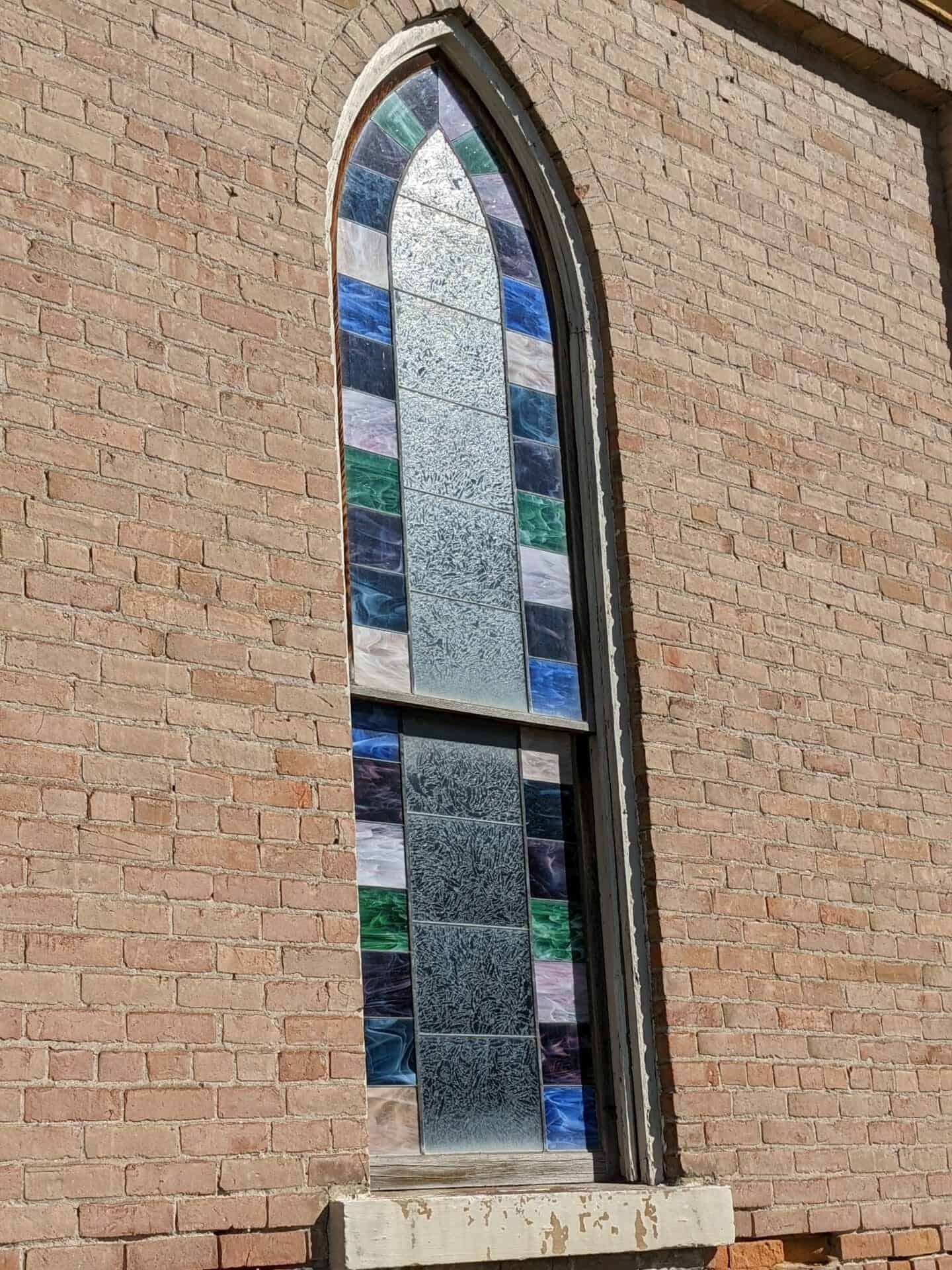
This is the oldest extant Protestant church building in Utah. It was dedicated by Chaplain C. C. McCabe and Reverend G. M. Peirce on September 20, 1870.
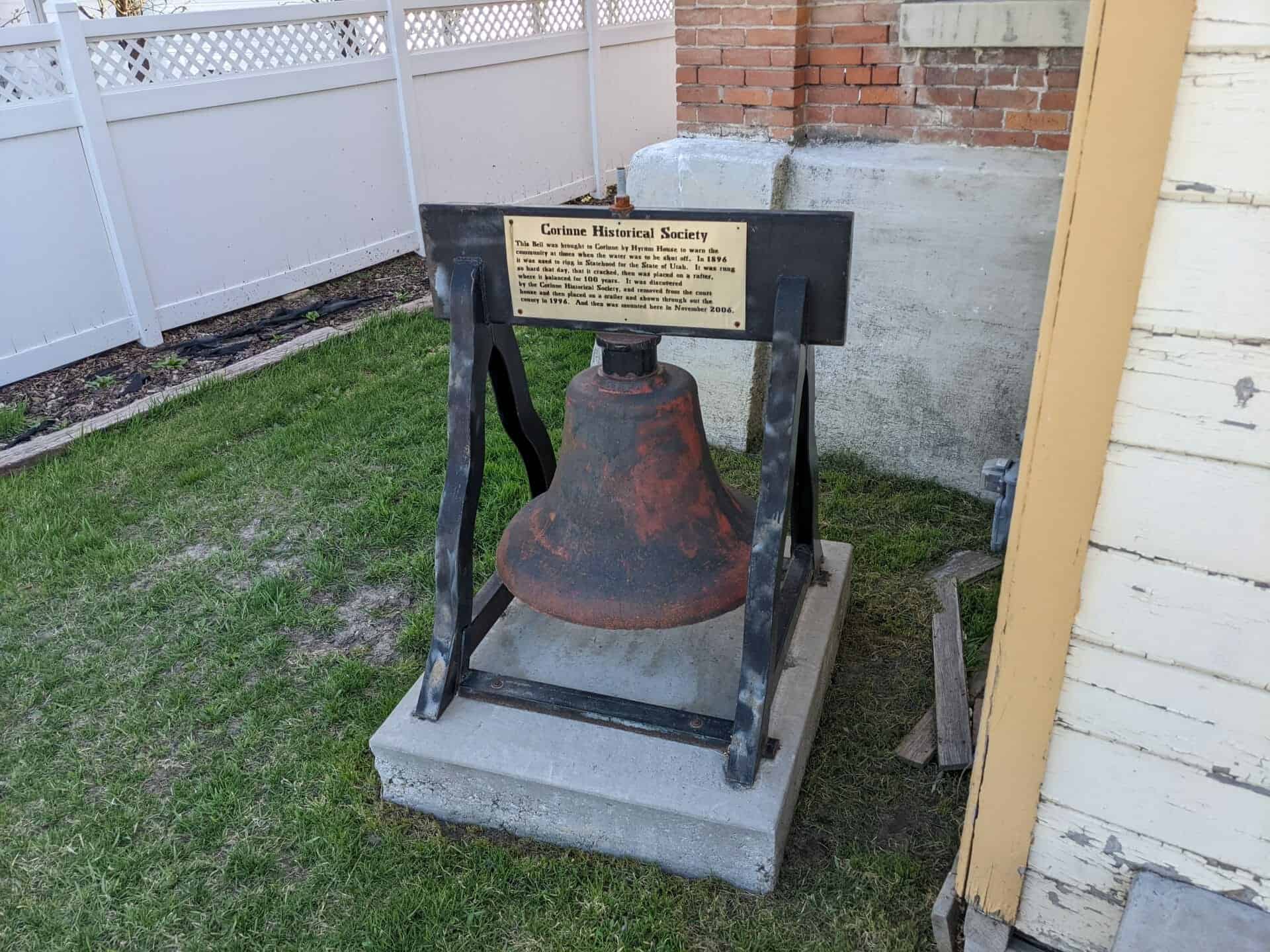
Corinne Historical Society This bell was brought to Corinne by Hyrum House to warn the community at times when the water was to be shut off. In 1896 it was used to ring in the Statehood for the State of Utah. It was rung so hard that day, that it cracked, then was placed on a rafter, where it balanced for 100 years. It was discovered by the Corinne Historical Society, and removed from the court house and then placed on a trailer and shown through out the county in 1996. And then was mounted here in November 2006.
The Corinne Methodist Episcopal Church, located at 3995 West 2300 North in Corinne, Utah was added to the National Register of Historic Places (#71000842) on May 14, 1971. The text below is from the nomination form from when it was added to the register.
Corinne, Utah lays claim to several distinctive features. It was Utah’s First “Gentile” City, having been dreamed of in 1868, but born and built during March and April, 1869, when the Union Pacific Railroad tracks reached there, It was the last U.P.R.R. track town on the transcontinental line, having 1500 inhabitants within a month and 3,000 by the end of April, It was laid out by J. E. Hause, chief engineer for the Union Pacific Railroad. Its name came either from Corinne Williamson, daughter of General J. A. Williamson, and the first white child born in the new town or from the actress who performed there on several occasions, Corinne LaVaunt.
By February, 1870, Corinne had been incorporated. Within another year an all gentile “school,” taught by Mr. A. B. Glockner, reported to have been Utah’s first “free public education” system, was organized. In addition, being a non-Mormon community of size and promise, Corinne is claimed as the birthplace of Utah’s American Liberal Party. The town asked to be made Utah’s capital and later to be annexed to Idaho.
Corinne is distinctive in Utah, because it was settled rapidly by non-Mormons. Within two years three protestant and one Catholic church had been organized. The first church in this “City of the Un-Godly,” probably was the Corinne Methodist Church; Reverend G. M. Pierce delivered his first sermon June 15, 1870, in the opera house, sought donations, and soon raised $4,000 for construction of the church. It was dedicated September 20, 1870.
Corinne retained a prominence as the northern-most point of the transcontinental railroad. However, in time, Ogden became the junction for the Utah Northern Railroad, which replaced the lucrative freighting enterprise centered at Corinne. Later, when Lucin Cutoff crossed the Great Salt Lake south of Promontory, the traffic through Corinne was further reduced.
The town held on and at times has been revived somewhat by mining and irrigated farming booms. Today it is the center of a small farming community.
Corinne was unusual. It represents the first Gentile inroad into Utah. Here the protestants first undertook to “convert” the Mormons. The old church today remains as the only tangible reminder of that role and that era.
In 1882, on this site, a Relief Society building was erected under the leadership of Elizabeth J. Stickney, President. It was a one room structure, 20 x 30 feet in size, built of red clay brick made by Joseph Chatwin. The interior was furnished with homemade carpet, a pot belly stove, chairs and benches made of native lumber, an organ and a small table. At one end was a stage with curtains. July 10, 1942, the building was sold to the city for a public library and was later known as the civic center. It toppled to the ground in May, 1963. This old fort and school bell served the community until 1917. It rang for school, alarms, and special events.
Daughters of Utah Pioneers Marker #196 – Early Schools
The first settlers arrived here in 1851. A one-room building was erected and used for Church and School purposes in 1852. George Spencer and his wife were teachers. In 1855 a schoolhouse was erected inside the fort and early teachers were: Martha Hayward, Thomas Ord, Andrew Love, Mary Ellen Love, John Chapman, Amy Bigler, Martha Shofield. Later school was held in the Social Hall, and in 1894 Central School was completed. The bell on this marker was installed and used as curfew and to call the children to school.
Erected 1869 by the first pioneers who settled in Tooele City with Bishop John Rowberry in charge of construction, George Atkin, Superintendent of Work, and Richard and William Kennington, David Adamson, John Pickett, James Hammond and Edward Broad, active in construction work. Rock used was taken from the mouth of Settlement Canyon. The Church was dedicated by Daniel H. Wells, accompanied by President Brigham Young, John Taylor, Orson Pratt and Wilford Woodruff, on April 29, 1870. The building was remodeled in 1918.
From the tower of the first Tooele Valley chapel, which stood on this site, the bell atop the monument served the people for 39 years. Construction began in 1854, finished in 1869, and demolished in 1968.
Daughters of Utah Pioneers historic marker #54, located at Veterans Memorial Park at 15 West Vine Street in Tooele, Utah.
The original 1940 marker was replaced with this new one in 2021:
Old Tooele Ward Church
The first Tooele church was erected in 1869 by the early pioneers who settled in Tooele. Bishop John Rowberry was in charge of construction; George Atkin was superintendent of work; and Richard and William Kennington, Dave Adamson, John Pickett, James Hammond and Edward Broad worked in construction. Rock used was taken from the mouth of Settlement Canyon. The Tooele church was dedicated by Daniel H. Wells on April 29, 1870. President Brigham Young, John Taylor, Orson Pratt and Wilford Woodruff were present. The building was remodeled in 1918 and served the community for 90 years. Up until its demolition in 1968, every prophet of the Church from Brigham Young to Joseph Fielding Smith had spoken from its pulpit.