“These are the mill stones from the first grist mill in this area”
It was built in 1863 by Elam Cheney, Sr. a pioneer of 1847. At the request of President Brigham Young he quarried & shaped the stones & moved them & his family to Fairview where he also blacksmithed the iron & carpentered the wood. The stones were turned by an overshot water wheel with water from the Sanpitch River. – By the Cheney Family Association – 1965
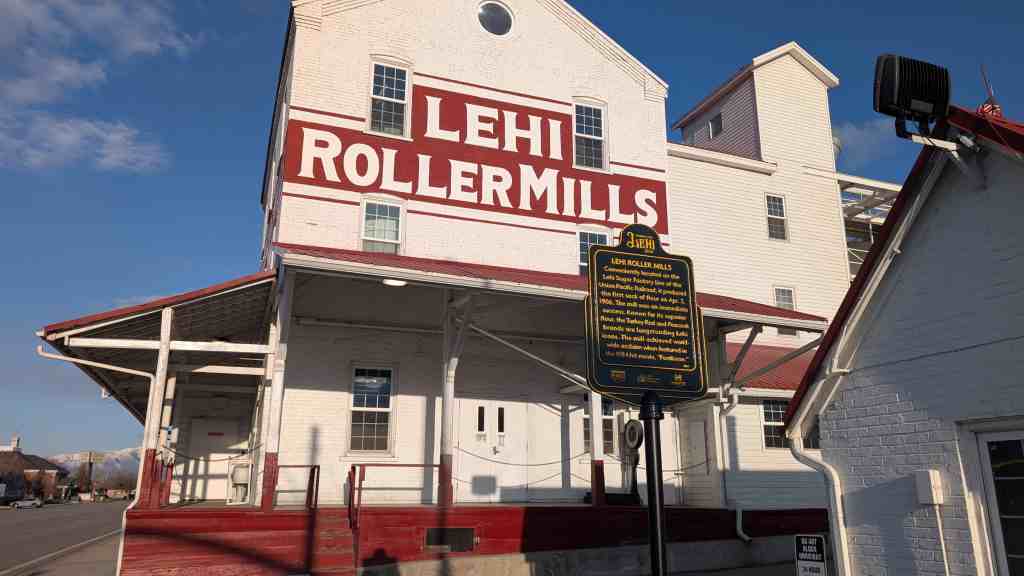
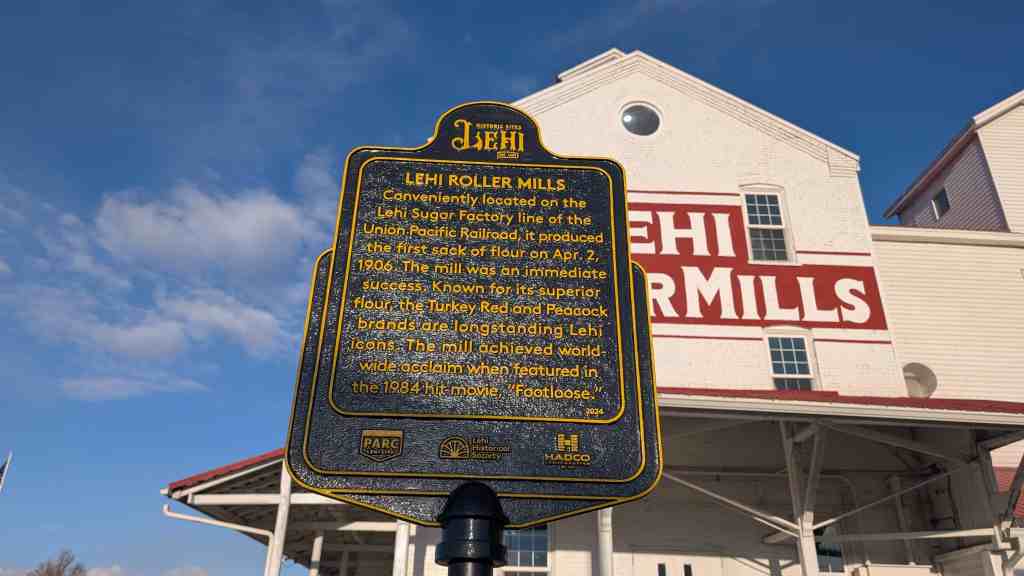
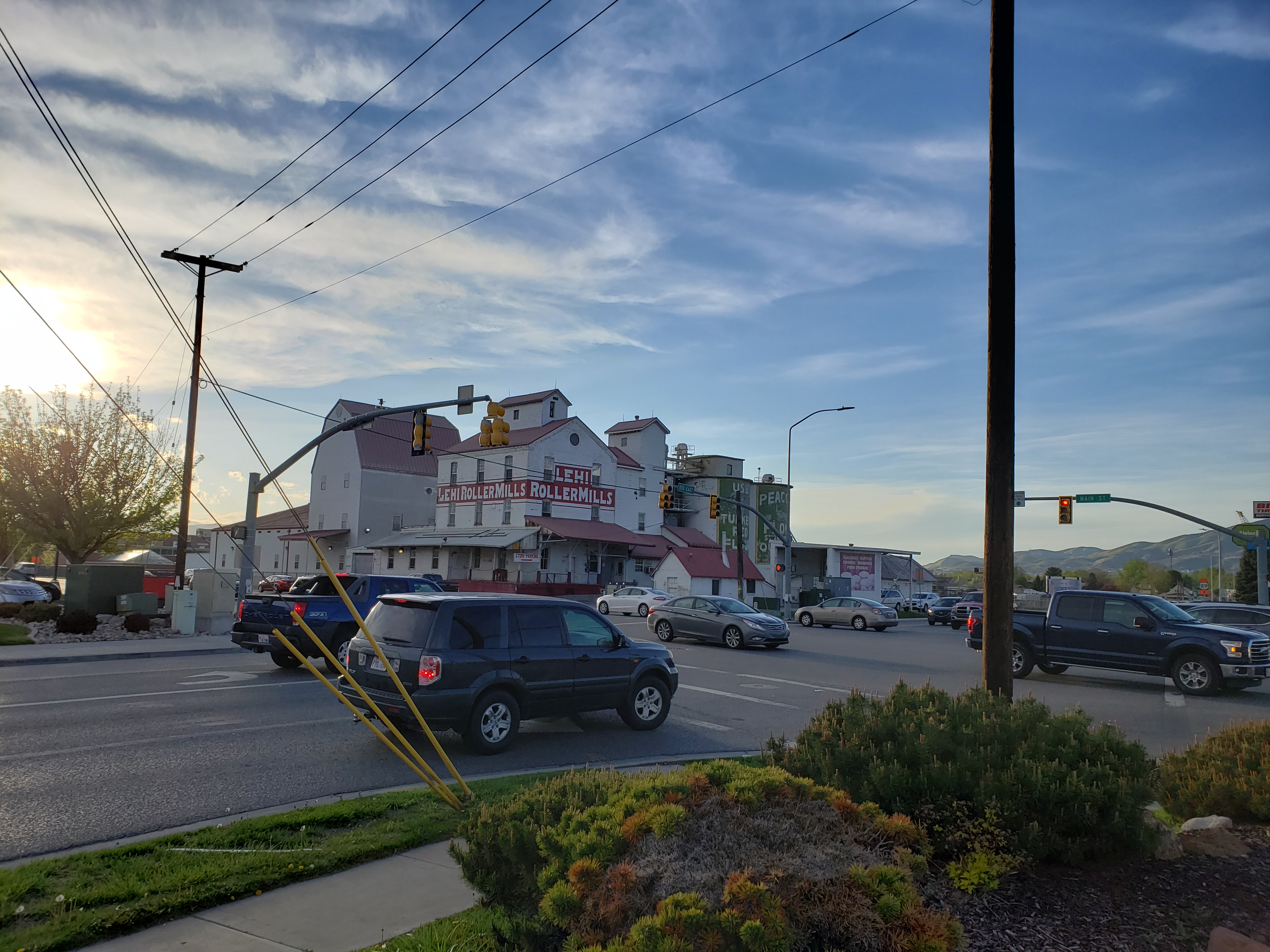
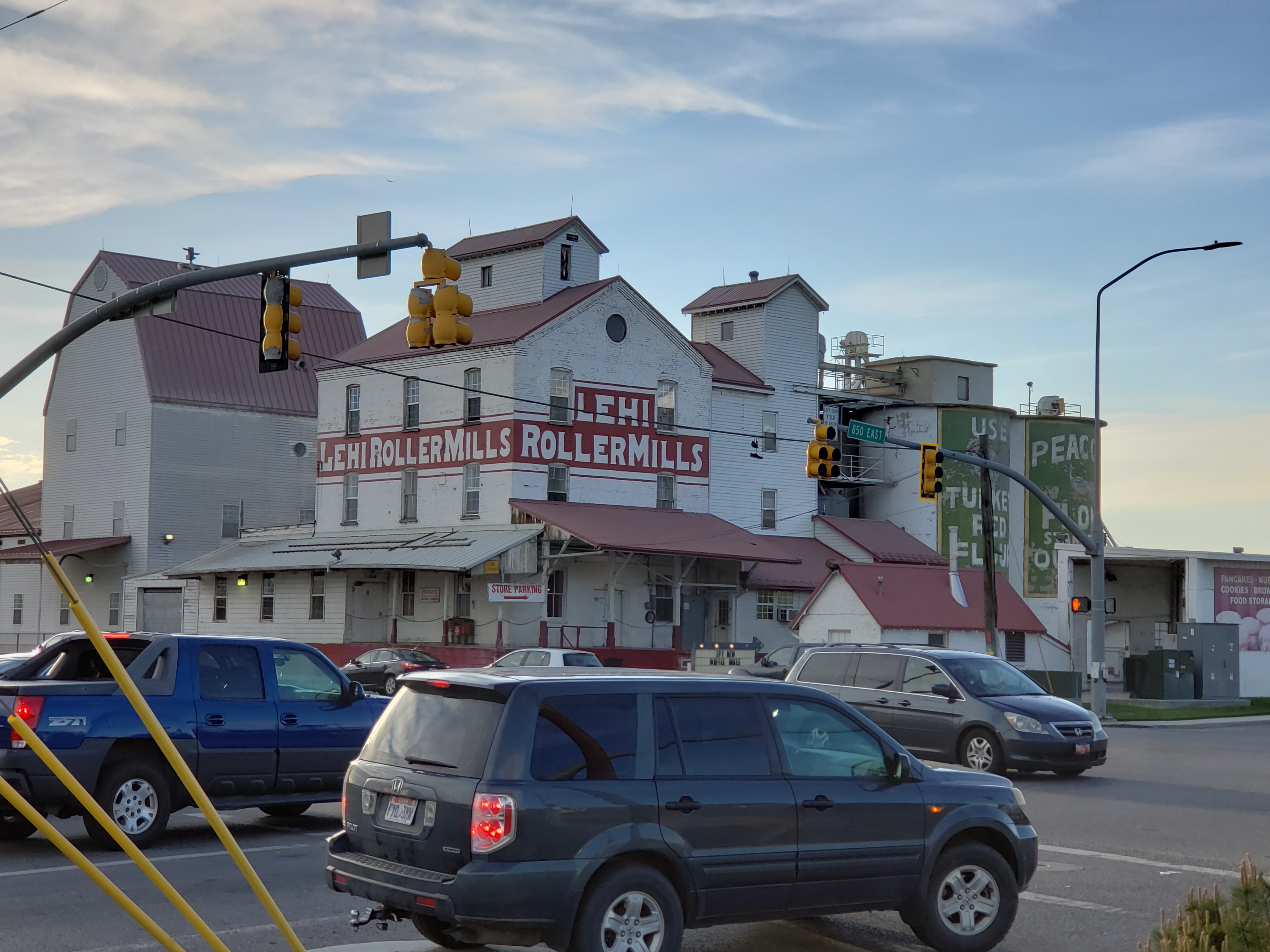
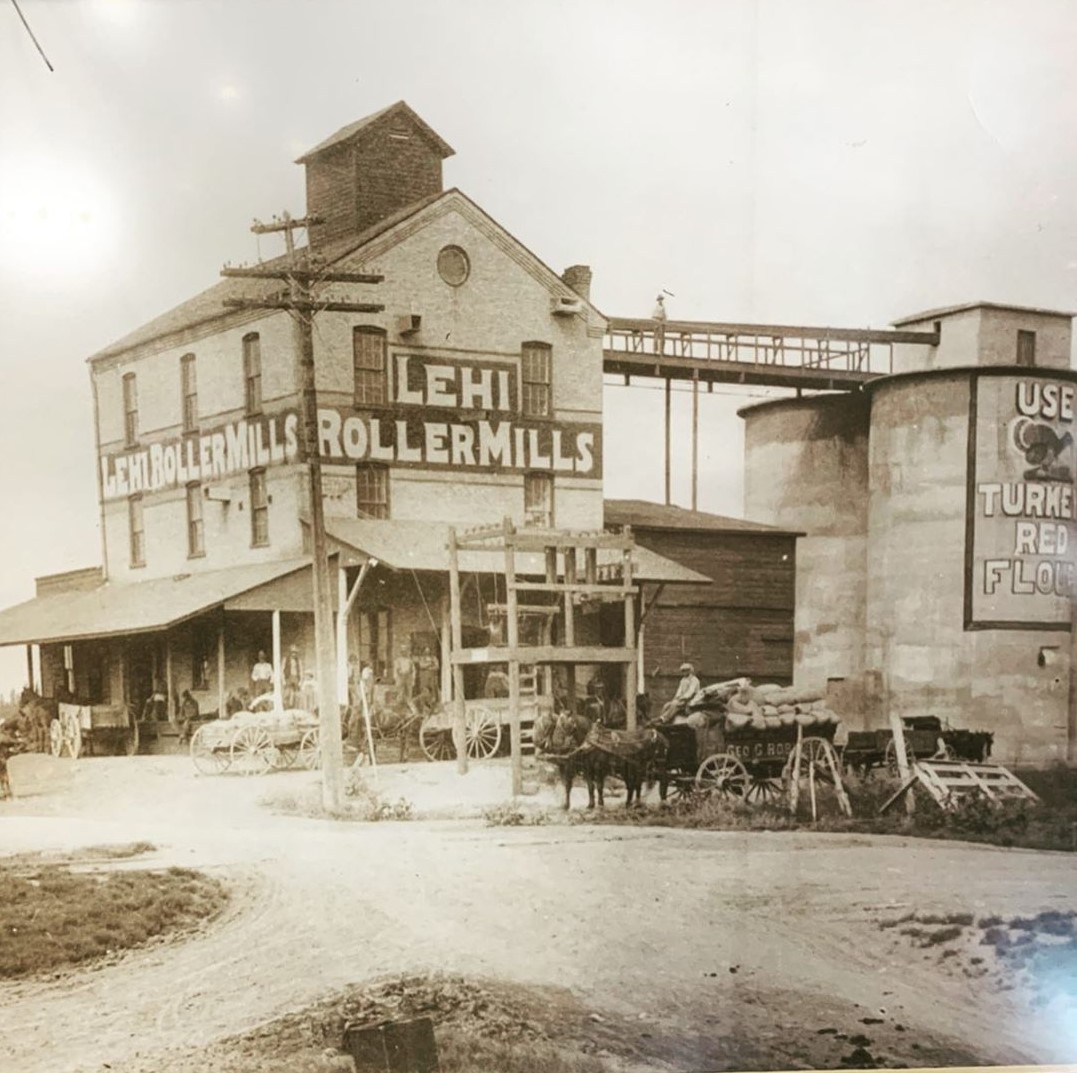
Conveniently located on the Lehi Sugar Factory line of the Union Pacific Railroad, it produced the first sack of flour on Apr. 2, 1906. The mill was an immediate success. Known for its superior flour, the Turkey Red and Peacock brands are longstanding Lehi icons. The mill achieved world-wide acclaim when featured in the 1984 hit movie, “Footloose.”
The public is invited to the unveiling of the Lehi Roller Mills historical marker on Sat., Sept. 28, at 10 a.m., at Lehi Roller Mills.
A member of the Robinson family, which owned the venture for three generations, will speak, and the Skyridge Ballroom Dance Team will perform a Footloose number.
Lehi Mills muffins will be served as refreshment.
The marker will be the fourth of 36 large historical markers to be installed over the next three years through the Lehi Historical Marker Program.
The program was founded in 2022 when the Lehi Historical Society won funding through a generous donation and continued support from the John David and Danaca Hadfield family of HADCO Construction and a large Lehi City PARC grant.
The June 2, 1905, Lehi Banner announced that Lehi was to have “a new flour mill with modern pattern and equipment” thanks to considerable effort by the Lehi Commercial Club, Lehi’s first booster organization.
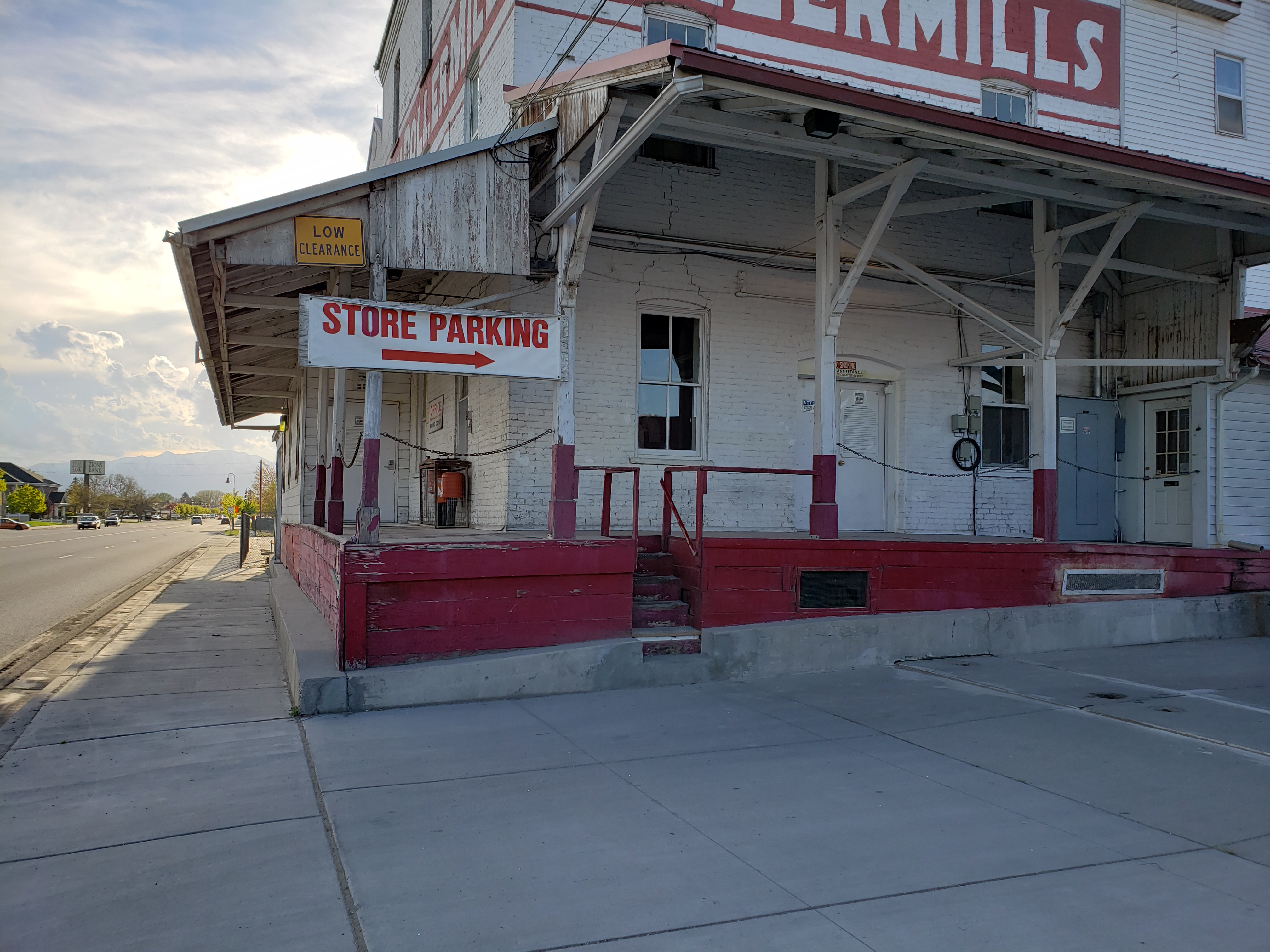
It chose a site on East Main Street as it was on the Lehi Sugar Factory spur of the Union Pacific Railroad. The first sack of flour was produced on April 2, 1906.
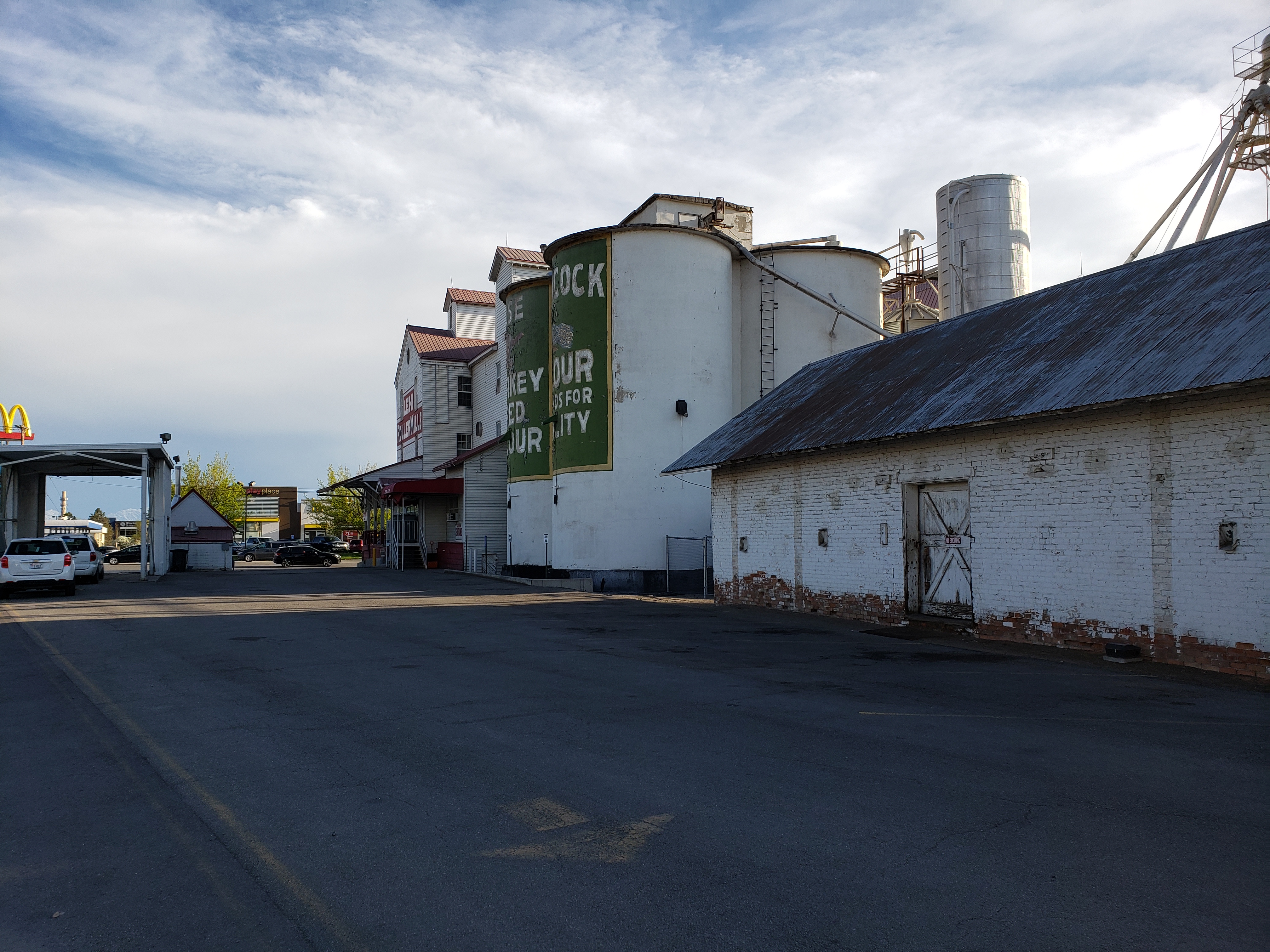
By 1907, the company had changed its name to the Lehi Roller Mills. In 1910, George G. Robinson purchased the mill and began an extensive modernization project. He installed a 43,000-bushel capacity grain elevator and four concrete silos. The Turkey Red and Peacock brand logos colorfully painted on the east side of the silos have been Lehi icons ever since.
After George’s death in 1936, his sons, Sherman and Raymond, operated the mill. During World War Il, all flour milled was sold to the government for the war effort. R. Sherman Robinson, George’s grandson, became the manager of the family-owned mill in 1980.
In 2013, Ken Brailsford, local entrepreneur, purchased the mill. In 2018, the mill was rebranded Lehi Mills.
Lehi Roller Mills might be best known for serving as the backdrop for many scenes in Paramount’s 1984 blockbuster movie, Footloose.
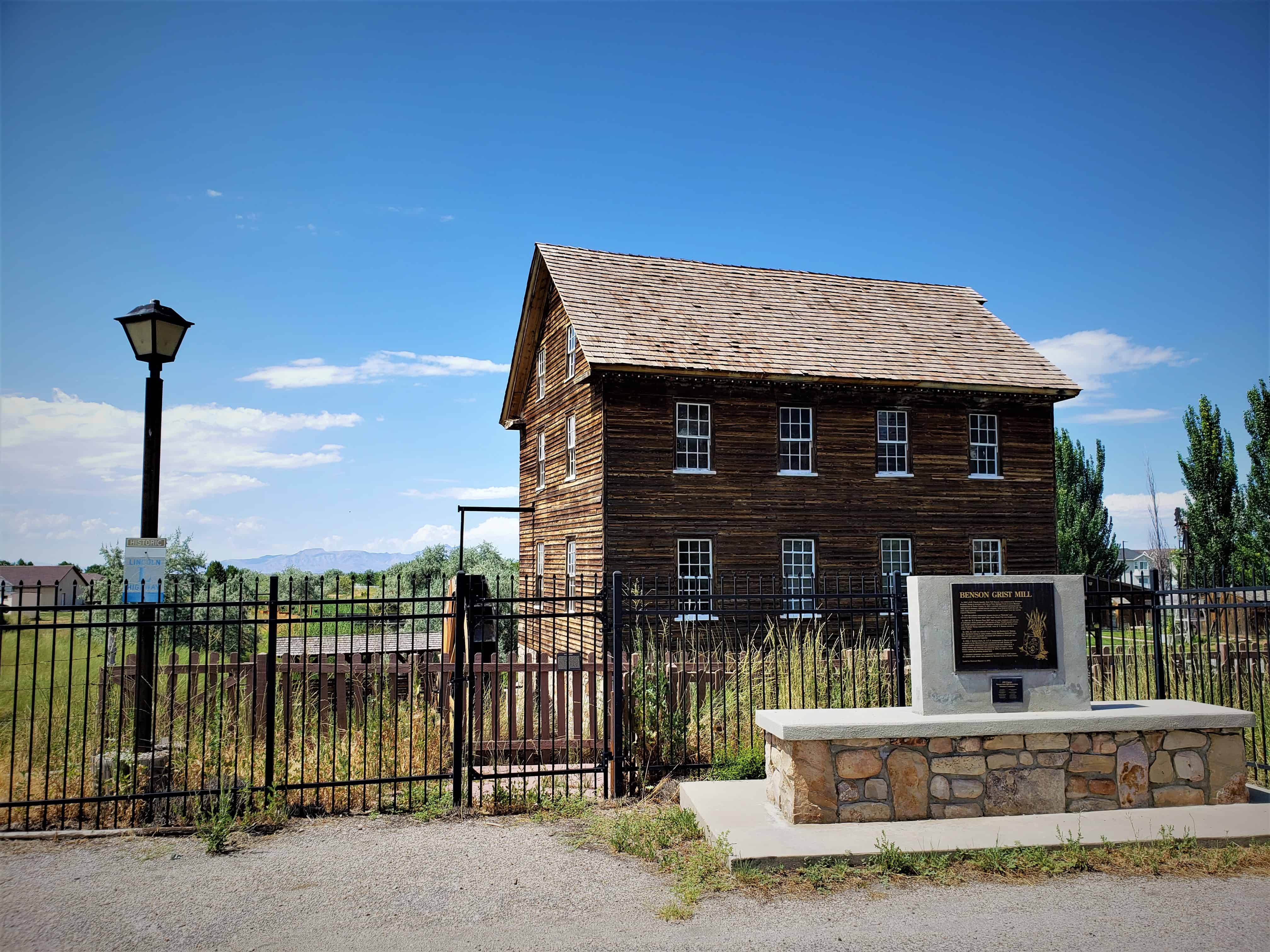
In 1851 L.D.S. Church Apostle, Ezra Taft Benson, was authorized by President Brigham Young to develop a mill site at Twin Springs Creek to serve Mormon communities in Tooele County. In 1851 a sawmill commenced operating and in 1854 the Lee brothers, skilled pioneer artisans, were hired to build the mill. The mill’s large mortised timbers were hauled by team and wagon from the nearby Oquirrh Mountains.
In 1855 the millsite community became known as “Richville” and served as the County Seat until 1861, when Tooele City was designated.
In 1860 the “E.T. Benson Flour Mill” had one male employee and one run of millstones which produced 1,200 barrels of flour, 72,000 pounds of bran and 56,000 pounds of corn meal, together valued at $17,000. In the same year, Brigham Young acquired the mill, when E.T. Benson moved to Cache Valley.
By 1862, the mill was referred to as “Young and Rowberry’s,” Bishop John Rowberry being an early resident of the Milltown (Richville) area. The mill that year reportedly processed 200 bushels of wheat per day under a 250 horsepower capacity.
In 1922, J. Reuben Clark, Jr. (A U.S. Ambassador to Mexico and later an apostle in the Mormon church) purchased the mill. Earlier it’s original wooden waterwheel and millstones had been replaced by metal turbine and imported free-standing “grain breakers.” After finally ceasing flour-milling operations in 1938, the mill was used several years for grinding animal feed.
A volunteer committee was organized in 1883 to acquire and restore the historic mill, which was donated by Terracor Corp. to Tooele County.
The Benson Mill is located at 325 South Highway 138 in Stansbury Park, Utah and was added to the National Historic Register (#72001260) on April 14, 1972.
In September 1849 the first settlers entered Tooele Valley. In their search for water power sites, a place on Twin Springs Creek was selected. A saw mill was completed by the spring of 1851 and was known as Ben son’s Saw Mill. The saw mill was destroyed several years after its construction.
In 1854 a grist mill was built on Twin Springs Greek and located near the saw mill. The grist mill was built by Thomas Lee who was hired by a church corporation among whose members included Ezra T. Benson, Benjamin Grosland and John Rowberry. The mill remained in the hands of the church corporation until June 1866 when Ezra T. Benson paid Brigham Young the sum of $3,333.33 for all claim to the grist mill known as Benson’s Mill located on Twin Springs Greek.
Sometime before January 1878 the grist: mill once again returned to the hands of a church corporation which was headed by Stake President Francis M s Lyman. In 1900 the Richville Milling Company, with a Mr. Wrathal as president and Mr. Rowberry as secretary, took over the grist mill. The Richville Milling Company operated the mill until 1922, when J. Reuben Clark Jr» bought the mill. An attempt was made by President Clark to produce flour to be sold commercially, but the small mill was unable to compete with the larger grist mills throughout the State. In 1936 a hammer mill was installed to grind feed for turkeys arid dairy cattle which belonged to the Clark Family, The mill served this function until 1960 when it was abandoned.
The E. T. Benson Mill is of significance for several reasons, It is one of the oldest buildings still standing in Tooele County and in Western Utah, According to many travelers, it is regarded as the most significant structural landmark between Salt Lake City and Reno, Nevada. Its successful operation for more than seventy-five years indicates its importance to the area. The economic evolution of the mill represents a similar experience of other business ventures in early Utah, Initially, in the 1850’s, it was built as a church cooperative effort. During the 1860’s it was acquired by a private individual, and during the 1870’s, the heyday of the cooperative movement of the church, the mill was obtained and operated by a church corporation. By 1900 the mill had returned to the control of private individuals. The survival of the mill, while most of the other early Utah grist mills have been destroyed, has been because of its long-time service to the area.
In 1855 this valley was discovered by Isaac Riddle an Indian Missionary, while searching for a lost cow. The first sawmill south of the rim of the Great Basin was built on this site in 1855-1856 by Robert Richey, Jehu Blackburn and Isaac Riddle.
The first homes in the valley were erected around the mill. Pine Valley became the source of much of the lumber used in early towns of southern Utah and Nevada.
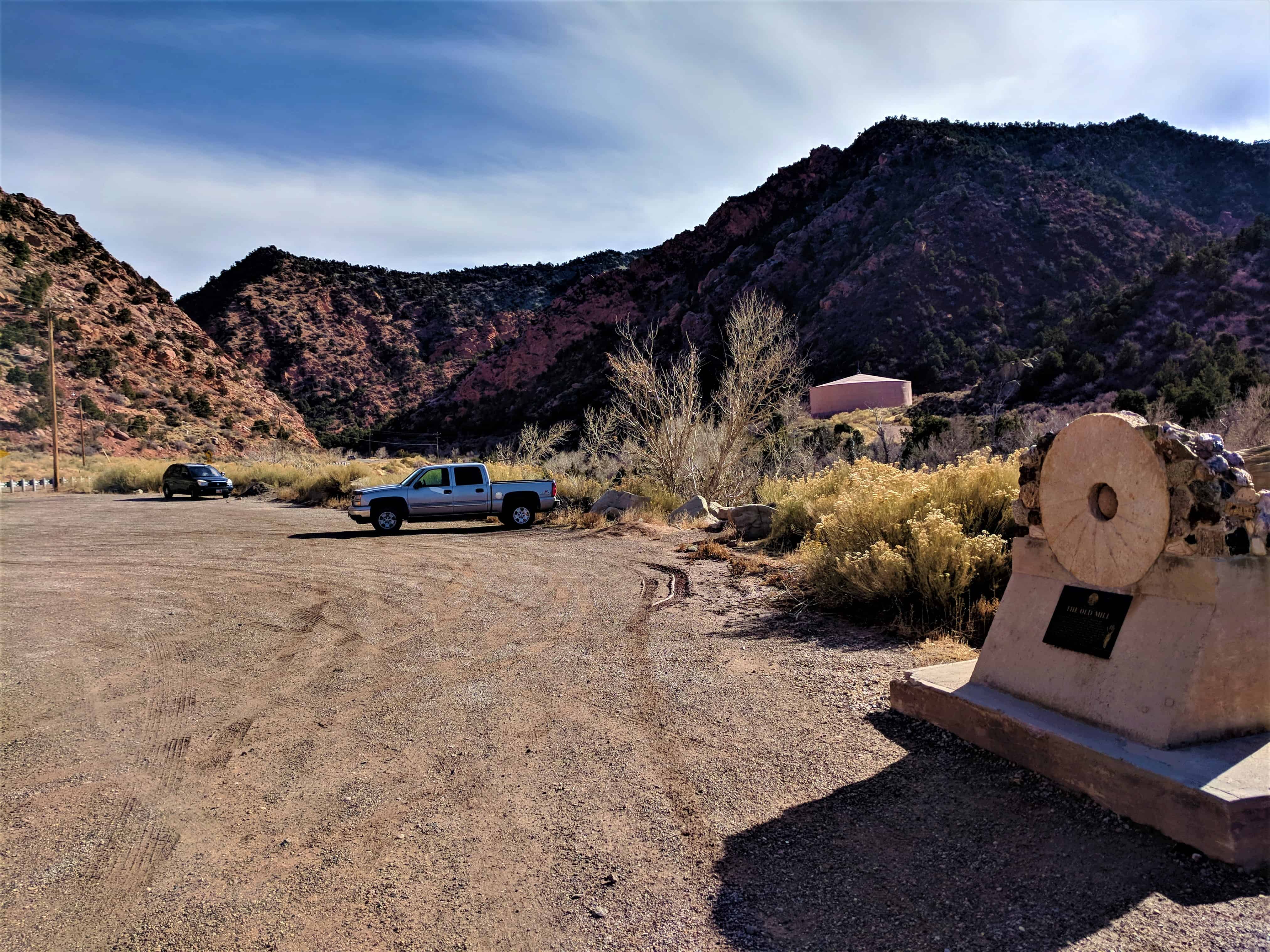
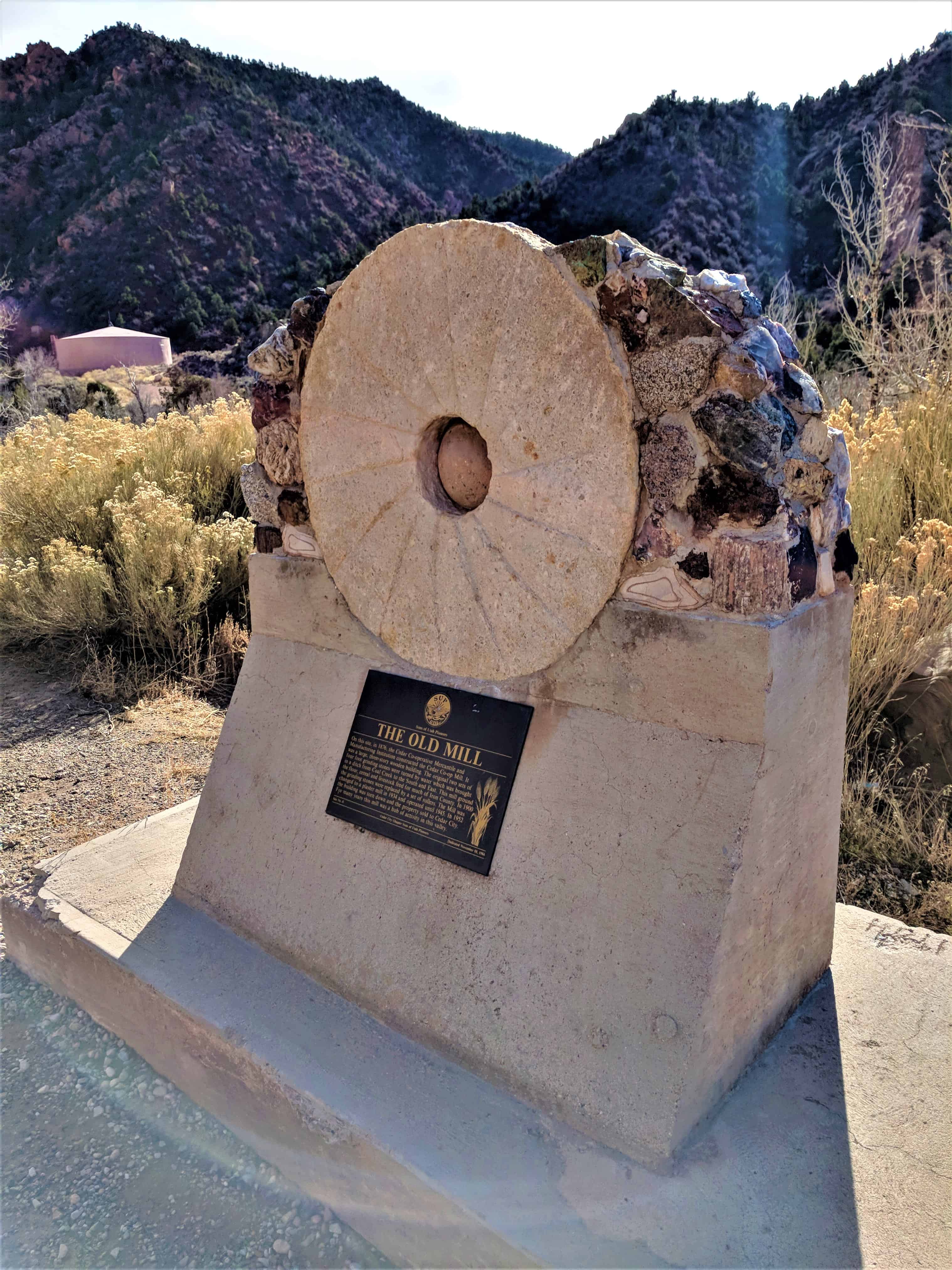
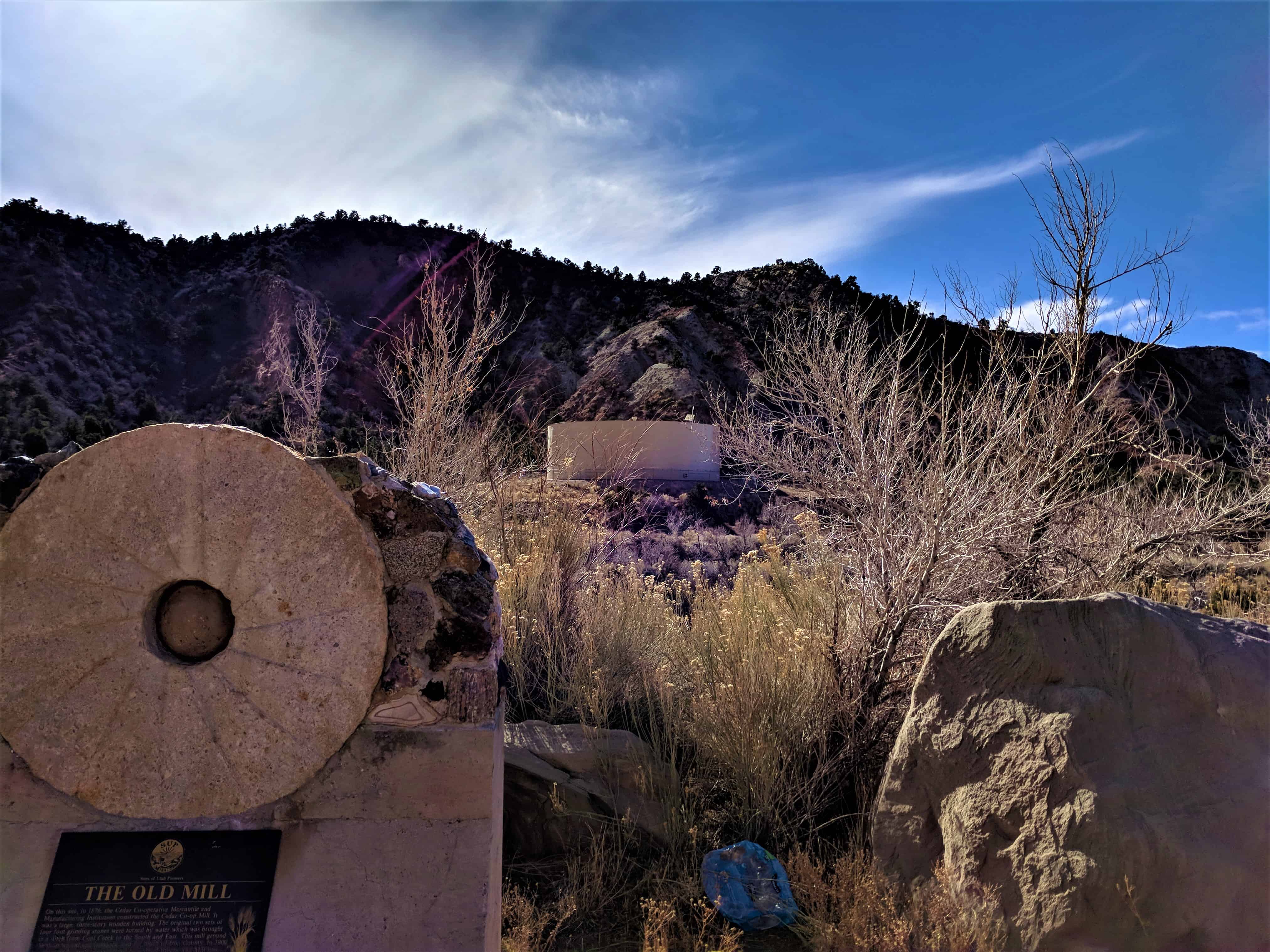
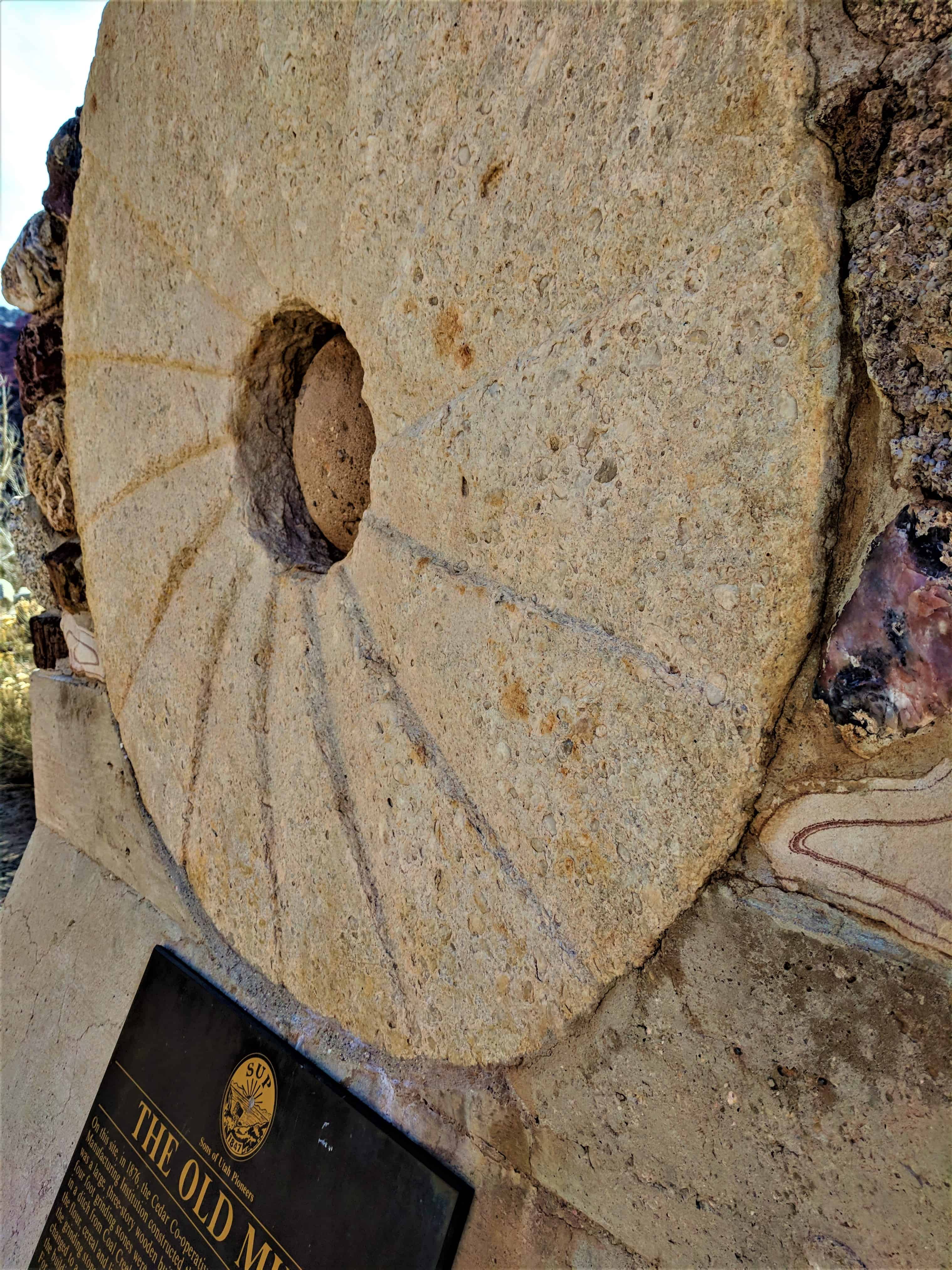
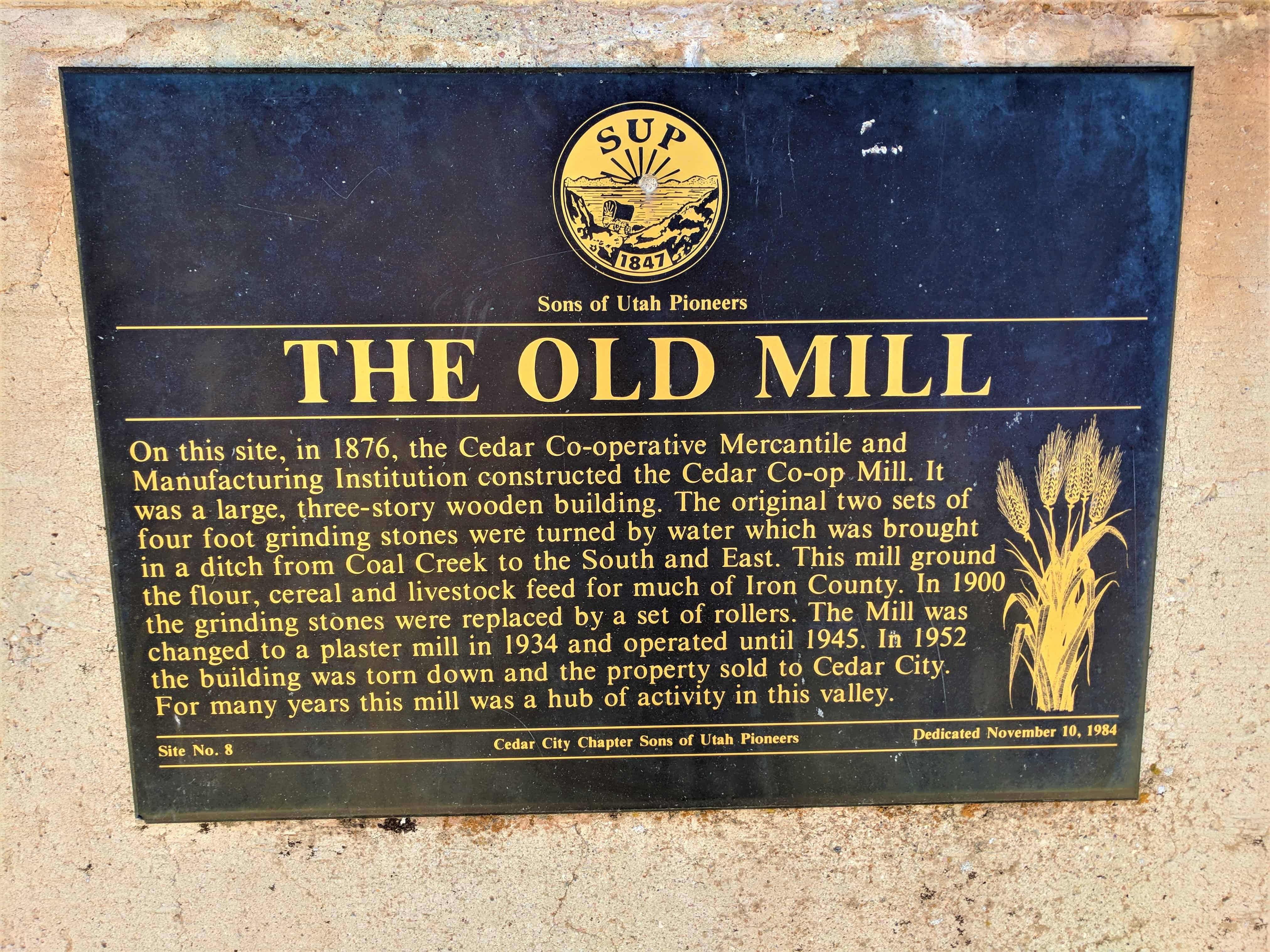
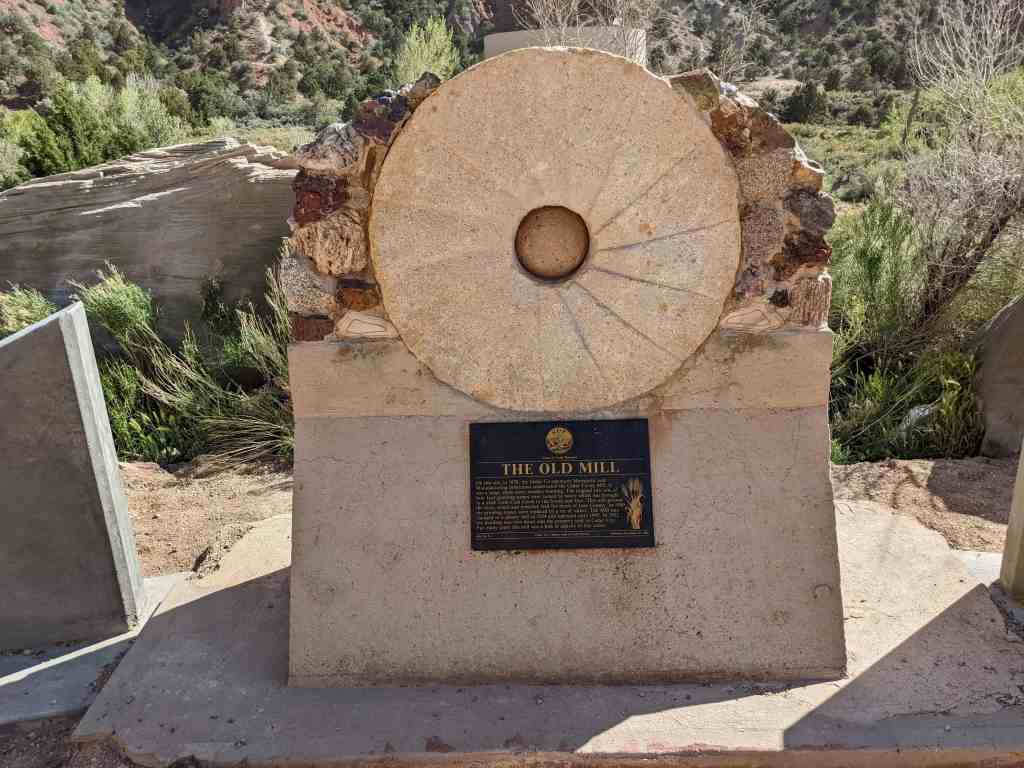
On this site, in 1876, the Cedar Co-operative Mercantile and Manufacturing Institution constructed the Cedar Co-op Mill. It was a large, three-story wooden building. The original two sets of four foot grinding stones were turned by water which was brought in a ditch from Coal Creek to the South and East. This mill ground the flour, cereal and livestock food for much of Iron County. In 1900 the grinding stones were replaced by a set of rollers. The Mill was changed to a plaster mill in 1914 and operated until 1945. In 1952 the building was torn down and the property sold to Cedar City. For many years this mill was a hub of activity in this valley.
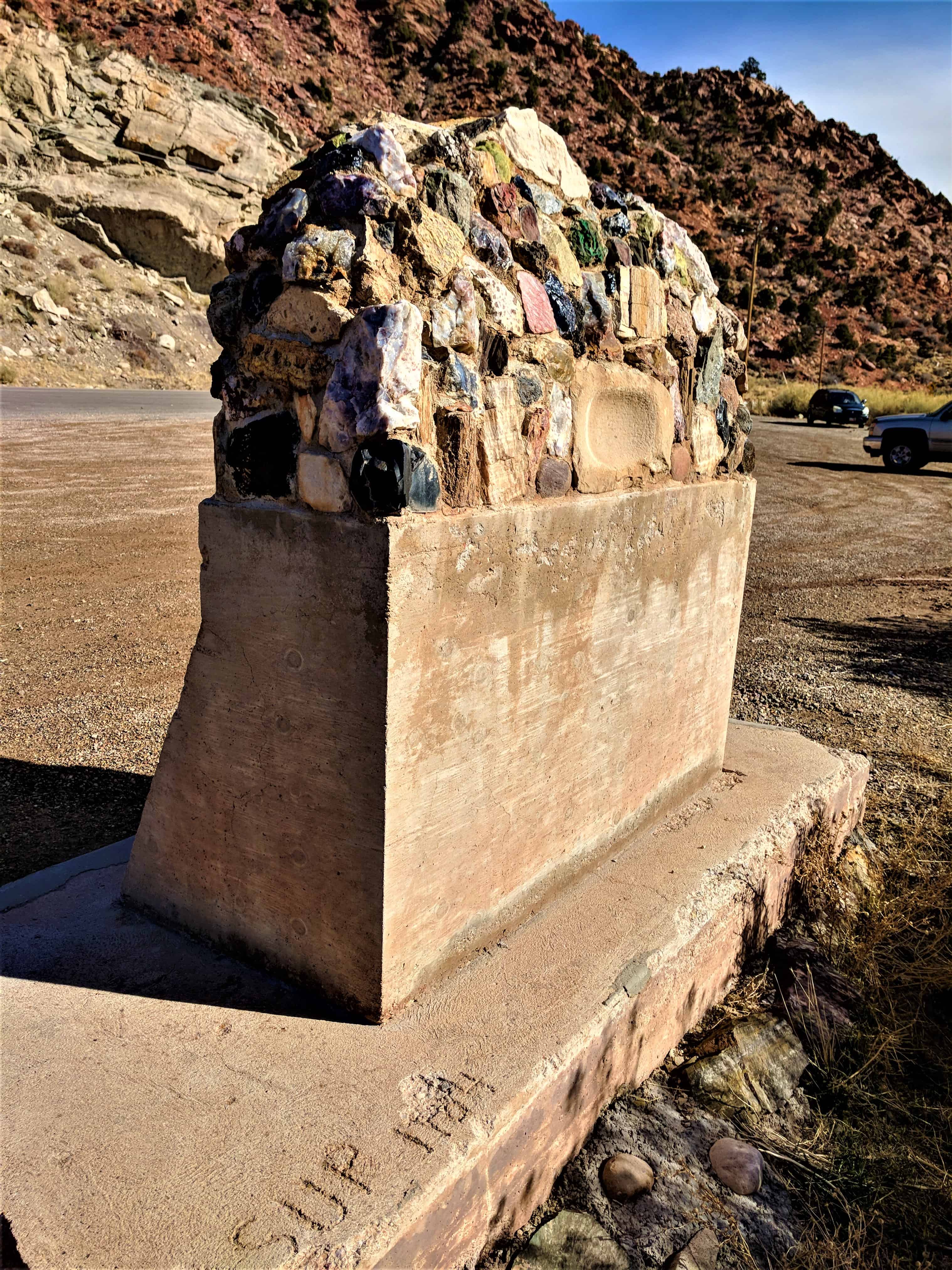
This is Sons of Utah Pioneers historic marker #8 located at the mouth of Cedar Canyon in Cedar City, Utah.
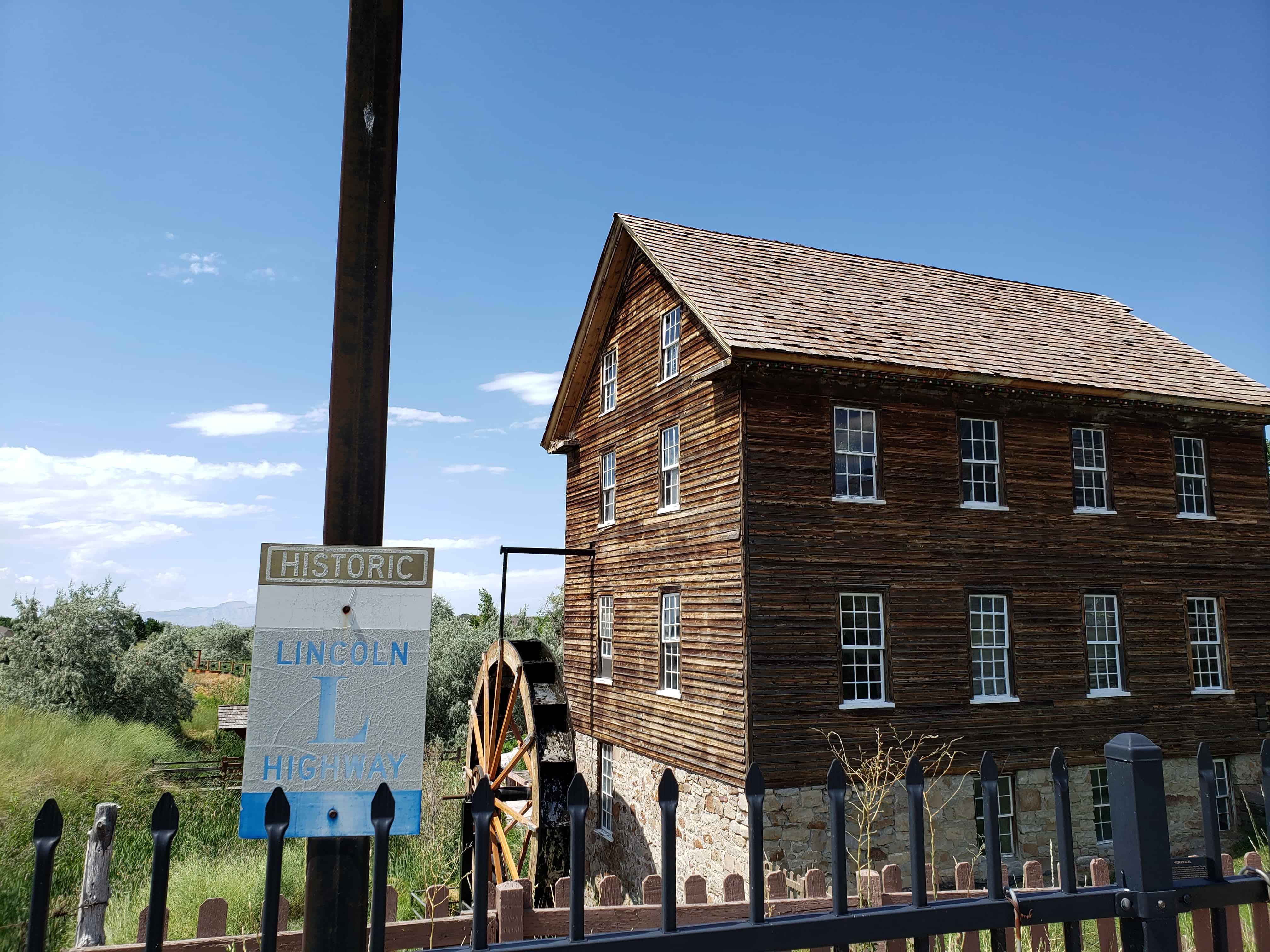
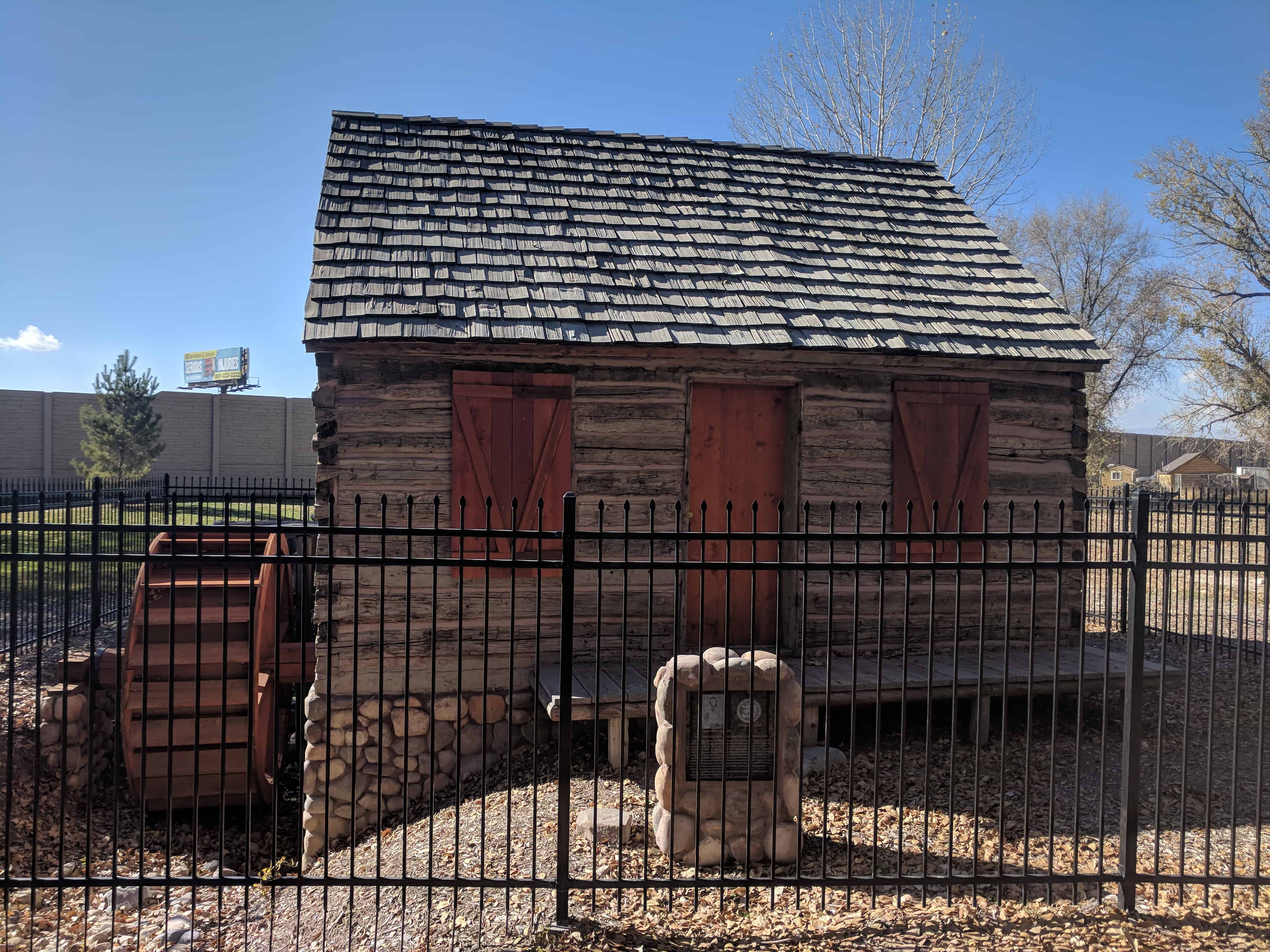
During the winter of 1850-51, Arza and Sabina Adams moved their family of seven children here from Mill Creek, Salt Lake Valley. They built a log cabin across the street east of where you stand. Journals tell that Arza built a Grist Mill near his log cabin. Arza learned how to build and operate flour mills from his father, Capt. Joshua Adams, in Ontario, Canada. The Adams Flour Mill was the first to produce baking flour for American Fork families. In 1853 Arza moved the water wheel, mill stones and other workings 4½ blocks north of here and built a larger mill near the Lake City Fort. During his lifetime, Arza also built and operated a third flour mill one mile north of town.
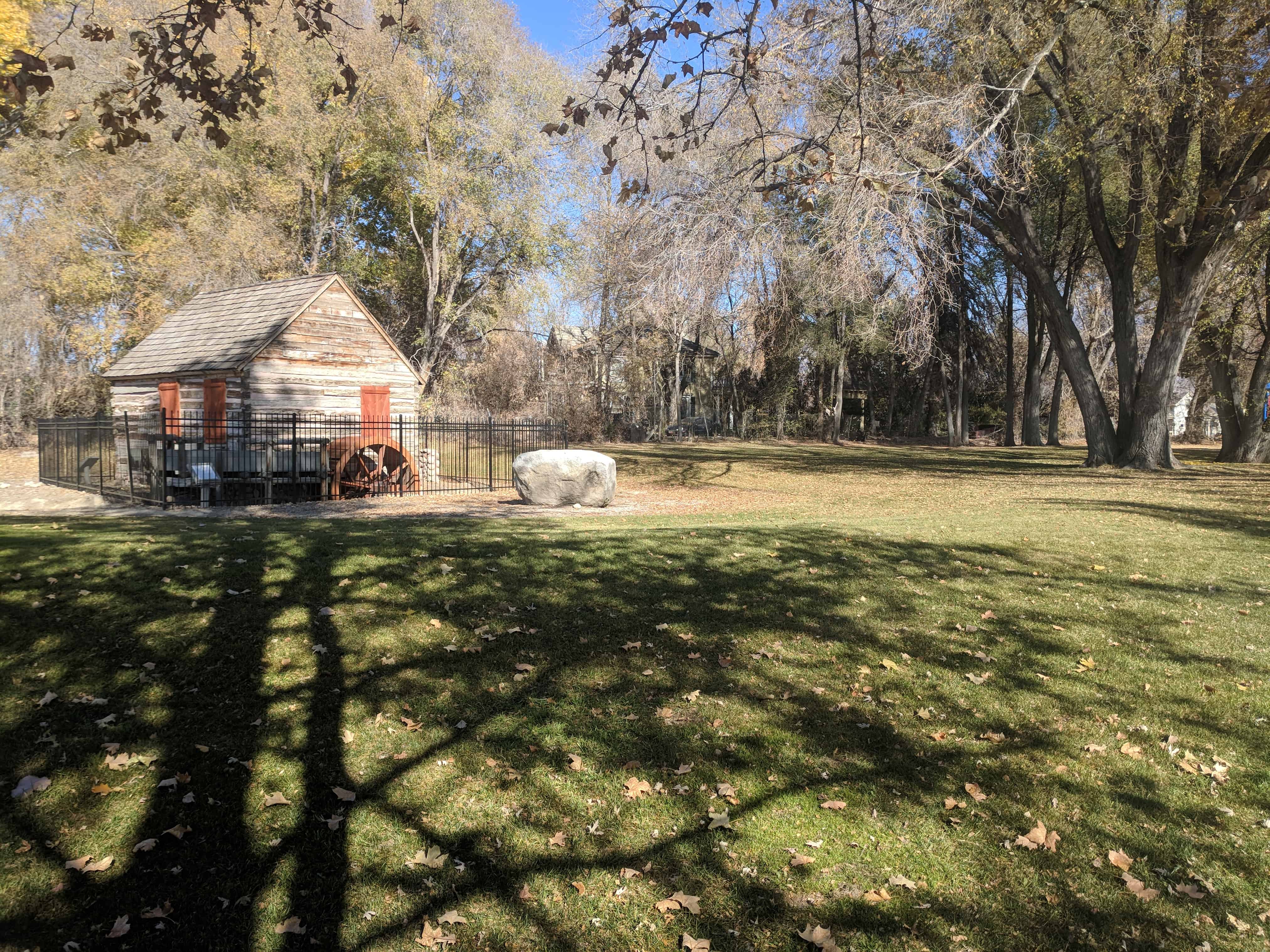
No photographs exist of the original 1851 mill. The log cabin and water wheel in front of you is a replication of that grist mill. Arza Adams built this log cabin at 234 North 100 East, American Fork in 1880. It became the home of his daughter, Bets Adams Robinson. The cabin was taken down log by log in 2012 and reassembled on this site in 2014. The water wheel is a replica of a wheel built in the mid 1800s. This park property originally belonged to Stephen Chipman who was Arza’s maternal uncle.
This Log Cabin Grist Mill stands as a Historical Monument of American Fork City and a tribute to Arza Adams, pioneer miller and one of the co-founders of this city.
SUP Monument dedicated July 11, 2015 by Daniel K. Adams, Arza’s Great-Grandson.
This is located in Centennial Park in American Fork. See other historic markers in the series on this page for SUP Markers.
Location: 49 East 200 North, American Fork, UT, on the same block where the second Arza Adams mill was located next to the millstream.
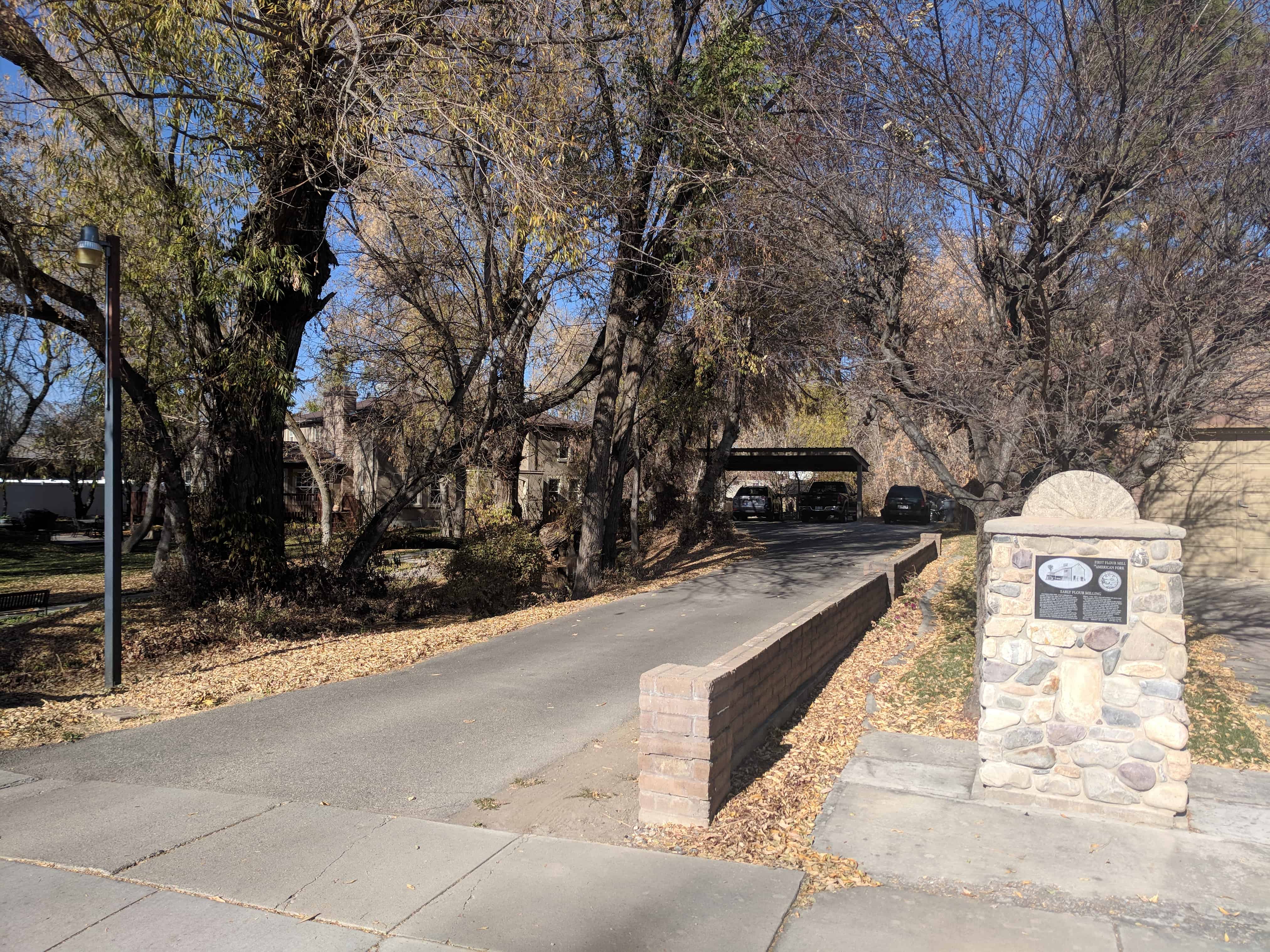
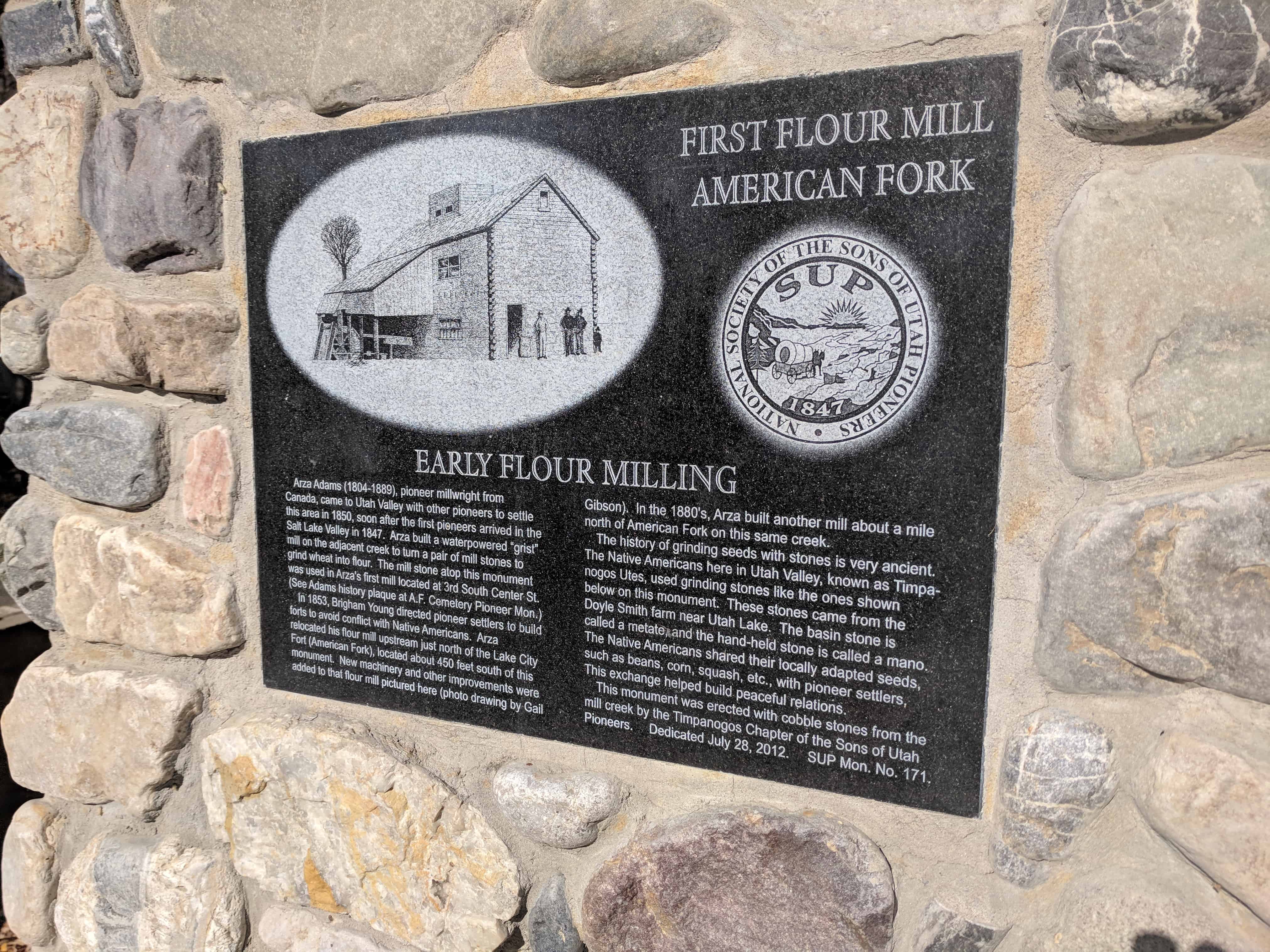
EARLY FLOUR MILLING
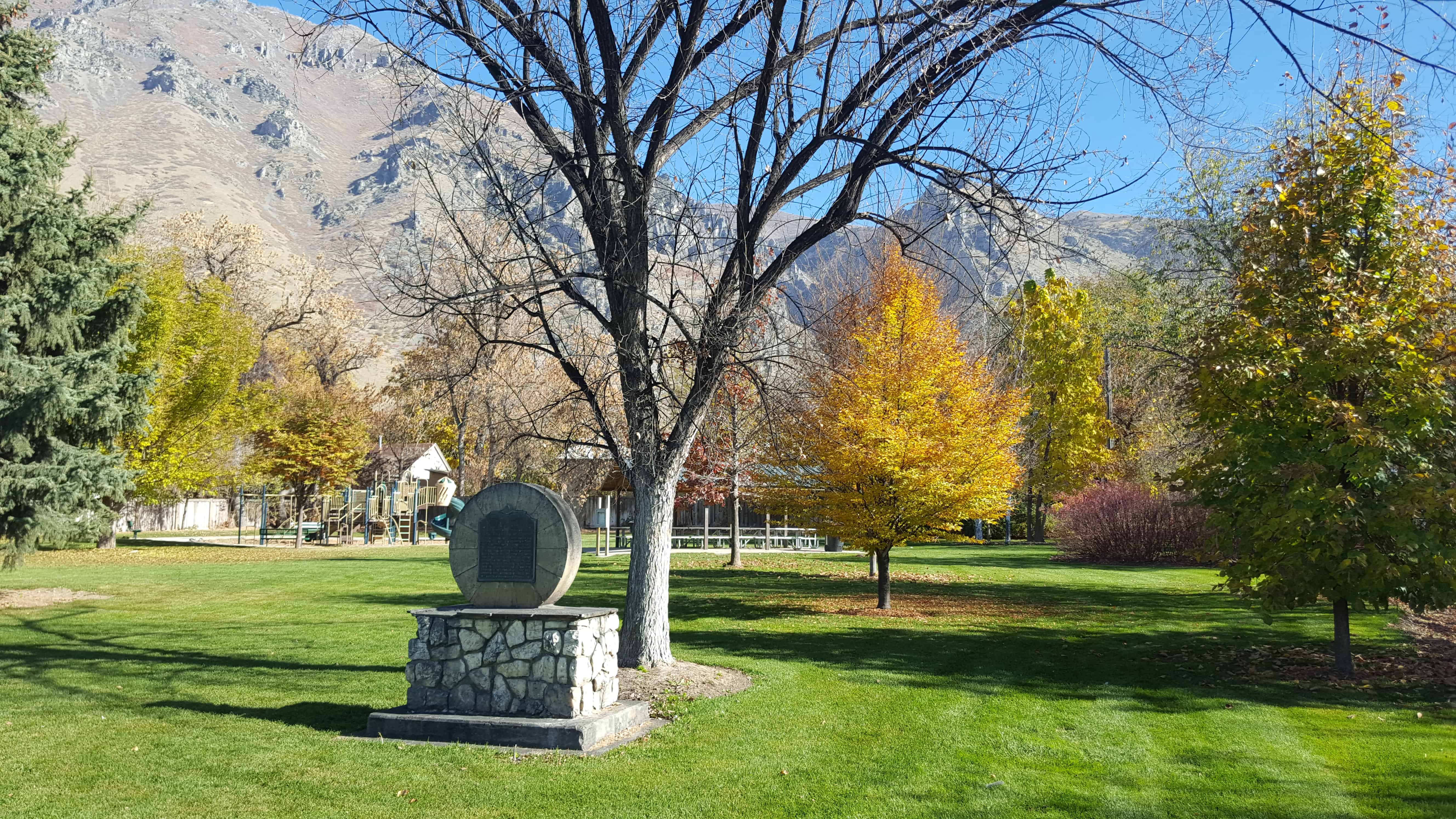
Arza Adams (1804-1889), pioneer millwright from Canada, came to Utah Valley with other pioneers to settle this area in 1850, soon after the first pioneers arrived in the Salt Lake Valley in 1847. Arza built a waterpowered “grist” mill on the adjacent creek to turn a pair of mill stones to grind wheat into flour. The mill stone atop this monument was used in Arza’s first mill located at 3rd South Center St. (See Adams history plaque at A.F. Cemetery Pioneer Mon.)
In 1853, Brigham Young directed pioneer settlers to build forts to avoid conflict with Native Americans. Arza relocated his flour mill upstream just north of the Lake City Fort (American Fork), located about 450 feet south of this monument. New machinery and other improvements were added to that flour mill pictured here (photo drawing by Gail Gibson). In the 1880’s Arza built another mill about a mile north of American Fork on this same creek.
The history of grinding seeds with stones is very ancient. The Native Americans here in Utah Valley, known as Timpanogos Utes, used grinding stones like the ones shown below this monument. These stones came from the Doyle Smith farm near Utah Lake. The basin stone is called a metate, and the hand-held stone is called a mano. The Native Americans shared their locally adapted seeds, such as beans, corn, squash, etc., with pioneer settlers. This exchange helped build peaceful relations.
This monument was erected with cobble stones from the mill creek by the Timpanogos Chapter of the Sons of Utah Pioneers. Dedicated July 28, 2012. SUP Mon. No. 171.
See other historic markers in the series on this page for SUP Markers.
Gardner’s Saw Mill was erected by Robert Gardner and his sons Archibald, Robert and William, on warm springs stream, in Salt Lake City, Oct. 1847 where three boards were sawed. The mill was moved to this site in 1848 producing the first commercial lumber in Utah on the first formal grant of water for industrial use. Later, a flour mill was erected a few rods upstream, these plants giving the name, Millcreek, to the stream and canyon. Gardner’s Fort, domicile of the Gardner families, was located a short distance northeast, the Gardners receiving the first permit to leave the pioneer fort.
Dedicated to the Two Hundredth Anniversary of the United States of America and sponsored by the Utah American revolution Bicentennial Commission and Springville Federated Women’s Clubs.
An official Bicentennial project of the sponsors, this park is on property acquired by Jacob Houtz in 1851. In 1915 it became a federal fish hatchery and was abandoned in 1922. Until deeded to Springville City in 1976 for exclusive park use, the site was neglected and unkempt.
Mills is an unincorporated community located in Juab County, Utah, United States. The cemetery and few building remnants remain.
Settled as a railroad town, it was also known as Wellington in the mid to late 1800’s. Many residents lived in dugouts or cabins. There was a local general store owned by John Williams, who lived nearby. John Williams Canyon was named after Williams.