Mills is an unincorporated community located in Juab County, Utah, United States. The cemetery and few building remnants remain.
Settled as a railroad town, it was also known as Wellington in the mid to late 1800’s. Many residents lived in dugouts or cabins. There was a local general store owned by John Williams, who lived nearby. John Williams Canyon was named after Williams.
Richville was located between Lake Point and Tooele near the former site of E. T. City. Saw, woolen, and flour mills were built nearby and subsequently names were developed: Mills, Milton, Millvale, and Milltown. For a short period of time Richville was the county seat. After the county seat was moved to Tooele and the mills shut down, the community was abandoned. Today it is Mills Junction.
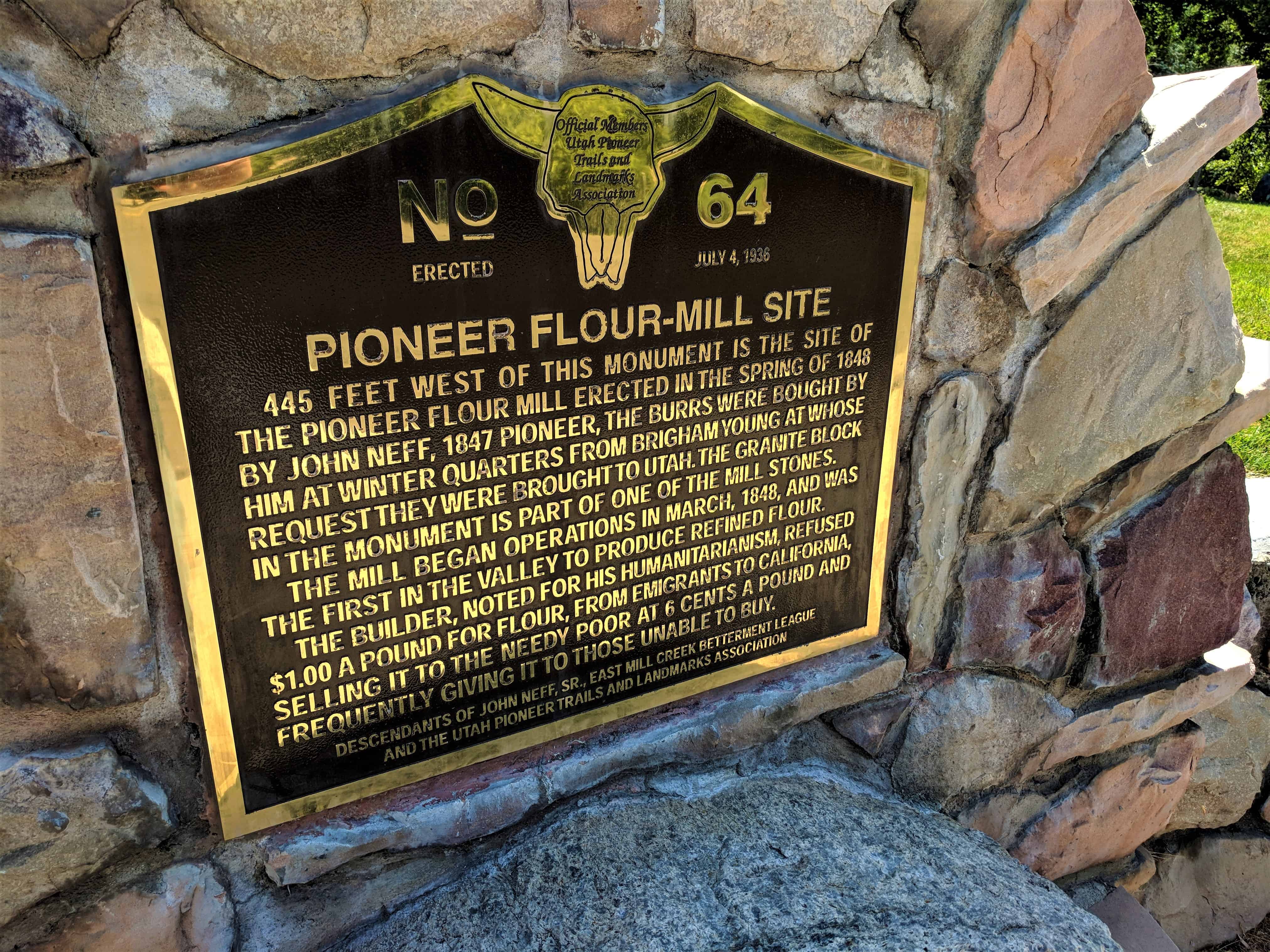
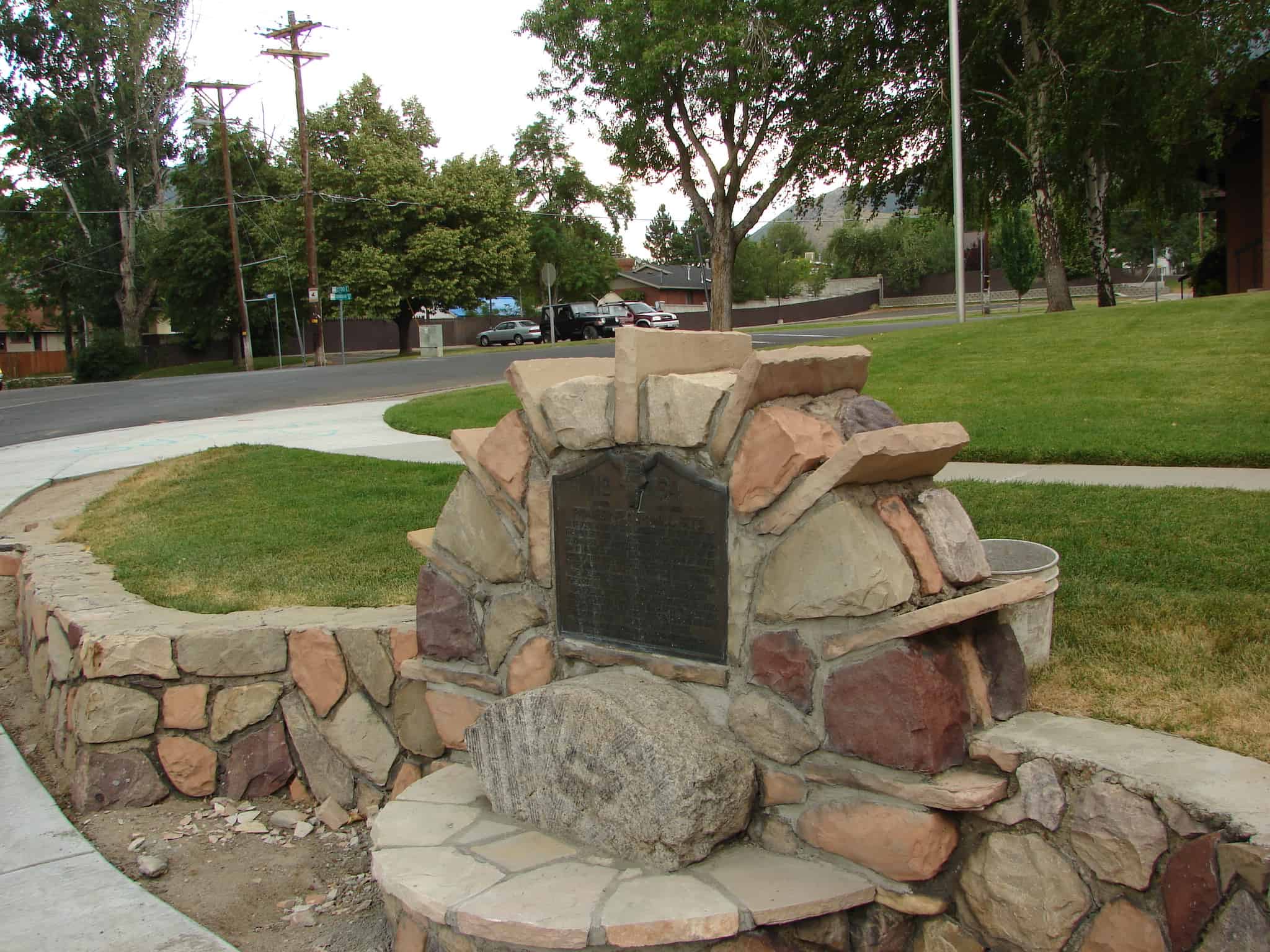
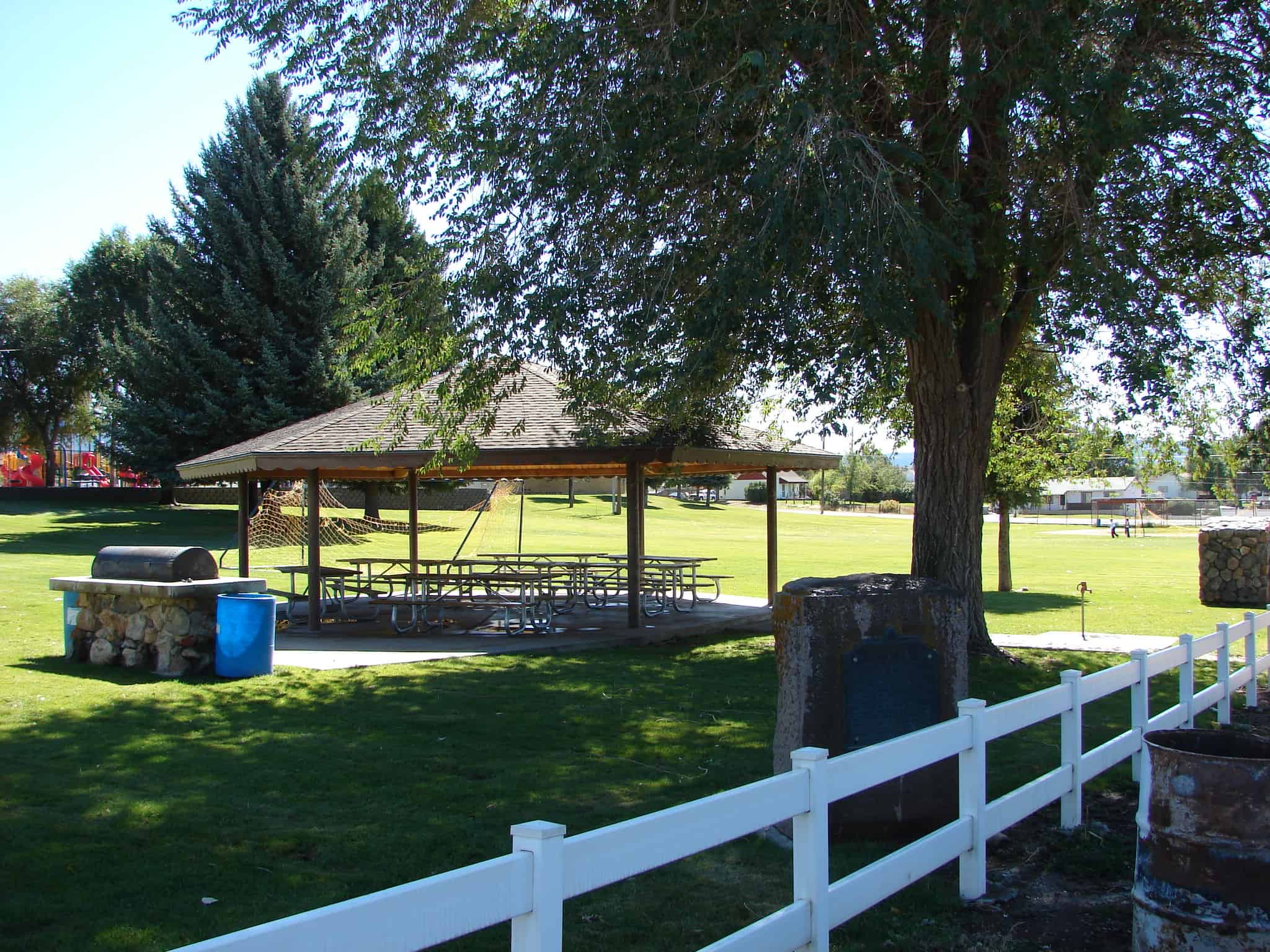
445 feet west of this monument is the site of the pioneer flour mill erected in the spring of 1848 by John Neff, 1847 Pioneer. The burrs were bought by him at Winter Quarters from Brigham Young at whose request they were brought to Utah. The granite block in the monument is part of one of the mill stones. The mill began operations in March, 1848, and was the first in the valley to produce refined flour. The builder, noted for his humanitarianism, refused $1.00 a pound for flour from emigrants to California, selling it to the needy poor at 6 cents a pound and frequently giving it to those unable to buy.
I was driving through Fairview and saw this gorgeous old mill and snapped a photo.
I later stopped in at the Museum in town and saw several paintings of the same Mill, I thought I’d post those here.
The historic Fairview Roller Mill has always been my favorite thing to see in Fairview. It was not in great shape but in 2016 the Utley family puchased it and fixed it up while converting it into a home.
In 1859, John Hoile established a flour gristmill at First South between First and Second East. The mill consisted of a small one-story frame building. On June 20, 1870, the mill was bought by John Hague who operated it until he died in 1900. The mill sat idle until 1907 when it was purchased by the Juab Mill and Elevator Company. They immediately enlarged the mill’s manufacturing capacity by adding a three-story brick structure.
This wheel is the third and last wheel used at the millsite. A wooden flume or millrace, raised 16 feet high on stilts, carried water from Salt Creek at a place between Third and Fourth East. The force of the flow turned the wheel which powered the whole mill. During the 1920s, the Juab Mill and Elevator Company bought the Nephi Mill and Manufacturing Company located at First North and Second West. From the time on, flour was milled at the Nephi Mill and Manufacturing Company, and the Old Mill operated as a feed mill, manufacturing poultry feed and chopping and grinding grain.
Activities came to an end at the original site in 1949 when both mills were sold.
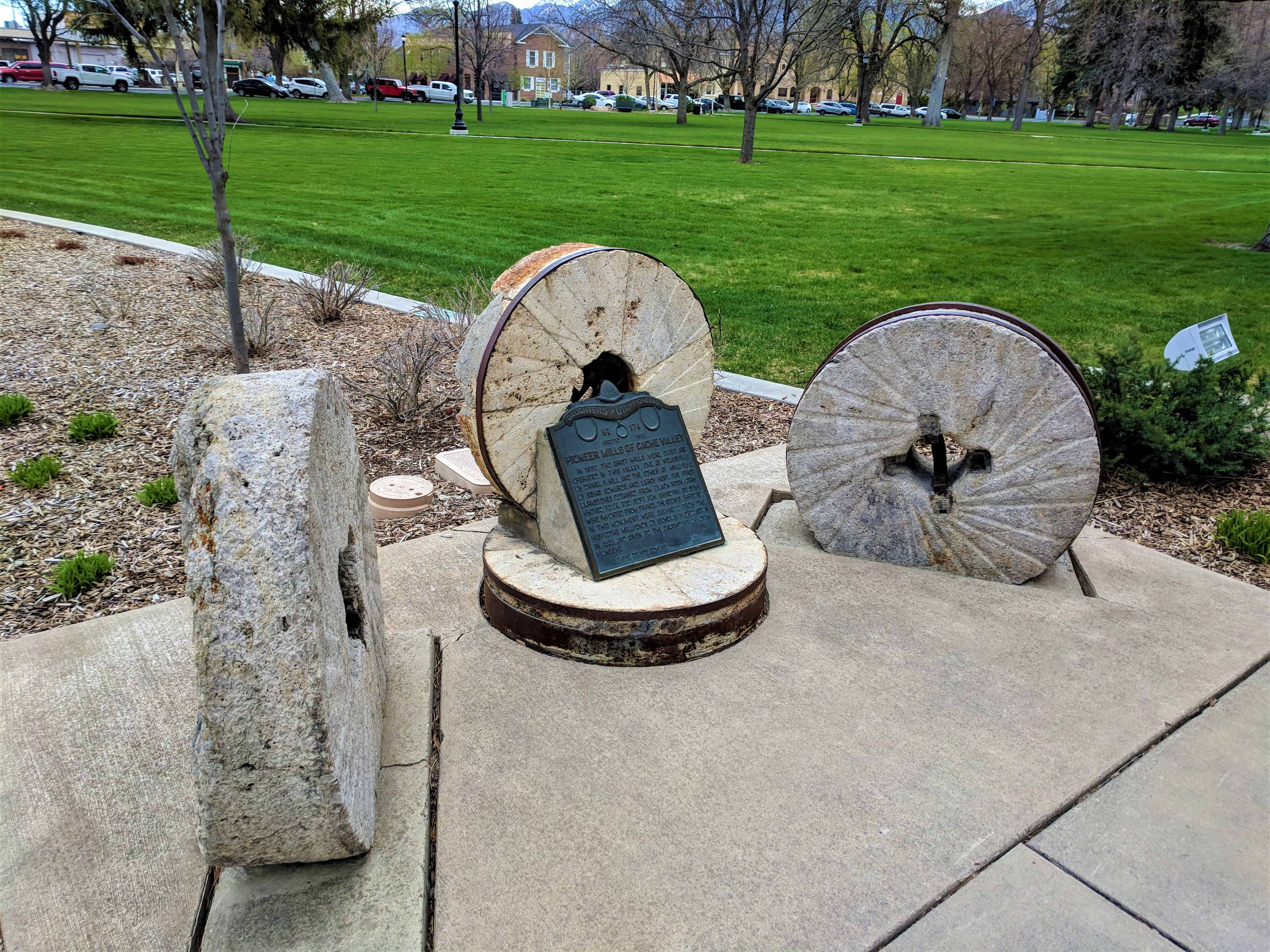
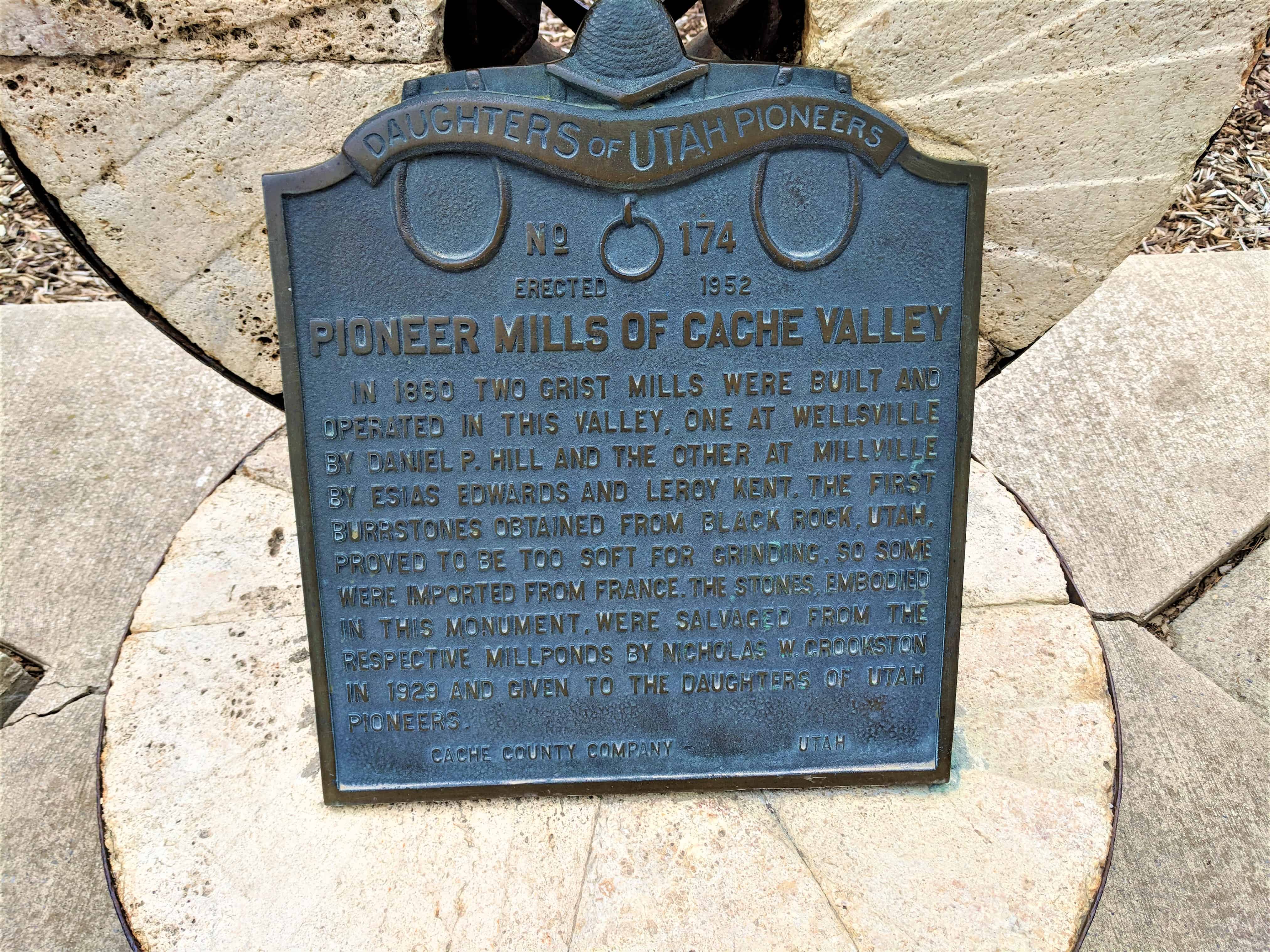
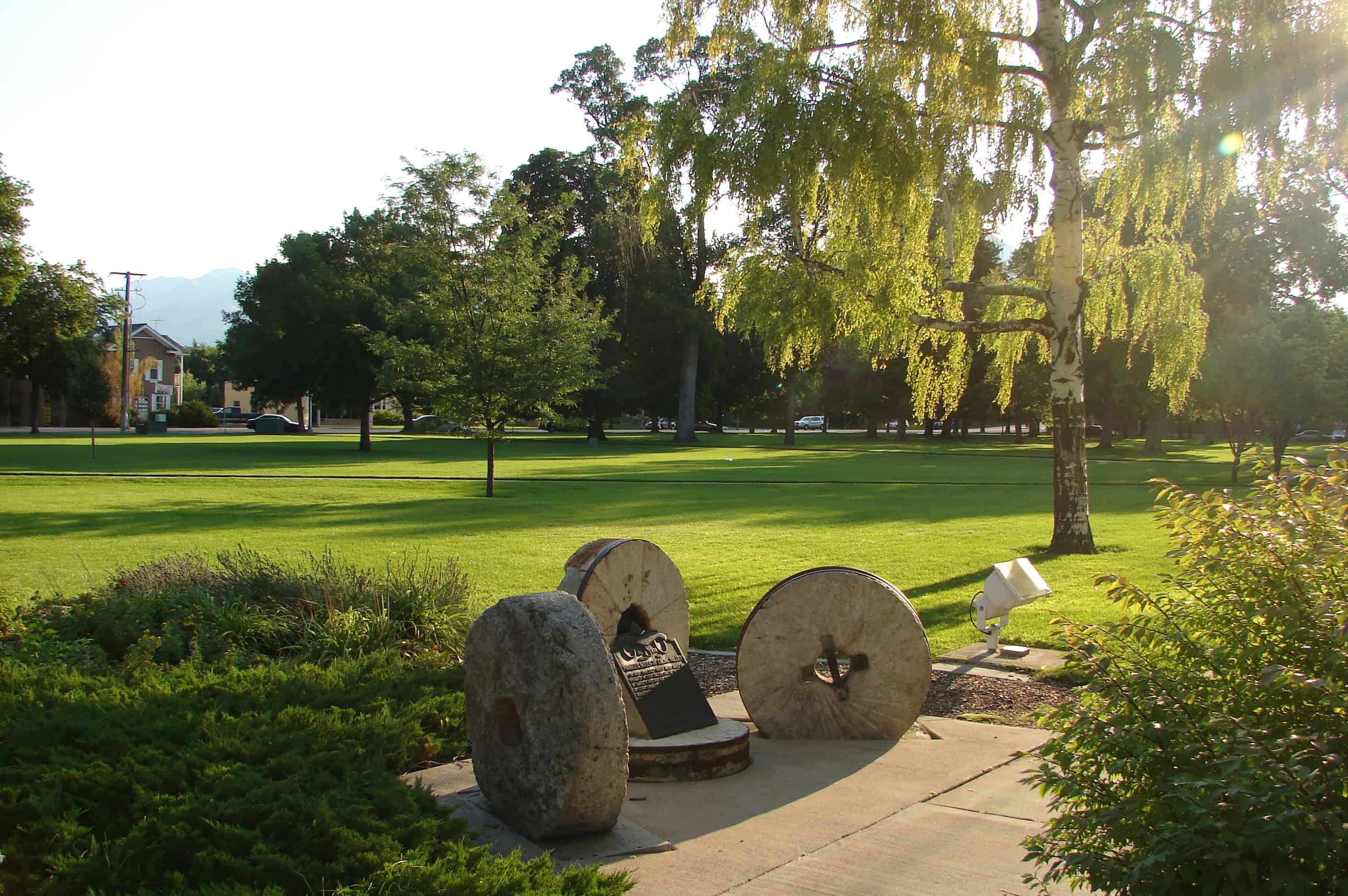
In 1860 two grist mills were built and operated in this valley, one at Wellsville by Daniel P. Hill and the other at Millville by Esias Edwards and LeRoy Kent. The first burrstones obtained from Black Rock, Utah, proved to be too soft for grinding, so some were imported from France. The stones, embodied in this monument, were salvaged from the respective millponds by Nicholas W. Crookston in 1929 and given to the Daughters of Utah Pioneers.
This marker is located at the Logan Tabernacle in Logan, Utah. Check out all of the historic markers placed by the Daughters of Utah Pioneers at JacobBarlow. com/dup
The site was surveyed August 1, 1852 and the mill (largest of its time in Utah) was dedicated May 6, 1853. Built on rock foundation with solid adobe walls trimmed with red sandstone. This burr mill operated until 1892, when roller mills replaced this type. For many years Bountiful Ward baptisms took place in the pond south of the mill. Millers, Daniel Davis, George Lincoln, George Winn, Richmond Louder, Charles Adcock, Wm. Adcock, Wm. D. Major.
Location: 905 Orchard Drive (corner Orchard Dr. and Mill St.), Bountiful, Utah
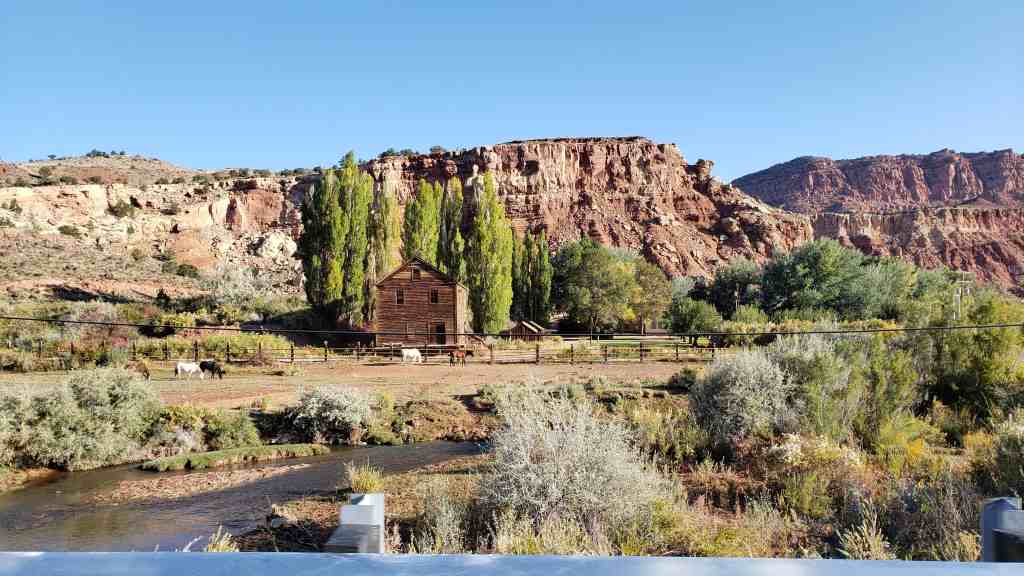
The Nielsen Grist Mill is located at the foot of the Thousand Lake Mountain on the edge of the scenic country referred to by ancient Indians as “The Land of Sleeping Rainbow.” Constructed around 1893 for Hans Peter Nielsen by his son-in-law, Niels Hansen, the mill was known as the Thurber Rolling Mills. Water for powering the mill was channeled from the Fremont River and dropped 22 feet through a wooden pope to the turbine that ran the mill.
The mill still has a double stand of Wolf Rolls and two double stands of McNalley Rolls with scalpers under each that are spouted to the various elevator legs. Sixteen elevators with five reels for flour milling are found in the mill. The Barnard and Leas dust collector and the turbine with belting still have the pulleys made of native wood, ready for use. Old models of Howe Scales, one for weighing wheat and one for weighing flour sacks, still exist. All equipment is in good shape, including the cash register. The mill produced flour, germade, shorts, and bran, each coming from individual sprouts.
farmers would receive one sack of flour for each three sacks of wheat. All 48-pound bags of flour were sewn by hand. The space between the ears was sewn with a long, sharp needle with a built-in thread cutter.
The mill made flour for the surrounding area for 40 years. Improved roads, constructed in the 1930s, spelled the beginning of the end for the Thurber Rolling Mills. Since Wayne County could not grow hard wheat, which made the best bread, it became just as east to truck in flour as hard wheat.
The Hans Peter Nielson Gristmill was added to the National Register of Historic Places (#75001835) on June 18, 1975. The following text is from the national register’s nomination form:
The Bicknell Gristmill was constructed in 1890 for Bans Peter Nielson, a miller born in Denmark who came to Utah in 1863, The mill was constructed by Niels Hansen, also born in Denmark and a carpenter by trade, Mr. Nielson ran the mill until his death in 1909, Prom 1910 to 1921 the mill was operated by -three brothers, Ernest, Jesse and Clinton Syrett, The mill was operated by several men until 1935 and since that time has remained idle,
Gristmills were constructed in almost every Mormon community and village and were an essential part of the agriculturally-based economy, two gristmills, the Isaac Chase mill built in Salt Lake City in 1852 and the E. T. Benson built 1849-50 in Tooele Valley, have been listed on the National Register. The significance of the Bicknell gristmill is that it illustrates how after 40 years the gristmill was such an important element in the economy of the Mormon village and, when compared with the E. T. Benson mill, how little the construction and architectural style of the gristmill has changed in forty years. Also of significance is that the Bicknell mill is the only gristmill in Utah in which the original machinery and equipment is still intact.
The Hans Peter Nielson gristmill is a two-story rectangular frame box with a gabled roof. The tall sandstone foundation wall provides some usable area in the crawl space for operating the roller and. bolting machinery. In some areas, the foundation wall has been pulled away to give access to the mechanical systems of the mill. A post and beam system supports the two-story superstructure above. The posts and beams are roughly hewn, but are fastened with mortise and tenon connections, It is significant that all of the original parts of the mill are still intact. These include the stone burrmills, slatted wooden flumes, water turbine and connecting gears and drive shafts- roller and bolting machinery and, in short, all of the original workings of the pioneer flour mill.
In appearance, the building is tall and imposing and beautifully situated in a meadow near a stream lined with poplar trees. The building is sided with wooden planks or clapboard. The cornice is boxed and has a slight return. The frieze ss plain. Windows are 6/6 double-hung sash and the doors feature diagonal siding. A wooden loading platform surrounds two sides of the mill, Two shed-roofed wings connect to the rear of the building. These are also wood sided and appear to have been added just after initial construction of the main mill. All roofs are covered with wood shingles. Plain boards situated vertically at the building’s corners and framing the windows are the only trim elements. The only existing chimney is made of brick.
The very pristine character of the old mill is due to the fact that its wood and stone show no evidence of paint or other elements of finish and refinement. Though built strictly as a utilitarian structure, the Hans Peter Neislon flour mill is nevertheless a thing of unassuming beauty.
Spanish Fork was settled in 1857. The first flour mill was built by Archibald Gardner in 1858-59. The water for the mill came from the Spanish Fork River. The stream was enlarged to give sufficient power to run the mill. This mill was constructed of rough lumber.
The grinding was accomplished by large round granite stone burrs about four feet in diameter and two feet thick. These stones had grooves running across them; the lower stones remained stationary while the upper one rotated. The wheat came to the center of the burrs through a wooden chute. The husks of the kernels of wheat, when separated, were called bran; the next finer are the shorts; and the finest made of flour. The burrs frequently had to be dressed to keep them in good operating condition. Gardner sold the mill to the Spanish Fork Co-op in 1874. Shortly after it was torn down, it was replaced by a larger, two-story building with more advanced equipment.
This mill was built of shiplap lumber with gables facing north and south. The flumes carried water to the mill wheel, with a fall of twenty feet. Flour was made in the mill for fourteen years until April 15, 1888, when it burned to the ground, probably from spontaneous combustion. Within a short time, a four-story brick building was started at a cost of $40,000. New machinery was installed, and large steel rollers replaced stone burrs. The new mill burned in December 1927. It was never rebuilt. Today nothing remains of the once busy whirring mill.
This is Daughters of Utah Pioneers historic marker #526, located at 200 East River Bottom Road in Spanish Fork, Utah.
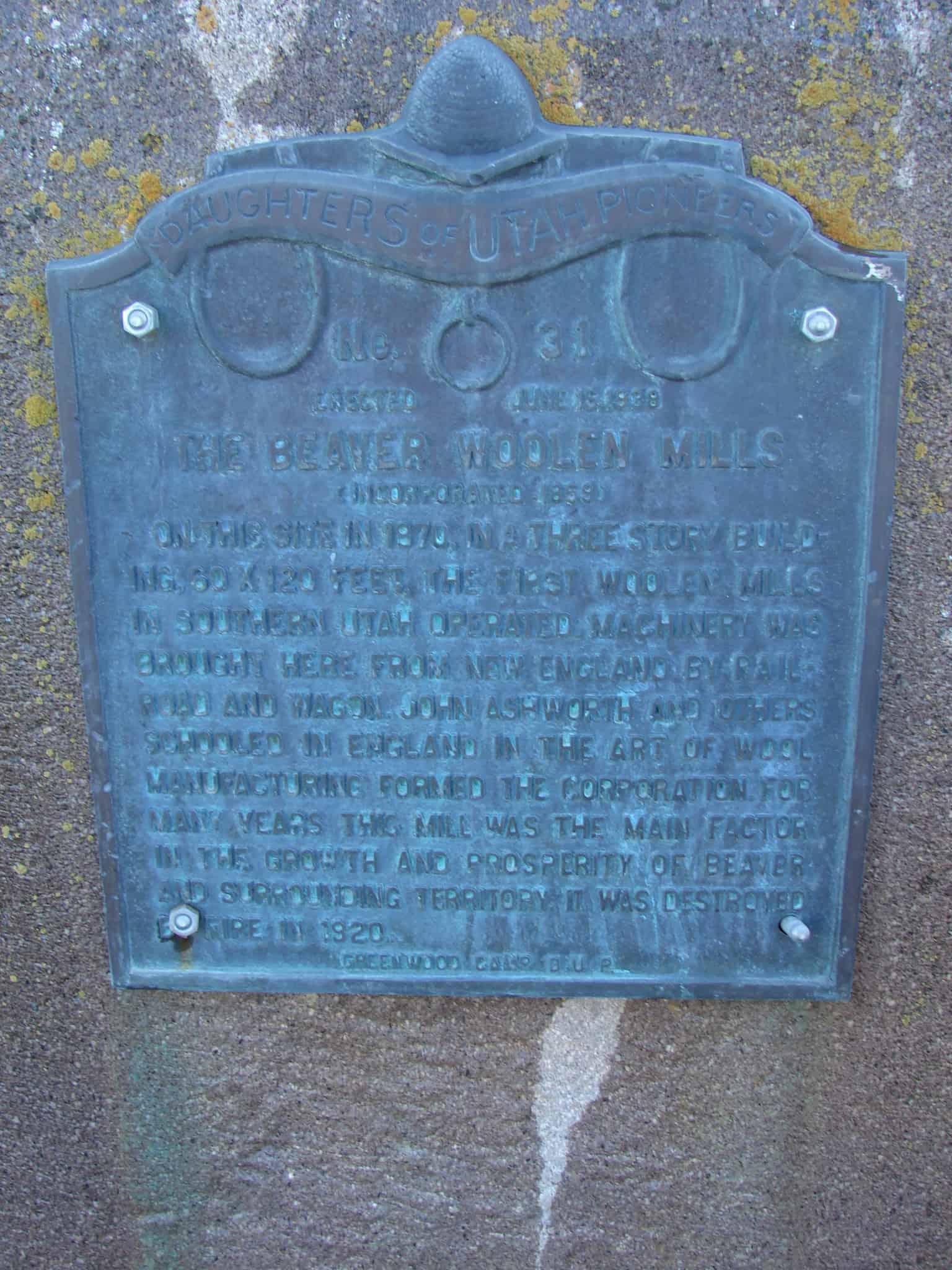
(Incorporated 1869) On this site in 1870, in a three story building, 60 x 120 feet, the first Woolen Mills in Southern Utah operated. Machinery was brought here from New England by railroad and wagon. John Ashworth and others schooled in England in the art of wool manufacturing formed the corporation. For many years this mill was the main factor in the growth and prosperity of Beaver and surrounding territory. It was destroyed by fire in 1920.