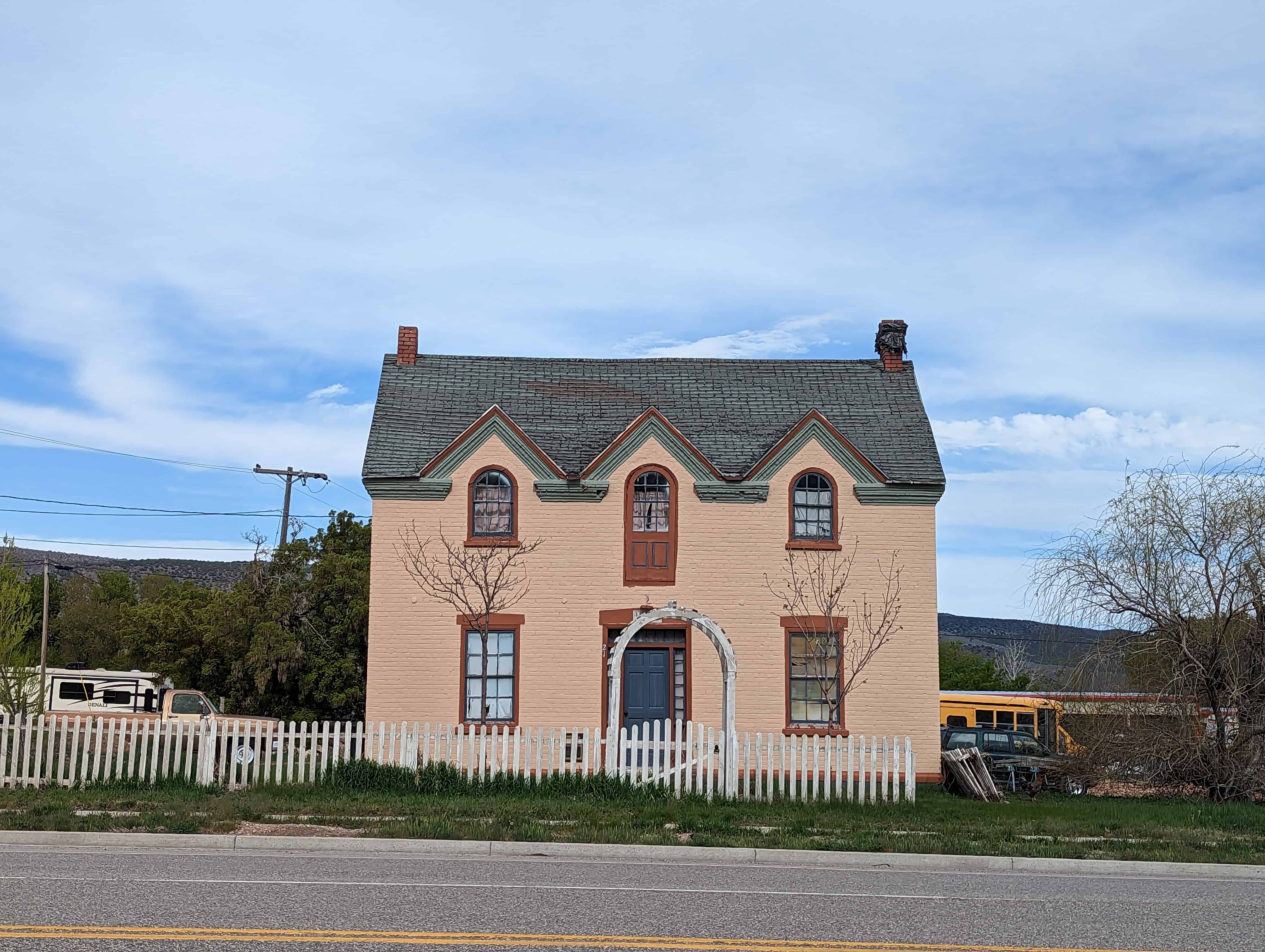
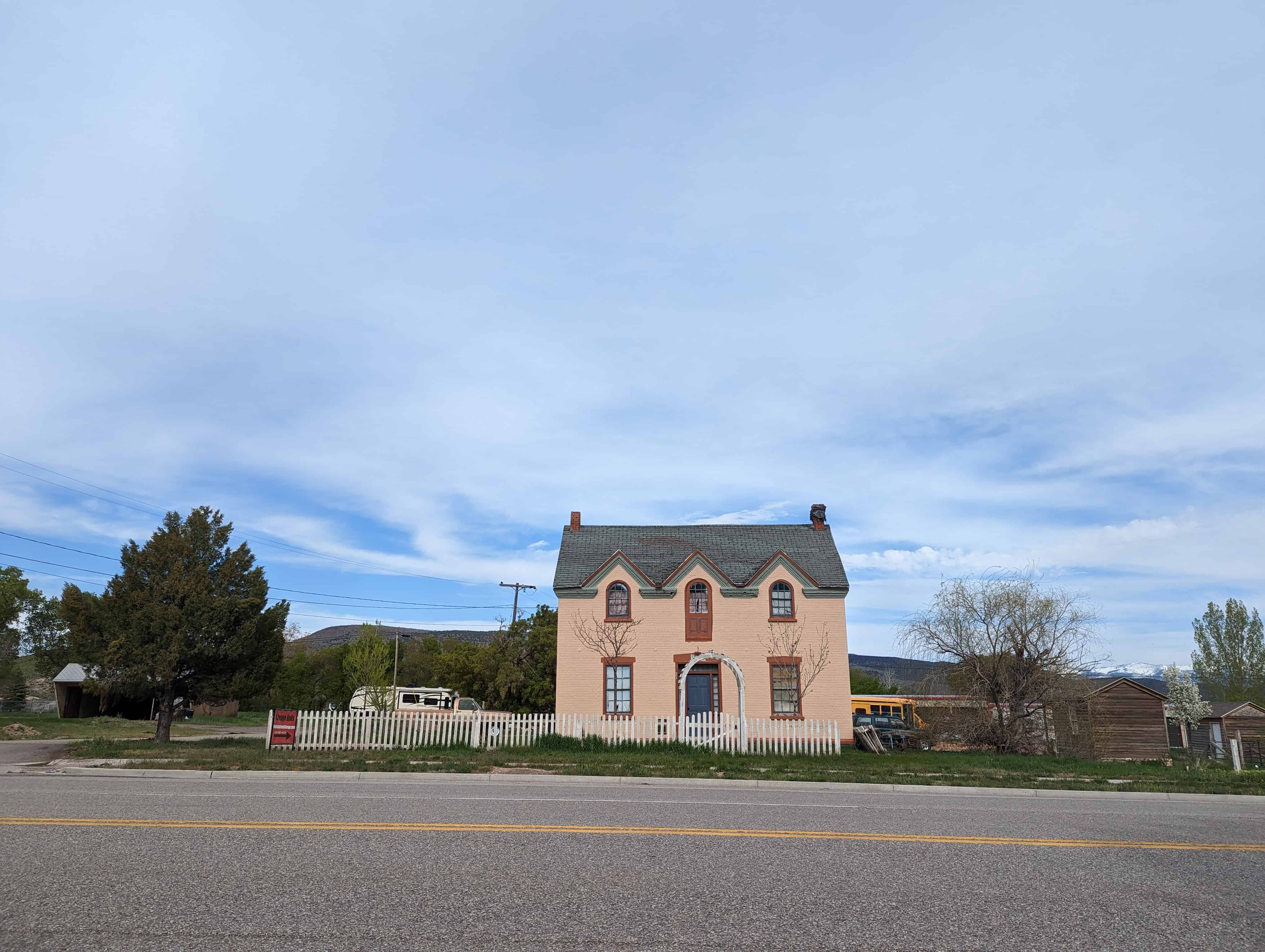
Charles Shreeve Peterson – Helped carve road through Weber Canyon. 1st Probate Judge.
George Washington Taggart – Helped build 1st grist mill. Mormon Battalion member.
Thomas Jefferson Thurston – Builder of roads and canals. 1st Bishop in valley.
Sanford Porter – Original settler of Porterville. Built sawmill, cut ties for railroad.
Thomas and Jane Brough – Church leadership and community service.
Jesse Carter Little – Military-Civic-Church leader, road builder, 1st Post Office.
Willard G. Smith – Community builder, 1st Stake President & Probate Judge, Haun’s Mill survivor, Mormon Battalion member.
Samuel and Esther Francis – Leaders in church and civic affairs.
Albert Douglas Dickson – Peacemaker, canal builder, bishop for 37 years.
Located at 221 East 125 North in Morgan, Utah – this is Sons of Utah Pioneers historic marker #155 placed in 2010 with a new name added every year for a few years.
Built in 1901, St. Paul’s Episcopal Church was the first building constructed in Vernal by the Episcopal Church and the second to be built in the Uintah Basin; the first was the Indian Mission church at Randlett. Designed by John P. Hill, an architect from Salt Lake City, the building is a good example of the Gothic Revival style. St. Paul’s Lodge was constructed in 1909 as a home for girls who came to Vernal to work or attend school. It also served as the center of the auxiliary activities of the Episcopal Church in the community and, from the late 1920s until 1947, as the major hospital in the Uintah Basin. During the past forty years it has continued in use as the center of church and community activities.
Located at 226 West Main Street in Vernal, Utah and added to the National Historic Register (#85000049) on January 3, 1985.
St. Paul’s Episcopal Church, built in 1901, and St. Paul’s Lodge, built in 1909, are significant for their historical role as the center of the Episcopal church activities both in Vernal and in the entire Uintah Basin of northeastern Utah. Both buildings are also architecturally significant. St. Paul’s was the first building constructed by the Episcopal Church in Vernal, a predominantly Mormon town, and the second church con- structed by the Episcopal church in the Uintah Basin; the first was the Indian Mission church at Randlett, which has been moved from its original location in recent years. St. Paul’s is second only to the church at Randlett as the oldest church building of any denomination in the Uintah Basin. The building documents the spirit of expansion and missionary activity that characterized the Episcopal church in Utah at that time. Architecturally, it is significant as a good example of the Gothic Revival style. St. Paul’s Lodge, which was constructed as a home for girls who came to Vernal to work or attend school, is significant for its central role in the auxiliary activities of the Epsicopal Church in the community. The building also served as one of the early hospitals in the Uintah Basin and was the major hospital in the area between the late 1920s and 1947. It is architecturally significant as a good example of the Craftsman style.
The Reverend O. E. Ostenson arrived in Vernal on September 20, 1900 to begin the work which would lead to the building of St. Paul’s. Regular services began on September 30, 1900 in Jake Workman’s Opera House, but were moved on October 22 to the Odd Fellows Lodge room. The first church committee was appointed by the missionary, Reverend Ostenson, on April 23, 1901.
Property was purchased by the Corporation of the Episcopal Church in Utah for $325 on the H7th of February, 1901 for construction of the church in Vernal. On May 16 of the same year, plans for the building had been completed by Salt Lake architect John P. Hill. Very little is known about Hill or his career in Utah. The church committee let the brick and stone work contract to Andrew Burkley and the carpentry work to William Cook on July 18, 1901. Ground was broken for the church on July 26. Three weeks later on August 20 the Rev. Ostenson, assisted by Indian missionary M.J. Hersey of Randlett, laid the cornerstone for the new church. With the permission of the rector, Miss Anna Forrest named the church that same day. It was named St. Paul’s after St. Paul’s Church in Washington, D.C.
Another building on the site is the parish house. Built in 1909, it was originally called St. Paul’s Lodge and was built by the Girl’s Friendly Society of New York as a home for girls who came to Vernal to attend school or to work. It also served as a center for civic activities and club meetings. In 1928, St. Paul’s church was closed because of inactivity. Four years later the lodge was sold and served for the next several years as the major hospital in Uintah County. Dr. Parley G. Eskelson ran the hospital, and even built his own house next door so that he would always be nearby. At the time that the building was converted into a hospital, its interior was renovated and remodeled in order to meet the needs of a medical care facility. The building had previously been used temporarily as a hospital during the flu epidemic of 1918, and was reportedly used again for a short time in the late 1920s under the direction of Mrs. Jane Murray.
St. Paul’s was reactivated in January of 1947 when Rev. Walter F. Cable was sent to be Deacon-in-charge by the Bishop of Utah. Two years later the lodge was repurchased by the church and has since served as the parish house with apartments for the vicar and meeting rooms for the church. The church building itself has continually remained in the hands of the Episcopal Church.
St. Paul’s Church is the second oldest religious structure still standing in the Uintah Basin. An Indian mission church of the Episcopal Church was built in Randlett in 1896, but it has been moved from its original location. St. Paul’s was completed prior to any of the existing religious buildings in the Vernal area – including LDS structures. The relatively late construction dates of church buildings in Vernal can be attributed to the fact that permanent settlers were not established in Vernal until after 1870.
St. Paul’s Episcopal Church is a small town parish church designed in the Gothic Revival style. It is a rectangular building and has a steeply pitched gable roof, brick exterior walls, and sandstone sills, foundation, and water tables. A large, pointed arch window is centered in the gable end wall facing the street, and it features ornate stained glass and wooden tracery elements. Two brick buttresses flank the stained glass window. The buttresses are decorative and are not repeated on the rear of the building, which has wood shingle siding instead of brick exterior walls. There are five buttresses along each side of the building which appear to be structurally supporting the roof trusses that are exposed on the interior. Pointed-arch, stained glass windows are evenly spaced on the sides of the building between the buttresses.
Alterations to the building are minor and do not detract significantly from the original integrity of the building. A small, concrete block addition was built on the rear of the church (n.d.), but it is not visible from the front or public views. The original wood shingles on the roof were replaced by asphalt shingles a number of years ago. On the interior, carpet has been added in the center aisle and in the altar area, and an entry cubical has also been added (n.d.). In recent years, in order to protect the stained glass windows on the building, sheets of transparent, hard plastic have been fitted into the window openings on the outside of the stained glass.
St. Paul’s is an excellent example of a small Gothic Revival church building. Elements which distinguish the church as a Gothic Revival building are the steeply pitched gable roof, the buttresses, and the pointed arch stained glass window with tracery and colored glass. It is probably the best example of the Greek Revival style in both the city of Vernal and the Uintah Basin.
St. Paul’s Lodge is a two-story, brick Craftsman style house with a gable roof and a full-width, one-story front porch. Elements of the Craftsman style include the broad gable roof, the half timbering in the upper portion of the gable end, and the exposed rafters and purlins, and the exposed woodwork in the gables of the wall dormers and porch on the west side of the building. The four symmetrically spaced windows on the upper story of the façade have pointed relieving arches. There is a bay window on the west side of the building. The foundation is constructed of coursed sandstone. There is a one-story gabled section on the rear of the building, which, judging from its appearance and materials, was probably built at the same time as the main portion of the house.
Alterations that have been made on the exterior of the house are minor and do not significantly detract from its original appearance. The exterior brick walls have been painted (n.d.), and the openings on the front porch have been filled in with windows (n.d.). The interior of the house was altered somewhat when the building was converted into a hospital.
Houses designed in the Craftsman style in Utah are quite limited, based on the results of the partially completed state survey of historical and architectural sites. The Craftsman influence, however, was profound, especially in the first two decades of the twentieth century. Broad gable roofs, exposed rafters and half timbering are the most prevalent evidence of the Craftsman influence and occur on bungalows in most Utah towns. Even though St. Paul’s Lodge is not a premier example of the style in the state, it is significant as one of the few houses that were specifically designed in the Craftsman style.
Right from the beginning, the Santa Clara Merc developed a presence on the main street of this small western town. Morphing from a one-room operation to a small, free-standing unit to a thriving mercantile that supplied needed essentials to residents and jobs for many of its youth, the Merc was the heart of Santa Clara. The building’s design is simple, reflecting the austere modern influence of the times with little architectural ornamentation, but the operation of the business wove a rich legacy. The story began long before construction took place, and it is best remembered through the writing of Ethel H. McArthur, a woman who personally knew the history.
The early citizens of Santa Clara were tired of having to go by wagon to St. George for their meager supplies, so a group of them got together and decided to open their own store. None of them had any experience running a mercantile business, but they chose John G. Hafen to be the manager… Before long, Grandpa Hafen bought the other stockholders out and with the small capital of ten dollars began to build up a mercantile business of his own. His work took him from home so much that the work in the store was done largely by grandmother.
The store was a small room in their home, but the business continued to increase, so in 1900 a small brick building was erected adjoining their house. The business remained at this location even though grandpa retired in 1917 and sold the business to his son Adolph and two grandchildren. It continued to be a general store, handling all varieties of goods needed by a community. It was the only mercantile ever established in Santa Clara.
In 1928 a new modern building of concrete brick and adobe was constructed one block west of the original site. It was a much larger store and also had space for a large garage. The garage was rented to the Stucki & Wittwer Produce Company, and gas pumps were installed outside the store.
The new store was named the Santa Clara Coop and was still owned by the Hafens. In the late 1930s merchandise became extremely difficult to buy, and the inventory dwindled to almost nothing. The store was sold to Adolph’s daughter Ethel and husband Horace McArthur. They moved home from California and took over operations on September 1, 1945. The majority of Adolph’s business was run on credit, and this tradition became a way of life when dealing with McArthur’s Santa Clara Merc.
Horace and Ethel expanded the store and its merchandise. The Merc was known to sell dishes, appliances, horseshoes, nails, dresses, shoes, fabric, toys, and the town’s first television. In 1960 Horace’s son Douglas was made manager, and he and Ethel operated the business until July 1, 1986. The business started by John G. Hafen was then sold, leaving family hands for the first time in more than one hundred years.
The Santa Clara Merc continued to operate for another ten years until the competition of modern supermarkets forced it to close.
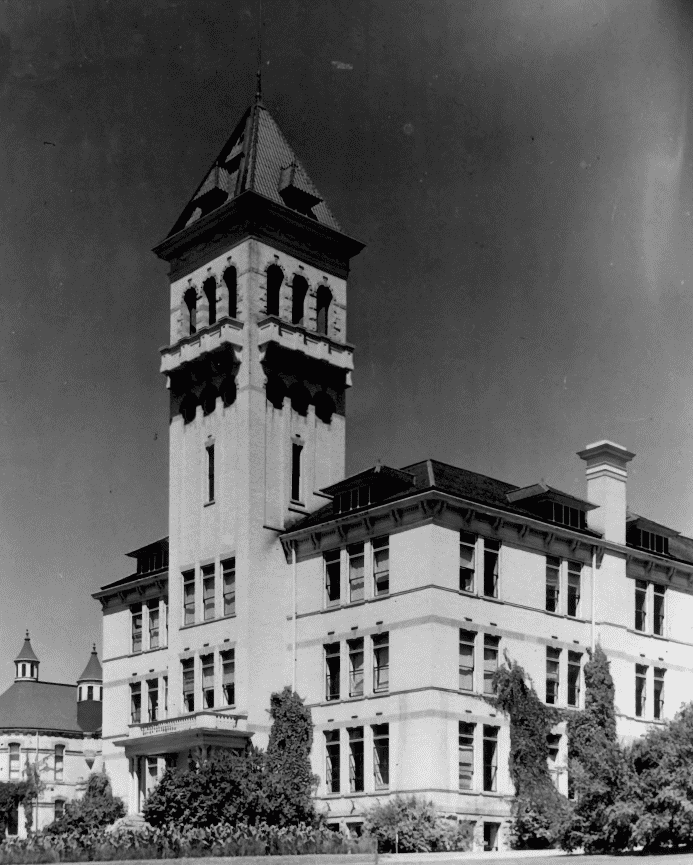
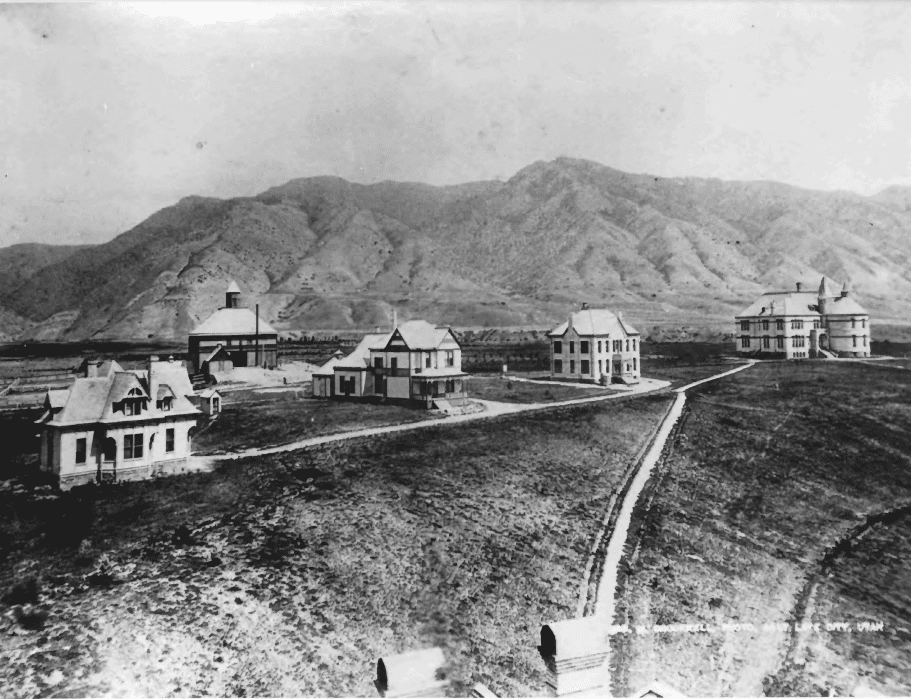
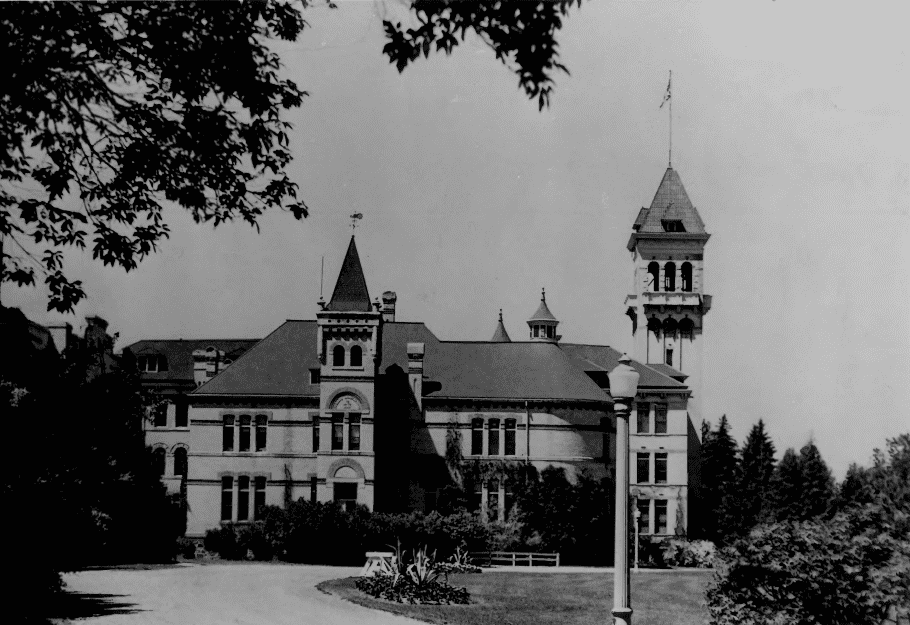
The Agricultural College of Utah was established by act of the 1888 Territorial Assembly. On March 26, 1889, the Board of Trustees met in Logan, accepted the offer of the campus site, and instructed the secretary of the Board “to advertise ‘for plans for a $20,000 building, plans to be delivered to the secretary before the 15th of April. On April 15, the Board met in Logan, accepting the plan of C. L. Thompson for a three-section structure. On May 18, 1889, the Board awarded the construction contract for the south wing to Sommer, Peterson and Company of Logan for a total cost of $20,305. The south wing was completed and accepted by the trustees on February 22, 1890. The College was dedicated on September 4th and officially opened on September 5, 1890, with the south wing of Old Main as the only complete classroom facility. As it stands today, Old Main is the oldest continuously used building at an institution of higher education in the State of Utah. During its history, it has housed virtually every University department or office. It is the best example of the “Campus Gothic” of the last century.
Located on the Utah State University campus in Logan, Utah and added to the National Historic Register (#72001258) on February 23, 1972.
The original plan by C. L. Thompson was for a three-section buff colored brick and stone structure 270′ x 100′ with sections that could be readily erected independently of each other. The south wing was completed February 1890. In 1892 the Board authorized the construction of the north wing and the east portion of the central section. The original plans of C. L. Thompson were re-drawn by Carl S, Schaub, a Logan architect. The new plans called for a building of 342′ x 190′. The Thompson plans for the north and south wings were maintained, though Schaub modified the projected tower and greatly enlarged the central section of the building, which until then had been planned as little more than a glorified hall between the two wings, A completion date of 1894 was postponed by the panic of 1893. Finally in 1901 and 1902 the front 80′ including the tower, was added to the structure.
In 1892 the catalog described the structure’s many uses:
“It contains . . . recitation rooms . . . workshops, cooking, sewing, householding, dairying, laundering, engineering, agricultural and business departments . . . laboratory, museum, library and gymnasium rooms and a military drill hall of ample size. Its audience room or chapel will hold 1600. Three large rooms have been set aside for halls for the literary societies. Its rooms are light and pleasant to a rare degree and its halls wide and roomy, extending on each floor the entire length of the building. In the near future, large bath rooms will be put in for the accommodation of both sexes, where baths can be taken at pleasure.”
Though the interior has been remodeled and some incongruous modernization done, Old Main retains enough of its original style to stand as the principal Utah example of the “Campus Gothic” of the late 19th century.
Fort Cameron is important because of its relationship to three significant aspects of Utah history.
In the early 1870’s, Indian raids against the isolated southern Utah communities began to occur with enough regularity and intensity that local settlers were fearful of the kind of confrontation that had characterized the Black Hawk Indian War in that area during the mid 1860’s.
In a letter to Washington officials, Cyrus M. Hawley, associate justice of the Utah Supreme Court, noted that attempts to bring those individuals guilty for the Mountain Meadows Massacre to trial were unsuccessful and would continue to be so until witnesses were convinced that the Federal Government would guarantee them protection, Hawley went on to recommend that a military force of at least five companies be sent to leaver to render the required protection.
Because of the “Indian problem” and the “Mormon problem,’ Secretary of War William W. Belknap recommended a governmental appropriation of $120,000 to construct a military post near Beaver. After the money was appropriated, Colonel John D. Wilkins, with four companies of troops (about 181), was sent to establish the post in mid-1872. After President Ulysses S. Grant officially set aside the reservation on May 12, 1873, the fort was named Fort Cameron in honor of Colonel James Cameron who lost his life during the Battle of Bull Run.
After the completion of the Utah Southern Railroad to Milford in 1880, General Phil Sheridan recommended that the post be closed because troops could be transported by rail into Southern Utah. Accordingly, the fort was closed May 1, 1883 and the troops removed to Fort Douglas.
The land and buildings were purchased for $15,000 by John R. Murdock, President of the Beaver Stake of the Church of Jesus of Latter-day Saints and Philo T. Farnsworth, former bishop of the Beaver Ward. Apparently the purchase was made in behalf of the church for, in 1893, Fort Cameron was converted into an academy. The laundress quarters were used as a dormitory to house students coming from outlying areas. In 1922, the church decided to discontinue the academy. The land was sold and the school equipment donated to Beaver High School.
The last use of the laundress quarters was made in 1937-1938 when a branch of the Milford Civil Conservation Corps was housed there.
The original fort site was laid out in a rectangular shape 700′ x 620′. In the center was a parade ground around which the buildings were constructed. On the east side and on the west side stood two barracks. On the south side were six officers’ quarters. To the north were the hospital, the headquarters building, and commissary store, Next to the east barracks stood the bakery. The stables were 300 yards west of the post.
The buildings were constructed of the black, basaltic lava stone quarried nearby, mainly by local laborers. The original buildings were roughly plastered except for a two-story, 12-bed hospital which was finished with plaster of Paris.
When taken over by the LDS Church for an academy, the buildings were remodeled and a new building constructed. However, after the buildings were abandoned as a school in 1922, they soon fell into disrepair. In 1938, the CCC and WPA programs cleared away debris and built a race track.
Today only one building, the laundress’ quarters, remains. It was of black basalt rock, but altered slightly. Its rectangular dimensions are 31′ x 57′ with a gabled roof. The building has three chimneys, both ends and the center, and divides lengthwise with four rooms on each side, an outside door and a window for each room. Some of the interior partitions have been removed.
With the plans of the fort still available and part of the site undisturbed, there is good archaeological potential for much of the site. However, part of the fort site has been covered by the Beaver Golf Course. Primary preservation efforts will be devoted to the restoration of the launderess’ quarters building.
The fort was added to the National Historic Register (#74001932) on September 9, 1974.
“Honor to the Soldier and Sailor everywhere, who bravely bears his country’s cause. Honor also to the citizen who cares for his brother in the field and serves, as he best can, the same cause.” – Abraham Lincoln
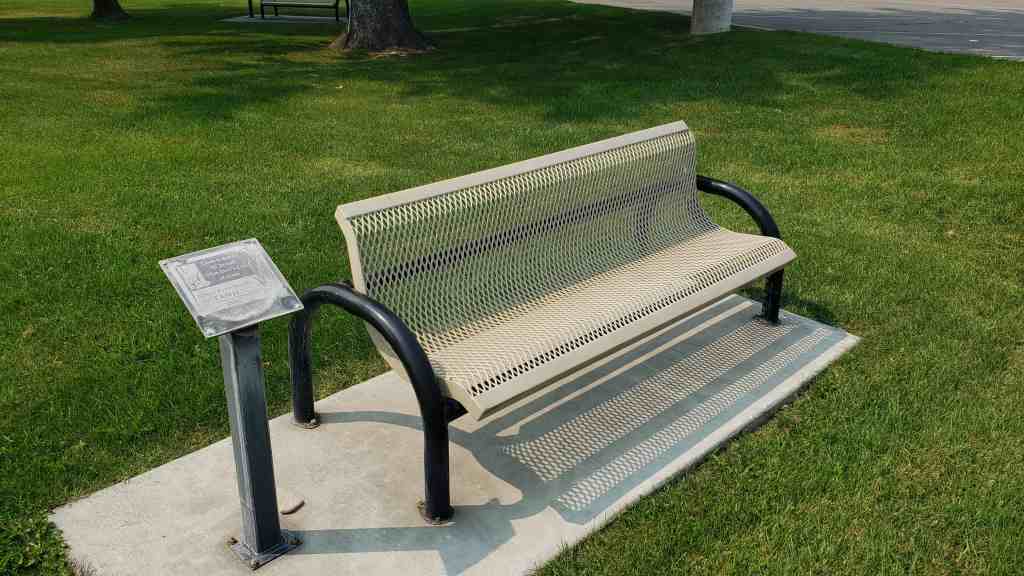
Glen & Ruby Thornley Memorial Bench There is beauty all around when there’s love at home.
“Bessie” Elizabeth P Hansen Memorial Bench Smithfield City Treasurer 1950-1971 Married to Edgar L. Hansen Elizabeth is the Great Granddaughter of Peter Maughan, founder of Cache Valley. For more than half a century Hansen family members have served the citizens of Smithfield.
Bishop Robert Sherwood, January 27, 1858 – August 6, 1942, donated parcels of this land known as Sherwood Forest Addition for perpetual public use on July 12, 1890.
The Hans Peter Olsen home was constructed in 1877, nineteen years after Mr. Olsen came to Utah from Denmark. Born May 30, 1833, in Jutland, Denmark, Hans Peter Olsen grew up on his father’s farm, In 1853 he joined the Mormon Church and spent the next four years as a traveling elder in his native country, In 1858 he sailed from Denmark on board the John Bright. Although the Utah War forced most of the European emigrants remain at Iowa City and Florence, Nebraska, until the following year, a group of fourteen “Danish Fellows” of which Hans Peter was a member, was allowed to journey to Utah with a group of missionaries returning to Utah in the Eldredge company. In November 1858 he settled in Manti and the following spring moved to Moroni as one of the first settlers of that community. In 1867 he moved to Fountain Green and ten years later constructed the lovely brick home. He returned to Denmark on two missions for the LDS Church first in 1869 and again in 1891, While living in Fountain Green, he was a farmer and director of the local co-op store.
The significance of the Hans Peter Olsen home is that it is one of the finest pioneer brick homes in Sanpete Valley.
Located at 211 South State Street in Fountain Green, Utah and added to the National Historic Register (#76001834) on April 22, 1976.
The Hans Peter Olsen home is significant architecturally as an outstanding example of pioneer industry, design and craftsmanship. The well preserved residence embodies the best elements of representative pioneer building during the transitional period of vernacular to “high-style” architecture. Late pioneer features such as the symmetrical 3-bay front façade, four-over-four plan, end wall chimneys and Federal entry bay are combined with less typical decorative embellishments such as Roman-arched upper windows and an unusual corbeled brick cornice with dentil band where a wooden frieze would ordinarily appear. In an area of predominantly white limestone homes, the Olsen home stands out as being unique to the region. Craftsmanship throughout the structure is excellent, a fit compliment to the stateliness and utility of the design. Qualities of permanence and beauty in the building reflect Olsen’s philosophic commitment to Mormon concepts of Kingdom-building in the Sanpete County community of Fountain Green.
In the year 1854 or 1855 the settlers built a mud wall most of the way around the town. The wall began at the corner of West Street and Vine Street intersection and then south to the south side of Locust Street (1st South) then east to the east side of 1st East Street then north to the north side of Green Street (1st North) then west to a point about twenty rods east of Main Street where it ended.
The Mud Wall was built to help protect the settlers from Indian attacks. The attacks never came, due in part to the counsel given by Brigham Young, to feed the Indians, rather than fight them.
The only thing that the Mud Wall was used for was that a number of wolves were shot from the wall at the south west corner.
We call the attention of the reader to the laborious work of building the Mud Wall. Food was scarce at that time. They had many hardships to contend with in their poverty, with houses to build, fencing materials to get out of the canyons, roads and irrigation canals to build and Indians to guard against. It should also be remembered that the tools they had to work with were crude and inferior.
Building the mud wall
The work of building the Mud Wall was done by taxing every able body man to do his share. The wall was 2 ½ feet wide at the base, 1 foot wide at the top, 9 feet high and each section was 16 feet long.
Water was flooded over the ground each night and a strip on both sides of the wall was ploughed to soften the mud. Planks were then set on edge and held together by long 1 ¾ inch round pins secured by wooden keys.
The wet soil was then shoveled between the planks from both sides with one man tamping the soil. A young boy spread straw into the mud so that it would be less likely to crack as it dried.
When the first pair of planks were filled and thoroughly tamped, the next pair was put in place until the top was reached.
When the mud dried the planks were removed and another section built as before so that the wall was built by section.
Note: The replica is one-half size of the original wall built 2 ½ feet wide at the base, 1 foot wide at the top, 9 feet high and built in 16 foot sections.
Sons of Utah Pioneers historic marker #147, located at 100 West Vine Street on the Library grounds in Tooele, Utah
In 1855, upon the counsel of Brigham Young, Joseph Harker, with John and Samuel Bennion, hand-dug the lower ditch to irrigate the farmland on the river bottoms west of the Jordan River.
A small rock dam was constructed on the Jordan River at about 6300 South. Water was taken from the river at that pointand came north to the park site. The ditch skirted the west and north boundaries of the park and then north to the mill.
In 1880, a new grist mill was constructed on the Jordan River near 4800 South. Water was taken from the Lower Ditch to power the mill and the name MILLRACE was applied to the ditch.
Sons of Utah Pioneers historic marker #117 erected in 2005 by the Taylorsville Bennion Sons of Utah Pioneers, it is located in Millrace Park at 1200 West 5400 South in Taylorsville, Utah