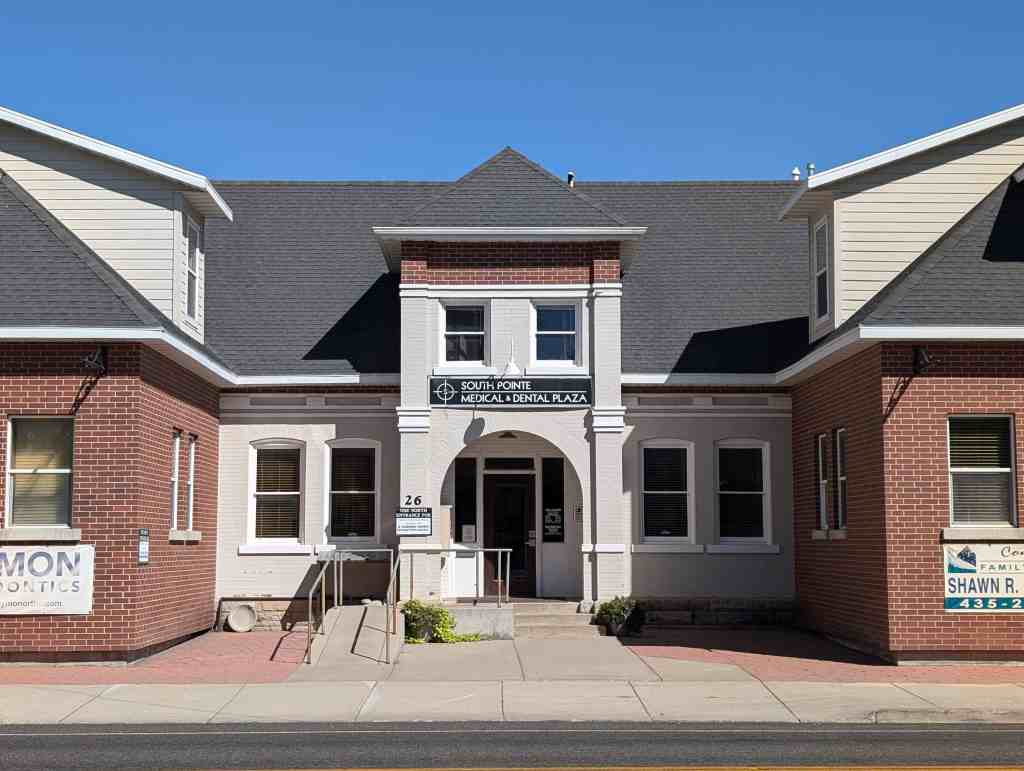
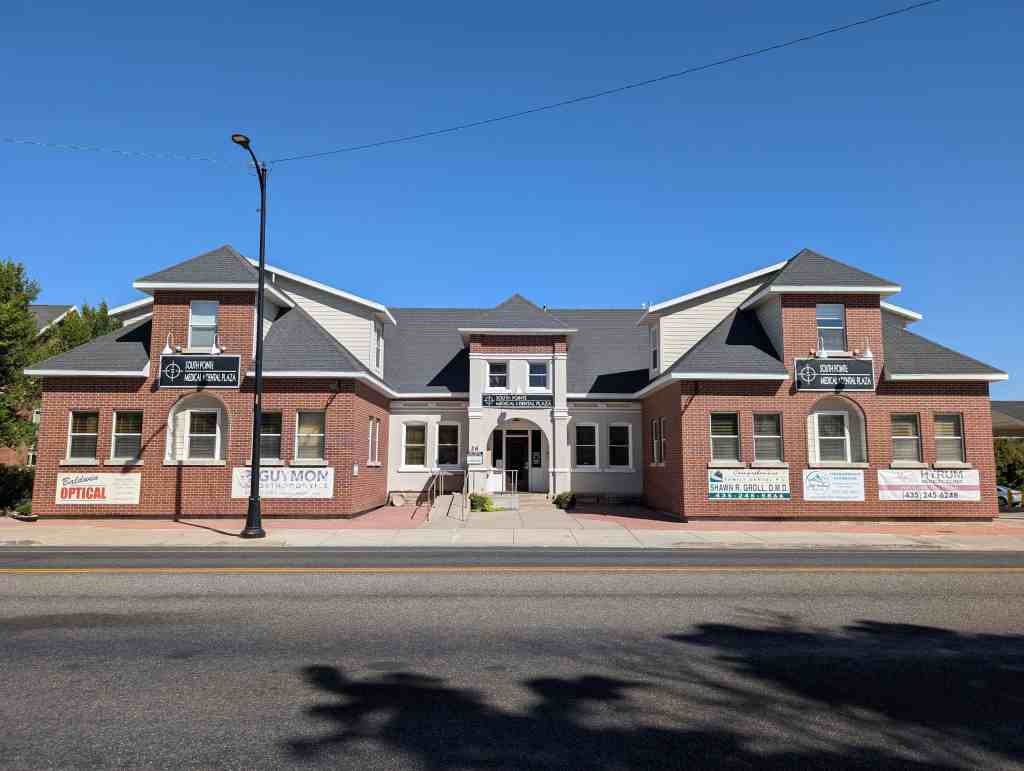
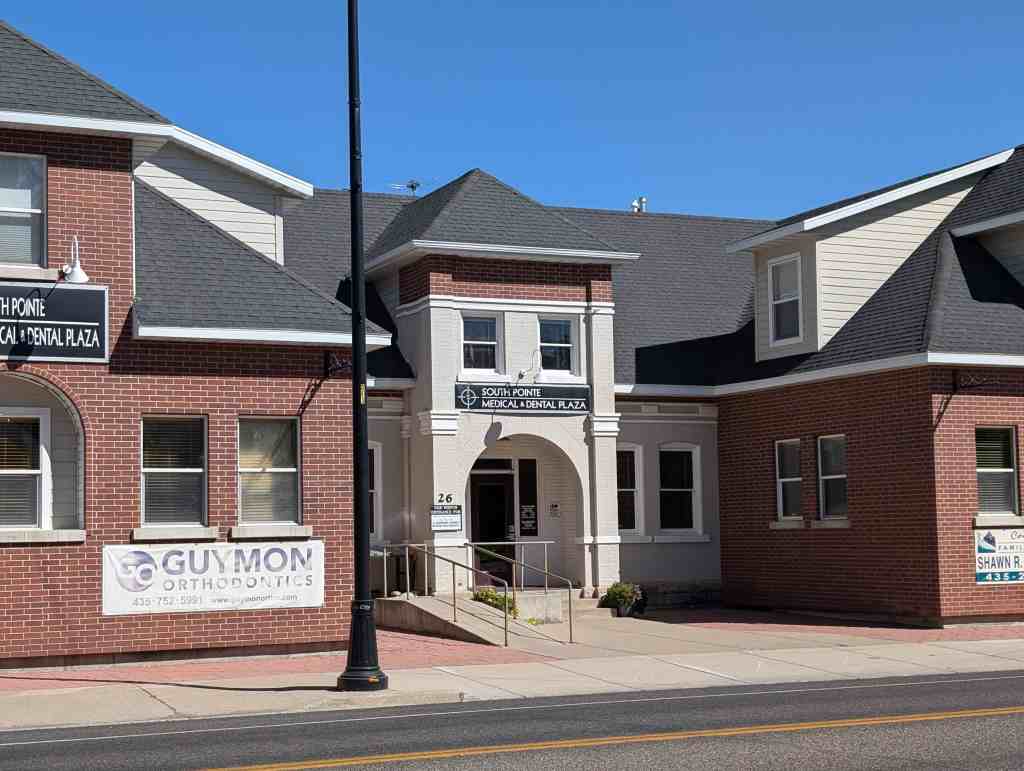
Hyrum Stake Office/Tithing Office/U.S. Post Office
Originally built as the United Order store with smaller tithing offices next door to the west, by the late 1800s this building was used as the stake tithing office. The center of the community’s economic life, it was virtually the only center of trade and exchange in most Mormon pioneer settlements during the last decades of the 1800s. Usually a place in the center of the village, it was the central agency for the expenditure or disposal of one’s tithes, be it cattle, butter, wheat, hay, potatoes, or honey.
Shortly after Hyrum Stake was organized, the need for a stake office, a high council room, and other stake facilities became apparent. In 1910, a stake building consisting of a president’s office, high council room, stake board room, supply room with a large steel vault, furnace room in the basement, and a large upstairs room was constructed by the Jeff Brothers of Logan. This building served the needs of the Hyrum Stake until 1951, when it was sold to Maud Liljenquist and for a time was the U.S. Post Office for Hyrum.1 In 2006, Dr. Lance Gunnell completed a major addition to the building allowing several medical practices to operate out of the space.
Woodruff Stake House / Woodruff Stake Tithing House
Completed in 1901, the Woodruff Stake House is locally significant as the only remaining historic building in Woodruff that represents the Mormon Church and its strong influence in the community. The church’s principal building, the chapel or meetinghouse, was demolished in the mid-1980s. The stake house served as offices for the local ward (congregation) as well as the regional stake, which is comprised of several wards. The bishop of the Woodruff Ward occupied the north wing of the building from 1901 until 1949, and the president of the Woodruff Stake had his offices in the south wing throughout that same period. The building also served as the ward “tithing office,” the place where church members settled their voluntary contributions of one-tenth of their annual “increase,” and as a meeting place for the women’s Relief Society. The community used the building for nonchurch purposes as well, including meetings for organizations such as the local livestock association and for school purposes when space was needed. It is the only remaining civic-use building in Woodruff. The building is one of twenty-seven tithing offices remaining in Utah, as documented in the 1985 National Register of Historic Places thematic resource nomination of Tithing Offices and Granaries of the Mormon Church.
Located at 50 South Main Street in Woodruff, Utah and added to the National Historic Register (#00001586) on December 28, 2000.
Woodruff is a small, livestock-based town in extreme northeastern Utah near the borders of both Idaho and Wyoming. Though the town is actually much closer, geographically, to the Wyoming hub-town of Evanston than to any Utah city of substantial size, its history is deeply embedded in Mormon-settled Utah. The town was settled in 1865 as part of the Mormon Church’s systematic plan to establish settlements throughout the Utah region after relocating here from the Midwest in 1847. The town’s name is derived from one of the prominent early settlers in the region, Wilford Woodruff, who later served as president of the Church of Jesus Christ of Latter-day Saints (Mormon or LDS Church) from 1889 until his death in 1898.
The decision to construct the stake house was made by leaders of the LDS Woodruff Stake (a stake is comprised of several wards or congregations) on March 10, 1900, and work commenced on March 17. Church headquarters contributed $400 toward the cost of the building, and the balance was covered by the Woodruff Ward and wards from other towns in the stake. A local history of the town notes that the building contained “a clerk’s office, a High Council Chamber [apparently the center room on the main floor], a Bishops Office and also a room upstairs for a prayer circle.” The “clerk” referred to was the stake clerk, who kept track of stake affairs under the direction of the stake president. In February 1901, a local correspondent to the statewide Deseret Evening News noted that “[W]e have a fine Stake house office, with five rooms nearly completed. It was built by contributions from each settlement, and is a credit to the people of this Stake.” The fifth room referred to in this article is probably the small, windowless room adjoining the upstairs prayer room. This small room may have been used to store sacred clothing used for the prayer circles, an activity now reserved only for temples, the most sacred of Mormon structures. It was more common in the late-nineteenth and early twentieth centuries for remote communities to perform some of the lesser temple functions, such as prayer circles, in non-temple facilities.
Though the building was usually referred to locally as the “stake house,” it was sometimes called the stake tithing office as well. Tithing offices or bishop’s storehouses, as they were also known, were built in most Mormon settlements as a place to accept contributions from ward members. Through the nineteenth century those contributions were usually “in-kind” farm commodities such as eggs, hay, livestock, and so forth. Tithing yards of the period included granaries, barns, and corrals to accommodate these contributions.
In Woodruff the tithing lot and granary were established in 1891 and “located west of and adjoined to John M. Baxter’s home.” (These tithing lot structures are no longer standing.) Baxter was the bishop at the time and later served for 38 years as stake president. Though most tithing lots were usually separate facilities, it was not uncommon for them to be located on the bishop’s property. Even after the task of settling tithing accounts shifted to the new stake house, the tithing lot remained in its former location; there never was a granary, barn, or other such facility on the stake house property. The stake house was constructed during a period in which tithing throughout the church was undergoing a transition from in-kind contributions to cash payments, so there was less of a need for the traditional tithing lot structures. Eventually in-kind contributions ceased altogether.
The Woodruff Stake House is unusual in that it was both constructed and used by both the ward and stake. Most tithing offices were simply ward structures. While there are probably other examples of this dual use, it was not the norm. The building is also unusual in that it continued with its original use until 1949. By mid-century, most other wards and stakes had long since moved their offices into newer or remodeled meetinghouses and either sold their tithing offices or allowed them to be used by auxiliary organizations.
The building’s temple-form design is much more representative of 1870s Utah architecture than it is of early 20th-century buildings. Shortly after the completion of this building, the LDS Church apparently came out with standard plans for such buildings. Tithing offices constructed in a number of Utah communities after 1900 represent some of those standard plans. By 1910, however, the construction of tithing offices appears to have been terminally suspended. The new concept was to consolidate all activities under one roof. The new church buildings that emerged in the 1920s were much larger than the earlier meetinghouses because they not only included a chapel but also a bishop’s office, classrooms, women’s Relief Society meeting room, and amusement/recreation halls.
The church’s women’s organization, the Relief Society, also used the building for its meetings. This is somewhat unusual given that most ward Relief Societies preferred having their own building. The nineteenth-century pattern of separate buildings for the various ward groups and functions changed in the early twentieth century, and by the 1920s new meetinghouses included those various functions under one roof.
The Woodruff Stake House served other non-church purposes as well. It served briefly as a home for Savannah and Marie Putnam after their home burned to the ground on March 2,1917. The first and second-story rooms accommodated school children for a year when the town’s school was overcrowded in the late 1920s. It also served as a meeting place for the Woodruff Livestock Association and very likely was used for town meetings as well, since there was not a town hall. Besides the stake house, there are no other civic or public buildings remaining in Woodruff from the nineteenth or early twentieth centuries.
In 1949, with the completion of major additions to the LDS meetinghouse, the ward and stake moved out of the stake house and decided to sell the building in order to help pay for some of the cost of the new facility. According to county records, Woodruff Ward sold the building in February 1950 to Osro and Fuchsia Cornia, who owned it for three years. They sold the house to Al and LaVerl Miller in January 1953. The Millers, who are generally credited with converting the stake house into a residence, owned it until 1971. Subsequent owners include Frank and Helen Shelby (1971-75), Ralph and Sally Eastman (1975-95), and the current owners Jef T. and Gayle Jensen. The house is currently vacant and for sale.
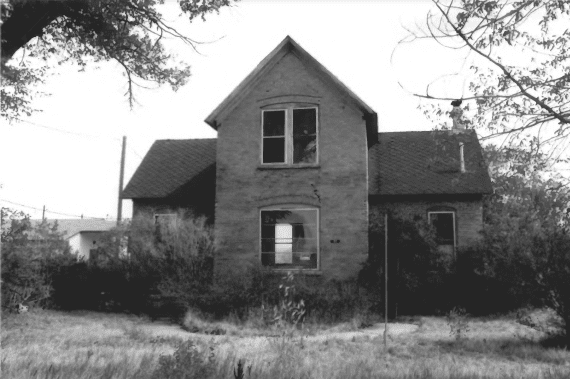
The Woodruff Stake House, constructed in 1900-1901, is a late example of the temple-form type that was typically constructed in Utah during the 1850s-1870s. The symmetrically composed brick building faces west and features a two-story central section with its gable end facing the street, characteristic of the temple form type, and flanking one-story wings on either side. Despite a few relatively minor alterations to both the exterior and interior, the building retains a significant amount of its historic integrity.
True to the classical origins of the temple form type, the building features a symmetrical facade. Windows are centered in the central gabled section, and the flanking wings contain a mirrored door/window arrangement, though both doors were enclosed in the 1950s after the building was converted to residential use. Other changes likely made at that time include the removal of Victorian-style porches in front of both one-story sections (see historic photo) and the replacement of the original paired double-hung window on the first-story facade with a c. 1950s window (though the overall size of the opening has not changed). The open porch on the rear was probably constructed or expanded in the 1950s, given its flat roof and open-rafter construction; its turned columns may have been recycled from the front porches. The foundation of the building is randomly laid fieldstone, and the walls are constructed of locally manufactured brick. Though the Victorian porches are now gone, vestiges of that stylistic influence include the segmental arches over the windows and the lathe-turned porch columns and single engaged column at the southwest corner that may have supported a sign for the building.
The interior contains three main rooms on the ground floor corresponding to the three sections visible from the exterior and a room upstairs in the central two-story section. There is also a small “attic” room above the north wing, though inexplicably there is not a matching room above the south wing. The upstairs is accessed by an unusual, enclosed frame stairway attached to the back of the building. This stairway, which is almost certainly original, includes a coal room on the north end of the ground floor under the stairs, accessed only from the exterior. The north wing on the main floor was divided into two rooms in the 1950s or ’60s to accommodate a bathroom after the building was converted into a home. Built-in propane heaters were installed in the corners of the rooms at about that same time. The ceiling height and woodwork have been retained on the interior. Those are the only alterations of note to the interior.
The stake house is located on Main Street (State Route 16) in Woodruff, a block north of where the LDS meetinghouse was located. Both in scale and setback from the street, the building is more typical of residential buildings in the community, as opposed to institutional buildings.
Also located on the property (at the northeast corner) is a frame single-hole outhouse constructed by the WPA in the 1930s. It has a shed roof, drop siding with 1×4 corner boards on the exterior, and distinctive WPA features on the interior, such as a concrete base and riser set diagonally in a rear corner, metal vent pipe, and a rectangular wooden lid and latch to hold it in an upright position. Though it is possible this outhouse was moved in later, it is more likely that the structure was built to serve the needs of this building. It is considered a contributing building on the property. Noncontributing features include the flagstone, freestanding outdoor fireplace behind the building and the flagstone planter box that replaced the porch in front of the north wing.
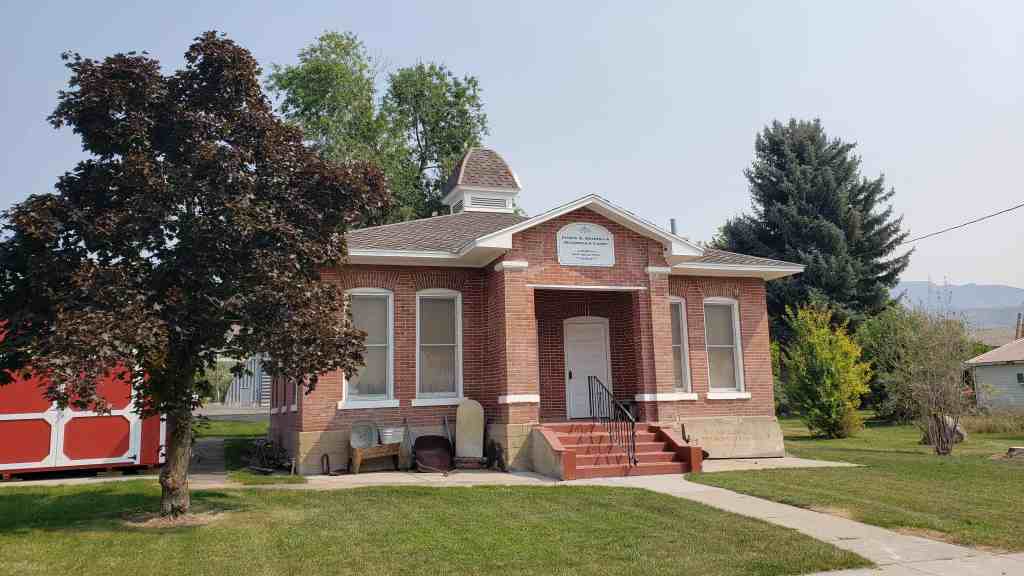
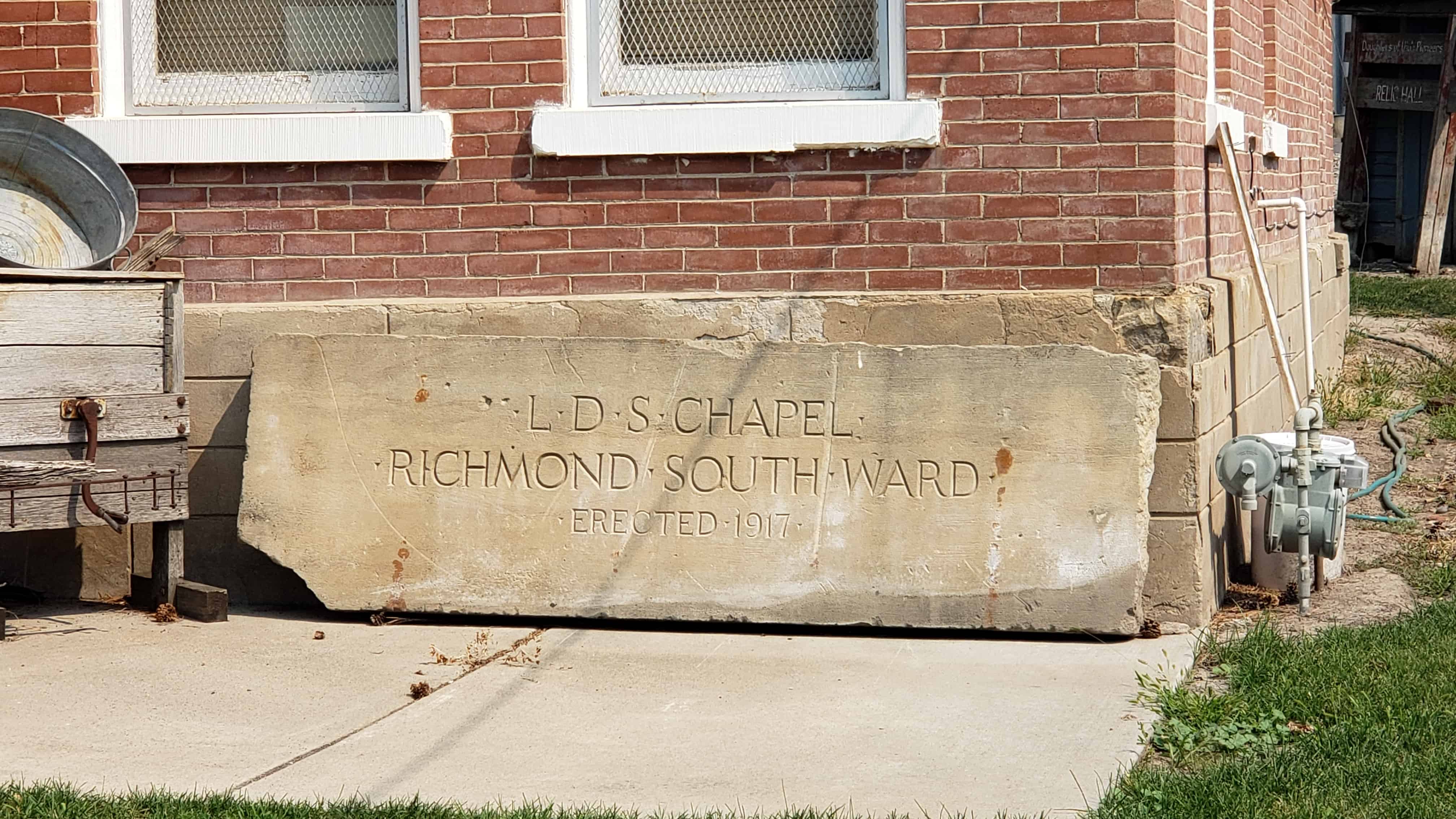
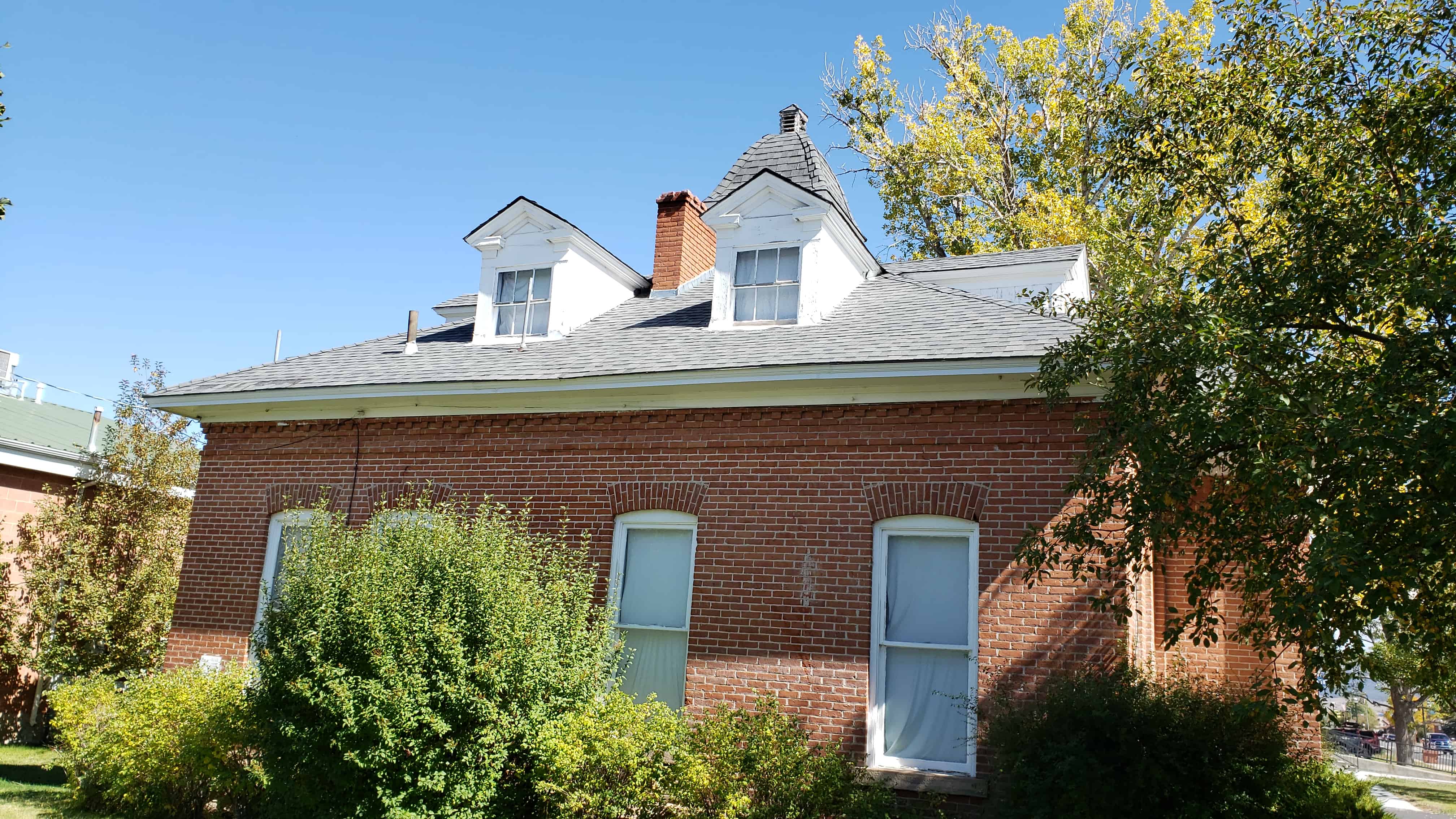
Built in 1907, the Richmond Tithing Office is significant as one of 28 well preserved tithing buildings in Utah that were part of the successful “in kind” tithing system of The Church of Jesus Christ of Latter-day Saints (LDS or Mormon church) between the 1850s and about 1910. Tithing lots, which usually included an office and several auxiliary structures, were facilities for collecting, storing, and distributing the farm products that were donated as tithing by church members in the cash-poor agricultural communities throughout the state. Tithing offices were a vital part of almost every Mormon community, serving as local centers of trade, welfare assistance, and economic activity. They were also important as the basic units of the church-wide tithing network that was centered in Salt Lake City, This building is also significant as one of about ten tithing offices which, having been built according to standard plans issued from church headquarters, represent the first known instances of centralized building administration in the LDS church.
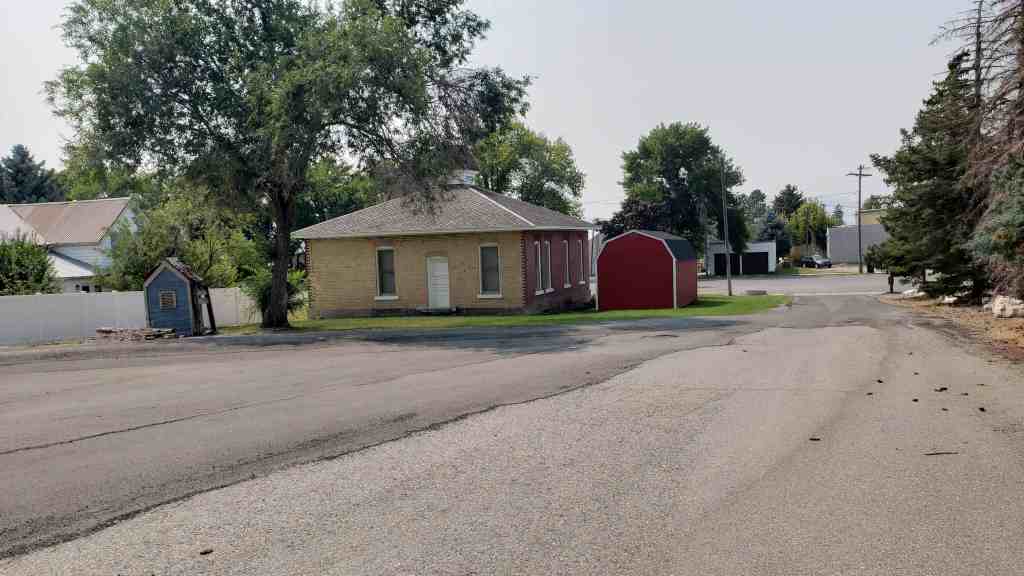
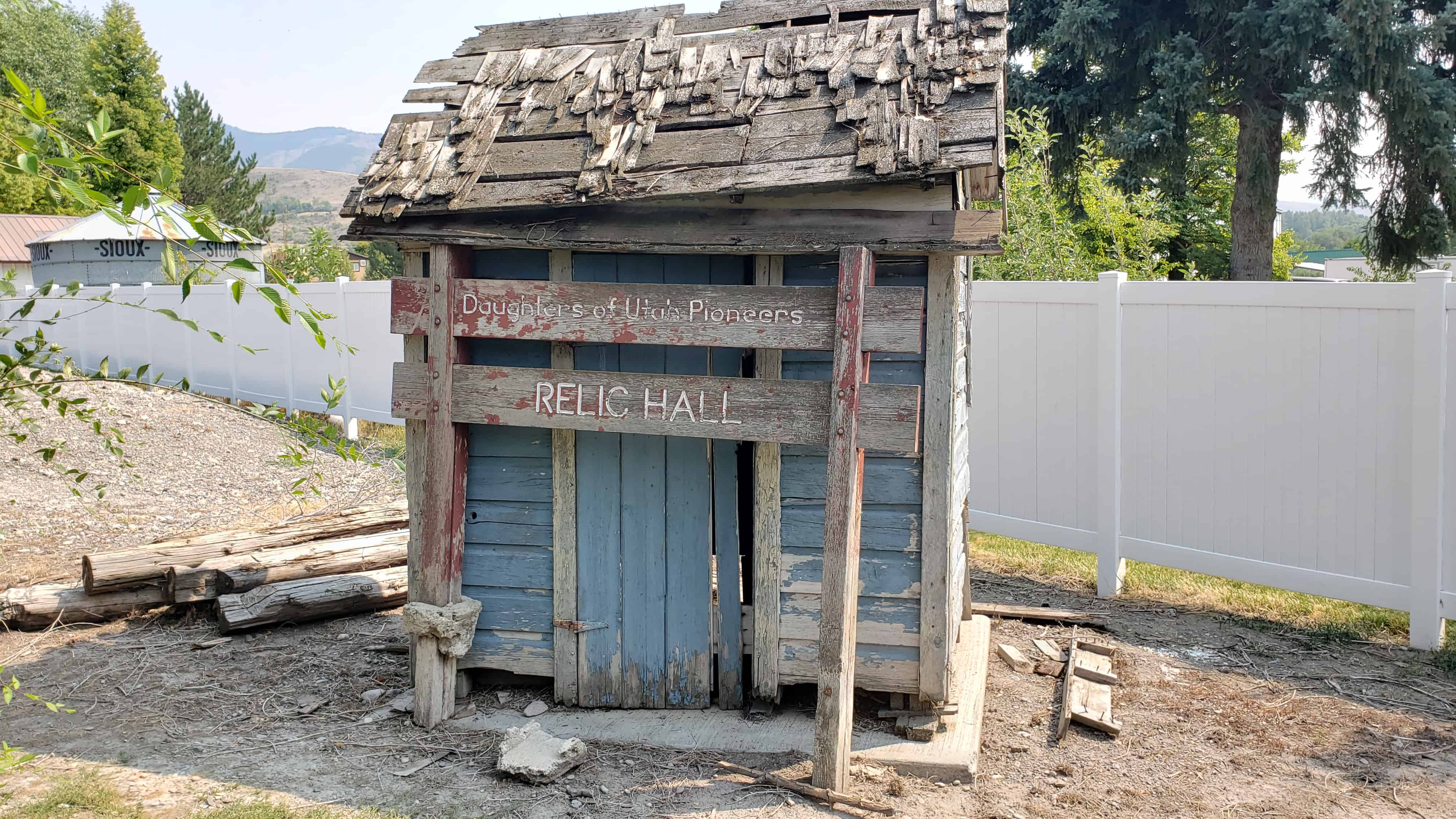
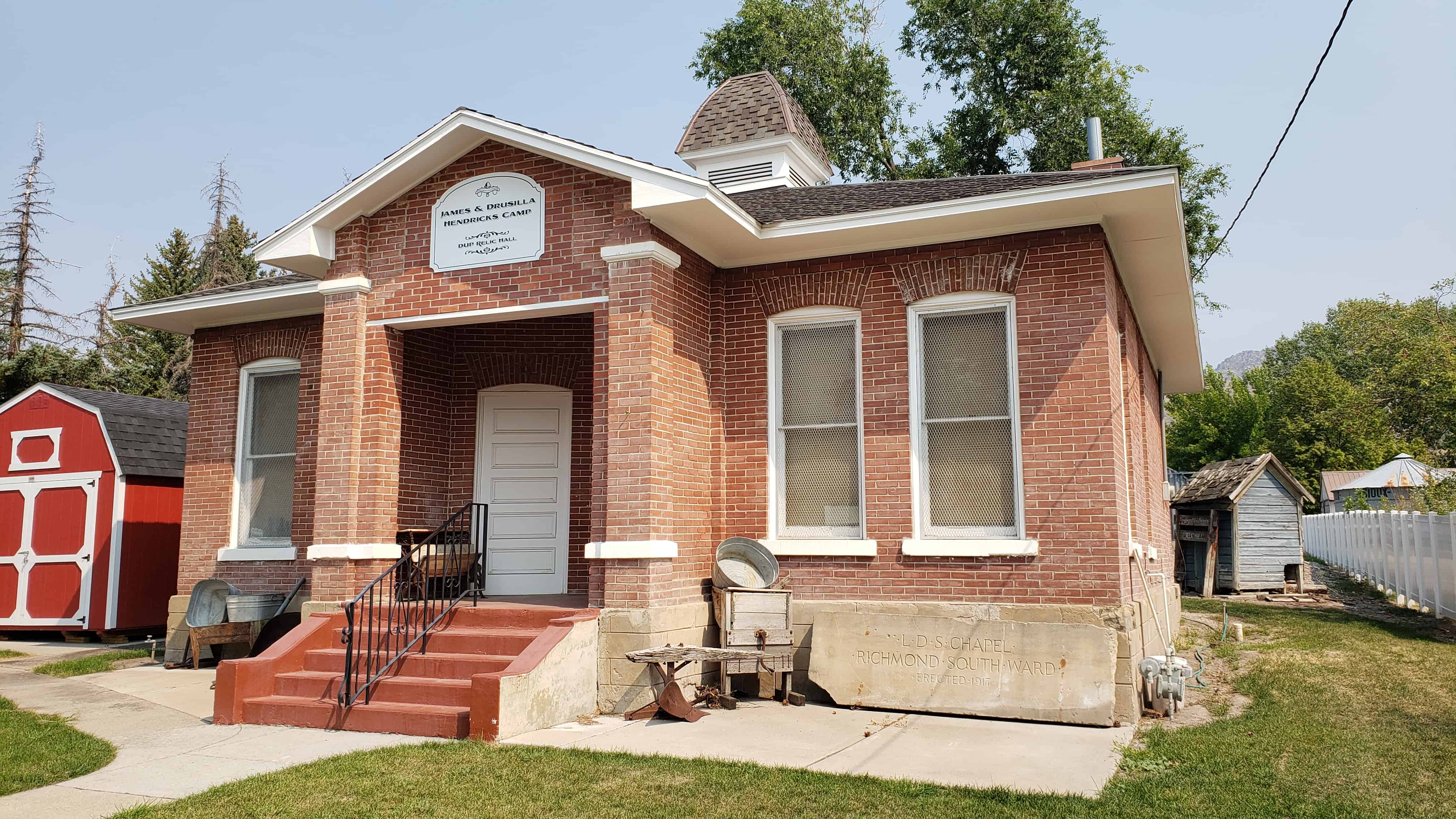
The Richmond Tithing Office is now the Richmond D.U.P. Relic Hall, James & Drusilla Hendricks Camp, located at 25 South State Street in Richmond, Utah. It was added to the National Historic Register (#85000256) on January 25, 1985.
In January 1907, Stake President Alma Merrill and Bishop Thomas H. Merrill of the Richmond Ward, submitted a request to the Presiding Bishopric of the LDS church for approval to construct a new tithing office which would also serve as offices for the stake presidency and a meeting place for the stake high council. Land for the new building was provided on the tithing lot in the center of town. Although plans for the building were provided by church headquarters in Salt Lake City, detailed instructions for constructing the building were not given. The Presiding Bishopric offered the following explanation for those omissions: “…regarding specifications for tithing office no. 3, will say, that no specifications were provided other than the bill of material listed on the plans, owing to the fact that the different stakes erect the office of the material at their disposal. ” A local builder, James Lewis Burnham, was reportedly hired to construct the tithing off ice, 3 which was completed by December 1907 or January 1908. In February 1908, Bishop Merrill applied to the Presiding Bishopric for help in furnishing the office. Construction of a fence around the new building and planting grass on the property were finishing touches to the new tithing office that were recommended by the stake clerk in June 1908, but it is unknown whether or not they were ever accomplished.
The design of the Richmond Tithing Office was one of at least three standard tithing office plans that were developed at church headquarters around 1905 and sent out to a number of wards in the state that requested to have a new tithing office built. Those plans were perhaps the first examples of what eventually became a policy with the church – developing standard building plans at church headquarters rather than having each ward generate its own. In addition to the Richmond Tithing Office, other tithing offices in the state that were built according to the plans of “tithing office no. 3” are those in Manti, Sandy, Panguitch, and Hyrum, all of which were built between about 1905 and 1910.
The Richmond Tithing Office was owned by the Richmond Ward of the LDS church until 1968, when it was sold to Richmond City. The city has allowed the local chapter of the Daughters of the Utah Pioneers to use the building as their relic hall.
The Richmond Tithing Office is a one story square red brick building with a pyramid roof, a coursed ashlar foundation, and a projecting gabled pavilion on the façade. It was designed from one of at least three standard plans which were created for tithing offices about 1905, two of which have been identified. The design of the Richmond Tithing Office has been identified as type No. 3, and is almost identical to the design of the Sandy, Manti and Panguitch Tithing Offices. It is also very similar to the Hyrum Tithing Office. The façade is symmetrically arranged with a gabled pavilion centered between pairs of one over one double hung sash windows. The pavilion has a flat arch opening. Above the opening is an inset rectangular panel above which is an enclosed semi -circular vent. Pilasters are attached to the corners of the pavilion. Two doors open off the pavilion, each set at an angle into the wall under the pavilion. The arrangement of openings on the other three sides of the building is irregular, but is very similar to that of other tithing offices of this type. Decorative elements include a wide frieze which wraps around the building below the cornice line. It consists of string courses of brick which project at different levels. Rock-faced brick highlights the relieving arches of the windows. A small domed cupola structure tops the building. The Richmond Tithing Office is unaltered, is in good condition, and therefore maintains its original integrity.
Early Church members brought goods instead of cash to contribute one-tenth of their earnings as tithing. The Brigham City Tithing Office, built in 1877, had storage rooms for perishable goods and a rock wall around the acre yard for animals received as tithing.
During the first settlement of Panguitch, between 1864 and 1867, members of The Church of Jesus Christ of Latter-day Saints paid tithes with produce and cattle, which were kept on this lot and disbursed as needed. Barns and corrals were constructed on the northeast section. One granary was built in the middle of the lot; another on the south side of the lot, with a wooden step loading dock.
On the northwest corner of the lot the Tithing Office was built of hewn logs covered with shiplap painted gray. The building served as a school classroom and priesthood meeting room. It also served as the first courthouse, for which the county paid $10.00 per month to rent to the Church. It is now part of a private home.
A new Bishop’s Storehouse constructed of brick was dedicated August 25, 1907. It was later used for church classrooms and seminary. In April 1964, it was leased to the Daughters of Utah Pioneers for their museum.
Located at 117 East Center Street in Panguitch, Utah
Built in 1887, the Vernal Tithing Office is historically significant as one of 32 well preserved tithing buildings in Utah that were part of the successful “in kind” tithing system of The Church of Jesus Christ of Latter-day Saints (Mormons) between the 1850s and about 1910. Tithing lots, which usually included an office and several auxiliary structures, were facilities for collecting, storing, and distributing the farm products that were donated as tithing by church members in the cash-poor agricultural communities throughout the state. Harley Mowery, a local stone mason of English descent, was contracted to construct the stone tithing office. The building was saved from demolition in 1958 when it was moved from its original site to its current location by the Daughters of Utah Pioneers.
This historic tithing office is located at 186 South 500 West in Vernal, Utah and is now the DUP Museum. It was added to the National Register of Historic Places (#85000286) on January 25, 1985.
Built in 1887, the Vernal Tithing Office is historically significant as one of o 30 well preserved tithing buildings in Utah that were part of the successful w “in kind” tithing system of The Church of Jesus Christ of Latter-day Saints (LDS or Mormon church) between the 1850s and about 1910. Tithing lots, which usually included an office and several auxiliary structures, were facilities for collecting, storing, and distributing the farm products that were donated as tithing by church members in the cash-poor agricultural communities throughout the state. Tithing offices were a vital part of almost every Mormon community, serving as local centers of trade, welfare assistance, and economic activity. They were also important as the basic units of the church-wide tithing network that was centered in Salt Lake City.
The Vernal Tithing Office was built in 1887 at the request of Samuel R. Bennion, stake president of the Uintah Stake of The Church of Jesus Christ of Latter-day Saints. Harley Mowery, a local store mason of English descent, was contracted to construct the stone building.
The Vernal area, like most of Utah in the nineteenth century, was a cash-poor agricultural area, so tithing donations by church members were necessarily farm products. These were stored in the tithing office and its auxiliary buildings and structures, such as granaries, barns, and corrals. Produce was stored in the half basement under the tithing office to keep it cool and prolong its usefulness.
It is uncertain how long the Vernal Tithing Office functioned under its original use, but its importance as a storage and collection facility probably decreased dramatically during the first two decades of the twentieth century as “in kind” tithing contributions were replaced by cash donations. The building was saved from demolition in 1958 when it was moved from its original site to its current location by the Daughters of Utah Pioneers. The LDS church had offered to give the building to the DUP if they would move it from the property, which was to be sold to Mountain States Telephone and Telegraph Company. After purchasing land across the street from the Old Tabernacle, and with the help of the telephone company which donated $500 to the cause, the DUP moved the tithing office to its current location.
The Vernal Tithing Office is a one story stone single cell temple-form building with a gable roof. The stone is cut and coursed. Typical of the Greek Revival temple-form building, it is oriented gable end to the street and has a boxed cornice with a wide fascia. The gable end orientation is meant to imitate monumental classical buildings. 1 The temple-form building was the preferred building type for religious buildings in Utah in the late nineteenth century. A door is centered on the facade and there is a single six over six double hung sash window on each side of the building. A frame hood which dates out of the historic period is attached over the door. It has a boxed cornice and a gable roof which repeats the pitch of the main roof. The hood is unobtrusive and could easily be removed. A low one story modern addition is attached to the rear of the tithing office. Its style does not complement the building, but because it is built of similar materials, having a stone veneer, and because it is a low building with a flat roof, it does not affect the original character of the tithing office. The attachment of the modern addition affects only the rear of the tithing office, and its penetration into the original fabric appears to be minimal.
The Vernal Tithing Office is an excellent example of an early tithing office form. Like the tithing offices in Kanosh, Escalante, Parowan, Leeds and Pine Valley, it is a simple traditional form with a minimal amount of exterior decoration.
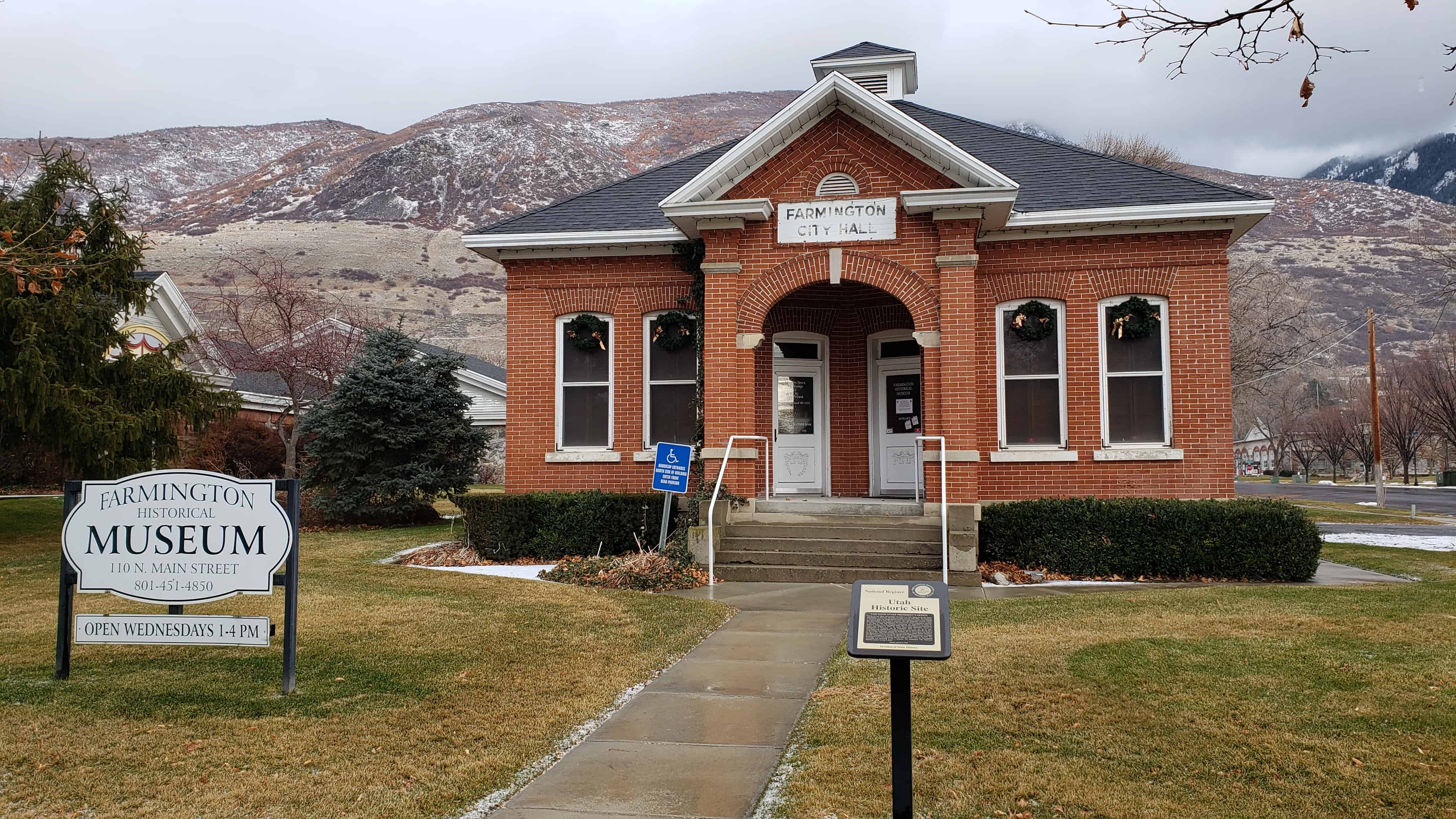
During the late 1800s, this property was used as an LDS tithing lot for hay, grain, and produce. At that time, all of Davis County was one LDS Stake. The president of the Davis Stake was Joseph Hyrum Grant, who resided in Woods Cross, making him inaccessible to most church members. The LDS leadership ordered a Stake President’s Office to be located near the center of the Stake’s population, and here it was built in 1907. The building’s construction was supervised by James H. Robinson, bishop of the Farmington Ward. After the North Davis and South Davis Stakes were formed in 1915, the South Davis Stake Presidency moved its headquarters to Bountiful, and the Farmington office was put up for sale. Farmington City purchased the property and moved its offices from the top floor of the County Courthouse, turning this building into the Farmington City Hall in the fall of 1917. Part of the building was converted into a library, and the Volunteer Fire Department used the east bay for storage of fire-fighting equipment. In August of 1970, Farmington City moved its offices into a new building to the north. The Farmington Lions Club leased the old City Hall until 2001, when the city regained ownership and renovated it into a museum. The Farmington City Historical Museum opened on July 9, 2004.
The old tithing office/Bishop’s Storehouse in Spring City, Utah. I’ve been trying to document all of the old tithing offices I can (see the link below for others). This one was built in 1905 and is very similar to those in Fountain Green and Ephraim.
In 1905 the Sanpete Valley received five new Bishop’s storehouses built from a standard plan: Fountain Green, Manti, Fairview, Ephraim and Spring City. These buildings were constructed to receive tithing, store ward records, and to hold meetings. This storehouse was built of stone and brick under a pyramidal roof with a corner entry framed by low rounded arches. The storehouse was once part of a tithing yard with a granary, cellar and barn. In the 1930s it was converted to a Relief Society Hall with a canning room. It also housed the DUP museum for a short while. It was restored and converted to a residence in the late 1990s.*
Built in 1906, this is one of 28 still extant, well-preserved tithing buildings in Utah designed from one of at least three standard plans. It is almost identical to the design of the Ephraim, Spring City, and Fairview tithing offices. One half of the facade consists of an arched porch set in the northeast corner; the other half has three windows. This is a one-story building with tall sandstone foundation and red brick walls plus a pyramid-shaped hip roof. A carved stone inscription plaque distinguishes it from its neighbors. The building is very well-preserved and has undergone some careful restoration. Bishop C.J. Christensen had this building constructed at a cost of $2300. He managed this tithing office between the 1850’s and 1910. It was also used as women’s Relief Society building. Vacant during the 1950’s it is now used by the Daughter of the Utah Pioneers.(*)
Built in 1908, the Fairview Tithing Office is historically significant as one of 28 well preserved tithing buildings in Utah that were part of the successful tithing system of The Church of Jesus Christ of Latter-day Saints (LDS or Mormon church) between the 1850s and about 1910. Tithing lots, which usually included an office and several auxiliary structures, were facilities for collecting, storing, and distributing the farm products that were donated as tithing by church members in the cash-poor agricultural communities throughout the state. Tithing offices were a vital part of almost every Mormon community, serving as local centers of trade, welfare assistance, and economic activity. They were also important as the basic units of the church-wide tithing network that was centered in Salt Lake City.
The Fairview Tithing Office was built in 1908 to serve as the new tithing office for the Fairview Ward. Also located on the tithing lot were a barn, granaries, and corrals to keep the farm products and livestock that were donated as tithing to the church. None of those buildings or structures are still standing. This building has three rooms on the main floor and a basement, in which was stored fresh produce, eggs, hams, etc. A safe for storing the cash tithing was located in the rear room on the right side, and the two front rooms were used as the bishop’s office and for bishop’s meetings.
Approval to construct the Fairview Tithing Office was received in March 1908 from the Presiding Bishopric’s Office of the LDS church by Bishop James C. Peterson of the Fairview Ward. His request of the previous year, “for a tithing office for the Fairview Ward similar to that built at Fountain Green,” was denied because the tithing office construction fund for that year had already been exhausted. 1 The Fairview Tithing Office, which was completed in either late 1908 or early 1909, was constructed at a cost of just over $2000.
The design of the Ephraim Tithing Office was one of at least two standard tithing office plans that were developed at church headquarters around 1905 and sent out to a number of wards in the state that requested to have a new tithing office built. Those plans were perhaps the first examples of what eventually became a policy with the church – developing standard building plans at church headquarters rather than having each ward generate its own. Other tithing offices in the state that have virtually the same design as the Fairview Tithing Office, referred to as “tithing office no. 2,” are those in Garland, Ephraim, Fountain Green, and Spring City.
In 1932, the tithing office was apparently no longer needed by the Fairview Ward, so it was sold to Henry A. Rasmussen, who has lived there ever since.
The Fairview Tithing Office is a one story square red brick building with a coursed sandstone foundation and a pyramid roof. It was designed from one of at least three standard plans which were created for tithing offices about 1905, two of which have been identified. The plan type of the Fairview Tithing Office has been identified as Type No. 2, and is almost identical to the design of the Ephraim, Spring City, Fountain Green, and Garland Tithing Offices. Typical of this particular design is the asymmetrical facade divided into equal halves by a simple buttress. One half consists of an arched porch set into the southeast corner. The other half is composed of three double hung sash windows. There is a large sandstone block centered over the buttress. Inside the porch a door is centered between two double hung sash windows. There is a second smaller arched opening at the east end of the porch. In addition there is a door flanked by two windows on the east wall, and a single window is set into the west wall. All of the windows and doors have sandstone sills and lintels. Triangular vents are centered on the front and back roof sections, and there are dormers on the east and west roof sections. Dormers were not a standard element on tithing offices of this type, and they may represent a later addition. They complement the building in scale and massing, and therefore are an unobtrusive addition. Except for the possible addition of the dormers, the Fairview Tithing Office is unaltered on the exterior and maintains its original integrity.