Tags
Millard County Court House
10 Monday Jan 2022
Posted in Uncategorized

10 Monday Jan 2022
Posted in Uncategorized
Tags
26 Sunday Sep 2021
Posted in Uncategorized

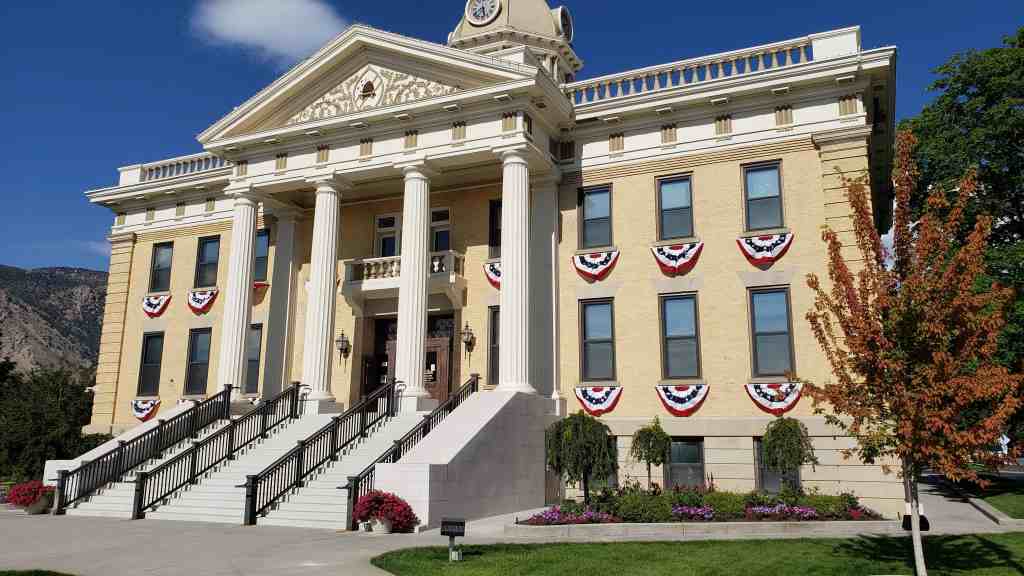
Constructed in 1857 and greatly enlarged in 1910, the Box Elder County Courthouse is historically significant as the center of government in Box Elder County for over 130 years. The building has housed virtually all departments of the county government, including the court and judge’s chambers, commission chambers, offices of the cleric, recorder, assessor, and so forth. No other courthouse has ever been built in the county, therefore, this is the only building associated with the administration of Box Elder County governmental affairs. The building is also architecturally significant as the best example of the Neo-Classical Revival style in both Brigham City and Box Elder County. The significant stylistic features are confined only to the 1910 section of the building; the 1857 section is now the non-descript rear wing. The Neo-Classical Revival style was used in Utah primarily just for public and institutional buildings, such as schools, civic buildings, and churches. No other examples of the style have been identified in the Brigham City area.
Located at 1 North Main Street in Brigham City, Utah
Related:

The county courthouse was begun in 1855 or 1856 as the first public building in the area. Vaughn Nielson in The History of Box Elder Stake stated that the rock walls for the basement story were all laid by the fall of 1856. After these basement walls were laid up and windows and doors installed, the structure was covered with a temporary roof, and the building was utilized for meetings and drama during the winter of 1856.
In 1857, two stories of adobe brick were built upon this foundation, but before the walls were finished, a strong wind partially blew them down. These walls were then rebuilt and the building was completed before the end of 1857. Lorenzo Snow, the leader of the community, stated that “by the fall of 1857 they had built the second and much better court house, the upper story of which was 45 x 65, while the original basement room was 22 x 45.” He says the roofing of the new structure was fastened with wooden pins.
The cost to construct this building came from donations or labor tithing provided by the townspeople, the vast majority of whom were members of the LDS or Mormon church. The men of the area were asked to spend one tenth of their time working, or were required to supply materials for the workers. Among those who labored on the building were George F. Hamson Sr. who donated ten thousand adobes, William Wrighton, D.M. Burbanks and Peter Baird did carpentry work, Lars Stranquist did rock masonry work, and Joshua Holland did plastering work.
As the only public building for a time, it had many uses: a church, a school, a dance hall, and a theater. Before the community was divided into wards (ecclesiastical boundaries) and separate churches were built, the people of the entire community met in the large upstairs room of the building for church services. It was the largest hall in town and had a gallery built into the entire west end of it with a choir loft under the gallery. A stage was located at the east end of the room and a table was placed on this stage which served as a pulpit during church meetings, When stage entertainment was held, public and church officials sat with their wives in the choir loft. After the town’s division into wards, the Fourth Ward continued to hold church services in the courthouse. They met in the down-stairs east room until 1880.
School was taught in the downstairs east room of the building as late as 1880 and theatrical productions were staged first in the basement, where the scenery was painted directly onto the walls, and later in the large hall upstairs where religious and social functions took place.
County and city government meetings were also held in the early courthouse. Brigham City was incorporated in 1867, and meetings with the mayor and city council at first took place quarterly, then by 1894 bi-monthly sessions were held.
By the early 1870’s there was a large bell which hung in the tower (on the roof) of the courthouse which signaled work time, lunch time, and quitting time with the Brigham City Co-operative enterprises. It also was a fire bell. Late in 1892, the old bell cracked and was replaced by a borrowed one. This one also cracked when it was rung too long celebrating Utah’s Statehood day on January 4, 1896. A town clock was procured in April 1887 for $433.15 and during this year the building was remodeled with a clock tower added plus Italianate detailing on the building. Around the turn of the century, the top floor of the courthouse was being used for the district courtroom, assessor’s office, commissioner’s chambers, sheriff’s office and judge’s chamber.
In January 1910 a major addition to the front (west end) of the original adobe structure was planned by the county commissioners. Local architects Funk and Wells designed this Neo-Classical style addition, which included four large pillars and a larger clock tower in which the 1887 clock would be placed. S.A. Sackett was accepted to do the construction with the low bid of $67,521.00.
By the spring of 1910, the new addition was well underway. it took a year and one-half to complete, and on November 14, 1911, county and district officials moved into the new wing. The Box Elder News of Thursday, November 9, 1911 gives a detailed description of the building and its interior arrangement.
Few changes have been made to the building since its completion. A new clock was purchased for the clock tower in 1950 and in 1960 a small addition was constructed on the northeast part of the building, which was the original adobe part. The architect was Don Frandsen and the contractor was Wayne A. Jensen. This new addition provided more office space for the assessor and treasurer plus additional office space in the basement. The board of education quarters on the top floor was also remodeled at that time – a section of the corridor was partitioned off for office spaces. the Daughters of Utah Pioneer’s relic hall that had been located in the several rooms at the top floor from 1928 until the 1940’s became more visible when it was put behind a glass partition in the hallway of the basement in 1948.24 Those exhibits were moved to the city museum-gallery in 1978 when the hallway was narrowed to accommodate an elevator for handicapped access. the board of education also moved out of the courthouse in March of 1977 when it acquired an old church building for its offices at 230 West 200 South.




12 Friday Mar 2021
Posted in Uncategorized
Tags

This courthouse was the 3rd Davis County Courthouse built, it was completed in 1932. I stopped by in 2021 to document the demolition of the 1958 addition.
It is located at 28 East State Street in Farmington, Utah.
It was also the location for filming this movie scene.
Also nearby:


08 Wednesday Jul 2020
Posted in Uncategorized
Tags

The old Sevier County Courthouse in Richfield before it was demolished.
23 Monday Mar 2020
Posted in Uncategorized
Tags
Courthouses, Historic Buildings, Manti, NRHP, PWA Projects, Sanpete County, utah, WPA

The gorgeous Sanpete County Court House is located at 160 N Main in Manti, Utah.
It is on the National Register of Historic Places and was build in 1935 as a PWA project.
Related:


These are some of the cool paintings I saw inside:


11 Thursday Oct 2018
Posted in Uncategorized

Frank E. Moss Federal Courthouse
Salt Lake City Federal Building and Post Office
1902-1905, James Knox Taylor, Supervising Architect of the Treasury
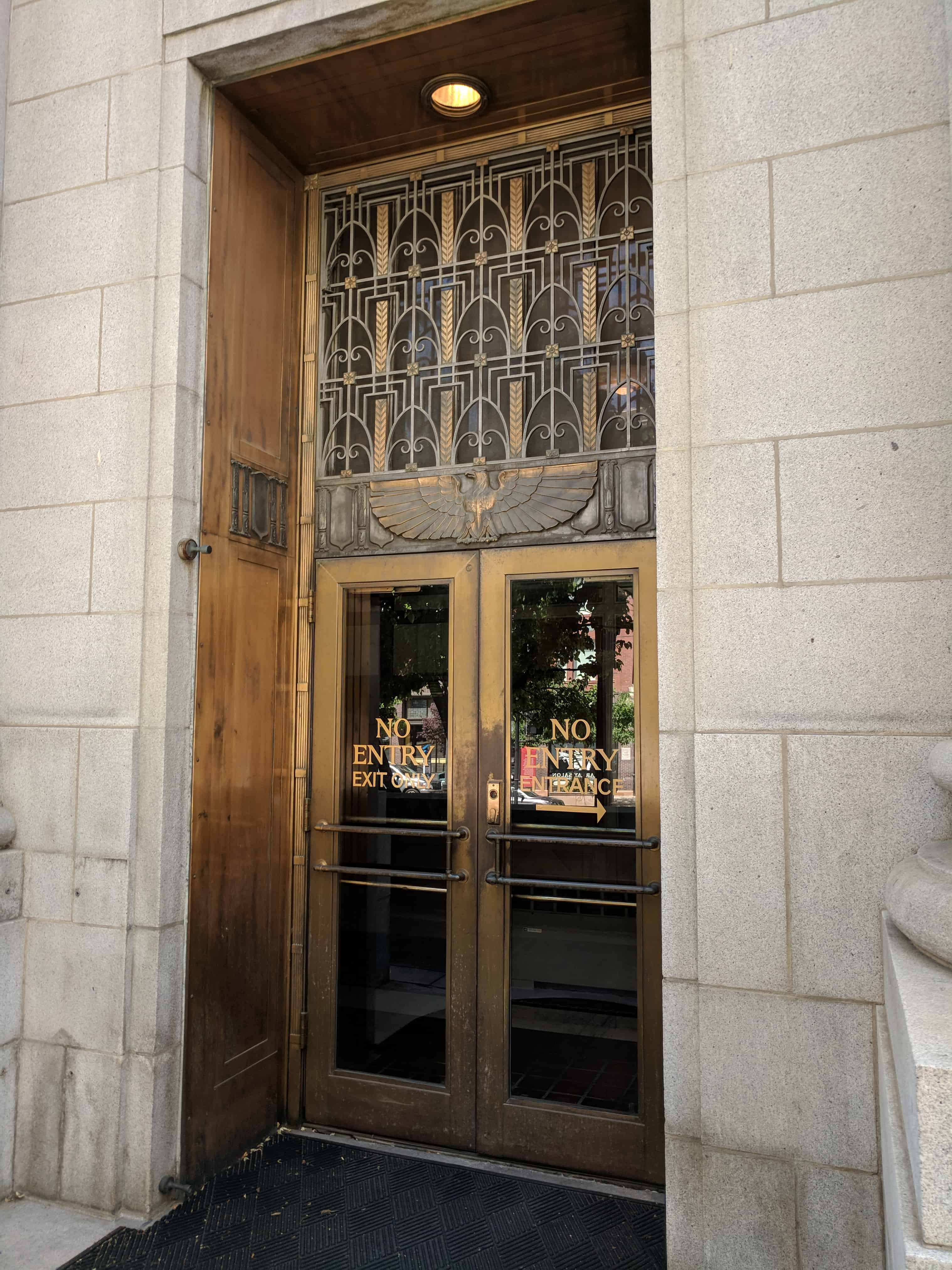
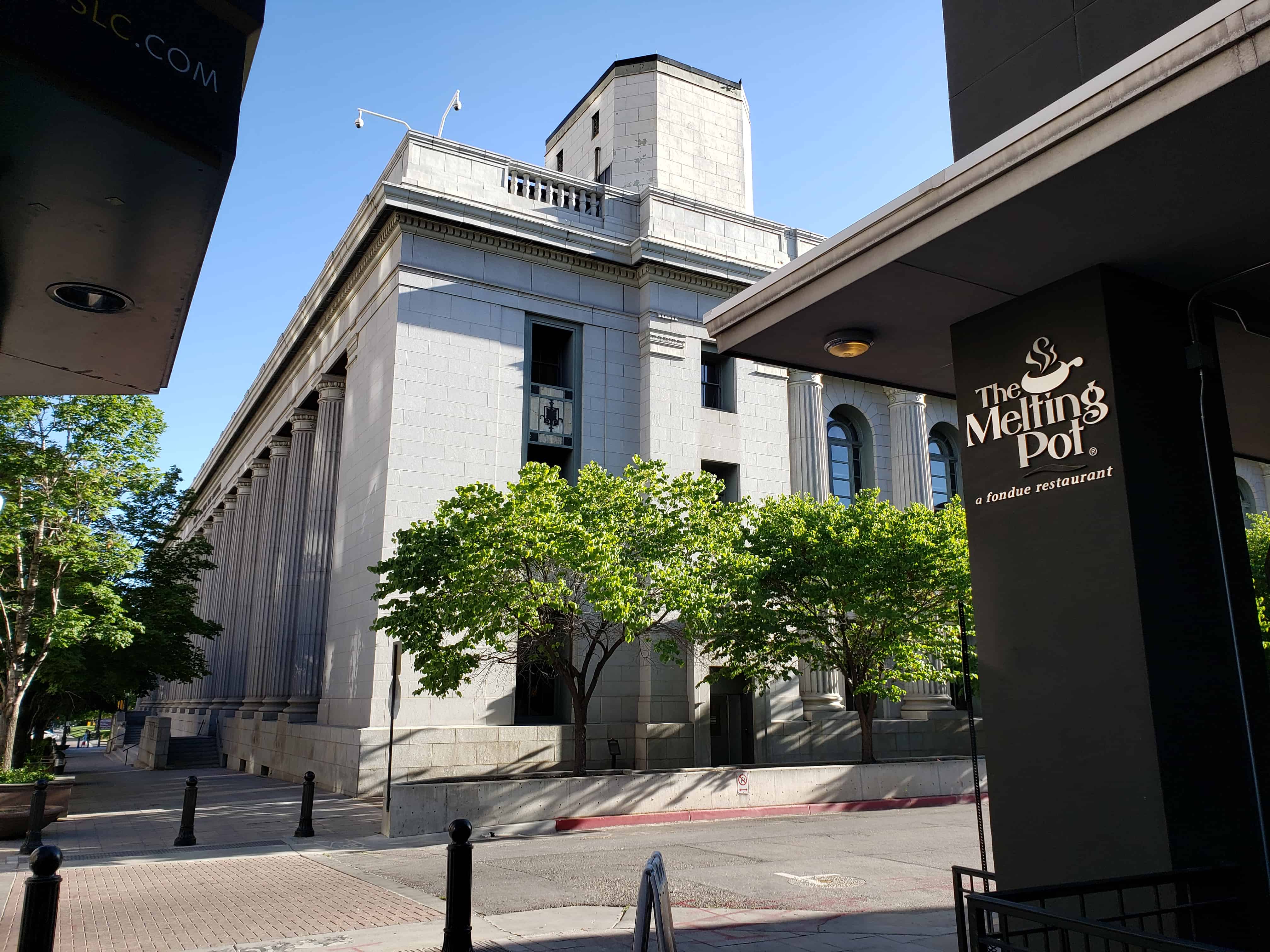
After Utah became a state in 1896, the Federal Government began planning a building to house federal offices in Salt Lake City. The Treasury Department considered two sites for the building. After vocal opposition from many of Salt Lake City’s leading non-Mormon businessmen to a site offered by the LDS Church near Temple Square, the federal government purchased this site. Completed in 1905, this building was one of the earliest examples of Neoclassical style architecture in Utah. Originally serving as a combination post office, courthouse, and federal building, it became the anchor of the non-Mormon south downtown business district.
This is part of the Exchange Place Historic District.


350 South Main Street in Salt Lake City, Utah








25 Sunday Jun 2017
Posted in Uncategorized
Tags
Beaver, Courthouses, DUP, historic, Historic Markers, Millard County, utah

Beaver Territorial Courthouse
Beaver Territorial Courthouse is considered one of the finest examples of Pioneer architecture. The architect, K.A. Kletting, designed the building in the Queen Ann style with Victorian overtones. The courthouse was constructed under the direction of William Stokes, a soldier of the Union army, stationed at nearby Fort Cameron. Constructed of local materials, the courthouse was built between 1877 and 1882, twenty-one years after Beaver was settled. The original cost of construction was $10,900. the three-storied structure had a deep basement made of black volcanic rock, and the upper portion was constructed of red brick. The building was finished with a tower, which was equipped with a good striking clock which faced all four directions. The clock chimed hourly. Throughout the years additions have been made to the original structure. Vaults and a county jail built of pink sandstone were eventually added to the courthouse.
Beaver was proclaimed the seat of the Second District Territorial Court in September 1870. During that time, the courthouse served as the center of justice for the expansive territory bordered by the Colorado River on the east and south and Nevada Territory on the west. Utah received statehood in 1896 and the Beaver Territorial Courthouse became known as the Beaver County Courthouse.
The courthouse survived a fire in 1889, an earthquake in 1901, and intended demolition in 1970, when a new courthouse was constructed. The courthouse was saved from demolition by the diligent efforts of Beaver Company Daughters of Utah Pioneers. Their committee, comprised of Susie Beeson, Clerynth Larson, Lulu T. Tanner, Viola Yardley, Phoebe Warby, Alta C Hickman, Margery Mackrell, Delia Nowers, Beatrice Hurst, and Jessie Ward, petitioned State Senators and County Commissioners to save the building. On December 5, 1974, county officials and DUP signed a 100-year lease which saved the historically significant courthouse. The building is now used as a DUP Pioneer Museum, and it is hoped that the building will remain in place for many generations for all posterity to enjoy. Renovations were completed in 2010.
Daughters of Utah Pioneers historic marker #570, located on the Beaver County Courthouse at 90 East Center Street in Beaver, Utah.


10 Monday Oct 2016
Posted in Uncategorized
Tags
Courthouses, DUP, historic, History, NRHP, St. George, utah, Washington, Washington County
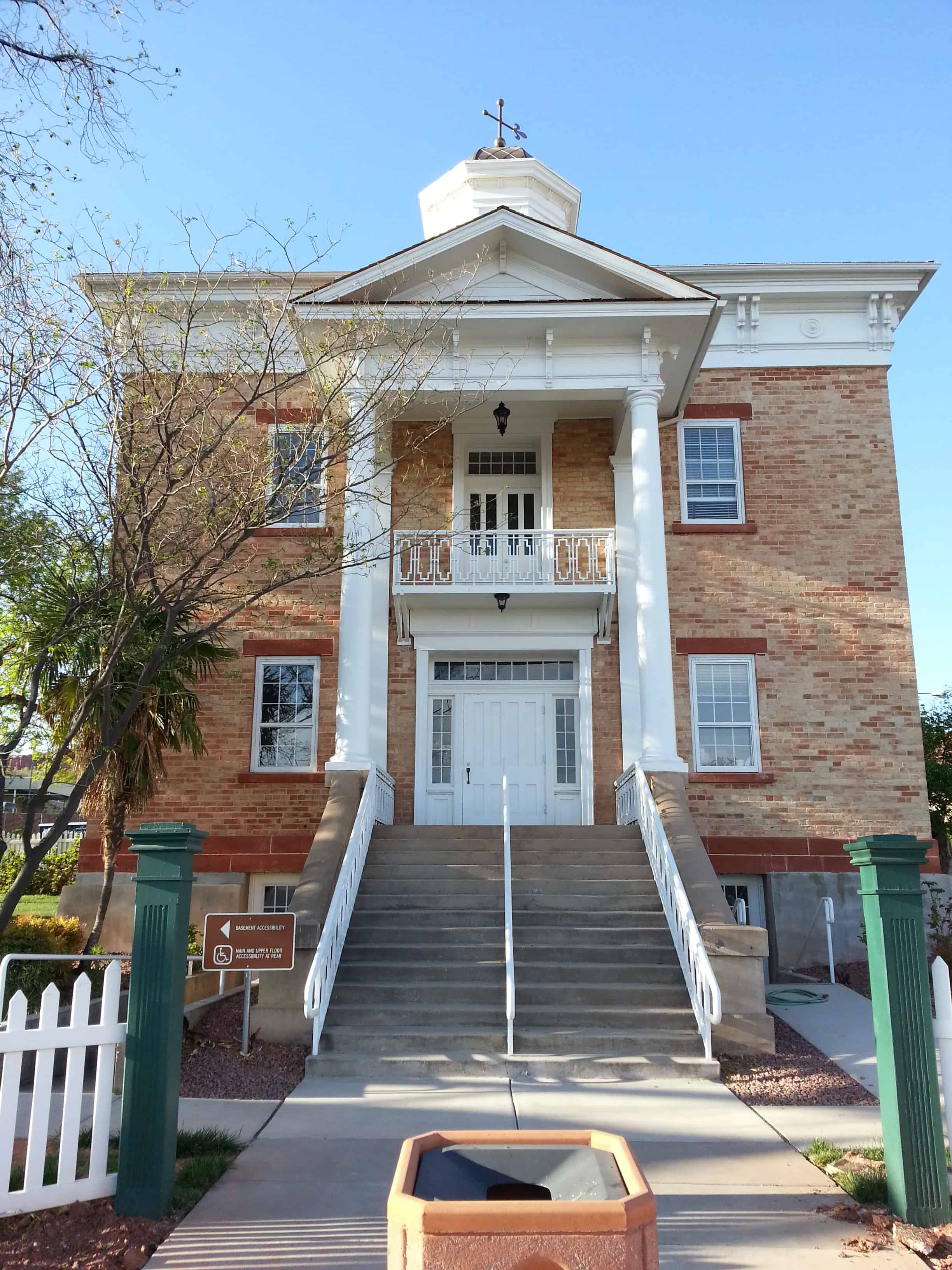
Pioneer – Washington County – Courthouse
St. George was designated as the County Seat on January 14, 1883. This building was begun in 1866 and completed in 1876. It served the County government as offices, the 18-inch thick walls housed the jail in the basement and school was held upstairs during the day and served as a courtroom by night. Still reflecting days old are the original panes of glass alongside the entrance doors, the chandeliers, security vault, exterior cornice work, roof cupola dome and original murals of Zion and Grand Canyons in upstairs assembly room.

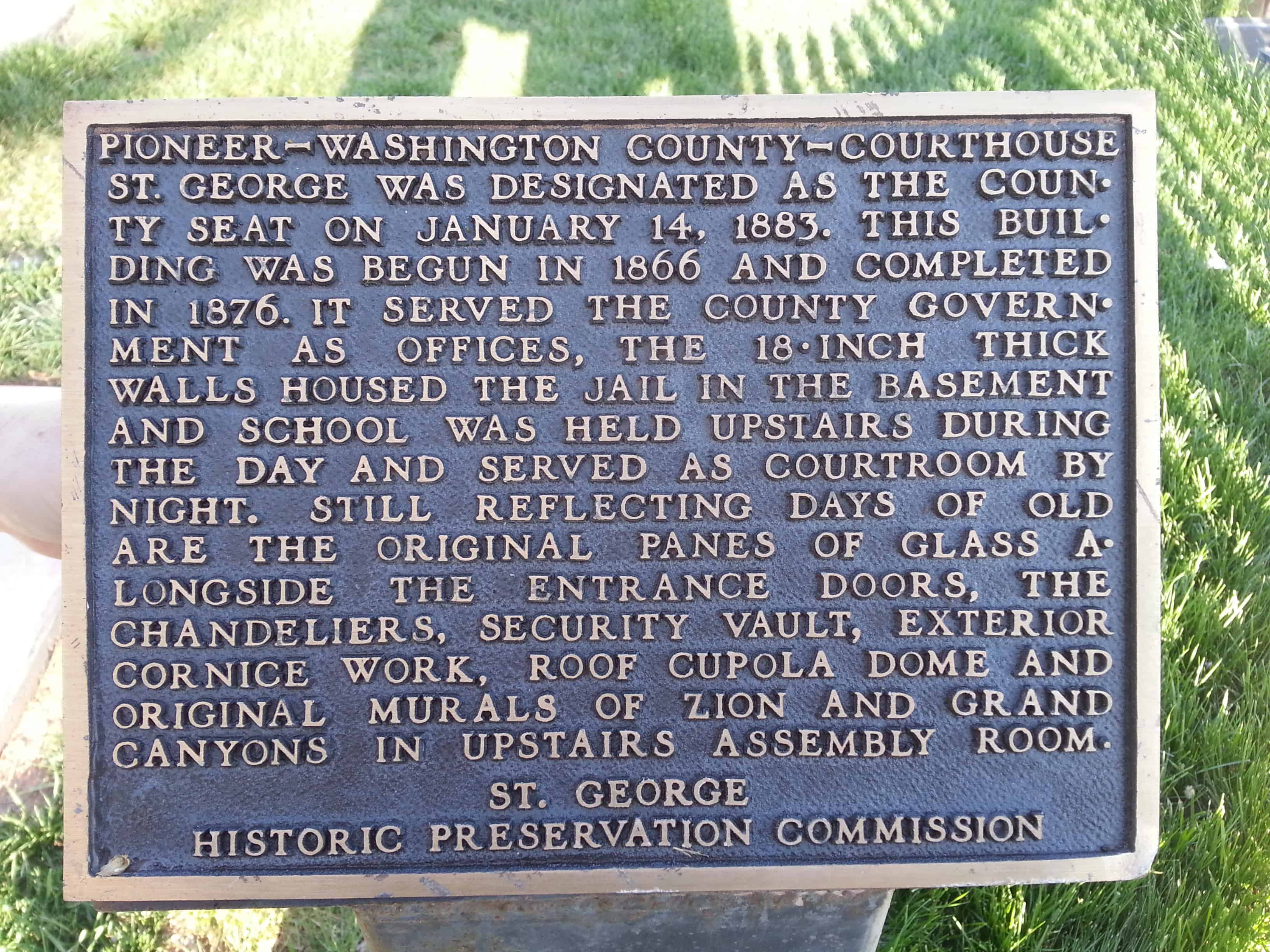
DUP Markers #14 and #298 are here.


Located at 97 East 100 North (St. George Blvd) in St. George, Utah, the Old Washington County Courthouse was listed on the National Historic Register on (#70000634) September 22, 1970.
Washington County, like most of Utah, was colonized by Mormon settlers Public life centered around the church and church leadership. Several fine public buildings, constructed In St. George, still remain today. One of these, the old Washington County Courthouse, is distinctive. It was the first, in fact the only, major public edifice built in Washington County during Utah’s Territorial period that was strictly a “citizen of Utah” effort. It was financed by tax assessment, usually in “kind or labor,” rather than by tithing or church donations.
St. George was settled late in the year 1861. In 1863, the county seat was moved from the town of Washington to St. George. The court consisted of Judge James D. McCullough and Selectmen, Robert D. Covington, Jacob Gates, and Annon P. Winsor. James S, Bleak was appointed probate and county clerk. They first met in September 1863 to organize. Their next meeting was September 4, 1865. In November 1866 plans were approved to build a basement for a courthouse in St. George. An appropriation of $560,00 was made, to be expended by Judge McCullough. Excavation on the basement got underway. The following August 1867 a tax of 1/4 of one percent to raise $10,000 was discussed. A public vote approved the action. In September 1869 the tax was increased to 3/4 of one percent by public vote. The court approved $1,500 and assigned Jacob Gates to supervise the construction. The building was completed and accepted by the county in 1876.
Raising revenue in a barter economy was difficult. At a special session the “Court,” in October 1869, set the following prices for goods: molasses, $1.25 per gallon; corn, $1.50 per bushel; cotton yard, $2.50 per bunch; flour, $8.00 per cwt.
in most instances men working on the building paid their taxes in kind, received 3 dollar wage, but were paid in kind. Disbursement prices of tax items reflect a good profit to the county: molasses, $2,00 per gallon; corn, $2.00 per bushel; cotton yard, $5.00 per bunch; and flour, $10.00 per cwt.
But the citizens of Washington County persisted and constructed an impressive courthouse that served the county well until as late as 1960. Their story is even more significant when it is realized that these same people, through the Mormon Church, were also building both their Mormon Temple and Tabernacle during the same period of time. All three of these projects were a kind of public works effort to shore up the sagging economy of southwestern Utah. They represented the skilled craftsmanship of those pioneers.
06 Wednesday Aug 2014
Posted in Uncategorized
Tags
1890s, City Office Buildings, Courthouses, Eureka, historic, Juab County, NRHP, utah

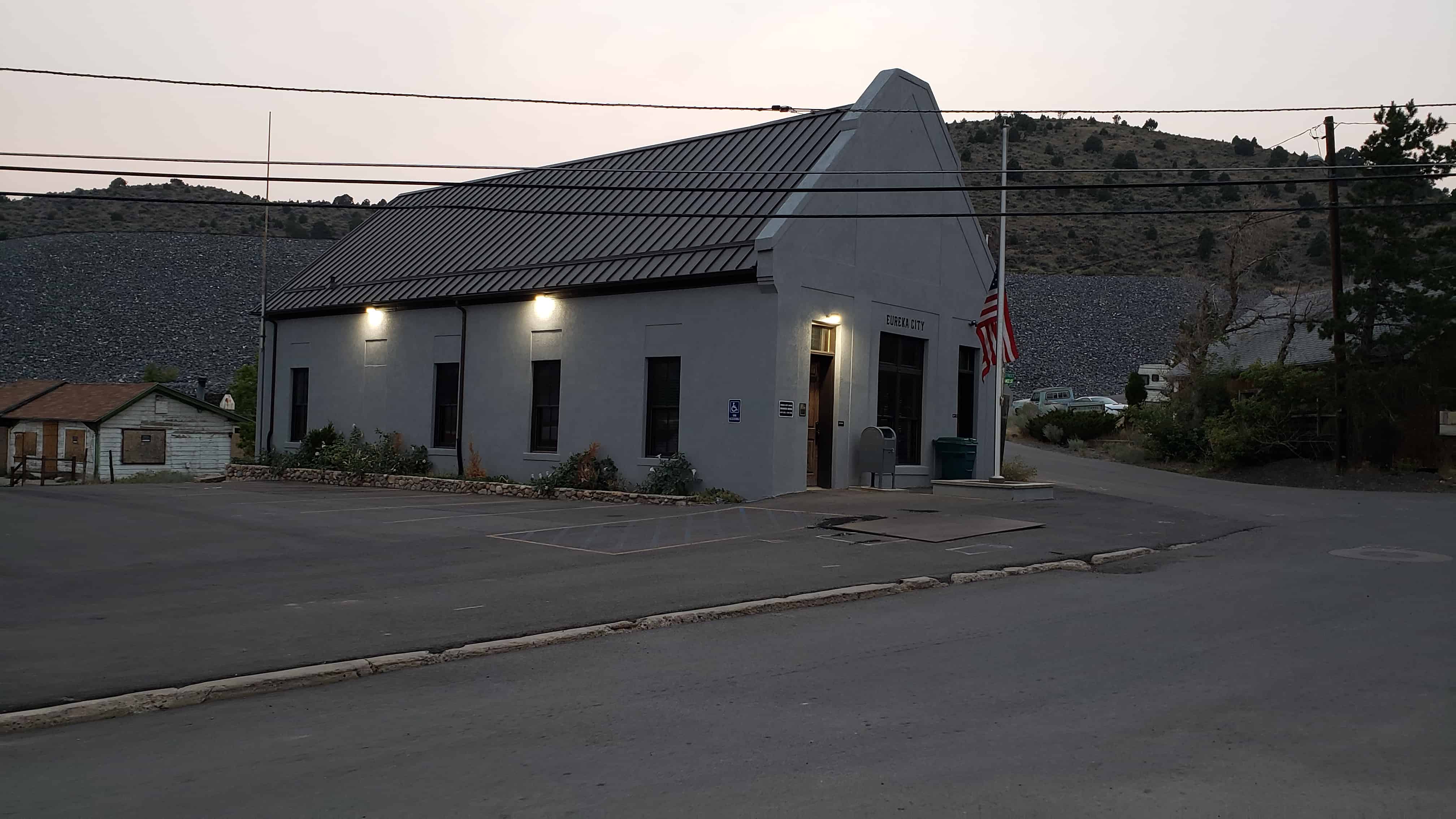
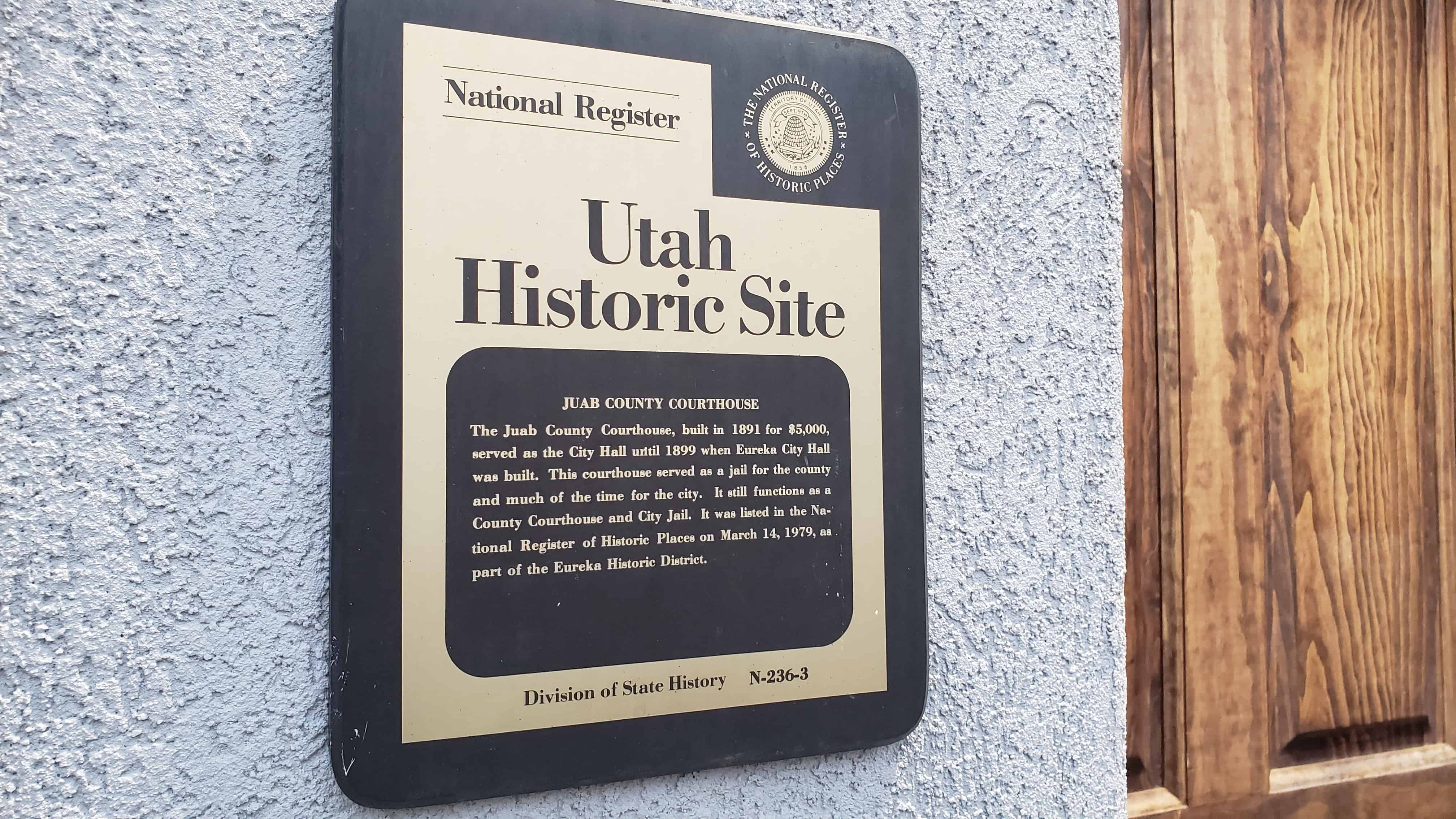
The Juab County Courthouse, built in 1891 for $5,000 served as the City Hall until 1899 when Eureka City Hall was built. This courthouse served as a jail for the county and much of the time for the city. It still functions as a County Courthouse and City Jail. It was listed in the National Register of Historic Places on March 14, 1979, as part of the Eureka Historic District.
Located at 15 Church Street in Eureka, Utah

a

23 Thursday Jan 2014
Posted in Uncategorized
Tags
City Hall Buildings, Courthouses, DUP, historic, Historic Markers, museums, NRHP, Tooele, Tooele County, utah

Pioneer City Hall
Erected in 1867 as a County Court House. Active in construction were James Hammond, William Broad, Isaac Lee, W.C. Gollaher, John Gillespie, George Atkin, and John Gordon. The building was used for Court House, City Hall and Amusement Center, until 1941, when the new city hall on Main Street was completed. Later the building was turned over to the Daughters of Utah Pioneers for use as an amusement and meeting hall.
Rock used in building was taken from Settlement Canyon in Tooele County.
The text above is from Daughters of Utah Pioneers historic marker #84, located at the Tooele County Courthouse and City Hall at 41 East Vine Street in Tooele, Utah. Marker #395 is also located here.
Related Posts:


Tooele County Courthouse and City Hall
This Greek Revival temple-form building was constructed in 1867 using local stone. The belfry, added sometime after 1874, is Picturesque in style and has lathe-turned posts accentuated by scroll brackets, a distinctive spindle band, and a slightly bellcast pyramid roof. The hall was built, according to a newspaper article of the time, by the citizens of Tooele “for a dancing hall, for dramatic representations and other social and intellectual purposes.” It was leased to William C. Foster and Thomas Croft but was also used for holding court and other city and county business. Live entertainment, however, proved financially unsuccessful, and by 1871 the hall was utilized primarily as a courthouse. In 1899 a new courthouse was constructed, and the building became solely the city hall. In 1942, with the construction of a new city hall, it was authorized for use as a museum by the Daughters of the Utah Pioneers.


