Archbishop Joseph S. Alemany of the Diocese of San Francisco asked Father Lawrence Scanlan to settle in the mining town of Silver Reef and minister to the miners and their families. Father Denis Kiely arrived in Utah in 1874 and assisted Father Scanlan in Silver Reef. Fathers Henry T. Hyde, P. O’Conner, and P. Galligan also also served the people in Silver Reef from 1880 to 1882.
In 1879, Father Scanlan established the St. John’s Catholic Church, the Silver Reef Hospital, and St. Mary’s School in Silver Reef.
When the church was first constructed, it didn’t have a tower. But Father Hyde collected money and eventually the tower was erected and a 400 lb bell was installed.
St. John’s Church was closed in 1885.
In 1895, William Stirling purchased and moved the vacant St. John’s Catholic Church from Silver Reef to Leeds. He converted the building into the Leeds Social Hall or “Old Stirling Hall.”
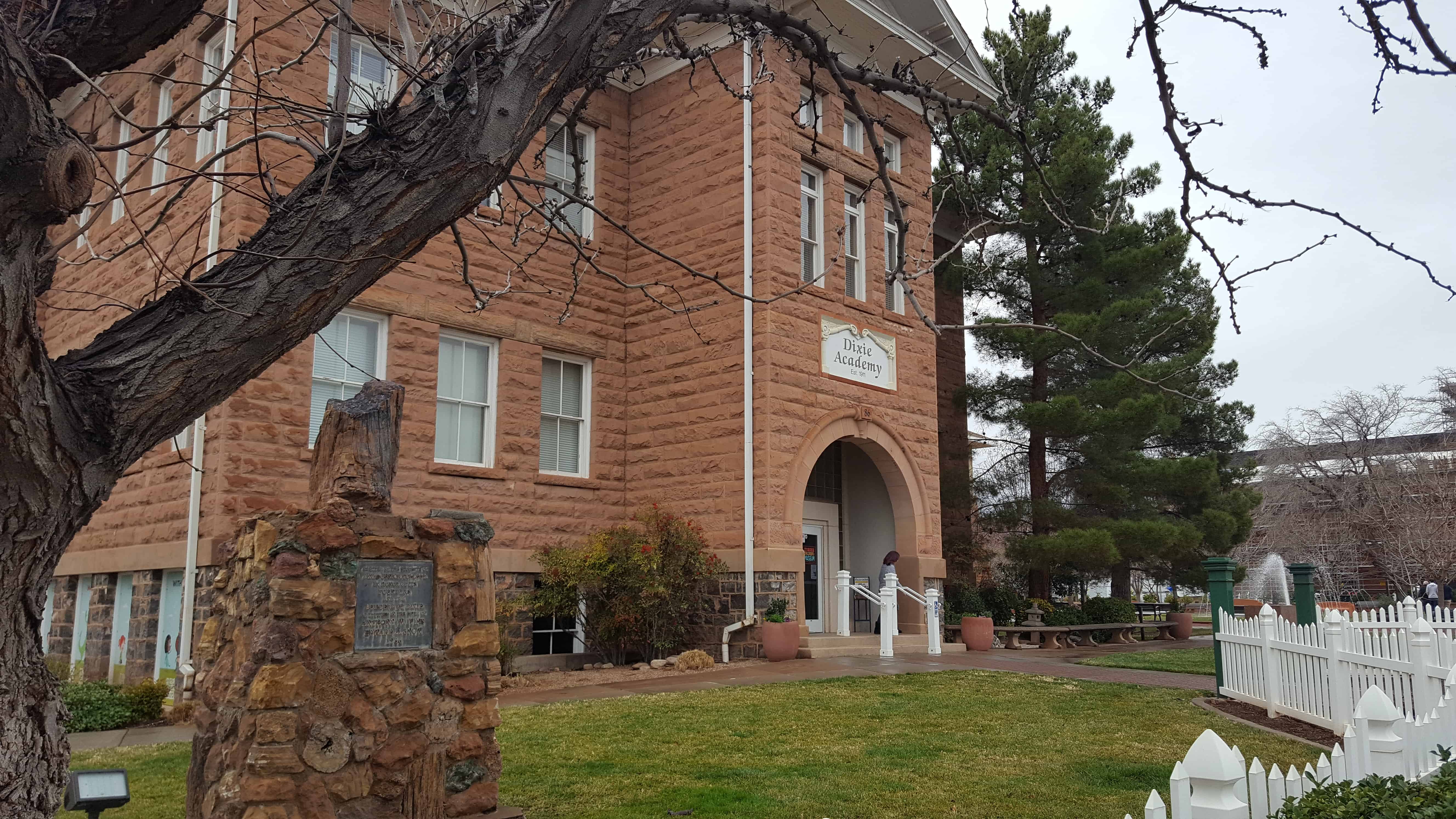
Dixie Academy was constructed to provide advanced courses of study. The St. George Stake Academy officially began in 1888 and moved into this building in 1911. A four year program was recognized as two years of senior high and two years of college. The college program grew into the institution known and Dixie Jr. College and eventually Dixie College.
The original “Round Station” Pony Express station, located about three miles west of here, was burned down in an Indian attack, rebuilt with stones on this site, and renamed Canyon Station.
Stories of solitary Pony Express riders valiantly galloping through the western frontier still inspire people around the world. Publishers and editors during the 1860s often developed romanticized tales of the Wild West. Eyewitness accounts paint a more accurate picture of frontier history.
British explorer Sir Richard Burton visited Salt Lake City in September of 1860. His journal entries paint an eerie image of the Overland Stage and Pony Express stations west of the Great Salt Lake. Near the top of Overland Canyon, Burton wrote: “Nothing, certainly, could be better fitted for an ambuscade than this gorge, with its caves and holes in snow-cuts, earth-drops, and lines of strata… in one place we saw the ashes of an Indian encampment; in another, a whirlwind, curling, as smoke would rise from behind a projecting spur, [it] made us advance with the greatest caution.”
When en route to California, author Mark Twain vividly recounts his experience as a Pony Express rider gallops past his stagecoach: “We had a consuming desire from the beginning to see a pony-rider, but somehow or other all that passed us… managed to streak by in the night, and… the swift phantom of the desert was gone before we could get our heads out of the windows. But now we were expecting one… Away across the endless dead level of the prairie a black speck appears against the sky, and it is plain that it moves.”
“In a second or two it becomes a horse and rider, rising and falling, rising and falling – sweeping toward us nearer and nearer – growing more and more distinct, more and more sharply defined – nearer and still nearer, and the flutter of the hoofs comes faintly to the ear… another instant a whoop and a hurrah from our upper deck, a wave of the rider’s hand, but no reply, and man and horse burst past our excited faces, and go winging away like a belated fragment of a storm!”
Atrocities and Hostilities
American Indians inhabited lands along the Pony Express Trail for thousands of years before the Pony began its historic run. From the 1840s through the 1860s, they watched swarms of white settlers cross their homelands – impacting traditional hunting grounds with cattle and oxen grazing prairie grasses down to bare ground, and then the senseless killing of thousands of buffalo.
A long history of hostilities on both sides, combined with the terrible atrocities committed by hordes of miners during the 1859-60 rush for silver and gold at the Comstock Lode Mine in western Nevada, launched several years of conflict throughout the Great Basin area. Emigrant wagon trains, Pony Express riders, and station keepers alike began experiencing the angry reactions of regional tribes.
Pony Express riders and station workers alike were frequent targets of attack. Because they could hide safely behind cabin walls during an attack, one might think that workers in the station were safer than the riders were. Not so – more station workers were killed than riders were. Unlike riders who could usually outrun threats, station keepers were sitting ducks. Most of the stations across western Utah and Nevada were not much more than flimsy shelters – frequently located in remote areas far from help.
British adventurer, Sir Richard Burton, on his way west from Salt Lake City in 1860, made this observation on the stations:
“On this line there are two kinds of stations, the mail stations, where there is an agent in charge of five or six ‘boys,’ and the express station – where there is only a master and an express rider… It is a hard life, setting aside the change of death – no less than three murders have been committed by the Indians during this year.”
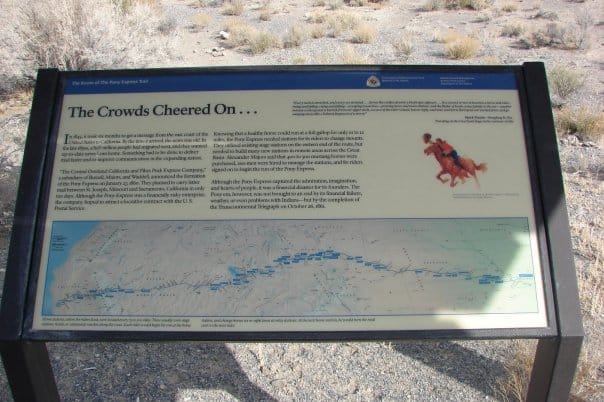
The Crowds Cheered On…
In 1845, it took six months to get a message from the east coast of the United States to California. By the time it arrived, the news was old. In the late 1850s, a half million people had migrated west, and they wanted up-to-date news from home. Something had to be done to deliver mail faster and to improve communication in the expanding nation.
“The Central Overland California and Pikes Peak Express Company,” a subsidiary of Russell, Majors, and Waddell, announced the formation of the Pony Express on January 27, 1860. They planned to carry letter mail between St. Joseph, Missouri and Sacramento, California in only ten days. Although the Pony Express was a financially risky enterprise, the company hoped to attract a lucrative contract with the U.S. Postal Service.
Knowing that a healthy horse could run at a full gallop for only 10 to 12 miles, the Pony Express needed stations for its riders to change mounts. They utilized existing stage stations on the eastern end of the route, but needed to build many new station in remote areas across the Great Basin. Alexander Majors said that 400 to 500 mustang horses were purchased, 200 men were hired to manage the station, and 80 riders signed on to begin the run of the Pony Express.
Although the Pony Express captured the admiration, imagination, and hearts of people, it was a financial disaster for its founders. The Pony era, however, was not brought to an end by its financial failure, weather, or even problems with Indians – but by the completion of the Transcontinental Telegraph on October 26, 1861.
“Every neck is stretched, and every eye stained… Across the endless prairie a black spec appears… In a second or two it becomes a horse and rider, rising and falling, rising and falling – sweeping toward us – growing more and more distinct, and the flutter of hoofs comes faintly to the ear – another instant a whoop and a hurrah from our upper deck, a wave of the rider’s hand, but no reply, and man and horse burst past our excited faces, and go winging away like belated fragment of a storm.” – Mark Twain – Roughing It, 1872.
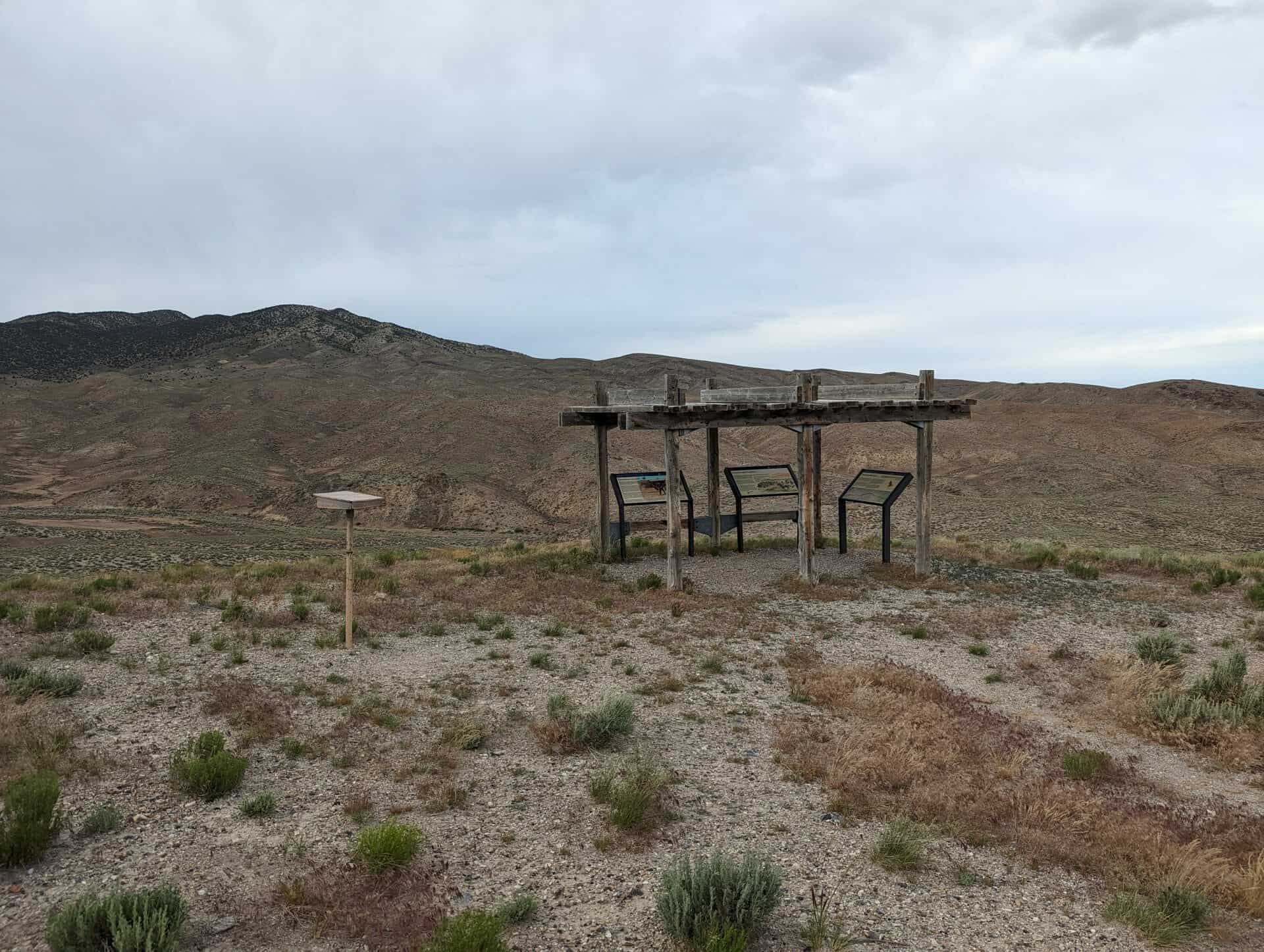
This stabilized fortification, known in modern times as Round Station, was built in 1863 to serve the Overland Stage. It was probably the third incarnation of Canyon Station, the first two having been burned by Indians. The ruin at Round Station is that of a structure probably used for defense, and the foundation of the station is visible to the south and east across the parking lot. The interpretation is the product of a cooperative agreement among the BLM, National Park Service, and the Utah Division of the National Pony Express Association.
Of the canyon ahead, now called Overland Canyon, Burton observed: “Nothing, certainly, could be better fitted for an ambuscade than this gorge, with its caves and holes in snow cuts, earth-drops, and lines of strata, like walls of rudely piled stone; in one place we saw the ashes of an Indian encampment; in another a whirlwind, curling, as smoke would rise, from behind a projecting spur, made us advance with the greatest caution.”
(*)Information provided by Patrick Hearty, NPEA Utah, 2005.
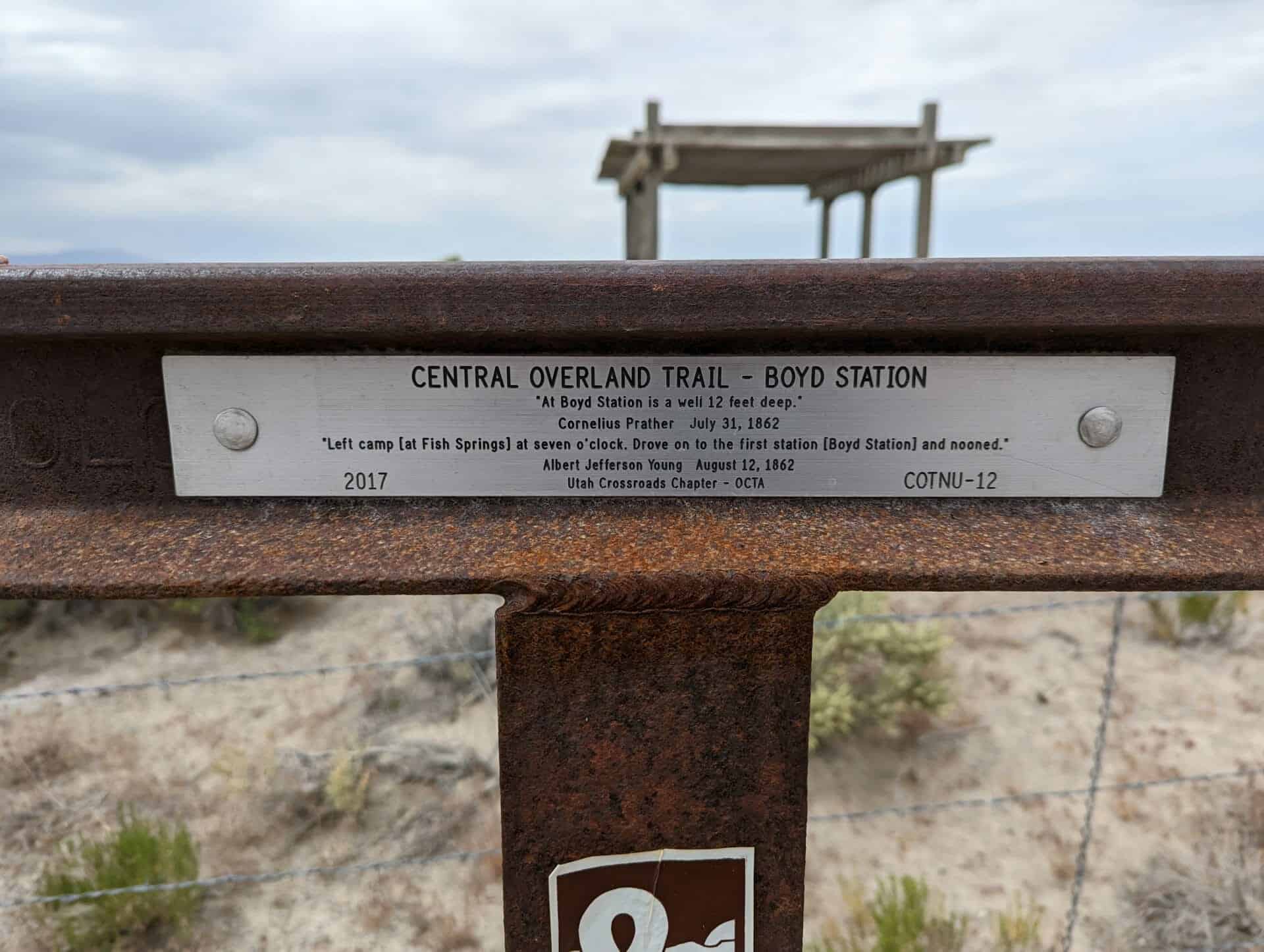
Boyd Station Also known as, Desert Station, Boyd’s Station and Boyd’s Half-Way House
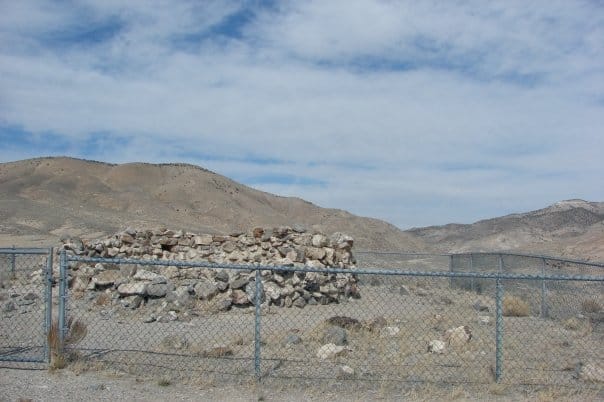
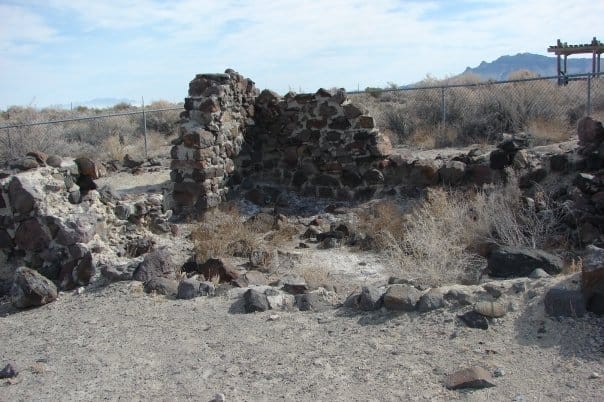
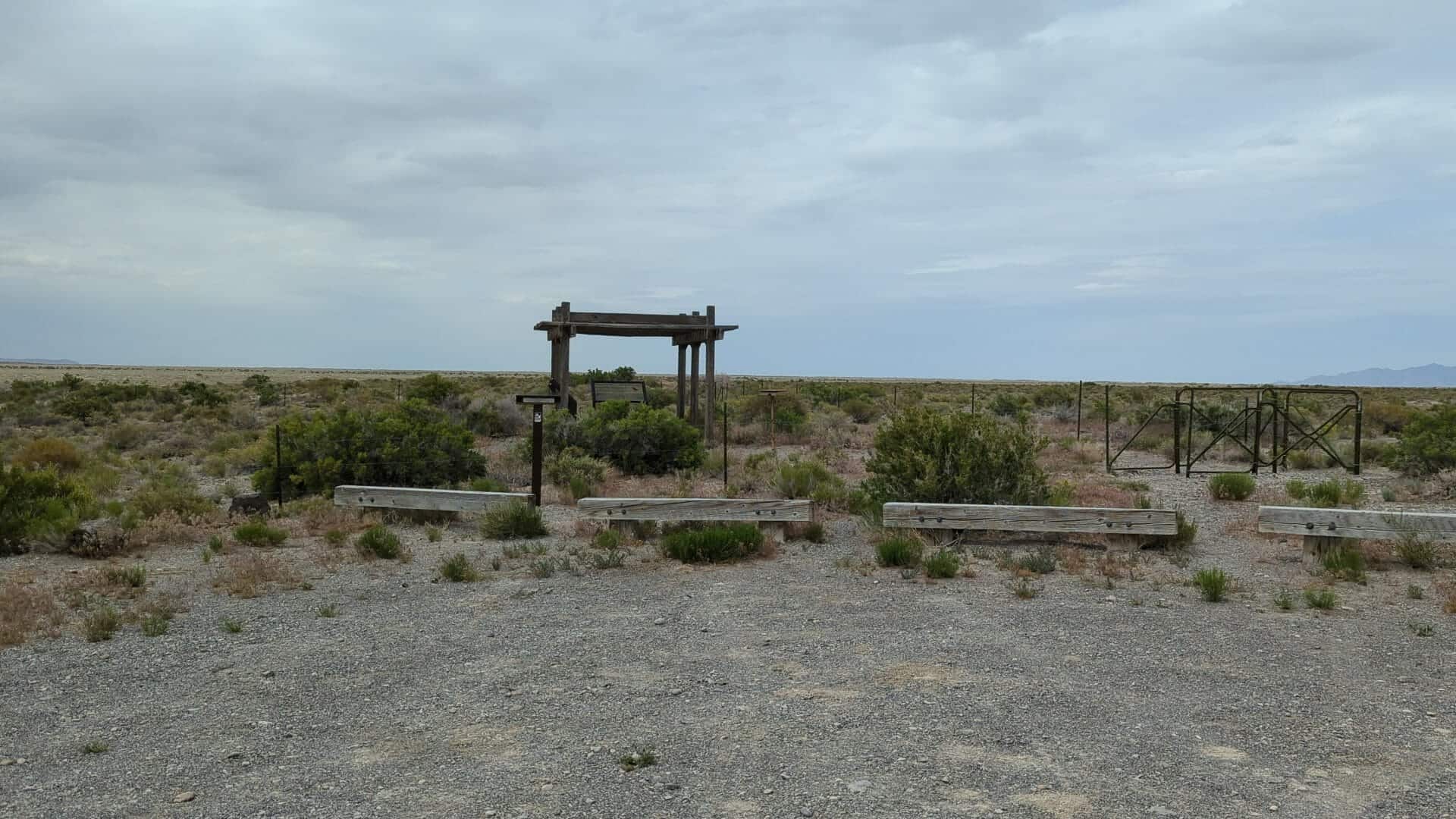
There is a very well preserved ruin of the station located here, fenced off and maintained by the BLM. The station was named for George Washington Boyd who built it in 1855 and lived there until after 1900, reportedly enjoying the solitude. He died in Salt Lake City in 1903.
This location is the site of Utah Pioneer Trails and Landmarks Association historic marker #92 which is no longer here (I did see a picture of the plaque in a museum and would like to find out where it is) and also Utah Crossroads Chapter – OCTA’s historic marker #COTNU-12.
“Left camp [at Fish Springs] at seven o’clock. Drove on to the first station [Boyd Station] and nooned.”
Albert Jefferson Young, August 12, 1862
Unsung Heroes
Strategically placed relay stations across the western frontier proved to be a major contributing factor to the early success of the Pony Express mail service. “Station Keepers” assigned to these outposts readied swift horses, fresh and rested, for each rider. Often working in pairs, day and night they kept a vigil for incoming riders.
Life for the brave men at these station covered a broad spectrum of living conditions depending upon location and situation. Home station were generally better established and more accommodating, even luxurious by some standards. Remote relay stations, especially in the West, were often exceedingly primitive.
In St. Joseph, Missouri, Patee House was one of the most luxurious hostelries on the frontier. This four story brick building, which is still standing, was well known for its social life and gala balls and parties. Smith Hotel in Seneca, KS, and the Salt Lake House in Utah, were other prominent hotels which served as comfortable home stations for riders and company personnel.
West of Salt Lake City and across the Great Basin to California, accommodations and quality of life tended to go downhill. Hot, dry summers and bitter, cold winters often were the only companions for station keepers. On other days, loneliness and idle time were interlaced by fending off horse thieves and Indian attacks. Frequently exposed to danger, many lost their lives in this daring American enterprise.
Though the Pony Express has become a romanticized legend in American history, the station keepers – those who kept the horse waiting and bid “Godspeed” to the rider as he galloped away – are the true unsung heroes of the Pony Express.
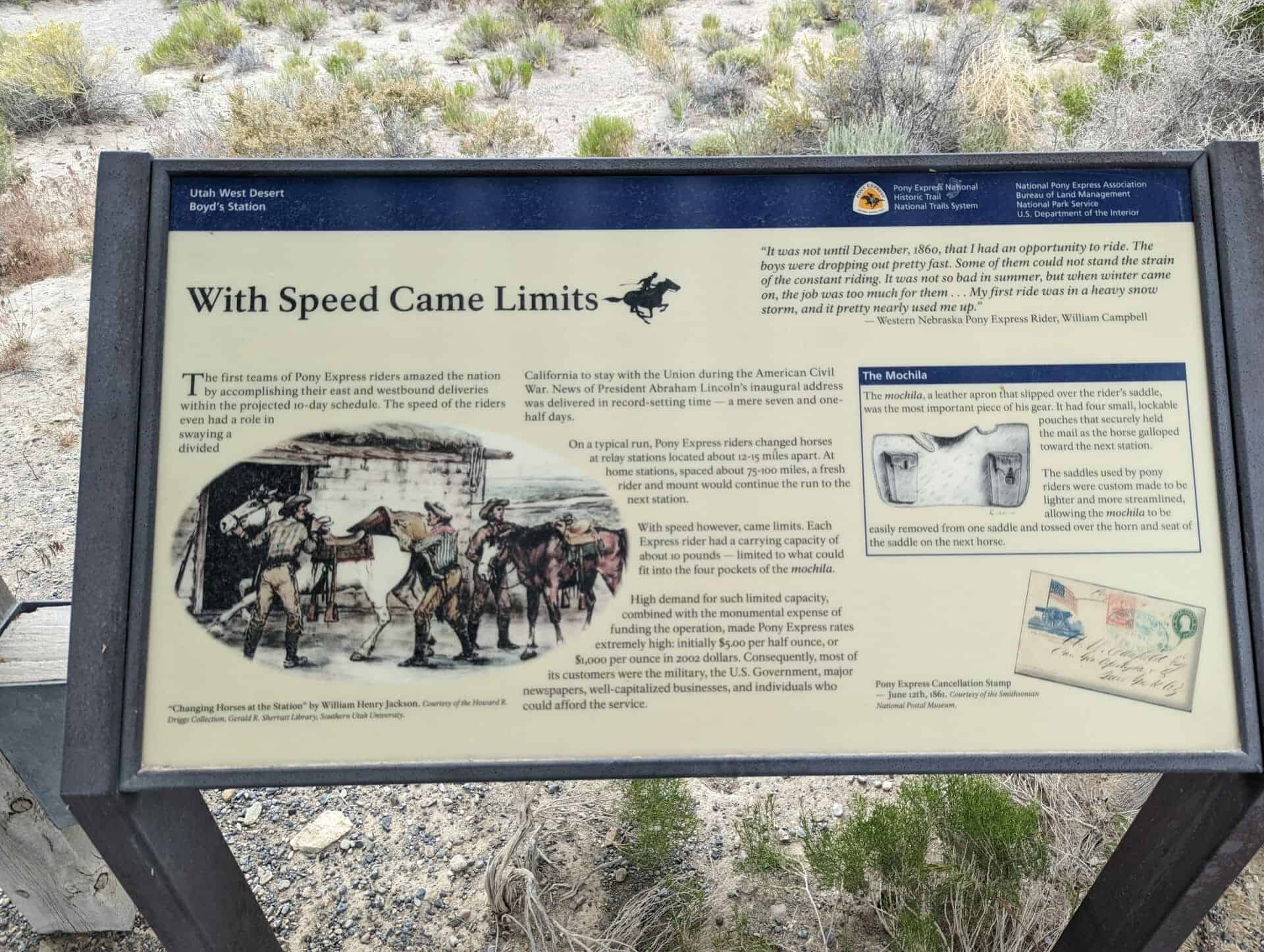
With Speed Came Limits
The first teams of Pony Express riders amazed the nation by accomplishing their east and westbound deliveries within the projected 10-day schedule. The speed of the riders even had a role in swaying a divided California to stay with the Union during the American Civil War. News of President Abraham Lincoln’s inaugural address was delivered in record-setting time – a new seven and one-half days.
On a typical run, Pony Express riders changed horses at relay stations located about 12-15 miles apart. At home stations, spaced about 75-100 miles, a fresh rider and mount would continue the run to the next station.
With speed however, came limits. Each Express rider had a carrying capacity of about 10 pounds – limited to what could fit into the four pockets of the mochila.
High demand for such limited capacity, combined with the monumental expense of finding the operation, made Pony Express rates extremely high: initially $5.00 per half ounce, or $1,000 per ounce in 2002 dollars. Consequently, most of its customers were the military, the U. S. Government, major newspapers, well-capitalized businesses, and individuals who could afford the service.
“It was not until December, 1860, that I had an opportunity to ride. The boys were dropping out pretty fast. Some of them could not stand the strain of the constant riding. It was not so bad in summer, but when winter came on, the job was too much for them. . . My first ride was in a heavy snow storm, and it pretty nearly used me up.” – Western Nebraska Pony Express Rider, William Campbell
The Crowds Cheered On…
In 1845, it took six months to get a message from the east coast of the United States to California. By the time it arrived, the news was old. In the late 1850s, a half million people had migrated west, and they wanted up-to-date news from home. Something had to be done to deliver mail faster and to improve communication in the expanding nation.
“The Central Overland California and Pikes Peak Express Company,” a subsidiary of Russell, Majors, and Waddell, announced the formation of the Pony Express on January 27, 1860. They planned to carry letter mail between St. Joseph, Missouri and Sacramento, California in only ten days. Although the Pony Express was a financially risky enterprise, the company hoped to attract a lucrative contract with the U.S. Postal Service.
Knowing that a healthy horse could run at a full gallop for only 10 to 12 miles, the Pony Express needed stations for its riders to change mounts. They utilized existing stage stations on the eastern end of the route, but needed to build many new station in remote areas across the Great Basin. Alexander Majors said that 400 to 500 mustang horses were purchased, 200 men were hired to manage the station, and 80 riders signed on to begin the run of the Pony Express.
Although the Pony Express captured the admiration, imagination, and hearts of people, it was a financial disaster for its founders. The Pony era, however, was not brought to an end by its financial failure, weather, or even problems with Indians – but by the completion of the Transcontinental Telegraph on October 26, 1861.
“Every neck is stretched, and every eye stained… Across the endless prairie a black spec appears… In a second or two it becomes a horse and rider, rising and falling, rising and falling – sweeping toward us – growing more and more distinct, and the flutter of hoofs comes faintly to the ear – another instant a whoop and a hurrah from our upper deck, a wave of the rider’s hand, but no reply, and man and horse burst past our excited faces, and go winging away like belated fragment of a storm.” – Mark Twain – Roughing It, 1872.
The first human occupation of the Fish Springs Marsh can be traced to the gradual evaporation of Pleistocene Lake Bonneville around 11,000 years ago and the formation of the marsh. Today, the Great Salt Lake and Utah Lake are all that remain of Lake Bonneville. Archaeological and botanical remains from Hot Springs Cave suggest the inhabitants of the cave were hunting and gathering the abundance of wild animals and plants that occur in this marsh environment.
Listed on the National Register of Historic Places in 1981, Hot Springs Cave is crucial to our understanding of our past. Permits to excavate or remove artifacts on all federally owned sites can be issued only to qualified persons for the purpose of furthering knowledge in the public interest. Preservation of our national heritage is everyone’s responsibility. Enjoy but do not destroy your American Heritage.
NAVAJO BRIDGE, sometimes called Marble Canyon or Grand Canyon Bridge, is the only highway bridge crossing the turbulent Colorado for approximately a thousand miles–from Boulder Dam to Moab, Utah. An engineering accomplishment and an object of great beauty, it is 834 feet long, has a single arch with a span of 616 feet, and measures 467 feet between its floor and the surface of the river–about the height of a forty-story building. Since its completion in 1929 the bridge as superseded the old Lee’s Ferry nearby. The Colorado River is the western boundary of the Navajo Reservation, largest in the United States.
Since the American Guide was published, a second bridge was built to withstand today’s traffic, the original bridge is now only open to pedestrians, and a visitor’s center replaced the rest area.
“After completion of the new bridge, the old rest area on the west side of the bridge was remodeled and expanded to include an interpretive center. On the Navajo Nation (east) side of the bridge, there is an area for Native American craft vendors. The Navajo Bridge Interpretive Center opened for business in April of 1997 and was dedicated on June 17, 1997.” Source: NPS Navajo Bridge Interpretive Center (visit link)
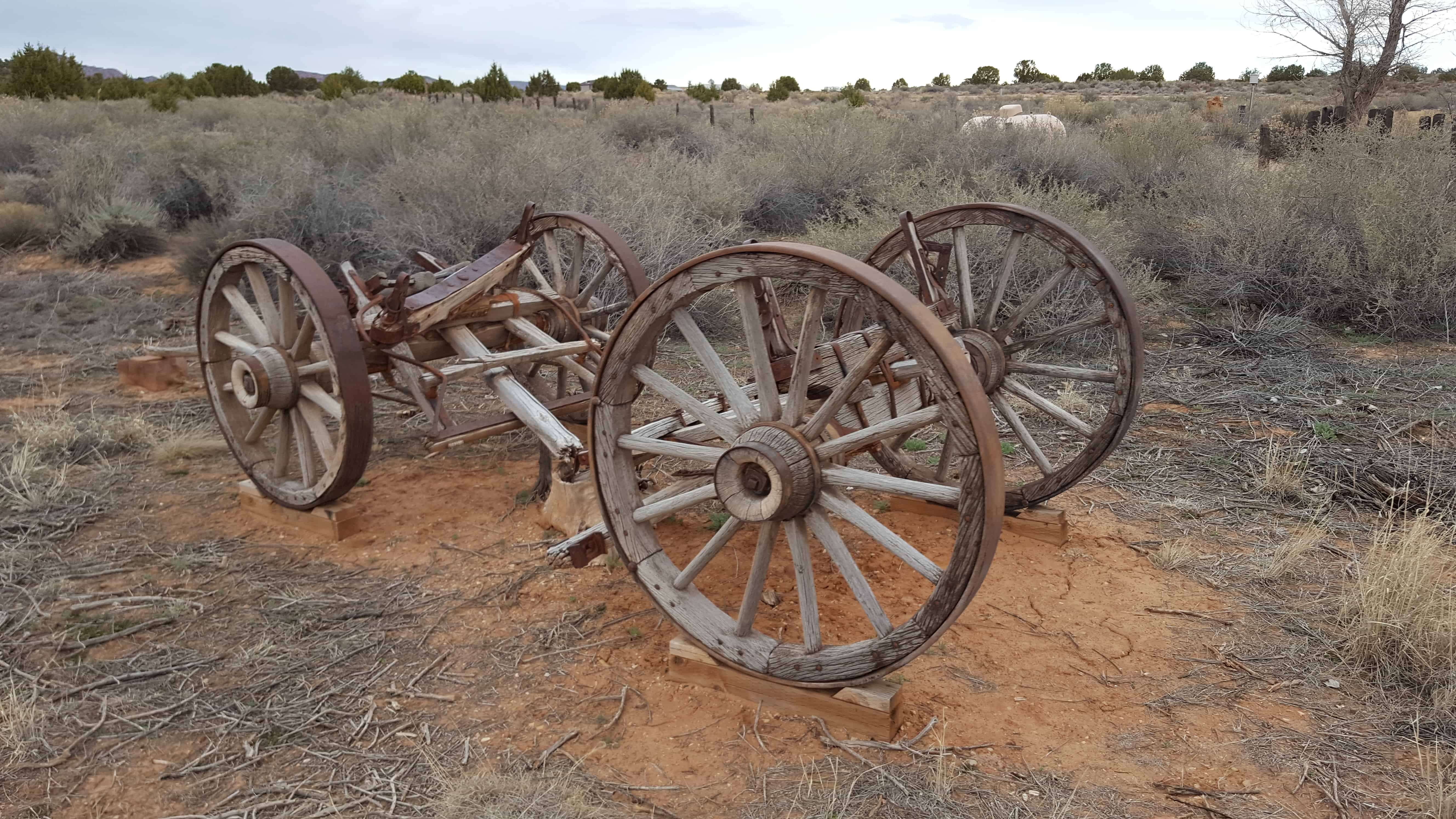
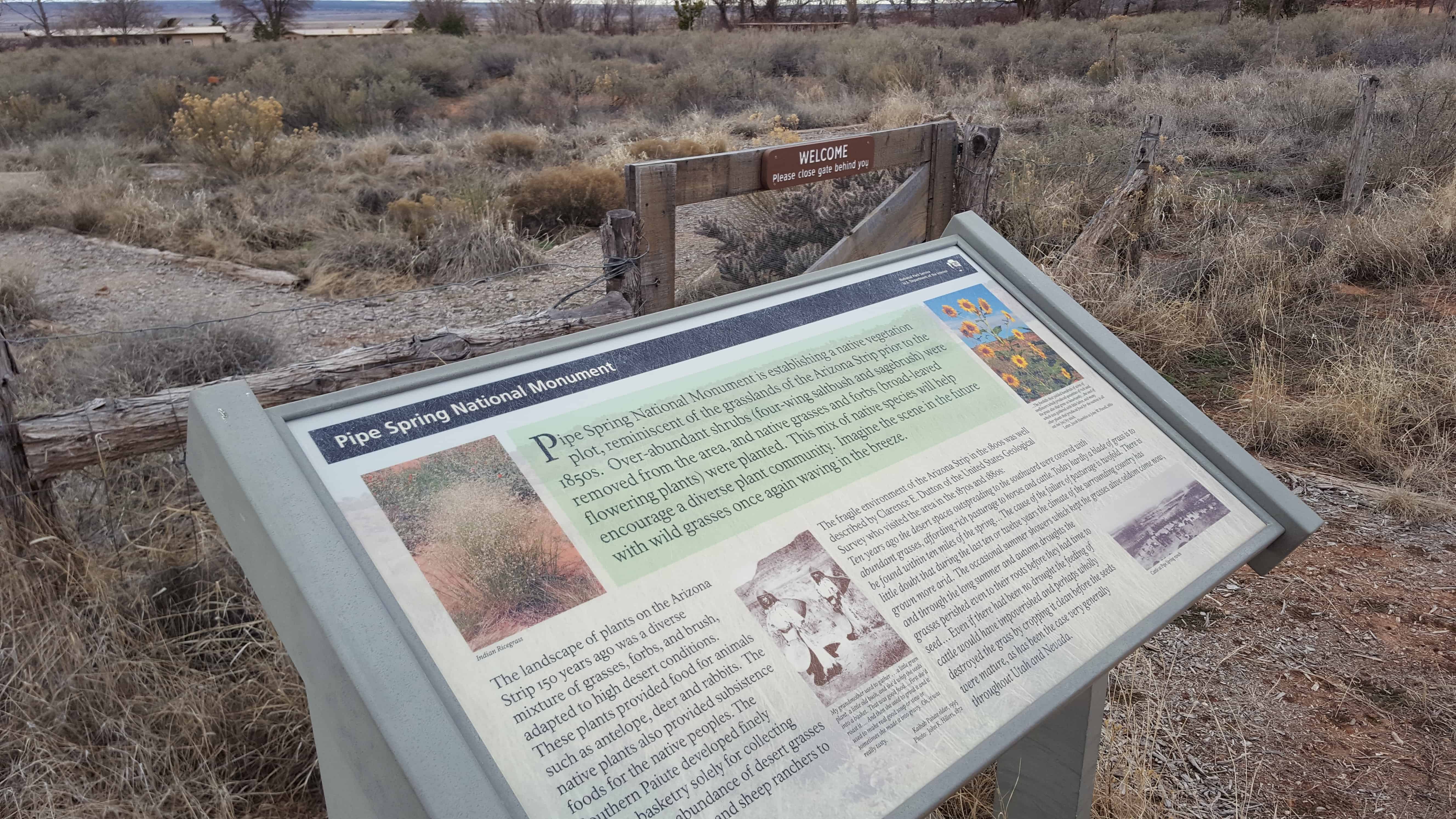
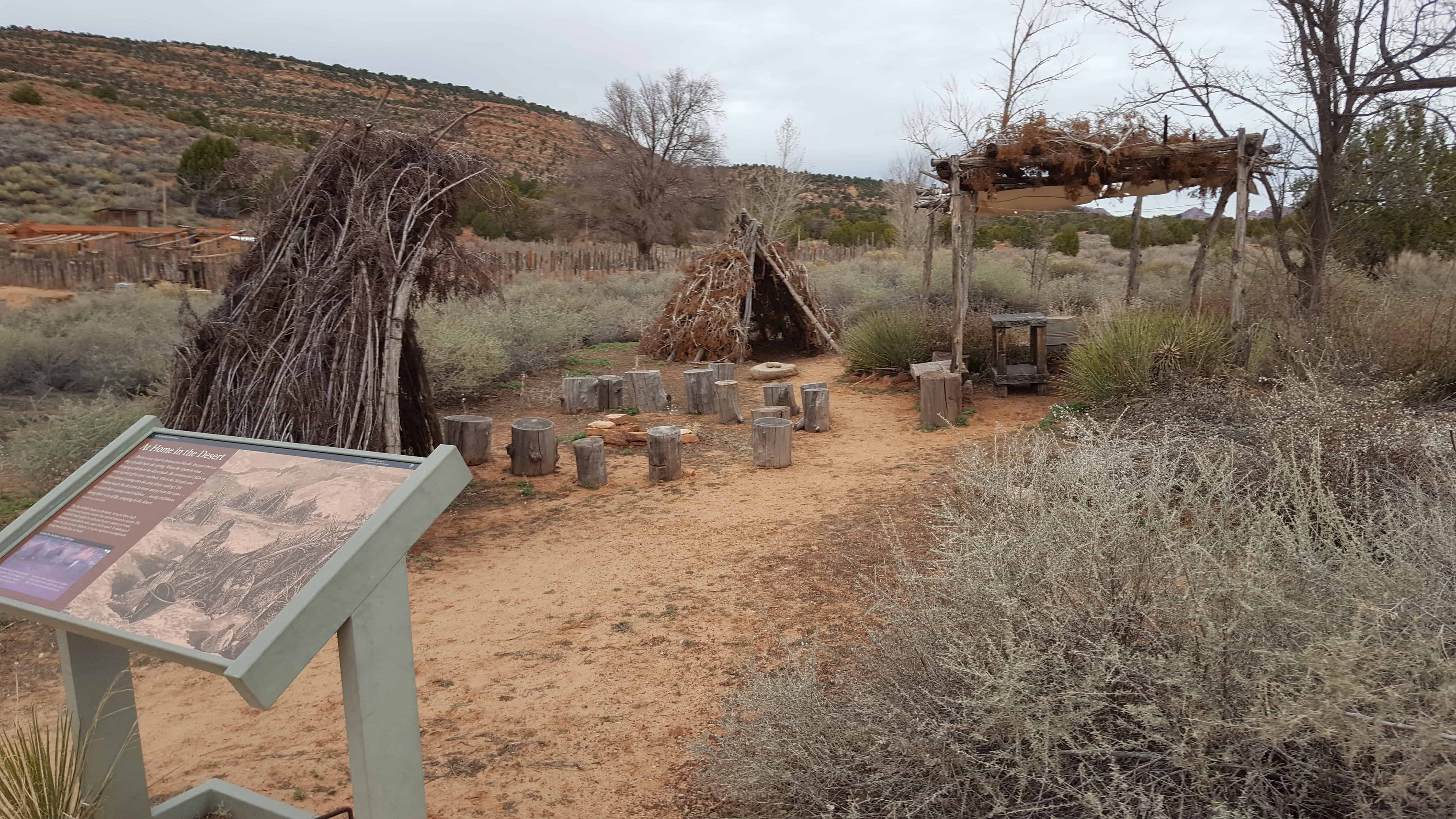
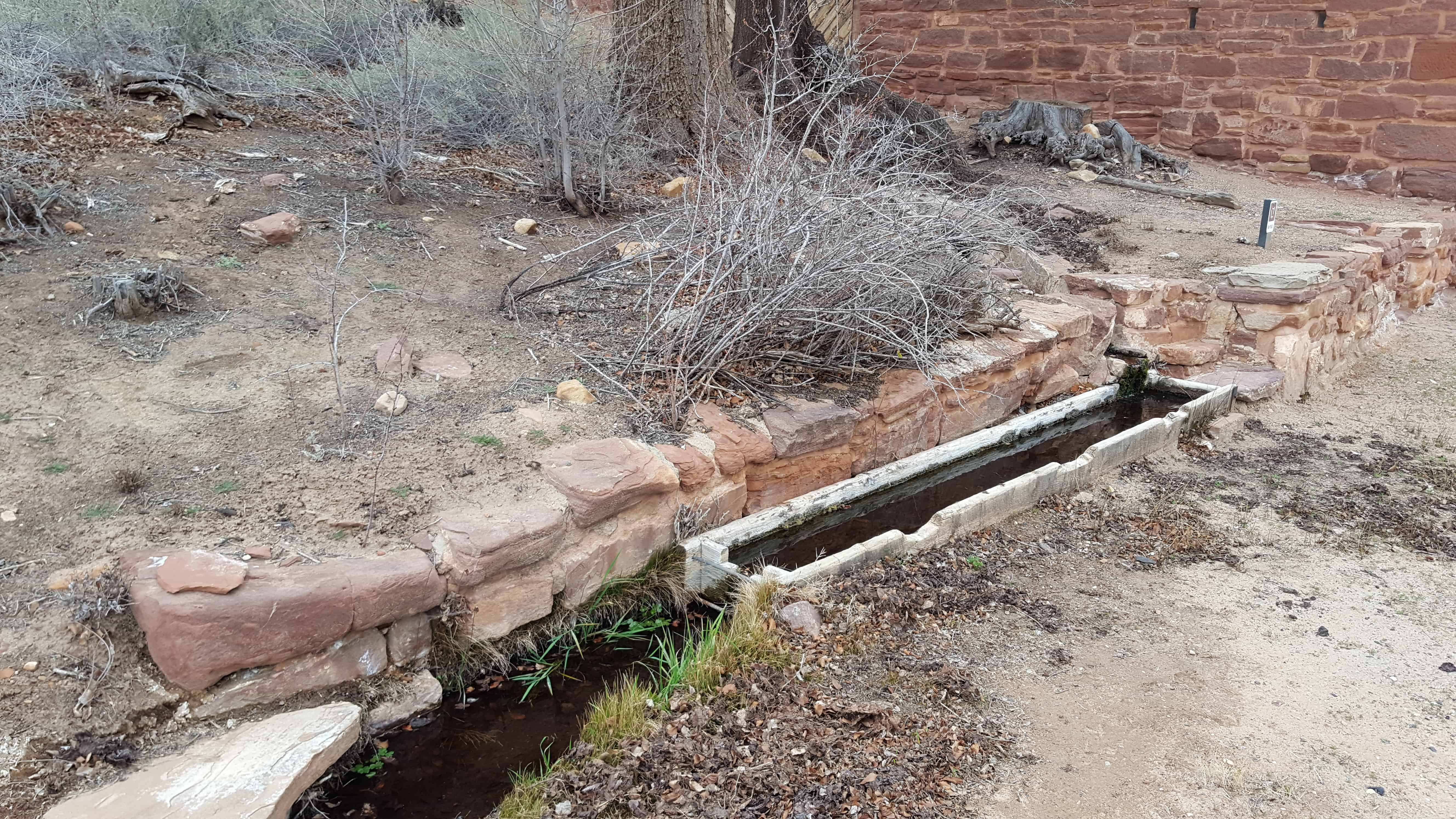
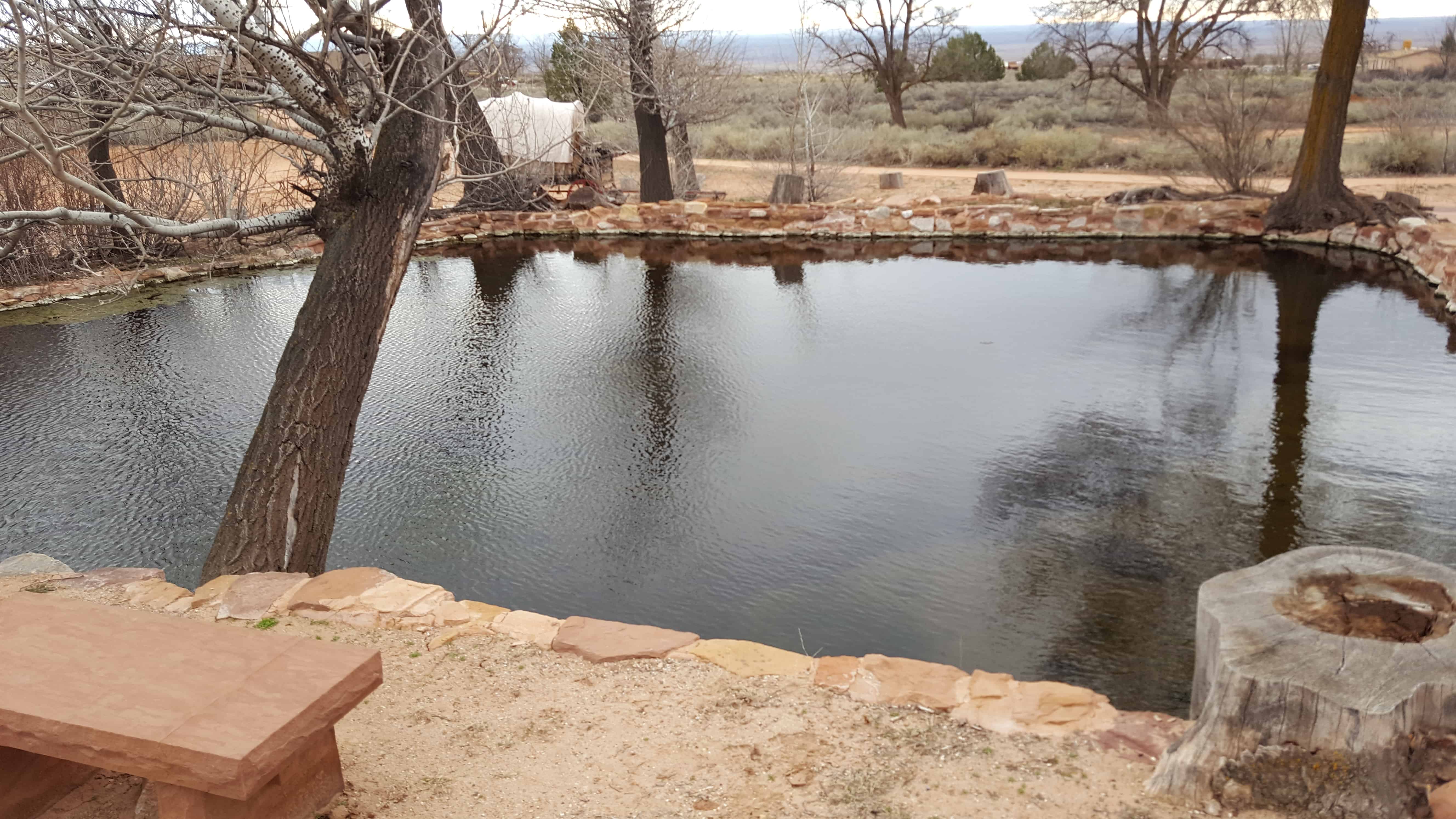
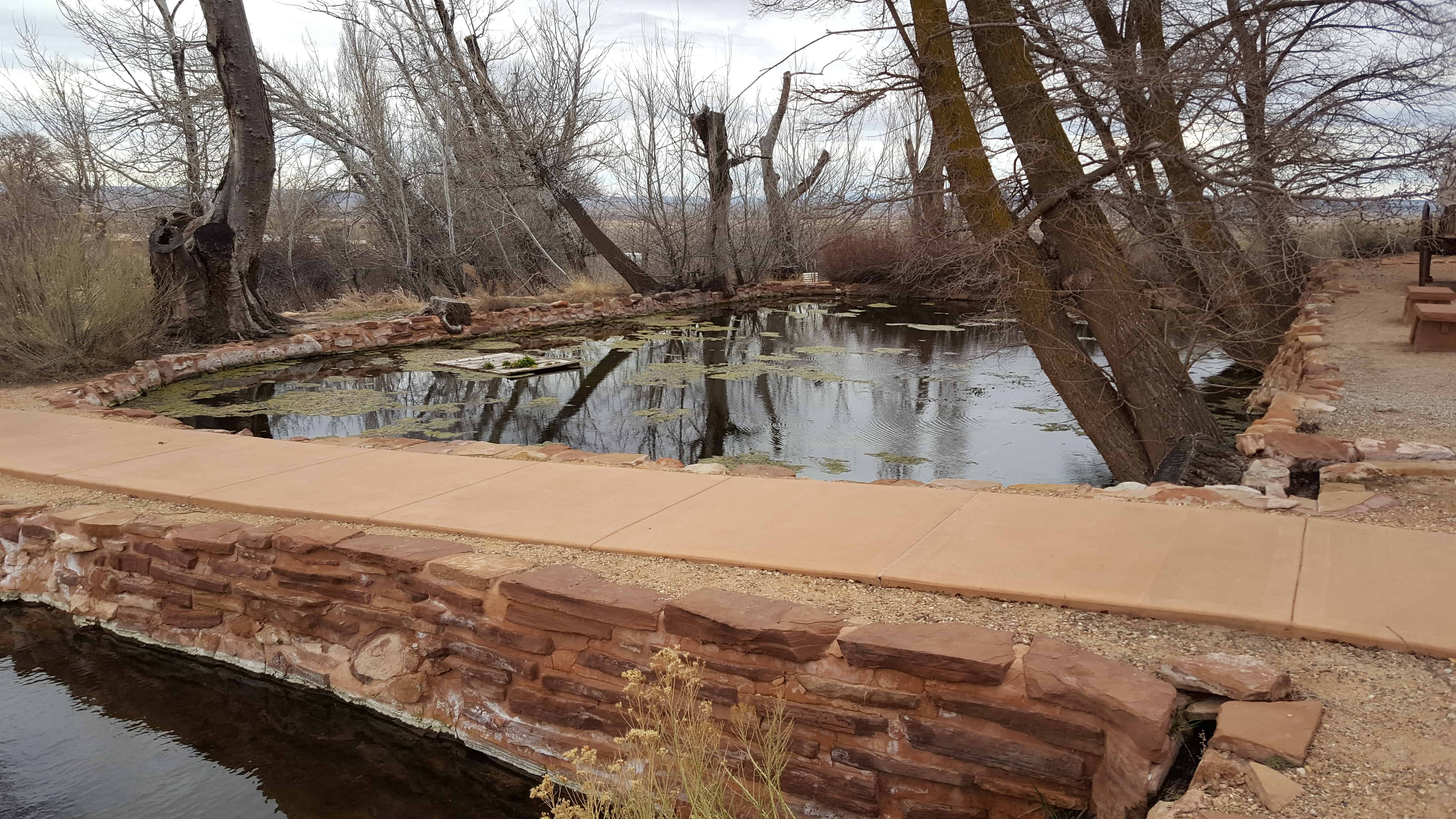
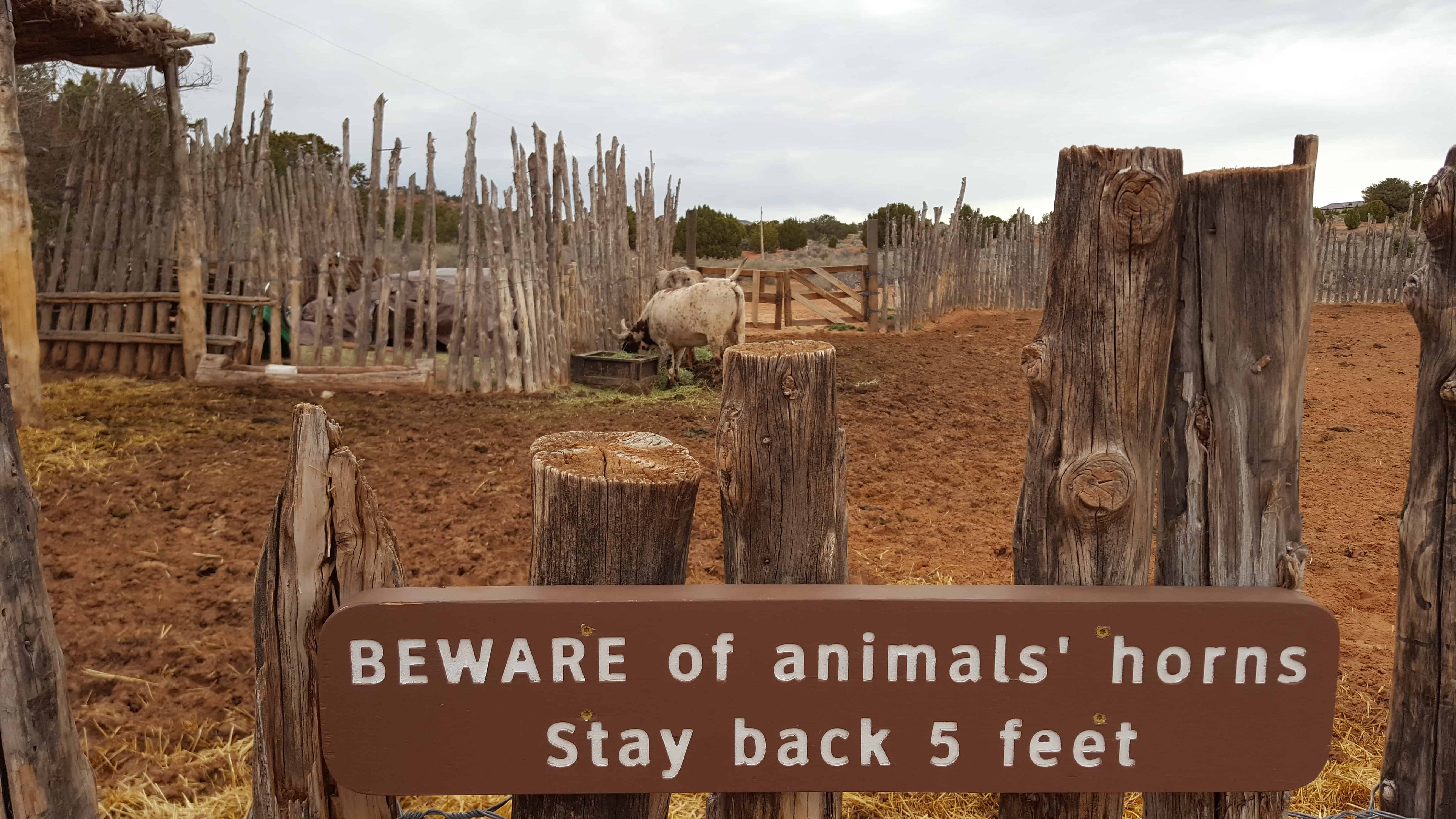
The water of Pipe Spring has made it possible for plants, animals, and people to live in this dry desert region. Ancestral Puebloans and Kaibab Paiute Indians gathered grass seeds, hunted animals, and raised crops near the springs for at least 1,000 years.
Antonio Armijo discovered the springs when he passed through the area in 1829, when he established by the Armijo Route of the Old Spanish Trail.
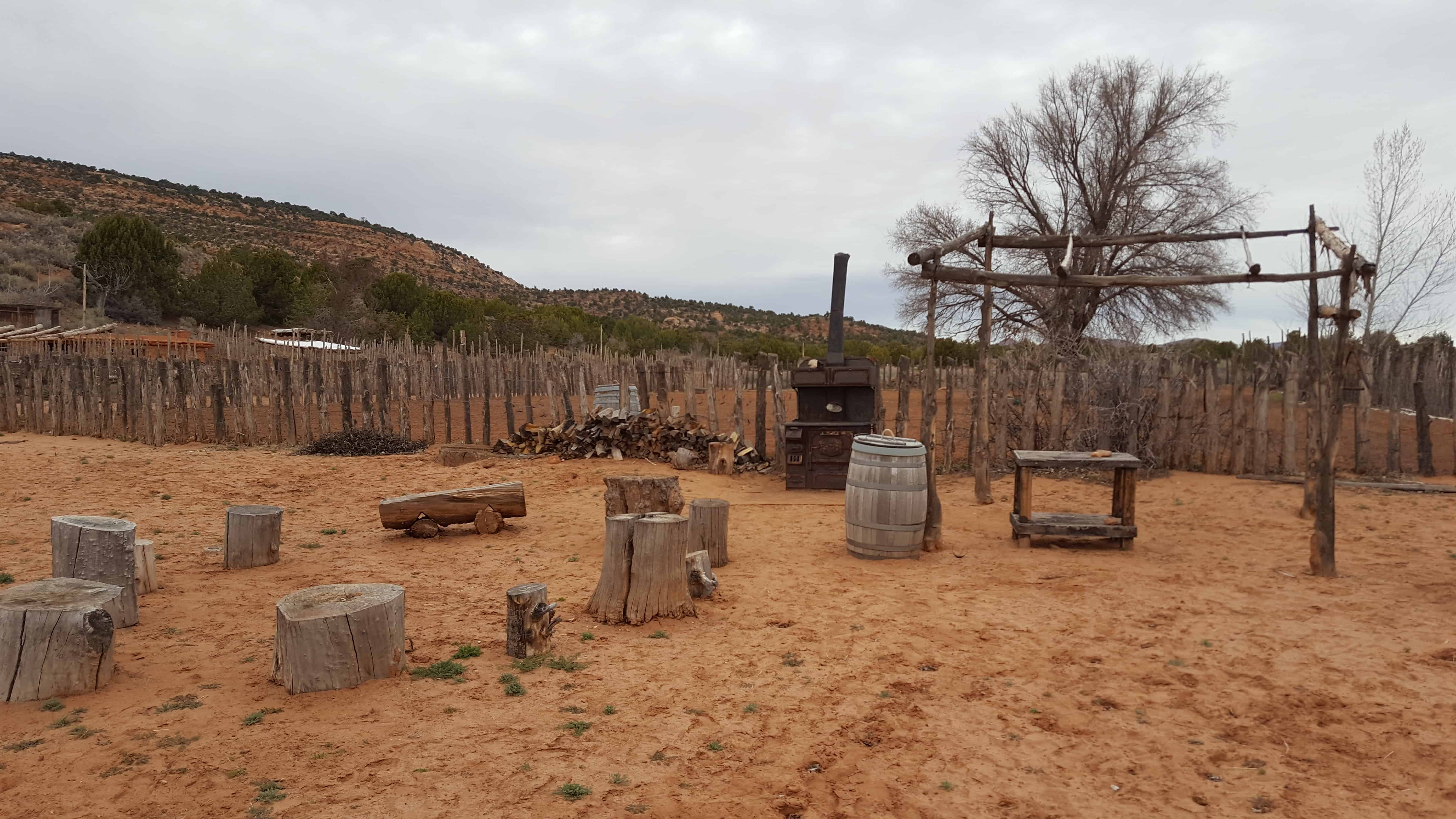
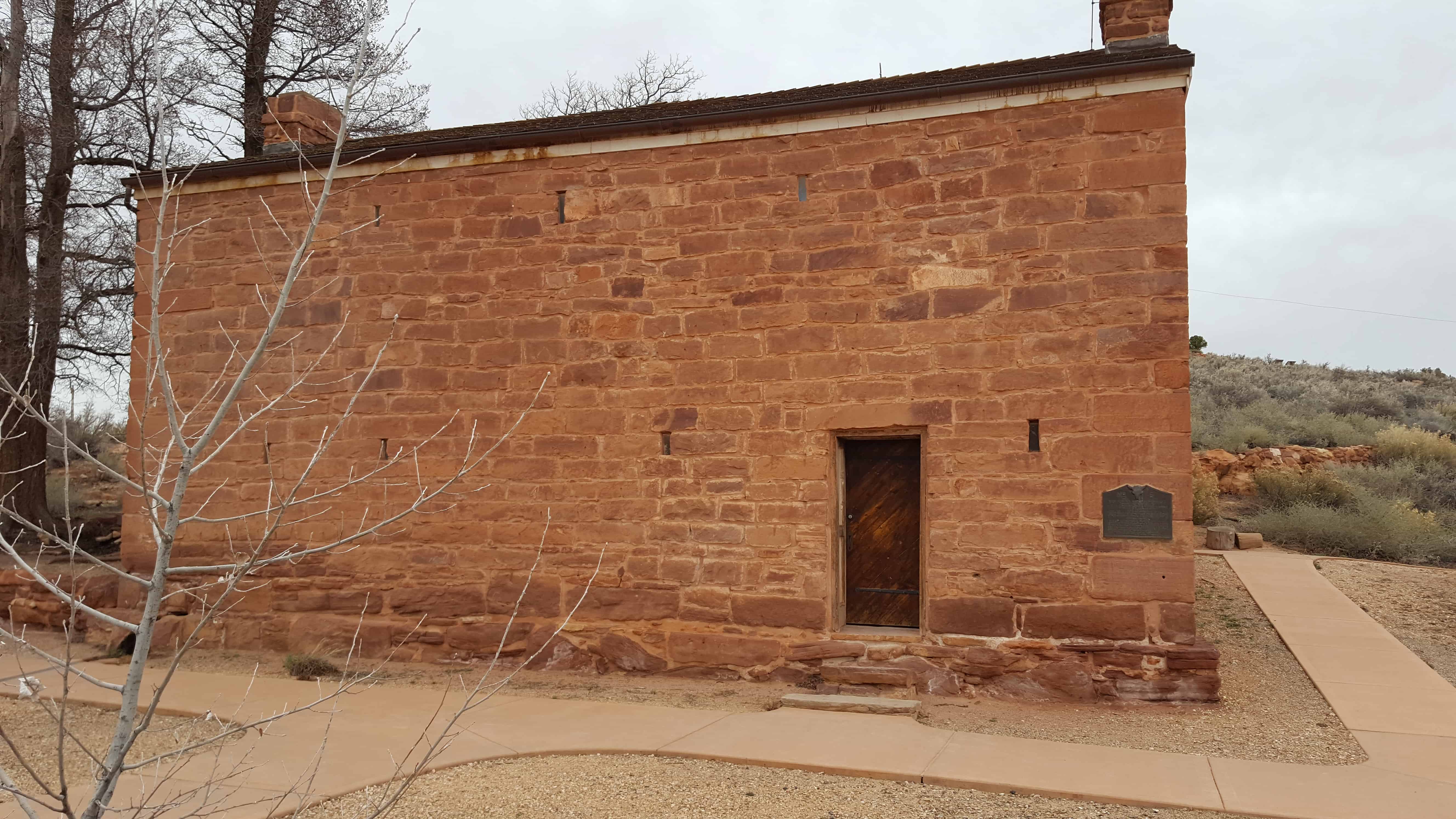
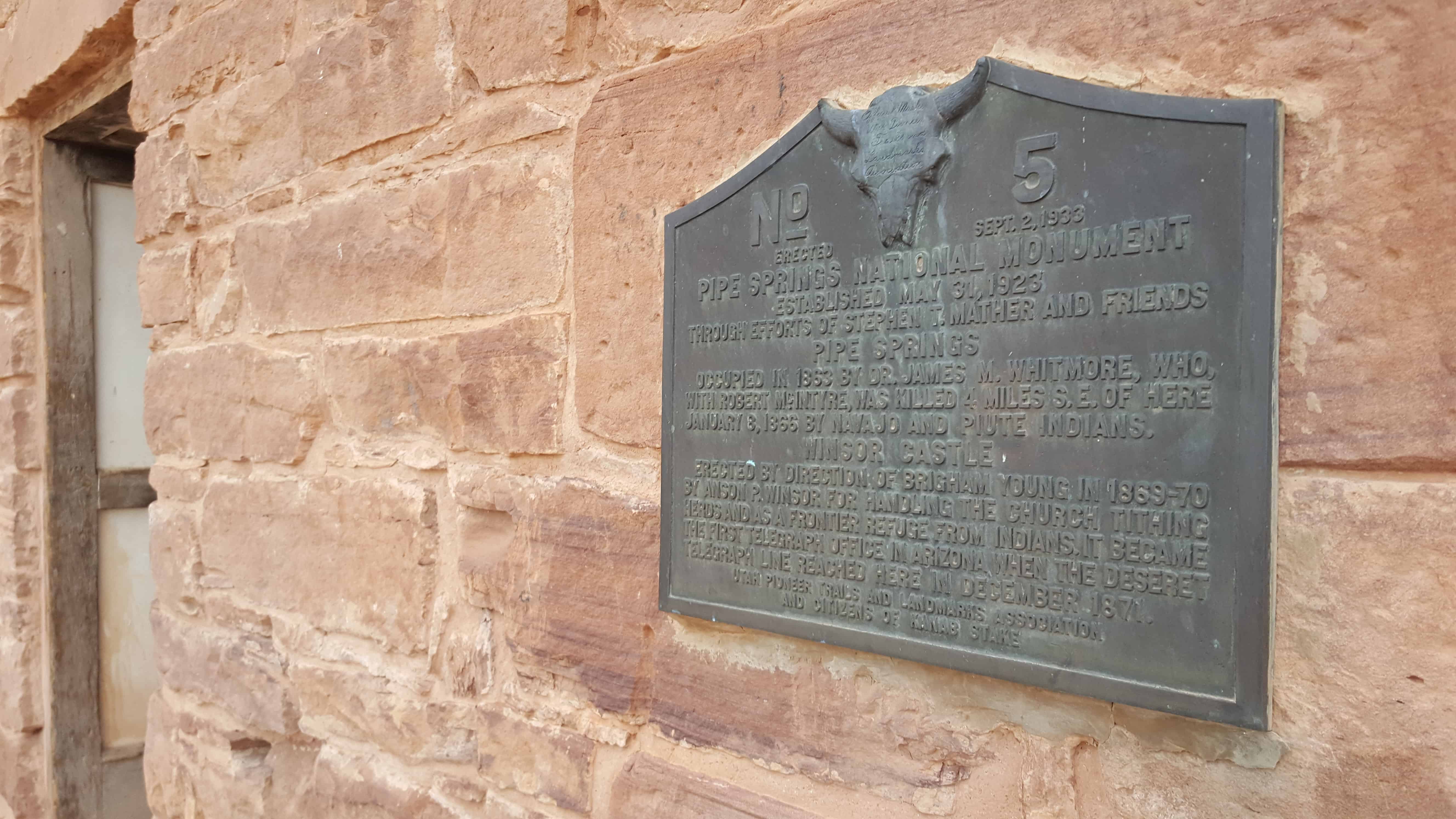
Pipe Spring was named by the 1858 Latter-day Saint missionary expedition to the Hopi mesas led by Jacob Hamblin. In the 1860s Mormon pioneers from St. George, Utah, led by James M. Whitmore brought cattle to the area, and a large cattle ranching operation was established. In 1866 the Apache, Navajo and Paiute tribes of the region joined the Utes for the Black Hawk War, and, after they raided Pipe Spring, a protective fort was constructed by 1872 over the main spring. The following year the fort and ranch was purchased by Brigham Young for The Church of Jesus Christ of Latter-day Saints (LDS Church). The LDS Bishop of nearby Grafton, Utah, Anson Perry Winsor, was hired to operate the ranch and maintain the fort, soon called Winsor Castle. This isolated outpost served as a way station for people traveling across the Arizona Strip, that part of Arizona separated from the rest of the state by the Grand Canyon. It also served as a refuge for polygamist wives during the 1880s and 1890s. The LDS Church lost ownership of the property through penalties involved in the federal Edmunds-Tucker Act of 1887.
Although their way of life was greatly impacted by Mormon settlement, the Paiute Indians continued to live in the area and by 1907 the Kaibab Paiute Indian Reservation was established, surrounding the privately owned Pipe Spring ranch. In 1923, the Pipe Spring ranch was purchased and set aside as a national monument to be a memorial to western pioneer life.
This lovely Old Church, built in 1929, is located in Joseph, Utah and has been meticulously remodeled to ensure that you and your group have a wonderful time.
This building once was an LDS Church and then used as a city office building. Now the Old Church offers the ultimate getaway for family reunions, corporate retreats, business meetings, weddings, group gatherings, and more!
This Bell is mounted on top of a brick monument in front of the Old Church Vacation Rental.
The pioneer log cabin was located on the original 160 acres homesteaded by David A. Giles on March 13, 1881. The site was across the Sevier River, east of the present town of Joseph. The cabin was donated to Camp Clear Camp Daughters of Utah Pioneers by Mrs. Reta Owens Meachim in the fall of 1982 and was relocated in 1994.